55 | P a g e
The Role of Rubrics
In Advanced Teaching and Learning Process
Chaturvedi Gayatri K
1, Pardeshi Archana D
2, Mankar Ravindra S
31
Lecturer, Department of Computer Engineering, Matoshri Aasarabai Polytechnic,
Eklahare, Nashik, M.S. (India)
1 2Lecturer, Department of Humanities and Science, Matoshri Aasarabai Polytechnic,
Eklahare, Nashik, M.S. (India)
2 3Lecturer, Department of Electronics & Telecommunication Engineering,
Matoshri Aasarabai Polytechnic, Eklahare, Nashik, M.S. (India)
3ABSTRACT
A rubric is a multi-purpose scoring guide for assessing student products and process. It is an assessment tool in matrix form. Assessment matrix covers all the key parameters for the assessment of each phase. This tool works in many ways to advance student learning and has great potential in particular for non-traditional, first generation and underground students. In addition, rubrics improve teaching learning process, contribute to complete assessment and are an important source of information for program improvement. The outcome of the each phase of Outcome Based Education (OBE) is assessed by evaluation team and the guide using the assessment matrix which is based on assessment rubrics. In this paper, we discuss key features of a quality rubric, types of rubrics, present an example of a rubric for assessing a programming study in computer domain, and describe three basic steps in designing an effective rubric.
Keywords: Rubrics, Assessment, Planning, Instructional design.
I INTRODUCTION
56 | P a g e
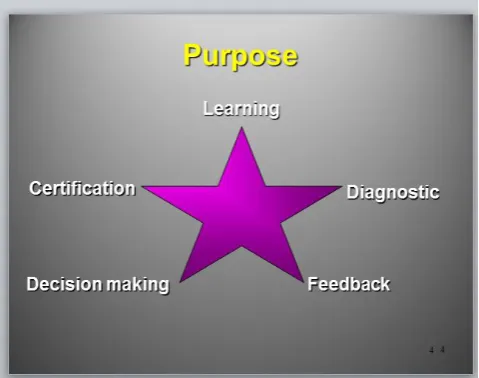
Figure 1.1: Purpose of Rubrics Formation
Benefits of Rubrics:
Sr No.
Benefits of Rubrics
1
Reduces time and efforts in assessment
2
More emphasis is on outcomes
3
Brings objectivity and transparency
4
Can be standardised across the institution for same type of ability
5
Can be used as self-assessment and peer assessment tools
6
Accessing the student‟s work efficient, reliable, objective and quick
7
Provide problem solving formative feedback which helps in student improvement
8
Rubrics make the learning target more clear
In this paper we describe a rubric that has developed to assess programming study in computer. A set of criteria have been documented and classified. We have chosen the criteria as per requirements from our faculty members and corporates we have interacted with and based on an analysis of literature in [1], [3], [5] and [7]. The criteria chosen have a direct or indirect impact on the students' learning experience. A “Weight” factor is assigned to each criterion and is mentioned against each criterion. We have provided a sample value for the weight but this can be modified as per the needs of the organization. The rating assigned is based on the five points with emphasis on both the positive and negative.
Elements of a Rubric:
57 | P a g e
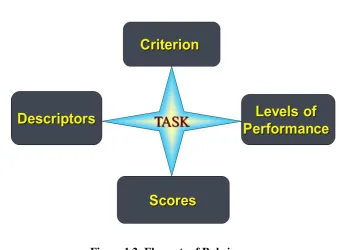
Figure 1.2: Elements of Rubric
When developing a rubric, starts with a task description which is the actual assignment or performance.
Task Example: Construct a Computer Application using programming concepts
a. Criteria identify the mannerism, feature or dimension which is to be measured and include a description and example to clarify the meaning of each trait being assessed. Each assignment or performance will determine the number of criteria to be scored. Criteria are derived from assignments, checklists, grading sheets or associates. Criteria example for a term Computer Application:
Data type Control Structure Debug
Perform Input Validation Produce Readable Program
b. Levels of performance determine the degree of performance which has been met and will provide for reliable and unbiased assessment and better feedback to students. These levels express students what they are expected to do. Levels of performance can be used without use of descriptors but descriptors help in achieving objectivity. Words used for levels of performance could effect a student‟s interpretation of performance level such as superior, moderate, poor or above or below average.
Levels of performance example:
Excellent, Good, Fair, Poor Complete, Incomplete Yes, No
Master, Apprentice, Beginner
58 | P a g e
c. Scores are numbers or values used to rate each criterion and often are combined with levels of performance. Begin by asking how many points are required to effectively define the range of performance you expect to see in student‟s work. Consider the range of possible performance level.
Score example: 1, 2, 3, 4, 5 or 2, 4, 6, 8
d. Descriptors are explicit descriptions of the performance. It shows how the score is derived and what is anticipated by the students. Descriptors spell out each gradation level of performance for each criterion and describe what performance at a particular level looks like. Descriptors describe how well students work is well-known from the work of their peers and will help you to differentiate between each student work. Finally, the same descriptors can be used for different criteria within one rubric. For example, the three level of performance: Excellent, Good, Fair and Poor can be used for the separate criteria of Data type, Control Structure, Debug & Perform Input Validation. Descriptors should be complete enough to distinguish all level and increase the objectivity of the rater.
Computer Application Using Programming Concept
Criteria
Excellent
Good
Fair
Poor
Very Poor
5
4
3
2
1
Ability to apply Data
Type
Able to apply required data type or data structure and produce correct results Able to apply required data type or data structure and produce partially correct results Able to apply required data type or data structure but does not produce correct results Able to identify required data type or data structure but does apply correctlyUnable to identify Data type
II. TYPES OF RUBRICS
Defining which type of rubric to use is subject to on what and how you plan to evaluate. There are numerous types of rubrics including holistic, analytical, general, and task-specific [1]. Details are as follows:
A. Holistic: In this type of rubric all criteria are assessed as a single score. These rubrics are good for evaluating overall performance on a task quickly. Holistic rubrics tend to be easier to score as only one score is given. However, it does not provide thorough information on student performance for each criterion; the levels of performance are treated as a whole.
These rubrics-
Usage for simple tasks and performances such as reading ease or response to an essay question.
Descriptor
Criterions
Task
Level of
59 | P a g e
Receiving a instant snapshot of complete quality or achievement.
Judging the effect of a product or performance.
B. Analytical: In this type of rubric each criterion is assessed individually, using different descriptive ratings. Each criterion obtains a separate score. This type of rubrics takes more time to score but provide more detailed feedback. These rubrics-
Judging complex performances - relating several major criteria.
Providing more precise information or feedback to students.
C. Generic: This type of rubric contains criteria that are all across tasks and can be used for related tasks or performances. Criteria are assessed separately, same as in an analytical rubric.
These Rubrics-
Useful when students will not all be doing exactly the similar task when students have a choice as to what proof will be chosen to show competency on a particular skill or product.
Useful when teachers are trying to judge consistently in different course sections.
D. Task-specific: This type of rubric assesses a specific task. Unique criteria are assessed distinctly. However, it may not be promising to account for each and every criterion involved in a particular task which could overlook a student‟s unique solution
These Rubrics-
Easier and faster to get reliable scoring
Useful in large-scale and “high-stakes” environments, such as state-level accountability assessments.
Useful when you want to know whether students recognize particular facts, equations, methods or procedures.
III. STEPS IN DEVELOPING RUBRIC
The following steps will be helpful to develop a rubric no matter which option you choose:
Step 1: Select a performance/assignment to be assessed. Step2: Enlist Criteria.
Step 3: Write Criteria Descriptions.
Step 4: Define level of performance adjectives. Step 5: Develop Scores.
Step 6: Write Descriptors. Step 7: Evaluate the Rubric.
IV. LIMITATIONS OF RUBRICS
60 | P a g e create a rubric that creates clear what is valued in the performance or product evaluation without constraining or diminishing them. Instead the problem with having no rubric or one that is so broad that it is hollow is to risk having an evaluation process that is based on individual oddity or worse unrecognized preconceptions.
V. CONCLUSION
Grading rubrics are operational and competent tools which allow for objective and consistent evaluation of a range of performances, assignments, and activities. Rubrics can help make clear your anticipations and will show students how to meet them, making students accountable for their performance in an easy-to-follow format. From the rubrics, students are able to estimate the amount of effort that is required to achieve the picture-perfect score. In this way, students are also playing active role of becoming independent in determining their own learning objectives. In the future, the rubrics will be used in establishing benchmarks for the programming courses and analyzing student performance to improve the teaching and learning process including making tunings to the curriculum.
REFERENCES
[1] Arter, J., & McTighe, J. (2001), „Scoring rubrics in the classroom: Using performance criteria for assessing and improving student performance’, Thousand Oaks, CA: Corwin Press, Inc.
[2] Stevens, D. D., & Levi, A. J. (2005), „Introduction to rubrics: An assessment tool to save grading time, convey effective feedback, and promote student learning’, Sterling, VA: Stylus.
[3] Brown, G. T. L., Glasswell K., & Harland, D. (2004), „Accuracy in the scoring of writing: Studies of reliability and validity using a New Zealand writing assessment system‟, Assessing Writing, 9, 105–121. [4] Flowers, C. P., & Hancock, D. R. (2003), „An interview protocol and scoring rubric for evaluating teacher
performance. Assessment in Education: Principles, Policy and Practice’, 10, 161–168.
[5] Osana, H. P., & Seymour, J. R. (2004), „Critical Thinking in Preservice Teachers: A Rubric for Evaluating Argumentation and Statistical Reasoning’.
[6] Educational Research and Evaluation, 10, 473–498 Penny, J., Johnson, R. L., & Gordon, B. (2000a), ‘ The
effect of rating augmentation on inter-rater reliability: An empirical study of a holistic rubric’.
[7] Hagen, Kim, and Diana Hibbert „Developing a learning Management System based on the IMS Learning Design Specification‟, Advanced Learning Technologies, 2006.Sixth International Conference on IEEE,