520 |
P a g e
High speed Image Dehazing Method Based on Linear
Transformation
Chithra.P
1, Karthika.A.R
2, Sahaya Edal Queen.G
3,D.Ramalingam
41
PG scholar, Department of Electronics and Communication Engineering,
James college of Engineering and Technology, Nagercoil, (India)
2
Assistant professor, Department of Electronics and Communication Engineering,
James college of Engineering and Technology, Nagercoil, (India)
3
Assistant professor, Department of Electronics and Communication Engineering,
James college of Engineering and Technology, Nagercoil, (India)
4
Principal, James college of Engineering and Technology, Nagercoil, (India)
ABSTRACT
De-hazing image is big challenge for the researchers, although there are many good algorithms but all of
them not regards as a perfect algorithm. In this paper we try to introduce new de-hazing method based on
many steps. We first preprocess the image to remove some of noise using average filter before we estimate
the dark channel prior which is estimated based on average. The main contribution in this paper is the
estimation of Air light value. We suggest new method based on comparing the standard deviation for RGB
image and the HSV color space image. For that, we suggested many rules to control the Air light value
according to experiments. Enhance local contrast implement based on V channel of color space HSV to
construct visually pleasing images. The quality of de-hazed images measured visually and by using many
qualities measuring metrics (blind quality and reference quality) which gives promised results. Although the
proposed method is not perfect method but it was more efficient than other algorithms when compared with
them.
I. INTRODUCTION
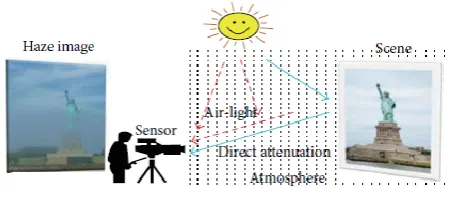
Suspended particles in atmosphere such as fog, murk, the mist, dust causes poor visibility image and distorts
the colors of the scene. Haze image regards as a major challenge problem in many applications in the fields
of image processing and computer vision. Hazy images can be modeled as a combination of scene radiance,
Air light and transmission [1]. The study of haze is closely related to the works on scattering of light in the
atmosphere. In imaging system, the main factors cause the image degradation can be due to atmospheric
absorption, reflecting and scattering. In scattering some of incident energy redistributes due to exist of
521 |
P a g e
Figure 1: Effects Of Atmospheric Scattering
The main problem or challenge in de-hazing process is due to different density of haze from one region to
other in the haze image, also the weather condition at the time of image capturing, The hazing images lose
the color fidelity and contrast. Also the position of camera and how far from the sense may be cause for
image degradation [3]. The task of image restoration is to estimate the latent high quality images given the
low-quality observations. Image de-hazing is one of the basic issues and more important research areas in the
field of image processing and computer vision, the final goal of image de-hazing is to reconstruct visually
pleasing images suitable for human visual perception, and to enhance the interpretability of images for
computer vision and preprocessing tasks [4]. Recent research works have focused on improving single
image de-hazing methods as they offer a more practical solution. The majority of these methods have
focused on solving by inferring depth information based on different statistical assumptions or priors.
Among them, the method based on the dark channel prior (DCP) [5] achieves the state-of-the-art
performance. Despite good performance, this method has some drawbacks. It estimates patch- wise
transmission that does not preserve depth edges, and thus de-hazing results in haloes around the object
boundaries. To reduce the haloes, a transmission refinement step is necessary, which is either time
consuming or less accurate [5]. In addition, for large bright surfaces, the DCP fails (treats the absence of
dark pixels as the presence of haze) and overestimates the haze from its actual value, which causes
over-de-hazing [6]. Since the dark channel prior is a kind of statistic, it may not work for some particular images.
When the scene objects are inherently similar to the atmospheric light and no shadow is cast on them, the
dark channel prior is invalid. Our method will improve the way of estimation dark channel in addition
to improve the estimation of the transmission factor to overcome these problem, and problem of
objects which is like the sky or air light, such as the white marble. Also the paper works to reduce the
haloes.
II.RELATED WORK
We will show some of the methods which have a significant role in explaining the problem and develop
solutions for it. Zhang introduced a developed atmospheric scattering model by dividing the hazy image
according to the haze density, and defines a weight function to locate a candidate scene and improve the
atmosphere light. Next combines with suggestion model named the average saturation prior (ASP), which
522 |
P a g e
scene atmospheric scattering coefficient and gets the scene albedo [7]. ia, Bolun used Convolutional Neural
Networks (CNN) relying on feature extraction to estimate a medium transmission map and offering a nonlinear
function called Bilateral Rectified Linear Unit (BReLU) to enhance the quality of a de-haze image. Then
making connections between the proposed DehazeNet and existing model [8].
Chen, Xumeng suggested a method depending on estimating illumination/reflection imaging model for
hazing image. The first step in the suggested method is estimation of atmospheric veil based on the
minimum intensity of RGB of each channel and enhances it by the guided filter. In the second, he computes
the residual image by subtracting atmospheric veil from haze image. Finally he determine the maximum
intensity in the residual which enhanced it by the guided filter to be as illuminating veil, Then divides
the residual image by the illuminating veil to get an image free from haze [9].
III.HAZE MODELING
The observed brightness of a capture image in the presence of haze can be modeled based on the
atmospheric optics [10] via
Ip = tp ∙ Jp + (1 − tp) ∙ A---(1)
where Jp and Ip denote the original color and the observed color at pixel position p, respectively,
and A is the airlight that represents the ambient light in the atmosphere. Also, tp ∈ [0, 1] is the transmission
of the light reflected by the object. Since the light traveling a longer distance is more attenuated, we
have
tp = e−βdp ---(2)
where β is the attenuation coefficient determined
by the weather condition and dp is the scene depth from the camera. Thus, the reflected object color Jp
is attenuated by tp, whereas the air light A is weighted by (1−tp) and plays a more important role if the
object is farther from the camera.
IV.METHODOLOGY
The proposed algorithm suggested new method for image de-hazing based on the following steps:
1. Image filtering.
2. Determine the dark channel prior.
3. Estimating the Atmospheric Light.
4. Update the Atmospheric light value.
5. Estimating the transmission value.
6. Recover the de-hazed image.
7. Improve local contrast.
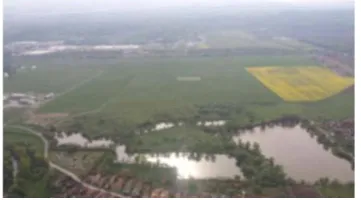
To illustrate the proposed algorithm we suggest to use the image in figure 2 to implement all the above steps
523 |
P a g e
Figure 2: Haze Image.
1. Image filtering
Filtering is a technique for modifying or enhancing an image. Image processing operations implemented
with filtering include smoothing, sharpening, and edge enhancement. Average filter is suggested to replace
each pixel by the average of pixels in a square window surrounding this pixel, in this paper we use small
widow because the large window can remove noise more effectively, but also blur the details and edge, we
need a trade-off between noise removal and detail preserving. For that we suggest 5x5 window using in
(average filter) which give best results, image after filtering show in figure 3.
Figure 3: Image After Average Filter.
2. Determine the dark channel prior.
According to the literature report [8], based on the observation on haze-free outdoor images, in most of the
non-sky patches, at least one color channel has very low intensity at some pixels, which is called the dark channel
prior (DCP). In another word, the minimum intensity in such a patch should have a very low value, in this paper
we use average instead of minimum to find the DCP. Dark channel determined by using the following formula
---(3)
Where K is a dark channel , Kc is an intensity of color channels R,G and B in image result from step 1, x is a
center of a local patch O(x), the size of the local patch is 5*5. From the dark channel process we get (2D)
524 |
P a g e
fig.4 2D Image
For the next step we need to select the top (1%) of pixels from dark channel matrix. This can be
implemented by sort the value of dark channel in descending order, then we select the top 1% of the
matrix values. With each value of the sorted top (1% pixels) we store the index (location in matrix).
3. Estimating the Atmospheric Light
The image will be divided to many non-overlap blocks, each block with size (30x30). For each
block determine the standard deviation:
---(4)
Standard deviation is used to find the minimum DCP. Dark channel determined by using the following
formula Where (s) is the standard deviation, (n) is the total numbers of pixels in block, (xi) is the intensity
of pixels and Where (s) is the standard deviation, (n) is th total numbers of pixels in block, (xi) is the
intensity of pixels and x is the mean of pixels in block. The standard deviation gives the amount of
smoothness, thus gives the amount of variation in intensity of pixels. We can take the value of Air-Light
from the sky region which has very low variation in intensity of pixels, that prevents us from taking the
value of Air-Light from a white object founded in image. At this case we compare the result of standard
deviation with the top value of dark channel, then we select the value from the dark channel which
correspond to the low standard deviation, which regards as the initial value of air light.
4.Update the Atmospheric light value
The next step is to enhance the value of air light, this can be accomplished by the following way
1)Determine the standard deviation (Std_haze) for the haze image ( RGB image).
2)Convert the haze image to HSV color space.
3)Determine the standard deviation for the (V) channel (Std_HSV).
4)Find the global standard deviation which equal: St=Std_haze*Std_HSV.
5)Determine the average value of initial air light components (R, G, B) (Av_of_Air).
6)Find the maximum value of dark channel histogram (most frequency value in dark channel).
7)Find the max value of top lightest values (1% pixels) histogram (most frequency value in top value
525 |
P a g e
8)According to the previous values we modify the initial Air light value according to the rules show in
flow chart figure 5: (Note: these rules suggested according to experiments).
Fig.5 flow chart
5. Estimating the transmission value
After we find the final value of Air light, we have to find the transmission value.
Transmission value can be determined by the following formula:
---(5)
The value of w is application-based. We fix it to 0.85 for all results reported in this paper, the result of this step
526 |
P a g e
Fig.6 transmission value of an image
6. Recover the de-hazed image
Now, the important step is recovering the haze free image, the de-hazed images are recovered
using the dichromatic model as follows [9].
---(6)
Where t0 is the lower bound for transmission map, t0=0.001 , we use t0 to prevent a very dense haze regions.
Where the direct attenuation closes to zero when (t(x)) is very low, recover image show in figure 7.
Fig.7 De-hazed image
7.Improve local contrast
Improve local contrast is essential step in dehazing process. Based on observation we conclude that we need the
local contrast whenever dense haze was exists in image. For that, first we sharpen the RGB image. While in the
second step we convert the image to (HSV color space), then we enhance the local contrast on the (V channel)
by using the (Log filter), then we reconstruct the RGB image, which represent the final result as show in figure
8.
527 |
P a g e
V.
THE RESULTS
Before we show the results of test the proposed method, we must talk about the Qualitative Evaluation or
metrics Evaluation. It is problematic to find universal measure to qualify of enhanced images and very hard to
find metrics evaluation to measure the amount of dehazing.
1.Measuring Image Quality
Generally, the image quality assessment (IQA) is divided into two classes; no reference and full reference.
A.No reference or blind quality:
We will use the qualities suggested by Hautire [11] ( e , s ,r) also we will use the Contrast to Noise Ratio
(CNR).
a) e- Descriptor counts the numbers of visible edges in the de-haze image comparing with the haze image.
Higher values means more visible edges in the dehaze image.
b)r_ Describer determine the ratios of the visible edges, that is shows the quality of the contrast restoration.
Higher value means better contrast.
c) s_ Descriptor count the number of pixels that are completely black or white after applying the de-haze
method.
d)Contrast to Noise Ratio (CNR) [12] : Contrast and noise are important scale to show image quality. The
CNR metric is used to evaluate the attenuation of contrast and is an estimate of noise in the image.
---
-(
7)Where (Ia) is the signal intensity of region a , (Ib) is the signal intensity of region (b and N) is the background
noise.
B.Full reference:
In this section we will use the following measurements:
a.Root mean square error (RMSE) [13]:
---(8)
b.Peak Signal to Noise Ratio (PSNR) [14]
---(9)
528 |
P a g e
---(10)
d.The universal image quality index
(UIQ ) [16]: The range of UIQ is [-1, 1], and the best value is one.
---(11)
Where (Mx) is the mean values of original image and (My) the mean values of distorted image. Cxy is the
covariance of both images. (sx) the standard deviation of original and (sy) the standard deviation of distorted
images. (c1, c2) are constants.
2.Test the Proposed MethodThe proposed method tested by using more than 3000 haze image; 1200 images
are chosen randomly from Internet, 420 images from FRIDA database (Foggy Road Image Database) [17],and
1472 images from D-HAZY A DATASET [18]. In this section we just display sample of images, and
measuring the quality for another sample of images.
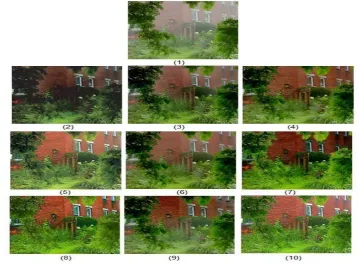
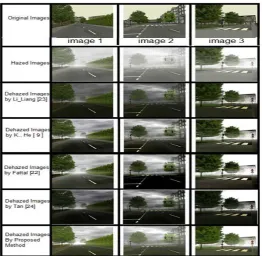
1. At first we compared the proposed method visually with other methods and the results show in figure 9.
529 |
P a g e
Proposed Method. In This Test It Is Clear The Image Result From Proposed Method Have More Quality From The Other Images It Is Visually Pleasing Images Suitable For Human Visual Perception.
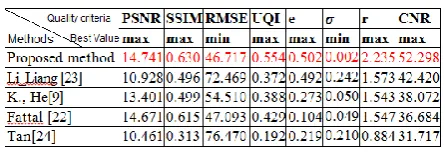
2. Using the quality measuring to test the proposed method and compared the results with other methods as in
table1.
Table 1: Comparing The Proposed Method With Other De-Hazing Method By Using The Quality Measurements.
Table 1 prove that the proposed method gives better results compared with other methods, it is clear from the
values in table 1 that the proposed method have more visible edges, better resolution and more contrast to noise
ratio which mean less noise.
3.The third test we select some images and add haze to them, then de-haze the images by proposed method and
other methods, the results show the quality in tables 2, 3, and 4, and visually in figure 10.
Table 2: Performance Measure For Dehazed_Image
Table 3: Performance Measure For Dehazed_Image
530 |
P a g e
This test used same amount of haze and de-haze the image by many methods. Table 2 show that the proposed
method have more visible edges, best resolution and contrast, better quality when measuring PSNR (the quality
is close to other methods), an same thing for other measures. SSIM and UQI can describe the information
fidelity between the original image and the recovered image . Increase these values indicate more similarity
between origin image and recovered image. Results show that the algorithm is valid, fast, and suitable for the
rapid de-hazing of numerous images.
Figure 10: Visual Test The Quality Of De-Hazing By Many Methods, When Add Haze To Origin Image.
It is clear that the proposed method better than other methods.
4.We compare the execution time for proposed method with other methods in table 5.
531 |
P a g e
From table 5 we conclude that the execution time for proposed method was reasonable and less than the
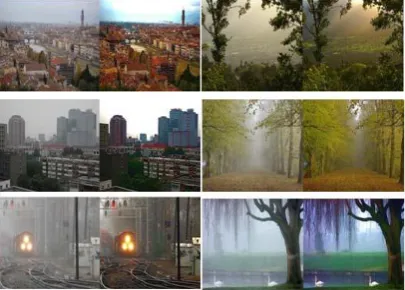
execution time for other methods. 5. Figure 11 show sample of haze images with corresponding of de-hazed
images by using proposed method.
Figure 11: Some Of Well-Known Images Dehazed By Proposed Method.
Recovering the image as origin image may be regards as a very difficult challenge faces researchers due to
many reasons. All algorithms now try to improve the image through de-hazing and recover more image contents
and details. The suggested method improve the current algorithms and gives better results than other algorithms.
From the quantitative results, the suggested method has a remarkable improvement on the quality of the
recovered image. One advantage of this method is no haloes shows with de-hazed image.
VI.
CONCLUSIONS
In this paper we suggest new method for dehazing images. The contribution of this paper is (1) estimate the
dark channel prior based on average. (2) Estimate the value of Air light based on standard deviation (which is a
result of standard deviation of RGB haze image and HSV color space haze image), we suggested many rules
based on experiments. (3) We suggested to enhance the contrast by local contrast for (V) channel in the HSV
color space. Results was very promised visually and by using some quality metrics. The proposed algorithm
compared with other methods and it was more efficient in many situations. One of important enhancement in
this paper is the removing of haloes. We think that the Air light need to enhance to recover some of de-haze
problems, for that we suggest for future works to estimate the Air light by two or more methods and use the best
532 |
P a g e
REFERENCES
[1]
Renjie He, Zhiyong Wang, Yangyu Fan and David Dagan Feng, “Combined constraint for single imageDehazing”, ELECTRONICS LETTERS, Volume 51, Issue 22, October 2015 ,pp 1776–1778.
[2]
Lin-Yuan He, Ji-Zhong Zhao, Nan-Ning Zheng, and Du-Yan Bi, “Hardy Variation Framework forRestoration of Weather Degraded Images”, Mathematical Problems in Engineering, Volume 2015, 2015 ,
pp 1-11.
[3]
Dan Wang, Jubo Zhu, “Fast smoothing technique with edge preservation for single image dehazing”, IETComputer Vision, Volume 9, Issue 6, 2015 ,pp 950–959.
[4]
Bingquan Huo and Fengling Yin, “Image Dehazing with Dark Channel Prior and Novel EstimationModel”, International Journal of Multimedia and Ubiquitous Engineering Volume 10, Issue 3,
2015 ,pp 13–22.
[5]
He, K., Sun, J., Tang, X.: „Guided image filtering‟. ECCV, 2010, pp. 1–14[6]
Yu, T., Riaz, I., Piao, J., et al.: „Real-time single image dehazing using blockto-pixel interpolation andadaptive dark channel prior‟, IET Image Process.,2015, 9, pp. 725–734.
[7]
Gu Z, Ju M, Zhang D. A Single Image Dehazing Method Using Average Saturation Prior. Hindawi ,Mathematical Problems in Engineering , 2017, pp 1–17
[8] Cai B, Xu X, Jia K, Qing C, Tao D. DehazeNet: An end-to-end system for single image haze
removal.IEEE Trans Image Process, Volume. 25, Issue 11, 2016, PP 5187-5198.
[9] Chen X. A Fast Algorithm for Single Image Dehazing Based on Estimating Illumination Veil. MEIC ,
2015, pp 987-991.
[10]Bingquan Huo and Fengling Yin, “Image Dehazing with Dark Channel Prior and Novel Estimation
Model”.International Journal of Multimedia and Ubiquitous Engineering , Volume 10 . Issue 3 , 2015,
pp13-22.
[11]He, K., Sun, J., and Tang, X.: „Single image haze removal using dark channel prior‟, IEEE transactions
on pattern analysis and machine intelligence, Volume 33 . Issue 12 ,2011, pp . 2341–2353.
[12]Jin-Hwan Kim, Jae-Young Sim, Chang-Su Kim, “Single image dehazing based on contrast enhancement”,
Acoustics, Speech and Signal Processing (ICASSP), 2011 IEEE International Conference on,
DOI:10.1109/ICASSP.2011.5946643.
[13]Hautire, N. and Tarel, J.-P. and Aubert, D. and Dumont E. “Blind Contrast Enhancement
Assessment By Gradient Ratioing At Visible Edges”. Image Analysis \& Stereology, Volume 27 ,
Issue 2, 2011, pp . 87–95.
[14]Levin A, Lischinski D, Weiss Y. “A closed-form solution to natural image matting”. IEEE Trans
Pattern . Volume 30 , Issue 2 , 2008, pp . 228–242
[15]Singh Y, Goyal ER. “Haze Removal in Color Images Using Hybrid Dark Channel Prior and Bilateral
Filter”. International Journal on Recent and Innovation trends in Comp. and Comm, Volume 2 , Issue 12
,2014, pp . 4165–4171.
533 |
P a g e
Volume 35 , Issue 7 ,2010, pp . 1–14
[17]Zhen C, Jihong S, Roth P. “Single image defogging algorithm based on dark channel priority”. Journal of
Multimedia, Volume 8, Issue 4, 2013, PP 432-438.
[18]Scholar MT. Remote Sensing Image Dehazing using Guided Filter. IJRSCSE, Volume 1, Issue 3, July 2014,
pp 44-49.
[19]Tarel JP, Hautière N, Cord A, Gruyer D, Halmaoui H. “Improved visibility of road scene images under
heterogeneous fog”. Intelligent Vehicles Symposium (IV) IEEE, 2010, pp 478–485.
[20]Ancuti C, Ancuti CO, De Vleeschouwer CD-HAZY: A dataset to evaluate quantitatively
dehazing algorithms. IEEE International Conference on Image Processing (ICIP) , 2016,pp
2226-2230.
[21] Raanan Fattal, “ Dehazing Using Color- Lines”, ACM Transactions on Graphics (TOG), vol. 34, issue
1, 2014, DOI: 10.1145/2651362.
[22]Codruta O. Ancuti, Cosmin Ancuti, Chris Hermans, Philippe Bekaert, “A Fast Semi-inverse Approach to
Detect and Remove the Haze from a Single Image”, Asian Conference on Computer Vision:Computer
Vision – ACCV 2010 pp 501-514, DOI: 10.1007/978-3-642-19309-5_39. [21] Jean-Philippe Tarel,
Nicolas Hautière, “Fast visibility restoration from a single color or gray level image”, Computer
Vision, 2009 IEEE 12th International Conference on, DOI: 10.1109/ICCV.2009.5459251.
[23]Kristofor B. Gibson, Truong Q. Nguyen, “Fast single image fog removal using the adaptive Wiener filter”,
Image Processing (ICIP), 2013 20th IEEE International Conference on,DOI: 10.1109/ICIP.2013.6738147.
[24]Raanan Fattal, “Single image dehazing”, ACM Transactions on Graphics (TOG) - Proceedings of ACM