Recent dibaryon studies at ANKE
D. Tsirkov1,∗, V. Komarov1, T. Azaryan1, S. Dymov2, A. Kunsafina1,3,4, V. Kurbatov1, Zh. Kurmanaliyev1,3,4, and Yu. Uzikov1,5,6
for the ANKE Collaboration
1Laboratory of Nuclear Problems, Joint Institute for Nuclear Research, RU-141980 Dubna, Russia 2Institut für Kernphysik, Forschungszentrum Jülich, D-52425 Jülich, Germany
3Al-Farabi Kazakh National University, KZ-050040 Almaty, Kazakhstan 4Institute of Nuclear Physics, KZ-050032 Almaty, Kazakhstan
5Dubna State University, RU-141980 Dubna, Russia
6Department of Physics, Moscow State University, RU-119991 Moscow, Russia
Abstract.The recent results of dibaryon studies at ANKE are being presented, along with our plans concerning further studies on the topic. TheD03resonance has been observed at ANKE in the coherentpd→pd+(ππ)0channel,
accompa-nied by the ABC effect. An explanation of the ABC effect has been proposed, suggesting to to explain it as a kinematic cumulation of the pion pairs in the
D03 →D12+π→d+(π+π)I=0cascade decay channel due to the
predomi-nantly collinearD12decay. Based on this hypothesis, a search for aD21signal in thepp → {pp}sππreaction is suggested. Thep-wave dibaryon resonances
3 P2and3
P0have been observed at ANKE; for3
P0it is a first experimental obser-vation. Preliminary results for a resonance peak in thepp→ {pp}sπ0reaction
with the massm=2646±5 MeV and the widthΓ =132±14 MeV are being presented. Also we propose to search for the narrowNN∗(1535) resonance in thepd→pdηreaction.
1 Introduction
Derivation of the hadron spectroscopy from QCD laws has been a important challenge for decades, but theoretical predictions cannot yet provide a clear set of rules for hadron construc-tion. One of the ways to advance in this field is to study exotic hadrons such as tetra-quarks, penta-quarks, and hexa-quarks. They are allowed by QCD, but convincing experimental ob-servations of tetra-quarks and penta-quarks have been made only recently (see, e. g., [1, 2] and refs. therein). As for hexa-quarks, a search for them has already a long history.
2 SU(6) dibaryon classification
Resonances in two-baryon systems were first considered in [3] and developed in [4] soon after the SU(3) symmetry formulation. In Ref. [4] a classification has been introduced for non-strange two-baryon states as members of an SU(6) unitary multiplet. The members of the multiplet followed the notationDIJ, whereIis the isospin andJis the angular momentum.
The lowest states of the multiplet were the deuteronD01, and the deuteron virtual singlet state or thes-wave proton pairD10. The next, higher states, so far unobserved that time, were the
s-waveNΔ(1232) resonance D12, thes-waveΔ(1232)Δ(1232) resonanceD03, the charge-3
pΔ++(1232) resonanceD21and the charge-4Δ++(1232)Δ++(1232) resonanceD30.
The extensive search for two-baryon states began later after the development of the quark-bag models, that reproduced quite well the spectroscopy of the known hadrons and predicted two-baryon resonances [5, 6]. In these searches, the term “dibaryons” was used to denote “genuine” compact six-quark resonances, and a main criterion of their existence was a small width,Γ100 MeV [7, 8].
Numerous studies have led to the discovery of three resonance states 1D2,3F3, 3P 2 in the partial wave analysis (PWA) of the pp → ppelastic scattering and then of the pp → dπ+ reaction (see [9–11] and refs. therein). Here the notation follows the PWA standard 2S+1L
J, whereL is the orbital angular momentum,S is the spin, and Jis the total angular momentum. The quantum numbers of the 1D
2 two-baryon resonance state coincide with those of the Dyson’sD12 dibaryon, and the predictedD12mass,∼2176 MeV, is close to the 1D
2mass, 2120–2150 MeV according to different PWA solutions [12].
However, the dominant interpretation for these resonances was that they are conventional hadron states in theΔNchannel instead of “genuine” quark dibaryons, since theirS-matrix poles were found to be close to the ΔN branching line, and their widths close to that of
Δ(1232). The situation has changed after the observation of an isoscalar two-baryon reso-nance state in the quasi-free channel pn → pnπ0π0, with a mass 2370–2380 MeV and an exceptionally small widthΓ ≈70 MeV [13–15], that was suggested as a candidate for the “true” dibaryon. The mass and the quantum numbers of this state [14] allowed to associate it with the Dyson’sD03dibaryon.
Calculations within constituent-quark models predicting theD03dibaryon have a long his-tory, and recent development of the model [16, 17] has resulted in the successful calculation of its mass, total width and partial decay widths. It follows from these works that the reso-nance wave function has a two-component content: aΔΔpart and a dominant hidden-color component, the six-quark exotic state. Nonetheless, the traditional meson-baryon approach to describe this resonance is still up to date. In [18] a general motivation was suggested for the decrease of theD03width compared to that of the freeΔ(1232). The recent work [19, 20] considered the two-component structure of theD03 resonance, consisting of a compactΔΔ component and a looseNΔnear-threshold system, and succeeded in describing its mass, total and partial decay widths. Thus, the resonance behavior of thepn→ pnπ0π0cross section can be rather well reproduced by both the meson-baryon and the quark-model approaches. On the basis of that, we would use the term “dibaryon” for any hadronic system with the baryon number two and a resonance-like behavior, without implying its “genuine” quark structure.
Recently, a signal for theD21dibaryon has been observed as well at WASA@COSY [21]. The quasi-freepp→ppπ+π−reaction has been measured exclusively inpdcollisions, allow-ing to obtain total and differential cross sections for the energy region √s=2350–2460 MeV, which coversD21mass expected from the original predictions [4]. The measured cross sec-tions are significantly underpredicted by thet-channel “modified Valencia” calculations ig-noring theD21 dibaryon, while introducing the one with the massm =2140 MeV and the widthΓ =110 MeV to the model allows to get rid of this discrepancy.
2.1 ANKE observations
In all the experiments performed so far theD03dibaryon was excited via free or quasi-free collision of fast nucleons. We at ANKE observedD03dibaryon in the coherent pd → pd+ (ππ)0 channel where both nucleons of the deuteron were excited to D
meson exchange with a fast projectile proton [22]. The reactionp+d→ p+d+Xwas studied at 0.8–2.0 GeV proton beam energies, and the proton-deuteron pairs emerging with high momenta, 0.6–1.8 GeV/c, were detected at small angles with respect to the proton beam. The invariant mass of thedππsystem in the region of pion-pair production exhibits a resonance-like peak atmdππ ≈2360 MeV/c2with the widthΓ≈100 MeV/c2, corresponding to theD03 excitation.
TheD03is known to have an association to the ABC effect—a significant near-threshold enhancement in the spectrum of the pion pair invariant massmππ, observed in the reactions with production of the isoscalar pion pair accompanied by the bound light nucleus, at the positionmππ≈300 MeV/c2with a surprisingly small width about 40 MeV/c2[23]. At ANKE, the invariant mass of the pion pairmππalso reveals a local enhancement with a structure of a narrow bump placed above a smooth continuum, specific to the ABC effect.
The explanation of the ABC effect, especially a rather narrow width of the enhancement, has puzzled science for decades. Various explanations have been proposed (see, e. g., [23, 24]). The one that seemed promising for us was the cascade decay channel
D03 →D12+π→d+(π+π)I=0, (1)
proposed in [24]. That work suggested that the effect could arise from the interference be-tween (1) and anotherD03decay channel,
D03 →d+σ→d+(π+π)I=0, (2)
with the mass and the width of theσmeson equal tomσ=300 MeV andΓσ=100 MeV due to the hypothetical chiral symmetry restoration in the hot and dense quark matter composing theD03dibaryon. Since such restoration in the case of theD03resonance decay does not seem to have enough confirmations to us, we have proposed a hypothesis that the ABC effect is a kinematic effect of pion-pair cumulation near the specific excitation energy in channel (1) due to the binary character of the reactions composing the cascade and predominantly collinear decay of the intermediateD12 dibaryon [22]. At the extreme case of zero dibaryon widths and exactly collinear decay, the position of the ABC enhancement would be theδfunction atmππ =271 MeV/c2 forπ0π0. Both receding from the collinear kinematics and dispersion of the resonance masses cause the peak smearing, but a simple simulation with the standard dibaryon masses and a cosθangular distribution for the D12 decay gives a peak position similar to that of the ABC one [22]. One more argument in favor of the collinear character of theD12decay is the concentration of fast deuterons,3He,4He nuclei near 0◦and 180◦angles in the experiments where the narrow ABC enhancement was observed [13, 22, 25].
One of the common reactions where it is suggested to search for theD21dibaryon is the
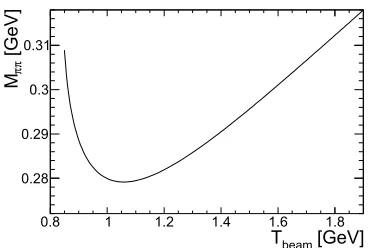
pp→ D21π−→ ppπ+π−channel [4, 21]. The effect of the pion-pair cumulation could take place in this reaction as well if we select final proton pairs with a small excitation energy, which would lead to a quasi-binary kinematics in the second step of the cascade. A simple calculation, done for the case of zero dibaryon width and exactly collinear decay, shows that the position of the two-pion peak would depend on the initial energy (see Fig. 1), though in the beam energy regionTp =1–2 GeV it would be close to the threshold, resulting in the ABC-like peak.
[GeV]
beam
T
0.8 1 1.2 1.4 1.6 1.8
[GeV]ππ
M
0.28 0.29 0.3 0.31
Figure 1.Position of theπ+π−enhancement calculated for the reaction
pp→D21π−→ppπ+π−in the approximation of zero dibaryon width and exactly collinear decay.
3 Dibaryons outside the SU(6) scheme
Known dibaryons are not limited to the Dyson’s classification. The resonance states3P 2and 3F
3 have long been known from PWA of the pp scattering [9–11]. According to theDIJ notation,3P2 would correspond toD12 with negative parity,D−12 (all SU(6) dibaryons have positive one), and3F3would beD−13.
Since3P
2is the least intensive resonance of the ones obtained from PWA, uncertainties in its parameters are rather large. New opportunities to study this resonance are offered by the
pp→ {pp}s+π0 (3)
channel (here diproton{pp}sis a proton pair in1S0state), since the intensive ones1D2,3F3are forbidden in it. At ANKE we have measured for the first time the differential cross section
dσ/dΩand the analyzing powerAyin theΔ(1232) excitation energy region of the reaction (3) (see [27] and refs. therein). The data exhibited the following features: a prominent peak in the energy dependence of the forward differential cross section in the region ofΔ(1232) ex-citation, the anomalous dip for the differential cross section at zero angle, and the significant analyzing power. A simple PWA of the ANKE results together with the data from [28] has been performed, taking into account only the transitions3P
0 → 1S0sand3P2 → 1S0d, since the other ones are known to be small from the PWA of thepp→ ppandpp→dπ+reactions. This allowed to explain the aforementioned features observed for the data as a result of the interference for the3P
2and3P0resonances.
The PWA results also allowed specify the parameters of the 3P2resonance, that turned out to bem = 2195±8 MeV/c2 andΓ = 134±22 MeV/c2. Besides, a3P
0 was observed experimentally for the first time, and PWA gave its massm =2199±5 MeV/c2 and width
Γ = 94±11 MeV/c2. In theD
IJ notation the3P0 resonance would beD−10, that could be treated as an excited state of the s-wave diproton/ virtual singlet deuteronD+10. Both3P
2 and3P
0resonances belong to the new family of p-wave dibaryons, as opposed to thes-wave dibaryons considered earlier.
One of the first ANKE studies of thepp→ {pp}sπ0reaction [29] suggested the following feature of the energy spectrum of the forward cross section: after reaching a minimum at
Tp = 1.4 GeV, it increased again forTp = 2.0 GeV, while its angular slope changed the sign. That suggested the existence of the second peak in the cross section spectrum at the energiesTp > 1.4 GeV. We have preliminarily analyzed the data on this reaction at several energies in the Tp =1–3 GeV range, which revealed the clear second peak with the mass
Figure 2.Energy dependence of the differential cross sectiondσ/dΩat zero angle for the reactionpp→ {pp}sπ0. The
curve is a Breit-Wigner fit to the data with the massm=2646±5 MeV and the width Γ =132±14 MeV.
The analysis of data on thepd→ pd+Xreaction in the region of theηmeson production exhibits a strong narrow enhancement in the event distribution with respect to mass of thedη
system (Fig. 3). Preliminary fitting of the Breit-Wigner function plus constant background to this data gives the position of the peakm0=2432±2 MeV/c2an its widthΓ =20±3 MeV/c2. The mass suggests that it could be a signal for the resonance state of the nucleon and the
N∗(1535) baryon, that is known to decay predominantly toNη[30]. In this case, it would be a first dibaryon including a non-Δexcited baryon with a dominant decay channel involving a meson other thanπ. Due to the fact that the peak is located very close to the acceptance boundary, a evaluation of the setup acceptance is required for this data to provide convincing results. It is planned to be done in the nearest future. Besides, we are going to examine data on thepd → pd+Xreaction from other ANKE beam times for the search of this signal in the more favorable conditions.
preliminary
]2
[GeV/c
dX
m
2.42 2.44 2.46 2.48 2.5 2.52
counts
0 10 20 30 40 50 60 70 80
90 Figure 3.Event counts with respect to the
invariant mass of thedηsystemmdXfor the
pd→pd+Xreaction in the missing mass region 295 MeV≤m2
X<310 MeV. The curve is a fit by the Breit-Wigner function plus constant background
bg+NΓ2/4 (m
dX−m0)2+ Γ2/4
. Its parameters areN=82±8,
m0=2432±2 MeV/c2,Γ =20±3 MeV/ c2, and
bg=4±1.
4 Conclusion
• The observation of theD03resonance has been performed at ANKE in the coherentpd→
pd+(ππ)0channel [22], accompanied by the ABC effect.
• We proposed an explanation of the ABC effect as a result of kinematic cumulation of the pion pairs in theD03→D12+π→d+(π+π)I=0decay channel due to the predominantly collinearD12decay.
• We suggest to extract a signal for D21 from the pp → {pp}sππdata [26] supposing the ABC “cumulation” hypothesis.
• The parameters of the3P
• Preliminary results have been obtained for the resonance peak in thepp→ {pp}sπ0reaction with the massm=2646±5 MeV and the widthΓ =132±14 MeV.
• Preliminary data suggest an existence of theNN∗(1535) resonance in thepd→ pdη reac-tion. Further analysis of the data on this reaction is planned.
We are grateful to colleagues from the COSY team for providing favorable data-taking conditions. Valuable discussions with L. Alvarez-Ruso, V. Baru, A. Gal, Ch. Hanhart, A. Kudryavtsev, V. Kukulin, and J. Niskanen are acknowledged. We are also thankful to H. Clement and T. Skorodko for fruitful discussions at the MESON2018 conference. The work was supported in part by the grants of BMBF-JINR, COSY FFE and RFBR (09-02-91332) and by the Heisenberg-Landau program.
References
[1] M.R. Shepherd, J.J. Dudek, R.E. Mitchell, Nature534, 487 (2016) [2] H.X. Chen, W. Chen, X. Liu, S.L. Zhu, Phys. Rep.639, 1 (2016) [3] R.J. Oakes, Phys. Rev.131, 2239 (1963)
[4] F.J. Dyson, N.H. Xuong, Phys. Rev. Lett.13, 815 (1964)
[5] A.T.M. Aerts, P.J.G. Mulders, J.J. de Swart, Phys. Rev. D17, 260 (1978) [6] P.J. Mulders, A.T. Aerts, J.J. de Swart, Phys. Rev. D21, 2653 (1980) [7] M.P. Locher, M.E. Sainio, A. Švarc, Adv. Nucl. Phys.17, 47 (1986) [8] B.L.G. Bakker, I.M. Narodetskii, Adv. Nucl. Phys.21, 1 (1994)
[9] R.A. Arndt, L.D. Roper, R.A. Bryan, R.B. Clark, B.J. VerWest, P. Signell, Phys. Rev. D
28, 97 (1983)
[10] R.A. Arndt, I.I. Strakovsky, R.L. Workman, D.V. Bugg, Phys. Rev. C48, 1926 (1993) [11] R.A. Arndt, W.J. Briscoe, I.I. Strakovsky, R.L. Workman, Phys. Rev. C76, 025209
(2007)
[12] saidinteractive code,http://gwdac.phys.gwu.edu
[13] M. Bashkanovet al.(WASA@COSY), Phys. Rev. Lett.102, 052301 (2009) [14] P. Adlarson (WASA@COSY), Phys. Rev. Lett.106, 242302 (2011)
[15] P. Adlarsonet al.(WASA@COSY), Phys. Rev. Lett.112, 202301 (2014) [16] Y. Dong, P. Shen, F. Huang, Z. Zhang, Phys. Rev. C91, 064002 (2015) [17] Y. Dong, F. Huang, P. Shen, Z. Zhang, Phys. Rev. C94, 014003 (2016) [18] J.A. Niskanen, Phys. Rev. C95, 054002 (2017)
[19] A. Gal, Phys. Lett. B769, 436 (2017)
[20] A. Gal, arXiv:1803.08788 [nucl-th] (2018),1803.08788
[21] P. Adlarsonet al.(WASA@COSY), Phys. Rev. Lett.121, 052001 (2018) [22] V. Komarovet al.(ANKE@COSY), arXiv:1805.01493 [nucl-ex] (2018) [23] M. Bashkanov, H. Clement, T. Skorodko, Nucl. Phys. A958, 129 (2017) [24] M.N. Platonova, V.I. Kukulin, Phys. Rev. C87, 025202 (2013)
[25] J. Banaigs, J. Berger, L. Goldzahl, T. Risser, L. Vu-Hai, M. Cottereau, C. Le Brun, Nucl. Phys. B67, 1 (1973)
[26] S. Dymovet al.(ANKE@COSY), Phys. Rev. Lett.102, 192301 (2009) [27] V. Komarovet al.(ANKE@COSY), Phys. Rev. C93, 065206 (2016) [28] R. Bilgeret al., Nucl. Phys. A693, 633 (2001)
[29] V. Kurbatovet al.(ANKE@COSY), Phys. Lett. B661, 22 (2008)