PRODUCTION AND OPTIMIZATION OF BIODIESEL
FROM WASTE VEGETABLE OIL
A.Ravindar
1, P M Sameera
2, P. Raja Rao
3 1,2,3Division of Biochemical Engineering and BioTechnology
University College of Technology, Osmania University, Hyderabad (India)
S N V Pharma MahaVidyalaya, Taranaka, Secunderabad (India)
ABSTRACT
B i o d i e s e l i s a n a t t r a c t i v e a l t e r n a t i v e t o f o s s i l f u e l . I t s p o r t a b i l i t y , a v a i l a b i l i t y ,
r e n e w a b i l i t y , h i g h e r c o m b u s t i o n e f f i c i e n c y , l o w e r s u l f u r a n d a r o m a t i c c o n t e n t m a k e i t a n
i d e a l f u e l f o r u s e i n t r a n s p o r t a t i o n a n d i n i n d u s t r y . B i o d i e s e l c a n b e p r o d u c e d f r o m
a n i m a l f a t a n d v e g e t a b l e o i l s o b t a i n e d f r o m v a r i e t y o f p l a n t s . T h e p r e s e n t w o r k e x p l o i t s
t h e b i o d i e s e l p r o d u c t i o n f r o m w a s t e v e g e t a b l e o i l s ( f r i e d o i l s ) a n d e s t e r i f i c a t i o n p r o c e s s
s t u d y w a s c a r r i e d o u t f o r d e v e l o p m e n t o f t h e s a m e . T h e f e e d - s t o c k s u s e d a r e w a s t e
c o o k i n g o i l s . E x t e n s i v e e x p e r i m e n t a t i o n w a s c a r r i e d o u t a t b e n c h s c a l e . Transesterification
reaction is carried out at 30, 40, 50, and 60°C with 1.5% of KOH as catalyst. Samples are taken at different
reaction times of 0, 30, 60, 90 and 120 min. The organic layers are then analyzed by thin layer chromatography
technique and glycerol is analyzed using sodium periodate oxidation method. It is observed that a maximum of
90% of conversion is obtained with waste vegetable oil at 60oC temperature. T h e s e l a b o r a t o r y b a s e d s o l u t i o n s c a n t h e n b e a p p l i e d t o o v e r c o m e t h e t e c h n i c a l b a r r i e r s a t c o m m e r c i a l l e v e l .
Keywords: Waste vegetable oil, Biodiesel production, Transesterification
I. INTRODUCTION
Biodiesel, an alternative diesel fuel, is made from renewable biological sources such as vegetable oils and
animal fats. Finite fossil fuel reserves, political, economic, health and environmental (ozone depletion, global
warming) issues and concerns have promoted biodiesel as an alternative renewable and eco-friendly fuel.
Biodiesel has shown its ability to meet the energy demand of the world in the transportation, agriculture,
commercial and industrial sectors.The annual world consumption of diesel is approximately 934 million tons.
As a green renewable and potentially unlimited, biodiesel has recently come out as the superlative alternative
fuel which can be used in compression ignition engines with minor or no modifications. The use of biofuelsin
place of fossil fuels would slow the progression of global warming by reducing sulfur and carbon oxides and
hydrocarbon emissions. Because of economic benefits and more power output, biodiesel is often blended with
diesel fuel in ratios of 2, 5 and 20%. Using a mixture containing 20% biodiesel reduces carbon dioxide net
emissions by 15.66% while using pure biodiesel makes the net emission of carbon dioxide zero variety of cheap
Methods for p r o d u c t i o n o f B i o d i e s e l :Biodiesel production was carried by using different processes,
direct use and blending, micro-emulsions, thermal cracking, and transesterification. Four main processes have
been investigated for production of biodiesel. They are a) Direct use and blending, b) Pyrolysis,
c)Micro-emulsification and d)Transesterification.
T r a ns e s t e r i fi c a t i o n ha s b e e n d e mo n s t r a t e d a s t he s i mp l e s t a nd mo s t e f f i c i e nt r o u t e fo r
b i o d i e s e l p r o d uc t i o n i n l a r g e q u a nt i t i e s . S o , t r a n s e s t e r i f i c a t i o n h a s b e c o m e p o p ul a r a nd t he
p r o d uc t i o n me t ho d o f c h o i c e . T r a n s e s t e r i f i c a t i o n c a n b e c a r r i e d o ut b y u s i n g a c a t a l ys t o r
e n z y me o r b y u s i n g s up e r c r i t i c a l a l c o ho l wi t ho ut c a t a l ys t .
Methodology:In this study,Waste Cooking Oil (WCO) was obtained from local restaurants around the
university campus. It was used as the raw material for the biodiesel production. Alkaline catalyst, potassium
hydroxide (KOH) was used in the transesterification processto reduce the free fatty acid, FFA, and carrying
out the transesterification process.The process variables areR e a c t i o n t e mp e r a t u r e , R a t i o o f a l c o ho l t o
o i l , C a t a l ys t t yp e a nd c o nc e nt r a t i o n , M i xi n g i nt e n s i t y a nd P ur i t y o f reactants.
II. MATERIALS AND METHODS
The esterified Waste vegetable oil are being used. .Initially the crude quality of these oils are collected from the
Hotels and mirchi vendors on the roads. Then these oils are refined and characterized for the free fatty acid
content, the saponification value, the iodine value, and the peroxide value according to the AOCS official
methods. The FFA content in the reaction mixture was determined by titrimetric analysis.
Transesterification is the process of exchanging the organic group R" of an ester with the organic group of an
alcohol. Transesterification is basically sequential reaction. The TGs are first reduced to DGs. The DGs are
subsequently reduced to MGs. The MGs are finally reduced to fatty acid ester.T he p r o d uc t i o n o f
b i o d i e s e l i s b a s e d o n o i l a nd me t ha no l . I t i s c l e a r t ha t 1 mo l t r i gl yc e r i d e r e a c t s wi t h 3 mo l
me t ha no l t o p r o d uc e 3 mo l me t h yl e s t e r a nd 1 mo l gl yc e r o l .
F ur t h e r i n v e s t i g a t i o n i nd i c a t e s t h a t d i gl yc e r i d e a nd mo no gl yc e r i d e a r e d e t e c t e d a s
i n t e r me d i a t e s d u r i n g t he t r a n s e s t e r i f i c a t i o n r e a c t i o n c a t a l yz e d b y K O H a nd N a O H .
T he o v e r a l l r e a c t i o n c a n b e d i vi d e d i nt o t h r e e c o ns e c u t i ve r e ve r s i b l e r e a c t i o ns ( i ) a
t r i g l yc e r i d e mo l e c u l e fi r s t l y r e a c t s wi t h me t ha n o l t o p r o d uc e a me t h yl e s t e r mo l e c u l e a nd
a d i g l yc e r i d e ( i i ) t he d i g l yc e r i d e p r o d uc e d t he n r e a c t s wi t h a me t ha no l mo l e c ul e t o
p r o d uc e a mo no g l yc e r i d e a nd a me t h yl e s t e r a nd ( i i i ) t h e mo no g l yc e r i d e f u r t he r r e a c t s
wi t h o ne me t ha no l t o p r o d uc e me t h yl e s t e r a nd gl yc e r o l . E a c h c o n ve r s i o n s t e p yi e l d s o ne
F A A E mo l e c u l e , gi v i n g a t o t a l o f t hr e e F A A E s p e r t r i gl yc e r i d e mo l e c u l e a s d e s c r i b e d b y
t h e fo l l o wi n g e q ua t i o n s :
1. Triglyceride (TG) + OH Diglyceride (DG) + COO
2. Diglyceride (DG) + OH Monoglyceride(MG) + COO
T he u s e o f a n a l c o ho l r e s ul t s i n t h e d e s i r e d F A A E s a nd a gl yc e r o l b yp r o d uc t wh i c h c a n b e
ut i l i z e d i n o t he r i nd u s t r i e s . F e e d s t o c k wi t h hi g he r c o n c e nt r a t i o n o f F r e e F a t t y Ac i d s
( F F A ' s ) ma y p o s e a p r o b l e m o f s o a p fo r ma t i o n a nd l e a d t o u nd e r r e a c t e d ma t e r i a l , t h u s
a f f e c t i n g yi e l d . T h u s , t h e r e i s a ne e d t o p r e t r e a t F F A ' s b e fo r e t he t r a n s e s t e r i f i c a t i o n u s i n g
o ne o f t he fo l l o wi n g me t ho d s : ( a ) a c i d e s t e r i fi c a t i o n ( b ) i o n e x c ha n ge r e s i n s a nd ( c )
e x t r a c t i o n wi t h a l c o ho l . Al l o wa b l e F F A ' s c o nt e nt i n t h e fe e d s t o c k i s l o we r t ha n 2 . 5 % wt
a nd t h e p r e t r e a t me n t s t e p b e c o me s n e c e s s a r y b e fo r e t he t r a n s e s t e r i fi c a t i o n p r o c e s s wh e n
t h e F F A c o n t e n t i s h i g h e r t ha n 2 . 5 % wt .
Feed stocks for biodiesel production:-The esterified Waste vegetable oil are being used. .Initially the crude
quality of these oils are collected from the Hotels and mirchi vendors on the roads. Then these oils are refined
and characterized for the free fatty acid content, the saponification value, the iodine value, and the peroxide
value according to the AOCS official methods. The FFA content in the reaction mixture was determined by
titrimetric analysis.
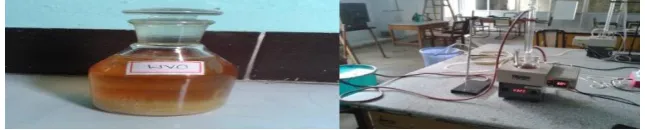
Fig 1: Waste vegetable oilFig 2 Experimental set up
B y c o n s i d e r i n g fo ur temperatures ( 30̊̊ C , 40̊̊ C , 50̊̊ C , 6 0 ° C ) , t h r e e mo l a r c o nc e nt r a t i o ns ( 1 : 3 ,
1 : 6 , 1 : 9 ) . C a t a l ys t ( K O H ) 1 2 r u n s a r e p e r f o r me d . T a b l e 3 . 1 s ho ws a l l t he p o s s i b l e
e xp e r i me n t s i n t he t r a n s e s t e r i f i c a t i o n o p t i mi z e d . Kinetic runs of transesterification are carried out
for two different oils over using potassium hydroxide as the catalyst and Sodium hydroxide as catalyst fo r
2 hr s at atmospheric pressure with different temperatures: 3 0 , 4 0 , 5 0 , 6 0 ° C at different mo l a r ratios of
methanol to oil. Transesterification reaction is carried out in 1 liter, 4 necked jacketed glass r e a c t o r
e q u i p p e d wi t h a condenser, overhead stirrer, which has a provision for t e mp e r a t ur e me a s ur e me n t a nd
sample withdrawal. The temperature in the reactor was ma i n t a i ne d b y c i r c ul a t i n g ho t fluid through the
jacket. The condenser temperature is ma i n t a i n e d b y circulating chilled water. The temperature of the
condenser is maintain between 8-10°C to minimize the methanol loss. The rpm of the stirrer is maintained at
300rpm.
Kinetics:T he s t ud y o f ki ne t i c s o f t r a n s e s t e r i f i c a t i o n r e a c t i o n i s c a r r i e d o ut b y c o l l e c t i n g
t h e c o nc e n t r a t i o n ve r s u s t u ne d a t a a t d i f fe r e nt t e mp e r a t ur e s ( 3 0 , 4 0 , 5 0 a nd 6 0 ° C ) wi t h
d i f fe r e n t molar ratios.During the reaction the samples are taken at the following reaction times: 0, 30, 60, 90,
120 min. The organic layers are then analysed by thin layer chromatography technique and glycerol is analysed
using sodium periodate oxidation method. Both the layers are separated, washed and analyzed.
Product Separation:The separation process is based on the facts that fatty acid alcohol esters andglycerol are
sparingly mutually soluble, and that there is a significant difference in density between the methyl ester and
glycerol phases. The presence of methanol in one or both phasesaffects the solubility of ester in glycerol and
transesterification process bygravity settling. Products separation was carried out by providing a settling timeof
lhour and the total product was separated into two layers, glycerol layer and methyl esterlayer (BD layer).
Glycerol layer:Glycerol formed in the reaction, catalyst and unreacted methanol form a layer at the bottom of
separating funnel, since catalyst density is high and maximum of catalyst comes into glycerol layer.There is a
chance of methyl ester in glycerol layer because of the mutual solubility of methyl esterin methanol and TG,
partial glycerides (DG, MG) in minute quantities.
Methyl ester layer :Methyl ester, unreacted TG, DG, and MG come under methyl ester layer which was the
toplayer in separating funnel during separation. Methanol, catalyst also present in smallquantities.
Water washing for biodiesel layer:Biodiesel layer was washed to remove soap formation, FFA, methanol and
other contaminants. Water and biodiesel have taken at equal ratios. Slightly shake the funnel to mix water with
biodiesel if we shake rigorously then DG and MG present in the biodiesel layer will form emulsion with water.
After settling for 30 mins the water effluent layer was separated. Then the PH range was checked for that layer.
Washing was repeated until biodiesel comes to neutral in nature. Methanol is sparingly soluble in biodiesel
layer, while washing it comes in to water effluents. Now we have pure biodiesel but with little moisture content,
to remove moisture drying is carried out. After drying we can get finished product.Water washed BD layer was
dried to remove water. Drying was done in rota vapor unit by applying vacuum for l h and was stopped by
observing that there was no formation of droplets in the condenser.Glycerol layer will have only 50 % glycerol
in it, remaining is methanol, FFA and catalyst. For that biodiesel water effluents can be added to recover the
glycerol in the biodiesel layer also. Since glycerol is soluble in water, glycerol present in the biodiesel will come
in to water effluent.
P r o d u c t s A n a l y s i s :Purified glycerol and biodiesel layers were analyzed to obtain the quantities of glycerol
and methyl ester formed during the transesterification process. Glycerol was estimated using the A O C S official
method (sodium periodate oxidation method), and thin layer chromatography (TLC) was used to analyze
biodiesel product.
G l y c e r o l ( S o d i u m p e r i o d a t e o x i d a t i o n ) :This method determines glycerol and other polyalcohols
containing three or more adjacent hydroxyl groups. The glycerol reacts with the sodium periodate in an acid
solution, forming aldehydes and formic acid. The latter is a measure of the glycerol in the sample. The sodium
periodate method replaces the acetin method and the dichromate method because it has been found to be more
accurate and more specific for the determination of glycerol as well as being simpler and more rapid.
TLC Analysis:A TLC plate is a sheet of glass, metal, or plastic which is coated with a thin layer of a solid
adsorbent (usually silica or alumina). A small amount of the mixture to be analyzed is spotted near the bottom of
this plate.The TLC plate is then placed in a shallow pool of a solvent in a developing chamber so that only the
very bottom of the plate is in the liquid. This liquid, or the eluent, is the mobile phase, and it slowly rises up the
TLC plate by capillary action.As the solvent moves past the spot that was applied, equilibrium is established for
each component of the mixture between the molecules of that component which are adsorbed on the solid and
the molecules which are in solution.
Measuring Rfvalues :W he n t h e s o l ve n t fr o nt g e t s c l o s e t o t he t o p o f t he p l a t e , t h e p l a t e i s
r e mo ve d fr o m t h e b e a k e r a nd t he p o s i t i o n o f t h e s o l v e nt i s ma r ke d wi t h a no t he r l i n e
s a me c o nd i t i o n s , t h e n t h e R f v a l ue s fo r e a c h c o mp o n e nt wo u l d a l wa ys b e t he
s a me . R e t e nt i o n fa c t o r i s p r o p o r t i o na l t o c o n ve r s i o n a nd i n t he p r e s e nt wo r k r e t e n t i o n
fa c t o r o f me t h yl e s t e r c o mp o ne n t wa s t a ke n a s t h e c o n ve r s i o n .
III. R ESU LT S A N D DISC US SIO N
Transesterification of Esterified Oil: Esterified waste vegetable oil are used in the present work,and it
contains FFA less than 1% initially. And the esterified product was processed in transesterification reaction with
KOH catalyst. Methanol was used in the reactions, hence the product formed is methyl ester. Effects of
following variables on the conversion of reactants (FFA/TG) to methyl ester during transesterification reactions
were studied.
Fig3 : Effect of Temperature with time.
Effect of temperature :In order to evaluate the kinetic parameters of the process, the reaction temperature is
varied i.e. (30, 40, 50,60c) and experiments were conducted for 1 hr(with KOH as catalyst) at a stirrer speed of
300rpm and optimizing other parameter such asCatalyst- KOH(1.5 wt%),Oil: Alcohol to oil molar ratio –
1:3,1:6,1:9Reaction time- 60 min, 120 min
Transesterification reaction can be written as TG + 3methanol 3methyl ester + glycerol
Esterified product of waste vegetable oil (0.998% FFA) was processed in transesterification reaction and the
conversion of transesterification reaction was measured from TLC. The value of retention factor of methyl ester
was taken as conversion since retention factor is directly proportional to conversion. From this data it is
observed that 50% of total conversion is achieved within 20 minutes. And conversion increased with increase in
reaction time up to 40 minutes after that the increase in conversion is very low. A maximum conversion of 89%
is obtained at 60°C temperature, 1.5 wt% catalyst, and 1:6 molar ratio of oil is to methanol.From the data it is
observed that a maximum of 90% of conversion is obtained with waste vegetable oil (non edible oil) at 60C
temperature.
Effect of temperature with catalyst: Experiments were conducted with different temperatures(30°C,
40°C,50°C and 60°C) at 1:3 oil to methanol molar ratio, catalyst concentration of 1.5% for 2 hrs and with a
mixing intensity of 300rpm. The effect of temperature on conversion of FFA is recorded as a function of time
Effect of oil to methanol molar ratios: Molar ratio of oil to methanol is one of the important factors effecting
the formation of methyl ester. The stoichiometry of the reaction shows that one mole of FFA requires one mole
of methanol to form one mole of methyl ester.
Product Purification
Biodiesel layer was washed to remove soap formation, FFA, methanol and other contaminants.Water and
biodiesel have taken at equal ratios, slightly shaken the funnel to mix waterwith biodiesel .If shaken rigorously
then DG and MG present in the biodiesel layer will form emulsion with water. After settling for 30 mins the
water effluent layer was separated. Then the pH range was checked for that layer. Washing was repeated until
biodiesel comes to neutral in nature.Methanol is sparingly soluble in biodiesel layer, while washing it comes in
to water effluents.
Fig4: Observations (WVO to Bio Diesel)
IV. CONCLUSIONS
Biodiesel has been processed using esterified waste vegetable oil. The study was therefore conducted using
waste vegetable oil. The detailed parametric study of the base catalysed transesterification reactions were carried
out experimentally to study the effect of temperature and molar ratio of oil to methanol. Transesterification
reaction is carried out at 30, 40, 50, and 60°C with 1.5% of KOH catalyst. Also the reactions were carried out at
different molar ratios of 1:3, 1:6 and 1:9. The results indicated that there is a strong effect of temperature and oil
to methanol molar ratios on the reaction rate.
Maximum conversion of 89% was obtained at 60°C with base catalyst and a maximum conversion of 60% was
obtained with enzyme catalyst at 50°C. It is also found that 1:3 is optimum molar ratio for enzyme catalysed
reaction and 1:6 for base catalysed reactions. Investigations were made in the present study to establish the
kinetics of transesterification reaction. The kinetic curves of the transesterification process indicated that under
the conditions employed, the rate of reaction was the highest during the initial stage of the reaction. The reaction
rate increased with the increase of temperature. The experimental results indicated increasing the temperature
increased the equilibrium conversions. The activation energies for the three reversible reactions involved in the
reaction were calculated from the Arhenius equation and were in the range of 8-20000 J/mol for waste oil
RE FE RENCES
[1].Hoydoncx HE, De Vos DE, Chavan SA, Jacobs PA Esterification and transesterification of renewable
chemicals. (2004) Topic Catal 27(l.l):83-96
[2].FangruiMaa, Milford A. Hannab, Biodiesel production: a review, Bioresource Technology 70 (2008) 1-15
[3].Akhil Bajaj, Purva Lohan, Prabhat N. Jha, Rajesh Mehrotra, Biodiesel production through lipase catalyzed
transesterification: An overview,Journal of Molecular Catalysis B: Enzymatic 62 (2010) 9-14.
[4].Stiefel, S., Dassori, G.: Simulation of biodiesel production through transesterification of vegetable oils. Ind.
Eng. Chem.Res. 48(3), 1068-1071 (2001).
[5].RogerioMatheus Vargas, Ulf Schuchardt, Ricardo Sercheli, Transesterification of Vegetable oils: a Review,
J. Braz. Chem. Soc, Vol.9, No.l, 199-210, 1998.
[6].Jon Van Germen, Biodiesel processing and production, Fuel Processing Technology 86 (2005) 1097- 1107.
[7].Yun Liu, Yunjun Yan, Fang Hu, An'na Yao, Zhicheng Wang, and Fuxiang Wei Transesterification for
Biodiesel Production Catalyzed by Combined Lipases: Optimization and Kinetics June 2010 Vol. 56, No. 6
AIChE Journal
[8].Hiroshi Yamada and TomohikoTagawa. Operation optimization of the lipase-catalyzed biodiesel
production. Chemical Engineering, Nagoya University, Furo-cho, Chikusa-ku, Nagoya, 464-8603 (Duet al.
[2008] ApplMicrobiolTechnol 79(3):331-337).
[9].LeneFjerbaek, Knud V. Christensen, BirgirNorddahl, A Review of the Current State of Biodiesel
Production Using Enzymatic Transesterification. Biotechnology and Bioengineering, Vol. 102, No. 5, April
1, 2009.
[10].KailiNie, Feng Xie, Fang Wang, TianweiTan Beijing Key Laboratory of Bioprocess, College of Life
Science and Technology, Beijing University of Chemical Technology (BUCT), Beijing 100029, China: