Scholarship@Western
Scholarship@Western
Electronic Thesis and Dissertation Repository
7-30-2018 2:00 PM
Compositional Variations of Titan's Impact Craters Indicates
Compositional Variations of Titan's Impact Craters Indicates
Active Surface Erosion
Active Surface Erosion
Alyssa Werynski
The University of Western Ontario
Supervisor
Neish, Catherine D.
The University of Western Ontario Graduate Program in Geophysics
A thesis submitted in partial fulfillment of the requirements for the degree in Master of Science © Alyssa Werynski 2018
Follow this and additional works at: https://ir.lib.uwo.ca/etd
Part of the Geology Commons
Recommended Citation Recommended Citation
Werynski, Alyssa, "Compositional Variations of Titan's Impact Craters Indicates Active Surface Erosion" (2018). Electronic Thesis and Dissertation Repository. 5585.
https://ir.lib.uwo.ca/etd/5585
This Dissertation/Thesis is brought to you for free and open access by Scholarship@Western. It has been accepted for inclusion in Electronic Thesis and Dissertation Repository by an authorized administrator of
i
Impact craters on Titan are relatively scarce but provide ample information about the
subsurface properties and modification processes present there. This study utilizes impact
craters to examine compositional variations across Titan’s surface and their subsequent
modification. Fifteen craters and their ejecta blankets were studied. Subsurface composition
was inferred from emissivity data from Cassini’s RADAR instrument, and surficial composition from Cassini’s Visible and Infrared Mapping Spectrometer (VIMS). Results
show subsurface composition of these craters is controlled by their degradation state and
local environment. Older craters are more infilled with organics than younger, and dunes
craters show more organic enrichment than plains craters. Surficial composition is only
controlled by the local environment (i.e. dunes or plains regions). Since degraded craters
show organic rich subsurfaces, but varying surface compositions, it is likely there is an active
surface process clearing the surface of sediments and infilling the craters’ subsurface
fractures.
Keywords
ii
Co-Authorship Statement
Chapter 3 is a version of a manuscript for publication submission titled “Compositional
Variations in Titan’s Impact Craters Indicates Active Surface Erosion”. Co-authors are Dr.
Catherine Neish, Dr. Alice Le Gall, Dr. Michael Janssen, and the Cassini RADAR team.
Mapping techniques and the first method of analysis was completed by A. Werynski. The
second method of analysis was completed by Dr. Le Gall. Interpretations and suggestions
iii
Acknowledgments
Thank you to Dr. Catherine Neish for not only providing me with a thesis topic I thoroughly
enjoyed but also for the unconditional and helpful guidance in this work. Thank you
especially for understanding the delicate balance and intricate relationship between work and
personal life. Thank you for pushing me, supporting me, and reminding me that I can do it!
Thank you for sending me to so many different conferences – these were all truly enjoyable
and of course, educational. An additional thank you to Dr. Alice Le Gall for all of her helpful
insights and feedback in this work.
Thank you to my friends near and far who helped me through the last year whether it was
with my research, field work, or enjoying my time in London. Thanks to Lindsay especially
for kicking my writing into gear. Thanks to Jordan and Sarah (and Lindsay) for keeping me
sane and introducing me to a lot of new things. Thanks to Liam for sharing a love of sports.
And of course, thanks to Josh for his helpful MATLAB guidance whenever Mathematica
failed me.
Finally, thank you to my parents. Thank you for unconditionally supporting me in
everything I want to do – whether it be moving to a new state or country, deciding to go back
to school, or wanting to travel the world. Thank you for putting up with me and thank you
iv
Table of Contents
Abstract ... i
Co-Authorship Statement... ii
Acknowledgments... iii
Table of Contents ... iv
List of Tables ... vi
List of Figures ... vii
Chapter 1 ... 1
1 Introduction ... 1
1.1 Titan ... 1
1.2 Geology of Titan ... 7
1.2.1 Geomorphologic units ... 8
1.3 Impact crater formation... 14
1.4 Titan’s craters... 17
1.5 Summary and aim ... 19
1.6 References ... 20
Chapter 2 ... 28
2 Remote Sensing Datasets and Methodology ... 28
2.1 Remote sensing datasets ... 28
2.1.1 Radar ... 28
2.1.2 Thermal microwave emission ... 31
2.1.3 Visible and Infrared Mapping Spectrometer (VIMS) ... 35
2.2 Methodology ... 41
2.2.1 Radar ... 41
v
2.2.3 Visible and Infrared Mapping Spectrometer (VIMS) ... 46
2.3 References ... 48
Chapter 3 ... 54
3 Compositional Variations of Titan’s Impact Craters Indicates Active Surface Erosion ... 54
3.1 Introduction ... 54
3.2 Methods... 57
3.2.1 Average emissivity of Titan’s impact craters ... 62
3.2.2 Filling factor emissivity of Titan’s impact craters ... 65
3.2.3 VIMS signatures of Titan’s impact craters ... 66
3.3 Results ... 67
3.3.1 Average emissivity of Titan’s impact craters ... 67
3.3.2 Filling factor emissivity of Titan’s impact craters ... 71
3.3.3 Infrared spectra of Titan’s impact craters ... 74
3.4 Discussion ... 76
3.5 Conclusions ... 79
3.6 References ... 81
Chapter 4 ... 87
4 Review and conclusions ... 87
4.1 Limitations ... 89
4.2 Future work ... 91
4.3 References ... 93
vi
List of Tables
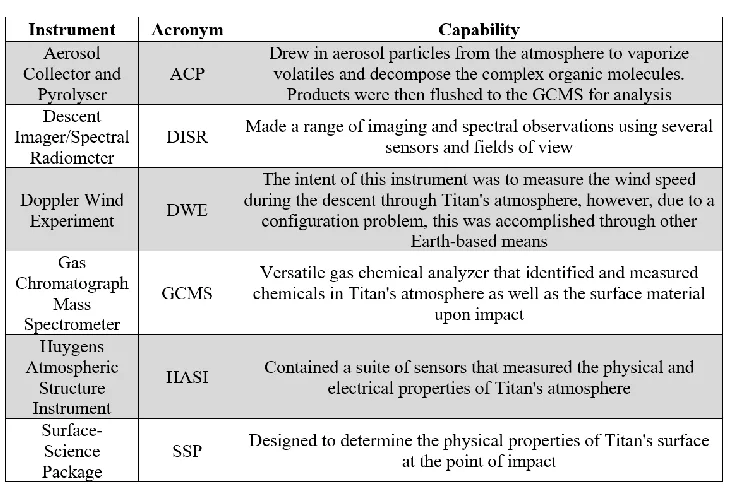
Table 1: Instrument suite for the Huygens probe... 5
Table 2: Payload suite onboard the Cassini spacecraft. ... 6
Table 3: Environmental Conditions on Titan... 7
Table 4: Relative depths for 10 craters on Titan. ... 65
Table 5: Calculated high and low resolution mean emissivity for 15 craters on Titan ... 67
vii
List of Figures
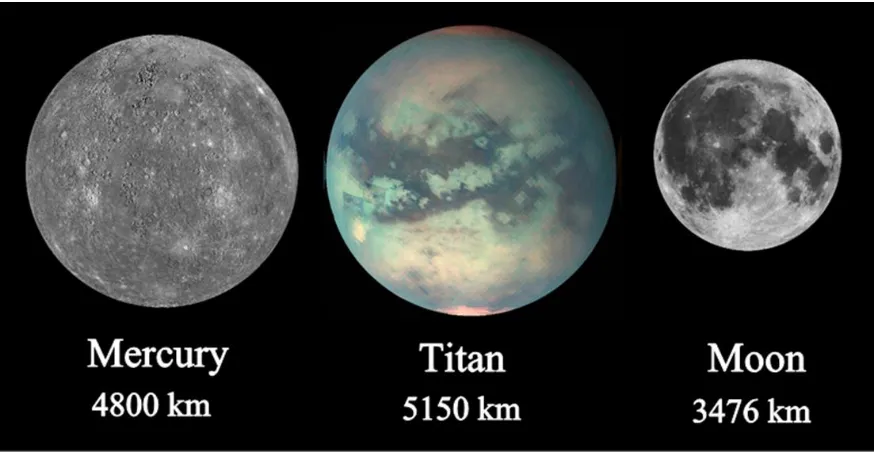
Figure 1: Size comparison of Mercury, Titan, and Earth's Moon. Approximate diameters
(km) for each body listed here. Image created from NASA's image archive. ... 2
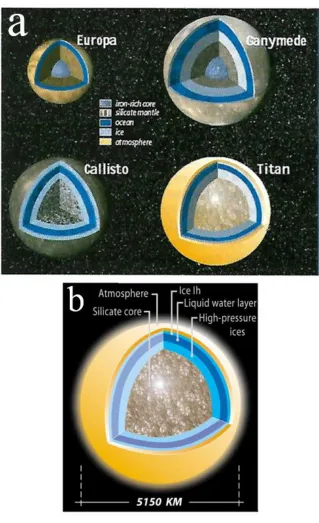
Figure 2: a) Hypothesized interior structures of the icy Galilean satellites, Europa,
Ganymede, and Callisto in comparison to Titan. Figure 2a from Sotin et al., 2009. b)
Modeled interior structure of Titan, which likely has a silicate, or mix of ice and rock, core,
surrounded by high pressure ices. Beneath the icy crust there is likely a liquid water ocean.
Figure 2b from Tobie et al., 2005. ... 3
Figure 3: Spectral plot obtained from VIMS image v1525115629_1 centered at ~32°N,
12°W. The atmospheric windows are illustrated by the wavelength peaks. ... 7
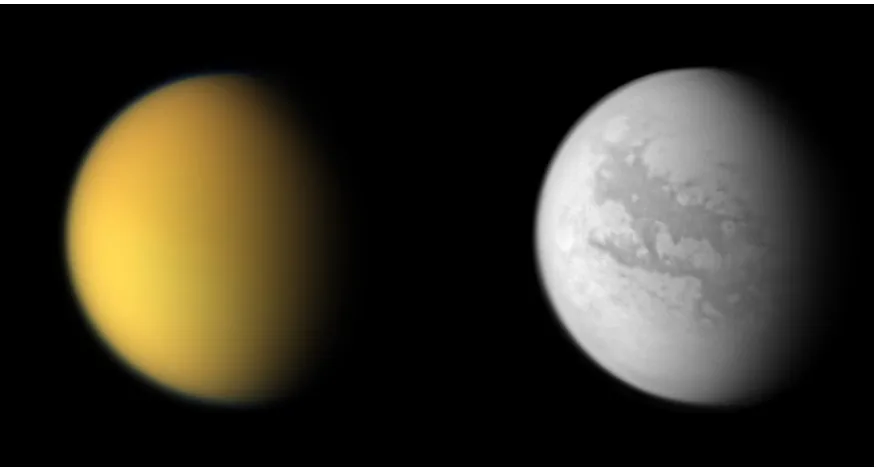
Figure 4: Titan in different wavelengths of light. The left image shows what Titan would
look like to the human eye. The right image shows a near-infrared wavelength image (0.938
µm), capable of viewing the surface (NASA, 2018). Both images were acquired by Cassini’s
Imaging Science Subsystem (ISS). ... 8
Figure 5: Map of major geomorphologic units on Titan. Labyrinth terrain represented in red,
undifferentiated plains in green, hummocky/mountainous terrain in yellow, and sand dunes in
purple. Cassini ISS map underneath available RADAR image swaths to provide context.
Image from Lopes et al., 2016. ... 9
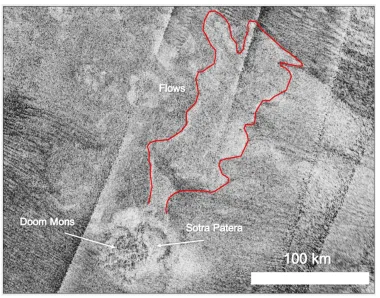
Figure 6: Radar image of potential cryovolcanic feature called Sotra Facula. Here, North is
up. A 1450 m high mountain, Dooms Mons is to the west of Sotra Patera, a 1700 m deep pit.
The associated lobate flows are outlined in red, flowing in a NE direction. ... 11
Figure 7: Cat scratch features (~16°N, 93°W) shown by the radar as dark streaks flanking the
western and eastern sides of the image. These were later determined to be longitudinal dune
features. Image from NASA’s image archive. ... 12
Figure 8: a) Visible images taken by the Huygens probe DISR showing dark, dendritic fluvial
viii
to be classified as a sea, named Ligeia Mare. These images are in polar projection (modified
from Lopes et al., 2010). ... 13
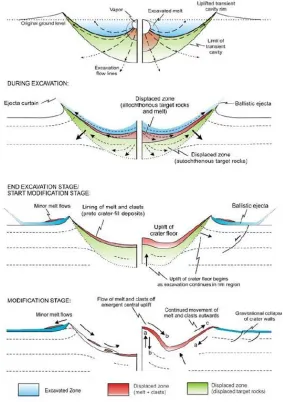
Figure 9: Series of schematic cross-sections depicting the three main stages in the formation
of simple (left) and complex (right) craters. Modified from Osinski et al., 2011. ... 15
Figure 10: Radar map of Titan with the 90 craters circled in red. The size of the circle is
proportional to the crater's diameter. Note the lack of craters near the poles. Image from
Hedgepeth et al., 2018. ... 18
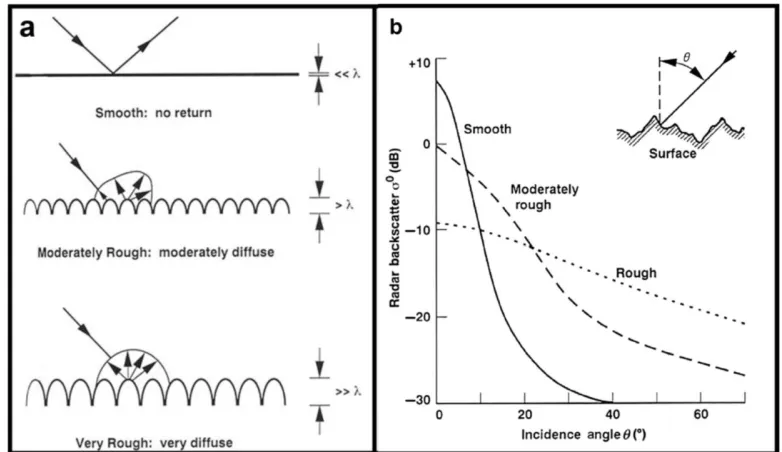
Figure 11: a) Schematic showing how a surface will scatter the radar energy in certain
directions based on the wavelength-scale roughness of its surface. b) Radar backscatter also
depends on the incidence angle of the beam. Smoother surfaces can have strong returns
when the incidence angle is close to the surface slope angle, but have very weak returns at
incidence angles greater than 30°. Image from Neish and Carter, 2014, adapted from Farr,
1993... 29
Figure 12: Cassini RADAR image of Santorini crater located at 2.2°N, 147.7°W. Radar
bright regions correspond with the rough crater rim and ejecta blanket. Radar dark regions
correspond with the smooth surrounding sand dunes and sediment infill in the crater interior.
Sand dunes appear smooth in radar because grain size is only a few hundred microns and the
radar senses surface roughness at centimeter scales. ... 30
Figure 13: The Sun’s spectrum (black) in relation to a perfect emitter, or blackbody (green),
at the same temperature. The Sun is considered a blackbody but note how the Sun’s
spectrum does not match up evenly with a laboratory spectrum of a similar temperature
blackbody. In nature, nothing is ‘perfect’, therefore objects in nature will have emissivity
values less than 1. Image from Physics Stack Exchange. ... 32
Figure 14: Global emissivity map of Titan from Janssen et al., 2016. Higher emissivities are
represented by warmer colors and indicate organic enrichment. Lower emissivity values are
represented by cooler colors and are interpreted as water-ice enrichment. ... 33
Figure 15: An example of volume scattering of sunlight on a tree top. Leaves, as well as
ix
Figure 16: Global VIMS mosaic of Titan from Cassini observations by Barnes et al., 2007.
Colors are mapped with red as 4.8-5.2 μm, green as 2.0 μm, and blue as 1.28 μm. Reds are
either clouds or evaporites, blue represents water-ice, browns are sand dunes, and green is an
unknown unit, likely a mix of organics and water-ice. Figure modified from Neish et al.,
2015... 36
Figure 17: Spectra of pure water-ice shown from a wavelength range of 0.8-3.0 microns.
Note the large absorption bands at ~1.5 and 2.0 microns (Kokaly et al., 2017). ... 37
Figure 18: VIMS spectra from 3 distinct units on Titan. a) VIMS brown spectra, indicative
of organics. b) VIMS blue spectra, indicative of a water-ice enrichment. c) VIMS green
spectra, an unknown unit, potentially a mix of water-ice and organics. ... 38
Figure 19: VIMS spectra for Sinlap crater and the surrounding region on Titan. The RGB
image shown is a band ratio image (R: 1.59/1.27, G: 2.03/1.27, and B: 1.27/1.08). Blue
regions and spectra correspond with a proposed water-ice unit, brown regions and purple
spectra are likely organic, white regions and red and black spectra represent an unknown
unit. The green spectra is derived from a single pixel and could be affected by a cosmic ray,
however, this pixel has been captured in previous images and likely represents a surface
heterogeneity. I/F is the observed spectral radiance divided by the solar irradiance (Le
Mouelic et al., 2007). ... 39
Figure 20: VIMS-IR images of the same area of Titan at 3 different wavelengths. As the
wavelength gets shorter, there are more scattering effects caused by the haze in the
atmosphere (McCord et al., 2006). ... 40
Figure 21: Surface mass to charge ratios acquired from the GCMS on board the Huygens
probe. Data was taken starting upon impact until signal was lost (Niemann et al., 2005). ... 41
Figure 22: Cassini RADAR basemap comprised of all available radar images. ... 42
Figure 23: Interpolated global elevation map of Titan obtained from Corlies et al., 2017.
x
Figure 24: Image showing process of creating the high resolution emissivity mosaic. a) The
global, low resolution, emissivity dataset for Titan. b) All high resolution, BIBQI-, radar
images of Titan. These images were acquired at the same time as the highest resolution
emissivity swatches and therefore match up with each other. c) The radar swatches shown in
b) were used to extract the emissivity data from a) to create the high resolution data product
shown here. ... 45
Figure 25: Three VIMS images with the color scheme outlined in Barnes et al., 2007
showing Sinlap crater. The highest resolution image is placed on top. The lowest resolution
is placed on the bottom, providing more context to the region. ... 47
Figure 26: Cassini RADAR map of Titan. All 15 craters in this study are shown in red and
labeled. ... 57
Figure 27: Cassini RADAR images of the 15 craters (outlined in red) studied in this work, in
order of size. North points up in all images. a) Menrva, D ~ 425 km. b) Forseti, D ~ 139 km.
c) Paxsi, D ~ 120 km. d) Afekan, D ~ 115 km. e) Hano, D ~ 100 km. f) Sinlap, D ~ 82 km.
g) Selk, D ~ 80 km. h) Soi, D ~ 78 km. i) Guabonito, D ~ 68 km. j) Nath, D ~ 58 km. k)
Unnamed crater discovered in flyby T104, D ~ 57 km. l) Momoy, D ~ 40 km. m) Ksa, D ~
39 km. n) Shikoku, D ~ 35 km. o) Santorini, D ~33 km. ... 58
Figure 28: 2.18 cm emissivity data overlain on Cassini RADAR images of the 15 craters of
interest on Titan (outlined in red), in order of size. North points up in all images. a) Menrva,
D ~ 425 km. b) Forseti, D ~ 139 km. c) Paxsi, D ~ 120 km. d) Afekan, D ~ 115 km. e)
Hano, D ~ 100 km. f) Sinlap, D ~ 82 km. g) Selk, D ~ 80 km. h) Soi, D ~ 78 km. i)
Guabonito, D ~ 68 km. j) Nath, D ~ 58 km. k) Unnamed crater discovered with flyby T104,
D ~ 57 km. l) Momoy, D ~ 40 km. m) Ksa, D ~ 39 km. n) Shikoku, D ~ 35 km. o)
Santorini, D ~33 km. ... 60
Figure 29: Available VIMS data overlain on Cassini RADAR images for 12 of the 15 craters,
outlined in red. VIMS spectra colors: blue is 1.28 µm, green is 2 µm, and red is 4.8-5.2 µm.
Blue units are water-ice, green units are an unknown unit potentially organics and water-ice,
xi
crater discovered with flyby T104 (smaller), d) Afekan, e) Sinlap, f) Selk, g) Soi, h)
Guabonito, i) Nath, j) Ksa, and k) Santorini. ... 61
Figure 30: Cassini RADAR image of Forseti crater. Radar bright regions here correlate with
the crater’s rough rim and ejecta blanket, outlined in red. The radar dark material in the crater
floor may be smooth sediments deposited there by aeolian or/and fluvial activity. A possible
central uplift as inferred from crater diameter and radar imagery is observed on the floor as
well. ... 62
Figure 31: Cassini RADAR image of Forseti crater with global emissivity data overlain. The
NE segment of the crater shows the higher resolution emissivity data available whereas the
SW segment of the crater is covered by the lower resolution data set. ... 63
Figure 32: Left: Outlines of the Forseti crater (black) and radiometry footprints (blue) over
the crater region. Right: Emissivity of the crater area as a function of the areal filling factor
by the crater rim and ejecta of each radiometry footprint and associated linear fit (solid line).
... 66
Figure 33: Mean emissivity versus (a) crater longitude (°W), (b) crater latitude and (c) crater
elevation. The dashed lines represent average global background values for the high
resolution data set in addition to the low resolution data set. Blue boxes correspond to the
low resolution data set, black circles represent the high resolution data set. ... 69
Figure 34: Mean emissivity for crater rim and ejecta blankets on Titan versus relative crater
depth. Craters with larger relative depths (more degraded) have higher emissivity than
craters with smaller relative depths (less degraded). However, composition also depends on
location. Here we see Santorini and Shikoku (dunes craters) with higher emissivities than
Soi, the most degraded crater. This will be discussed further in section 3.3.2. The arrow
indicates that this is an upper limit to Forseti’s relative depth. ... 70
Figure 35: Filling factor emissivity of the ejecta blanket + rim and the floor of 12 craters on
Titan. Cooler colors correspond with lower emissivities and warmer colors represent higher
emissivities. The crater ejecta blanket + rim and floor emissivities were obtained by
extrapolation of the emissivity for a filling factor of 100% (see section 3.2.2). There is a
xii
Santorini which have been observed with radiometry footprints including more than 50% of
other terrains. Note that, except for Sinlap, the crater floors are always more emissive than
the crater ejecta blankets + rims, most likely because these are sinks for organics. ... 72
Figure 36: Emissivity difference between crater floor and crater ejecta blanket + rim versus
relative depth. The dashed line represents an equivalent emissivity for the crater interior and
exterior. The solid blue line shows the general trend of the craters. Sinlap is the only crater
with a lower emissivity value in the interior, implying extreme youth. As craters degrade
toward intermediate ages, this difference increases. As craters become heavily degraded, this
difference becomes minimal again. ... 73
Figure 37: Top images show radar images, center images show VIMS data, bottom images
show 2.18-cm emissivity data of Sinlap, Santorini, and Soi. The ejecta of Sinlap, a dunes
region crater, exhibits a bright green VIMS spectra, potentially a mix of organics and
water-ice. The emissivity data shows a blue signature, indicative of a lower value that is interpreted
as water-ice. Santorini, a relatively degraded dunes crater, but less degraded than Soi, shows
a VIMS green spectra on its ejecta blanket. The emissivity data shows a heavily organic
region, represented by the dark red hue. The ejecta of Soi crater, a degraded plains crater,
shows VIMS dark blue unit, suggestive of water-ice. The emissivity data shows a reddish
hue, indicating a higher value or an organic-rich composition. ... 75
Figure 38: Hypothesis for the evolution of a crater in the dunes region. In the pre-impact
stage, the surface shows a brown spectra, indicative of sand dunes, and a high emissivity,
indicative of an organic-rich substrate. Immediately post-impact, a well-preserved crater is
formed. The ejecta blanket and rim shows a surficial VIMS green spectra, likely a mix of
organics and water-ice. The ejecta blanket and rim shows a water-ice rich subsurface. Over
time, as this crater degrades, the VIMS signature of the ejecta blanket remains the same due
to active surface processes, but the subsurface becomes more organic-rich as the fractures are
infilled by sediment. A similar process happens in the plains regions: the VIMS spectra
Chapter 1
1
Introduction
Impact cratering affects virtually all solid rocky and icy surfaces in the solar system. By
studying the cratering processes on different planetary bodies, more can be learned about
the process as a whole, as well as provide clues about the characteristics and exogenic
processes on the target body. Since this process affects a wide range of planetary
surfaces with various differing geologic characteristics, it is possible to learn how
different factors control the process. For instance, the effects of an atmospheric
component on the cratering process could be studied. Additionally, impact cratering
reveals valuable information about the target subsurface and its composition, something
that would otherwise remain hidden from study. Researching this process is especially
important for bodies at great distances from Earth – it is difficult and costly for missions
to reach these locations, so we must be as prepared as possible for what environments
will be encountered. For example, Saturn’s moon Titan is in the outer solar system, and
by studying its craters, we are learning that it is a dynamic place. We do not, however,
understand how craters on Titan are modified over time and what that implies about its
modification processes.
1.1
Titan
Titan was discovered by Dutch astronomer Christiaan Huygens on March 25, 1655. It
was the first Saturnian moon discovered and is the largest of Saturn’s 62 known satellites,
as well as the second largest satellite in the entire solar system. It has a mean radius of
2,576 km and is larger than the smallest planet, Mercury, which has a radius of 2,440 km
(Figure 1). The sheer grandness of Titan inspired its name, suggested by John Herschel.
Titan is tidally locked to Saturn, therefore its rotational period and orbital period are
equivalent, completing a full orbit or rotation during a period of 15.945 days (Coustenis,
Figure 1: Size comparison of Mercury, Titan, and Earth's Moon. Approximate
diameters (km) for each body listed here. Image created from NASA's image
archive.
The interior structure of Titan is believed to be somewhat similar to the icy Galilean
satellites of Jupiter (Figure 2). Callisto likely has a rocky core, surrounded by alternating
layers of ice and liquid oceans, whereas Europa likely has an iron core, a rocky shell
surrounding the core, followed by a liquid ocean layer entrapped by a shell of ice (Sotin
and Tobie, 2004). The interior of Ganymede is thought to be similar to Europa’s interior,
with the exception of an icy layer between the liquid ocean and the rock surrounding the
iron core. Titan most closely resembles the interior of Ganymede, however with
differing core compositions (Figure 2b). Titan’s core is thought to be rocky, or perhaps
an ice-rock mix, different than Ganymede’s iron core (Tobie et al., 2005). Overall, the
internal structure of Titan is poorly understood, however, recent studies (e.g. Nimmo and
Bills, 2010; Iess et al., 2012; Mitri et al., 2014) provide explanation for the likelihood of a
subsurface liquid ocean through modeling and observations of gravity anomalies, tidal
Figure 2: a) Hypothesized interior structures of the icy Galilean satellites, Europa,
Ganymede, and Callisto in comparison to Titan. Figure 2a from Sotin et al., 2009.
b) Modeled interior structure of Titan, which likely has a silicate, or mix of ice and
rock, core, surrounded by high pressure ices. Beneath the icy crust there is likely a
Titan’s average surface temperature is quite cold (93.7 K or -179.5 °C) because of its
extreme distance from the Sun at ~9-10 AU. It does experience some heating from its
atmosphere due to the greenhouse effect, although this is largely offset by the
antigreenhouse effect caused by its atmospheric haze (Fulchignoni et al., 2005). Titan’s
substantial atmosphere is a unique characteristic amongst the entirety of the solar system
satellites. It is this which caused some astronomers prior to the 1970s to miscalculate and
believe Titan to be larger than Jupiter’s moon, Ganymede, thus being mistakenly dubbed
the largest moon in the solar system (Lorenz and Mitton, 2008). When the Voyager I
spacecraft reached the Saturnian system in 1980, radio signals from the spacecraft were
used to assess Titan’s true diameter (Lorenz and Mitton, 2008). Unfortunately, Voyager
1 and 2 did not have the capabilities to see through Titan’s atmosphere, but Earth-based
telescopes in conjunction with Voyager 1 revealed that the main atmospheric constituents
are N2 and CH4 (Hanel et al., 1981; Kunde et al., 1981). The Voyager missions sparked
interest about the elusive moon, and the Cassini-Huygens mission began development in
1989 as a joint effort between the National Aeronautics and Space Administration
(NASA) and the European Space Agency (ESA). The Cassini-Huygens mission was
launched in 1997 and reached Saturn in 2004. The Huygens probe was designed to learn
more about Titan’s atmosphere by slowly descending to the surface. It had a six
experiment payload suite to complete this objective (Table 1). There were a lot of
unknowns about Titan’s surface prior to Cassini, so landing on the surface was neither a
priority nor requirement for the mission to be successful. However, ESA did design the
probe with the possibility in mind (Lorenz and Mitton, 2008). ESA bargained for a
maximum of three minutes of imaging and sensing after the probe landed on the surface
(Lorenz and Mitton, 2008). Indeed, this extended part of the atmospheric probe mission
was successful, and it took place in 2005. As it was descending and even after it landed,
Huygens imaged the surface. These images revealed remarkable views of the geology of
Titan. In the process of descent, it also recorded the atmospheric wind profile, electrical
conductivity, temperature and pressure profiles, etc. (Lebreton et al., 2005). Cassini itself
had its own suite of instruments capable of investigating Titan’s atmosphere (Table 2).
The ion and neutral mass spectrometer (INMS) aboard Cassini determined the
such as methane, ethane, etc. (Lorenz and Mitton, 2008). The surprising discovery was
the abundance of more complex compounds with masses up to 100 Daltons or more, such
as benzene (Lorenz and Mitton, 2008).
Table 1: Instrument suite for the Huygens probe
Weather is driven on planetary bodies primarily by redistributing the Sun’s energy in the
atmosphere and subsequently moving the air around. In general, the closer the planetary
body is to the Sun, the more intense the received energy will be. Although Titan is on
average between 9 and 10 times further away from the Sun than Earth is, there are some
surprising similarities in terms of weather. On Earth, there is an active hydrological
cycle: water evaporates, condenses into clouds, and produces rain. However, due to the
~94 K temperatures on Titan, water is not a liquid, and instead, methane evaporates,
condenses, and rains on Titan. There are also thought to be infrequent methane
‘monsoons’ on Titan, similar to what occurs in terrestrial deserts but much smaller in size
and intensity (MacKenzie et al., 2014). These occur at low latitudes typically near the
equinox (Jaumann et al., 2008; Schneider et al., 2012). The northern region gets more
rainfall than the southern region, though this is also dependent on seasonality (Rannou et
al., 2006; Schneider et al., 2012). Like Earth, Titan has seasonal weather patterns as well
the time Titan takes to complete one. The slow rotation of Titan produces a global
Hadley cell (Horst, 2017). Titan’s Hadley cell redistributes the heat in the atmosphere
efficiently and therefore produces small atmospheric temperature differences between
equator and pole locations (Jennings et al., 2009; Schinder et al., 2011; Cottini et al.,
2012; Schinder et al., 2012). Though the atmospheric temperature is relatively
homogenous, seasonal temperature variations in Titan’s surface temperature have been
observed by Cassini (Jennings et al., 2011). These seasonal temperature variations are
likely due to the asymmetries in the amount of solar energy at Titan, caused by Saturn’s
eccentricity. The similarities between weather on Earth and weather on Titan also extend
into the basic geological features on both bodies. A summary of the main environmental
conditions on Titan is shown in Table 3.
Table 2: Payload suite onboard the Cassini spacecraft.
Table 3: Environmental Conditions on Titan
1.2
Geology of Titan
Titan’s thick atmosphere obstructs most wavelengths of the electromagnetic spectrum
from transmitting through, therefore impeding the view of the surface. The wavelengths
that can penetrate the atmosphere are found in the visible and near infrared regions and
are 0.94, 1.08, 1.28, 1.6, 2.0, 2.7-2.8, and 5.0 microns (Figure 3) (Barnes et al., 2007).
Figure 3: Spectral plot obtained from VIMS image v1525115629_1 centered at
~32°N, 12°W. The atmospheric windows are illustrated by the wavelength peaks.
Voyager 1 and 2 lacked instruments capable of observing through the atmosphere of
barely managed to acquire extremely low resolution images of the surface in the visible
range that only showed some large-scale bright and dark regions (Richardson et al.,
2004). After Voyager, in the early 1990s, the Hubble Space Telescope imaged Titan.
The first few images were unsuccessful at viewing the surface, but in 1994, some
distinguishable low resolution surface features were seen (Lorenz and Mitton, 2008).
One such feature is now dubbed Xanadu and will be discussed in the next subsection. It
was not until Cassini, in the early 2000s, that the first high-resolution images of the
surface were taken (Figure 4). Using multiple instruments aboard Cassini (RADAR,
VIMS, ISS), an intriguing surface is revealed and major geomorphological units are
recognized, some of them quite Earth-like.
Figure 4: Titan in different wavelengths of light. The left image shows what Titan
would look like to the human eye. The right image shows a near-infrared
wavelength image (0.938 µm), capable of viewing the surface (NASA, 2018). Both
images were acquired by Cassini’s Imaging Science Subsystem (ISS).
1.2.1
Geomorphologic units
The Cassini RADAR instrument has provided an unprecedented view to the surface
geologic processes seen on Earth, such as tectonics, cratering, and fluvial and aeolian
activity. These modification processes shape the surface and provide a range of major
geomorphologic units. Figure 5 shows a map of four major units across Titan.
Figure 5: Map of major geomorphologic units on Titan. Labyrinth terrain
represented in red, undifferentiated plains in green, hummocky/mountainous
terrain in yellow, and sand dunes in purple. Cassini ISS map underneath available
RADAR image swaths to provide context. Image from Lopes et al., 2016.
1.2.1.1
Xanadu
Before Cassini, the only surface feature that stood out from observations from Hubble
was a large bright region near Titan’s equator, centered at ~100 °W, now named Xanadu.
Cassini confirmed this to be the largest and brightest region on Titan in multiple
wavelengths (Jaumann et al., 2009). Xanadu is roughly 4500 km across and is distinct
from other regions because of its brightness and its low emissivity values (see section
oldest terrains on Titan, along with the rest of the bright, hummocky, and mountainous
terrains (Jaumann et al., 2009).
1.2.1.2
Tectonic features
The hummocky and mountainous terrains are seen in bright patches throughout the
surface of Titan and are relatively small in area, on the order of 10s of kilometers.
Xanadu looks similar to these terrains but is expected to be different because it is so
much larger than the hummocky and mountainous regions (Radebaugh et al., 2007;
Lopes et al., 2010). It is hypothesized that these terrains are tectonic in origin, either
extensional or compressional (Radebaugh et al., 2007). It is also considered that some of
the blockier patches neighboring craters could be of ejecta origin (Radebaugh et. al.,
2007).
1.2.1.3
Impact features
Impact cratering is a common process throughout the solar system and is found on all
solid bodies with the exception of Io, a volcanically active Galilean satellite. On Titan,
however, there is a relative scarcity of craters on the surface, which is likely due to the
presence of Titan’s large and dense atmosphere. The atmosphere shields the surface from
smaller impactors (Lorenz et al., 2007), while the reduction in larger craters (> 20 km in
diameter) is likely due to rapid resurfacing from erosion and burial (Lorenz et al., 2007).
Titan’s impact craters will be discussed in greater detail in section 1.4.
1.2.1.4
Cryovolcanic features
As described in section 1.1, there exists a liquid layer in Titan’s interior (e.g. Tobie et al.,
2005; Nimmo and Bills, 2010; Iess et al., 2012; Mitri et al., 2014). Therefore, with
thermal convection, it is possible for mixtures from the interior to erupt onto the surface
(Lopes et al., 2013). One such hypothesis for how cryovolcanism occurs on Titan is
proposed by Mitri et al. (2008). They describe the liquid subsurface ocean to be the
source, but with an ammonia constituent (Mitri et al., 2008). Adding the ammonia to the
decreases the density and is close to neutral buoyancy between its liquid and solid phase
(Mitri et al, 2008). Neutral buoyancy, in conjunction with large-scale tectonic stresses
and cracks in the bottom layer of the ice shell, could enable eruption of the liquid
ammonia-water (Mitri et al., 2008). It is difficult to conclusively say if a feature is
volcanic in origin (Moore and Pappalardo, 2011), and only a few candidate features have
been proposed as such so far (Lopes et al., 2013). One strong candidate revealed by radar
images is the Sotra Facula region (Figure 6). Alternate candidates identified on radar
images are other apparent volcanic features with associated flows as well as depressions
that appear to be calderas (Lopes et al., 2013).
Figure 6: Radar image of potential cryovolcanic feature called Sotra Facula. Here,
North is up. A 1450 m high mountain, Dooms Mons is to the west of Sotra Patera, a
1700 m deep pit. The associated lobate flows are outlined in red, flowing in a NE
1.2.1.5
Aeolian features
Sand dunes on Titan were discovered by the Cassini RADAR in 2005 during the T3 flyby
(Elachi et al., 2006). The origin of these features was unknown at first, and they were
initially dubbed ‘cat scratches’ (Radebaugh et al., 2008) (Figure 7). It has been discerned
that there are thousands of longitudinal dunes found primarily between 30°N and 30°S of
the equator (Radebaugh et al., 2008). They are organic rich (Barnes et al., 2007;
Soderblom et al., 2007), thought to be complex hydrocarbons with grain sizes of a few
hundred microns (Radebaugh et al., 2013). They typically align with an E-W orientation
(Radebaugh et al., 2008). Aeolian features appear to be among the youngest features on
Titan, with little evidence of incision by streams (Jaumann et al., 2009).
Figure 7: Cat scratch features (~16°N, 93°W) shown by the radar as dark streaks
flanking the western and eastern sides of the image. These were later determined to
be longitudinal dune features. Image from NASA’s image archive.
1.2.1.6
Fluvial features
As mentioned in section 1.1, Titan has a hydrological cycle. This cycle creates fluvial
channels and lakes, quite reminiscent of terrestrial features, with one obvious difference:
these are created by flowing methane and (possibly) ethane. There were visual hints at
features that could have been fluvial channels on Titan in the first radar images of the
surface (Elachi et al., 2005), and were confirmed to be fluvial channels with images taken
from the Huygens probe as it descended to the surface (Figure 8a) (Lunine and Lorenz,
which is not the case for lakes (Lopes et al., 2010). Lakes are mostly found at high
northern latitudes, with a few that exist at southern latitudes (Lopes et al., 2010).
Aharonson et al. (2009), proposed this asymmetry to be a result of an unevenness in
Titan’s seasons due to the eccentricity of Saturn’s orbit around the Sun. They believe this
would result in hemispheric differences in evaporation and precipitation, which would
lead to one hemisphere having larger amounts of lakes than the other (Aharonson et al.,
2009). In this mechanism, it is likely that there would be reversals of the asymmetry on
timescales on the order of tens of thousands of years (Aharonson et al., 2009).
Additionally, some of these lakes at high latitudes are considered seas due to their large
size (Figure 8b) (Lopes et al., 2010). The shapes of these lakes vary and are classified
into five categories: circular, irregular, nested, canyon-like, and diffuse (Jaumann et al.,
2009).
Figure 8: a) Visible images taken by the Huygens probe DISR showing dark,
dendritic fluvial channels (modified from Lunine and Lorenz, 2009). b) Radar
image of a lake, large enough to be classified as a sea, named Ligeia Mare. These
images are in polar projection (modified from Lopes et al., 2010).
1.2.1.7
Units of unknown origin
In the mid-latitudes, approximately between 20-60° N and S, there are relatively
2010). Undifferentiated plains are large scale, hundreds to thousands of km, and are of
low relief compared to the rest of the moon (Lopes et al., 2010; Lopes et al., 2016). A
second plain type, mottled plains, exist primarily at high northern latitudes (Lopes et al.,
2010). Mottled plains typically are found in patches, between 10s-100s of km across
(Stofan et al., 2006). Some hypotheses for the origin of these two units include:
cryovolcanic flood lavas, sedimentary/depositional, and aeolian deposition (for more
detail, see Lopes et al., 2016). The preferred hypothesis for the undifferentiated plains is
that they are sedimentary/depositional in origin (Lopes et al., 2016). These
undifferentiated plains are highly organic (i.e. complex hydrocarbons), not water-ice rich,
which supports the sedimentary hypothesis (Lopes et al., 2016). Additionally, there are
some undifferentiated plains material inside craters, which is evidence for depositional
origin (Lopes et al., 2016).
A feature type called labyrinth terrains are always associated with these undifferentiated
plains (Malaska et al., 2014; Lopes et al., 2016). Labyrinth terrains cover a small amount
of Titan’s surface, less than 5%, and are found mostly at high latitudes (Lopes et al.,
2016). These terrains are locally elevated in relation to the nearby undifferentiated plains
(Lopes et al., 2016). The elevation of this unit suggests two potential origins: these could
be very ancient terrains that were resistant to erosion or deflation, or they were uplifted
by an unknown mechanism (Lopes et al., 2016).
1.3
Impact crater formation
There are two main morphological categories of craters: simple and complex. Simple
craters are basic bowl shaped impact features and are smaller in diameter than complex
craters. The transition diameter between the two categories depends on the physical
properties of the target body, primarily its mass and subsequent gravitational pull. On
Titan, the transition diameter is thought to be similar to Ganymede, at about 3 km
(Collins and Johnson, 2014). Complex craters are, as the name implies, more
multifaceted than simple craters. They are much flatter than simple craters due to
often terraced. There are three general stages in the impact cratering process: contact and
compression, excavation, and modification (Figure 9).
Figure 9: Series of schematic cross-sections depicting the three main stages in the
formation of simple (left) and complex (right) craters. Modified from Osinski et al.,
2011.
The first stage, contact and compression, is the fastest occurring of the three stages of
impact crater formation (Figure 9). During this stage, the projectile or impactor (e.g., an
asteroid or a comet) strikes the surface of a planetary body at high velocity (Melosh,
2013). Once this contact is made, the high kinetic energy enables shock waves to form at
resulting in a compression and distortion of the target and projectile (Melosh, 2013).
After the quick compression of the target and projectile, the rarefaction waves from the
projectile propagate inward and rapidly decompress the shocked material, vaporizing the
target, thus initializing an excavation flow (Melosh, 2013). The end of this stage is
marked by the vaporization and complete passage of the rarefaction wave through the
projectile (Melosh, 1989).
After the contact and compression stage, the crater formation transitions seamlessly into
the excavation stage (Figure 9). The initial shock wave from the first stage expands
hemispherically and deteriorates in strength into a plastic wave and then an elastic wave
(Osinski et al., 2013). Portions of this shock wave interact with the upper ground surface
and is then reflected back into the ground as rarefaction waves (Osinski et al., 2013). The
combination of these complex shock and rarefaction waves moves target material into an
‘excavation flow’ (Osinski et al., 2013). This ‘excavation flow’ creates a bowl-shaped
cavity and is opened up to create the ‘transient cavity’ or ‘transient crater’ (Melosh,
1989). The transient cavity is typically 10-20 times the diameter of the projectile
(Kenkmann et al., 2013). The differing directions of materials in the excavation flow
result in two separate zones: an upper excavated zone and a lower displaced zone
(Osinski et al., 2013). The materials in the upper zone are ejected outward and away
from the transient cavity, forming an ejecta blanket made of target material (Osinski et
al., 2013). The materials in the lower zone, the displaced zone, have a downward and
outward trajectory that forms the base of the expanding cavity (Stoffler et al., 1975;
Grieve et al., 1977). There is some additional melt material generated, the majority of
which remains in the transient cavity, but some deposits occur outside of the rim (Grieve
et al., 1977; Melosh, 1989; Osinski et al., 2013).
The third and final stage is representative of the processes that alter the overall crater
shape produced during the first two stages, resulting in the final crater form (Kenkmann
et al., 2013). This stage is primarily driven by the gravitational forces on the planetary
body, as well as the properties of the target rock, and typically initiates after the crater has
been fully excavated (Melosh and Ivanov, 1999). The resulting product is either a simple
stage; this stage is considered a continuous geologic process, constantly being
re-characterized by endogenic and exogenic processes.
1.4
Titan’s craters
There is a paucity of craters on Titan’s surface; in fact, the very first radar image taken by
Cassini revealed no impact structures. As of present, there have only been 60 potential
craters that have been published; however, current research by Hedgepeth et al., 2018, is
updating this number to 90. Each of these 90 potential impact features are ranked in
different classes to represent the likelihood the feature is of impact origin (Wood et al.,
2010). Craters given the ‘certain’ ranking have the clear morphology of an impact
crater: a well-defined rim, interior, and possible ejecta blanket (Wood et al., 2010).
‘Nearly certain’ craters lack some of these diagnostic morphologies (Wood et al., 2010). The lowest ranked class, ‘probable’, is morphologically similar to those in the ‘nearly certain’ class, but are more degraded or are seen in much lower resolution (Wood et al.,
2010). It is certainly possible that there are more craters than this on Titan since the
entirety of the surface has not been mapped by radar and many craters are difficult to
identify given the extensive erosion on the surface. Nonetheless, it is clear that there is a
lack of these features, implying that Titan’s surface is relatively young and quite active.
The deficiency of smaller diameter craters (< 20 km) is a direct result of Titan’s dense
atmosphere, which acts as a shield and destroys these smaller projectiles before they
reach the surface (Lorenz et al., 2007). The low number of mid-sized craters is likely
accounted for by erosional and burial processes, supporting the notion of an active world
(Lorenz et al., 2007). Further evidence for Titan’s high level of surface activity is shown
by the relative depths of its known craters. Craters on Titan are consistently shallower
than similar sized craters on Ganymede, suggestive of a modification process such as
aeolian infilling (Neish et al., 2013). Section 1.2 noted the large regions of sand dunes on
Titan, which would provide a modification process consistent with the locations of most
craters. It also appears as though fluvial modification of craters is a factor (Neish et al.,
2013). Demonstrated in radar images as well as VIMS images, fluvial channels and
networks have been identified all over Titan, even in the equatorial regions dominated by
fluvial modification. For instance, there is evidence of channels cross-cutting ejecta
blankets or dissecting crater rims (Wood et al., 2010; Neish et al., 2016). It is also worth
noting the distribution of craters on the surface (Figure 10).
Figure 10: Radar map of Titan with the 90 craters circled in red. The size of the
circle is proportional to the crater's diameter. Note the lack of craters near the
poles. Image from Hedgepeth et al., 2018.
The majority of impact structures are found within 45 degrees of the equator, with only a
few possible structures near the poles (Neish and Lorenz, 2014). One hypothesis for this
asymmetrical crater distribution is extensive fluvial modification near the poles. This
could occur given higher precipitation rates near the summer poles, which is consistent
with predicted and observed weather patterns (Neish and Lorenz, 2014). There is also the
possibility of an ocean existing in the past, at the poles or in lowland regions (Larsson
and McKay, 2013; Neish and Lorenz, 2014). If this were the case, any impacts occurring
in the ocean environments would lack any distinctive evidence or topography (Neish and
Lorenz, 2014).
There is only one known large crater (diameter >200 km) on Titan and it was one of the
size of Menrva is only expected to occur on Titan once in 10 billion years, so it not
surprising that only one such feature has been identified (Neish and Lorenz, 2012).
However, in many ways, Menrva is an outlier among the potential craters that have been
discovered. It is a two ring impact structure with diameter of ~440 km, located just north
of the large, bright region called Xanadu (Wood et al., 2010). Westward of Menrva,
there is evidence of fluvial features which terminate at the rim (Wood et al., 2010). On
the eastern edge of the crater, bright fluvial features seem to begin at the rim low and then
proceed to flow eastward (Wood et al., 2010). For comparison, the remaining impact
features found on Titan are all less than 139 km in diameter (Hedgepeth et al., 2018).
1.5
Summary and aim
Titan has intrigued scientists for hundreds of years with its large size and substantial
atmosphere. Since then, multiple missions as well as Earth-based telescopes have delved
deeper into understanding this elusive moon. Cassini has uncovered a wide-range of
geologic features with striking similarities to features observed on Earth. Though there is
a relative scarcity of impact craters on Titan, by studying them, more can be learned
about the subsurface as well as target environments. The aim of this research is to study
the composition of multiple impact craters and their ejecta blankets, and learn how their
compositions evolve over time, providing insight to the modification processes on Titan.
This thesis is divided into four chapters, including this one. Chapter 2 provides a
background on the remote sensing and data processing methods used in this research.
Chapter 3 provides an in depth description of this research on understanding the
compositional variations in Titan’s craters and what the implications are for the moon
and its processes. Chapter 4 provides interpretations, a conclusion, and future work for
1.6
References
Aharonson, O., Hayes, A. G., Lunine, J. I., Lorenz, R. D., Allison, M. D., and Elachi, C.
2009. An asymmetric distribution of lakes on Titan as a possible consequence of
orbital forcing. Nature Geoscience 2, 851-854.
Barnes, J. W., Brown, R. H., Soderblom, L., Buratti, B. J., Sotin, C., Rodriguez, S., Le
Mouelic, S., Baines, K. H., Clark, R., and Nicholson, P. 2007. Global-scale
surface spectral variations on Titan seen from Cassini/VIMS. Icarus 180,
242-258.
Collins, G., and Johnson, T. V. 2014. Ganymede and Callisto. In Spohn, T., Breuer, D.,
and Johnson, T. V. (Eds)., Encyclopedia of the Solar System, Amsterdam,
Netherlands, Elsevier, 813-829.
Cottini, V., Nixon, C. A., Jennings, D. E., de Kok, R., Teanby, N. A., Irwin, P. G. J., and
Flasar, F. M. 2012. Spatial and temporal variations in Titan’s surface
temperatures from Cassini CIRS observations. Planetary and Space Science 60,
62-71.
Coustenis, A. 2014. Titan. In Spohn, T., Breuer, D., and Johnson, T. V. (Eds).,
Encyclopedia of the Solar System, Amsterdam, Netherlands, Elsevier, 831-849.
Elachi, C., Wall, S., Allison, M., Anderson, Y., Boehmer, R., Callahan, P., Encrenaz, P.,
Flamini, E., Francescetti, G., Gim, Y., Hamilton, G., Hensley, S., Janssen, M. A.,
Johnson, W., Kelleher, K., Kirk, R. L., Lopes, R. M. C., Lunine, J. I., Muhleman,
D., Ostro, S., Paganelli, F., Picardi, G., Posa, F., Roth, L., Seu, R., Shaffer, S.,
Soderblom, L., Stiles, B., Stofan, E., Vetrella, S., West, R., Wood, C., Wye, L.,
and Zebker, H. 2005. Cassini radar views the surface of Titan. Science 308,
970-974.
Elachi, C., Wall, S., Janssen, M. A., Stofan, E., Lopes, R. M. C., Kirk, R. L., Lorenz, R.
D., Lunine, J. I., Paganelli, F., Soderblom, L., Wood, C., Wye, L., Zebker, H.,
Flamini, E., Francescetti, G., Gim, Y., Hamilton, G., Hensley, S., Johnson, W.,
Kelleher, K., Muhleman, D., Picardi, G., Posa, F., Roth, L., Seu, R., Shaffer, S.,
Stiles, B., Vetrella, S., and West, R. 2006. Titan Radar Mapper observations from
Cassini’s T3 fly-by. Nature 441, 709-716.
Fulchignoni, M., Ferri, F., Angrilli, F., Ball, A. J., Bar-Nun, A., Barucci, M. A.,
Bettanini, C., Bianchini, G., Borucki, W., Colombatti, G., Coradini, M.,
Coustenis, A., Debei, S., Falkner, P., Fanti, G., Flamini, E., Gaborit, V., Grard, R.,
Hamelin, M., Harri, A. M., Hathi, B., Jernej, I., Leese, M. R., Lehto, A., Lion
Stoppato, P. F., Lopez-Moreno, J. J., Makinen, T., McDonnell, J. A. M., McKay,
C. P., Molina-Cuberos, G., Neubauer, F. M., Pirronello, V., Rodrigo, R., Saggin,
B., Schwingenschuh, K., Seiff, A., Simoes, F., Svedhem, H., Tokano, T., Towner,
M. C., Trautner, R., Withers, P., and Zarnecki, J. C. 2005. In situ measurements
of the physical characteristics of Titan’s environment. Nature 438, 785-791.
Grieve, R. A. F., Dence, M. R., and Robertson, P. B. 1977. Cratering processes: as
interpreted from the occurrences of impact melts. In Roddy, D. J., Pepin, R. O.,
and Merrill, R. B. (Eds.), Impact Explosion Cratering, New York, NY, Pergaman
Press, 791-814.
Hanel, R., Conrath, B., Flasar, F. M., Kunde, V., Maguire, W., Pearl, J., Pirraglia, J.,
Samuelson, R., Herath, L., Allison, M., Cruikshank, D., Gautier, D., Gierasch, P.,
Horn, L., Koppany, R., and Ponnamperuma, C. 1981. Infrared observations of
the Saturnian system from Voyager 1. Science 212, 192-200.
Hedgepeth, J. E., Neish, C. D., Turtle, E. P., and Stiles, B. W. 2018. Impact craters on
Titan: Finalizing Titan’s crater population. 49th Lunar and Planetary Science
Conference, Houston. Abstract #2105.
Horst, S. M., 2017. Titan’s atmosphere and climate. Journal of Geophysical Research:
Iess, L., Jacobson, R. A., Ducci, M., Stevenson, D. J., Lunine, J. I., Armstrong, J. W.,
Asmar, S. W., Racioppa, P., Rappaport, N. J., and Tortora, P. 2012. The tides of
Titan. Science 337, 457-459.
Jaumann, R., Brown, R. H., Stephan, K., Barnes, J. W., Soderblom, L. A., Sotin, C., Le
Mouelic, S., Clark, R. N., Soderblom, J., Buratti, B. J., Wagner, R., McCord, T.
B., Rodriguez, S., Baines, K. H., Cruikshank, D. P., Nicholson, P. D., Griffith, C.
A., Langhans, M., and Lorenz, R. D. 2008. Fluvial erosion and post-erosional
processes on Titan. Icarus 197, 526-538.
Jaumann, R., Kirk, R. L., Lorenz, R. D., Lopes, R. M. C., Stofan, E., Turtle, E. P., Keller,
H. U., Wood, C. A., Sotin, C., Soderblom, L. A., and Tomasko, M. 2009.
Geology and surface processes on Titan. In Brown, R. H., Lebreton, J., and
Waite, J. H (Eds)., Titan from Cassini-Huygens, New York, NY, Springer,
75-140.
Jennings, D. E., Flasar, F. M., Kunde, V. G., Samuelson, R. E., Pearl, J. C., Nixon, C. A.,
Carlson, R. C., Mamoutkine, A. A., Brasunas, J. C., and Gaundique, E. 2009.
Titan’s surface brightness temperatures. The Astrophysical Journal Letters 691,
L103-L105.
Jennings, D. E., Cottini, V., Nixon, C. A., Flasar, F. M., Kude, V. G., Samuelson, R. E.,
Romani, P. N., Hesman, B. E., Carlson, R. C., and Gorius, N. J. P. 2011.
Seasonal changes in Titan’s surface temperatures. The Astrophysical Journal
Letters 737, L15.
Kenkmann, T., Collins, G. S., and Wunnemann, K. 2013. The modification stage of
crater formation. In Osinski, G. R., and Pierazzo, E (Eds.), Impact Cratering:
Processes and Products, Oxford, UK, Blackwell Publishing, 60-75.
Kunde, V. G., Aikin, A. C., Hanel, R. A., Jennings, D. E., Maguire, W. C., and
Samuelson, R. E. 1981. C4H2, HC3N and C2N2 in Titan’s atmosphere. Nature
Larsson, R. and McKay, C. P. 2013. Timescale for oceans in the past on Titan. Planetary
and Space Science 78, 22-24.
Lebreton, J., Witasse, O., Sollazzo, C., Blancquaert, T., Couzin, P., Schipper, A., Jones,
J. B., Matson, D. L., Gurvits, L. I., Atkinson, D. H., Kazeminejad, B., and
Perez-Ayucar, M. 2005. An overview of the descent and landing of the Huygens probe
on Titan. Nature 438, 758-764.
Lopes, R. M. C., Stofan, E. R., Peckyno, R., Radebaugh, J., Mitchell, K. L., Mitri, G.,
Wood, C. A., Kirk, R. L., Wall, S. D., Lunine, J. I., Hayes, A., Lorenz, R. D.,
Farr, T., Wye, L., Craig, J., Ollerenshaw, R. J., Janssen, M. A., Le Gall, A.,
Paganelli, F., West, R., Stiles, B. W., Callahan, P., Anderson, Y., Valora, P.,
Soderblom, L., and the Cassini RADAR team. 2010. Distribution and interplay of
geologic processes on Titan from Cassini radar data. Icarus 205, 540-558.
Lopes, R. M. C., Kirk, R. L., Mitchell, K. L., Le Gall, A., Barnes, J. W., Hayes, A.,
Kargel, J., Wye, L., Radebaugh, J., Stofan, E. R., Janssen, M. A., Neish, C. D.,
Wall, S. D., Wood, C. A., Lunine, J. I., and Malaska, M. J. 2013. Cryovolcanism
on Titan: New results from Cassini RADAR and VIMS. Journal of Geophysical
Research: Planets 118, 416-435.
Lopes, R. M. C., Malaska, M. J., Solomonidou, A., Le Gall, A., Janssen, M. A., Neish, C.
D., Turtle, E. P., Birch, S. P. D., Hayes, A. G., Radebaugh, J., Coustenis, A.,
Schoenfeld, A., Stiles, B. W., Kirk, R. L., Mitchell, K. L., Stofan, E. R.,
Lawrence, K. J., and the Cassini RADAR team. 2016. Nature, distribution, and
origin of Titan’s undifferentiated plains. Icarus 270, 162-182.
Lorenz, R. D., Wood, C. A., Lunine, J. I., Wall, S. D., Lopes, R. M. C., Mitchell, K. L.,
Paganelli, F., Anderson, Y. Z., Wye, L., Tsai, C., Zebker, H., and Stofan, E. R.
2007. Titan’s young surface: Initial impact crater survey by Cassini RADAR and
model comparison. Geophysical Research Letters 34, L07204.
Lorenz, R. D., and Mitton, J. 2008. Titan unveiled. Princeton, NJ: Princeton University
Lunine, J. I. and Lorenz, R. D. 2009. Rivers, lakes, dunes, and rain: Crustal processes in
Titan’s methane cycle. Annual Review of Earth and Planetary Sciences 37,
299-320.
MacKenzie, S. M., Barnes, J. W., Sotin, C., Soderblom, J. M., Le Mouelic, S., Rodriguez,
S., Baines, K. H., Buratti, B. J., Clark, R. N., Nicholson, P. D., and McCord, T. B.
2014. Evidence of Titan’s climate history from evaporite distribution. Icarus
243, 191-207.
Malaska, M. J., Radebaugh, J., Lopes, R. M. C., Mitchell, K. L., Hayes, A. G., Le Gall,
A., Turtle, E., Solomonidou, A., and Lorenz, R. 2014. Labyrinth terrain on Titan.
2014 Annual Meeting of the Geological Society of America, Vancouver. Abstract
#T227.
Melosh, H. J. 1989. Impact cratering: A geologic process. Oxford University Press, New
York, NY.
Melosh, H. J., and Ivanov, B. A., 1999. Impact crater collapse. Annual Review of Earth
and Planetary Science 27, 385-415.
Melosh, H. J. 2013. The contact and compression stage of impact cratering. In Osinski,
G. R., and Pierazzo, E (Eds.), Impact Cratering: Processes and Products, Oxford,
UK, Blackwell Publishing, 32-42.
Mitri, G., Showman, A. P., Lunine, J. I., and Lopes, R. M. C. 2008. Resurfacing of Titan
by ammonia-water cryomagma. Icarus 196, 216-224.
Mitri, G., Meriggiola, R., Hayes, A., Lefevre, A., Tobie, G., Genova, A., Lunine, J. I.,
and Zebker, H. 2014. Shape, topography, gravity anomalies and tidal deformation
of Titan. Icarus 236, 169-177.
Moore, J. M. and Pappalardo, R. T. 2011. Titan: An exogenic world? Icarus 212,
Neish, C. D., and Lorenz, R. D. 2012. Titan’s global crater population: A new
assessment. Planetary and Space Sciences 60, 26-33.
Neish, C. D., Kirk, R. L., Lorenz, R. D., Bray, V. J., Schenk, P., Stiles, B. W., Turtle, E,
Mitchell, K., Hayes, A., and the Cassini RADAR team. 2013. Crater topography
on Titan: Implications for landscape evolution. Icarus 223, 82-90.
Neish, C. D. and Lorenz, R. D. 2014. Elevation distribution of Titan’s craters suggests
extensive wetlands. Icarus 228, 27-34.
Neish, C. D., Molaro, J. L., Lora, J. M., Howard, A. D., Kirk, R. L., Schenk, P., Bray, V.
J., and Lorenz, R. D. 2016. Fluvial erosion as a mechanism for crater
modification on Titan. Icarus 270, 114-129.
Nimmo, F., and Bills, B. G. 2010. Shell thickness variations and the long-wavelength
topography of Titan. Icarus 208, 896-904.
Osinski, G. R., Tornabene, L. L., and Grieve, R. A. F. 2011. Impact ejecta emplacement
on the terrestrial planets. Earth and Planetary Science Letters 310, 167-181.
Osinski, G. R., Grieve, R. A. F., and Tornabene, L. L. 2013. Excavations and impact
ejecta implacement. In Osinski, G. R., and Pierazzo, E (Eds.), Impact Cratering:
Processes and Products, Oxford, UK, Blackwell Publishing, 43-59.
Radebaugh, J., Lorenz, R. D., Kirk, R. L., Lunine, J. O., Stofan, E. R., Lopes, R. M. C.,
Wall, S. D., and the Cassini RADAR team. 2007. Mountains on Titan observed
by Cassini Radar. Icarus 192, 77-91.
Radebaugh, J., Lorenz, R. D., Lunine, J. I., Wall, S. D., Boubin, G., Reffet, E., Kirk, R.
L., Lopes, R. M. C., Stofan, E. R., Soderblom, L., Allison, M., Janssen, M. A.,
Paillou, P., Callahan, P., Spencer, C., and the Cassini RADAR team. 2008. Dunes
on Titan observed by Cassini Radar. Icarus 194, 690-703.
Radebaugh, J. 2013. Dunes on Saturn’s moon Titan as revealed by the Cassini mission.
Rannou, P., Montmessin, F., Hourdin, F., and Lebonnois, S. 2006. The latitudinal
distribution of clouds on Titan. Science 311, 201-205.
Richardson, J., Lorenz, R. D., and McEwen, A. 2004. Titan’s surface and rotation: new
results from Voyager 1 images. Icarus 170, 113-124.
Schinder, P. J., Flasar, F. M., Marouf, E. A., French, R. G., McGhee, C. A., Kliore, A. J.,
Rappaport, N. J., Barbinis, E., Fleischman, D., and Anabtawi, A. 2011. The
structure of Titan’s atmosphere from Cassini radio occultations. Icarus 215,
460-474.
Schinder, P. J., Flasar, F. M., Marouf, E. A., French, R. G., McGhee, C. A., Kliore, A. J.,
Rappaport, N. J., Barbinis, E., Fleischman, D., and Anabtawi, A. 2012. The
structure of Titan’s atmosphere from Cassini radio occultations: Occultations
form the Prime and Equinox missions. Icarus 221, 1020-1031.
Schneider, T., Graves, S. D. B., Schaller, E. L., and Brown, M. E. 2012. Polar methane
accumulation and rainstorms on Titan from simulations of the methane cycle.
Nature 481, 58-61.
Soderblom, L. A., Kirk, R. L., Lunine, J. I., Anderson, J. A., Baines, K. H., Barnes, J. W.,
Barrett, J. M., Brown, R. H., Buratti, B. J., Clark, R. N., Cruikshank, D. P.,
Elachi, C., Janssen, M. A., Jaumann, R., Karkoschka, E., Le Mouelic, S., Lopes,
R. M. C., Lorenz, R. D., McCord, T. B., Nicholson, P. D., Radebaugh, J., Rizk,
B., Sotin, C., Stofan, E. R., Sucharski, T. L., Tomasko, M. G., and Wall, S. D.
2007. Correlations between Cassini VIMS spectra and RADAR SAR images:
Implications for Titan’s surface composition and the character of the Huygens
Probe Landing Site. Planetary and Space Science 55, 2025-2036.
Sotin, C., and Tobie, G. 2004. Internal structure and dynamics of the large icy satellites.
Sotin, C., Mitri, G., Rappaport, N., Schubert, G., and Stevenson, D. 2009. Titan’s
interior structure. In Brown, R. H., Lebreton, J., and Waite, J. H (Eds)., Titan
from Cassini-Huygens, New York, NY, Springer, 61-74.
Stofan, E. R., Lunine, J. I., Lopes, R. M. C., Paganelli, F., Lorenz, R. D., Wood, C. A.,
Kirk, R. L., Wall, S. D., Elachi, C., Soderblom, L. A., Ostro, S., Janssen, M. A.,
Radebaugh, J. Wye, L., Zebker H., Anderson, Y., Allison, M., Boehmer, R.,
Callahan, P., Encrenaz, P., Flamini, E., Francescetti, G., Gim, Y., Hamilton, G.,
Hensley, S., Johnson, W. T. K., Kelleher, K., Muhleman, D., Picardi, G., Posa, F.,
Roth, L., Seu, R., Shaffer, S., Stiles, B. W., Vetrella, S., and West, R. 2006.
Mapping of Titan: Results from the first Titan radar passes. Icarus 185, 443-456.
Stoffler. D., Gault, D. E., Wedekind, J., and Polkowski, G. 1975. Experimental
hypervelocity impact into quartz sand: distribution and shock metamorphism of
ejecta. Journal of Geophysical Research 80, 4062-4077.
Tobie, G., Grasset, O., Lunine, J. I., Mocquet, A., and Sotin, C., 2005. Titan’s internal
structure inferred from a coupled thermal-orbital model. Icarus 175, 496-502.
Tomasko, M. G., Archinal, B., Becker, T., Bezard, B., Bushroe, M., Combes, M., Cook,
D., Coustenis, A., de Bergh, C., Dafoe, L. E., Doose, L., Doute, S., Eibl, A.,
Engel, S., Gliem, F., Grieger, B., Holso, K., Howington-Kraus, E., Karkoschka,
E., Keller, H. U., Kirk, R., Kramm, R., Kuppers, M., Lanagan, P., Lellouch, E.,
Lemmon, M., Lunine, J., McFarlane, E., Moores, J., Prout, G. M., Rizk, B.,
Rosiek, M., Rueffer, P., Schroder, S. E., Schmitt, B., See, C., Smith, P.,
Soderblom, L., Thomas, N., and West, R. 2005. Rain, winds and haze during the
Huygens probe’s descent to Titan’s surface. Nature 438, 765-778.
Wood, C. A., Lorenz, R., Kirk, R., Lopes, R., Mitchel, K., Stofan, E., and the Cassini
Chapter 2
2
Remote Sensing Datasets and Methodology
2.1
Remote sensing datasets
In order to study craters on different planetary surfaces, remote sensing techniques are
often used. There are two main types of remote sensing: passive and active. Passive
instruments utilize an external energy source (such as the Sun) and detect radiation
emitted or reflected from the surface of the object being viewed. Active instruments
utilize their own energy source and send a pulse of energy from the sensor to the object
being viewed. This energy is then reflected or backscattered from the object. On Titan,
the wavelengths that can view the surface are very limited due to its dense atmosphere
(see section 1.2). The Cassini spacecraft was equipped with a RADAR instrument
capable of observing the surface through its atmosphere at 2.18-cm wavelength, and
providing insights into its surface roughness properties, elevation, and composition.
Cassini was also equipped with the Visible and Infrared Mapping Spectrometer (VIMS),
which measures both visible and infrared light to learn more about the composition of
objects. Remote sensing data from the RADAR instrument and VIMS are used in this
study.
2.1.1
Radar
Radar is an active remote sensing technique and therefore does not rely on an external
energy source to operate. It involves transmitting a radio signal towards a target and
receiving the associated echo. Radar images are sensitive to electrical and physical
properties such as surface roughness, dielectric constants of the target surface and
subsurface, as well as topography (Neish and Carter, 2014). One advantage of using radar
to study distant planetary bodies such as Titan is its ability to penetrate Titan’s thick
atmosphere at 2.18-cm wavelength and thus ‘see’ the surface. Synthetic aperture radar
(SAR) is useful for the geologic mapping of Titan’s surface because it is sensitive to
surface roughness (Figure 11). Smooth surfaces, with roughness features smaller than the
receiver which produces weaker responses. However, a smooth surface can produce a
strong signal depending on the incidence angle of the active beam. The incidence angle
is the angle between the source beam to the surface normal. If the difference between the
incidence angle of the active beam and the surface slope angle is minimal, a strong signal
can be produced (Neish and Carter, 2014). On the contrary, rough surfaces will scatter
the beam in multiple directions and therefore more of the beam will be scattered back
towards the receiver and will create a stronger response (Neish and Carter, 2014).
Figure 11: a) Schematic showing how a surface will scatter the radar energy in
certain directions based on the wavelength-scale roughness of its surface. b) Radar
backscatter also depends on the incidence angle of the beam. Smoother surfaces can
have strong returns when the incidence angle is close to the surface slope angle, but
have very weak returns at incidence angles greater than 30°. Image from Neish and
Carter, 2014, adapted from Farr, 1993.
Radar’s sensitivity to surface roughness is especially useful to distinguish crater features
on planetary surfaces. For instance, crater rims and ejecta appear brighter in radar. This
is due to the impact crater formation processes: the resulting crater could have a
structurally complex rim or a terraced rim, in addition to rocky rims and ejecta blankets.
are typically smoother as a result of erosional deposition of sediments or aeolian infill by
sand (Figure 12).
Figure 12: Cassini RADAR image of Santorini crater located at 2.2°N, 147.7°W.
Radar bright regions correspond with the rough crater rim and ejecta blanket.
Radar dark regions correspond with the smooth surrounding sand dunes and
sediment infill in the crater interior. Sand dunes appear smooth in radar because
grain size is only a few hundred microns and the radar senses surface roughness at
centimeter scales.
Another surface property radar is sensitive to is topography. For Titan, there are multiple
ways radar was used to determine topography with Cassini: radar altimetry,
stereophotogrammetry, and a method called SARTopo. Radar altimetry utilizes only the
central, narrow antenna beam at nadir to make surface elevation measurements by
considering the distance and travel time the echo takes to reach the elevated surface and
return to the receiver (Elachi et al., 1999). Unfortunately, altimetry measurements cannot