Pseudorandom Signatures
?Nils Fleischhacker1, Felix G¨unther2, Franziskus Kiefer3, Mark Manulis3, and Bertram Poettering4 1
Cryptographic Algorithms Group, Saarland University, Germany
2
Cryptographic Protocols Group, Technische Universit¨at Darmstadt, Germany
3 Department of Computing, University of Surrey, United Kingdom
[email protected], [email protected]
4 Information Security Group, Royal Holloway, University of London, United Kingdom
Abstract. We develop a three-level hierarchy of privacy notions for (unforgeable) digital signature schemes. We first prove mutual independence of existing notions of anonymity and confidentiality, and then show that these are implied by higher privacy goals. The top notion in our hierarchy is pseudorandomness: signatures with this property hide the entire information about the signing process and cannot be recognized as signatures when transmitted over a public network. This implies very strong unlinkability guarantees across different signers and even different signing algorithms, and gives rise to new forms of private public-key authentication.
We show that one way towards pseudorandom signatures leads over our mid-level notion, called in-distinguishability: such signatures can be simulated using only the public parameters of the scheme. As we reveal, indistinguishable signatures exist in different cryptographic settings (e.g. based on RSA, discrete logarithms, pairings) and can be efficiently lifted to pseudorandomness deploying general trans-formations using appropriate encoding techniques. We also examine a more direct way for obtaining pseudorandomness for any unforgeable signature scheme. All our transformations work in the standard model. We keep public verifiability of signatures in the setting of system-wide known public keys. Some results even hold if signing keys are disclosed to the adversary — given that signed messages have high entropy.
1
Introduction
A digital signature σ on a messagem is generated using a private key sk and is verified in respect to the corresponding public key pk. Digital signatures shall be unforgeable and offer authenticity of signers and integrity of signed messages. In the 90’s, however, with the advent of public key infrastructures (PKIs), digital signatures were criticized for being a threat to user’s privacy [19]. For instance, with system-wide known (PKI-certified) public keys, and due to the public verifiability of signatures, any transmission of (m, σ) over a public network such as the Internet implicitly reveals to all intermediate parties the identity of the signer, i.e. owner of (certified)pk — and not only to the intended recipients/verifiers. Considering public availability of bothσandpk, we can hope to obtain privacy only by restricting the amount of publicly available information about messagem. Indeed, messages might be delivered through a different communication channel (e.g. in an online banking scenario with two-factor authentication) or at some earlier or later point in time (e.g. in anonymous auctions), and thus still remain out of reach of the adversary that obtains signatures and public keys. Further on, verifiers might expect signatures on messages that need not be transmitted at all: for example, private outputs computed with secure multi-party computation techniques or in (anonymous) key exchange protocols can be viewed as messages for which parties may wish to exchange signatures.
?A shortened version of this paper appears in the proceedings of the 8th ACM Symposium on Information, Computer
Current Privacy Notions and Open Issues. Privacy of digital signatures, where signatures σ are revealed but associated messagesmare not disclosed, has found attention in definitions and security models of anonymous signatures by Yang et al. [28] and Fischlin [17], and in the notion ofconfidential signatures by Dent et al. [16]. These schemes aim at either hiding the identities/public keys of signers (anonymity) or the content of signed messages (confidentiality). Both privacy notions were defined for high-entropy message spaces, which is a necessary requirement, presuming the system-wide knowledge of public keys and signatures. This conceptual similarity raises a question on the possible relationship between anonymity and confidentiality, and triggers interest in a deeper study on the limits of privacy achievable with traditional signature schemes: Are there schemes whose signaturesσhide signer’s identity/public key and simultaneously keep signed messages secret? What are the differences between deterministic and probabilistic schemes in terms of these goals? Is the property of ‘message recovery’ damaging for privacy? Answers to these questions would clarify the relationship among the existing notions of privacy for signature schemes, shed light on their privacy-enabling properties, and possibly pave the way for more sophisticated privacy guarantees. We give answers to many such questions.
Pseudorandom Signatures and Applications. In fact, the most interesting question in respect to privacy of signature schemes is whether signatures can look (to observers) completely random. On the one hand, this property would repel attention of intermediate parties, possibly performing traffic analysis, to the transmission of signatures. Those parties could not learn whether a given datagram represents something potentially valuable (in this case a signature) or not. On the other hand, and more importantly, signatures that cannot be distinguished from random strings (of some fixed length) also hide which signing algorithm its signer was using — this knowledge alone is often sufficient to identify signers (even if the signature scheme itself is anonymous).
We give some examples where signers, or groups of signers, naturally use different parameters settings for (potentially) the same signing algorithm.
For instance, in the new European travel documents, the selection of specific (elliptic curve) parameters is the priority of respective states [9]. Many banks and health insurance companies issue smart cards to their customers, initialized with different signing algorithms and parameters. We observe that distinguishing among different settings, implementations, or instantiations of the same signature schemeS can be seen as a privacy problem, e.g. if signatures can be used to derive which citizenship or which customer relationship to which bank or insurance company the signer has. Now assume that different signature schemes S1, S2,
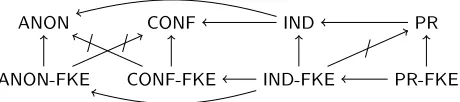
IND CONF
IND-FKE ANON
CONF-FKE ANON-FKE
PR
PR-FKE
Fig. 1.Privacy Hierarchy for Digital Signatures.
Notation:X→Y means thatX is a strictly stronger privacy notion thanY.X9Y means thatX does not imply Y.X-FKE stands forX defined with of full key exposure.
1.1 Our Results and Techniques
Privacy Hierarchy for Digital Signatures. We develop a three-level hierarchy of privacy notions for digital signatures, starting our work with the investigation of the relationship between anonymity and con-fidentiality, two previously established privacy notions for signatures. Definitions of anonymity were first given by Yang et al. [28], with later refinements by Fischlin [17]. These definitions presume messages with high entropy (unlike Bellare and Duan [2] and Saraswat and Yun [24], who regard a more restrictive form of signatures5). For confidentiality, we use the original definitions by Dent et al. [16] (in its strongest vari-ant). We show that anonymous signatures and confidential signatures are independent privacy notions6. For this reason, anonymity (ANON) andconfidentiality (CONF) are located at the lowest level of our privacy hierarchy.
At the mid-level of our hierarchy we have indistinguishability (IND), expressing that signatures can be simulated from the public parameters of the scheme. We prove that such signatures offer stronger privacy guarantees than purely anonymous and purely confidential schemes. In particular, any transmission of anIND signature simultaneously hides both the signer and the associated message. The IND property is thus a generalization of bothANONandCONFand is sufficient for obtaining privacy in anticipated applications of both schemes.INDsignatures may, however, leak some recognizable structure about the signature scheme in use.
The strongest privacy notion in our arsenal lets signatures appear to privacy adversaries as (structureless) strings of random bits, and is hence termedpseudorandom (PR). We show why this property is sufficient to hideall information about the signing process, including the signature scheme itself. The introduced privacy hierarchy with the intuitively strongest notion of pseudorandomness on top is thus likely to close the subject of privacy-preserving signatures.
Each of our privacy notions is defined in two variants, reflecting that adversaries might of might not have a copy of the signing key. That is, we also address security with full key exposure (FKE), which has been formalized for anonymous schemes by Fischlin [17] (and is also considered in [2, 24], but did not find formal treatment in the definitions of confidentiality in [16]). In our privacy hierarchy, we further distinguish between probabilistic and deterministic schemes. Within other, we show that with full key exposure, obtaining any form of privacy for deterministic schemes is hopeless.
The universe of privacy notions considered in this paper and their relationships is illustrated in Figure 1. 5
Anonymity definitions in [2, 24] assume thatσ consists of two parts — signatureσ1 and a valueσ2 (called de-anonymizerin [2] orverification tokenin [24]), both of which are needed to perform the verification. Transmission of the entireσ= (σ1, σ2), that is amenable to verification, becomes a two-stage process, withσ1(together withm) being disclosed in the first stage, andσ2 in the second stage. Anonymity of the signer is then defined with respect to an adversary that knowsσ1 but not σ2. As discussed in [2, 24], this definition essentially implies anonymity from [17, 28], allowing also low-entropy message spaces. Since we look on privacy from a more general perspective (e.g. consider confidentiality as another privacy goal), it appears more advisable to work with high-entropy messages and use conceptually simpler anonymity definitions from [17, 28].
6
Setting Example scheme INDwithFKE PRwithFKE Model RSA FDH-RSA [4] randomized hash with padding IND-to-PRcompiler ROM
DL Schnorr [25] X IND-to-PRcompiler ROM
Pairings Boneh-Boyen [5] for random`-bitm/ hash-then-sign IND-to-PRcompiler STD / ROM any unforgeable signature scheme inherited fromPRcompiler directPRcompiler STD
Table 1.Indistinguishable and Pseudorandom Signatures (Settings, Techniques, Compilers)
Constructions and Transformations. For a selection of existing signature schemes, we investigate indis-tinguishability and pseudorandomness properties and, where appropriate, propose modifications and generic transformations to achieve these goals. We build privacy-preserving signatures in three different crypto-graphic settings, namely using RSA parameters on the example of the full-domain hash RSA (FDH-RSA) scheme [4], using cyclic prime-order groups on the example of Schnorr’s scheme [25], and using pairings on the example of the Boneh-Boyen (BB) scheme [5]. These results are summarized in Table 1 and detailed in the following.
Indistinguishable Signatures. We formalize the notion ofinformation recovering signatures (as a generaliza-tion of the known concept of ‘message recovery’) and discuss its negative impact on confidentiality, and hence on indistinguishability and pseudorandomness. We show that not only known message recovering schemes (e.g. ‘text-book’ RSA and Nyberg-Rueppel [21], together with their ‘hash-then-sign’-based transformations), but also several other schemes (in different cryptographic contexts) fall under our more general notion of ‘information recovery’ and thus do not offer indistinguishability. Examples include schemes by Cramer and Shoup (CS) [15], Camenisch and Lysyanskaya (CL) [11], and Boneh, Lynn, and Shacham (BLS) [7]. That is, signatures in these schemes leak information even if they do not allow full recovery of signed messages.
We then focus on three cryptographic settings — RSA, discrete logarithms (DL), and pairings — and provide examples of indistinguishable schemes. In particular, we show that, using appropriate randomization and padding techniques, FDH-RSA becomes indistinguishable. In DL setting we prove that the (generalized) signature scheme by Schnorr [25] offers indistinguishability ‘off the shelf’, yet assuming that its cyclic group is shared among all signers. We notice that anonymity of FDH-RSA and Schnorr’s schemes was previously analyzed in [28], their confidentiality in [16]. Our analysis essentially shows that both schemes admit much stronger privacy guarantees. Finally, we prove that the pairing-based Boneh-Boyen (BB) [5] scheme is indis-tinguishable in the standard model, yet for uniformly distributed (fixed-length) messages only. As suggested in [5], the ‘hash-then-sign’ approach can be used in standard model to sign longer messages. We show that in the random oracle model this method readily offers indistinguishability for arbitrary long high-entropy messages. We note that indistinguishability of all analyzed schemes holds in the presence of full key exposure (FKE). Bottom line, we show existence of INDschemes in different cryptographic settings, paving the way towards pseudorandom signature schemes (based on different hardness assumptions).
Pseudorandom Signatures. PR signatures, which cannot be distinguished from random bit strings of the same length, offer the highest form of privacy that signatures can provide.
Our first result on PR signatures is a generic transformation that strengthensINDsignatures to obtain the PR property (we call it IND-to-PR compiler in Table 1). It uses admissible encodings, introduced in a different context by Boneh and Franklin [6] for elliptic curves, generalized later by Brier et al. [8], and also used to preserve privacy in the password-based authentication protocol by Bringer, Chabanne and Icart [9] (we thus show another interesting application of this primitive). By finding appropriate admissible encodings for different types of sets, we can immediately obtain thePR property for the IND versions of FDH-RSA, Schnorr, and BB schemes. We also prove that the obtained PR property holds in the presence of full key exposure.
or deterministic. Moreover, the PR property is guaranteed even if secret signing keys are exposed (FKE). This compiler uses randomness extractors and its techniques have been previously developed by Fischlin [17] to construct anonymous signatures. We thus prove formally that Fischlin’s anonymous signature admits a general transformation, which is strong enough to convert any unforgeable signature scheme into a scheme satisfying the strongest7privacy property. This directPRcompiler, however, is slightly less efficient than our IND-to-PRcompiler.
1.2 Related Work on Signature Privacy
Anonymity of signers assuming high-entropy messages was initially defined by Yang et al. [28], who analyzed anonymity of ‘text-book’ RSA, PSS, and Schnorr signatures, after applying some necessary modifications. Their definition was simplified by Fischlin [17] (and relaxed to full key exposure), who showed how to obtain anonymity using randomness extractors. Anonymity definitions for arbitrary messages, yet with specific restrictions on the format of disclosed signatures, were formulated independently by Bellare and Duan [2], Saraswat and Yun [24], and Zhang and Imai [29]. Using the ‘sign-then-commit’ approach, Bellare and Duan [2] gave four constructions: Their first scheme (also presented in [24]) uses commitments as black-box to produce anonymous signatures in the standard model. The second scheme uses randomized hash functions and can be applied to deterministic signature schemes. Their third solution relies on deterministic hash functions and can be used with probabilistic signature schemes. The fourth scheme from [2], termed ‘splitting construction’ follows closely the design of Schnorr signatures in the discrete logarithm setting. Saraswat and Yun [24] proved anonymity of the signature scheme by Boneh and Boyen [5]. Furthermore, both [2] and [24] formalize another requirement (called unambiguity in [2] and unpretendability in [24]) that prevents the adversary from claiming the ownership of an anonymous signature at a later stage. Note that this requirement is orthogonal to privacy and can be handled separately. The anonymous scheme by Zhang and Imai [29] uses what they call ‘collision-resistant exposure-free functions’ which are instantiated with randomized hash functions in the random oracle model. Confidentiality of signature schemes has been considered so far formally by Dent et al. [16] for messages with high entropy, inspired by the definitional treatment of confidentiality for deterministic public-key encryption [3]. They defined three flavors (weak, mezzo, and strong) with increasing strength and addressed both deterministic and probabilistic schemes (without full key exposure). Confidentiality of several schemes used in practice was analyzed as well, including those that use full-domain hash constructions (for which [16] defined confidentiality of hash functions, following earlier ideas from [12]), those obtained from Fiat-Shamir transformation, and those based on randomness extractors. Manifold solutions for obtaining privacy were also proposed with more advanced signing techniques. For example, in group signatures [14], users obtain membership certificates from the manager of a group and issue signatures that identify the signer as a valid group member without revealing its actual identity. The latter can be recovered from the signature only by the group manager. Ring signatures [23] allow the signer to form ‘ad-hoc’ groups and so hide its own identity (in an unrevocable way) from a potential verifier, who only learns that the signer belongs to the formed group. As discussed in [17], ring signatures differ substantially from anonymous signatures as, in the former, anonymity is bound to a (presumably small) group, and in the latter it is guaranteed as long as some information needed for the public verification of signatures remains secret. Anonymity notions have also been considered for other signature types, e.g. undeniable and confirmer signatures by Galbraith and Mao [18]; as discussed in [24], these notions differ from anonymity in ordinary signature schemes.
2
Previous Privacy Notions
We recall the syntax of digital signatures in Definition 1 and the notion of existential unforgeability in Definition 2. Note that all schemes used in this work are existentially unforgeable.
7
Definition 1 (Digital Signature Scheme). A digital signature scheme S = (KGen,Sign,Ver) is given by three algorithms: The key generation algorithm KGen, on input security parameter 1λ, generates a key pair (sk, pk)←KGen(1λ), the signing algorithm Sign, on input a secret key sk and a message m∈ {0,1}∗, outputs a signature σ ←Sign(sk, m), and the (deterministic) verification algorithm Ver, on input a public keypk, a messagem, and a candidate signatureσ, outputs a bitd←Ver(pk, m, σ). The schemeSiscorrect if for all λ∈N,(sk, pk)←KGen(1λ), m∈ {0,1}∗, and σ←Sign(sk, m), we have Ver(pk, m, σ) = 1. The schemeS is deterministic if every two invocations of Sign(sk,·)on the same input messagem result in the same signature σ.
Definition 2 (Existential Unforgeability). A signature scheme S is existentially unforgeable under adaptive chosen-message attacks (EUF-CMA) if all PPT adversaries A have negligible probability to out-put (m∗, σ∗) ← ASign(sk,·)(pk) (where (sk, pk) ←KGen(1λ) andSign(sk,·) is a signature oracle) such that Ver(pk, m∗, σ∗) = 1, provided thatm∗ was not queried toSign(sk,·)oracle.
We focus in the main part of this paper on privacy of probabilistic schemes in a setting with system-wide known public keys. Please refer to Appendix A for a discussion of restrictions and impossibility results on privacy fordeterministic schemes.
2.1 Anonymous Signatures
Anonymity of signatures for high-entropy messages [17, 28] hides which signer (presuming the system-wide knowledge of public keys) generated a given challenge signatureσ. Definition 3 is essentially from [17], where we also let the adversaryAchoose the challenge messagem(similar to [2]). In case of full key exposure,A receives secret keys, which obsoletes the signing oracle.
Definition 3 (Anonymous Signatures).A signature schemeSis anonymous (ANON), possibly with full key exposure (ANON-FKE), if for all PPT adversaries A= (A1,A2)the advantage function
AdvANON[-FKE]S,A (λ) := Pr
h
ExpANON[-FKE]S,A ,0(λ) = 1i−PrhExpANON[-FKE]S,A ,1(λ) = 1i
is negligible in λ, where ExpANON[-FKE]S,A ,b(λ), b ∈ {0,1}, are the anonymity experiments from Figure 2, and where the following high entropy constraint holds: The function µ(λ) = maxM∈{0,1}∗Pr[M =m:m← A1] is negligible in λ, assuming that A1 is provided with all admissible inputs and oracles as specified in the respective anonymity experiment. The minimum entropy ofA is then given by−log2µ(λ).
ExpANONS,A ,b(λ) :
(sk0, pk0)←KGen(1λ) (sk1, pk1)←KGen(1λ)
m← ASign(sk0,·),Sign(sk1,·)
1 (pk0, pk1)
σ←Sign(skb, m)
d← ASign(sk0,·),Sign(sk1,·)
2 (pk0, pk1, σ) outputd
ExpANONS,A -FKE,b(λ) :
(sk0, pk0)←KGen(1λ) (sk1, pk1)←KGen(1λ)
m← A1(sk0, pk0, sk1, pk1)
σ←Sign(skb, m)
d← A2(sk0, pk0, sk1, pk1, σ) outputd
2.2 Confidential Signatures
Confidentiality of digital signatures, formalized by Dent et al. in [16], hides information about the messagem
that was signed. Definition 4 corresponds tostrong confidentiality from [16], the strongest among the three notions (weak, mezzo, strong) proposed there.
Definition 4 (Confidential Signatures).A signature schemeSis confidential (CONF), possibly with full key exposure (CONF-FKE), if for all PPT adversariesA= (A1,A2)the following advantage function
AdvCONF[-FKE]S,A (λ) := Pr
h
ExpCONF[-FKE]S,A ,0(λ) = 1i−PrhExpCONF[-FKE]S,A ,1(λ) = 1i
is negligible inλ, whereExpCONF[-FKE]S,A ,b(λ),b∈ {0,1}, are the confidentiality experimentsfrom Figure 3, and where the following high entropy constraint holds: The function µ(λ) = maxM∈{0,1}∗Pr[M ∈m: (m, t)← A1]is negligible inλ, assumingA1 is provided with all admissible inputs and oracles as specified in the resp. confidentiality experiment. The minimum entropy ofA is then given by−log2µ(λ).
ExpCONFS,A ,b(λ) :
(sk, pk)←KGen(1λ)
(m0, t0)← A
Sign(sk,·) 1 (pk) (m1, t1)← ASign(sk,
·) 1 (pk) if|m0| 6=|m1|then output 0
σ∗←Sign(sk,mb)
t0← ASign2 (sk,·)(pk,σ∗)
ift0=t0 then output 1, else output 0
ExpCONFS,A -FKE,b(λ) : (sk, pk)←KGen(1λ)
(m0, t0)← A1(sk, pk) (m1, t1)← A1(sk, pk) if|m0| 6=|m1|then output 0
σ∗←Sign(sk,mb)
t0← A2(sk, pk,σ∗)
ift0=t0 then output 1, else output 0
Fig. 3.Confidentiality Experiments (without and with Full Key Exposure).8
Observe that, in the confidentiality experiments from Figure 3, the first-stage adversary A1 outputs a vectormof messages, each of high entropy, and an additional tokent. This token models the intuition that confidential signatures shouldn’t leak ‘any information’ about signed messages.9
2.3 Independence of ANONand CONF
Lemmas 1 and 2 separate the two notions ANON and CONF. Their independence follows then from the fact that some unforgeable schemes are neither anonymous nor confidential and that for other schemes both notions hold simultaneously (cf. Section 4).
Lemma 1 (CONF[-FKE]6⇒ANON). Confidential signature schemes (with full key exposure) are not nec-essarily anonymous.
Proof. LetS be a confidential signature scheme. We construct a confidential but not anonymous signature schemeS0 fromSas follows.
KGen0(1λ) : Output (sk, pk)←KGen(1λ). 8
Values m output by (stateless) A1 are vectors of messages in {0,1}∗ and |m|denotes the number of elements inm. Accordingly, byσ ←Sign(sk,m) we denote the process of signing the messages inm element-wise and independently of each other, resulting in a vectorσof corresponding signatures.
9
Sign0(sk, m) : σ←Sign(sk, m). Outputσ0:= (σ, pk).
Ver0(pk, m, σ0) : Parseσ0 as (σ, pk0). Return 1 iff Ver(pk, m, σ) = 1∧pk=pk0.
As the public verification key pk is extractable from a signatureσ0, S0 is not anonymous. Yet, S0 remains confidential (as theCONFadversary knowspk anyway). Clearly, the construction preserves unforgeability.
u t
Lemma 2 (ANON[-FKE]6⇒CONF). Anonymous signature schemes (with full key exposure) are not neces-sarily confidential.
Proof. LetSbe an anonymous signature scheme andlast:{0,1}∗→ {0,1}denote the function that outputs the last bit of its argument. We construct an anonymous but not confidential signature schemeS0from Sas follows.
KGen0(1λ) : Output (sk, pk)←KGen(1λ).
Sign0(sk, m) : σ←Sign(sk, m). Outputσ0:= (σ,last(m)).
Ver0(pk, m, σ0) : Parseσ0 as (σ, b). Return 1 iff Ver(pk, m, σ) = 1∧last(m) =b.
To see thatS0 is not confidential, consider the following confidentiality adversaryA= (A1,A2).A1outputs (m0, t0) (resp. (m1, t1)), where mi = (Mi) for Mi ∈R {0,1}λ, and ti =last(Mi). A2 parses σ∗ as σ∗ = ((σ, b)) and outputsb. SoAdvCONFS0,A (λ) =|Pr[Exp
CONF,0
S0,A (λ) = 1]−Pr[Exp CONF,1
S0,A (λ) = 1]|= 1−1
2 =12. To show anonymity ofS0, consider any adversaryA= (A1,A2) againstANONofS0. Flip a coinβ ∈R{0,1} and define ANON adversaryB = (B1,B2) against S as follows: On inputpk0, pk1, B1 runs A1(pk0, pk1) as a black-box and receives a message m. If last(m) = β, m is output, otherwise the simulation aborts which is modeled by letting B’s simulator output 0, i.e. Pr[ExpANONS,B ,b(λ) = 1|A] = 0 for b ∈ {0,1}. The “abort” eventAwill occur with probability 1
2. Now, on inputpk0, pk1, σ, algorithmB2appendsβ toσ, runs
d← A2(pk0, pk1,(σ, β)) and outputsd. Then
Pr[ExpANONS,B ,b(λ) = 1] = Pr[ExpSANON,B ,b(λ) = 1|¬A]·Pr[¬A] + Pr[ExpANONS,B ,b(λ) = 1|A]·Pr[A] = Pr[ExpANONS0,A ,b(λ) = 1]· 12+ 0·12
and hence AdvANONS,B (λ) = 12 ·AdvANONS0,A (λ). Thus S0 is anonymous, as the left hand side is negligible by
assumption. ut
3
Digital Signatures with Information Recovery
The following definition of ‘information recovery’, where in the verification procedure signer’s public key is used together with the signature to compute some information that is then compared to information determined by the public key and the message, generalizes the known concept of ‘message recovery’.
Definition 5 (Information Recovering Signatures). A digital signature scheme S = (KGen,Sign,Ver) is called information recovering if there exist two polynomial-time algorithms Inf and Rec such that for all (sk, pk)←KGen(1λ), m∈ {0,1}∗, and σ←Sign(sk, m), the verification algorithmVer(pk, m, σ)outputs 1 if and only if Inf(pk, m) =Rec(pk, σ).
Remark 1. Note that information recovering signature schemes with Inf(pk,·) = pk =Rec(pk,·) might be correct, but are necessarily forgeable. More precisely, if Inf(pk, m0) =Inf(pk, m1) happens with noticeable probability (for independently drawn m0, m1 ∈R {0,1}λ), an adversary A against unforgeability can be constructed by lettingArequest a signatureσ0 on a random messagem0 and output (m1, σ0), for random
3.1 Examples of Schemes with Information Recovery
Classical examples of information recovering schemes include “text-book” RSA and Nyberg-Rueppel [21], whose signatures can be used to recover messages. Observe that if the “hash-then-sign” approach is used, e.g. FDH-RSA [4], then signatures computed on hash values H(m) (rather than on messages m) are still information recovering, even ifH is modeled as a random oracle, i.e. the corresponding algorithmInf(pk, m) would simply outputH(m). This property can also be found amongst signature schemes that are not message recovering or where messages need not be hashed to compute (unforgeable) signatures, as shown in the following.
Cramer-Shoup (CS) [15]. The Strong RSA-based CS scheme outputs signatures of the form σ = (e, s, σ01, σ20) and its verification algorithm checks whether e is an odd integer of certain length, followed by two checks of the form σ10e≡thH(s)modN andσ02e˜≡shmmodN with ˜e, t, h, andN being part of the public key pk. These equation can be rewritten to Inf(pk, m) =Rec(pk, σ) usingInf(pk, m) that outputs a pair (t, hmmodN) and Rec(pk, σ) returning a pair (σ10e·h−H(s), σ20e˜·s−1modN) after verifying the appro-priate form for e. The equality of the outputs of Inf and Reccan then be tested component-wise to verify the signature.
Camenisch-Lysyanskaya (CL) [11]. The Strong RSA-based CL scheme outputs signatures of the form
σ= (e, s, σ0) and its verification algorithm checks ifeis in the appropriate range andσ0e≡ambscmodNwith
a,b,c, andNbeing part of the public keypk. By rewriting the verification equation toam≡σ0e/(bsc) modN we can define algorithmInf(pk, m) to outputammodN andRec(pk, σ) to outputσ0e·(bsc)−1modN ifeis in the appropriate range.
Boneh-Lynn-Shacham (BLS) [7]. The pairing-based BLS scheme, which can be initialized for example in cyclic groupsG=hgiof prime orderqwith a suitable bilinear mape:G×G7→GT, outputs signatures of the formσ=H(m)xwhereH:Z∗q 7→Gis a random oracle andxis a secret key. Its verification equation
e(H(m), y) =e(σ, g) withg,y belonging topk, immediately definesInf(pk, m) andRec(pk, σ).
3.2 Information Recovery Limits Privacy
The property of information recovery of a scheme can be immediately used to break the scheme’s confi-dentiality by including information derived via algorithm Inf from messages in m into t, as shown in the following lemma.
Lemma 3. There is no unforgeable information recovering signature scheme that provides confidentiality.
Proof. Let S = (KGen,Sign,Ver) be an information recovering signature scheme. Consider the following adversary A = (A1,A2) against confidentiality of S: A1 on input pk picks a random λ-bit message m, computest←Inf(pk, m), and outputs (m, t).A2 on input (pk, σ∗) outputst0←Rec(pk, σ∗). In this setting, we observe that correctness of S and the construction ofVer from Inf and Rec implies Pr[ExpCONFS,A ,0(λ) = 1] = 1. We now considerExpCONFS,A ,1(λ), where we useσ1to denote the challenge signatureσ∗←Sign(sk, m1). Note that by construction ofA2 we havet0 =Rec(pk, σ1). We see that
Pr[ExpCONFS,A ,1(λ) = 1] = Pr[t0=t0] = Pr[Rec(pk, σ1) =Inf(pk, m0)] = Pr[Inf(pk, m1) =Inf(pk, m0)],
4
Indistinguishable Signatures
The independence of the notions of anonymity and confidentiality of digital signature schemes places these concepts at the bottom level of our privacy hierarchy and puts forward the question on the existence of a more general privacy property that implies both of them. We call this property indistinguishability and formalize it in Definition 6. We use a simulation-based approach, following the intuition that anonymity and confidentiality are implied if all information that can be extracted from a real signature can also be extracted from a ‘signature’ that wassimulated without knowledge of keys and messages.10
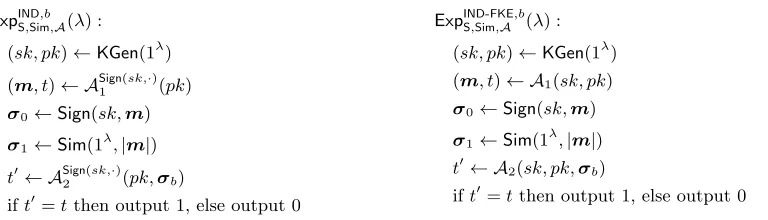
Definition 6 (Indistinguishable Signatures).A signature schemeSis indistinguishable (IND), possibly with full key exposure (IND-FKE), if there exists a PPT simulator Sim such that for all PPT adversaries A= (A1,A2)the following advantage function
AdvIND[-FKE]S,Sim,A (λ) := Pr
h
ExpIND[-FKE]S,Sim,A ,0(λ) = 1i−PrhExpIND[-FKE]S,Sim,A ,1(λ) = 1i
is negligible inλ, whereExpIND[-FKE]S,Sim,A ,b(λ),b∈ {0,1}, are theindistinguishability experiments from Figure 4, and where the following high entropy constraint holds: The function µ(λ) = maxM∈{0,1}∗Pr[M ∈ m : (m, t)← A1] is negligible inλ, assuming A1 is provided with all admissible inputs and oracles as specified in the resp. indistinguishability experiment. The minimum entropy ofA is given by−log2µ(λ).
ExpINDS,Sim,b,A(λ) :
(sk, pk)←KGen(1λ)
(m, t)← ASign1 (sk,·)(pk)
σ0←Sign(sk,m)
σ1←Sim(1λ,|m|)
t0← ASign2 (sk,·)(pk,σb)
ift0=tthen output 1, else output 0
ExpINDS,Sim-FKE,A,b(λ) :
(sk, pk)←KGen(1λ)
(m, t)← A1(sk, pk)
σ0←Sign(sk,m)
σ1←Sim(1λ,|m|)
t0← A2(sk, pk,σb)
ift0=tthen output 1, else output 0
Fig. 4.Indistinguishability Experiments (without and with Full Key Exposure).
Lemmas 4 and 5 confirm the intuition that indistinguishable signatures are also anonymous and confi-dential (even in presence of full key exposure).
Lemma 4 (IND⇒ANON, IND-FKE⇒ANON-FKE). Every indistinguishable signature scheme is anony-mous. The same implication holds in presence of full key exposure.
Proof. LetSbe an indistinguishable signature scheme with simulatorSim. For anANON-adversaryAconsider experimentExp∗S,Sim,A(λ), which is likeExpSANON,A ,0(λ), except that challenge signatureσis computed asσ← Sim(1λ,1). ConstructIND-adversaryBby generating random (sk0, pk0)←KGen(1λ) and definingB1 andB2 as follows:B1, on inputpkand having oracle access toSign(sk,·), runsm← A
Sign(sk,·),Sign(sk0,·)
1 (pk, pk0) as a
black-box, relaying oracle queries toSign(sk,·), and answering Sign(sk0,·) queries itself. After receiving m, B1 outputs (m, t) = ((m),1) and stops.B2, on input pk and challenge signatureσ = (σ), feedsσinto A2 10
(together withpk andpk0). Valuedoutput byA2 is used as return valuet0 ofB2. Careful inspection results in Pr
ExpANONS,A ,0(λ) = 1 −Pr
Exp∗S,Sim,A(λ) = 1 =
Pr
ExpINDS,Sim,0,B(λ) = 1 −Pr
ExpINDS,Sim,1,B(λ) = 1
=AdvINDS,Sim,B(λ).
EqualityPr[ExpANONS,A ,1(λ) = 1]−Pr[Exp∗S,Sim,A(λ) = 1] =Adv
IND
S,Sim,B(λ) can be shown similarly (by swapping
pk and pk0 in the construction of B). All in all we have shown AdvSANON,A (λ) ≤ 2·Adv IND
S,Sim,B(λ), which is negligible by assumption. The implicationIND-FKE⇒ANON-FKEis shown analogously. ut
Lemma 5 (IND⇒CONF,IND-FKE⇒CONF-FKE). Every indistinguishable signature scheme is confiden-tial. The same implication holds in presence of full key exposure.
Proof. Let S be an indistinguishable signature scheme with simulator Sim. For a CONF-adversary A con-sider experimentExp∗S,Sim,A(λ), which is likeExpSCONF,A ,0(λ), except challenge signaturesσ∗ are computed as σ∗ ← Sim(1λ,|m0|). Construct IND-adversary B defining B1,B2 as follows: B1, on input pk and with or-acle Sign(sk,·), runs A1Sign(sk,·),Sign(sk0,·)(pk) twice as a black-box, relaying oracle queries to Sign(sk,·) and answering Sign(sk0,·) queries itself, to obtain (m0, t0) and (m1, t1), respectively. Algorithm B1 aborts if |m0| 6=|m1|. Else it outputs (m0, t0) and stops.B2, on inputpk and challenge signaturesσ, feedsσintoA2 (together withpk). Valuet0 output byA2 is used as return valuet0 ofB2. Now we have
Pr
ExpCONFS,A ,0(λ) = 1−PrExp∗S,Sim,A(λ) = 1 = Pr
ExpINDS,Sim,0,B(λ) = 1−PrExpINDS,Sim,1,B(λ) = 1
=AdvINDS,Sim,B(λ).
EqualityPr[ExpCONFS,A ,1(λ) = 1]−Pr[Exp∗S,Sim,A(λ) = 1]=Adv IND
S,Sim,B(λ) can be shown similarly (by lettingB1 output (m1, t1) instead of (m0, t0)). All in all we have shown AdvCONFS,A (λ) ≤ 2·Adv
IND
S,Sim,B(λ), which is negligible by assumption. The implicationIND-FKE⇒CONF-FKEis shown analogously. ut
4.1 Techniques and Examples
We now exemplifyINDconstructions using three known signature schemes: FDH-RSA [4], Schnorr [25], and Boneh-Boyen [5]. That is, we show that indistinguishable schemes can be obtained in different cryptographic setting, i.e. RSA, discrete logarithms (DL), and pairings. We notice that our techniques can be applied to many existing schemes that either fulfill this privacy notion directly or can be slightly modified to become indistinguishable.
RSA-based Construction. On the example of FDH-RSA [4], which is neither confidential nor anonymous, we demonstrate two techniques to obtain indistinguishability. First, we apply arandomized hash [2], where a message m is hashed together with some randomness r, which is chosen within the signing procedure. The hash value H(m, r) is then used in the signing algorithm (instead of m), and r is appended to the resulting signature. This method eliminates information recovery since the output ofInf(pk, m) depends now onH(m, r) (and not only on m), and the probability that the first stageINDadversary learns information about H(m, r) is negligible (given that r is sufficiently long and chosen in the challenge phase). We can then applypadding to hide the length of signature components that are elements ofZN, and by this protect anonymity [28]. These methods turn out to be sufficient for the indistinguishability of the scheme.
FDH-RSA.KGen(1λ) : Let (N, e, d)←GenRSA(1λ),pk:= (N, e), andsk:=d. Output (sk, pk). FDH-RSA.Sign(sk, m) : Choose r ∈R {0,1}λ and k ∈R [0,bZ
λ/Nc −1]. Let σ0 := HN(mkr)dmodN. Outputσ:= (σ0+kN, r).
FDH-RSA.Ver(pk, m, σ) : Parseσas (σ0, r). Leth0←HN(mkr) andh:= (σ0)emodN. Outputh=h0. Observe that on each signatureσ0a probabilistic padding is applied, computingk∈R[0,bZλ/Nc−1], σ:=
σ0+kN, which can be reversed by computing σ0 :=σmodN. It maps uniformly distributed integers from [0, N−1] to (nearly) uniformly distributed integers in [0, Zλ−1] (cf. Lemma 13).
Lemma 6. The probabilistic FDH-RSA scheme with padding is indistinguishable with full key exposure, in the random oracle model.
Proof. We will consider the simulator Sim that, on input security parameter 1λ and message number `, outputs a vector of` integers in [0, Zλ−1], drawn uniformly at random. Let A= (A1,A2) be any indistin-guishability adversary against the modified FDH-RSA scheme. Consider experiments ExpINDFDH-RSA,0,j ,Sim,A(λ), similar to ExpINDFDH-RSA,0 ,Sim,A(λ), except that the first j signatures in σ∗ are simulated using Sim(1λ, j), i.e. ExpFDH-RSAIND,0 ,Sim,A(λ) =ExpFDH-RSAIND,0,0 ,Sim,A(λ) andExpINDFDH-RSA,1 ,Sim,A(λ) =ExpFDH-RSAIND,0,` ,Sim,A(λ) for some` polyno-mially bounded byλ. It will suffice to prove that
Pr
h
ExpINDFDH-RSA,0,j ,Sim,A(λ) = 1i−PrhExpINDFDH-RSA,0,j+1,Sim,A(λ) = 1i
is negligible for allj.
LetExpbe the experiment which is likeExpFDH-RSAIND,0,j ,Sim,A(λ) except that, in the generation of the (j+ 1)th signature ofσ∗, we replace the output of hash functionHN by a valueh∈RZN, picked uniformly at random (or, equivalently, we use the valuehd, forh∈R
ZN). By the Random Oracle Model, this change can only be detected by adversaries that correctly guess both: messagem and randomizerr. But this will happen only with negligible probability, sinceA1 would have to guessr∈ {0,1}λ, andA2 would have to guessm, which has large entropy. Consider now the hop to experimentExpINDFDH-RSA,0,j+1,Sim,A(λ), which is exactly likeExp, except that the returned (j+ 1)th ‘signature’ is not computed via the padding, i.e. σ= (h+kN, r), but instead viaσ= (h0, r), whereh0∈R[0, Z
λ−1]. We will show in Lemma 13 (1) that this introduces only a negligible statistical difference between the output distributions ofExpand ExpFDH-RSAIND,0,j+1,Sim,A(λ). ut
DL and Pairing-Based Constructions. We now move to the DL and pairing-based settings and focus on the signature schemes by Schnorr [25] and by Boneh and Boyen [5], respectively.
Schnorr Signature Scheme. LetG=hgibe a cyclic group of prime orderq, where|q|=λ, andH :{0,1}∗→
Zq be a hash function modeled as random oracle. Schnorr’s signature scheme is specified as follows. SCH.KGen(1λ) : Choosex∈RZq. Output (sk, pk) := (x, gx).
SCH.Sign(sk, m) : Chooser∈RZq. Letc←H(grkm) ands:=sk·c+rmodq. Outputσ:= (c, s). SCH.Ver(pk, m, σ) : Parseσas (c, s). Computec0←H(pk−c·gskm). Outputc=c0.
In the indistinguishability analysis (akin to prior work on anonymity and confidentiality of the scheme [16,28]) we assume that all signers use the same groupG.
Lemma 7. The (generalized) Schnorr signature scheme is indistinguishable with full key exposure, in the random oracle model.
Proof. Consider the following simulator Sim: On input security parameter 1λ and message number `, Sim independently samples ` random pairs (c01, s01), . . . ,(c0`, s`0)∈R Zq×Zq and outputsσ∗ = (σi)1≤i≤`, where
are simulated usingSim(1λ, j), i.e.ExpINDSCH,,0Sim,A(λ) =ExpINDSCH,,0Sim,0,A(λ) andExpINDSCH,,1Sim,A(λ) =ExpINDSCH,,0Sim,`,A(λ) for some` polynomially bounded byλ. It suffices to prove that, for allj,
Pr
h
ExpINDSCH,,0Sim,j ,A(λ) = 1i− PrhExpINDSCH,,0Sim,j+1,A(λ) = 1i
is negligible.
Denote byExpthe experiment which is likeExpSCHIND,,0Sim,j ,A(λ) except that, in the generation of the (j+ 1)th signature ofσ∗, we replace the output of hash functionH by a valuec0∈RZq, picked uniformly at random. By the Random Oracle Model, this change can only be detected by adversaries that correctly guess both: group element gr and message m. This will happen only with negligible probability, since A
1 would have to guess gr (with success probability 1
q ≈ 2
−λ), and A
2 would have to guessm, which has large entropy. Note that c is now independent of r, i.e., in the calculation of s :=sk·c+r, variable r acts like a one-time pad onsk·c. It follows that also s can be replaced by a uniformly random value s0 ∈R Zq, without A noticing it. We have just shown that |Pr[ExpINDSCH,,0Sim,j ,A(λ) = 1]−Pr[Exp = 1]| is negligible, and that |Pr[Exp= 1]−Pr[ExpINDSCH,,0Sim,j+1,A(λ) = 1]|= 0. This concludes the proof. ut Boneh-Boyen Signature Scheme. The signature scheme by Boneh and Boyen [5] based on pairings works over cyclic groupsG1, G2, GT of prime orderq(with|q|=λ) for which an efficient bilinear mape:G1×G2→GT is known. Letg1andg2be generators of G1 andG2, respectively. The scheme is specified for message space
Zq as follows.
BB.KGen(1λ) : Choosex, y∈RZq\ {0}. Letsk:= (x, y) andpk:= (u, v) = (g2x, g y
2). Output (sk, pk). BB.Sign(sk, m) : Chooser∈RZq\ {−x+ym}. Letσ0:=g
1/(x+m+yr)
1 . Outputσ:= (σ0, r). BB.Ver(pk, m, σ) : Parseσas (σ0, r). Outpute(σ, ug2mvr) =e(g1, g2).
Lemma 8. The “hash-then-sign” version of the signature scheme by Boneh and Boyen is indistinguishable with full key exposure, in the random oracle model.
We first prove that this construction is indistinguishable (in the standard model), yet for uniform message distributions only, and then generalize this result to arbitrary distributions in{0,1}∗ (in the random oracle model).
Lemma 9. Signature scheme BB is (perfectly) indistinguishable with respect to full key exposure, for uni-formly distributed messages.
Proof. Consider the following simulatorSim: On input security parameter 1λand message number`,Sim in-dependently samples`random pairs (σ0, r)∈R(G1\ {1})×Zq. LetA= (A1,A2) be any indistinguishability adversary against theBBsignature scheme such thatA1outputs uniformly distributed messages inZq. De-note byExpINDBB,,Sim0,j,A(λ) the experiment that is likeExpBBIND,,Sim0 ,A(λ), except that the firstjsignatures inσ∗are simulated usingSim(1λ, j), i.e.ExpIND,0
BB,Sim,A(λ) =Exp IND,0,0
BB,Sim,A(λ) and finallyExp IND,1
BB,Sim,A(λ) =Exp IND,0,` BB,Sim,A(λ) for some` polynomially bounded byλ.
Note that in BB.Sign the mapping r 7→ σ0 =g11/(x+m+yr) is one-to-one between domainZq \ {−x+ym} and range G1\ {1}. Basically, this is due to the fact that Zq is a finite field, in which all elements but zero can be multiplicatively inverted. It follows that, if r is picked uniformly at random from the given domain, thenracts like a one-time pad onmand makesσ0 uniformly distributed, inA1’s eyes. The analog holds forA2: This time, it is uniformly distributed message mthat makesσ0 look uniform. This shows that Pr[ExpINDBB,Sim,0,j,A(λ) = 1] = Pr[ExpINDBB,Sim,0,j,A+1(λ) = 1] for allj, and hence concludes the proof. ut In general, digital signature schemes are expected to support arbitrary message spaces, i.e. messages
m ∈ {0,1}∗. As pointed out by Boneh and Boyen [5], their scheme can be converted into an unforgeable signature scheme for arbitrary long messages by using the “hash-then-sign” approach, for a suitable hash functionH:{0,1}∗→
Zq. Such ‘hybrid’ version ofBBcan still be proven unforgeable in the standard model, as the only condition posed onH is that of collision-resistance. If, on the other hand, the hash functionH
5
Pseudorandom Signatures
Although indistinguishability is already a strong privacy notion it still has one important limitation: The simulatorSimused to define theINDproperty depends on the signature schemeS; in particular, it simulates signatures using public parameters ofS. Although both the signer and the message are successfully hidden in INDsignatures, the very scheme that was used to create a given signature might not be, e.g.INDsignatures may have characteristic lengths or follow specific formats, like element representation of the components of Schnorr signatures, and so on. In practice, usage of some S in an application or network protocol can be prescribed via standards. However, instantiations with concrete parameters (e.g. prime modulus pin a Schnorr groupG⊆Z×
p) is often left unspecified. Different parameter choices may introduce a unique pattern that can be (mis)used to distinguish among the signing algorithms and by this obtain more information about signers and about the context in which the signatures were produced.
We address this limitation in Definition 7 with the property ofpseudorandomness, where we require that signatures output byS are indistinguishable from randomly chosen binary strings of lengthL(λ) =LS(λ). This simpler definition is sufficient to obtain pseudorandom signatures of some fixed lengthL∗, viewed as a global upper bound on the individual lengthsLS(λ) for all signature schemesSin the system, using a simple padding with random bits. That is, all signatures in the system would be L∗ bits long and look completely random, no matter how they were produced. It would hence become impossible, for some given signatureσ
to derive any information about the scheme S that was used to generate it. This seems to be the highest level of privacy that can be offered by a signature scheme.
Definition 7 (Pseudorandom Signatures).A signature schemeSis pseudorandom (PR), possibly with full key exposure (PR-FKE), if there is a polynomially bounded functionL(λ)such that for all PPT adversaries A= (A1,A2)the advantage function
AdvPR[-FKE]S,A (λ) := Pr
h
ExpPR[-FKE]S,A ,0(λ) = 1i−PrhExpPR[-FKE]S,A ,1(λ) = 1i
is negligible in λ, where ExpPR[-FKE]S,A ,b(λ), b∈ {0,1}, are the pseudorandomness experiments from Figure 5, and where the following high entropy constraint holds: The function µ(λ) = maxM∈{0,1}∗Pr[M ∈ m : (m, t)← A1]is negligible inλ, assuming thatA1is provided with all admissible inputs and oracles as specified in the respective pseudorandomness experiment. The minimum entropyof Ais then given by −log2µ(λ).
ExpPRS,A,b(λ) :
(sk, pk)←KGen(1λ)
(m, t)← ASign1 (sk,·)(pk)
σ0←Sign(sk,m)
σ1∈R{0,1}L(λ)×|m| t0← ASign2 (sk,·)(pk,σb)
ift0=tthen output 1, else output 0
ExpPRS,A-FKE,b(λ) :
(sk, pk)←KGen(1λ)
(m, t)← A1(sk, pk)
σ0←Sign(sk,m)
σ1∈R{0,1}L(λ)
×|m|
t0← A2(sk, pk,σb)
ift0=tthen output 1, else output 0
Fig. 5.Pseudorandomness Experiments (without and with Full Key Exposure).11
Pseudorandomness is as a special case of indistinguishability, where simulatorSimdraws at random from {0,1}L(λ). However,PRis strictly stronger thanIND, i.e. Lemmas 10 and 11 settle thePRnotion at the top of the privacy hierarchy:
11We denote byσ ∈
R {0,1}L×|m| the process of picking|m| strings independently at random from {0,1}L. We
Lemma 10 (PR⇒IND,PR-FKE⇒IND-FKE). Every pseudorandom signature scheme is indistinguishable. The same implication holds with full key exposure.
Proof. The lemma follows directly from Definitions 6 and 7 by choosing the simulator Sim that draws signatures at random from{0,1}L(λ)in the indistinguishability experiment.
Lemma 11 (IND[-FKE]6⇒PR). Indistinguishable signature schemes (with full key exposure) are not nec-essarily pseudorandom.
Proof. LetSbe an indistinguishable signature scheme, with simulatorSim. We construct an indistinguishable but not pseudorandom signature schemeS0 from Sas follows.
KGen0(1λ) : Output (sk, pk)←KGen(1λ). Sign0(sk, m) : σ←Sign(sk, m). Outputσ0:=σk1.
Ver0(pk, m, σ0) : Parseσ0 as σkb. Return 1 iff Ver(pk, m, σ) = 1∧b= 1.
SchemeS0is not pseudorandom: DefineA1to pick single random messagesm∈R{0,1}λ, and output (m,1), wherem= (m). LetA2, on inputσ= (σ), output the last bit ofσ. We computeA’s advantage as follows:
AdvPRS0,A(λ) = Pr
h
ExpPRS0,A,0(λ) = 1 i
−PrhExpPRS0,A,1(λ) = 1 i
=
1−1
2 =12.
However,S0is still indistinguishable: An appropriate simulatorSim0(1λ) is given bySim(1λ)k1. It is straight-forward to show that any successful indistinguishability adversary for S0 can be turned into a successful
adversary againstS. ut
5.1 Two Pseudorandomness Compilers
We present two compilers for pseudorandomness of digital signatures. Our first compiler assumes that the underlying scheme is indistinguishable (with some additional constraints), while our second compiler offers pseudorandomness for arbitrary (unforgeable) signature schemes. Both transformations workwithoutrandom oracles.
IND-to-PR Compiler: From Indistinguishability to Pseudorandomness. OurIND-to-PR compiler converts any indistinguishable signature scheme into a pseudorandom one. This is done by considering the different elements that form the signature component-wise (e.g., in case of Schnorr signatures, the elements
c ∈ Zq and s∈ Zq), and encoding them as binary strings via appropriate admissible encodings. Resulting strings are concatenated to obtain the pseudorandom signature. The concept of admissible encodings was created for the main purpose of hashing into elliptic curves in the IBE scheme of Boneh and Franklin [6]. Their definition was later generalized to arbitrary sets by Brier et al. [8], and used recently in the construction of a privacy-preserving authentication protocol by Bringer, Chabanne and Icart [9].
Definition 8 (Admissible Encoding [8]).LetS,Rdenote finite sets with|S|>|R|. A functionF :S→
R is called -admissible encodingfor(S, R)if it satisfies the following properties: 1. Computable:F is computable in deterministic polynomial time.
2. Invertible: There exists a PPT algorithm IF such thatIF(r)∈F−1(r)∪ {⊥} for all r∈ R, and for r uniformly distributed in R the distribution of IF(r)is -statistically indistinguishable from the uniform distribution in S.
If is a negligible function of the security parameter then F is called an admissible encoding.
Lemma 12 (Aggregation of Admissible Encodings).LetS =S1×. . .×SnandR=R1×. . .×Rndenote Cartesian products of finite sets. For each 1 ≤ i ≤n, let Fi : Si → Ri denote an i-admissible encoding. ThenF :S → R; (s1, . . . , sn)7→(F1(s1), . . . , Fn(sn))is an -admissible encoding, for=P
n
i=1i. ut
In our compiler, we will use admissible encodingsF :S→R, whereS={0,1}L(λ)andRis the ‘signature space’ of the scheme. Note that w. l. o. g. it would even suffice to have S ={0,1}` for ` < L(λ) as we can always pad12withL(λ)−`random bits at the end inIF, and ignore the lastL(λ)−`bits when evaluating
F. Thus, ifσis indistinguishable thenσ0 :=IF(σ)∈ {0,1}L(λ)is pseudorandom. This admissible encoding-based compiler works as follows, where the input signature schemeSis assumed to be indistinguishable with a regular simulator and (F,IF) denotes an appropriate admissible encoding that maps strings in{0,1}L(λ) into the signature space.
AEC.KGen(1λ) : Output (sk, pk)←S.KGen(1λ).
AEC.Sign(sk, m) : Letσ←S.Sign(sk, m). Outputσ0← IF(σ). AEC.Ver(pk, m, σ0) : Letσ←F(σ0). OutputS.Ver(pk, m, σ).
The pseudorandomness of the resulting scheme AEC is proven in Theorem 1. This proof requires the following notion ofregular simulators that can be found in our proofs ofINDsignature schemes from Section 4.1 and exist for many other schemes.
Definition 9 (Regular Simulators).A simulatorSimin the indistinguishability experiment (cf. Figure 4) is called regularif it samples uniformly at random from the ‘signature space’S(λ), i.e. the range of theSign algorithm. That is, for regular simulators Sim, runningσ∗←Sim(1λ, `) andσ∗∈
RS(λ)` are identical.
Theorem 1. If S is an indistinguishable signature scheme with a regular simulator Sim and F is an -admissible encoding that maps {0,1}L(λ) into the signature space ofS then the AEC signature scheme, ob-tained viaIND-to-PRcompiler, is pseudorandom.
Proof. Let A = (A1,A2) be any pseudorandomness adversary against AEC signature scheme. Denote by Expthe experiment that is likeExpPRAEC,0,A(λ), except that the signatures inσ∗ are not computed individually as σ :=IF(S.Sign(sk, m)), but as σ∗ :=IF(Sim(1λ,|m|)), whereIF is executed component-wise. As S is indistinguishable by assumption, we know that
Pr h
ExpPRAEC,0,A(λ) = 1i−Pr [Exp= 1]
is negligible. Consider now experiment Expj, which is like Exp except that the first j values in σ∗ are randomly picked strings in {0,1}L(λ), i.e. Exp = Exp0
and ExpPRAEC,1,A(λ) = Exp` for some ` polynomially bounded by λ. As Sim is regular, the distribution ofIF(Sim(1λ,1)) is -close to the uniform distribution over {0,1}L(λ). That is, we proved thatPr
Expj= 1 − Pr
Expj+1= 1
≤is negligible for allj. All in all, we showedAdvPRAEC,A(λ) =
Pr
h
ExpPRAEC,0,A(λ) = 1i −PrhExpPRAEC,1,A(λ) = 1i
is negligible. Note thatAECpreserves the unforgeability of
schemeS. ut
As shown above, general transformation of indistinguishable signatures into pseudorandom becomes straightforward — once appropriate admissible encodings are identified. If signatures are formed by tu-ples of elements of certain sets then by the aggregation lemma it will suffice to identify encodings for these particular sets. Lemma 13 shows existence of admissible encodings for a variety of algebraic sets that are often used in practical cryptography, including sets behind the indistinguishable versions of FDH-RSA, Schnorr, and Boneh-Boyen schemes from Section 4.1.
Lemma 13 (Sets with Admissible Encodings). For the following sets R there exist polynomials`(λ) and admissible encodingsF :{0,1}`(λ)→R:
(1) Ranges R={0, . . . , N−1}=ZN of natural numbers, for arbitraryN ∈N.
12 Such pad/ignore steps can also be seen as the aggregation of F with the canonical admissible encoding for
{0,1}L(λ)−`→ {
0,1}0
(where{0,1}0
(2) The set of quadratic residues modulo safe primesp, i.e.R=QR(p)⊆Z×p. (3) Arbitrary subgroupsGq ⊆Z×p of prime orderq.
(4) The setR=E(F) of rational points on (certain) elliptic curves, defined over a finite field.
Proof. The set{0,1}`(λ) can be canonically identified withT`(λ):=
Z2`(λ). It will hence, for all considered setsR, suffice to indicate admissible encodingsT`(λ)→R.
(1) Let N ∈Nbe a natural number, and λ=|N|its length. Consider polynomial `(λ) = 2λ, function
F: T`(λ) →
ZN;a 7→ amodN, and the probabilistic mappingIF: ZN → T`(λ); b 7→ b+kN for random
k ∈R [0,b2`(λ)/Nc −1]. It is easy to see that IF invertsF. According to [26, Section 8.8], the statistical distance between IF(r) forr ∈R ZN and the uniform distribution in T`(λ)is bounded by < N/2`(λ)≈ 2λ/22λ= 2−λ, and hence negligible.
(2) and (3) Let p = αq + 1 with primes p, q such that gcd(α, q) = 1 and |p| = λ (if α = 2 we have the safe prime setting). Let g be a generator ofG = Z×
p. Consider the probabilistic IF:Gq → Z×p; a 7→ (gq)raα−1modqmodpfor r∈R Zα together with its inversionF:Z×p →Gq; b 7→bαmodp. Asgq and also (gq)r have orderα, it is easy to see thatF perfectly ‘inverts’IF. The encoding is 0-admissible as for every
h ∈ G we have h = gt = (gq)x(gα)y for some t, x, y (by CRT or Euclid), i.e. every element in G is the (unique) product of the power of an order-αand the power of an order-qelement. In above construction, the role of the former is taken by (gq)r, while element aα−1 ∈Gq corresponds to the latter. This encoding can be composed with (1) forN =pto obtain the desiredF:{0,1}`(λ)→R.
(4) We refer to Brier et al. [8] for an overview of (pairing-friendly) curves with suitable admissible
encodings. ut
DirectPR Compiler. ThePRcompiler introduced below outputs pseudorandom signatures (with full key exposure) for any signature scheme S; underlying techniques were proposed in [17] for building anonymous signatures. Its main building block is a pair of associated randomness extractor E and hash function H. Here, we only recall the properties of such a pair (E, H) and refer to [17] for a rigorous treatment. Basically, a randomized hash function H takes a message m and some randomnessr ∈R {0,1}t(λ) and outputsh=
H(m;r). H is calledcollision-intractable if it is difficult to findm6=m0 andr∈ {0,1}t(λ) withH(m;r) =
H(m0, r), for the same randomnessr. The task of the randomness extractorEis to distill uniformly distributed strings of fixed length from inputs x ← X whose distribution is unknown but where a certain minimum level of entropy is assumed. As auxiliary input, E gets a uniformly distributed randomnessu∈ {0,1}d(λ). The extracted value is denoted by E(m;u). A pair (E, H) is called pseudorandom if tuples (r, y, u, e) and (r, y, u, v) are computationally indistinguishable, where r∈R {0,1}t(λ), y ←H(x;r), u∈R {0,1}d(λ), e← E(x;u), and v ∈R {0,1}|e|, for x ← X. Fischlin [17] offers an efficient instantiation for such primitive in the standard model13. Our analysis shows that this primitive gives rise to the following compiler for pseudorandom signatures, which are also indistinguishable and confidential (by Lemmas 10 and 5). We notice that this compiler results in somewhat less efficient schemes as opposed to our IND-to-PR compiler (e.g. when used with ourINDexamples).
DPRC.KGen(1λ) : Output (sk, pk)←S.KGen(1λ).
DPRC.Sign(sk, m) : Chooser∈R{0,1}t(λ)andu∈R{0,1}d(λ). Leth←H(m;r) andσ←S.Sign(sk, h). Computeτ:=σ⊕ E(m;u) and outputσ0:=τkrku.
DPRC.Ver(pk, m, σ0) : Parse σ0 as σ0 = τ k r k u. Let σ := τ ⊕ E(m;u) and h ← H(m;r). Output S.Ver(pk, h, σ).
Theorem 2. If(E, H)is a pseudorandom pair of an associated randomness extractorE and a hash function
H then for any signature schemeS the DPRCsignature scheme, obtained using our direct PR compiler, is pseudorandom with respect to full key exposure (in the standard model).
Proof (Sketch).Anonymity of DPRCis shown in [17] by presenting a game-hopping proof that, in the first hop, modifiesANON game such that challenge signatureσ∗ is computed as specified inDPRC, except that
τ is replaced byτ :=σ⊕vfor randomv∈R{0,1}|E(m;u)|. Asv acts as a one-time pad onσ, componentτ is uniformly distributed in{0,1}|σ|. Obviously, the concatenationσ0=τkrkuis uniformly distributed as well, in{0,1}|σ|+t(λ)+d(λ). This shows pseudorandomness ofDPRC. Note that the transformed scheme inherits its unforgeability fromS under standard assumptions as proven in [17]. ut
6
Conclusion
In this paper we gave a detailed account on the privacy hierarchy for ordinary signature schemes, taking into account earlier definitions of anonymity and confidentiality in the setting of high-entropic message spaces and system-wide known public keys. Our major result are pseudorandom signatures that cannot be distinguished from random strings and thus hide the entire information about message, signer, and signing algorithm. To obtain such fully private signatures we gave two compilers: the more efficient one adds pseudorandomness to indistinguishable signature schemes and we have shown that such schemes exist in different cryptographic settings; our second compiler, based on Fischlin’s work [17], adds pseudorandomness to any unforgeable signature scheme but is less efficient (though in the standard model). In summary, with our hierarchy of privacy notions and generic transformations we showed how to efficiently achieve an ultimate form of privacy for arbitrary signature schemes, both in the random oracle and the standard model.
Acknowledgments.
The majority of work on this paper was performed while all its authors were in the Cryptographic Protocols Group at TU Darmstadt. This research was supported by the German Science Foundation (DFG) through the project PRIMAKE (MA 4957).
References
1. M. Bellare, A. Boldyreva, A. Desai, and D. Pointcheval. Key-Privacy in Public-Key Encryption. InASIACRYPT 2001,LNCS2248, pp. 566–582. 2001.
2. M. Bellare and S. Duan. Partial Signatures and their Applications. Cryptology ePrint Archive, Report 2009/336, 2009. http://eprint.iacr.org/2009/336.
3. M. Bellare, M. Fischlin, A. O’Neill, and T. Ristenpart. Deterministic Encryption: Definitional Equivalences and Constructions without Random Oracles. InCRYPTO 2008,LNCS5157, pp. 360–378. 2008.
4. M. Bellare and P. Rogaway. Random Oracles are Practical: A Paradigm for Designing Efficient Protocols. In CCS 1993, pp. 62–73. 1993.
5. D. Boneh and X. Boyen. Short Signatures Without Random Oracles and the SDH Assumption in Bilinear Groups. J. of Cryptology, 21(2):149–177, 2008.
6. D. Boneh and M. Franklin. Identity-Based Encryption from the Weil Pairing. InCRYPTO 2001,LNCS2139, pp. 213–229. 2001.
7. D. Boneh, B. Lynn, and H. Shacham. Short Signatures From the Weil Pairing. J. of Cryptology, 17(4):297–319, 2004.
8. E. Brier, J.-S. Coron, T. Icart, D. Madore, H. Randriam, and M. Tibouchi. Efficient Indifferentiable Hashing into Ordinary Elliptic Curves. InCRYPTO 2010,LNCS6223, pp. 237–254. 2010.
9. J. Bringer, H. Chabanne, and T. Icart. Password Based Key Exchange Protocols on Elliptic Curves Which Conceal the Public Parameters. InACNS 2010,LNCS6123, pp. 291–308. 2010.
10. C. Cachin. An Information-Theoretic Model for Steganography. InInformation Hiding 1998,LNCS1525, pp. 306–318. 1998.
11. J. Camenisch and A. Lysyanskaya. A Signature Scheme with Efficient Protocols. InSecurity in Communication Networks 2002,LNCS2576, pp. 268–289. 2003.
13. R. Canetti and H. Krawczyk. Security Analysis of IKE’s Signature-Based Key-Exchange Protocol. InCRYPTO 2002,LNCS2442, pp. 143–161. 2002.
14. D. Chaum and E. van Heyst. Group Signatures. InEUROCRYPT 1991,LNCS547, pp. 257–265. 1991. 15. R. Cramer and V. Shoup. Signature Schemes Based on the Strong RSA Assumption.ACM TISSEC, 3(3):161–185,
2000.
16. A. W. Dent, M. Fischlin, M. Manulis, M. Stam, and D. Schr¨oder. Confidential Signatures and Deterministic Signcryption. InPKC 2010,LNCS6056, pp. 462–479. 2010.
17. M. Fischlin. Anonymous Signatures Made Easy. InPKC 2007,LNCS4450, pp. 31–42. 2007.
18. S. D. Galbraith and W. Mao. Invisibility and Anonymity of Undeniable and Confirmer Signatures. InCT-RSA 2003,LNCS2612, pp. 80–97. 2003.
19. G. Greenleaf and R. Clarke. Privacy Implications of Digital Signatures. IBC Conference on Digital Signatures, 1997. Available athttp://www.anu.edu.au/people/Roger.Clarke/DV/DigSig.html.
20. N. J. Hopper, J. Langford, and L. von Ahn. Provably Secure Steganography. In CRYPTO 2002,LNCS2442, pp. 77–92. 2002.
21. K. Nyberg and R. Rueppel. Message Recovery for Signature Schemes Based on the Discrete Logarithm Problem. InEUROCRYPT 1994,LNCS950, pp. 182–193. 1995.
22. J.-F. Raymond. Traffic Analysis: Protocols, Attacks, Design Issues, and Open Problems. InWorkshop on Design Issues in Anonymity and Unobservability 2000,LNCS2009, pp. 10–29. 2000.
23. R. L. Rivest, A. Shamir, and Y. Tauman. How to Leak a Secret. InASIACRYPT 2001,LNCS2248, pp. 552–565. 2001.
24. V. Saraswat and A. Yun. Anonymous Signatures Revisited. InProvable Security 2009,LNCS5848, pp. 140–153. 2009.
25. C.-P. Schnorr. Efficient Identification and Signatures for Smart Cards. InCRYPTO 1989,LNCS435, pp. 239–252. 1990.
26. V. Shoup. A Computational Introduction to Number Theory and Algebra. Cambridge Uni Press, 2008. 27. G. J. Simmons. The Prisoners’ Problem and the Subliminal Channel. InCRYPTO 1983, pp. 51–67. 1983. 28. G. Yang, D. S. Wong, X. Deng, and H. Wang. Anonymous Signature Schemes. InPKC 2006,LNCS3958, pp.
347–363. 2006.
29. R. Zhang and H. Imai. Strong Anonymous Signatures. InInscrypt 2008,LNCS5487, pp. 60–71. 2009.
A
Privacy and Impossibility Results for Deterministic Signature Schemes
In the following, we discuss why the privacy properties anonymity, confidentiality, indistinguishability, and pseudorandomness from Definitions 3, 4, 6, and 7, respectively, can only be achieved by probabilistic signature schemes. By specifying further definitional constraints on the respective experiments, we obtain meaningful notions of these privacy properties for deterministic schemes. In addition, we give several impossibility results in case of full key exposure.
A.1 Anonymity of Deterministic Signature Schemes.
A trivial attack against anonymity of any deterministic signature schemeSworks as follows: LetP(·) be some efficiently computable non-trivial predicate (e.g. the last bit of its argument) that is hard-coded into bothA1 andA2. By random sampling and testing,A1picks a messagemfor whichP(σ0) = 0 andP(σ1) = 1, where
σ0 ← Sign(sk0, m) andσ1 ← Sign(sk1, m). Adversary A2 outputs P(σ) and clearly breaks the anonymity of the deterministic scheme S. Hence, any meaningful definition of anonymity for deterministic signature schemes will require at least the following additional constraint (whose name was coined for confidential signatures by Dent et al. [16]):
– Signature free: A1may not outputmthat has been queried to the signing oracle before.
If we also allow full key exposure, whereA1learns bothsk0andsk1 and can sign messages on its own, then obviously the above constraint does not help:
Lemma 14. There is no deterministic signature scheme that provides anonymity with full key exposure.