Journal of Fundamental Sciences Vol. 7, No. 1 (2011) 12-18.
ISSN 1823-626X
Journal of Fundamental Sciences
available online at
http://jfs.ibnusina.utm.my
Integral and differential equations for conformal mapping of bounded multiply
connected regions onto a disk with circular slits
Ali H.M. Murid1, Ali W. Kareem Sangawi1 and M.M.S. Nasser2,
1
Ibnu Sina Institute for Fundamental Science Studies, Universiti Teknologi Malaysia, 81310 UTM Skudai Johor, Malaysia.
2
Department of Mathematics, Faculty of Science, Ibb University, P. O. Box 70270, Ibb, Yemen.
Received 25 December 2010, Revised 5 January 2011, Accepted 10 January 2011, Available online 21 Januari 2011.
ABSTRACT
Conformal mapping is a useful tool in science and engineering. On the other hand exact mapping functions are unknown except for some special regions. In this paper we present a new boundary integral equation with classical Neumann kernel associated to fc f , where f is a conformal mapping of bounded multiply connected regions onto a disk with circular slit domain. This boundary integral equation is constructed from a boundary relationship satisfied by a function analytic on a multiply connected region. With fc f known, one can then treat it as a differential equation for computing f . | Conformal mapping | Boundary integral equations | Multiply connected regions | Boundary relationship | Differential equations |
® 2011 Ibnu Sina Institute. All rights reserved.
1. INTRODUCTION
Integral equation methods for conformal mapping of
multiply connected regions is currently still a subject of
importance. Nehari [1, p. 334] described the five types of
slit region as important canonical domain regions for
multiply connected regions. They are the parallel slit region,
the circular slit region, the radial slit region, the disk with
concentric circular slits, and the annulus with concentric
circular slits. In general the exact mapping functions are
unknown except for some special regions.
Several methods for numerical approximation for the
conformal mapping of multiply connected regions have
been proposed in [2, 3, 4, 5, 6, 7, 8, 9]. Recently,
reformulations of conformal mappings from the bounded
multiply connected region onto a previous five canonical
slit domains as a Riemann-Hilbert problem are discussed in
Nasser [10]. Murid and Hu [11] formulated an integral
equation method based on the multiply connected Neumann
kernel for conformal mapping of bounded multiply
connected regions onto a disk with circular slit but the
boundary integral equation involved the unknown circular
radii.
In this paper we describe an integral equation method
for computing the conformal mapping of multiply
connected regions onto a disk with circular slits.
Corresponding author at: Ibnu Sina Institute for Fundamental Science Studies, Universiti Teknologi Malaysia, 81310 UTM Skudai Johor,Malaysia. E-mail addresses: [email protected] (Ali H.M. Murid)
This boundary integral equation is constructed from a
boundary relationship satisfied by a function analytic on a
multiply connected region.
The plan of the paper is as follows: After
presentation of some auxiliary material in Section 2, we
derive in Section 3 a boundary integral equation satisfied by
f
f
c
, where
fis a conformal mapping of bounded
multiply connected regions onto a disk with circular slit
domain. Section 4 give a numerical implementation for
computing
f
c
f
. In Section 5, we give three examples for
verifying our boundary integral equation that was given in
Section three. Finally, Section 6 presents a short conclusion.
2. NOTATIONS AND AUXILIARY MATERIAL
Let
:be a bounded multiply connected region of
connectivity
M1. The boundary
*consists of
M 1smooth Jordan curves
*0,*1,...,*Msuch that
*1,...,*Mlies in the interior of
*0, where the outer curve
*0has
counterclockwise orientation while the inner curves
M *
*1,...,
have clockwise orientation. The positive
direction of the contour
* *0*1*Mis usually
that for which
:is on the left as one traces the boundary
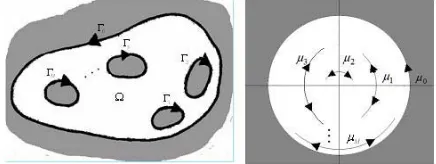
(see Figure 1).
The unit tangent to
*at
zis denoted by
z z z
T c c
, and if
fis analytic function which maps
:conformally onto a disk with circular slit, then we have the
boundary relationship [11, p. 1126].
| 13 |
, .
2 2 2 2
2 *
c c
z
z f
z f z T z f z
f 1
Suppose that k is a complex constant, Qz and H z are complex-valued functions defined on * such that
0
z z
H , Qz z0 and H
z T z Qz satisfies the Holder condition on *. Then the interior relationship is defined as follows:
A complex-valued function Pz is said to satisfy the interior relationship if Pz is analytic in : and satisfies the non-homogeneous boundary relationship
, *, P z H z z
z G
z Q z T k z
P 2
where Gz is a complex-valued function, analytic in :,
Holder continuous on *, and G z z0 on *.
Figure 1. Mapping of the bounded multiply connected region : of connectivity M1 onto a disk with circular slits.
The following theorem gives an integral equation for an analytic function satisfying the interior relationship (2) [12, p. 45].
Theorem 1:
Let z*, U z and V z be any complex-valued
functions that are defined on *. If the function P z
satisfies the interior relationship, then
, 3
Re
, 2
1
1
z L z U w G z w
w P s z kU
dw w P w z K PV z P z Q z T
z U z V
R M
j w aj
*
» » ¼ º «
« ¬ ª
» ¼ º «
¬ ª
¦
³
where
,
2 1
, »
¼ º «
¬ ª
w z
w T z V w Q z w
z U i w z K
S 4
, 5
2 1 2
1
dw w T w Q z w
w H i
PV z T z Q
z H z
LR
³
*
S
and the sum is over all those zeros a1,a2,...,aM of G
that lie inside :. If G has no zeros in :, then the term containing the residue in (3) will not appear.
3. THE BOUNDARY INTEGRAL EQUATION FOR
CONFORMAL MAPPING OF MULTIPLY CONNECTED REGIONS
This section gives an application of Theorem 1 to conformal mapping of multiply connected regions to disk with circular slit domain. Let f z be the mapping function which maps the domain : in the z-plane onto a canonical domain of the disk with circular slit domain in the w-plane. The function f is made uniquely determined by
prescribing that f a 0 and fca !0. Thus the function
f can be written as [10, p. 134]
z zaeza hzD,
f 6
where h is an analytic in : and D is real constant. Taking the derivative of both sides of the equation (6) and dividing both sides by f yields
z z a
h z h
a z z f
z
f c
c 1
. Then
z z a
h z h
a z z f
z f z
D c
c 1
is analytic in :.
Thus
. 1
a z z D z f
z f
c
7
Note that equation (1) can be written in the following form
. ,
2 2
2
* ¸¸¹ · ¨¨© § c
c
z z f
z f z T z f
z f
8
From equations (7) and (8), and after some arrangement
yields
1 , .
2 2
*
z
a z a z
z T z D z T z
| 14 | Comparison of equation (2) and equation (9) leads to a choice of P
z Dz , k 1, Q
z T z , Gz 1,
a z a z z T z H
2 1 , U
z T z Q z and V z 1.
Substituting these assignments into (3) leads to an integral equation,
10 . , 2 1 2 2 * » » ¼ º « « ¬ ª *
³
z z L z T dw w D z w w T w T z w z T i PV z D R SNote thatGz does not have any zeros in :
because Gz is a constant function so the term containing the residue does not appear in (10). Multiply both sides of
(10) by T z and using the fact that T
zT z T z 2 1,
gives
, , 11
2 1 * » ¼ º « ¬ ª *
³
z z L z T dw w T w D z w z T z w z T i PV z D z T R S Where, . 12
2 1 1 2 1 2 1 2 * » ¼ º « ¬ ª
³
³
* * z dw a w z w w T i PV z T dw a w z w i PV z T a z z T a z z T z L z T R S S Since wawz zaª«¬wzwa»¼º1 1 1 1
,
and for z*, a: by [4, p. 91]
2 1 1 2 1
³
* dw z w iS , 1
1 2 1
³
* dw a w iS . Thus
w zw adw z ai PV
³
* 21 1
2 1
S .
Substituting this result into equation (12) and using the fact that T wdw dw , gives
, . 13
2 1 2 1 *
³
* z dw a w z w w T i PV z T a z z T a z z T z L z T R S Let z f z f zF c . Then
1 . 14
a z z F z D
From equations (11), (13), and (14) we get
15 . , 2 1 2 1 2 1 * u » ¼ º « ¬ ª
³
³
* * z a z z T dw a w z w w T i PV z T dw w F w T z w z T z w z T i PV a z z T z F z T S SAlso by using [4, p. 91] and the fact that T w dw dw,
gives
w zw adw z aw T i PV
³
* 1 2 1 2 1 S .Substituting this result into equation (15) yields
. , 2 1 * » ¼ º « ¬ ª
³
* z a z z T a z z T dw w F w T z w z T z w z T i PV z F z T SThe above integral equation can also be written briefly as
, 1 , , 16
1 *
³
* z a z z T a z z T dw w F w z N z F wherez T z F z
F1 ,
>
@
° ° ° ¯ °° ° ® * c c cc z * »¼ º «¬ ª . if , Im 2 1 , , , if , Im 1 ,3 z w
t z t z t z w z w z w z z T w z N S S
| 15 | uniquely solvable. So we need to modify the integral equation to solve it numerically.
Note that a: and h
z z a
h z
a z z f z f c c 1 so
by using the fundamental theorem [14, p. 164] and the fact
that Tw dw dw, gives
0 2 1 1 1
³
* dw w FS , 17
By using the same manner we can show that
0 2 1 2 1
³
* dw w FS , …, 2 0
1 1
³
* M dw w FS . 18
We can combine the conditions (17) and (18) in the following form . ..., , 2 , 1 , 0 2 1
1 w dw q M
F q
³
* S 19Thus the integral equation (16) with the condition (19) has a unique solution.
By solving the integral equations (16) and (19) simultaneously for F1, we can obtain the function Fand hence determine D. With D known, one can then treat (7) as a first order ordinary differential equation for computing
f , as follows
. 1 z f a z z D z f »¼ º «¬ ª
c 20
After finding f we can calculate the radii by taking the modulus for f .
4. NUMERICAL IMPLEMENTATION
In this section we first describe in detail a numerical method for computing the mapping function F1 for the case of doubly connected region. Using the parameterizations
t
z0 of *0 for t:0dtdE0 and z1t of *1 for
1
0 : dtdE
t the system of integral equations (16) and (19) become
, , 21
Im 2 2 1 , , 0 0 0 0 0 1 1 1 1 0 0 0 0 1 0 0 0 1 1 0 * » ¼ º « ¬ ª c ¸ ¹ · ¨ © § c
³
³
t z a t z t z T i ds s z s z F s z t z N ds s z s z F s z t z N t z F E E S22 . , Im 2 2 1 , , 1 1 1 1 0 1 1 1 1 1 0 0 0 1 0 1 1 1 1 0 * » ¼ º « ¬ ª c ¸ ¹ · ¨ © § c
³
³
t z a t z t z T i ds s z s z F s z t z N ds s z s z F s z t z N t z F E E SMultiply both sides of equations (21) and (22) by z0c t
and z1ct respectively, yields
, , 23
Im 2 2 1 , , 0 0 0 0 0 1 0 1 1 1 0 0 0 0 0 1 0 0 0 0 1 0 1 0 * » ¼ º « ¬ ª c c u ¸ ¹ · ¨ © § c c u c c
³
³
t z a t z t z T t z i ds s z s z F s z t z N t z ds s z s z F s z t z N t z t z F t z E E S24 , , Im 2 2 1 , , 1 1 1 1 1 1 0 1 1 1 1 1 0 0 0 1 0 1 1 1 1 1 1 0 * » ¼ º « ¬ ª c c u ¸ ¹ · ¨ © § c c u c c
³
³
t z a t z t z T t z i ds s z s z F s z t z N t z ds s z s z F s z t z N t z t z F t z E E S Defining 0 ,1 0
0 t zc t F z t
I I1t z1ct F1 z1t ,
t s z t Nzt z s
K00 0, 0 0c 0 , 0 ,
¸ ¹ · ¨ © § c S 2 1 ,
, 1 0 0 1
0
01t s z t N z t z s
K ,
t s z t Nzt z s
K10 1, 0 1c 1 , 0 ,
¸ ¹ · ¨ © § c S 2 1 ,
, 1 1 1 1
1
11t s z t N z t z s
| 16 |
» ¼ º «
¬ ª
c
a t z
t z T t z i t
0 0 0
0 2 Im
\ ,
» ¼ º «
¬ ª
c
a t z
t z T t z i t
1 1 1
1 2 Im
\ ,
the system of equations (23) and (24) can be briefly written as
25 ,
, ,
0 0
1 1 0 01 0
0 0 0 00 0
1 0
t ds s s t K ds s s t K t
\ I I
I E
³
E³
26 .
, ,
1 0
1 1 1 11 0
0 0 1 10 1
1 0
t ds s s t K ds s s t K t
\ I I
I E
³
E³
Since the functions I and K in the above systems
are periodicE , a reliable procedure for solving equations (25) and (26) numerically is by using the Nystrom's method [15] with the trapezoidal rule. The trapezoidal rule is the most accurate method for integrating periodic functions numerically [16, pp. 134-142]. We choose
S E
E0 1 2 and n equidistant collocation points ,
1 0 n
i
ti E 1didn on*0 and m equidistant
collocation points t~i ~i1E1 m, di dm ~
1 on*1.
Applying the Nystrom's method with trapezoidal rule to discretize equations (25) and (26), we obtain
27 ,
, ,
0
~ 1 1
~
~ 01 1
1
0 00 0 0
i j m
j j
i n
j
j j i i
t t t t K m t t t K n t
\ I E
I E
I
¦
¦
28 ,
, ,
~ 1 1 ~
~ 1 ~ ~ 11 1
1
0 ~ 10 0 ~ 1
i m j
j j i n
j
j j i i
t t t t K m t t t K n t
\ I E
I E
I
¦
¦
Equations (27) and (28) lead to a system of
nm non-homogeneous linear complex equations in n unknownsi
t 0
I ,m unknowns I1 ti~ . By defining the matrices
j i j
i K t t
n
B E0 00 , ,
j i j
i K t t
m
C~ E1 01 , ~ ,
j i j
i n K t t
D~ E0 10 ~, , i j K ti tj m
E~~ E1 11 ~, ~ ,
i
t 0 i 0
x I , 1 t~i
i ~ 1
x I ,
i
i t
b0 \0 , b1i~ \1 ti~ ,
the system of equations (27) and (28) can be written as
nm by nm system of equations>
InnBnn@
x0nCnmx1m b0n, 29>
@
x .x0n mm mm 1m 1m
mn I E b
D 30
The result in matrix form for the system of equations (29) and (30) is
, x
x
1 0
1m 0n
¸ ¸ ¸
¹ ·
¨ ¨ ¨
© §
¸ ¸ ¸
¹ ·
¨ ¨ ¨
© §
¸ ¸ ¸
¹ ·
¨ ¨ ¨
© §
m n
mm mm mn
nm nn
nn
b b
E I D
C B
I
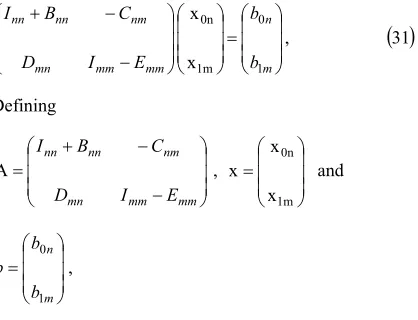
31
Defining
, A
¸ ¸ ¸
¹ ·
¨ ¨ ¨
© §
mm mm mn
nm nn
nn
E I D
C B
I
¸ ¸ ¸
¹ ·
¨ ¨ ¨
© §
1m 0n
x x
x and
¸ ¸ ¸
¹ ·
¨ ¨ ¨
© §
m n
b b b
1 0
,
the
nm by nm system can be written briefly asb
x
A .
5. NUMERICAL EXPERIMENT
For numerical experiments, we have used three test regions based on the examples given in [5, 17, 18]. All the computations are done using MATHEMATICA 7.1 (16 digit machine precision).
The test regions are annulus, circular frame and frame of Limacon. N number of collocation points on each boundary has been chosen. The sub-norm error results between exact values for fc f and their approximations
fc fn are shown in Tables 1, 2 and 3.Example 1 Annulus:
| 17 | Consider a frame of circular annulus A
^
z:~r z 1`
,0 , ~ q eSW W!
r .
^
zt cost isint`
:0
* ,
^
zt r~cost sint`
:1
* .
The exact mapping function is given by [17]
32 ,
2 0 ,
2 log 2
1
2 log 2
1
4 4
2 SW
V V SW T
V SW T
V
¸ ¹ · ¨
©
§
¸ ¹ · ¨
©
§
i i z i
i i z i e z f
with P e2V and T4 being the Jacobi Theta-functions. We have chosen W 0.5, ~r eSW and V 0.2. Since
2 04SWi
T [17], this implies a e2V P.
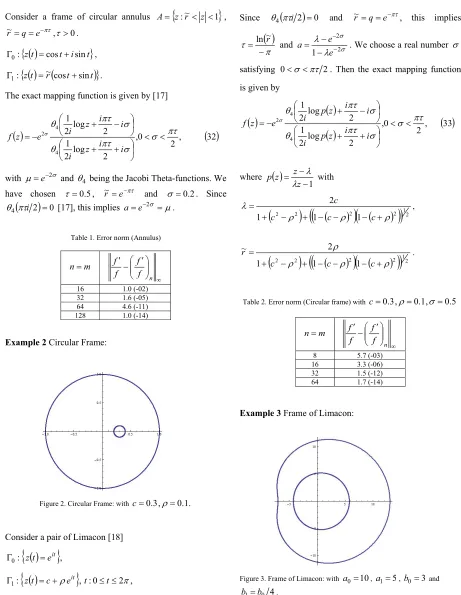
Table 1. Error norm (Annulus)
m n
f
¸¸¹ · ¨¨© § c c
n
f f f f
16 1.0 (-02) 32 1.6 (-05) 64 4.6 (-11) 128 1.0 (-14)
Example 2 Circular Frame:
Figure 2. Circular Frame: with c 0.3,U 0.1.
Consider a pair of Limacon [18]
^
`
, :0 zt eit *
^
`
, :0 2 , :1 U d d S
* zt c eit t t
such that the domain bounded by *0 and *1is the domain
between a unit circle and a circle center at c with radius U.
Since T4
SWi 2 0 and r~ q eSW, this impliesS W
r
~ ln
and V
V
O O
2 2
1
e e
a . We choose a real number V
satisfying 0VSW 2. Then the exact mapping function
is given by
33 , 2 0 ,
2 log
2 1
2 log
2 1
4 4
2 V SW
V SW T
V SW T
V
¸ ¹ · ¨
©
§
¸ ¹ · ¨
©
§
i i z p i
i i z p i e z f
where
1
z z z p
O
O with
2 2 2 2121 1
1
2
U U
U O
c c c
c
,
2 2 2 2121 1
1
2 ~
U U
U
U
c c c
r .
Table 2. Error norm (Circular frame) with c 0.3,U 0.1,V 0.5
m n
f
¸¸¹ · ¨¨© § c c
n
f f f f
8 5.7 (-03) 16 3.3 (-06) 32 1.5 (-12) 64 1.7 (-14)
Example 3 Frame of Limacon:
Figure 3. Frame of Limacon: with a0 10,a1 5,b0 3 and
4
0 1 b
b .
| 18 |
^
`
, 0 , 0 , 2 sin sin 2cos cos :
0 0 0 0 0
0 0
! !
*
b a
t b t a i t b t a t z
^
`
, 0 , 0 , 2 sin sin 2cos cos :
1 1 1 1 1
1 1
! !
*
b a
t b t a i t b t a t z
with 10a0 , 5a1 , 3b0 and b1 b0 4 where
S
2 0 : dtd
t . The value of a0, a1, b0 and b1are chosen so
that b1 b0 a1 a0and ~r a1 a0. Since T4
SWi 2 0 andSW
e q r
~ , this implies
S W
1 0
lna a
and
0 2 0 2 0 2 0
4 2
b a a e b
a
V
. We choose a real number V
satisfying 0V SW 2. The exact mapping function is
given by
34 , 2 0 ,
2 log
2 1
2 log
2 1
4 4
2 V SW
V SW T
V SW T
V
¸ ¹ · ¨
©
§
¸ ¹ · ¨
©
§
i i z p i
i i z p i e z f
where
P 2V0 0 2 1
0 2 0
, 2
4
e b
a z b a z
p .
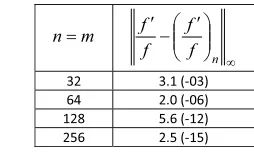
Table 3. Error norm (frame of Limacon) with V 0.1
m
n
f
¸¸¹ · ¨¨© § c c
n
f f f f
32 3.1(03)
64 2.0(06)
128 5.6(12)
256 2.5(15)
6. CONCLUSION
From this study, we have constructed a new boundary integral equation for conformal mapping of regions of connectivity M 1 onto a disk with circular slits. The boundary integral equation for fc f involved the classical Neumann kernel, where f is a conformal mapping of bounded multiply connected regions onto a disk with circular slit domain. The advantage of our method over [11] is that our boundary integral equation does not involve the unknown circular radii. Discretized integral equation leads to a system of linear equations. With fc f known, one can then treat it as a differential equation for computing
f .
ACKNOWLEDGEMENT
This work was supported in part by the Malaysian Ministry of Higher Education (MOHE) through the Research Management Centre (RMC), Universiti Teknologi Malaysia (FRGS Vote 78479). This support is gratefully acknowledged.
REFERENCES
[1] Z. Nehari, Conformal Mapping, Dover Publications, Inc, New York, 1952.
[2] D. Crowdy, and J. Marshall, Computational Methods and Function Theory 6 (2006) 59-76. [3] S.W. Ellacott, Numerische Mathematik 33 (1979) 437-446.
[4] P. Henrici, Applied and Computational Complex Analysis, Vol. 3, John Wiley, New York, 1974. [5] P.K. Kythe, Computational Conformal Mapping, Birkhauser Boston, New Orleans, 1998. [6] A. H. M. Murid and N. A. Mohamed, Int. J. of Pure and Appl. Math. 38(2007), 229-250. [7] A. H. M. Murid and M. R. M. Razali, Matematika 15 (1999), 79-93.
[8] D. Okano, H. Ogata, K. Amano and M. Sugihara, Journal of Comp. Appl. Math. 159 (2003), 109-117. [9] G. T. Symm, Numer. Math. 13 (1969), 448-457.
[10] M. M. S. Nasser, Journal of Comput. Methods. Funct. Theory 9 (2009), 127-143. [11] A. H. M. Murid and Laey-Nee Hu, Int. J. Contemp. Math. Sciences 4 (2009), 1121-1147.
[12] M. M. S. Nasser, Boundary Integral Equation Approach for Riemann Problem, PhD Thesis, Department of Mathematics, Universiti Teknologi Malaysia, 2005.
[13] R. Wegmann and M. M. S. Nasser, J. Comput. Appl. Math. 214 (2008), 36-57.
[14] E. B. Saff and A. D. Snider, Fundamentals of Complex Analysis, Pearson Education, Inc. New Jersey, 2003.
[15] K. E. Atkinson, A Survey of Numerical Methods for the Solution of Fredholm Integral Equations, Society for Industrial and Applied Mathematics, Philadelphia, 1976.