Productivity in Platinum Mining
A CONTINUING PROGRAMME OF SUCCESSFUL
DEVELOPMENT IN UNDERGROUND MECHANISATION
Notable progress has been made by Rustenburg Platinum Mines in their eiforts to increase mechanisation and to improve efficiency during mining operations; a brief account of some aspects of this work is presented here. I t is anticipated confidently that such means will help them to maintain supplies of the platinum group metals at prices which both encourage demand and ensure supply.
The Bushveld Igneous Complex includes three extensive geological formations which contain platinum group minerals; these are the Merensky Reef, the Upper Gabbro Seam 2 and the Platreef. While it is not possible to deter- mine with accuracy the platinum group metals content of the Complex, or the amount recover- able by existing mining techniques, it has been estimated that the reserves in the Merensky Reef and the Upper Gabbro Seam z amount to 1,330 million ounces, of which 800 million ounces are platinum (I). When this is compared
with the world output of the six platinum group metals in 1977, about 6.4 million ounces (2), it is clear that there are sufficient reserves to meet all foreseeable needs for many decades.
The
Merensky
Reef
At present commercial mining of the Com- plex for platinum group metals is confined to the Merensky Reef and the mines situated on it are the only major ones in the world producing platinum as the primary metal. As primary pro- ducers they have the potential to respond most rapidly to the changing needs of the plati- num users, and Rustenburg Platinum Mines Limited-the world’s largest producer of the platinum metals-is actively engaged in a programme of research and development desig- ned to increase the productivity and efficiency of all their operations, in line with world market needs. Previous articles in this journal have described the discovery and the geology of the Merensky Reef (3, 4, 5 ) and the mining,
extraction and refining of the platinum metals
(6, 7, 8, 9 , IO), while over the years the expan-
sion of output by Rustenburg Platinum has been reported frequently as capacity has been increased to about one and a quarter million ounces of platinum a year. Their mines form the world’s biggest underground mining opera- tion and this article features some of the areas where increased effort has been committed to achieving significant improvements in the utilisation of resources, and specifically labour productivity during mining operations. Similar programmes are examining the surface facili- ties, such as those shown in Figure I, which complement the underground operations.
Where the Reef meets the surface it outlines a vast oval, approximately 200 miles across the
1 i g . 1 The Elushwld Igneous ( ompler of central 7 ransvaal contains thrrc~ rrten9ivr gnolopical lorma- tions that contnznplntznum group mrtnls, although at prpsrnl they nrr o n h minrd commrrcrall~ o n thr llrrrnsk? Re(>/’. The mines of Rustenburg Platinum form thr itorld’b lorgeqt itnd(,rground mining
operation and the proccwznp of material brought to the surface. by inrlmcd hnulngc, \yst(’m9 and
iwtirul shafts, requirtJs rxt(’nsar faciliiies, possihlr in rPmotr country urru+
sinking of these is one of several operations to benefit from continuing research and develop ment work.
Shaft Raiseboring and Sliping
Traditional shaft sinking methods involve making a hole in the ground which is progressively deepened until the required depth in the earth is reached. If underground access is already available to the position of the bottom of the proposed shaft the method known as raise boring may be employed, and Rustenburg Platinum Mines has successfully used this technique during the development of their underground programme. It involves boring a pilot hole vertically downwards to the existing access at the bottom of the proposed shaft and then reaming upwards, that is enlarging, from the lower access point such that the diameter of
this hole is the required shaft width. The broken rock falls to the bottom of the hole and the technique allows for greater flexibility in handling the spoil. In addition to lowering costs and saving time the safety hazards associated with the older methods have been reduced significantly.
Incline and Haulage Development
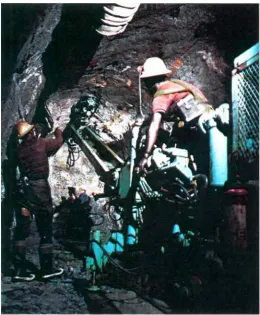
The degree of success achieved with raise boring has also been obtained with the mechanisation of incline and haulage develop ment. Rigs incorporating one or more pneumatic drills, such as that shown in Figure 2, are now in general use to drill the holes
as those shown in Figure 3 carrying out clean- ing operations during incline development at the Amandelbult Section of the mines, have significantly improved the rate of advance with a reduction in the amount of labour required.
Mechanisation
of
the Stoping
Operations
Stoping, that is excavating ore from which the platinum group metals will be extracted, is the mining process which uses the largest number of operators and is consequently an area where mechanisation could provide con- siderable benefit. As the platinum bearing minerals mostly occur in a narrow seam within the Reef the stoping width is kept to a minimum, so that the platiniferous ore hoisted to the surface for milling and extraction is diluted as little as practicable by waste material broken from above and below the seam. One
Fig. 2 Single or multi-boom rips arc’ nou in gencv-a1 use for drilling the holm which carry the blnsting cxplosivcs during haulagc? dPoo1opmmt. The introduction of such rigs
has improvcd working condi-
tions and rcduccd oprrutor
,/aatigu~, and has contributed
to incrcnscd productivity
result of this is that the development of mechanical equipment is hindered by the need to work in a stope which is frequently only 80 cm high.
Fig. 3 1,onders powered by c o rnp r e s s e d h (z u P i nr r ens ~d p r o d u r t i 1) i t y uppreciubly during incline and hacdagr development. TIIP rail-mountt.d machines shown h w e scoop up rack
b r o k m f r o m the work face in front o,f them; the buckets
arr then swung oiwr the l(iudc?rs tu tip the rock into a wagon rrndy ,tor rerntmzl f r o m thr working face. l3erausc~ of t h v head room
required, such machines cnnnot hr u w d i n the stopes
(I i r
have been proved. The equipment illustrated in Figure
4
enables a skilled operator to increase his productivity by over 300 per cent. The broken rock blasted from the Reef planemust be removed from the stope and passed to the haulage roadways along which it is trans- ported to one of the inclined haulages, or vertical shafts, for hoisting to the surface. Traditionally removing rock from the stope face has necessitated a considerable amount of manpower, due in part to the physical restric- tion imposed by the very narrow stope width. Now a programme designed to mechanise this operation is nearing completion, despite difficulties created by the lack of geological uniformity in the working areas.
Hangingwall Support
The stope hangingwall, that is the rock for- mation which rests on the platiniferous seam, is controlled by a system of stope supports. Packs of timber were conventionally used for this purpose, but a system of timber stick support and concrete has now been designed to achieve this hangwall control with the minimum use of both timber and labour. Manhandling of timber into the stopes has been replaced wherever possible by the use of mono rope winches, again
achieving significant savings in labour require- ments. When mining at increased depths, and where the technique of longwall mining is practised, a system of concrete pack supports has been introduced successfully to give improved control of the hangingwall. For this form of support the concrete is pumped from the surface into expanded metal frames contain- ing cloth bags positioned in the stope. During filling the sides of the bags are restrained by the metal frames, but these are removed for use elsewhere once the concrete has set. By pumping the cement mix from the surface directly to the working stope a saving of manpower is achieved and shaft hoisting capacity is increased.
Longwall Mining
I i p . 4 K i p mountrd on crawlcv traLhs and p o u w r d b i cornprvwd air h a w lwrn d w p n r i l cmd built l o Hustrnburg Platinum Vinra’ oun sprrification t o farilitatr mmhznrral drilling in vrrv narrow stopva. ?’hi, sophrsticnted drilling rip qhouin hrrp Pnnblrs a highl? trainrd. ahilfril o p r a t o r to incrrnao h produrtiaitl bv over 300 p w rent nnd ha5 drmonatratcd i t s mvchanicnl rrliabilrty and (vonorn i r m b i l i t > for drilling C ~hard rock P of thr Wrrrn,kv Rrrf
mining is the removal of all the seam in one continuous dip face. Since the first longwall face was brought into production by Rusten- burg Platinum in 1976 increasing areas at all three sections of the mine are being worked by longwalling, which now accounts for approxi- mately 35 per cent of the total area mined. As well as better extraction of the seam, the ad- vantages of this system include greater oppor- tunities for mechanisation, higher productivity, improved ventilation and ground control, and better supervision.
Conclusions
T h e continuing development of mining equipment and techniques, such as those briefly described here, demonstrate a desire on the part of the world’s largest platinum producer to utilise economically viable technology for the efficient mining of platiniferous ores. Similar
programmes of research and development are being carried out on surface operations, on the mechanical handling of ore and waste materials, and on many stages of the extraction and refining processes.
In addition Rustenburg Platinum Mines is exploring various areas of the Bushveld Igneous Complex, as part of a continuing evaluation of possible future mining areas. Although the whole range of platinum-bearing ores is being evaluated, particular emphasis is being placed at present on the Platreef in the Potgietersrust district. Prospecting results so far indicate that this area, which was originally mined in the 1920s, has the potential to support a major new
metallurgical characteristics of the ore are different from those currently being worked, and much work has still to be done to evaluate the deposit.
By such exploration, research and develop- ment Rustenburg Platinum Mines will con- tribute to the availability of platinum metals from the rich deposits in the Bushveld Igneous Complex in the quantities, and at the time, that they are required by the platinum metals users of the world.
Acknowledgement
This article was prepared in conjunction with the technical staff of Rustenburg Platinum Mines
Limited. 1.E.C.
I 2 3 4 5 6 7 8 9 10 References
S. C. Newman, Trans. Inst. Mitr. Metal]., 1973, 82, (April), A52-A68
“Platinum-Group Metals”, Mineral Commodity Profiles, MCP-22, United States Department of the Interior, I 978
Platinum Metals Rev., 1971, 15, (3), 102
Plarinum Metals Rev., 1957, I , ( I ) , 3
C. A. Cousins, Platinum Metals Rev., 1959, 3, f3), 94
C. B. Brath,
K.
J . Westwood and C . A. Cousins, Plarinum MeralsRev., 1961, 5 , (3), 102A. F. S . Gouldsmith and B. Wilson, Plarinum Metals Ree., 1963, 7, (4), 136
Platinum Metals Rev., 1969, 13, (I), 1 5
I.. B. Hunt and F. M. Lever, Plarinurn Meials
Platinum Metals Rev., 1970, 14, ( 2 ) , 48
Rw., 1969, 13, (41, 126
The
Platinum Metals are Essential
to
Industry
Supply and Use Patterns for the Platinum-Group Metals, National Materials Advisory Board Publication NMAB-359, National Academy of Science, Washington, 1980, I 97 pages
‘The platinum group metals continue to be used for a wide and increasing variety of applications because their remarkable proper- ties, particularly their freedom from chemical attack-even at high temperatures, their ability to catalyse a large number of chemical reac- tions, their high melting points and strength, make them more effective than other materials that are initially cheaper and more readily available.
-4 most valuable study of the present and future uses of these metals and their com- pounds has just become available. Conducted by a panel drawn from processors, suppliers, users and minerals economists, it is based upon data compiled up until the end of November 1978 and is concerned mainly with the situa- tion in the United States of America. However, the information it contains makes it essential reading for platinum producers and users, world wide. The geology, reserves and resources of the platinum group metals are surveyed, and as further background information a summary of their chemical and physical properties is given. This is followed by an account of their extraction, refining, and recycling after use. The production and fabrication of the metals and some of their compounds are also briefly considered.
Production and consumption statistics are given, and present and potential applications are discussed. Over the 25 year period since
1954 the total world production of the platinum metals has increased by 850 per cent, thus generally keeping pace with the enormous expansion in their utilisation as industry has responded to such crucial problems as the need to increase the world’s food supply, to utilise fuel and energy more sensibly, and to limit further damage to the environment. In addition to the many industrial uses, the platinum metals are also used for a variety of other purposes including medical and dental applica- tions, in laboratory investigations and for jewellery. I t is suggested that the requirement for the platinum group metals will more than double in the next 12 to I 5 years, although this
increase will not be the same for all the six metals. One significant increase in demand for platinum is predicted to be for the production of first generation commercial fuel cells, an application which seems close to realising its potential as a viable, environmentally accept- able source of electrical power.
While some of the conclusions of the study relate especially to the U.S.A. most are relevant to all industrial countries, as it is stressed that the platinum metals, particularly platinum, palladium, rhodium and iridium, are essential to many of the most vital industries.
This book is now being reprinted and will be available at