University of South Carolina
Scholar Commons
Theses and Dissertations
1-1-2013
Identifying Values and Benefits of Congaree
National Park
Maka Bitsadze
University of South Carolina
Follow this and additional works at:https://scholarcommons.sc.edu/etd Part of theEarth Sciences Commons
This Open Access Thesis is brought to you by Scholar Commons. It has been accepted for inclusion in Theses and Dissertations by an authorized administrator of Scholar Commons. For more information, please [email protected].
Recommended Citation
i
IDENTIFYING VALUES AND BENEFITS OF CONGAREE NATIONAL PARK
by
Maka Bitsadze
Master of Science
Ivane Javakhishvili State University of Tbilisi, 1998
Submitted in Partial Fulfillment of the Requirements
For the Degree of Master of Earth and Environmental Resource Management
Earth and Environmental Resources Management
College of Arts and Sciences
University of South Carolina
2013
Accepted by:
John A. Kupfer, Director of Thesis
David C. Shelley, Committee Member
Jason H. Murray, Committee Member
ii
iii
D
EDICATIONiv
A
CKNOWLEDGEMENTSI would like to express my sincere appreciation for my thesis advisor, Dr. John A.
Kupfer for his guidance and advice throughout this research. I extend my high
appreciation to the committee members, Dr. David C. Shelley and Dr. Jason H. Murray
for their support during the research. This research would not have been possible
without encouragement, enthusiasm and great support of my advisor and committee
members. The research reflects their contribution.
I would like to thank all experts who contributed to the research: Kimberly
Meitzen, Terri Hogan, John A. Kupfer, Rebecca R. Sharitz, David C. Shelley, Tracy
Swartout, Theresa A. Thom, William L. Graf, Corinne Fenner, Lauren Gurniewicz, John
Grego, and Adam King. This research could not have been completed without their
expertise and professional input.
Finally I would like to thank my husband Josef and son Alexander for their
v
A
BSTRACTProtected areas are important tools for the conservation of biological diversity.
They also support a wide range of ecosystem services and provide economic, cultural
and social values and benefits. Many values and benefits of protected areas are poorly
understood and greatly under-valued by decision-makers, the business sector, and the
general public. Accordingly, identification and assessment of values and benefits of
protected areas has been increasingly promoted during recent years.
This research investigates values and benefits of Congaree National Park and
provides guidance for the further economic valuation of identified values and benefits.
While the ecological significance of Congaree National Park has been well documented,
it is also important to identify and study a broader range of social, cultural and
economic values and benefits provided by the park in addition to those associated with
biodiversity conservation. The research is conceptually based on The Protected Areas
Benefit Assessment Tool, a methodology developed by World Wide Fund for Nature for
the identification of values and benefits that protected areas bring to a range of
stakeholders, from local to global. Key values and benefits of Congaree National Park
were identified based on the input of experts who contributed to the research and
through an extensive review of corresponding literature and research-based
vi
The research identified the following key values and benefits of Congaree
National Park: biodiversity conservation value; recreational value; science, knowledge
and educational value; cultural, spiritual and historical value; climate regulation; water
quality protection; flood storage and control; erosion control / soil stabilization; coastal
protection; and management value. From these identified values and benefits, seven
are recommended for further economic valuation. This research provides the guidance
for economic valuation through defining categories / types of identified values and
proposing possible applicable valuation methods with consideration of their advantages
vii
TABLE OF CONTENTS
D
EDICATION ... iiiA
CKNOWLEDGEMENTS ...ivA
BSTRACT ...………vL
IST OFF
IGURES………ixL
IST OFA
BBREVIATIONS……….xCHAPTER 1: INTRODUCTION………..1
1.1STUDY RATIONALE ……….1
1.2RESEARCH OBJECTIVES………....2
CHAPTER 2: BACKGROUND……….2
2.1RECOGNITION OF VALUES AND BENEFITS OF PROTECTED AREAS ………..3
2.2TERMINOLOGY AND DEFINITIONS………..3
2.3KEY VALUES AND BENEFITS OF PROTECTED AREAS………....6
CHAPTER 3: STUDY AREA………15
CHAPTER 4: METHODOLOGY………20
4.1OVERVIEW OF THE ORIGINAL STANDARD METHODOLOGY……….20
4.2OVERVIEW AND APPLICATION OF THE ADAPTED METHODOLOGY ………..23
CHAPTER 5: RESULTS……….…...…26
viii
5.2 OVERVIEW:FUNCTIONS AND VALUES OF BOTTOMLAND HARDWOOD
FOREST………..27
5.3KEY VALUES AND BENEFITS OF CONGAREE NATIONAL PARK……….32
CHAPTER6:GUIDANCETOWARDSECONOMICVALUATIONOF CONGAREE NATIONAL PARK………..……58
6.1INTRODUCTION………...58
6.2TYPES OF VALUES AND VALUATION METHODS………..…...58
6.3KEYS TOWARDS THE VALUATION OF CONGAREE NATIONAL PARK………...…….65
CHAPTER 7: CONCLUSIONS……….….75
REFERENCES……….………78
A
PPENDIXA:
V
ALUE-B
ASEDD
ATASHEETS………..………....
85A
PPENDIXB:
E
XPERTSW
HOC
ONTRIBUTED TO THER
ESEARCH……….……….…..
98ix
LIST OF FIGURES
Figure 3.1 Congaree National Park ……….…18
Figure 3.2 Vicinity of Congaree National Park………...….…19
Figure 5.1 Relationships between Functions and Values of
Bottomland Hardwood Forest………..…….…….………..….29
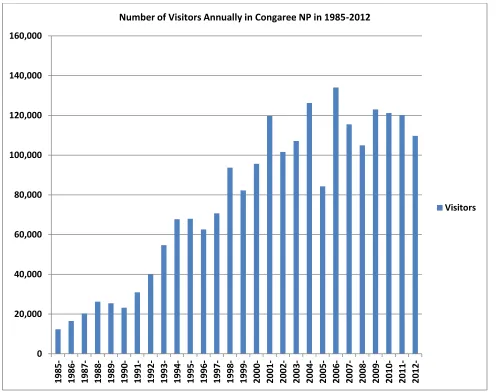
Figure 5.2 Number of Visitors Annually in Congaree NP in 1985-2012………...42
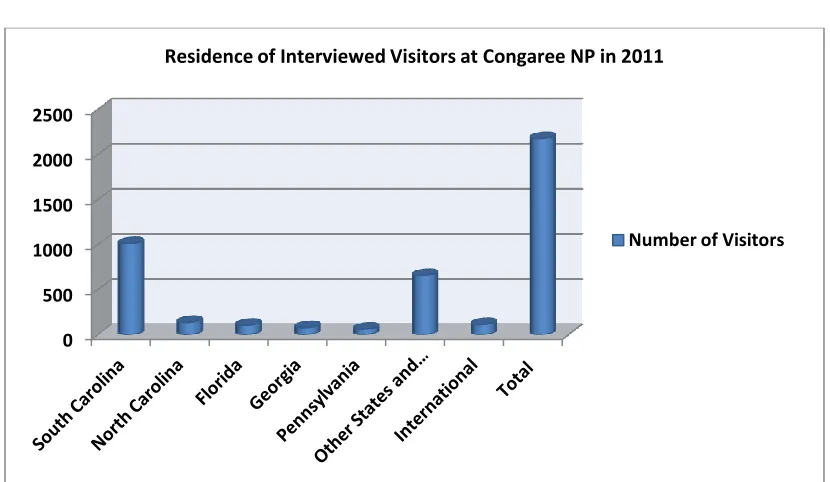
Figure 5.3 Residence of Interviewed Visitors at Congaree NP in 2011……….…..43
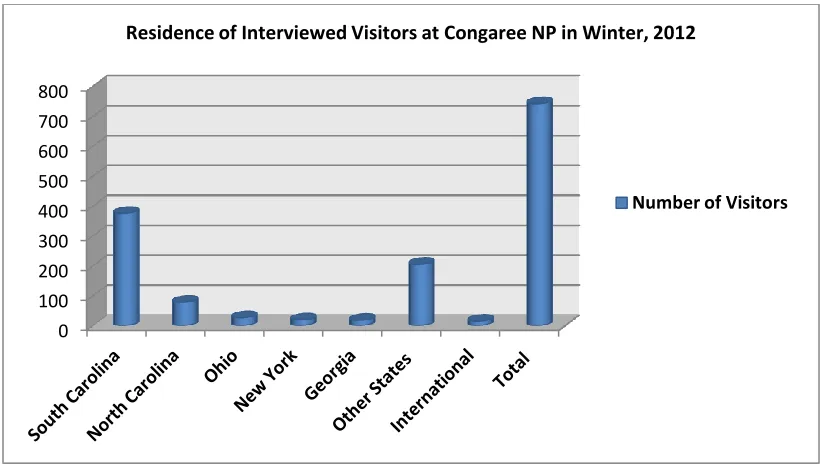
Figure 5.4 Residence of Interviewed Visitors at Congaree NP in Winter, 2012.……44
Figure 5.5 Archeological sites listed as “classified structures” in the National Register of Historic Places ……….………52
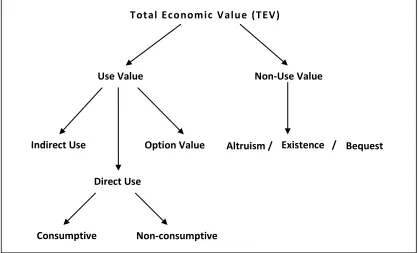
Figure 6.1 Total Economic Value Framework……….…59
x
LIST
OF
ABBREVIATIONS
CBD ………..Convention on Biological Diversity
CI ………Conservation International
CSNPA………..Congaree Swamp National Preserve Association
DEFRA………..Department for Environment, Food and Rural Affairs
IBRD………..International Bank for Reconstruction and Development
IUCN………..International Union for Conservation of Nature
MEA………Millennium Ecosystem Assessment
NP………..National Park
NPS……….National Park Service
RMP………Resource Management Plan
SC DHEC………..South Carolina Department of Health and Environmental Control
TEV……….Total Economic Value
TNC……….The Nature Conservancy
USGS………..U.S. Geological Survey
VSP………..The Visitor Services Project
WB………..The World Bank
1
CHAPTER 1
INTRODUCTION
1.1
S
TUDYR
ATIONALEUnder the Convention on Biological Diversity (CBD), protected areas are
recognized as cornerstones for the conservation of biological diversity at genetic,
species and ecosystem levels. Many protected areas also support a wide range of
ecosystem services and provide economic, cultural and social benefits (CBD, 2008; IBRD
& WB, 2010). For example, nearly 1.1 billion people – around one sixth of the world’s
population – depend on protected areas for a significant percentage of their livelihoods
(UN Millennium Project, 2005). Through conservation of both material and non-material
riches, protected areas play a key role in the economic and social welfare of people, as
well as the ecological health of the planet.Many values and benefits of protected areas
are poorly understood and greatly under-valued by decision-makers, the business
sector, and the general public (Mulongoy & Gidda, 2008). A number of international
environmental organizations, such as the World Wide Fund for Nature (WWF), The
Nature Conservancy (TNC), Conservation International (CI), and the International Union
for Conservation of Nature (IUCN) are actively working to increase understanding and
communication of the values and benefits of protected areas (Stolton & Dudley, 2009).
Assessment of values and benefits of protected areas has been increasingly
2
many countries where site-specific and system-wide assessments of protected areas
have been carried out. While the ecological significance of Congaree National Park (NP)
has been well documented, it is also important to identify and study a broader range of
social, cultural and economic values and benefits provided by the park in addition to
those associated with biodiversity conservation.
1.2
R
ESEARCHO
BJECTIVESThis research investigates values and benefits of Congaree NP and provides
guidance for the further economic valuation of identified values and benefits. In
particular, the research has the following two primary objectives:
1. To identify the ecological, economic, social and cultural values and benefits of
Congaree NP.
2. To provide initial guidance for further economic valuation of identified values
and benefits of Congaree NP.
By addressing these two specific objectives, this research attempts to provide a
solid theoretical foundation that will contribute to further economic assessment of the
3
CHAPTER 2
BACKGROUND
2.1
R
ECOGNITION OFV
ALUES ANDB
ENEFITS OFP
ROTECTEDA
REASThe importance of wider values and benefits are recognized in the definition of a
protected area by IUCN: “A clearly defined geographical space, recognized, dedicated
and managed, through legal or other effective means, to achieve the long-term
conservation of nature with associated ecosystem services and cultural values” (Dudley,
2008: 8). Further, realizing that decisions are frequently influenced by economic
considerations, identifying values and benefits provided by protected areas may be the
most effective way to communicate the right message to various groups of
stakeholders.
2.2
T
ERMINOLOGY ANDD
EFINITIONSThe terms “values and benefits”, “ecosystem services”, and “goods and services”
are often used interchangeably in the field of valuation of nature and ecosystem
services. Using different terminology, with the same content and even in similar
conditions, creates misunderstandings and uncertainty. The Millennium Ecosystem
Assessment Framework considers all kinds of “goods and services” together under one
term – “ecosystem services”, and this approach is widely accepted (MEA, 2003).
4
terms of “values and benefits” and “ecosystem services”, which are provided in this
section below.
Ecosystem servicesare defined as “the benefits people obtain from ecosystems”
(MEA, 2003: 3), or “services provided by the natural environment that benefit people”
(DEFRA, 2007: 10). While there is no single, agreed upon method of categorizing all
ecosystem services, the Millennium Ecosystem Assessment Framework (2003), which is
widely recognized and applied in practice, identifies four broad categories of ecosystem
services. It is recognized that some of these categories may overlap to some degree.
These categories include (MEA, 2003):
Provisioning Services are products directly obtained from ecosystems such as
food (e.g. crops, fruit, fish), fiber and fuel (e.g. timber, wool), bio-chemicals,
natural medicines and pharmaceuticals, genetic resources (genes and genetic
information used for animal/plant breeding and biotechnology), ornamental
resources (e.g. animal products, such as skins and shells, and flowers used as
ornaments), and fresh water. The latter is a very good example that
demonstrates linkages between two categories of ecosystem services, in this
particular case, between provisioning and regulating services.
Regulating Services are the benefits obtained from the regulation of ecosystem
processes such as air-quality maintenance, climate regulation, water regulation
and purification / quality control, erosion control, pollination, natural hazard
5
Cultural Servicesare nonmaterial benefits obtained by people from ecosystems,
including spiritual and religious values, knowledge and educational values,
inspiration and aesthetic values, cultural heritage values, and recreation and
ecotourism.
Supporting Services are benefits that are crucial for providing other ecosystem
services, including primary production, soil formation, nutrient cycling, water
cycling, production of atmospheric oxygen, and habitat provision.
The following definitions represent the main content and practical ideas of
values and benefits(Stolton & Dudley, 2009):
Value: “refers to the resources of the protected area that could be exploited to
produce a benefit. Values are in this context therefore potential benefits.” (p. 5).
Benefit: “refers to a resource that is being used to provide direct gains (which
could be in terms of money earned, or subsistence resources collected or less
tangible gains such as spiritual peace or mental well-being) to stakeholders. The
resources of the protected area become a benefit when they are successfully
used to provide such gains.” (p. 4)
Valuesof protected areas can be theoretical and are converted to benefits when
they are used by an individual or a community. For instance, the value of trees in water
filtration becomes a benefit to a community that derives its clean drinking water from
that source (IBRD & WB, 2010). Values can be classified as use-values and non-use
6
While presenting results, the term “value” is predominantly used and in this
case, this term is reserved to refer to characteristics and features of Congaree NP that
benefit humans in some way.
2.3
K
EYV
ALUES ANDB
ENEFITS OFP
ROTECTEDA
REASAs mentioned above, protected areas are important tools for the conservation of
biological diversity, but there are many other significant values and benefits that need
to be recognized. These values and benefits are presented in this section.
2.3.1 WATER SUPPLY
Water is a renewable natural resource, but unsustainable use of water
resources, rapid population growth and development, and increasing demands
represent major sources of concern to safe supplies of water resources (IBRD & WB,
2010). Protected watersheds show clear and direct links between human welfare,
ecological services and conservation (Mulongoy & Gidda, 2008). For example, it is
known that natural vegetation in protected areas supports the maintenance of water
quality and can increase the quantity of available water through groundwater renewal
and maintenance of natural flows. Water from protected areas is important for both
non-commercial (subsistence agriculture and potable water) and commercial
(large-scale irrigation, bottling plants, hydro-electric power or municipal drinking water source)
purposes (Pabon-Zamora et al., 2008).It should be highlighted that: (i) in many parts of
the world, adequate supplies of potable water depend on protected, healthy and
functioning natural ecosystems; (ii) agriculture is the largest user of fresh water globally
7
rain fed crops; and (iii) hydropower is the third largest source of energy worldwide and
provides approximately 20% of global energy, which makes protecting sustainable water
supplies for electricity generation crucial for countries dependent on hydropower (IBRD
& WB, 2010). Some examples of the value that protected areas provide in terms of
water resources for drinking, agriculture and hydropower include (Mulongoy & Gidda,
2008; IBRD & WB, 2010)1:
Around 2.7 million people in Peru use water that originates from 16 protected
areas with an estimated value of US$ 81 million. The rivers in these protected
areas also contribute to 60% of Peru’s hydroelectricity generation, with an
estimated value of US$ 320 million.
The fresh water needs of 19 million people of Venezuela’s urban population
come from 18 national parks. About 20% of the country’s irrigated lands depend
on protected areas for their irrigation water.
About 80% of population in Quito, Ecuador receives water supply from two
protected areas, Antisana (120,000 ha) and Cayambe-Coca Ecological Reserve
(403,103 ha).
In the Mekong region, over 40 major existing and proposed hydropower projects
are linked to protected areas.
The value of ecosystem services in terms of water regulation and supply alone is
worth US$ 2.3 trillion globally. Very little of this potential value is spent on
ensuring this ecosystem function.
1
8
Around a third (33 out of 105) of the world’s largest cities obtains a significant
proportion of their drinking water directly from protected areas.
2.3.2 HUMAN HEALTH AND RECREATION
Health benefits from protected areas can be derived through direct and indirect
ways. Protected areas are very important recreational places to promote physical and
mental health. They can also act as important repositories for medicinal plants for
traditional medicines and traditional knowledge: Protected areas with unique and rich
biodiversity can, for example, ensure protection and effective management of local
medicinal plants, which creates sustainable resources for local use and for
pharmaceutical development (Pabon-Zamora et al., 2008; IBRD & WB, 2010).
Additionally, there are many examples demonstrating links between human and wildlife
health and ecosystem health. For example, there are cases when forest clearings have
increased the spread of diseases such as malaria, leishmaniasis, avian flu and ebola.
Some examples of the values and benefits provided by protected areas include
(Mulongoy & Gidda, 2008):
Recently protected areas yielded valuable commercial drug discoveries such as
cyclosporine and Taq polymerase. Cyclosporine was first discovered from a
soil-sample taken from Hardangervidda National Park in Norway in 1969 and became
the 33rd top-selling drug worldwide in 2000, with total sales of US$ 1.2 billion.
Taq polymerase, which was isolated from bacteria discovered in the natural hot
springs of the Yellowstone National Park in 1966, has been used in a range of
9 2.3.3 NATURAL DISASTER MITIGATION
Natural, healthy and well-managed ecosystems have a great potential to provide
protection against some disasters. Forests can protect against floods, avalanches, heavy
storms, desertification, droughts and landslides while wetlands can mitigate flooding,
and coral reefs play an important role in protection against storm surges, tsunamis and
flooding events(IBRD & WB, 2010). Accordingly, well-managed protected areas provide
unique and cost-effective natural solutions that: (i) protect against the disasters; (ii)
reduce vulnerability of communities to disasters; and (iii) provide the communities with
livelihood resources to recover in a timely fashion from crises (Mulongoy & Gidda,
2008).
2.3.4 CLIMATE CHANGE: RESILIENCE, ADAPTATION AND MITIGATION
Protected areas play crucial roles in climate change resilience, adaptation and
mitigation. Through conservation of intact sites and habitats, protected areas increase
the ecosystems’ resilience to climate change since functional and dynamic ecosystems
with high biodiversity and richness recover more easily from climatic disturbances.
Effectively managed protected areas are the most significant tools for maintaining
carbon stored in oceans, forests, soils and wetlands, in order to contribute to climate
change mitigation. Protected areas also play an important role in adaptation to climate
change as they are better able to help populations adapt to the impacts of climate
change, such as flooding, desertification or landslides. Protected areas that contain
healthy ecosystems are also in good position to provide adequate environmental goods
10
protected areas with regard to climate change resilience, mitigation and adaptation
include (IBRD &WB, 2010; Mulongoy & Gidda, 2008):
In Peru, the total value of protected areas as a carbon sink has been estimated at
US$ 127 million per year at a price of US$ 3.5 dollars per ton.
Approximately 4.43 gigatonnes of carbon are sequestered in Canada’s national
parks. If society had to replace this stored carbon, it would cost between US$ 11
billion and US$ 2.2 trillion depending upon society’s valuation of the carbon
sequestration function.
The value of Uganda’s protected areas as a carbon sink is estimated at US$ 20.3
million annually.
Protected areas globally are estimated to hold 312 gigatonnes of carbon or at
least 15% of terrestrial carbon storage.
2.3.5 ECONOMIC BENEFITS
Protected areas have a great potential to provide direct and indirect economic
benefits and to significantly contribute to poverty reduction efforts. They create
employment opportunities for managers, rangers, wildlife biologists, scientists and
guides and thereby provide direct economic benefit to local residents and economies.
Tourism is one of the largest industries in the world, in part due to growth in ecotourism
and an increasing number of visitors to protected areas. For example, market surveys
revealed that 42% of European travelers surveyed in 2000 included a visit to natural
parks as part of their vacation activities. The number is even higher in Costa Rica, where
11
can be substantially higher than that from unsustainable use of natural resources. For
example, the estimated total economic value of a healthy coral reef for tourism,
coastal protection and sustainable fisheries in the Philippines has been estimated at
US$3,300 per ha versus unsustainable fishing generating US$870 per ha. Examples of
the demonstrated economic benefits of protected areas to ecotourism include
(Pabon-Zamora et al., 2008; Mulongoy & Gidda, 2008; IBRD & WB, 2010):
Park tourism provided 207 million Australian dollars in 2005 to the Southern
Forest and Gascoyne Coast Region in Australia.
Between 2003 and 2005, in New Zealand, tourism specifically targeted to four
protected areas (West Coast, Abel Tasman National Park, Queen Charlotte Track,
and Fiordland National Park) generated four thousand jobs, up to 15% of total
jobs in the areas, 130 million New Zealand dollars in direct household income,
and a total tourism revenue of 560 million New Zealand dollars.
Protected ecosystems also provide many raw materials for survival and
livelihoods and are particularly important for poor communities. In some categories of
protected areas, or in specific zones within them, the harvesting or collection of
natural products, including non-timber forest products such as resin or rubber, fuel
wood, coral, shells and grass, is legally permitted. Many communities around the
world depend on such materials for their subsistence and livelihoods. Examples of
the important roles that protected areas play in providing livelihood benefits include
12
In Cambodia fuel wood, fishing and other resources provided by
mangrove-protected areas, constituted 20-58% of household incomes.
In Zambia 50,000 residents of Lupande game management area raise annual
revenue of US$ 230,000 / 80% of the total revenue from two hunting
concessions.
In India, 35,000 people depend on the Periyar Tiger reserve for natural products:
57% for fuel-wood collection, 28% for grass and 13% for non-wood forest
products.
2.3.6 FOOD SECURITY
In a world experiencing food insecurity, protected areas have a crucial role in (i)
maintaining wild food supplies, (ii) providing key ecosystem services for food security,
such as pollination, and (iii) protecting agro-biodiversity. Globally, around 150 million
people rely directly on wild species for food. Many protected areas maintain stocks of
wild food and provide for both humans and livestock, particularly where such protected
areas are zoned for appropriate use. Protected areas also provide services that are vital
for food production and security, such as pollination. Globally, the annual value of
pollinationhas been estimated at between US$120 billion and US$200 billion. Protected
areas also conserve agro-biodiversity as they hold important plant genetic resources for
food and agriculture, including endemic and threatened crop wild relatives. Many
successful examples of plant agro-biodiversity conservation in protected areas already
exist around the world. Wild relatives of globally important crops such as barley, maize,
13
importance of conserving crop wild relatives as sources of novel traits for resistance to
disease and drought, and tolerance to extreme temperatures and salinity. Examples of
the food security benefits associated with protected areas include (CBD, 2008;
Pabon-Zamora et al., 2008; Mulongoy & Gidda, 2008; IBRD & WB, 2010):
In Armenia, Erebuni State Reserve is known for its diversity of wild wheat,
including Triticum urartu, T. boeoticum, T. araraticum and Aegilops spp.;
In Costa Rica, Corcovado National Park (47,563 ha) is a genetic reserve for
avocado (Persea americana), nance (Byrsonima crassifolia) and sonzapote
(Licania platypus);
Organ Pipe Cactus National Monument (133,925 ha), located in Southwestern
Arizona, protects small populations of wild chili peppers (Capsicum annuumchili).
2.3.7 CULTURAL, HISTORICAL AND SPIRITUAL VALUES
Many of the world’s oldest protected areas have cultural, spiritual and historical
values. They encompass important archaeological sites and historic buildings, and some
protected areas include sacred natural sites or landscapes, such as sacred groves,
waterfalls and mountains of great symbolic importance to particular faiths. Many Asian
religions and the faiths of indigenous people are spiritually linked to certain natural
sites, and people may use these places for worship and rites. Some examples of the
cultural and spiritual values associated with protected areas include (Pabon-Zamora et
14
Muntanya de Montserrat National Park in Spain includes 12 Hermitages and two
Catholic monasteries, one of which is devoted to the Holy Virgin Mary and has
been a pilgrimage centre since the 14th century.
Lanin National Park in Argentina is famous for its monkeypuzzle tree (Araucaria
araucana), which is sacred to the indigenous Mapuche Indians.
Boabeng Fiema-Monkey Sanctuary in Ghana is considered as a sacred place
because it protects populations of black and white Colobus monkey (Colobus
vellerosus) and Mona monkey (Cercopithecus mona), which are idolized as sons of
the gods of the people of Boabeng and Fiema villages.
2.3.8 KNOWLEDGE AND SCIENCE
Protected areas can be used for scientific research, education and monitoring
purposes. There are categories of protected areas whose primary focus centers on
scientific research, often with a goal of promoting more effective reserve management.
Such areas provide opportunities for research on individual species, natural ecosystem
functioning, and ecological processes while providing baseline environmental data for
further monitoring, educational and research purposes (Pabon-Zamora et al., 2008;
IBRD & WB, 2010). Additionally, protected areas can play key roles in supporting
environmental education and raising public awareness through relevant place-based
15
CHAPTER 3
STUDY AREA
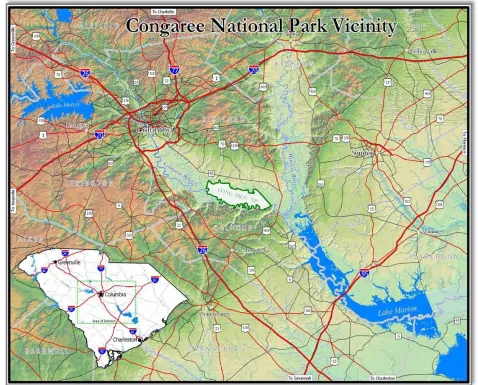
The focus of this thesis is Congaree National Park, which is located about 20
miles (32km) southeast of Columbia, SC (Figures 3.1 & 3.2). Congaree NP encompasses
approximately 24,230 acres (9,806 ha) of land, including around 11,000 acres (4,452 ha)
of old-growth forest and the largest intact stand of old growth bottomland hardwood
forest in the southeastern United States. The park thus represents a unique
environment with a well-preserved, biologically-diverse and dynamic river floodplain
ecosystem. The park is also special in that it contains one of the highest forest canopies
in the southeastern United States, with a number of national and state champion trees
(Jones, 1997). Most park lands are densely forested and lie within the primary river
floodplain. A wide variety of forest communities are represented, with dominant tree
species ranging from upland pines to deepwater alluvial bald cypress and tupelo
swamps (Kupfer et al., 2010). The forest environment is characterized by silty clay soils,
oxbow lakes, swales and sloughs, and meandering creeks. The Congaree River and the
Wateree River are the major sources of floodwaters, sediment, and nutrients delivered
to the park, although several tributary creeks also flow into and across park boundaries
16
Congaree NP is known and recognized both nationally and internationally for its
ecological condition and high levels of floral and faunal biodiversity. It has received a
number of special designations during recent decades. Congress recognized the
‘Congaree Swamp’ as a National Natural Landmark in 1974, and the area was included in
the National Park System as Congaree Swamp National Monument in 1976. The
monument was later designated as an International Network of Biosphere Reserve
(1980), a Wilderness Area (1988), and a Globally Important Bird Area (1988). In 2003, it
was recognized as the nation's 57th National Park (CNP RMP, 2004), and in 2012, it was
designated as a Ramsar Wetland of International Importance.
Beyond the list of designations for the terrestrial and wetland areas
encompassed by the park, the National Park Service listed the Congaree River in a
Nationwide Rivers Inventory as possessing scenic, recreational, geologic, fish, wildlife,
historic, and culturally outstanding values in 1982 (CNP RMP, 2004). In 2006, the waters
within Congaree were reclassified as “Outstanding Resource Waters”, and portions of
Cedar Creek were reclassified as “Outstanding National Resource Waters” by the South
Carolina General Assembly (Mallin & Mclver, 2010).
As stated in the enabling legislation, Congaree NP (under its previous name,
Congaree Swamp National Monument) was established “… to preserve and protect for
the education, inspiration, and enjoyment of present and future generations an
outstanding example of a near-virgin, southern hardwood forest situated in the
Congaree River flood plain in Richland County, South Carolina” (H.R. 11891--94th
17
“Congaree National Park was established to assure the preservation, conservation, and
protection of the natural, scenic, hydrologic, floral and faunal, and recreational values of
the Congaree River floodplain and to provide for the enhancement and public
18
19
20
CHAPTER 4
METHODOLOGY
4.1
O
VERVIEW OF THEO
RIGINALS
TANDARDM
ETHODOLOGYThe research was conceptually based on The Protected Areas Benefit
Assessment Tool (PA-BAT), a methodology developed by the World Wide Fund for
Nature through the support of the World Bank to collate and build information about
the overall benefits from protected areas (Stolton & Dudley, 2009). The PA-BAT has
been designed to identify values and benefits that protected areas bring to a range of
stakeholders, from local to global. It is a questionnaire-type assessment tool consisting
of the following nine main groups of value-based datasheets which are completed by
key stakeholders to the target protected area: (i) Nature Conservation Values; (ii)
Protected Area Management Values; (iii) Values related to Food; (iv) Values related to
Water; (v) Cultural and Spiritual Values; (vi) Health and Recreation Values; (vii)
Knowledge; (viii) Environmental Services; and (ix) Materials. The methodology, which is
relatively new, has been tested by Equilibrium Research and WWF and also has been
applied in Turkey, Slovenia, Croatia, Montenegro, Bosnia and Herzegovina, and Albania,
among others. Also, a modified and shortened version of the methodology is being used
for all Natural World Heritage sites as a part of IUCN`s World Heritage Outlook
21
Each group of value-based datasheets has a set of main guiding questions. These
questions attempt to provide thematic understanding of the protected area’s value and
reveal the main benefits of the protected area to a wide range of stakeholders:
Group 1 - Nature Conservation Value: Is the protected area valued for its nature conservation?
Group 2 - Protected Area Management Value: Does management of the protected area provide jobs (e.g. for managers, rangers etc.)?
Group 3 - Values Related to Food: (i) Is the hunting of wild game permitted in the protected area? (ii) Is the use of wild food plants permitted in the protected
area? (iii) Are fisheries (permissible fishing and/or contribution to fish stocks by
protecting spawning area) an important resource in the protected area? (iv) Is
traditional agriculture (i.e. use of locally adapted crops (landraces) and/or
practices) undertaken legally in the protected area? (v) Is livestock grazing and
fodder collection permitted in the protected area?
Group 4 - Values Related to Water: Are non-commercial water use (e.g. subsistence agriculture, drinking, washing and/or cooking) or commercial water
use (e.g. for large-scale irrigation, waterways, bottling plants, hydro-electric
power or municipal drinking water source) permitted in the protected area?
Group 5 - Cultural and Spiritual Value: (i) Does the protected area have cultural and historical values (e.g. archaeology, historic buildings including temples,
pilgrimage routes and/or historic/culturally important land use patterns)? (ii)
22
groves, waterfalls and/or mountains)? (iii) Does the protected area contain
wilderness values or other similar iconic values?
Group 6 - Health and Recreation Value:(i)Is the collection of medicinal resources (e.g. herbs) for local use or for the pharmaceuticals industry permitted from the
protected area? (ii) Is the protected area important for recreation and tourism?
Group 7 – Knowledge: (i)Is the protected area an important resource for building knowledge? (ii) Does the protected area contribute to education (i.e. formal and
informal dissemination of information)? (iii) Is the collection of genetic material
(e.g. crop wild relatives, tree species) permitted from the protected area?
Group 8 - Environmental Services: (i) Can the protected area contribute to climate change mitigation (e.g. by providing significant carbon sequestration or
by ameliorating local climate impacts)? (ii) Is the protected area important for
soil stabilization (e.g. avalanche prevention, landslide and erosion)? (iii) Is the
protected area important for coastal protection (e.g. mangroves, sand dunes,
coral reefs)? (iv) Is the protected area important for flood prevention (e.g.
mitigation in small watersheds, flood plains and wetland protection)? (v) Is the
protected area important for water quality and quantity (e.g. filtration,
groundwater renewal, maintenance of natural flows)? (vi) Is the protected area
an important resource for pollination of nearby crops or for pollination products
such as honey?
23
materials (e.g. coral, shells, resin, rubber, grass, rattan, minerals, etc) permitted
from the protected area?
For each value, the assessment generally considers the following six issues: (i)
who benefits; (ii) what benefits are supplied; (iii) what portion of the protected area
provides the benefit; (iv) what is the economic value of the provided benefit, if it was
assessed; (v) are activities relating to the particular value / benefit consistent with the
area’s management objectives, and (vi) what type of management is currently taking
place in relation to these values/benefits and what additional management responses
are needed. The assessment form also provides users with an opportunity to add any
other significant information related to the particular value / benefit.
Although the PA-BAT includes the option to record economic information, the
primary purpose of the tool is to record the types of benefits provided by the protected
area and to whom they are provided, and not necessarily to put an economic value on
these benefits.
4.2 O
VERVIEW ANDA
PPLICATION OF THEA
DAPTEDM
ETHODOLOGYAs the PA-BAT has been developed to use globally for all protected area types
(e.g. in all IUCN management categories) and in any biome, the range of values and
benefits they provide is necessarily generic, and not all will apply to every protected
areas. Thus, in case of necessity, the PA-BAT can be simplified and adapted before use
to make it more relevant to a specific site or particular system of protected areas.
In this research, the PA-BAT methodology has been simplified and adapted to
24
potential values and benefits. As a result, a number of value groups were reduced, and
the content of value-based datasheets was modified. In particular, potential values and
benefits of Congaree NP were divided under the following six groups: (i) Biodiversity
Conservation Value; (ii) Management Value; (iii) Cultural, Historical and Spiritual Value;
(iv) Recreational Value; (v) Scientific, Knowledge and Educational Value; and (vi)
Regulating Services Value, which included climate regulation, flood storage and control,
water quality protection, erosion control / soil stabilization, and coastal protection.
The modified value-based datasheets covered the following issues to be
completed by experts: (i) key data and information about the particular value or benefit
of the park; (ii) key literature sources to be addressed for more detailed information; (iii)
other key experts to be contacted for more specific knowledge and experience for the
particular value or benefit; (iv) economic value of this benefit, if it has been assessed;
and (v) any additional information, caveats, or details necessary to consider while
identifying values and benefits of Congaree NP (Appendix A).
Following the adapted PA-BAT methodology, two-phase approach was used to
gather and synthesize information about the potential values and benefits of Congaree
NP:
1. Input from experts and stakeholders familiar with the park was gathered through
completion of the value-based datasheets. To do so, the value-based datasheets
were sent to 22 key experts representing current and former park managers and
staff as well as scientists and private citizens with extensive park-based
25
considered while sending the value-based datasheets. Of these experts, 12
participated and provided their professional feedback about values and benefits
of Congaree NP by completing the datasheets (Appendix B).
2. Key values and benefits of Congaree NP were then identified: (i) by summarizing
the experts` contributions as provided in the completed value-based datasheets,
and (ii) through an extensive review of corresponding literature and
research-based documentary materials (books, articles, reports, analysis, assessments,
reviews and legal documents) about potential values and benefits of Congaree
26
CHAPTER 5
RESULTS
5.1
I
NTRODUCTIONThe wide range of ecosystem values discussed in Chapter 2 is provided by nature
throughout the world. However, not all ecosystems provide all those services, and some
services are more predominant in certain ecosystems. The effectiveness and level of
provided services is very much ecosystem and area specific (Hawkins, 2003) and
depends on the geological, ecological and hydrological characteristics and management
approaches of the particular area. Besides, many provided services are functionally
connected and depend on each other. For example, the conservation of biological
diversity is important for providing genetic resources, food, medicine, and raw materials
while the nursery function is invaluable to many endangered species as well as for
economically important harvested species. Close relationships among provided services
clearly demonstrate that the ecosystems need to be considered and managed as an
integrated unit even from the perspectives of benefits to the society.
In this chapter, I first provide a brief overview of functions and values of
bottomland hardwood forest and then present key values and benefits of Congaree NP
27
5.2
O
VERVIEW:
F
UNCTIONS ANDV
ALUES OFB
OTTOMLANDH
ARDWOODF
ORESTSFloodplain ecosystems are a definitive feature of the Coastal Plain in the
southeastern United States, where they consist mainly of bottomland hardwood forests
and other associated wetlands, rivers and streams (King et al., 2009). Bottomland
hardwood communities support distinct assemblages of plants and animals that are
associated with particular landforms, soils, and continuous hydrologic regime of the
functioning ecosystem (Wharton et al., 1982). As the ecosystem at the dynamic
boundary between aquatic and terrestrial systems, forested wetlands demonstrate the
classic “edge effect” with high species abundance and diversity. Bottomland hardwood
forests have relatively high plant productivity, which is reflected in their high carrying
capacity for some fish and wildlife species (Taylor et al., 1990).
It has been estimated that bottomland hardwood forests covered 11.8 million
acres of the Mississippi Alluvial Plain in 1937, but by 1977, this cover had been reduced
to 5.2 million acres (Clark & Benforado, 1981). Changes in coverage of southern
bottomland hardwood areas was calculated for the period from 1960 through 1975, and
the average annual net loss was about 431,000 acres (175,000 ha). During this period,
three states – Alabama, Florida, and Kentucky - gained acreage while major losses
occurred in Arkansas, Georgia, Louisiana, Missouri, North Carolina, South Carolina and
Virginia (Turner et al., 1981). A large part of the forest area lost in the southern United
States from 1962 to 1970 was bottomland hardwoods (Kellison & Young, 1997). Much of
the loss of bottomland hardwood forests occurred due to clear cutting and drainage for
28
wetlands, in turn, can result in the loss of functions and values provided by these
ecosystems (Taylor et al., 1990).
In the scientific literature, functions and values of bottomland hardwood forests
are often discussed from the same perspective, but contextually, they differ. According
to accepted definitions, functions are “characteristics of the bottomlands in the absence
of any consideration of their importance to humans” (Taylor et al., 1990: 29) while
values are “those benefits derived from the functions of bottomland hardwood
wetlands” (Taylor et al., 1990: 56) or “characteristics of bottomlands that happen to
provide benefit to current human needs” (Taylor et al., 1990: 29). Thus, bottomland
forest values may change following changes in society`s perception and technology
development while the functions of the forest remain the same in the absence of
anthropogenic impact (Harris & Gosselink, 1990).
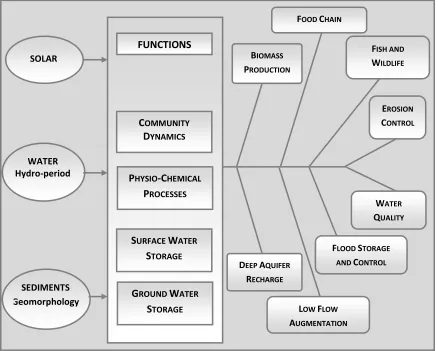
The functions of bottomland hardwood forests can be divided into four
categories: (i) community dynamics; (ii) physio-chemical processes (e.g., the deposition
of sediments, retention of nutrients and toxins, and biochemical transformations); (iii)
surface water storage through floodplain structure, vegetation cover and soil types; and
(iv) groundwater storage (Taylor et al., 1990; Harris & Gosselink, 1990). The ecological
functions of bottomland hardwood forests lead to the following values: (i) biomass
production; (ii) downstream food chain support through the export of organics; (iii) fish
and wildlife habitats that also provide recreation services; (iv) erosion control; (v) water
quality protection; (vi) flood storage and control; (vii) climate regulation; (viii) low flow
29
values of bottomland hardwood forests are closely linked to healthy functioning of
these systems (Figure 5.1).
Figure 5.1: Relationship between functions and values of bottomland hardwood forest (source: Taylor et al., 1990).
From the above listed values of bottomland hardwood forests, only values of
those regulating services applicable to Congaree NP will be discussed in more detail
below. Functions and values of bottomland hardwood forest ecosystems are
increasingly recognized, and they have been discussed to some extent in a number of
publications. However, the discussion below is mainly based on Taylor et al. (1990) and
Harris & Gosselink (1990) because these papers provide generalized processual basics of
SOLAR ENERGY E WATER Hydro-period SEDIMENTS
Geomorphology GROUND WATER STORAGE
SURFACE WATER
STORAGE
PHYSIO-CHEMICAL
PROCESSES COMMUNITY DYNAMICS FUNCTIONS BIOMASS PRODUCTION
FOOD CHAIN SUPPORT
FISH AND WILDLIFE HABITAT EROSION CONTROL WATER QUALITY PROTECTION
FLOOD STORAGE AND CONTROL
LOW FLOW
AUGMENTATION
DEEP AQUIFER
30
functions and values of specifically bottomland hardwood wetlands ecosystems and are
not linked to any particular target area.
5.2.1 WATER QUALITY PROTECTION
Wetlands are known to be effective in water purification through removal of
excess nutrients, sediments, metals and other pollutants from upland runoff and surface
water. Bottomland hardwood forests improve water quality in different ways and with
varying levels of success. During periods when the forest is not flooded, runoff is filtered
as it flows slowly through the bottomland area. Forested wetlands effectively convert
inorganic nitrogen and phosphorus into organic forms. Nutrients are adsorbed on the
forest floor, taken up by the forest vegetation and then released as organic plant
detritus, which also constitutes a food source for organisms. Nutrients are retained by
sediments, indefinitely when sediments are buried (Taylor et al., 1990; Harris &
Gosselink, 1990).
The protection and improvement of water quality depends not only on
vegetative uptake, biochemical transformation, and sediment deposition but also on the
hydrology of the particular area. Nutrient retention may be temporary over a period of
years with storage in woody biomass, or it may be seasonal, with storage in
spring-summer and release in fall-winter (Taylor et al., 1990). As for toxic materials such as
heavy metals and chlorinated hydrocarbons, the primary ways for their removal is
through adsorption onto suspended solids. Metals are active under anaerobic
conditions but will remain trapped in the sediments if an aerobic surface layer is present
31
done about a role of bottomland hardwood forests in metal removal (Taylor et al.,
1990).
5.2.2 FLOOD STORAGE AND CONTROL
One of the main values of forested floodplains is flood storage and control. The
functional abilities of floodplain wetlands to slow floodwater velocities and temporarily
store water are crucial for this value provided to society (Taylor et al., 1990; Harris &
Gosselink, 1990), although the value of a forested floodplain for flood storage and
control needs to be determined on an individual basis. In some watersheds, wetlands
may play a crucial role in flood control while in others the flood prevention value would
not override the value of various land-uses on the floodplain (Adamus & Stockwell, 1983
cited by Taylor et al., 1990). There are two main approaches to determine the flood
prevention capacity of a particular floodplain: (i) actual measurement of water storage
capacity through detailed field studies of inflows and outflows, and (ii) developing
mathematical models with realistic coefficients for different wetland types which could
be further applied to each individual case considering the wetland type (Taylor et al.,
1990).
5.2.3 EROSION CONTROL
Floodplain areas (and especially forested wetlands) significantly contribute to
stabilizing land masses and protecting downstream embankments through surface
water storage and by reducing water-flow velocities. However this value of floodplain
32
floodplains to control erosion have focused on how floodplain vegetation acts to hold
soils (Taylor et al., 1990).
The biotic community of bottomland hardwood wetlands contributes to erosion
prevention by: (i) reducing wave energy and current velocity through friction against the
plant structure, and (ii) binding the sediments by vegetation root systems (Adamus &
Stockwell, 1983 cited by Taylor et al., 1990). Bottomland hardwood wetlands also
protect erodible uplands adjacent to the wetlands because less water with lower
current velocity reaches the upland areas. At the same time there are scientific concerns
that some types of wetlands may contribute occasionally to downstream erosion
through filtering out sediments which, itself, increases the sediment carrying capacity of
the water (Taylor et al., 1990).
5.3 K
EYV
ALUES ANDB
ENEFITS OFC
ONGAREEN
ATIONALP
ARKAs it was mentioned above key values and benefits of Congaree NP were
identified based on the experts` contributions as provided in the completed value-based
datasheets and through an extensive review of corresponding literature and
research-based documentary materials recommended by experts. A major part of this discussion
about potential values and benefits of Congaree NP is based on corresponding literature
and research-based materials while a certain part of results, for which the literature was
limited, heavily borrows from experts` contribution. Appendix C presents quotes from
33 5.3.1 KEY BIODIVERSITY CONSERVATION VALUE
FLORAL DIVERSITY: A vegetation classification for the park identified twenty-two
vegetative associations, including twenty forest associations, one woodland association,
and one shrubland association. Twelve associations were newly described plant
associations, and one was a broadly defined upland successional forest (The Nature
Conservancy, 1998). This diversity of habitats is matched by high floral diversity.
According to the most recent data of the National Park Service Inventory and
Monitoring Program, around 855 vascular plants species are represented within the
Park (NPS IMP, 2013). Thus, as Gaddy et al. (2000: 2) noted: Congaree NP “is probably
one of the most diverse assemblages of forest communities in North America. The
richness of the woody flora … is surpassed in North America only by the Great Smoky
Mountain National Park.”
CHAMPION TREES AND TALLEST CANOPY:Another distinguishing feature of Congaree
NP is its richness in big champion and tallest trees (Bronaugh, 2009). In 1997, 29 state
champion trees representing 25 species, and 4 national champion trees representing 3
species were identified (Jones, 1997). There are currently six national- and 29
state-champion trees in Congaree NP (Bronaugh, 2009). In the park, even non-state-champion trees
are notably large and tall. Congaree NP contains one of the tallest broad-leaved forest
canopies in North America (Jones, 1997), has the greatest concentration of tall trees in
eastern North America, and is among the tallest broad-leaved forests in the world (CNP
34
FAUNAL DIVERSITY: The richness, diversity and productivity of ecosystems at
Congaree NP provide a range of habitats that contribute to a remarkably rich faunal
diversity. There are roughly 46 mammal species (Byrne & Lagana, 2009; Loeb, 2006) and
around 60 fish species in the park (NPS IMP, 2013). Sixty native reptile and amphibian
species (Tuberville et al., 2005) and 191 bird species (Carter, 2005) have also been
recorded within the park. Thirty-two species of recorded reptiles include one crocodilian
(the American alligator), 19 snakes, five lizards and seven turtles while twenty-eight
recorded amphibian species include twenty frogs and toads and eight salamanders. As
noted by Tuberville et al. (2005) such high taxonomic richness of amphibians and
reptiles within the park is strongly supported by the size and high diversity of habitat
types.
RARE,THREATENED AND ENDANGERED FAUNA AND FLORA:Congaree NP plays a critical
role in the preservation of rare, threatened and endangered species as the park protects
and supports plant assemblages typical of increasingly rare old-growth forest
ecosystems (CNP RMP, 2004). Although there are no known federally-listed rare,
threatened or endangered plant species currently occurring within Congaree NP, there
are nine vascular plant species listed as Species of Concern by the State of South
Carolina (Mallin & Mclver, 2010). The federally endangered red-cockaded woodpecker
(Picoides borealis) was known to have active colonies within a small portion of the park
as late as 1996, and the federally threatened bald eagle (Haliaeetus leucocephalus) is an
occasional visitor. Observations of the federally endangered eastern cougar (Puma
35
contains some of the best remaining potential habitat for two critically endangered (and
possibly extinct) species, the ivory-billed woodpecker (Campephilus principalis) and
Bachman’s warbler (Vermivora bachmanii) ( CNP RMP, 2004; USFWS, 2013).
5.3.2 REGULATING SERVICES VALUE
Regulating services of the Congaree floodplain were recognized by scientists
decades ago. Charles Wharton, a professor of Biology at Georgia State University who
was one of the first scientists studied the ecology of swamp forests in the 1960s-1970s,
considered the floodplain as “a laboratory for the future welfare of the common man”
(Sierra Club, 1975: 110) and “a resource that we all need and use since it involves such
things as drinking water and tertiary sewage treatment” (Sierra Club, 1975: 109).
However, after conducting a literature search for studies that address the regulating
services of Congaree NP, it became obvious that little specific information existed.
Available reports about hydrology, water resources assessment and management, water
quality, soils, and flood modeling do not directly address and set forth values of
regulating services of Congaree NP. For this reason, this section of the research borrows
heavily from the knowledge, experience and opinion of experts who have been working
with Congaree NP and have been investigating ecosystems of the park. Based on the
expertise of these experts and through review of the limited research materials, the
following values of key regulating services provided by Congaree NP have been
identified: (i) Climate Regulation; (ii) Flood Storage and Control; (iii) Water Quality
36
CLIMATE REGULATION:Experts generally consider the Congaree River floodplain as
a major carbon storage area. Congaree NP protects an old-growth floodplain forest and
thus supports a biologically diverse, structurally complex, and abundantly dense forest
that provides significant carbon sequestration in the region (Appendix C - experts`
evaluation, 2013: John Kupfer, Kimberly Meitzen, Theresa A. Thom, Rebecca R. Sharitz,
Terri Hogan, & William L. Graf). Because Congaree NP contains both deciduous (e.g.
bottomland hardwoods and cypress-tupelo) and evergreen (e.g. pine and palmettos)
plant diversity, it is especially important to annually permanent carbon sequestration
from the atmosphere. In addition, the park provides significant terrestrial carbon
sequestration service through accumulation of organic materials in soil development,
particularly in the rim-swamp peat deposits. As for source-sink dynamics, the terrestrial
and aquatic sequestrations are closely linked to each other through flooding which
supports the exchange of carbon between the floodplain and river (Appendix C –
expert`s evaluation, 2013: Kimberly Meitzen).
There is very limited study assessing the contributions of Congaree NP to climate
regulation and climate change mitigation. Preliminary results of a 2012 study on the
spatial variability of soil carbon in park environments demonstrated that bottomland
hardwood wetlands ecosystems play a key role in storing carbon (Ricker et al., 2012).
According to results of the study, wetland soils stored significantly more carbon in the
upper 1 m and had a greater carbon percentage at the 1-2 m depths than non-wetland
soils, while root carbon stocks were much greater on the drier floodplain landscapes. On
37
data suggest, root carbon stocks are minor when compared to wetlands soils carbon
stocks. Also, deep soil (below the upper 1m) carbon storage is a very significant function
of the floodplain (Ricker et al., 2012).
In addition to carbon sequestration, the park is important for regulating local
microclimate. Due to its flooding and precipitation patterns, the park area and its
vicinity maintain lower temperature in comparison with the surrounding metropolitan
and developed areas (Appendix C - experts` evaluation, 2013: John Kupfer & Terri
Hogan).
FLOOD STORAGE AND CONTROL: There is extensive research on flood processes in
Congaree NP as well as about the significance of flooding for maintenance of functioning
ecosystem within the park. However, there is no specific research that discusses the
water storage capacity of the park and its value in terms of flood prevention.
According to experts` opinion, Congaree NP floodplain has the capacity to retain
and store a large amounts of flood water on a temporary basis because: (i) the park
encompasses quite large area and over 90% of the park is covered by wetlands; (ii) the
park locates just below the Fall Line and at the confluence of the Broad and Saluda
Rivers; and (iii) the park is characterized with a complex web of water channels which
distribute water and sediment throughout the park area. Since the majority of the park’s
total area functions as temporary flood water retention and storage, it may be
particularly important for flood prevention during large floods that inundate the lower
valley from main stem flooding while also providing flood prevention from smaller, local
38
R. Sharitz & Terri Hogan). “Congaree NP’s capacity to absorb flood waters and provide
flood prevention is one of its critical benefits to society” (Appendix C – expert`s
evaluation, 2013: Kimberly Meitzen).
WATER QUALITY PROTECTION:Based on expert evaluations, Congaree NP serves as
a catch basin for sediments and other pollutants coming from upstream development
areas. Due to its location at the confluence of the Wateree and Congaree Rivers,
Congaree NP could play a key role in removing pollutants and filtering water. The
forested land cover, floodplain depositional features and wetland characteristics of
Congaree NP are important for filtering and improving water quality as well as for
providing natural patterns of water availability/quantity through flooding and recession.
Because Congaree NP spans a hydrologically-sensitive hillslope-to-valley drainage
boundary, it is especially important for water quality protection benefits and recharging
the shallow water table for further floodplain forest uptake (Appendix C - experts`
evaluation, 2013: Kimberly Meitzen, John Kupfer, Theresa A. Thom, Rebecca R. Sharitz &
William L. Graf).
There is a lack of knowledge concerning the quantity of water stored and the
quantity of water purified by the Congaree NP floodplain forest ecosystem. Ongoing
research on water quality by the U.S. Geological Survey (USGS), the South Carolina
Department of Health and Environmental Control (SC DHEC), and the National Park
Service (NPS) may help to support an evaluation of the park`s contribution to water
purification. The USGS National Water Information System (NWIS) supports the
39
through this system is a part of the USGS investigations of the occurrence, quantity,
quality, distribution, and movement of the surface and underground waters that
constitute the nation's water resources. This system operates at 16,887 sites in South
Carolina and provides access to inventory information about sites at stream reaches,
wells, test holes, springs, tunnels, drains, lakes, reservoirs, ponds, excavations, and
water-use facilities (USGS NWIS, 2013).
The SC DHEC implements a Watershed Water Quality Assessment program for all
of the 8-digit sub-watersheds in the state. One of the major products of this program is
a watershed water quality assessment that discusses components of water chemistry,
biological monitoring, physical characteristics, natural resources, growth potential,
potential nonpoint source contributions and point source discharges (SC DHEC, 2013).
Since 1993, the NPS has implemented the Baseline Water Quality Data Inventory
and Analysis Project to provide descriptive water quality information to every national
park unit. The project retrieves water quality and related data from the Environmental
Protection Agency's database, develops a complete descriptive inventory, and reformats
the water quality and other related data for use with the park-based Water Quality Data
Management System. In the context of this project, Congaree NP received its Baseline
Water Quality Data Inventory and Analysis Report in 1998 (NPS, 2013a).
More locally, assessment of water resources and watershed conditions in
Congaree NP was carried out in 2010 by Mallin & McIver (2010), who gave background