Polynomials
Gizem S. C¸ etin1and Berk Sunar1
Worcester Polytechnic Institute
{gscetin,sunar}@wpi.edu
Abstract. In this paper we propose a rank based algorithm for sort-ing encrypted data ussort-ing monomials. Greedy Sort is a sortsort-ing technique that achieves to minimize the depth of the homomorphic evaluations. It is a costly algorithm due to excessive ciphertext multiplications and its implementation is cumbersome. Another method Direct Sort has a slightly deeper circuit than Greedy Sort, nevertheless it is simpler to im-plement and scales better with the size of the input array. Our proposed method minimizes both the circuit depth and the number of ciphertext multiplications. In addition to its performance, its simple design makes it more favorable compared to the alternative methods which are hard to parallelize, e.g. not suitable for fast GPU implementations. Further-more, we improve the performance of homomorphic sorting algorithm by adapting the SIMD operations alongside message slot rotation tech-niques. This method allow us to packN integers into a single ciphertext and computeN comparisons at once, thus reducingO(N2) comparisons toO(N).
Keywords: Private computation, encrypted computing, fully homomorphic en-cryption, homomorphic sorting
1
Introduction
Blind sort is basically arranging a set of encrypted integers in order by using a somewhat, leveled or Fully Homomorphic Encryption (FHE) scheme [1–7,10, 11, 13–16, 19, 23, 26] without knowledge of neither the plaintext data or the secret key used in encryption. The operations do not require decryption either. The crucial drawback of using FHE schemes in practice is their poor performance in high-level computations due to the high noise growth at the end of deep circuit evaluations. Most recent FHE schemes make use of noise reduction techniques in order to overcome this problem by setting the FHE parameters to evaluate only up to a certain depth. As a result, deep circuits require large parameters and they perform poorly.
and Odd-Even Merge Sort [21]. Due to the high depths of known algorithms, the authors propose two new depth-optimized methods: Greedy Sort and Direct Sort. Both of these algorithms require a circuit of depthO(log(N) + log(`)) whereN is the number of elements and ` is the bit-length of the elements. Other en-crypted sorting works in the literature are of Chatterjee et al. [9] and Emmadi et al.’s [12]. In [9], the authors introduce a hybrid technique, i.e. Lazy Sort. This method first uses Bubble Sort to nearly sort the input elements. Then, the list is sorted again by using Insertion Sort. The authors claim that this method has better complexity than the worst case scenario. This is refuted by both [8] and [12]. Emmadi et al. implements and compares Bubble Sort, Insertion Sort, Bitonic Sort and Odd-Even Merge Sort in [12] and their observations are par-allel with the analysis of [8]. Recently, Narumanchi et al. compared bitwise and integer-wise encryption within the context of comparison and sorting in [24]. Their analysis shows that it is more efficient to use bitwise encryption in terms of performance. All of the previous works still perform poorly in case of sorting a large data set. In the experiments, the largestN used is around 64.
The main contribution of this work is proposing an alternative way of sorting numbers by computing the Hamming weight ofN bits with only N ciphertext multiplications. In comparison to our proposed method with O(N) multipli-cations, Direct Sort and Greedy Sort require O(NlogN) andO(2N) multipli-cations, respectively. Our algorithm implements Direct Sort method with the minimum number of operations. We observe that our proposed method is also a compact implementation of Greedy Sort. Therefore, it both minimizes the cir-cuit depth and the number of homomorphic evaluations. Furthermore, efficient evaluation of the Hamming weight can be used in many other homomorphic applications. In addition to performance improvements, the proposed algorithm is easier to analyze and implement in comparison to previous methods. Even when batching is not applicable, the highly parallelizable nature of the algo-rithm makes it an efficient candidate for a GPU implementation. Our sorting method is generic and can be implemented with existing software libraries, e.g. HElib [20], SEAL [22].
2
Background
Following a similar notation to [17,18,25], we define the plaintexts with lowercase lettersa∈Ap, batched plaintexts with Greek lettersα∈Apand the ciphertexts with uppercase letters A ∈ Aq where Ap = Zp/Φm(X) and Aq = Zq/Φm(X). We use primep, q in our scheme andΦm(X) is themth cyclotomic polynomial. Given two ciphertextsA, Bthat are encrypted under an FHE scheme, computing A+B andA×B in Aq gives us encryptions ofa+b anda×bin Ap.
When a numberahaskbase-pdigits, we use an array index notation to rep-resent its digits [a0, a1,· · ·, ak−1] anda=Pk−1i=0 piai. An encryption ofawould be a vector of ciphertexts with encryptions of its digits, i.e. [A0, A1,· · ·, Ak−1]. When there is a list of numbers, we use the double-indexed positioning with the first one being the number’s position and the second one is for the digit’s index. For instance, a plaintextαi,jis thejthdigit of theith number and similarlyAi,j is an encryption of thejth digit of theith number.
2.1 Batching and Rotation of the Message Slots
From [25], we know that with specific parameters we can enable batching, a technique that is used for parallel evaluations in the message slots. For example, when we choose the cyclotomic polynomial with m that divides pd−1 with smallest suchd, we have the factorization,
Φm(X) = ` Y
i=1
Fi(X) modp
where Fi’s are `= φ(m)/d irreducible polynomials of degree d. Then we have the isomorphism in between the plaintext space and the`copies ofFpd.
Ap∼=F p[X]
F1
⊗ · · · ⊗Fp[X]
F`
We define a vector with `messagesα=hα1,· · · , α`iwith eachαi belonging to the fieldLi = Fp
[X]
Fi . Applying inverse Chinese Remainder Theorem (CRT), we
derive a single message inAp. We write this as: α=CRT−1(hα1,· · · , α`i)
with αi ∈ Li and α∈ Ap. We say the plaintext has ` message slots and each message is packed in a single slot. Additions and multiplications over CRT plain-texts will be evaluated in each slot due to the natural isomorphism. For example given another plaintextβ=CRT−1(β), we have
with αi? βi ∈Li and ?∈ {+,×}. In some applications, we need to do compu-tation across message slots, i.e. αi? βj where i 6= j. To this end, we permute the message slots so that messageiand messagejaligns. Due to the relation in between the factors of the cyclotomic polynomial, the automorphism
κg:α(X)7−→α(xg) modΦm(X)
for agthat is not a power of 2 in (Z/mZ)∗with order`performs a permutation. To see why this works and for the underlying Galois field theory we refer readers to [17].
2.2 Problem Definition and Existing Algorithms
Encrypted Sorting Problem:Given an unordered set of encrypted elements
{A0, A1,· · ·, AN−1}, we want to find an ordered set of encrypted elements
{B0, B1· · ·, BN−1} where the decrypted list {b0,· · · , bN−1} is a permutation of{a0,· · ·, aN−1} with nondecreasing order, i.e.b0≤b1≤ · · · ≤bN−1.
In the following part of this section, we will briefly describe the previously proposed methods to solve the encrypted sorting problem. Before the algorithm descriptions, we shall define a comparator. In order to sort a set of elements, we need to be able to compare two numbers with respect to their magnitude. In [8], where the input elements are bitwise encrypted, this comparison is converted to a binary circuit as follows1:
AlB=
k−1 X
i=0
(Ai⊕1)Bi k−1
Y
j=i+1
(Aj⊕Bj⊕1) (1)
whereAi, Biare the encryptions ofithbit ofkbit numbersaandb, respectively. The decryption ofAlB outputs a 1 ifa < band a 0 otherwise.
Greedy Sort In [8], authors propose Greedy Sort as an alternative method to classical sorting algorithms, due to its low circuit depth. However, due to the algorithm’s exhaustive nature, the method is not efficient when implemented without optimizations. In this section, we describe the algorithm and later in Section 3, we propose our optimization that minimizes the total number of ci-phertext multiplications.
Greedy Sort works by computing every possible permutation of the input set. In order to find the minimum element b0, one needs to compare eachai to every other element in the set. If it is smaller than all ajs wherei6=j, then we can conclude it is the smallest element and set b0 =ai. Similarly, in order to find the next smallest element b1, we need to compare every ai to every other element and if it is smaller than all but one, then we know that it is the second
1
minimum and setb1=ai. We can follow the same idea until the last element of the sorted arraybn−1 which is the maximum element is found.
This method requires comparison of every pair in the set, thus the initial step is to build a matrixM that holds the comparison outputs. Entries of this matrix, let them beMi,js are evaluated using the binary circuit given in Equation 1 such thatMi,j=AilAj. Here, note thatMi,js andMj,is naturally complement each
other2 and Mi,is are always zero. ThereforeMi,js are only evaluated fori < j. Given the comparison matrix, the ordered elements are computed as follows:
Br=θr,0A0+· · ·+θr,N−1AN−1= N−1
X
i=0 θr,iAi
where
θr,i= N−r−1
X
k1=0 k16=i
Mk1,i · · · N−1
X
kr=kr−1+1 kr6=i
Mkr,i
N−1 Y
j=0 j6=i j6=k1,···,kr
Mi,j . (2)
θr,i values can be seen as the binary place indicators or a decision flag that indicates whether the inputAi will be mapped to output Br. In other words, if the inputAihas the rankr, it is an encrypted one. This requires computation of allθr,is fori, r= 0,· · ·, N−1, thus making the method inefficient. The Greedy Sort algorithm steps can be seen in Appendix C of [8].
Direct Sort In the same work [8], the authors propose another low-depth method for sorting, i.e. Direct Sort. The algorithm implements Rank Sort in the homomorphic setting. The first step is constructing the same comparison matrix M as in Greedy Sort. Then, it computes the ranks by performing a column-wise summation of the entries of M. Since the elements of M are bits, the summation result gives the Hamming weights of the columns ofM. It is im-plemented using a Wallace Tree of depth O(log3/2N). The challenge is having the rank values encrypted after this step. This requires an additional homomor-phic equality check to place the elements in the output in an ordered manner. This equality check is performed on rank values which are logN bit numbers, hence requires a homomorphic evaluation of depth log logN. The method can be found in Algorithm 1 in [8].
3
Our Proposal: Polynomial Rank Sort
In a nutshell, the idea is to use the rank of an input as the degree of a monomial –which we call arank monomial– and place the input element in the coefficient of the monomial.
2
Definition. Given an input set {a0, a1,· · ·, aN−1} with N elements, let ri be the rank ofai in the set, we callρi(x) =xri therank monomial of integerai. Claim.If we can find the rank monomials{xr0, xr1,· · ·, xrN−1} of all of the set elements, then we can have an output polynomial with input elements lined up in its coefficients with respect to their rank:
b(x) = N−1
X
i=0
aiρi(x) = N−1
X
i=0 aixri
=b0+b1x+· · ·+bN−1xN−1 withb0≤b1≤ · · · ≤bN−1.
Proof Sketch. To see why this works, note that the ranks of the inputs are a permutation of natural numbers in the range [0, N−1]. Thus, there is a bijective mapping in between theiandrivalues. The same mapping gives us the ordered permutation of the input elements, i.e. bri =ai. Bijection ensures the exclusive
positions of each input element in the output polynomial.
Challenge.Implementing this method on private data has two challenges: find-ing the ranks of encrypted inputs and placfind-ing the encrypted rank values in the exponent. In the following section, we propose a solution to this problem.
3.1 Finding Rank Monomials
In order to show how the algorithm works, first we assume that the inputs are not encrypted. After demonstrating the steps of the method, we show how to implement it for encrypted data, i.e. by using only homomorphic operations.
We shortly describe the method as follows: For anN-element input set, we start by finding the zero-based rankings in each 2-subset, being either 0 or 1. We start by constructing surrogate monomials using these ranks. Then, we merge the subsets by performing polynomial multiplication among the surrogates. At the end, this gives us the rank monomials of each input element.
Initially, we consider the base case: an input set with only two elements{a, b}. We say the rank of aisra and rank ofb isrb with the rank monomials defined as:
ρa(x) =xra and ρb(x) =xrb .
If, for instance, the input elements have the relationa < b, then we can write ra= 0 and rb= 1 and ρa = 1,ρb=x, respectively.
Now, we include a third elementcin the input set. In this case, the first step is to find the ranks in each 2-subset. We look at all two element subsets;{a, b},
{a, c}and{b, c} and define the following surrogate monomials: ρab(x) =xrab ρba(x) =xrba
whererijis the rank of inputiin the 2-subset{i, j}andρijis the rank monomial of the same element in the same subset. The next step is merging two subsets to find the final rank monomials. Multiplying two surrogates adjusts the degree of the rank monomial depending on the subset-wise rank values. When we want to find the rank monomial for a particular input, we multiply each surrogate that is pertinent to that element:
ρa=ρab·ρac=xrab+rac
ρb=ρba·ρbc=xrba+rbc
ρc=ρca·ρcb=xrca+rcb
Following the previous example witha < b, we fix the following relations and the partial rank monomials for the set where c < a < b:
a < b⇔ρab(x) = 1, ρba(x) =x c < a⇔ρac(x) =x, ρca(x) = 1 c < b⇔ρbc(x) =x, ρcb(x) = 1 Then the rank monomials will be:
ρa =ρab·ρac=x ρb=ρba·ρbc=x2 ρc=ρca·ρcb= 1.
If we examine the degrees of the monomials, we find that the ranks are:ra= 1, rb= 2 andrc= 0 which are consistent with the given relationc < a < b.
We now generalize this method to an N-element input set by defining the following surrogate monomials for each input elementai:
ρij(x) =xrij (3)
for all 2-subsets {ai, aj} that contain ai, i.e. ∀j ∈ [0, N−1] and j 6= i. Then, computing the product of all the surrogates would carry the overall rank of ai in the power of:
ρi(x) = N−1
Y
j=0 j6=i
ρij(x). (4)
The degree of ρi(x) is the rank of ai in theN-element set. This operation can be viewed as increasing the rank by one whenever an elementai is larger than another element. In other words, it is counting the number of smaller elements, i.e. the rank ofai.
performed in Direct Sort (see Algorithm 1 in [8]). In order to see this connection, we must first confirm that comparison matrix elementsmij and 2-subset ranks rij complement each other. This is because mij is the Boolean output of the comparisonai < aj, which is 1 if and only ifai is smaller than aj. Howeverrij is 0 in this case, since it is the smallest element in the same 2-set. Hence, rij and mij complement each other and we can assert thatrij =mji. We expand the product as in Equation 5 and notice that the summation in the exponent is equivalent to the Hamming weight of the columns ofM.
ρi(x) = N−1
Y
j=0 j6=i
xrij =x N−1
P
j=0 j6=i
rij
=x
N−1
P
j=0 j6=i
mji
(5)
Until now, we have showed that we can find the rank monomials given the base case surrogates by applying polynomial multiplication. In the following section we describe how to apply this method to encrypted input sets.
3.2 Finding Rank Monomials in the Encrypted Domain
In the encrypted domain, we have a set ofNencrypted numbers{A0, A1,· · · , AN−1}
by utilizing an FHE scheme. Recall that the first step of the proposed algorithm constructs the surrogates for all 2-subsets as in Equation 3. This requires find-ing the encrypted rankRij in set{Ai, Aj}. Hence we use the comparison circuit from Equation 1 and compute the encrypted rank ofai as:
Rij = 1−(AilAj)
Using this value, we can set the base case surrogate monomial using the following operation that requires arithmetic suitable for homomorphic evaluation:
Pij(x) = 1−Rij+Rij·x (6)
Rechecking the base case example witha < b, we can confirm that3; AlB=[1] BlA=[0]
Rab=[0] Rba=[1]
Pab(x) = 1−[0]+[0]x Pba(x) = 1−[1]+[1]x
=[1] =[x]
What happens when two elements are equal to each other? Then, both alb andblaare expected to output a zero. To fix this problem, we always perform only the first comparison and fix the second comparison to its complement. In other words, computing first one of the ranks Rji = AilAj and setting the otherRij = 1−Rji solves the equality problem by making sure that the ranks
3
always complement each other. Thereby, we also avoid redundant homomorphic comparisons. Note that, in [8], only the upper half of the comparison matrix M is computed and the lower half entries are set as the complements. This is identical to computingRij for half of the element pairs.
The next step is to compute the final rank monomials by using Equation 4. This operation which only includes polynomial multiplication, can simply be evaluated using homomorphic evaluations:
Pi(x) = N−1
Y
j=0 j6=i
Pij(x).
If we multiply eachPiwith the corresponding inputAi, i.e. computingPiAi, we can place the element in the rank coefficient and since every rankriis exclusive to an element, each element will be placed in a distinct coefficient. Thus, we can have an output polynomial B with the ordered elements in its coefficients:
B(x) = N−1
X
i=0
Aixri=
N−1 X
j=0 Bjxj
whereb0≤b1≤ · · · ≤bN−1. The overall algorithm is summarized in Algorithm 1 with given encrypted input set and the set size N. In comparison to intricate Greedy Sort Algorithm given in Appendix C [8], the simplicity and elegance of Algorithm 1 makes it more favorable and convenient to implement and less troublesome to analyze. As we shall see in the next section, we also gain further in efficiency.
Algorithm 1Polynomial Rank Sort
Input: A,N Output: B(x)
B(x)←0
for allAi∈Ado for allj > ido Mij←AilAj Mji←1−Mij end for
Pi(x)←1 for allj6=ido
Pi(x)←Pi(x)×(Mij+Mjix) end for
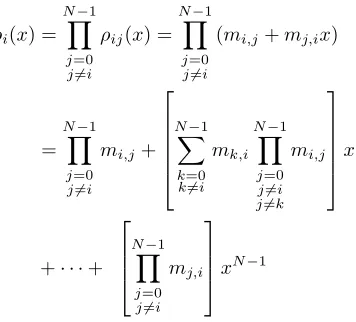
Remark.To see the connection to Greedy Sort, note that the coefficients of the product polynomial are the binary place indicatorθr,i values:
ρi(x) = N−1
Y
j=0 j6=i
ρij(x) = N−1
Y
j=0 j6=i
(mi,j+mj,ix)
= N−1 Y j=0 j6=i mi,j+ N−1 X k=0 k6=i mk,i N−1 Y j=0 j6=i j6=k mi,j x +· · ·+ N−1 Y j=0 j6=i mj,i
xN−1 (7)
3.3 Comparison with the Previous Methods
All three algorithms work by computing the comparison matrixM. Since that is a mutual step for all of the methods, we disregard the cost of constructingM in this analysis. The rest of the operations can be summarized for each method in Table 1.
Table 1.Comparison of the proposed algorithm with the previous methods in terms of number of ciphertext multiplications, multiplicative depth and output size.
Na¨ıve Greedy Direct Our Proposed Method Ciphertext
O(2N) O(NlogN) O(N) Multiplications
Multiplicative
O(logN) O(logN) O(logN) Depth
The Na¨ıve Greedy implements the Greedy Sort in a straightforward manner, hence the multiplications can be counted in the θr,i computations. In order to find the binary place indicators for an arbitrary elementXi, we need to compute θ0,i, θ1,i,· · · , θN−1,i as in Equation 2 with each one contributing
N−1 X
k=0
N−1 k
= 2N−1
multiplications.
by using a Wallace Tree of N bits for each column. The latter is computed by using the bit-wise equality check circuit for logN bits for each possible rank, i.e.N times. Therefore, total number of multiplications to find the rank of one element becomesO(logN) +O(NlogN).
Instead, our proposed method requires only a product ofN−1 ciphertexts, in order to find a single rank.
4
Batching Input Elements
In this section, we describe how to pack input elements in the plaintexts to evaluate parallel comparisons in the message slots. All previously mentioned sorting algorithms require N2−N
2 comparisons. By enabling batching, we can reduce it to N/2. Finding the rank monomial of one element requires N −2 ciphertext multiplications, thus finding all rank monomials requires N(N−2) multiplications. We also reduce this number to N−2 with batching. Finally, when we encrypt the input elements, instead of havingN k encryptions, we only havekencryptions when batching is used, wherekis the bit-length of the input elements. As a result, we have both a memory and performance gain with a factor ofN. However, there is an additional cost of key switching that we need to perform after each rotation. This operation also increases the noise in the ciphertext, thus we try to limit the number of rotations.
For our application, we use the plaintext modulusp= 2. ChoosingΦmwith m|2d−1, we utilize ` message slots defined over F2d. Next we choose a g ∈
(Z/mZ)∗ with order`. We fix the first factorF
1(X) and reorder the rest of the factors so that the permutation given byκg is a cyclic shift to the left. There is an isomorphism in between the different slot fields, hence we define a mapping in betweenL1 andLi for eachi:
ψi: (
L17−→Li
X 7−→Xg(1−i) mod` modFi(X)
Using this mapping we transfer the input elements fromL1toLiand pack them as follows
α=CRT−1(hψ1(α1), ψ2(α2),· · · , ψ`(α`)i) and rotate the slots by computing the automorphismγ=κg(α).
CRT(γ) =hκg(ψ2(α2)), κg(ψ3(α3)),· · · , κg(ψ`(α`)), κg(ψ1(α1))i
Using the inverse of the above mappingsψ−1i , we can retrieve the original mes-sage contents after computingCRT(γ):
ψ−11 (κg(ψ2(α2))),· · ·, ψ−1` (κg(ψ1(α1)))
=hα2,· · ·, α1i .
basic operations to clear out a slot content and to select a slot content. Both can be performed with a logical AND operation by defining a bit-mask vector. If we want to clear the data in the ith slot, we create a vector ζ with ζ
i = 0 and ζj = 1 for allj 6=i and use its batched polynomial, i.e.ζ =CRT−1(ζ), to perform a logical AND with the input. Similarly, if we want to select the data in the ith slot, we create a vectorσ withσi = 1 andσj = 0 for allj6=i, batch itσ=CRT−1(σ) and multiply it with the input.
CRT(α×ζ) =hα1,· · · , αi−1,0, αi+1,· · ·, α`−1i
CRT(α×σ) =h0,· · · ,0, αi,0,· · ·,0i
Going back to our sorting algorithm, initially we have a set ofk-bit elements
{a0, a1,· · · , aN−1}. We declare a vector for each bit, α0=ha0,0, a1,0,· · ·, aN−1,0i α1=ha0,1, a1,1,· · ·, aN−1,1i
.. .
αk−1=ha0,k−1, a1,k−1,· · ·, aN−1,k−1i
where the ith slot is reserved for the ith element. Hence, each plaintext corre-sponding to a bit is batched, i.e. αj =CRT−1(αj), for j = 0,· · ·, k−1. Note that, we do not need to apply the mappingψibefore batching, when the slot con-tent is an integer. Hence a vectorαcan be viewed as holding different elements in each slot as,
α=ha0, a1,· · ·, aN−1i
for simplicity. Then,α=CRT−1(α) is the batched plaintext with each element in a separate slot. The first step in Algorithm 1 is computing the comparisons Mij = AilAj for all i < j. To this end, we apply rotation and obtain the
following vectors:
γ0 =< a0, a1, · · ·, aN−2, aN−1 > γ1 =< a1, a2, · · ·, aN−1, a0 > γ2 =< a2, a3, · · ·, a0, a1 >
.. . γbN
2c
=< abN
2c , abN
2c+1
,· · ·, abN
2c−2 , abN
2c−1 >
by deploying the cyclic shift asγi=κgi(α). We clear second half of the last vector
whenN is even, i.e. clear slot contents ofγN
2 in the range N
2,· · ·, N−1
. This is due to the fact that we need exactly N(N−1)2 comparisons. By aligning the elements as above, we can perform parallel comparisons ofMij =AilAj for 0 < j−i ≤ N
2
and Mji = Aj lAi where j−i > N2
comparison circuit as; µ1=γ0lγ1
µ1=ha0la1,· · · , aN−2laN−1, aN−1la0i
µ2=γ0lγ2
µ2=ha0la2,· · · , aN−2la0, aN−1la1i
.. .
µt=γ0lγbN
2c
µt=
D
a0laN−1
2 ,· · ·, aN−2la
N−1
2 −2, aN−1la
N−1 2 −1
E
,ifN is odd, D
a0laN
2,· · · , aN2−1laN−1,0,· · · ,0 E
,ifN is even.
Their complements are ¯µi = 1−µi for i = 1,· · · , t. By rotating each com-plementitimes to the right, we successfully align allMij values with only N/2 comparisons andN rotations in total. It is important to remark that even though rotation operation by itself is not expensive it is followed by a key switching op-eration which is both costly and increasing the noise. Therefore the rotation is not completely free. We define νis as follows:
µi =hm0,i, m0,i+1,· · ·, mN−1,i−1i ¯
µi = 1−µi ¯
µi =hmi,0, mi+1,0,· · ·, mi−1,N−1i νi =κg−i(µi)
νi =hm0,N−i, m1,N−i+1,· · ·, mi−1,N−1, mi,0, mi+1,0,· · ·mN−1,N−i−1i ¯
νi = 1−νi, fori= 1,· · ·, t .
The vectors, µ1,· · · ,µt,ν1,· · ·,νt hold all comparison values mi,j for i 6= j in the (i+ 1)th slot and ¯µ1,· · · ,ν¯1,· · · hold their complements, i.e. mj,i = 1−mi,j in the same slot. Next step of the algorithm is computing the product Q
i6=j(Mij+Mjix). For multiplication with constant x, we batch anxin each slot and multiply with the complement vectors ¯µi and ¯νi. However, we first need to apply the mappingΨi that is defined in the beginning of this section.
χ=hψ1(x), ψ2(x),· · ·, ψN−1(x)iandχ=CRT−1(χ) Next, we define the surrogates in the parallel slots as
ϕi=µi+χµ¯i
ϕt+i=νi+χνi,¯ fori= 1,· · · , t .
Finally, the last step is computing the product of the surrogates to find the rank monomials. We write
ϕ= 2t Y
i=1 ϕi
where ρis are the rank monomials of the input elements. The final rotation is performed so that all rank monomials can be summed in the first message slot.
β =σi N−1
X
i=0 κgi(ϕ)
β=hb,0,· · ·,0i
We have the sorted polynomialb=PNi=0−1ρi∈L1 in the first message slot. We give a breakdown of the bandwidth and bottleneck operations in ho-momorphic evaluation of Polynomial Rank Sort to compare batching with no batching in the Table 2. The cost of a key switching operation depends on the underlying FHE scheme, however it is similar to the relinerization technique and mostly requires logqmultiplications inAq. A singlek-bit comparison circuit re-quireskciphertext multiplications. Therefore, the cost of the key switching can exceed theN2 comparisons, especially with large q. In that case, batching may not be preferable. On the other hand, some new schemes such as GSW [19] and F-NTRU [11] may need to compute logq multiplications in Aq for a single ci-phertext multiplication. In that case, batching would perform better since the cost of key switching is same as a single ciphertext multiplication.
Table 2.A comparison of the storage and computation with and without batching.
Inputs Comparisons Key Multiplications Outputs
Switching
No Batching kN N2−N
2 − N
2−2N k
Batching k N
2 2N N−2 k
4.1 Choosing m and d
In most recent FHE schemes, the security parameter heavily depends on the degree of Aq, i.e. φ(m) and it is usually a large number. For instance, in the homomorphic evaluation of AES [18], (m, d) = (11441,48) is given as an example for a circuit of depth 10. This choice ofmanddutilizes`= 224 message slots. In that scenario,dis chosen to be a multiple of 8 because of the underlying algebra of AES operations. In our case, the only restrictions are:
1. The output of the algorithm is an N−1 degree polynomial, hence we need d≥N.
2. There must be at leastN message slots, thus`≥N.
Thus the parameters depend on the number of elementsN. We also havem|2d−1 and`=φ(m)/dby definition. For example, whenN≤28, we can usem= 16385 and d = 28 with ring degree φ(m) = 12544 and ` = 448 message slots. This means that, we can sort`/N= 16 sets in parallel.
5
Conclusion
In conclusion, our proposed method Polynomial Rank Sort performs significantly better than previous algorithms and provides a depth and cost-optimized circuit for homomorphic sorting. It reduces the number of ciphertext multiplications to O(N2) for sorting an array of N elements without packing. Furthermore, it is a refined algorithm suitable for parallelization. When batching is enabled, we sort the whole list with only N/2 comparisons and following with only N multiplications. Proposed batching method also reduce the data size fromkN to N wherekis the bit-length of the input elements. However it requires costly key switching operation in exchange. All of our proposed homomorphic algorithms are generic and can be used with the recent FHE schemes. The performance gain however depends on the choice of the scheme and the trade-off between the cost of key switching and ciphertext multiplication.
6
Acknowledgment
This work was supported by the US National Science Foundation CNS Award #1561536.
References
1. Brakerski, Z.: Fully homomorphic encryption without modulus switching from clas-sical gapSVP. IACR Cryptology ePrint Archive 2012, 78 (2012)
2. Brakerski, Z., Gentry, C., Vaikuntanathan, V.: Fully homomorphic encryption without bootstrapping. Electronic Colloquium on Computational Complexity (ECCC) 18, 111 (2011)
3. Brakerski, Z., Gentry, C., Vaikuntanathan, V.: (leveled) fully homomorphic encryp-tion without bootstrapping. In: Proceedings of the 3rd Innovaencryp-tions in Theoretical Computer Science Conference. pp. 309–325. ACM (2012)
4. Brakerski, Z., Vaikuntanathan, V.: Efficient fully homomorphic encryption from (standard) LWE. In: Ostrovsky, R. (ed.) FOCS. pp. 97–106. IEEE (2011) 5. Brakerski, Z., Vaikuntanathan, V.: Fully homomorphic encryption from ring-LWE
and security for key dependent messages. In: Rogaway, P. (ed.) CRYPTO. Lecture Notes in Computer Science, vol. 6841, pp. 505–524. Springer (2011)
6. Brakerski, Z., Vaikuntanathan, V.: Fully homomorphic encryption from ring-lwe and security for key dependent messages. In: Advances in Cryptology–CRYPTO 2011, pp. 505–524. Springer (2011)
8. C¸ etin, G.S., Dor¨oz, Y., Sunar, B., Sava¸s, E.: Low Depth Circuits for Efficient Homomorphic Sorting. In: LatinCrypt (2015)
9. Chatterjee, A., Kaushal, M., Sengupta, I.: Accelarating sorting of fully homomor-phic encrypted data. In: Paul, G., Vaudenay, S. (eds.) Progress in Cryptology – INDOCRYPT 2013, Lecture Notes in Computer Science, vol. 8250, pp. 262–273. Springer International Publishing (2013)
10. van Dijk, M., Gentry, C., Halevi, S., Vaikuntanathan, V.: Fully homomorphic en-cryption over the integers. In: Gilbert, H. (ed.) EUROCRYPT. Lecture Notes in Computer Science, vol. 6110, pp. 24–43. Springer (2010)
11. Dor¨oz, Y., Sunar, B.: Flattening ntru for evaluation key free homo-morphic encryption. Cryptology ePrint Archive, Report 2016/315 (2016), http://eprint.iacr.org/2016/315
12. Emmadi, N., Gauravaram, P., Narumanchi, H., Syed, H.: Updates on sorting of fully homomorphic encrypted data. In: 2015 International Conference on Cloud Computing Research and Innovation (ICCCRI). pp. 19–24 (Oct 2015)
13. Fan, J., Vercauteren, F.: Somewhat practical fully homomorphic encryption. IACR Cryptology ePrint Archive 2012, 144 (2012)
14. Gentry, C.: A Fully Homomorphic Encryption Scheme. Ph.D. thesis, Stanford Uni-versity (2009)
15. Gentry, C.: Fully homomorphic encryption using ideal lattices. In: STOC. pp. 169– 178 (2009)
16. Gentry, C., Halevi, S.: Fully homomorphic encryption without squashing using depth-3 arithmetic circuits. IACR Cryptology ePrint Archive 2011, 279 (2011) 17. Gentry, C., Halevi, S., Smart, N.P.: Fully homomorphic encryption with
polylog overhead. IACR Cryptology ePrint Archive Report 2011/566 (2011), http://eprint.iacr.org/
18. Gentry, C., Halevi, S., Smart, N.P.: Homomorphic evaluation of the AES circuit. IACR Cryptology ePrint Archive 2012 (2012)
19. Gentry, C., Sahai, A., Waters, B.: Homomorphic encryption from learning with errors: Conceptually-simpler, asymptotically-faster, attribute-based. In: CRYPTO. pp. 75–92. Springer (2013)
20. Halevi, S., Shoup, V.: Algorithms in helib. Cryptology ePrint Archive, Report 2014/106 (2014), http://eprint.iacr.org/2014/106
21. Knuth, D.E.: The Art of Computer Programming, Fundamental Algorithms, vol. 1. Addison Wesley Longman Publishing Co., Inc., 3rd edn. (1998), (book)
22. Laine, K., Player, R.: Simple encrypted arithmetic library - seal (v2.0). Tech. rep. (September 2016), https://www.microsoft.com/en-us/research/publication/simple-encrypted-arithmetic-library-seal-v2-0/
23. L´opez-Alt, A., Tromer, E., Vaikuntanathan, V.: On-the-fly multiparty computation on the cloud via multikey fully homomorphic encryption. In: STOC (2012) 24. Narumanchi, H., Goyal, D., Emmadi, N., Gauravaram, P.: Performance analysis of
sorting of fhe data: Integer-wise comparison vs bit-wise comparison
25. Smart, N.P., Vercauteren, F.: Fully homomorphic SIMD operations. IACR Cryp-tology ePrint Archive 2011, 133 (2011)