A Constant Time, Single Round
Attribute-Based Authenticated Key Exchange in
Random Oracle Model
Suvradip Chakraborty1, Y. Sreenivasa Rao1, C. Pandu Rangan1, Srinivasan Raghuraman2
1 Theoretical Computer Science Lab, Department of Computer Science and
Engineering, Indian Institute of Technology Madras (IITM), Chennai, India {suvradip1111, y.sreenivasarao2008, prangan55}@gmail.com 2
Cryptography and Information Security (CIS) Research Group, CSAIL, Massachusetts Institute of Technology (MIT)
Abstract. In this paper, we present a single round two-party attribute-based authenticated key exchange(ABAKE) protocol in the framework of ciphertext-policy attribute-based systems. Since pairing is a costly op-eration and the composite order groups must be very large to ensure security, we focus on pairing free protocols in prime order groups. The proposed protocol is pairing free, working in prime order group and hav-ing tight reduction to Strong Diffie Hellman (SDH) problem under the attribute-based Canetti Krawzyck (CK) model which is a natural ex-tension of the CK model (which is for the PKI-based authenticated key exchange) for the attribute-based setting. The security proof is given in the random oracle model. Our ABAKE protocol does not depend on any underlying attribute-based encryption or signature schemes unlike the previous solutions for ABAKE. Ours is the first scheme that re-moves this restriction. Thus, the first major advantage is that smaller key sizes are sufficient to achieve comparable security. Another notable feature of our construction is that it involves only constant number of exponentiations per party unlike the state-of-the-art ABAKE protocols where the number of exponentiations performed by each party depends on the size of the linear secret sharing matrix. We achieve this by doing appropriate precomputation of the secret share generation. Ours is the
first construction that achieves this property. Our scheme has several other advantages. The major one being the capability to handle active adversaries. Most of the previous ABAKE protocols can offer security only under passive adversaries. Our protocol recognizes the corruption by an active adversary and aborts the process. In addition to this prop-erty, our scheme satisfies other security properties that are not covered by CK model such as forward secrecy, key compromise impersonation attacks and ephemeral key compromise impersonation attacks.
1
Introduction
The goal of an Authenticated Key Exchange (AKE) protocol is for two parties to establish a common shared session key which they can later use to securely communicate with each other. Theminimum requirement from a key exchange protocol is that it should maintain secrecy of the established session keys from an adversary who can passively eavesdrop on the protocol messages and who may also send messages of its choice to various parties. Besides the minimum requirement of session key secrecy, we require other crucial properties from an AKE protocol such askey independence,Key Compromise Impersonation (KCI) resilience, forward secrecy to mention a few.Key independence means that the session keys are computationally independent of each other. This is an essential security requirement of AKE protocols as it helps to prevent against “Denning-Sacco” type of attacks [9]. KCI means that the adversary should not be able to impersonate other honest parties to a party by revealing the long term secret key of this party. Forward secrecy requires the secrecy of the session keys to hold even if the adversary gets the long term secret key or static key of parties who have previously established a common session key later at some point of time.
the functional role he/she assumes in an organization, where a role reduces to no more than a set of attributes. In this regard, Ciphertext-Policy ABE (CP-ABE) enables cryptographic access control with respect to functional roles.
Naturally it is worth studying the AKE protocols in attribute based settings since this would allow users to establish a secure channel and at the same time al-lowing for fine grained access control over data.Attribute-BasedAKE (ABAKE) is a new variant of the Authenticated key Exchange (AKE) that serves that pur-pose and allows users to authenticate each other using their attributes unlike in the PKI settings where the users authenticate each other using their public keys. ABAKE can hide the identity information of an individual, which allows users to achieve mutual authentication and establish a secret session key by their attributes and some fine grained access control policy. Attribute-based key exchange finds its application in distributed collaborative systems where it is more convenient for users to communicate with other users using their roles or responsibilities which can be described by attributes, interactive chat rooms, online forums where a user can have read/write access to threads only if they have desired attributes etc. Another interesting application is sharing of med-ical history of patients with doctors who are appropriately qualified but both doctors and patients would like to remain anonymous without revealing their specific identities. This may be of particular use for health chat rooms or online medical consultancy services where the patients would like to keep their iden-tity hidden and also the doctors who are providing consultancy services to the patients would like to keep their identity anonymous to avoid legal hassles later on. Hence an authenticated key exchange protocol that critically uses attributes can be employed in these settings.
on any underlying public key encryption or identity based encryption scheme for their construction. Hence we raise this fundamental question in the design of ABAKE protocol :
“Is it possible to design a protocol for AKE in attribute-based settings, hand-crafted using only basic group operations rather than using attribute encryption or signature schemes as building blocks?”
Our paper answersaffirmatively to this question. However we note that in gen-eral using an underlying encryption and/or signature scheme in designing an AKE protocol makes the design more modular. However it may not be efficient especially when we consider ABE schemes as discussed above. So this is a trade-off between modularity and efficiency. We choose efficiency over modularity and we show that indeed it is possible to design much simpler and efficient ABAKE protocol without using any ABE schemes as building block which, at the same time, achieves comparable level of security desired from an ABAKE protocol.
1.1 Related Works
Birkett and Stebila [6] introduced the concept of predicate-based key ex-change with fine-grained access control. They proposed a generic construction using a predicate-based signature as building block and following the signed Diffie Hellman paradigm for their construction. Here the parties can specify the condition the peer is expected to satisfy. It also achieves security againstactive adversaries. An active adversary is one who can extract the messages that are exchanged during key agreement and modify them arbitrarily during transit. Since the construction uses predicate-based signatures as underlying building block, it achieves security against active attacks. Also, an additional property that is called credential privacy (CP) is guaranteed as well as the standard secu-rity of the session key. CP states that an adversary cannot distinguish between two individuals whose credentials satisfy the same access policy. The scheme is proven secure without random oracles in the predicate-based key exchange secu-rity model based on the BR model. However their scheme has several drawbacks. Firstly, the concrete instantiations of their protocol has some problem. The pred-icate based signature scheme can be instantiated using some predpred-icate based (attribute based) signature schemes [17, 18, 21, 24]. Instantiations using [24], [17] cannot achieve expressive ABAKE (i.e., these signatures only allow threshold access policies). In [18], three signature schemes are proposed. One instantiation in [18] is expressive, but the security proof is given in Generic Group Model (GGM). Other instantiations in [18] need large communication complexity. The instantiation in [21] provides fully secure and expressive access policies in StdM. However, communication complexity of it is larger than that of the efficient in-stantiation in [18], depending on the size to represent access policies. Secondly, the protocol execution is inherently sequential in nature, i.e., a party needs to wait for the message from its peer before sending its message to the peer. So this is not a two flow (or one round) protocol since it requires three flows where a flow is a single message exchange from one party to another. This is mainly due to the adoption of signed Diffie Hellman paradigm. Thirdly, the protocol can only be proven in the much weaker BR model. The major security models like the CK [8] and the eCK model [15] for key exchange allows the adversary to reveal the session state (which includes all the session specific randomness excluding the session key) and ephemeral secrets used during a run in a session. This requires a signature scheme to satisfy the property that it should be un-forgeable against revealing the randomness of the underlying signature scheme. Unfortunately as observed in [6], there is no such predicate signature scheme satisfying this property.
which it uses. Also this scheme is vulnerable to an active attack. In the scheme presented in [32], the adversary can extract the ephemeral component (X,{U}) and change it to (X0,{U0}) and chooses an access structure by itself that is trivially satisfied by the attributes of user B and sends it to B. Similarly, he can extract the ephemeral component (Y,{V}) and change it to (Y0,{V0}) and chooses an access structure by itself that is trivially satisfied by the attributes of user A and sends it toA. Thus the final shared secret key of A and B will not be in agreement. So although the adversary may not know the actual session key between the two parties he can launch this type of denial-of-service (DOS) attack. Our protocol avoids this kind of an attack by incorporating appropriate verification mechanisms that would abort the process in case of any change in values to be agreed upon. Later Yoneyama [33] proposed another round optimal (one round) ABAKE in the CP-ABE settings which is shown to be more efficient compared to the scheme presented in [6]. It also achieves security against active adversaries by incorporating a one time signature in their construction. However the construction of this ABAKE protocol is also based on Waters CP-ABE protocol [31]. The main idea of their construction is that both the parties will exchange a ciphertext of the Waters CP-ABE along with their respective access policies. Since Waters CP-ABE is only CPA secure, [33] used a one time signature which is used as a standard conversion tool from CPA to CCA security. However since the Waters CP-ABE achieves selective security, the ABAKE scheme also achieves the same level of security. The security of their scheme is proved in the ABCK model which is a natural extension of the CK model and the security of the scheme is reduced to the non standard Decisional Parallel Bilinear Diffie-Hellman Exponent Assumption (DPBDHE) as in the Waters CP-ABE.
1.2 Our Contribution
– In this paper, we present an attribute-based key agreement protocol which can be proved secure under the Strong Diffie-Hellman (SDH) assumption [1] in the RO model. We extend the techniques used in [27] to the attribute-based framework. Doing this is not trivial since in an attribute-attribute-based system the keys and the ciphertexts have richer structure than identity-based en-cryption schemes. Besides, an ABAKE protocol hides the attributes of both the parties involved in the key exchange which is not a requirement of an ID based AKE protocol. We are able to achieve a tight reduction to the SDH problem based on the RO model.
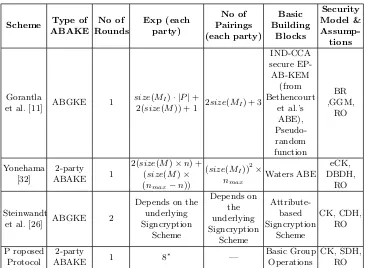
exponentiations (to be specific only 8) and this is independent of the number of attributes or number of parties in the system. The output of the setup algorithm of our protocol does not depend on the number of attribute can-didates, i.e., the setup algorithm outputs constant size parameters, so the size of the master public key of our system is also constant. A comparison of our protocol with the existing state-of-the-art attribute-based two-party and group key exchange are shown in Table 1.
– Our scheme is also resistant to an active adversary which is allowed to modify the components exchanged during the key agreement. The scheme performs a check which will detect any tampering done on the components. In this way, a fully authenticated key agreement protocol (both the parties are mu-tually authenticated to each other) is achieved. The protocol also satisfies additional security properties such as forward secrecy, key compromise im-personation attacks.
– Finally, we prove the security of our ABAKE system in the Attribute-Based CK (ABCK) model [33] which is a natural extension of the CK model [8] for attribute-based settings. In the ABCK model, the adversary is allowed to pose queries that allows him to reveal the static secret key, master secret key and the ephemeral secret key. Also the freshness conditions are a little different than the CK model and the parties are identified by a set of at-tributeSP. We prove the security of our ABAKE in this model under the
SDH assumption. From the relation between hard problem and the instance of the protocol, it is clear that the key size be just same as the problem size that makes the SDH problem hard. Such tight reductions imply stronger security even with smaller keys. Thus, in practice, we may obtain a decent degree of security with reasonable sized keys.
In Table 1,Type of ABAKErefers to the settings in which the protocols are applicable, e.g. ABGKE means it is an attribute-based group key exchange protocol as [11] and [26]. AlsoExprefers to the number of exponentiations each party needs to compute in the considered protocols. Gorantla et al.’s ABGKE was based on the ABE scheme of Bethencourt et al. [5]. From the design principle of [5], they constructed an IND-CCA2-secure Key Encapsulation Mechanism (KEM) for attribute-based settings, which they called, Encapsulation Policy attribute-based KEM (EP-AB-KEM). The number of exponentiations each party needs to compute during encryption is two for each leaf node in the ciphertext’s access structure and|L|denotes the number of leaf nodes in the access structure. The number of leaves in the access structure corresponds to the number of rows in the share generating matrixM, i.e., size of M denoted as size(M). In the decryption algorithm, each user needs to perform two pairing operations for each leaf in the access structure that is matched by a private key attribute, i.e., the size of the submatrix MI of M as shown in Definition 2 in Section 2.2 and
denotes the maximum number of columns in the share generating matrix andn
denotes the number of the columns of the share generating matrix correspond-ing to the encryptor which in most cases will be less thannmax, i.e.,n≤nmax.
Here size(M) denotes the number of rows of the share generating matrix and
I⊂ {1,2,· · ·, l}corresponds to those rows of the decryptor whose attributes sat-isfy the access structure of the encryptor (after applying the injective function selected by the encryptor), i.e.size(MI). The protocol in [26] is also a ABGKE
which uses attribute-based signcryption as its main workhorse. So the number of pairing and exponentiation operations also depends on the underlying attribute-based signcryption schemes which is generally very large and computationally intensive considering the state-of-the-art attribute-based signcryption schemes like [22], [10] etc. Our protocol has considerable advantages over the above men-tioned protocols. Our protocol involves no pairing operations and a constant number of exponentiations by appropriately doing the computations related to share generation in a preprocessing stage as will be discussed in Section 3.1. So the computation cost at each party for our protocol is independent of the size or depth of the access structure.
Scheme Type of
ABAKE No of Rounds Exp (each party) No of Pairings (each party) Basic Building Blocks Security Model & Assump-tions Gorantla
et al. [11] ABGKE 1
size(MI)· |P|+
2(size(M)) + 1 2size(MI) + 3
IND-CCA secure EP-AB-KEM (from Bethencourt et al.’s ABE), Pseudo-random function BR ,GGM, RO Yonehama [32] 2-party ABAKE 1
2(size(M)×n) + (size(M)× (nmax−n))
(size(MI))2× nmax Waters ABE eCK, DBDH, RO Steinwandt
et al. [26] ABGKE 2
Depends on the underlying Signcryption Scheme Depends on the underlying Signcryption Scheme Attribute-based Signcryption Scheme CK, CDH, RO P roposed Protocol 2-party
ABAKE 1 8
∗
— Basic Group
Operations
CK, SDH, RO
Table 1 :Comparison with the existing schemes
∗
2
Preliminaries
Notation. Throughout this work, we denote the security parameter by κ. We denote byx∈RX the fact that the valuexis chosen uniformly at random from
the set of valuesX. The notationG∗ denotes all the invertible elements of the
groupG. We denote byaa vector, which is the tuple of values (a1, . . . , an), where nis the length of the vectora. For a vectorV chosen by a partyPi we use the
notationV(i). Thekth component of this vector is denoted byV(i)
k . If the length
of V(i) is m say, then the entire vector V(i) is given by (V(i) 1 , V
(i) 2 ,· · ·, V
(i)
m ).
When we write {Vk(i)}b
k=a, we mean the tuple of values (V
(i)
a ,· · ·, Vb(i)). If not
mentioned otherwise, we will always assume the counting of the components of a vector starts from the index 1. When we writeAf() we mean thatA is given oracle access to the functionalityf.
2.1 Access Structure
Definition 1. [3] LetP ={P1,· · ·Pn}be a set of parties. A collection A⊆2P
is monotone if ∀B, C: if B ∈ Aand B ⊆C, then C ∈ A. An access structure
(respectively, monotone access structure) is a collection (respectively, monotone collection) A of non-empty subsets of P, that is, A⊆2P \ {∅}. The sets in A
are called authorized sets, and the sets not in Aare called unauthorized sets.
In our setting, attributes will play the role of parties and we will only deal with monotone access structures. So, from now on, unless stated otherwise, by an access structure we mean a monotone access structure. We note that it is possible to (inefficiently) realize general access structures by having the negation of an attribute be a separate attribute (so the total number of attributes will be doubled).
2.2 Linear Secret-Sharing Scheme
Our construction will employ Linear Secret-Sharing Schemes (LSSSs) [3].
Definition 2. A secret-sharing schemeΠ over a set of partiesP is called linear (overZp) if:
• The shares for each party form a vector overZp.
• There exists a matrixAcalled the share-generating matrix forΠ. The matrix
Ahas l rows and ncolumns. For all i= 1, . . . , l, the ith row ofA is labeled by a partyρ(i)(ρis a function from{1, . . . , l}toP). When we consider the column vectorv= (s, r2, . . . , rn), wheres∈Zp is the secret to be shared and r2, . . . , rn∈Zp are randomly chosen, thenAv is the vector ofl shares of the
secrets according to Π. The share (Av)i belongs to partyρ(i).
letS denote an authorized set, and defineI⊆ {1,· · · , l,}as I={i:ρ(i)∈S}. Then there exist constants {ωi ∈Zp}i∈I such that for any valid shares {λi} of
a secretsaccording toΠ,P
i∈Iωiλi=s.These constants{ωi} can be found in
time polynomial in the size of the share-generating matrix A[3]. We note that for the security property of LSSS, no such constants{ωi}exist for unauthorized
sets.
Boolean Formulas.Access policies might also be described in terms of mono-tonic boolean formulas. LSSS access structures are more general and can be derived from such representations. More precisely, one can use standard tech-niques to convert any monotonic boolean formula into a corresponding LSSS matrix. We can represent the boolean formula as an access tree, where the inte-rior nodes are AND and OR gates, and the leaf nodes correspond to attributes. The number of rows in the corresponding LSSS matrix will be same as the num-ber of leaf nodes in the access tree. So, naturally boolean formulas are used to describe the access policy, and equivalent LSSS are used to encrypt the message and decrypt the ciphertext in a CP-ABE system.
2.3 Monotone Span Program
The labelled matrix (A, ρ) in Definition 2 is also called a Monotone Span Program (MSP) [14]. Karchmer and Widgerson [14] introduced the model of MSP, and proved that if there is a MSP for some boolean function then there exists a LSSS for the corresponding access structure. We give the formal definitions and conclusions as in [14], [19].
Definition 3. A MSP M is a quadruple (F, M,ε, ρ) where F is a field, M
is a matrix (with m rows and d ≤ m columns) over F, ρ : {1,2, . . . , m} → {1,2, . . . , n} is a surjective function and the row vector ε= (1,0,0· · ·0)∈Fd is
called the target vector. The size of M is the number m of rows is denoted by size(M).
As the functionρlabels each row iof the matrix M to a partyPρ(i), each party can be regraded as the owner of one or more rows. For any set of partiesG⊆ P, let us denote the sub-matrix consisting of rows owned by the parties inGbyMG.
The span of the matrixM, denoted by span(M), is the subspace generated by the rows ofM. A MSPMis said to compute an access structureAifG∈A⇔ε∈ span(MG).
LSSS induced from MSP [14, 19]. Assume that there is a MSP M = (F, M,ε, ρ), of sizem, computing the access structure A. Then there is a LSSS
Π overF realizing the access structure in which the total size of the shares is the number of rows in the span program, i.e., the size of the span program (i.e.,
m) [14].
We mention the linear reconstruction property of the LSSS here. For any secret s ∈Z∗
p, let v = (s, r2, . . . , rn)∈(Z∗p)d denote a random vector. For any
authorized set S ∈ A, let I = {i : Pρ(i) ∈S} and let Mi denote the ith row
is an authorized set, it holds that P
i∈IωiMi =ε, where the {ωi}i∈I are the
reconstruction constants. Then S can compute:
X
i∈I ωiλi=
X
i∈I
ωi(Mi·v) =
X
i∈I ωiMi
·v=ε·v=s. (1)
2.4 Complexity Assumptions
The complexity assumptions required for our construction are Computational Diffie-Hellman Problem (CDH), Decisional Diffie-Hellman Problem (DDH) and Strong Diffie-Hellman Problem (SDH) assumptions which are well known and well studied assumptions.
Definition 4 (Computation Diffie-Hellman (CDH) Problem).Given(g, ga, gb)∈ G3 for unknowna, b∈Z∗p, whereGis a cyclic prime order multiplicative group
with g as a generator andpis the order of the group, the CDH problem inGis
to compute gab.
The advantage of any probabilistic polynomial time algorithm A in solving the CDH problem in Gis defined as
AdvACDH =P r
A(g, ga, gb)→gab |a, b∈Z∗p
The CDH Assumption is that, for any probabilistic polynomial time algorithm
A, the advantage AdvCDH
A is negligibly small.
Definition 5 (Decisional Diffie-Hellman (DDH) Problem).Given(g, ga, gb, h)∈
G4for unknowna, b∈Z∗q, whereGis a cyclic prime order multiplicative
group withg as a generator and pas the order of the group, the DDH problem inGis to check whether h=? gab.
The advantage of any probabilistic polynomial time algorithm A in solving the DDH problem inGis defined as
AdvDDHA =P r
A(g, ga, gb, gab)→1−P rA(g, ga, gb, h)→1:a, b∈Z∗p
The DDH Assumption is that, for any probabilistic polynomial time algorithm
A, the advantage AdvDDH
A is negligibly small.
Definition 6 (Strong Diffie Hellman (SDH) Problem [1]).Letκbe the se-curity parameter andGbe a multiplicative group of orderp. Given(g, ga, gb)∈R G3and access to a Decision Diffie Hellman (DDH) oracleDDHg,a(., .)which on
inputgb and gc outputs
True if and only ifgab=gc, the strong Diffie Hellman
problem is to computegab∈
G(i.e., the problem of solving CDH problem using
a DDH oracle)
The advantage of an adversary A in solving the SDH problem is defined as the probability with which Asolves the above SDH problem.
AdvASDHDDHg,a(.,.) =P r[A(g, g
a, gb) =gab]
The SDH assumption holds in G if for all polynomial time adversaries A, the advantageAdvSDH
2.5 ABCK Security Model
In this section we describe the ABCK model which is a natural extension of the CK model for attribute-based settings. All the definitions given here are for single-round two-party ABAKE scheme. For multiple rounds, we need to extend these definitions appropriately. An ABAKE consists of three polynomial time algorithms: Setup, KeyGen and KeyExchange. These algorithms are discussed below.
ISetup: The setup algorithm takes as input the implicit security parameterκ
and the attribute universe U and outputs the master public key M P K and master secret keyM SK.
IKeyGen: The key generation algorithm takes in the master secret key M SK,
the master public keyM P K, and a set of attributesSP given by a partyP, and
outputs a static secret keySKSP corresponding toSP.
IKeyExchange: This algorithm is run between two or more users or parties in
the system (in our case the number of users is two as it is two-party setting). Each party in an ABAKE protocol executes the KeyExchangealgorithm which initially takes as input the master public keyMPK, an access structureAand a
private key for a set of attributesS. The partyA(resp.,B) starts the protocol
by taking as input the master public keyM P K, the set of attributesSA(resp., SB), the access policy or access structureAA(resp.,AB), and outputs a message
say out (resp.,out0). The out sent byA is considered to as in0 for B andout0
sent by B is considered to asin forA. After the exchange is over, the party A
attempts to construct the session key ZA using the key construction function
that takesM P K, the set of attributesSA, the static secret keySKSA, the access
policy or access structureAB,outandinas parameters. The partyB attempts
to construct the session key ZB, using the key construction function that takes M P K, the set of attributes SB, the static secret key SKSB, the access policy
or access structure AA, out0 and in0 as parameters. The session key ZA will be
equal to ZB if and only if SA ∈ AB and SB ∈ AA (i.e., the attributes of one
party satisfies the access structure of its peer and vice versa). The session key
Z =ZA=ZB is defined as the session key established between partyA andB.
Session. An instance of the protocol as described above when run at a party is called a session. The user/entity that initiates a session is called the owner and the other user is called the peer. A session is activated with an incoming message of the form (I,AA) or (R,AA,AB, out), where I and R denote role
identifiers, and A and B are user identifiers. If A was activated with (I,AA),
thenA is called the sessioninitiator. If B was activated with (R,AA,AB, out),
thenB is called the sessionresponder. After getting activated with an incoming message of the form (I,AB, out0) from the responderB, the initiatorAcomputes
the session key. Similarly after getting activated with an incoming message of the form (R,AA, out) from the initiatorA, the responderB computes the
session. If A is the initiator of the session, it sets the session identifier sid as (I,AA,AB, out, in) whereoutandinare respectively the components sent toB
and received fromB. IfB is the responder of a session initiated byA, it sets the
sidas (R,AA,AB, out0, in0) whereout0 andin0 are respectively the components
sent toAand received byB. We note that thesidof the responder is defined im-mediately when it receives a message from the initiator of the form (I,AA, out),
whereas sidof the initiator is defined only when it receives the response from its peer.
Adversary.The adversaryAis also modeled as a probabilistic polynomial time Turing machine which has full control on the communication network over which protocol messages can be altered, injected or eavesdropped at any time. Apart from this the adversary can also get secret keys corresponding to a polynomial number of users of its choice adaptively. The adversary can also register at-tributes of its choice on behalf of any party. The adversary can also access the session states of a polynomial number of sessions of parties which allows him to obtain all the ephemeral secrets or session states corresponding to those sessions. To model these, the adversary is given access to the following oracle queries:
1. Send(message): The ability of the adversary to control the communication network is modeled bySend query. Here the adversary can send a message of the form (I,SA,SB, m). It sends a messagemto the partyAon behalf of
partyB and returnA’s response to this message to the adversary. Ifm= 0, this query makes party A to start an AKE session with B and to provide communication fromB to A. Else it will send the messagemfrom party A
to partyB and makesB respond to the supposed session (I,SA,SB, m, ?)
2. SessionStateReveal(sid): The adversaryAobtains the ephemeral secret keys and the session state associated with the sessionsid, if the session is not yet completed (the session key is not established yet). Session state includes all chosen randomness and intermediate computation results, but not the static secret key.
We assume that once a session gets successfully completed, the session key is output and all the associated session states are erased. So we allow the adversary to makeSessionStateRevealqueries on an incomplete session. The former case where the adversary makesSessionStateRevealquery on a com-pleted session is captured by theSessionKeyReveal(sid) oracle query. 3. SessionKeyReveal(sid):Ais given the session key of a completed sessionsid,
provided that the session holds a session key.
4. PartyCorruption(SP): The adversary learns the static secret key
correspond-ing to the set of attributesSP.
5. Establish(P,SP): This query allows the adversary to register a set of
at-tributes SP on behalf of the party P; the adversary totally controls that
party. If a party is established byEstablish(P,SP) query issued by the
ad-versary, then we call the partyP dishonest.
If a party is notcorrupt ordishonest,we call the partyhonest.
Definition 7 (Matching Sessions).LetΠ be a protocol andsid= (ζ,AA,AB, out, in)
andsid0 = (ζ0,AB,AA, in0, out0)be the identifier of two sessions. Then sidand sid0 are called matching (or partnered) sessions if:
• The attributes of userB satisfy the access structure of user A, i.e., SB sat-isfiesAA
• The attributes of userA satisfy the access structure of user B, i.e., SA sat-isfiesAB
• out=in0 andin=out0 • ζ6=ζ0
Definition 8 (Freshness). A session with identifiersidis called fresh if none of the following queries by an adversaryAare allowed on that sessionsidor it’s matching session sid0 (if it exists)
• Aissues aSessionKeyRevealquery onsidor sid0 • Aissues aSessionStateRevealquery onsidor sid0
• Aissues aParty Corruption(SP)query on the partyP owning the sessionsid
or aParty Corruption(SP0) query on P0 which is the peer of the party P in the Test session (defined below).
• Aissues anEstablish(P,SP)query on partyP or anEstablish(P0,SP0)query on partyP0.
The adversary begins the second phase of the game by choosing a fresh session sid* and issuing aTest(sid*) query, where the Test query are defined as follows:
Test(sid*): Here the sessionsid* must be a fresh session. On the Testquery, a bit b∈ {0,1} is randomly chosen. The session key is given to the adversaryA, if b = 0, otherwise a uniformly chosen random value from the distribution of valid session keys is returned to A. Only one query of this form is allowed for the adversary. Of course, after theTestquery has been issued, the adversary can continue querying the oracles provided that the test session is fresh. Aoutputs his guessb0 in the test session. The adversary wins the game if the selected test session is fresh and if he guesses the challenge correctly, i.e.,b0=b. The advan-tage of Ain the ABAKE scheme Πis defined as
AdvABCKΠ (A) = Pr[Awins]−1
2 We now define the ABCK security definition as follows:
Definition 9 (ABCK security).We say that an ABAKE schemeΠis secure in the ABCK model, if the following conditions hold:
• If two honest parties complete matching sessions, SA satisfies AB and SB
satisfies AA, then except with negligible probability, they both compute the
same session key.
The following notions of security may also be considered depending upon the types of oracle queries the adversary is allowed to ask:
1. Key Independence: An adversary A can ask Send(message),
SessionKeyRe-veal(sid),Establish(P,SP), but notPartyCorruptionquery.
2. Forward Secrecy:An adversary A can ask all the queries as before for key
independence, and in additionPartyCorruption query. Note that forward se-crecy implies key independence.
3. Key Compromise Impersonation (KCI):Here the adversaryA can ask all the
queries for both key independence and forward secrecy as before. In partic-ular we allow the adversary to corrupt the owner of the test session which captures KCI attacks.
Our model also captures these security properties by giving the adversary access to the appropriate oracle access.
3
Our Construction
Design Rationale: Suppose two users Pi and Pj wish to establish a common
session key among each other. Each user obtains his private key from Private Key Generator (PKG) after proving he is a legitimate user. In order to validate these private key components, the user performs the key sanity check mechanism. If it passes, then as a pre-processing phase, each user formulates several access structures he wants to be satisfied by the other user’s attribute vector. Now, the two users participate in key agreement session. UserPi checks whether the
session state information obtained by Pj is valid. If yes, Pi can compute the
common shared secret key if and only if his attribute vector satisfies the access structure used to calculate the session state information sent by Pj, and vice
versa. In this construction, access structures are boolean formulas which are represented by LSSS. The main idea of our construction is that the secret of our LSSS is chosen as one of the ephemeral keys tk (k ∈ {i, j}) and as part
of session state we are using the share values as Diffie-Hellman exponents. If the other party has legitimate attributes, he can exponentiate the constants generated in the secret reconstruction phase corresponding to the rows of the secret reconstruction submatrix of LSSS and get back the Diffie-Hellman value of the secret, i.e.,gtk. Note that this valuegtk is bound to the values
eck,ebk and e
ek and also used in the construction of the shared secret key. So if the other
party does not possess the appropriate attributes he cannot construct the gtk
value and hence the session keys will not be in agreement.
We now give the detailed description of our one-round attribute-based key agreement protocol.
ISetup:The Key Generation Centre (KGC) or Private Key Generator (PKG)
functions: H1 : {0,1} ∗
→G, H2 : {0,1} ∗
→Z∗
p. It then makes paramspublic
and keepsmskto itself, whereparamsandmskare defined as follows:
params=hG, g, q, p, y1, y2, H1, H2iandmsk=hs1, s2i. IKeyGen:On input an attribute vectorS(i)= (
S(1i),S (i) 2 ,· · · ,S
(i)
mi) corresponding
to a partyPi, the PKG does the following to generate its private key :
– Choosexi∈RZ∗p.
– Computeu1,i=gxi and set hi=H1 S(i).
– Computev1,i=hixi.
– Pickri∈RZ∗p, computeu2,i=gri andv2,i=hiri.
– Setci=H2(u1,i),bi=H2(u1,i, v1,i, u2,i, v2,i,0) andei=H2(u1,i, v1,i, u2,i, v2,i,1).
– Computed1,i=xi+s1·ci wheres1 is the master secret key. – Computed2,i=xi+ri·bi+s2·ei and ˆhi=his2
Finally, PKG sendshu1,i, v1,i, u2,i, v2,i, d1,i, d2,i,ˆhiito the partyPi.
Similarly partyPj with attribute vectorS(j)= (S(1j),S (j) 2 ,· · · ,S
(j)
mj) gets it’s
private keyhu1,j, v1,j, u2,j, v2,j, d1,j, d2,j,ˆhjifrom the PKG corresponding to his
attributes where the respective components of the private key ofPjare computed
in a similar fashion as ofPi.
The users after receiving the private key components from the PKG performs Key Sanity Check as shown in Appendix A to ensure the correctness of the received components.
IKeyAgreement:The two parties Pi andPj with attribute vectorsS(i) andS(j)
respectively get their respective private keys from the PKG. They now proceed with the key agreement phase as follows:
– First,Pi decides an access structure A(i) and he hopes that the set of
at-tributesS(j) of party P
j satisfies A(i). Note that the access structure A(i)
will be represented by (M(i), ρ(i)) whereM(i)is thel
i×ni share generating
matrix andρ(i)is the injective labeling function corresponding to this matrix
M(i)that maps the rows ofM(i)to attributes in our case. Similarly, partyP
j
also decides an access structureA(j) and he hopes that the set of attributes
S(i)of partyPisatisfiesA(j). This access structureA(j)will also be specified
by alj×njshare generating matrixM(j)and the injective labeling function ρ(j) that maps the rows ofM(j)to attributes.
– PartyPi then chooses an ephemeral secret component wi ∈R Z∗p and
com-putesWi=gwi. Similarly partyPj chooses an ephemeral secret component wj ∈RZ∗pand computesWj =gwj.
– PartyPi (resp.,Pj) also chooses a random vectorσ(i)∈R(Z∗p)ni whereσ(i)
is of the formσ(i) = (ti, σ2(i),· · ·σ (i)
ni). Similarly party Pj chooses σ
(j) ∈
R
(Z∗p)nj where σ(j) is of the form σ(j) = (t
j, σ2(j),· · ·σ (j)
nj). Here ti in the
place of σ1(i) (resp., tj in the place of σ1(j)) represents the secret value corresponding to the underlying LSSS scheme.
– PartyPi now computes the following values:
2. Computeeci=H2(Xi, u1,i),ebi =H2(Xi, u1,i, v1,i, u2,i, v2,i,0)
andeei=H2(Xi, u1,i, v1,i, u2,i, v2,i,1).
3. For each rowτ∈ {1,2, . . . , li}, computeT
(i)
τ =gM
(i)
τ ·σ(i),whereM(τi)is τth row of the matrixM(i).
4. Computeηi=wi+d1,i·H2({T (i)
τ }lτi=1, Wi, M(i), ρ(i)).
PartyPithen sends the valuesF(i)= (u1,i, v1,i, d2,i, bi, ei,eci,ebi,eei,ˆhi, M(i), ρ(i)),
V(i)= (η
i,{T
(i)
τ }lτi=1, Wi)
to partyPj as shown in Table 2.
– Similarly partyPj also computes the values:
1. ComputeXj =gtj.
2. Computeecj =H2(Xj, u
(1)
j ),ebj=H2(Xj, u1,j, v1,j, u2,j, v2,j,0)
andeej=H2(Xj, u1,j, v1,j, u2,j, v2,j,1).
3. For each row τ ∈ {1,2, . . . , lj}, compute T
(j)
τ =gM
(j)
τ ·σ(j), whereM(τj)
isτth row of the matrixM(j). 4. Computeηj =wj+d1,j ·H2({Tτj}
lj
τ=1, Wj, M(j), ρ(j)).
PartyPjthen sends the values
F(j)= (u1,j, v1,j, d2,j, bj, ej,ecj,ebj,eej,hˆj, M(j), ρ(j)),
V(j)= (η
j,{T
(j)
τ } lj
τ=1, Wj)to partyPi.
– PartyPj on receiving the tuple [F(i),V(i)] from partyPi checks the
consis-tency of the individual components as shown in Table 2. We note that to check the consistency of the hash valuesecj,ebj,eej, the partyPj needs to get
back the secret componentXiwhich is only possible if the partyPjpossesses
an authorized set, i.e., the partyPj has the required attributes to compute ti. In other words as shown in subsection 2.2 and 2.3, if the party Pj has
permissible attributes that comprises an authorized set, he can compute the required constants corresponding to the submatrix that will be generated and the secret value can be reconstructed back from these constants and the corresponding shares of the party.
Remark 1. We now show the correctness of the steps 2 (b) of our key agreement protocol.
gd2,i u1,i.y2ei
bi−1
=
gxi+ri·bi+s2·ei gxi·gs2·ei
bi−1
= gri·bibi
−1
=gri =u
2,i. hid2,i
v1,i·(his2)ei
!bi−1
= hi
xi+ri·bi+s2·ei hixi·(his2)ei
!bi−1
=hiri·bi
bi−1
=hiri =v2,i.
If the attribute vectorSj satisfies the access structureA(i)of userPi,then
P
τ∈IωτM
(i)
τ ·σ(i)= (Pτ∈IωτM
(i)
τ )·σ(i)= (1,0, . . . ,0)·(ti, σ2(i),· · ·σ (i)
ni) =ti.
Hence,Xi0 =Q
τ∈I(T
(i)
τ )ωτ =Qτ∈I(gM
(i)
τ ·σ
(i)
)ωτ =gPτ∈IωτM(τi)·σ
(i) =gti.
Therefore, the components that are recomputed are valid and if the attributes of partyPj satisfy the access structure of partyPi, the computation of
ebi = H2(σ1(i), u1,i, v1,i, u2,i, v2,i,0) and eei = H2(σ1(i), u1,i, v1,i, u2,i, v2,i,1) will
match with the one obtained fromPi. So, any tampering done with these values
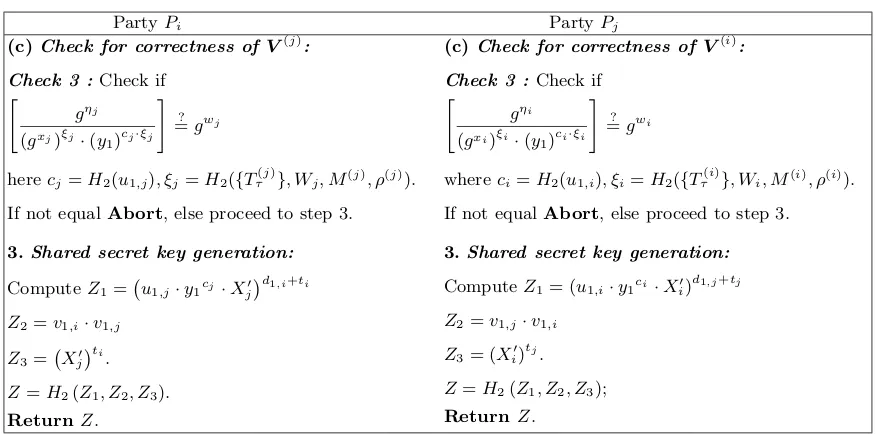
PartyPi PartyPj
1. Local Computation:
(a)Choosewi∈RZ∗p,
(b)ComputeWi=gwi
(c)Chooseσ(i)= (t
i, σ2(i), . . . , σn(ii))∈R(Z
∗ p)ni,
wheretiis a secret value.
(d)Xi=gti
(e)Compute:(i)eci=H2(Xi, u1,i)
(ii)ebi=H2(Xi, u1,i, v1,i, u2,i, v2,i,0)
(iii)eei=H2(Xi, u1,i, v1,i, u2,i, v2,i,1)
(f )For each rowτ∈ {1,2, . . . , li}, compute Tτ(i)=gM
(i)
τ ·σ(i),whereM(i)
τ isτth row of the matrix M(i).
(g)ηi=wi+d1,i·H2 {T (i)
τ }lτi=1, Wi, M(i), ρ(i)
F(i)= (u
1,i,v1,i,d2,i,bi,ei,cei,ebi,eei,ˆhi,M
(i),ρ(i)), V(i)= (η
i,{Tτ(i)}liτ=1,Wi)
−−−−−−−−−−−−−−−−−−−−−−−−−−−−−−−−−−−−−−−−−−−−−−−−−−−−−−−→
F(j)= (u1,j,v1,j,d2,j,bj,ej,ecj,ebj,eej,hˆj,M
(j),ρ(j)), V(j)= (η
j,{Tτ(j)}ljτ=1,Wj)
←−−−−−−−−−−−−−−−−−−−−−−−−−−−−−−−−−−−−−−−−−−−−−−−−−−−−−−−
2. Verification:
(a)Check 1: (Membership Testing)
Check if(i)F1(j), F2(j), F9(j)∈G∗;
(ii){Fk(j)}8k=3⊂Z ∗ p
If¬(a) or¬(b) or both,Abort
(b)Check for correctness ofF(j):
Compute(i)u02,j=
gd2,j
u1,j·y2ej
bj−1
(ii)v20,j=
hjd2,j v1,j·(ˆhj)
ej
!bj−1
(iii)IfS(i)satisfies
A(j), then compute Xj0 =
Q
τ∈I(T (j) τ )ωτ
whereI={τ :ρ(τ)∈S(i)}and{ωτ}τ∈I⊂Z∗p
(iv)Check 2 :Check if
e
cj ?
=H2(Xj0, u1,j)
ebj ?
=H2(Xj0, u1,j, v1,j, u02,j, v20,j,0)
e
ej ?
=H2(Xj0, u1,j, v1,j, u02,j, v02,j,1)
If any of them not equal,Abort, else proceed.
1. Local Computation:
(a)Choosewj∈RZ∗p,
(b)ComputeWj=gwj
(c)Choosesσ(j)= (t
j, σ2(j), . . . , σn(jj))∈R(Z
∗ p)nj,
wheretj is a secret value.
(d)Xj=gtj
(e)Compute:(i)ecj=H2(Xj, u1,j)
(ii)ebj=H2(Xj, u1,j, v1,j, u2,j, v2,j,0)
(iii)eej=H2(Xj, u1,j, v1,j, u2,j, v2,j,1)
(f )For each rowτ∈ {1,2, . . . , lj}, compute Tτ(j) = gM
(j)
τ ·σ(j),where M(j)
τ isτth row of the
matrixM(j).
(g)ηj=wj+d1,j·H2 {T (j) τ }
lj
τ=1, Wj, M(j), ρ(j)
2. Verification:
(a)Check 1: (Membership Testing)
Check if (i)F1(i), F2(i), F9(i)∈G∗;
(ii){Fk(i)}8k=3⊂Z ∗ p
If¬(a) or¬(b) or both,Abort
(b)Check for correctness ofF(i):
Compute(i)u02,i=
gd2,i
u1,i·y2ei
bi−1
(ii)v02,i=
hid2,i v1,i·(ˆhi)
ei
!bi−1
(iii)IfS(j) satisfiesA(i), then compute
Xi0=
Q
τ∈I(T (i) τ )ωτ
whereI={τ:ρ(τ)∈S(j)}and{ωτ}τ∈I⊂Z∗p
(iv)Check 2 :Check if
e
ci ?
=H2(Xi0, u1,i)
e
bi ?
=H2(Xi0, u1,i, v1,i, u02,i, v 0 2,i,0)
e
ei ?
=H2(Xi0, u1,i, v1,i, u02,i, v 0 2,i,1)
PartyPi PartyPj
(c)Check for correctness ofV(j):
Check 3 :Check if "
gηj
(gxj)ξj ·(y1)cj·ξj
#
?
=gwj
herecj=H2(u1,j), ξj=H2({Tτ(j)}, Wj, M(j), ρ(j)).
If not equalAbort, else proceed to step 3.
3.Shared secret key generation:
ComputeZ1= u1,j·y1cj·Xj0
d1,i+ti
Z2=v1,i·v1,j
Z3= Xj0
ti
.
Z=H2(Z1, Z2, Z3).
ReturnZ.
(c)Check for correctness ofV(i):
Check 3 :Check if "
gηi
(gxi)ξi·(y1)ci·ξi
#
?
=gwi
whereci=H2(u1,i), ξi=H2({Tτ(i)}, Wi, M(i), ρ(i)).
If not equalAbort, else proceed to step 3.
3.Shared secret key generation:
ComputeZ1 = (u1,i·y1ci·Xi0) d1,j+tj
Z2=v1,j·v1,i
Z3= (Xi0) tj.
Z=H2(Z1, Z2, Z3);
ReturnZ.
Table 2.Description of the Key Agreement protocol.
Remark 2. Check 3 is done to verify the value ofηi=wi+di1·H2({T (i)
τ }lτi=1, Wi, M(i), ρ(i))
which ensures that an active adversary cannot tamper with the components ex-changed and affect the shared secret key generation.
g
wi+d1,i·H2({Tτ(i)}liτ=1,Wi,M(i),ρ(i))
(gxi)H2({T
(i)
τ }liτ=1,Wi,M(i),ρ(i)).(y
1)ci·H2({T (i)
τ }liτ=1,Wi,M(i),ρ(i))
= g
wi+(xi+s1·ci)·H2({Tτ(i)}liτ=1,Wi,M(i),ρ(i))
gxi·H2({Tτ(i)}τli=1,Wi,M(i),ρ(i))·gs1·ci·H2({Tτ(i)}liτ=1,Wi,M(i),ρ(i))
=gwi.
We now show the correctness of our protocol, i.e., the keys computed by both the parties are thesame.
Lemma 1. The shared secret key computed by both the parties are identical. Proof. PartyPi computes: sinceu1,j =gxj andxj+s1·cj =d1,j, we have Z1= u1,jy1cjXj0
d1,i+ti
= (u1,jy1cjgtj)
d1,i+ti
= g(xj+s1·cj+tj)d1,i+ti=g(d1,j+tj)(d1,i+ti).
PartyPj computes: since u1,i=gxi and xi+s1·ci=d1,i, we have Z1= (u1,iy1ciXi0)
d1,j+tj = (u
1,iy1cigti)
d1,j+tj = g(xi+s1ci+ti)d1,j+tj =g(d1,i+ti)(d1,j+tj).
Thus, Z1 computed by both the parties are identical. Z2 and Z3 are also consistent. Hence, the final shared secret keyZ computed by both the parties is
3.1 Complexity Analysis of Our Protocol
In this section we give the complexity analysis of our protocol. Firstly, we note the computational cost of each party is dominated by the number of exponen-tiations it needs to do in the actual execution of the protocol. In the naive im-plementation of our protocol, the number of exponentiations performed by each party will depend on the size of the share generating matrix for share generation and secret reconstruction phase. However, here we show by doing appropriate preprocessing, the number of exponentiations at each party can be made O(1) (precisely 8). The detailed analysis is shown as follows:
1. In the Local Computation phase of our protocol, each party needs to perform 2 exponentiations corresponding to steps 1 (b), 1 (d) respectively.
2. In the naive implementation of our protocol, in the share generation phase (step 1 (f)), each party needs to perform size(M) many exponentiations wheresize(M) denotes the number of rows in the share generating matrix
M. However, it is to be noted that the computation of Tτ(i) = gM
(i)
τ ·σ(i)
values can be precomputed in the preprocessing steps as the share generation phase does not depend on the other party’s access structure. So each party can locally choose random access structure that it needs the other party to satisfy and it precomputes the Tτ(i) values and stores it in a table T
say. So the actual computational cost for each party in the actual protocol execution is independent of the cost of share generation. For each execution of the protocol a party can simply pick up an unused tuple of values from the tableT and use it for the current session.
3. In step 2 (b) (i) and (ii) of the verification phase, each party can get away with performing no exponentiation in the actual protocol execution. This is beacuse the checks does not require the knowledge of ephemeral secret keys
wi or wj or the valueηi orηj. The componentshu1,i, v1,i, d2,i, bi, ei,hˆii, are
sent only once by each party because they are part of static private key of that party and are invariant across all sessions in which this party is involved. So a party can perform these checks in the preprocessing step for the first time itself; next time onwards it need not do these checks.
4. In step 2 (b) (iii), each party needs to reconstruct back the secret value if he/she is a legitimate party, i.e., its attributes satisfy the access structure of the other party. The secret reconstruction cost of each party comes for free since we are working with access structures specified as boolean formula. This is due to the fact that the secret can be constructed by using Gaussian Elimination method inO(n3) time for access policies expressed as boolean formulas (for more details, see [25]).
5. For performing the checks 3 and 4 in step 2 (c), each party needs to do 4 exponentiations in all. Finally in step 3 in the Shared secret key generation phase, each party neds to perform 2 exponentiations (the value (y1)
cj can
again be precomputed).
4
Security Proof
In this section we present the formal security proof for the proposed protocol (described in the previous section). The detailed probability calculation is shown in section 4.1. The proof is based on the ABCK security model described in section 2.5. The scheme is proved secure under the Strong Diffie-Hellman (SDH) assumption in the random oracle model. The security proof is modeled as a game between the challenger and the adversary.
Theorem 1. Under the SDH assumption in G and the random oracle model,
our protocol is secure in theABCKmodel. Ifis the probability of the adversary in distinguishing between a random shared secret key and a valid shared secret key in the test session, the probability of solving the underlying SDH problem, 0 is given by:
0=· 1 h5
1− 1
qE+ 2
qE+1
. 1
qE+ 2
where qE = Number of key extract or Party Corruption queries and h5 is the number of queries on the hash oracleH2 of the formhZ1, Z2, Z3i.
Proof. We now give the formal security proof for our protocol from section 3.
Setup:The challenger is given the SDH problem instancehG, g, q, p, C=ga, D= gbiand access to the Diffie Hellman OracleDH(y
1, ., .). The challenger sets the master public key y1 =C and hence the master secret key s1 is implicitly set as a. The challenger chooses s2 ∈R Zp∗ and setsy2 =gs2. The challenger gives the tuplehG, g, q, p, y1, y2i to the adversary. The challenger simulates the hash oracles in the following way:
H1 Oracle: The adversary queries the challenger for the hash value of the at-tribute vectorSicorresponding to partyPi. If theH1Oraclewas already queried withSias input, the challenger returns the value computed before which is stored
in the hash list LH1 described below. Otherwise the challenger tosses acoin τi where theP r(τi= 0) =α. The output of this oracle is defined as:
hi=
gki, if τ
i= 0 gbki
, if τi= 1
whereki ∈RZ∗p. The challenger makes an entry in the hash listLH1=hhi,Si, τi, kii for future use and returnshi.
H2 Oracle : When the adversary queries the hash function H2 on any input sayx, if theH2oracle was already queried before with this input, the challenger simply extracts the value from the hash listLH2 described below and returns the value. Otherwise, the challenger chooses a random element sayy ∈RZ∗p, makes
an entry of the formhx, yiand returnsy. For example, the adversary may query the challenger with inputs (u1,i) or (u1,i, v1,i, u2,i, v2,i,0) or (u1,i, v1,i, u2,i, v2,i,1)
Leth1, h2, h3, h4 and h5 are the number of queries corresponding to each type of queries in the order mentioned above.
If the H2 Oracle was already queried with u1,i as input, the challenger
extracts the value ci from the hash list LH2 described below and returns the value. Otherwise, the challenger chooses a random valueci ∈RZ∗p respectively.
It makes an entry in the hash list LH2 = hci, u1,ii and returns ci. Similarly when the adversary queries the challenger with inputs (u1,i, v1,i, u2,i, v2,i,0) or
(u1,i, v1,i, u2,i, v2,i,1), if theH2Oraclewas already queried with (u1,i, v1,i, u2,i, v2,i,0)
or (u1,i, v1,i, u2,i, v2,i,1) as input, the challenger extracts the valuebi orei from
the hash list LH2 described below and returns the value. Otherwise, the chal-lenger chooses a random value bi ∈RZ∗p or ei ∈RZ∗p. It makes an entry in the
hash list LH2 = hbi,(u1,i, v1,i, u2,i, v2,i,0)i or LH2 = hei,(u1,i, v1,i, u2,i, v2,i,1)i and returns bi or ei respectively. Similarly the rest of the queries will also be
answered in a similar fashion.
Party corruption: The adversary presents the challenger with an attribute vectorSi and the challenger should return the private key of that partyPi. The
challenger proceeds in the following way:
The challenger checks if the H1 Oracle was already queried for Si. If yes and τi= 1, itaborts. Otherwise it extractski, hi from the list LH1 and proceeds to the next step. If Si was not queried before, the challenger runs theH1 Oracle with Si as input. If τi = 1, it aborts. Else the challenger chooses ki ∈R Z∗p,
computeshi=gki, adds the tuplehhi,Si, τi, kiito theLH1 list.
The challenger does not know the master secret keys1 as the master public key is set asy1=ga (implicitly settings1=a). Therefore, in order to generate the private key of users, the challenger makes use of the random oracles and generates the private key as described below:
– The challenger choosesci, bi, ei, xi0, ri0∈RZ∗p.
– It setsu1,i=gx
0
i·y1−ci.
– It setsH2(u1,i) =ci and stores the tuplehci, u1,iiin theLH2 list. – It setsd1,i=x0i,d2,i=x0i+r0i·bi+s2·ei andu2,i=gr
0
i·y1ci·bi−1.
– It computesv1,i=gki·x
0
i·y1−ki·ci andv
2,i=gki·r
0
i·y1ki·ci·bi−1.
– It also sets the hash function valuesH2(u1,i, v1,i, u2,i, v2,i,0) =bi,
H2(u1,i, v1,i, u2,i, v2,i,1) =ei and adds the tupleshbi, u1,i, v1,i, u2,i, v2,i,0i,
hei, u1,i, v1,i, u2,i, v2,i,1ito the listLH2. – It computeshis2.
– It returns the tuple hu1,i, v1,i, u2,i, v2,i, d1,i, d2,i, his2i as the private key of
the user with attribute vector Si and makes an entry in the list LE =
hu1,i, v1,i, u2,i, v2,i, d1,i, d2,i, his2,Sii.
Lemma 2. The private key returned by the challenger during thePartyCorruption
query are consistent with the system.
– Test 1 : Check if g
d1,i
yH2(u1,i)
1
? =u1,i.
This can be verified as g
x0
i
ga·H2(u1,i) where ci=H2(u1,i).
This is equal togx0i−a·ci =gx0i·y1−ci =u
1,i.
– Test 2 : Check if g
d2,i
u2,iH2(u1,i,v1,i,u2,i,v2,i,0)·y2H2(u1,i,v1,i,u2,i,v2,i,1) ? =u1,i.
This follows as g
x0
i+r
0
i·bi+s2·ei gr0
i·y1ci·bi−1bi·gs2·ei
=gx0i−a·ci =gx0i·y1−ci =u
1,i,
asbi=H2(u1,i, v1,i, u2,i, v2,i,0) andei=H2(u1,i, v1,i, u2,i, v2,i,1).
– Test 3 : Check if h
d2,i
i
v2,iH2(u1,i,vi,1,ui,2,vi,2,0)·(his2)
H2(u1,i,v1,i,u2,i,v2,i,1)
? =v1,i.
This follows as h
x0i+r0i·bi+s2·ei
i
gki·r0i·y1ki·ci·bi−1bi·(his2)ei
=hix
0
i·y
1−ki·ci =v1,i
wherebi=H2(u1,i, v1,i, u2,i, v2,i,0) andei=H2(u1,i, v1,i, u2,i, v2,i,1).
Thus the components generated by the challenger are consistent with the system
as the tests 1, 2 and 3 are satisfied.
Session Simulation:The adversary requires the challenger to simulate shared secret keys. The challenger simulates sessions other than the test session. Here we mention the party which initiates the session as theownerof the session and the other party who responds to the request of the owner as thepeer. We have to consider the following cases during the session simulation phase.
Case 1: In this case, the adversary has executed the PartyCorruption query with respect to Pi. Hence the adversary knows the static secret key of Pi.
The adversary treats Pi as owner and generates the tuple of values given by
hu1,i, v1,i, d2,i, bi, ei, his2,{T
(i)
τ }lτi=1, ηi=wi+d1,i·H2 {T (i)
τ }lτi=1, Wi, M(i), ρ(i), Wi, Xi, M(i), ρ(i)i and passes it to the challenger and asks the challenger to
complete the session withPj as the peer.
Case 1a: Ifτj = 0, the challenger knows the secret key and hence executes the
actual protocol and delivers the session key to the adversary.
Case 1b: If τj = 1, the challenger does not know the secret key and hence
simulates the session key as follows:
1. The challenger first performs the checks presented in the Step 2 of the Key Agreement protocol, onhu1,i, v1,i, d2,i, bi, ei, his2,{T
(i)
τ }lτi=1, ηi, Wi, M(i), ρ(i)i.
2. The challenger generates the parameters for the party Pj in the form of a
s2·ej, bj, ej,ecj,ebj,eej, hjs2,{T
(j)
τ } lj
τ=1, wj0+xj·fj, gwj0·y1−cj·fj, M(j), ρ(j)i,
whererj, xj, wj0, fj ∈RZp∗,σ(j)= (tj, σ2(j), . . . , σ (j)
nj)∈R Z
∗
p
ni
. It computes
hj =H1(Sj),bj =H2 u1,j, v1,j, grj, h rj
j ,0
,ej =H2(u1,j, v1,j, grj, hjrj,1),
ebj = H2 gtj, u1,j, v1,j, grj, h rj
j ,0
, eej = H2(gtj, u1,j, v1,j, grj, hjrj,1) and
{Tτ(i)}lτi=1 is computed as per the protocol specification. 3. IfH2was already queried with inputs
{Tτ(j)} lj
τ=1, g
wj0 ·y
1−cj·fj, M(j), ρ(j)
, generate a freshwj0 and recompute the last but two components. With very high probability, the new {Tτ(j)}
lj
τ=1, g
wj0·y
1−cj·fj, M(j), ρ(j)
will not result in a previously queried input set toH2. SetH2 {T
(j)
τ }lτj=1, gw
0
j·y1−cj·fj, M(j), ρ(j)
asfj.
4. The parameters generated by the challenger will satisfyCheck 2 in Step 2 of Key Agreement. This is because the parametershu1,j, v1,j, d2,j, bj, ej, hjs2i
are generated in the same way as the original scheme.
5. The parameters generated by the challenger will satisfyCheck 3 in the Step 2 of Key Agreement of Section 3. In fact the expression
gw0j+xj·fj
(gxj)H2({T
(j)
τ }ljτ=1,g
w0j
·y1−cj·fj,M(j),ρ(j)).(y 1)
cj·H2({Tτ(j)}ljτ=1,g
w0j
·y1−cj·fj,M(j),ρ(j))
is indeed equal togw0j ·y1−cj·fj =gwj
6. Thus the parameters generated by the challenger are consistent with that of the system.
7. The challenger sends the parameters to the adversary. 8. The challenger computes Z1 = (gxi·y1ci·gti)
xj+tj where c
i =H2(u1,i). It
also computes P1 = (u1,i·y1ci·gti)
cj and P
2 = y1 where cj = H2(u1,j).
Note that the challenger can compute the value gti only if it’s attributes
satisfy the access structure of partyPj.
9. The challenger computesZ2=v1,i·v1,j andZ3= (gti)
tj.
10. The challenger is given access to theDH(y1,·,·) oracle, since we assume the hardness of Strong-Diffie Hellman problem. The challenger makes use of the
DH(y1,·,·) Oracle to answer the query as follows:
– The challenger finds aZsuch thatDH P2, P1, Z1/Z1(valid sinceP2=
y1) andH2(Z1, Z2, Z3) =Z, where Z2=v1,i·v1,j andZ3= (gti)
tj.
– If aZ exists, the challenger returnsZ as the shared secret key.
– Otherwise the challenger chooses Z ∈R Z∗p and for any further query
of the form (Z1, Z2, Z3) to theH2 Oracle, ifDH P2, P1, Z1/Z1, Z2=
v1,i·v1,j andZ3= (gti)
tj, the challenger returns Z as the result to the
query.
Case 2: The adversary does not know the secret key of Pi, the owner of the
session. Here the adversary simply asks the challenger to generate a session with
Pi as owner andPj as peer.
Case 2a: The case where τi = 0 andτj = 0. In this case, the challenger can
simulate the computations of both the parties since the challenger knows the private key of the ownerPi and the peerPj.
Case 2b: The case where either τi = 0 or τj = 0. Without loss of generality
let us consider that τi = 0 and τj = 1. Here the challenger knows the secret
key of i but does not know the secret key of Pj. Hence for Pi the challenger
will generate the session secret key as per the algorithm. ForPj the challenger
simulates similar toCase 1b
Case 2c: The case where τi = 1 and τj = 1. In this case the challenger does
not know the secret key of bothPi andPj. Hence the challenger has to simulate
the session values for bothPi andPj, which is done identically toCase 1b. Test Session:The adversary impersonates as userPiand sends the parameters
as the following tuple of valueshu1,i, v1,i, d2,i, bi, ei,cei,ebi,eei, his2,{T
(i)
τ }lτi=1,
ηi=wi+d1,i·H2({T (i)
τ }lτi=1, Wi, M(i), ρ(i)), Wi, M(i), ρ(i)ito the challenger for
session simulation. The challenger runs the H1 Oracle with inputSi. The test
session is assumed to run between two usersPi andPj, where adversary
imper-sonates asPiand challenger has to generate parameters for userPj. Ifτi= 0, it
aborts. Else it does the following:
– The challenger now passes on to the adversary the parameters as being the following tuple of values:
hu1,j =gxj, v1,j =hjxj, d2,j =xj+rj·bj+s2·ej, bj, ej, hjs2,{T
(j)
τ } lj
τ=1, wj+ d1,j·H2({T
(j)
τ } lj
τ=1, gwj, M(j), ρ(j)), M(j), ρ(j)i, whereTτ(j)= (D·g−d1,j)M
(j)
τ1·Qnj
ς=2gσ (j)
ς M
(j)
τ ς , hereM(τj)= (M(j)
τ1, M (j)
τ2, . . . , M (j)
τ nj)
isτth row of the matrixM(j).Note thatt
j=b−d1,j is implicitly defined, and d1,j is the private key component associated with user Pj which is known
to the challenger, and {Tτ(i)}τli=2 ∈R G, rj, xj ∈R Z∗p, wj,σ(j) ∈R (Z∗p)nj, hj =H1(Sj), bj =H2(u1,j, v1,j, grj, hjrj,0), ej =H2(u1,j, v1,j, grj, hjrj,1).
The parameters passed satisfy the checks as they are generated in the way similar to the scheme andgtj =gb−d1,j =D·g−d1,j.
– The challenger performs the checks specified inStep2 of theKey Agree-mentalgorithm described in Section 3 onhu1,i, v1,i, d2,i, bi, ei, his2,{T
(i)
τ }lτi=1,
ηi, Wi, Xi, M(i), ρ(i)i. If the checks pass, the challenger proceeds to next step.
Else, it aborts.
– The challenger returns aZ∈RZ∗p as the shared secret key. This won’t be a
valid shared secret key. But in order to find that this is invalid the adversary should have queried the H2 Oracle with a valid tuple (Z1, Z2, Z3). Thus the challenger computes Z2 = (Z2/v1,j)
ki−1 and Z
3 = Z3·(gti)
d1,j. The
challenger also computesS= Z1/Z2·Z3
ci−1
– Finally the challenger can return the solution for the CDH hard problem as shown in the lemma below.
Lemma 3. The challenger returns the solution to the CDH instance of the SDH hard problem set in the beginning.
Proof: The challenger computes S= Z1/Z2·Z3
ci−1
whereci=H2(u1,i).
• S= g(d1,i+ti)(d1,j+b−d1,j)/Z
2·Z3
ci−1
. Since,τi = 1,
Z2= (Z2/v1,j)
(ki)−1
= (v1,i·v1,j/v1,j)(ki)
−1
= (hixi)(ki)
−1
= gb·kixi·(ki)
−1
=gb·xi.
(Note: The componenthi = gb ki
asτi = 1.).
• Z3=Z3·(gti)
d1,j
= (gti)(b−d1,j)·(gti)d1,j =gb·ti. • ThereforeS= g(xi+a·ci+ti)(d1,j+b−d1,j)/gb·xi·gb·tici
−1 =gab.
Thus we have proved that the challenger returns the solution to the SDH
Prob-lem. ut
4.1 Probability Analysis
In this section we present the probability analysis of our scheme presented in Section 3.
Proof. A solution to the hard problem can be generated only if the following events hold good.
• S1 : The challenger is able to answer all the Party Corruption queries. In other words, the challenger should not abort in the Party Corruption phase.
• S2: In the test session, the private key of user that the adversary imperson-ates should not be computable.
• S3: In the test session, the challenger should be able to compute the private key of the user it is simulating.
• S4 : The challenger should choose the valid tuple (Z1, Z2, Z3) from the list
Lh2which has the hard problem injected in it.
Therefore, a solution to SDH problem can be obtained if
(Adversary succeeds in the game in Section3) V S
1 V S2 V S3VS4.
P r(breaking SDH) =
Consider the H1 Oracle. Assume P(τi= 0) = α. Let qE be the total number
of key extract or Party Corruption queries. Now qE can be divided into two
mutually disjoint subsets ¯A and ¯B. Let ¯A be a set of queries for whichH1(Si)
resulted inτi = 0 and hence the private keys can be computed as described in
Party Corruption phase and it will not abort in the Party corruption phase. Let
Bbe the set for whichH1(Si) resulted inτi = 1 and hence an abort in the Party
Corruption phase. Therefore private keys cannot be computed for attributes in
B. There are α.qE attributes in Aand remaining (1−α).qE attributes inB.
• P r(S1) =P r Si∈A
for all theqE queries. This is equal to
α·q
E qE
qE
=
αqE.
• P r(S2) =P r Si∈B
, whereSi is the attribute vector of the partyPithat
the adversary impersonates in the Test Session. Therefore τi = 1 in this
case and hencehi = gb
ki
. This is needed to solve the SDH problem. The
probability is equal to (1−α).qE
qE
= 1−α.
• P r(S3) =P r Sj∈A, Sj is the attribute vector of the partyPj the
chal-lenger emulates in the Test Session. This ensures that the private key ofPj
is computable by the challenger. This is equal toα.
• P r(S4) = P r(a valid hZ1, Z2, Z3i ∈ LH2 is chosen by the challenger) = 1
h5
, where h5is the number of queries made of the form hZ1, Z2, Z3ito the
H2 Oracle.
Therefore the probability of solving the SDH problem,0=.αqE.(1−α).α.
0 =. 1 h5
.αqE+1.(1−α).
By maximizing this probability with respect toα, we getα=
q
E+ 1 qE+ 2
.
Therefore0 =· 1
h5
1− 1
qE+ 2
qE+1 .
1
qE+ 2
.
5
Additional Security Properties
The proposed protocol also offers additional security properties which we discuss informally. Formal details of these properties can be found in the full version of the paper.