Adding Distributed Decryption and Key Generation to a Ring-LWE Based
CCA Encryption Scheme
Michael Kraitsberg3, Yehuda Lindell1,3, Valery Osheter3, Nigel P. Smart2,4, and Younes Talibi Alaoui2
1 Bar-Ilan University, Israel, 2
KU Leuven, Leuven, Belgium.
3
Unbound Technology, Israel,
4
University of Bristol, Bristol, UK.
[email protected], [email protected], [email protected], [email protected],
Abstract. We show how to build distributed key generation and distributed decryption procedures for theLIMA Ring-LWE based post-quantum cryptosystem. Our protocols implement the CCA variants of distributed decryption and are actively secure (with abort) in the case of three parties and honest majority. Our protocols make use of a combination of problem specific MPC protocols, generic garbled circuit based MPC and generic Linear Secret Sharing based MPC. We also, as a by-product, report on the first run-times for the execution of the SHA-3 function in an MPC system.
1
Introduction
Distributed decryption enables a set of parties to decrypt a ciphertext under a shared (i.e. distributed) secret key. Distributed decryption protocols for traditional public key encryption and signature schemes have had a long history of innovation [10–13,15,17,20,21,26,27]. But the research on such protocols for schemes based on Ring-LWE (Learning-With-Errors) has only been started quite recently.
Despite research on Ring-LWE, and Fully/Somewhat Homormorphic Encryption (FHE/SHE) schemes derived from Ring-LWE being relatively new, applications of distributed decryption have found numerous applications already. One of the earliest applications we could find is the two-round passively secure FHE-based multiparty computation (MPC) protocol of Gentry [14]. In this MPC protocol, nparties encrypt their inputs to the MPC computation via an FHE scheme, and broadcast the ciphertexts. All parties can then homomorphically compute the desired function, with the result finally obtained via a distributed decryption. A similar methodology is applied in the multi-key FHE techniques of Asharov et al [4]. These two works only aim for passive security, whereas a similar technique is applied in [22] to obtain low-round MPC via the BMR methodology [5], and in [8] to utilize Gentry’s technique via an SHE scheme (and not an FHE scheme) for non-full-threshold access structures (such as the ones considered in this paper). Despite the overal protocols obtaining active security, the distributed decryption procedures in [8,22] are only required to be actively secure up to additive errors. A similar situation occurs in the SPDZ protocol [9] in which an actively secure (up to additive errors) distributed decryption protocol is required to produce the multiplication triples in the offline phase. The same technique is used in the High Gear variant of the Overdrive [18] offline phase for SPDZ.
The application of such distributed decryption protocols is however not just restricted to usage in MPC protocols. It is well established in the side-channel community that such key-splitting techniques can form the basis of various defences based on ‘masking’; see for example a recent initiative of NIST in this area [7]. However, every masking technique requires a recombination technique, which is exactly what distributed decryption provides.
to additive error (i.e. they are not fully actively secure) and they only allow distributed decryption of the IND-CPA versions of the underlying encryption schemes.
In this paper we present efficient methods to perform actively secure distributed decryption for IND-CCA versions of Ring-LWE based encryption in the case of three party honest majority protocols. This is done by combining in a novel manner traditional garbled circuit based MPC, with bespoke protocols for the specific functionality we require. On the way we also provide, to our knowledge, the first MPC implementation of the evaluation of the SHA-3 function; previously in [29] an MPC-optimized circuit was given, but no execution times for an actual MPC evaluation of SHA-3 has been presented. We also show how to utilize secret sharing based protocols such as embodied in the SCALE-MAMBA system [3] to produce an efficient distributed key generation procedure suitable for our underlying distributed decryption procedure.
Prior work on CCA secure distributed decryption protocols, even for encryption schemes based on “traditional” assumptions (such as RSA or Discrete Logarithms), such as those in [12,20,27], have looked at designing special purposes encryption procedures which are both CCA secure, and which enable an efficient distributed decryption procedure. In this work we instead take an off-the-shelf CCA secure encryption scheme and show how it can be made into a scheme which supports both distributed decryption and distributed key generation. This brings added challenges as the method for ciphertext checking is not immediately “MPC-friendly”. Despite this drawback we show that such schemes can be implented via MPC.
In total we usefourdifferent types of secret sharing between the three parties in order to obtain efficient protocols for the various sub-steps:
1. INS-sharing [16] moduloqof the Ring-LWE secret key.
2. Shamir secret sharing moduloqto generate the INS secret key via SCALE-MAMBA.
3. An additive 3-party binary sharing of the output of the Round function, before we pass it to the KMAC operation. This additive sharing is non-standard and looks like a cross between INS and replicated sharing.
4. An additive sharing moduloqof the output of the KMAC operation between two of the partiesS1andS2.
To illustrate our methods in terms of a concrete Ring-LWE system we take theLIMAsubmission [1] to the PQC contest. We take the latest version of this submission (version 1.1 at the time of writing). However, almost all our techniques will apply, with minor changes to the specific definitions of usage of SHA-3 etc, to a number of the other Ring-LWE systems under submission. A major advantage of theLIMAproposal versus a proposal such as say NTRU is that key generation and encryption are essentially linear operations; thus providing a distributed actively secure protocol for key generation and re-encryption becomes easy. For NTRU the key generation method, for example, needs to generate polynomials with distributions which cannot be generated in a linear fashion; in particular distributions with given coefficients with a given weight of−1and+1coefficients.
We end this section by noting that running our distributed decryption protocol using two as opposed to three parties, and using traditional passively secure Yao protocols, results in a passively secure distributed decryption protocol. For the two party case of the key generation protocol we could utilize the SPDZ [9] implementation within the SCALE-MAMBA framework. The two-party key generation would be actively secure and, more importantly, is possible since the modulusq = 40961used in the LIMAv1.1 scheme is “FHE-Friendly” and hence can be used as the plaintext modulus for the SPDZ-offline phase.
1.1 Overview of Prior Techniques
To encrypt a messagem∈Rpthe encryptor selects random valuesei∈χiand computes
c0=b·v+p·e1+m (modq) and c1=a·v+p·e2.
A ciphertext is then given by the pairc= (c0, c1). If one considers a (somewhat) homomorphic variant of the above then all valid ciphertexts (i.e. ones which will always validly decrypt) will be of the form
c0=c1·s+p·e+m (modq)
whereecomes from some other distributionχ(which depends on the function which has been evaluated). It is readily seen that processed, and fresh, ciphertexts can be decrypted by computing
m= (c0−s·c1 (modq)) (modp).
Decryption will be valid as long as thekc0−s·c1 (modq)k∞≤B, and a value ofqjust larger than2·Bis chosen so that this is guaranteed to produce no wrap-around.
Now consider the situation where the secret keyshas been additively shared amongstnparties, i.e.P1holdss1, P2holdss2and so on, such thats=s1+· · ·+sn (modn). A naive method to perform such a distributed decryption would be for each partyPito compute a ‘decryption share’dias
di=
c0−s1·c1+p·e01 (modq)Ifi= 1
−si·c1+p·e0i (mod q) Ifi6= 1
wheree0icomes from some LWE distributionχ0i. On broadcasting these values all parties can compute
m= n
X
i=1
di (modq)
!
(modp).
Naively this seems to be (passively) secure, as the valuesdiseem to be indistinguishable from uniform under the LWE assumption, and thus hidesi, however the partial sum
n
X
i=1
di (modq)
reveals information abouts. To see this, consider the decryption equation for a fresh BGV ciphertext.
This naive method does however form the basis of prior techniques to perform this operation; see [4,9] for the full threshold case and [8] for the case of threshold access structures. To remove the information leakage onsfrom the sum, the prior work applies the Smuddging Lemma from [4]. In essence, one selects a statistical security parameter
secp, and we now chooseqso thatq > 2·(1 +n·2secp)·B. To produce the partial decryptions each party then computes decryption sharesdi as before, except now thee0i are selected uniformly from ring elements with infinity norm bounded by2secp·B/p. Then, when we form the partial sumPn
i=1di (mod q)we have added in an essentially uniform random element which masks any information aboutsto the parties.
It should be noted that the statistical security in this step is really only per coefficient of the ring-element, and thus to obtain “true” security one needs to actually choosesecpmuch larger than is done in (say) the SCALE-MAMBA system [3] (where a value of secp = 40 is selected). Although in practice this is probably not a problem as it is unknown how to extract the minor statistical variations per coefficient when processing a number of full ring elements in this manner. Even when selecting low values ofsecpsuch as40, one obtains a huge blow-up in the parameters of the scheme and hence increased computational cost.
2
Preliminaries
To focus our discussion we pick a specific Ring-LWE submission to the NIST PQC “competition”; in particular v1.1 ofLIMA[1]. This was selected as it utilizes a relatively standard transform for ciphertext validity checking; namely randomness recovery followed by re-encryption which could pose a particular problem for a distributed decryption protocol. In addition the encryption and key generation procedures are also relatively linear, allowing one to utilize simple MPC protocols to perform re-encryption and distributed key generation.
We will focus on the main parameter sets in theLIMAproposal. In particularN = 1024andq= 40961. However, our protocol can be easily adapted to the other parameter sets (in fact the protocol stays the same, all that needs to change is the specific implementation of the underlying garbled and arithmetic circuits).
In this section we summarize theLIMAconstruction and also summarize some tools from the MPC literature which we will be using. Our focus in the MPC literature will be on three party honest majority protocols which offer active securitywith abort.
2.1 TheLIMAIND-CCA Encryption Scheme
Here we summarize theLIMAv1.1 construction. For more details readers are referred to [1]. As explained above we use the latest version of the proposal which avoids the rejection sampling in encryption of the first proposal and has, as a result, smaller parameters.
Cycloctomic Rings: LIMAmakes use of two types of cyclotomic rings, in this paper we will concentrate on only the first type (minor modifications in what follows are needed to support the second type proposed inLIMA). We selectN to be power of two,qto be a prime such thatq≡1 (mod 2·N). The scheme makes use of the following rings
R=Z[X]/(XN+ 1), R2=Z2[X]/(XN+ 1), andRq =Zq[X]/(XN + 1).
Note thatΦ2·N(X) =XN + 1in this case. Elements of these rings are degree(N−1)polynomials with coefficients fromZ,Z2,Zq, respectively. Equivalently, these are represented as vectors of lengthN, with elements in theZ,Z2,Zq, respectively.
LIMAmakes a lot of use of the number theoretic FFT algorithm to enable fast multiplication of ring elements. We will denote this operation in this paper byf ←FFT(f)for the forward FFT, andf ←FFT−1(f)for the inverse FFT operation. The forward direction maps a polynomial of degreeN−1into a vector of lengthN over the same finite fieldFq (by choice ofq). For our MPC operations it is important to note that the FFT operation is a linear operation, i.e.FFT(f+g) =FFT(f) +FFT(g).
Use of SHA-3 in KMAC256: LIMAmakes use of KMAC256, to create an XOF (Extendable Output Function) and a KDF (Key Derivation Function). The algorithm KMAC256 is itself derived from the SHA-3 hash function and is defined in NIST SP 800 185 [25]. Following theLIMAspecification we use the following notation for the various uses of KMAC256. When called in the formXOF←KMAC(key,data,0)the output is an XOF object, and when called in the formK←KMAC(key,data, L)the output is a string ofLbits in length. In both cases the input is a keykey(of length at least 256 bits), a (one-byte) data stringdata, and a length fieldLin bits. The data stringdatais a diversifier and corresponds to thedomain separationfield in the KMAC standard. Different values ofdatawill specify different uses of the KMAC construction. In the case whenL = 0we shall leta ←XOF[n]denote the process of obtaining nbytes from the XOF object returned by the call toKMAC. The KDF inLIMAis given by the notationKDF[n](k), which outputs the result of computingKMAC(k,0x00, n).
In Figure1we describe howLIMAuses the XOF to generate random values in different domains and with different distributions. These area ←
XOFFq to generate uniformly random single finite field element,a XOF← F
n
a ←
XOFFq
1. s←XOF[ 2· dlog256qe].
2. Convertsto an integer (msb is the left most bit). 3. a←s (modq).
4. Outputa.
a ←
XOFF n q
1. Forifrom1tondo (a) ai ←
XOFFq. 2. Outputa.
GenerateGaussianNoiseXOF(σ)
1. t←XOF[5]; interprettingtas a bit string of length40. 2. s←0.
3. Fori= 0toBdo
(a) s←s−t[2·i] +t[2·i+ 1]. 4. Returns.
Figure 1.Using of a XOF to generate random values
KeyGen(N)
1. a= (a0, . . . , aN−1) ←
XOFF N q .
2. Fori= 0toN−1dosi←GenerateGaussianNoiseXOF(σ). 3. Fori= 0toN−1doe0i←GenerateGaussianNoiseXOF(σ). 4. a←FFT(a),s←FFT(s),e0←FFT(e0).
5. b←(a⊗s)⊕e0, 6. sk←(s,a,b). 7. pk←(a,b). 8. Return(pk,sk)
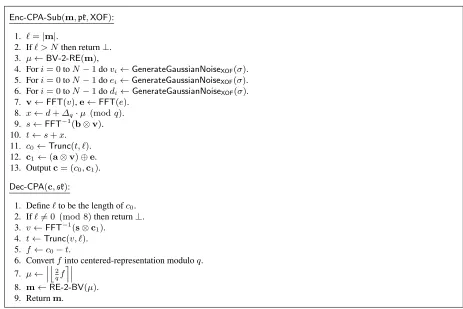
LIMAKey Generation: The specification ofLIMAdetails that the private component of a public/private key pair are generated from the KMAC256 XOF. However, in practice this component can come from any source of random bits, thus the XOF output in lines2and3of Figure2can be replaced byanysource of random bits known to the secret key creator. We will make use of this fact in our distributed key generation procedure later on. Key Generation proceeds as in Figure2, where we assume a XOF has already been initiated and the operations⊗and⊕denote pointwise multiplication and addition (mod q).
Enc-CPA-Sub(m,pk,XOF):
1. `=|m|.
2. If` > Nthen return⊥. 3. µ←BV-2-RE(m),
4. Fori= 0toN−1dovi←GenerateGaussianNoiseXOF(σ). 5. Fori= 0toN−1doei←GenerateGaussianNoiseXOF(σ). 6. Fori= 0toN−1dodi←GenerateGaussianNoiseXOF(σ). 7. v←FFT(v),e←FFT(e).
8. x←d+∆q·µ (modq). 9. s←FFT−1(b⊗v). 10. t←s+x.
11. c0←Trunc(t, `).
12. c1←(a⊗v)⊕e.
13. Outputc= (c0,c1).
Dec-CPA(c,sk):
1. Define`to be the length ofc0.
2. If`6= 0 (mod 8)then return⊥. 3. v←FFT−1(s⊗c
1).
4. t←Trunc(v, `). 5. f←c0−t.
6. Convertfinto centered-representation moduloq. 7. µ←
j
2
qf m
8. m←RE-2-BV(µ). 9. Returnm.
Figure 3.BaseLIMAEncryption and Decryption Operations
Encryption and Decryption: Both the CCA encryption and decryption operations make use of a sub-procedure, calledEnc-CPA-Sub(m,pk,XOF)which takes as input a message inm ∈ {0,1}`, a public key and an initialized XOF objectXOF, and outputs a ciphertextc. The associated inverse operation is denotedDec-CPA(c,sk). These algorithms are defined in Figure3. These operations make use of three sub-routines:
– Truncdenotes a procedure which throws away unnecessary coefficients ofc0, retaining only the`elements corre-sponding to message component.
– BV-2-REis a procedure which takes a bit string of length at mostNand maps it intoR2. – RE-2-BVis the inverse operation toBV-2-RE.
We can then define the CCALIMAencryption, decryption, encapsulation and decapsulation operations as in Figure4
2.2 Three Party Honest Majority MPC Using Garbled Circuits
Enc-CCA(m,pk,r):
1. If|r| 6= 256or|m| ≥N−256then return⊥. 2. µ←mkr.
3. XOF←KMAC(µ,0x03,0). 4. c←Enc-CPA-Sub(µ,pk,XOF). 5. Returnc.
Dec-CCA(c,sk):
1. µ←Dec-CPA(c,sk). 2. If|µ|<256then return⊥. 3. XOF←KMAC(µ,0x03,0). 4. c0←Enc-CPA-Sub(µ,pk,XOF). 5. Ifc6=c0then return⊥.
6. mkr←µ, whereris256bits long. 7. Returnm.
Encap-CCA(`,pk,s):
1. If|r|<384or|r|> Nthen return⊥. 2. XOF←KMAC(r,0x05,0).
3. c←Enc-CPA-Sub(r,pk,XOF). 4. k←KDF[`](r).
5. Return(c= (c0,c1),k).
Decap-CCA(`,c,sk):
1. r←Dec-CPA(c,sk). 2. If|r|<384then return⊥. 3. XOF←KMAC(r,0x05,0). 4. c0←Enc-CPA-Sub(r,pk,XOF). 5. Ifc6=c0then return⊥.
6. k←KDF[`](r).
from partiesP1, P2andP3 is as follows. PartiesP1andP2agree on a random seedsand then usesto generate a garbled circuit. PartyP3acts as evaluator. IfP1orP2cheats then this is detected byP3as they will obtain different circuits, where as ifP3cheats in sending output tables values incorrectly back toP1orP2(for their output), then the table values will not decode correctly. The overall protocol is described in Figure5. Thus we cheaply obtain active security with abort in this scenario.
1. Denote the inputs ofS1,S2andS3byx1,x2andx3, respectively.
2. Letf(x1, x2, x3)be the function to be computed and letC(x1, x2, x3)be a circuit that computesf.
3. PartyS1 chooses a random seedsand generates a garbled circuitGC computingCand the output translation tables
O1, O2andO3for the three parties outputs), using seeds.
4. PartyS3chooses a randomxa3 ← {0,1}|x3|and setsxb3 ←xa3⊕x3and it sendsxa3toS1, and sendsxb3toS2.
5. PartyS1sends(GC, O3)toS3. For every wirewassociated with the inputx3in the circuit, the garbled circuit definition
is assumed to includes(H(k0w), H(kw1))in this order (where the keys on that wire arekw, k0 1w). 6. PartyS1sendsstoS2.
7. PartyS2computesGCfromsand sendsh=H(GC)toS3.
8. S3checks thath=H(GC)wherehis the value it received fromS2, andGCis as received fromS1. If not, it aborts.
9. PartyS1sendsS3the keys associated with its own inputx1and withxa3.
10. PartyS2sendsS3the keys associated with its own inputx2and withxb3.
11. PartiesS1andS2run a secure tossing protocol to generate random stringsR1, . . . , R|x3|.
12. Denote the bits ofxa3byxa3[1], . . . , xa3[`], denote the bits ofxb3byxb3[1], . . . , xb3[`], and denote the wires associated with
x3byw1, . . . , w`.
13. For everyi= 1, . . . , `, partyS1sendsk0i ← kw0i ⊕x a
3[i]·∆⊕RitoS3. We use the “free-XOR” trick so we have
kw1i =k
0
wi⊕∆.
14. For everyi= 1, . . . , `, partyS2sendski00←xb3[i]·∆⊕RitoS3.
15. For everyi= 1, . . . , `, partyS3computeskwx3i[i]←k
0
i⊕k00i and checks that this is consistent with the appropriate hash. That is, ifx3[i] = 0then the hash of the key equals the first value in the appropriate pair; otherwise the second value. If
not thenS3aborts.
16. S3computes the garbled circuitGCand obtains their output using the tableO3.
17. S3sends the garbled outputs corresponding toS1andS2’s output wires toS1andS2respectively.
18. S1andS2decode their output using the translation tablesO1andO2.
Figure 5.Garbled Circuit Based Three Party Computation
2.3 Three Party Honest Majority MPC Using Shamir Secret Sharing
We also require honest majority three party actively secure MPC with abort based on linear secret sharing over the finite fieldFq. For this we use a protocol based on Shamir secret sharing implemented in the SCALE-MAMBA system [3]. This uses an offline phase to produce multiplication triples and shared random bits (using Maurer’s multiplication protocol [23]) and then an online phase which checks for correctness by using the error detection properties of the underlying Reed-Solomon codes. See [19,28] for precise details of how this protocol works. This arithmetic circuit based MPC protocol is used in our distributed key generation phase, and we make crucial use of the ability of the SCALE-MAMBA system to generate shared random bits in the offline phase; as then our online phase becomes essentially a local operation.
We denote secret shared values over Fq by the notation [a]. In this notation linear operations, such as[z] ← α·[x] +β·[y] +γ are local operations, and hence essentially for free. Where as non-linear operations, such as [z]←[x]·[y]require interaction. In the SCALE-MAMBA system these are done using a pre-processed set of Beaver triples([a],[b],[c])withc=a·b.
Output/opening values to all players will be denoted byOutput([a])by which we mean all players learn the value ofa, and abort if the value is not output correctly. Outputing to a specific player we will denote byOutput-To(i,[a]), in which case playeriwill learn the value ofa, and abort if the value is not correct.
using a PRSS, however the SCALE-MAMBA system does not currently support this functionality. So when generating random elements in the online phase we simply consume the first two components of a Beaver triple, and we will write ([a],[b],[c])←Triples, this is secure as long as[c]is never used later.
The offline phase also produced shared random bits, namely sharings of the form [b]withb ∈ {0,1}. We will denote this operation in what follows as[b]←Bits.
3
SHA3 in MPC
The TinyGarble compiler [29] has been reported to produce a circuit for the SHA-3 core internal Keccak-f function of 38,400 AND gates (160,054 total gates). Using similar techniques to the TinyGarble paper we compiled our own circuit for Keccak-f, finding a circuit with the same number of gates and 193,686 wires. This function takes as input, a sequence of 1600 bit values, and returns a 1600 bit value. The output is either then passed into the next round, during the absorption phase where it is combined with additional input, or part of the output is used as the output of SHA-3, in the squeezing phase.
Using our garbled circuit based protocol for honest majority computation amongst three parties, we were able to execute the Keccak-f function with a latency of 16ms per operation. With the testing being conducted on a set of three Linux RHEL servers running on AWS of typet2.small, which correspond to one “virtual CPU” and 2GB of RAM.
4
Distributed Decryption for CCA-Secure Ring-LWE Encryption
Recall that a public key is a pair(a,b)and a secret key is a values, wherea,b,s ∈ ZN
q . Given our three servers, of which we assume at least two are honest, we share the secret key using Ito–Nishizeki–Saito sharing [16]. In par-ticularS1is assumed to hold(s1,21 ,s11,3)∈ZNq ,S2is assumed to hold(s
1,2 2 ,s
2,3
1 )∈ZNq , andS2is assumed to hold (s1,32 ,s2,32 )∈ZN
q such that
s1,21 +s1,22 =s1,31 +s1,32 =s2,31 +s2,32 =s.
How one generates a valid secret key satisfying this secret sharing we discuss in the next section. We call such a sharing an INS-sharing ofs. Our overall distributed decryption and decapsulation protocols are then build out of a number of special protocols which either utilize our generic 3-party garbled circuit based protocol from earlier, or utilize special purpose MPC protocols built on top the ISN-sharing of inputs or other sharings of inputs. Thus in this protocol we combine a variety of MPC techniques together in a novel manner.
4.1 Sub-Protocol: Round Function
We first require a protocol which takes an ISN-sharing of a vectorfand produces the output of the function
µ←
j2
qf
m
from the procedureDec-CPA(c,sk). In particular it needs to evaluate the functionality given in Figure6, which we do via the protocol given in Figure7
Input:
1. S1hasf11,2, f 1,3
1 ∈Z
` q. 2. S2hasf21,2, f
2,3
1 ∈Z
` q. 3. S3hasf21,3, f
2,3
2 ∈Z
` q.
Computation:
1. Computef1,2 =f1,2
1 +f
1,2 2 modq.
2. Computef1,3 =f11,3+f 1,3 2 modq.
3. Computef2,3 =f2,3
1 +f
2,3 2 modq.
4. Computeb= 1iff1,2=f1,3=f2,3andb= 0otherwise. 5. Convertfinto centered representation.
6. Computeµ← j
2
qf m
.
7. Choose randomµ1, ν1← {0,1}`and setµ2 ←µ1⊕µandν2←ν1⊕µ(where here we mean bitwise XOR).
Output:
1. All partiesS1, S2, S3receiveb.
2. Ifb= 1thenS1receivesµ1, ν1,S2receivesµ2, ν2, andS3receivesµ2, ν1.
Figure 6.The Functionality :FRound
4.2 Sub-Protocol: Secure Evaluation of theEnc-CPA-SubFunction
Our next sub-protocol is to evaluate theEnc-CPA-Subfunction on inputs which have been INS-shared. The protocol is given in Figure9 but from a high level works as follows: Firstly the three parties execute the KMAC function on their suitably padded inputs (which have been shared via a different secret sharing scheme), from thisS1andS2 obtain an additiveFq-sharing of the output bits. This operation utilizes the SHA-3 implementation given earlier as a sub-procedure, and to aid readability we separate this operation into a sub-protocol in Figure8. In this protocol the parties have as input a sharing of a bit stringµdefined as follows:S1holds(µ1, ν1),S2holds(µ1, ν2), andS3holds (µ2,ν1)such thatµ=µ1⊕µ2=ν1⊕ν2. The output of the function will be anFq-sharing betweenS1andS2of the XOF applied to this input with diversifierD. The diversifier will be0x03for decryption and0x05for decapsulation). Note, that the first thing the circuit does is to ensure the input values are consistent, i.e.µ1⊕µ2 = ν1⊕ν2. Also note that only partyS2obtains output from this step. Since the number of AND gates in the permutation function is 38,400 and we have 114 rounds, then the total number of AND gates needed to execute this step isapproximately
114·38,400 = 4,377,600, plus the number of AND gates needed to createS2’s output (which is approximately 3·40·N·log2q≈1,966,080).
The additiveFq-sharing betweenS1andS2output from Figure8is then used in a completely local manner by S1 andS2 to obtain a moduloqadditive sharing of the supposed ciphertext. The fact we can perform mainly local operations is because the method to generate approximate Gaussian noise is completely linear and the FFT algorithm is itself linear. This is then revealed to playersS1andS2, via means of a garbled circuit computation between the three players. See Figure9for details.
The privacy of the protocol to evaluateEnc-CPA-Subis inherent in the fact we use secure actively secure protocols to evaluate the two required garbled circuits. The only place that an active adversary could therefore deviate is by entering incorrect values into the evaluation of theTruncfunction; e.g.S1could enter the incorrect value forµ1 or y(1). Any incorrect adversarial behaviour here will either result in an incorrect value ofc0
0, which will be detected by the calling algorithm.
4.3 Secure Evaluation ofDec-CCA(c,sk)
We first, define a boolean circuitCthat receives for input bitα, βand six elementsa, b, c, d, e, f∈Zq, and works as follows:
1. Computex=a+bmodq,y=c+dmodqandz=e+fmodq. Observe that addition moduloqinside a circuit works by first adding two numbers (into a value that is larger by one bit) and then subtractingqif the comparison of the result withqis returns a value one. In a circuit this looks like:
a+b−(LT(a+b, q)∧q)
whereLT(r, s) = 0if and only ifr < s(as integers). Note that we compute the AND of a single bitLT(a+b, q)and a valueq; our meaning is to compute the AND of each bit ofq.
2. Computev=x⊕yandw=x⊕z. Denote byγthe bitwise NOR of all the bits ofvandw(i.e.,γ= 1if and only if
allthe bits ofvandwequal 0, meaning thatx=yandx=zand sox=y=z). 3. Letδbe the bit that satisfies the following Boolean formula:
δ=
x≥q−1
4
∧
x < 3(q−1) 4
4. Outputβon the first output wire. 5. Outputγon the second output wire. 6. Outputγ∧(α⊕δ)on the third output wire. 7. Outputγ∧(β⊕δ)on the fourth output wire.
Now, the functionRoundcan be computed securely, as follows:
1. S1chooses randomµ1, ν1← {0,1}`; denote theith bit ofµ1byµi1and theith bit ofν1byν1i.
2. For everyi= 1, . . . , `:
(a) Denote byf[i]theith element off∈Z`q. (b) S1, S2 and S3 securely computeC µi1, ν1i, f
1,2 1 , f
1,2 2 , f
1,3 1 , f
1,3 2 , f
2,3 1 , f
2,3 2
using the previous 3-party garbled circuit protocol. Note thatS1 provides input(µi1, νi1, f
1,2 1 , f
1,3
1 ),S2 provides input(f21,2, f 2,3
1 ), andS3provides
input(f21,3, f 2,3
2 ). The secure protocol provides outputs as follows:
i. S3onlyreceives the output bitβon the first output wire.S3denotes this output byν1i.
ii. Allparties receive the output bitγon the second output wire. They denote the output bit byγ. iii. S2andS3onlyreceive the output bit on the third output wire.S2andS3denote this output byµi2.
iv. S2onlyreceives the output bit on the fourth output wire.S2denotes this output byν2i.
(c) If any party receives output bitγ= 0, it aborts. 3. S1outputsµ1=µ11, . . . , µ1`andν1=ν11, . . . , ν1`.
4. S2outputsµ2=µ12, . . . , µ2`andν2=ν21, . . . , ν2`.
5. S3outputsµ2=µ12, . . . , µ2`andν1=ν11, . . . , ν1`.
The parties using the 3-party garbled circuit protocol from earlier securely compute the application of KMAC (with diversifer D) on the valuesµ=µ1⊕µ2=ν1⊕ν2as follows. In addition partyS1enters a random valueb(1)i ∈Fqfor each output bit.
Padding: The parties first defin:µ¯1=µ1||1||0r−|µ1|−2||1,µ¯2=µ2||0r−|µ2|,ν¯1=ν1||1||0r−|ν1|−2||1andν¯2=ν2||0r−|ν2|
wherer= 1088.
The parties then run the following circuit:
1. Computeu= ¯µ1⊕µ¯2.
2. Computev= ¯ν1⊕ν¯2.
3. Check thatu=v, if not, abort. i.e. output 1 on a special abort wire and 0 on all others; if no abort, then the abort wire should hold 0.
4. Compute KMAC(u): We need one absorbtion round, and for the squeezing we repeatedly apply the garbled round function for SHA-3, so as to obtain3·40·N bits of shared output. Thus we need to execute3·40·N/rrounds of squeezing, whenN= 1024andr= 1088, so we require113rounds of squeezing.
Specifically: Letp(x, y)denote the permutation function of SHA-3, with domain size of 1600 bits (a) Define:R0= 01088,C0= 0512
(b) (R00, C 0
0) =p(u,0512)
(c) Fori= 1to113:(R0i, Ci0) =p(R0i−1, Ci0−1).
(d) The values(R10, . . . , R0113)are then used (combined with the respectedb (1)
i input fromS1) to produce the output for
S2. In particular if bitkofRj0 corresponds to output bitbithen we setb
(2)
i tobi−b
(1)
i (modq).
Figure 8.Protocol to securely evaluate KMAC on shared inputs
1. Using Figure8partyS1andS2obtain an additive sharing overFqof the output bits from the KMAC operation applied toµ=µ1⊕µ2 =ν1⊕ν2.
2. PartiesS1 andS2 now locally compute additive sharings moduloqof the random Gaussian valuesvi, eianddifrom
the Enc-Sub-CPAalgorithm of LIMA. This is done by locally applying the algorithm to produce Gaussian values, GenerateGaussianNoisesince it is a linear function of the input random bits. Thus partyS1obtains three ring elements
(v(1), e(1), d(1)), and partyS2obtains three ring elements(v(2), e(2), d(2))such thatv=v(1)+v(2),e =e(1)+e(2)
andd=d(1)+d(2)
.
3. PartyS1locally computes the valuesv(1) =FFT(v(1)),e(1) =FFT(e(1)),s(1) =FFT−1(b⊗v(1)),c(1)1 = (a⊗
v(1))⊕e(1).
4. PartyS2locally computes the valuesv(2) =FFT(v(2)),e(2) =FFT(e(2)),s(2) =FFT−1(b⊗v(2)),c(2)1 = (a⊗
v(2))⊕e(2).
5. PartiesS1andS2 locally compute sharing ofy=y(1)+y(2) =s+dby computingy(1) =s(1)+d(1)andy(2) =
s(2)+d(2).
6. The partiesS1andS2openc(1)1 andc (2)
1 to each other, so they can obtainc 0 1.
7. With private input(y(1), µ1)and(y2), µ2)fromS1 andS2 the three parties compute (using a secure Garbled Circuit
based secure computation protocol) the value
c00=Trunc
y(1)+y(2)+∆q·BV-2-RE(µ1⊕µ2), `
.
withS1andS2obtaining the output.
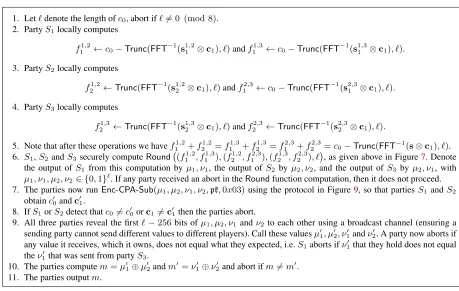
1. Let`denote the length ofc0, abort if`6= 0 (mod 8).
2. PartyS1locally computes
f11,2←c0−Trunc(FFT −1
(s11,2⊗c1), `)andf11,3←c0−Trunc(FFT −1
(s11,3⊗c1), `).
3. PartyS2locally computes
f21,2←Trunc(FFT−1(s12,2⊗c1), `)andf12,3←c0−Trunc(FFT −1
(s21,3⊗c1), `).
4. PartyS3locally computes
f21,3←Trunc(FFT −1
(s12,3⊗c1), `)andf22,3←Trunc(FFT −1
(s22,3⊗c1), `).
5. Note that after these operations we havef11,2+f 1,2
2 =f
1,3
1 +f
1,3
2 =f
2,3
1 +f
2,3
2 =c0−Trunc(FFT−1(s⊗c1), `).
6. S1,S2andS3securely computeRound (f11,2, f 1,3 1 ),(f
1,2 2 , f
2,3 1 ),(f
1,3 2 , f
2,3 2 ), `
, as given above in Figure7. Denote the output ofS1 from this computation byµ1, ν1, the output of S2 by µ2, ν2, and the output ofS3 by µ2, ν1, with
µ1, ν1, µ2, ν2 ∈ {0,1}`. If any party received an abort in theRoundfunction computation, then it does not proceed.
7. The parties now runEnc-CPA-Sub(µ1, µ2, ν1, ν2,pk,0x03)using the protocol in Figure9, so that partiesS1 andS2
obtainc00andc01.
8. IfS1orS2detect thatc06=c00orc16=c01then the parties abort.
9. All three parties reveal the first`−256bits ofµ1, µ2, ν1 andν2to each other using a broadcast channel (ensuring a
sending party cannot send different values to different players). Call these valuesµ01, µ 0 2, ν
0 1andν
0
2. A party now aborts if
any value it receives, which it owns, does not equal what they expected, i.e.S1aborts ifν10 that they hold does not equal
theν10that was sent from partyS3.
10. The parties computem=µ01⊕µ 0 2andm
0
=ν10 ⊕ν 0
2and abort ifm6=m 0
. 11. The parties outputm.
Figure 10.Secure Evaluation ofDec-CCA(c,sk)
Security of the protocol: TheRoundfunction is computed by a protocol that is secure against malicious adversaries. Intuitively, this means that the view of each party can be trivially simulated since S1,S2 andS3 receive nothing but random shares as output from this subprotocol and no other messages are even sent. However, the partiescan
provide incorrect values at all steps of the protocol. Specifically, a corruptS1 can input an incorrectf1intoRound, similarly a corruptS2can input an incorrectf2intoRound, etc. We resolve this problem by adding redundancy into the computation.
First, we compute the initialfvalues three times; once between each different pair or parties. Since at least one of these pairs is guaranteed to be honest, we have that the output of the operationc0−Trunc(FFT−1(s⊗c1))will be correct for this pair. Since theRoundfunction computation verifies that all these values are equal (or elseγ= 0in the output and the parties learn nothing and abort), we have that this must be correct.
The parties then the protocol to evaluateEnc-CPA-Subfrom Figure9to obtain the re-encryption(c0
0,c01). Note, that for this to be correct, and so the equality check to pass, the servers must act honestly. Otherwise an invalid ciphertext is produced. Finally, the output message is obtained, and checked for correctness, using the redunancy inherent in the output of theRoundfunction.
We prove the security of the protocol via simulation by constructing a simulator S for the adversary A. The simulatorSknows the shares of the key held by each party, and works as follows:
– IfS1 is corrupted byA, then the simulatorS sendsc0,c1 to the trusted party computing the functionality and receives back m = xks. Then,S invokes A and receives the inputs(f11,2, f11,3) that Ainputs to the Round
The view ofAin the simulation is clearly identical to its view in a hybrid execution where the functionRound,
Truncand a function to perform secure computation are ideal functionalities. Thus, the output distributions are computationally indistinguishable, as required.
– The simulation forS2andS3is similar; withS3being a little simpler.
4.4 Secure Evaluation ofDecap-CCA(c,sk)
The distributed decapsulation routine works very much like the distributed decryption routine. However, to obtain the same ideal functionality of a real decapsulation routine we need to evaluate theKDFcomputation within a secure computation. This can be done using the same method we use to evaluate the KMAC needed in theXOFcomputation; since inLIMAboth are based on different modes of the SHA-3 based KMAC operation. The overal protocol is given in Figure11.
1. Let`denote the length ofc0, abort if`6= 0 (mod 8).
2. PartyS1computes
f11,2←c0−Trunc(FFT−1(s11,2⊗c1), `)andf11,3←c0−Trunc(FFT−1(s11,3⊗c1), `).
3. PartyS2computes
f21,2←Trunc(FFT −1
(s12,2⊗c1), `)andf12,3←c0−Trunc(FFT −1
(s21,3⊗c1), `).
4. PartyS3computes
f21,3←Trunc(FFT−1(s21,3⊗c1), `)andf22,3←Trunc(FFT −1
(s22,3⊗c1), `).
5. Note that after these operations we havef11,2+f21,2=f11,3+f21,3=f12,3+f22,3=c0−Trunc(FFT−1(s⊗c1), `).
6. S1,S2andS3securely computeRound (f11,2, f 1,3 1 ),(f
1,2 2 , f
2,3 1 ),(f
1,3 2 , f
2,3 2 ), `
, as given above in Section4.1. Denote the output ofS1from this computation byµ1, ν1, the output ofS2byµ2, ν2, and the output ofS3byµ2, ν1(recall that
S3receives the sameµ2asS2and the sameν1asS1). Note thatµ1, ν1, µ2, ν2∈ {0,1}`. If any party received an abort
in theRoundfunction computation, then it does not proceed.
7. The parties now runEnc-Sub-CPA(µ1, µ2, ν1, ν2,pk,0x03)so that partiesS1andS2obtainc00andc01.
8. IfS1orS2detect thatc06=c00orc16=c01then the parties abort.
9. Using a method similar to that above for producing the KMAC value inEnc-Sub-CPAthe parties now compute the value
k←KDF[`](µ1⊕µ2) =KDF[`](ν1⊕ν2)
using their private inputsµ1, µ2, ν1, ν2. Note, we again need to check for consistency of inputs within the garbled circuit.
10. The valuekis returned.
Figure 11.Secure Evaluation ofDecap-CCA(c,sk)
4.5 Experimental Results
5
Distributed Key Generation for Ring-LWE Encryption
Distributed key generation can be performed relatively straightforwardly using a generic MPC system based on linear secret sharing which supports two-out-of-three threshold access structures and gives active security with abort. As explained earlier we selected SCALE-MAMBA to do this, as we could use an off-the-shelf system.
SecGauss()
1. [a]←0.
2. Fori∈[0, . . . ,19]do (a) [b]←Bits. (b) [b0]←Bits.
(c) [a]←[a] + [b]−[b0]. 3. Return[a].
Figure 12.Securely Generating Approximate Gaussians
The main difficulty in key generation would appear to be the need to generate the approximate Gaussian distri-butions needed forLIMA. However, the specific distribution method chosen inLIMAdovetails nicely with the offline pre-processing found in SCALE-MAMBA. This results in the method to securely generate approximate Gaussian dis-tributions given in Figure12, which we note becomes a completely local operation in the online phase of the MPC protocol.
Inner(a)
1. Common input a polynomiala∈Rq. 2. Fori∈[0, . . . , N−1]do
(a) [s]i←SecGauss(). (b) [e]i←SecGauss().
(c) ([s11,2]i,[s11,3]i,[c])←Triples. (d) ([s21,3]i,[b],[c])←Triples.
(e) [s12,2]i= [s]i−[s11,2]i.
(f) [s12,3]i= [s]i−[s11,3]i.
(g) [s22,3]i= [s]i−[s21,3]i.
(h) Output-To(1,[s11,2]i). (i) Output-To(1,[s11,3]i). (j) Output-To(2,[s21,3]i). (k) Output-To(2,[s12,2]i). (l) Output-To(3,[s12,3]i). (m) Output-To(3,[s22,3]i).
3. [b]←a·[s] + [e] (modΦ2·N(X)).
This is a completely local operation asais public which we do as follows fork= 0, . . . , N−1 (a) [b]k←
P
i+j=kai·[s]j
−P
i+j=k+Nai·[s]j
+ [e]k.
4. Fori∈[0, . . . , N−1]do (a) Output([b]i).
Figure 13.Inner MPC Routine of KeyGen
algorithms we utilize vectors/polynomials of secret shared values which we will write as[f]which we use to represent the element inRgiven by[f]0+ [f]1·X+. . .+ [f]N−1·XN−1.
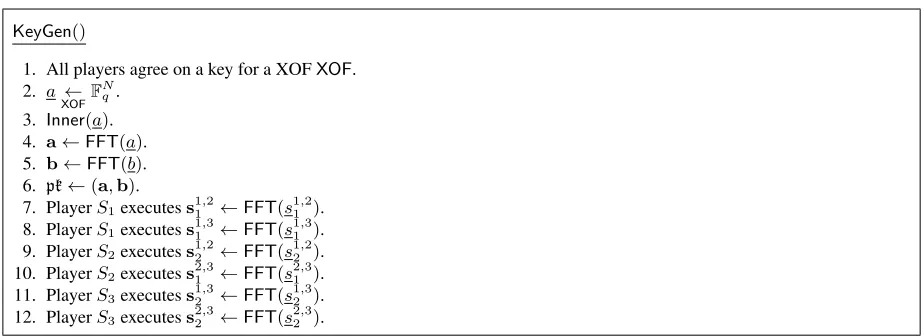
KeyGen()
1. All players agree on a key for a XOFXOF. 2. a ←
XOFF N q. 3. Inner(a). 4. a←FFT(a). 5. b←FFT(b). 6. pk←(a,b).
7. PlayerS1executess11,2←FFT(s 1,2 1 ).
8. PlayerS1executess11,3←FFT(s 1,3 1 ).
9. PlayerS2executess12,2←FFT(s 1,2 2 ).
10. PlayerS2executess21,3←FFT(s 2,3 1 ).
11. PlayerS3executess12,3←FFT(s 1,3 2 ).
12. PlayerS3executess22,3←FFT(s 2,3 2 ).
Figure 14.Main Key Generation Routine
5.1 Experimental Results
We implemented the above key generation phase within the SCALE-MAMBA framework for the parametersN = 1024andq= 40961ofLIMA. We used the settings of Shamir secret sharing and the Maurer [23] based offline settings of SCALE-MAMBA. Our experiments for this component were executed on three Linux Ubuntu machines with Intel i7-7700K processors running at 4.20 GHz, and with 8192KB cache and 32GB RAM.
The SCALE-MAMBA system runs in an integrated offline–online manner, however one can program it so as to obtain estimates for the execution times of both the offline and the online phases. An important parameter within the system is a statistical security parametersecpwhich defines the probability that an adversary can get the pre-processing to invalid data.
The variables=sacrifice_stat_secin the system defines the value ofsecpvia the equation
secp=dlog2qe ·l s dlog2qe
m
.
Whenqis large (i.e.q >2128), as it is in most envisioned executions of SCALE-MAMBA the default value ofs= 40 results in a suitable security parameter. However, for our small value ofqwe needed to modifysso as to obtain a suitable value ofsecp. We note, that this setting only affects the runtime for the offline phase; and as can be seen the effect on the run times in Table1is marginal.
The online run time takes 1.22seconds, although roughly one second of this is used in performing the 6144 output operations. On further investigation we found this was because SCALE-MAMBA performs all the reveals in a sequential as opposed to batch manner (requiring6144rounds of communication as opposed to one). We suspect a more careful tuned implementation could reduce the online time down to less than a quarter of a second. However, our implementation of the Key Generation method in SCALE-MAMBA took about a day of programmers time; thus using a general system (even if inefficient) can be more efficient on the development time.
Acknowledgements
s secpTime (Seconds) 40 48 20.2 80 80 20.7 128 128 23.1
Table 1.Times to produce the offline data for the Key Generation operation. This is essentially producing81920shared random bits,2048multiplication triples and enough shared randomness to enable the output of the shared keys.
References
1. Albrecht, M.R., Lindell, Y., Orsini, E., Osheter, V., Paterson, K.G., Peer, G., Smart, N.P.: LIMA-1.1 : A PQC encryption scheme (2018),https://lima-pq.github.io/
2. Alkim, E., Ducas, L., P¨oppelmann, T., Schwabe, P.: Post-quantum key exchange - A New Hope. In: Holz, T., Savage, S. (eds.) 25th USENIX Security Symposium, USENIX Security 16, Austin, TX, USA, August 10-12, 2016. pp. 327–343. USENIX Association (2016),https://www.usenix.org/conference/usenixsecurity16/technical-sessions/ presentation/alkim
3. Aly, A., Keller, M., Orsini, E., aru, D.R., Scholl, P., Smart, N.P., Wood, T.: SCALE and MAMBA documentation (2018), https://homes.esat.kuleuven.be/˜nsmart/SCALE/
4. Asharov, G., Jain, A., L´opez-Alt, A., Tromer, E., Vaikuntanathan, V., Wichs, D.: Multiparty computation with low commu-nication, computation and interaction via threshold FHE. In: Pointcheval, D., Johansson, T. (eds.) Advances in Cryptology – EUROCRYPT 2012. Lecture Notes in Computer Science, vol. 7237, pp. 483–501. Springer, Heidelberg, Germany, Cambridge, UK (Apr 15–19, 2012)
5. Beaver, D., Micali, S., Rogaway, P.: The round complexity of secure protocols (extended abstract). In: 22nd Annual ACM Symposium on Theory of Computing. pp. 503–513. ACM Press, Baltimore, MD, USA (May 14–16, 1990)
6. Brakerski, Z., Gentry, C., Vaikuntanathan, V.: (Leveled) fully homomorphic encryption without bootstrapping. In: Goldwasser, S. (ed.) ITCS 2012: 3rd Innovations in Theoretical Computer Science. pp. 309–325. Association for Computing Machinery, Cambridge, MA, USA (Jan 8–10, 2012)
7. Brandao, L.T.A.N., Mouha, N., Vassilev, A.: Threshold schemes for cryptographic primitives: Challenges and opportuni-ties in standardization and validation of threshold cryptography (2018),https://csrc.nist.gov/publications/ detail/nistir/8214/draft
8. Choudhury, A., Loftus, J., Orsini, E., Patra, A., Smart, N.P.: Between a rock and a hard place: Interpolating between MPC and FHE. In: Sako, K., Sarkar, P. (eds.) Advances in Cryptology – ASIACRYPT 2013, Part II. Lecture Notes in Computer Science, vol. 8270, pp. 221–240. Springer, Heidelberg, Germany, Bengalore, India (Dec 1–5, 2013)
9. Damg˚ard, I., Pastro, V., Smart, N.P., Zakarias, S.: Multiparty computation from somewhat homomorphic encryption. In: Safavi-Naini, R., Canetti, R. (eds.) Advances in Cryptology – CRYPTO 2012. Lecture Notes in Computer Science, vol. 7417, pp. 643–662. Springer, Heidelberg, Germany, Santa Barbara, CA, USA (Aug 19–23, 2012)
10. Desmedt, Y.: Society and group oriented cryptography: A new concept. In: Pomerance, C. (ed.) Advances in Cryptology – CRYPTO’87. Lecture Notes in Computer Science, vol. 293, pp. 120–127. Springer, Heidelberg, Germany, Santa Barbara, CA, USA (Aug 16–20, 1988)
11. Desmedt, Y., Frankel, Y.: Threshold cryptosystems. In: Brassard, G. (ed.) Advances in Cryptology – CRYPTO’89. Lecture Notes in Computer Science, vol. 435, pp. 307–315. Springer, Heidelberg, Germany, Santa Barbara, CA, USA (Aug 20–24, 1990)
12. Fouque, P.A., Pointcheval, D.: Threshold cryptosystems secure against chosen-ciphertext attacks. In: Boyd, C. (ed.) Advances in Cryptology – ASIACRYPT 2001. Lecture Notes in Computer Science, vol. 2248, pp. 351–368. Springer, Heidelberg, Ger-many, Gold Coast, Australia (Dec 9–13, 2001)
13. Frederiksen, T.K., Lindell, Y., Osheter, V., Pinkas, B.: Fast distributed RSA key generation for semi-honest and malicious ad-versaries. In: Shacham, H., Boldyreva, A. (eds.) Advances in Cryptology – CRYPTO 2018, Part II. Lecture Notes in Computer Science, vol. 10992, pp. 331–361. Springer, Heidelberg, Germany, Santa Barbara, CA, USA (Aug 19–23, 2018)
14. Gentry, C.: A fully homomorphic encryption scheme. Ph.D. thesis, Stanford University (2009), http://crypto. stanford.edu/craig
15. Hazay, C., Mikkelsen, G.L., Rabin, T., Toft, T.: Efficient RSA key generation and threshold Paillier in the two-party setting. In: Dunkelman, O. (ed.) Topics in Cryptology – CT-RSA 2012. Lecture Notes in Computer Science, vol. 7178, pp. 313–331. Springer, Heidelberg, Germany, San Francisco, CA, USA (Feb 27 – Mar 2, 2012)
17. Katz, J., Yung, M.: Threshold cryptosystems based on factoring. In: Zheng, Y. (ed.) Advances in Cryptology – ASI-ACRYPT 2002. Lecture Notes in Computer Science, vol. 2501, pp. 192–205. Springer, Heidelberg, Germany, Queenstown, New Zealand (Dec 1–5, 2002)
18. Keller, M., Pastro, V., Rotaru, D.: Overdrive: Making SPDZ great again. In: Nielsen, J.B., Rijmen, V. (eds.) Advances in Cryptology – EUROCRYPT 2018, Part III. Lecture Notes in Computer Science, vol. 10822, pp. 158–189. Springer, Heidelberg, Germany, Tel Aviv, Israel (Apr 29 – May 3, 2018)
19. Keller, M., Rotaru, D., Smart, N.P., Wood, T.: Reducing communication channels in MPC. In: Catalano, D., De Prisco, R. (eds.) SCN 18: 11th International Conference on Security in Communication Networks. Lecture Notes in Computer Science, vol. 11035, pp. 181–199. Springer, Heidelberg, Germany, Amalfi, Italy (Sep 5–7, 2018)
20. Libert, B., Yung, M.: Non-interactive CCA-secure threshold cryptosystems with adaptive security: New framework and con-structions. In: Cramer, R. (ed.) TCC 2012: 9th Theory of Cryptography Conference. Lecture Notes in Computer Science, vol. 7194, pp. 75–93. Springer, Heidelberg, Germany, Taormina, Sicily, Italy (Mar 19–21, 2012)
21. Lindell, Y.: Fast secure two-party ECDSA signing. In: Katz, J., Shacham, H. (eds.) Advances in Cryptology – CRYPTO 2017, Part II. Lecture Notes in Computer Science, vol. 10402, pp. 613–644. Springer, Heidelberg, Germany, Santa Barbara, CA, USA (Aug 20–24, 2017)
22. Lindell, Y., Smart, N.P., Soria-Vazquez, E.: More efficient constant-round multi-party computation from BMR and SHE. In: Hirt, M., Smith, A.D. (eds.) TCC 2016-B: 14th Theory of Cryptography Conference, Part I. Lecture Notes in Computer Science, vol. 9985, pp. 554–581. Springer, Heidelberg, Germany, Beijing, China (Oct 31 – Nov 3, 2016)
23. Maurer, U.: Secure multi-party computation made simple. Discrete Applied Mathematics 154(2), 370–381 (2006)
24. Mohassel, P., Rosulek, M., Zhang, Y.: Fast and secure three-party computation: The garbled circuit approach. In: Ray, I., Li, N., Kruegel:, C. (eds.) ACM CCS 15: 22nd Conference on Computer and Communications Security. pp. 591–602. ACM Press, Denver, CO, USA (Oct 12–16, 2015)
25. NIST National Institute for Standards and Technology: SHA-3 derived functions: cSHAKE, KMAC, TupleHash and Parallel-Hash (2016),http://nvlpubs.nist.gov/nistpubs/SpecialPublications/NIST.SP.800-185.pdf 26. Shoup, V.: Practical threshold signatures. In: Preneel, B. (ed.) Advances in Cryptology – EUROCRYPT 2000. Lecture Notes
in Computer Science, vol. 1807, pp. 207–220. Springer, Heidelberg, Germany, Bruges, Belgium (May 14–18, 2000)
27. Shoup, V., Gennaro, R.: Securing threshold cryptosystems against chosen ciphertext attack. In: Nyberg, K. (ed.) Advances in Cryptology – EUROCRYPT’98. Lecture Notes in Computer Science, vol. 1403, pp. 1–16. Springer, Heidelberg, Germany, Espoo, Finland (May 31 – Jun 4, 1998)
28. Smart, N.P., Wood, T.: Error-detecting in monotone span programs with application to communication efficient multi-party computation. Cryptology ePrint Archive, Report 2018/467 (2018),https://eprint.iacr.org/2018/467