International Journal of Research (IJR)
e-ISSN: 2348-6848, p- ISSN: 2348-795X Volume 2, Issue 06, June 2015Available at http://internationaljournalofresearch.org
Service recommendation on QoS Using Collaborative filtering by
Self-organizing map Visualization.
C.Uma Kumara Prabha
PG Scholar, St. Martins Engineering College,Dhoollapally Road,Kompally
Student Mail Id:[email protected]
Guide Name: C.Yosepu
Guide Designation:-Asst.Professor, IT DEPT, St. Martins Engineering College,Dhoollapally Road,Kompally Guide Mail Id:[email protected]
Abstract:
Web accommodations are software components that designed to fortify interoperable interaction between machines over network. It has been use in industry and academia. An abundance of research has concentrated on QoS cull and recommendation .In antecedent system; the y had not given good performance on web accommodation recommendations and provided
circumscribed information about the
performance of the accommodation candidates. In this paper, for immensely colossal -scale web accommodation recommendation a novel collaborative filtering algorithm is designed and characteristics of QoS by clustering users into different regions have been studied. This recommendation visualization technique is demonstrated how a recommendation is grouped with other culls.
Keywords: Service recommendation; QoS; Collaborative filtering; Self-organizing map; Visualization
Introduction
Web accommodation is method of
communication between two electronic
contrivances over network. Most of the applications of web accommodations are being utilized in business and astronomically immense scale enterprises. Nowadays, in businesses these applications have hoisted from sizably voluminous application to dynamic setup of business processes. In current scenario, web
accommodations are widely utilized in industry and academia. It is an amassment of open
protocols and utilized for superseding
databetween applications or systems. Software applications are indited in different types of programming languages and running on different platforms which can be used in web accommodations to exchange data over computer networks like the Internet. Web
Accommodations have consequential
characteristics like they are self-contained, modular, spread, dynamic applications, platform independent, language independent, highly interoperable, portable and having well defined interfaces.
In SOA (accommodation-oriented
application), first users request the
accommodation from the server. Servers get the entire request from users. Afore the server gets the entire request from users, first this request goes through the accommodation brokers. When implementing SOA,accommodation users conventionally get a list of web accommodations from accommodation brokers or search engines that will meet the concrete functional requisites. It requires to identify the ideal one from the functionally equipollent candidates. It is hard to cull the best performing one, since accommodation users have partial cognizance of their performance. It has issued to accommodation cull and
recommendation which is exigently
International Journal of Research (IJR)
e-ISSN: 2348-6848, p- ISSN: 2348-795X Volume 2, Issue 06, June 2015Available at http://internationaljournalofresearch.org
accommodation cull. QoS is defined as set of
utilizer cognizant properties including
replication time, availability, and reputation etc. It is not facile to users to acquire QoS
information by evaluating all the
accommodation candidates, since it Is
conducting authentic-world web
accommodation invocations which takes long time and is resource-consuming. Some properties of QoS are arduous to find like reputation and reliability etc because it need long time observation and chant required.
1. Related Work: 2.1 Existing System
When developing accommodation-oriented applications, developers first design the business process according to requisites, and then endeavor to find and reuse subsisting accommodations to build the process. Currently, many developers search accommodations through public sites like Google Developers
(developers.google.com), Yahoo! Pipes
(pipes.yahoo.com), programmable Web
(programmableweb.com), etc. However, none of
them provide location-predicated QoS
information for users. Such information is quite
consequential for software deployment
especially when trade compliance is concerned. Some Web accommodations are only available in EU, thus software employing these accommodations cannot be shipped to other countries. Without erudition of these things,
deployment of accommodation-oriented
software can be at great jeopardy. 2.2 Proposed System
We propose a novel collaborative filtering-predicated Web accommodation recommender system to avail users cull accommodations with
optimal Quality-of-Accommodation (QoS)
performance. Our recommender system
employs the location information and QoS values to cluster users and accommodations, and
makes personalized accommodation
recommendation for users predicated on the clustering results. Compared with subsisting accommodation recommendation methods, our
approach achieves considerable amelioration on the recommendation precision. Comprehensive experiments are conducted involving more than 1.5 million QoS records of authentic-world Web accommodations to demonstrate the efficacy of our approach.
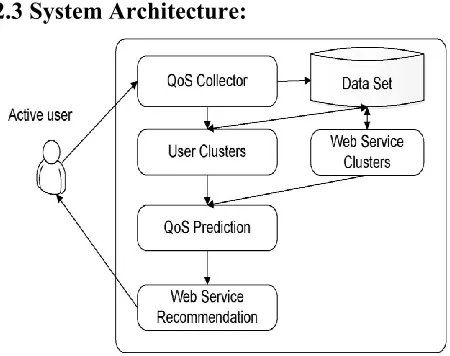
2.3 System Architecture:
Fig 1: Architecture Diagram.
2.4 Collaborative Filtering
Collaborative Filtering (CF) is widely employed in commercial recommender systems, such as Netflix andAmazon.com [4], [8], [9], [2]. The rudimental conception of CF is to soothsay and recommend potential favorite items for a particular utilizer employing rating data amassed from other users. CF is predicated on processing the utilizer-item matrix. Breese et al. [3] divide the CF algorithms into two broad classes: recollection predicated algorithms and
model-predicated algorithms. The most
International Journal of Research (IJR)
e-ISSN: 2348-6848, p- ISSN: 2348-795X Volume 2, Issue 06, June 2015Available at http://internationaljournalofresearch.org
implement, require little or no training cost, and can facilely take ratings of incipient users into account. However, recollection predicated algorithms do not scale well to a sizably voluminous number of users and items due to the high computation involution.
2.5 Service Selection and Recommendation:
Z. Manama, S.K. Mostefaoui, and Q.H. Mahmud[5] have worked on con text.
Web accommodation personalization is
developed by utilizing the contexts. Context is the information that characterizes the sodalities among people, applications, and location. Web accommodations are personalized so that users’ can be owned. Predilections are dissimilar types. Predilections are quantified predicated on performance of Web accommodations when it commences and ends. Personalization has two types such as explicit or implicit. Explicit Personalization: Straight participation of the users in the modification of applications can be utilized with explicit personalization. Users are pellucidly defined the data that are needs to be
preserved or repudiated. Implicit
personalization: Implicit personalization does not call the some users participation and can be made upon learning plans that path users' deportments and benefits. Personalization is predicated on the features that can be connected to users such as stationary utilizer, mobile and locations. They have utilized some context such as U-context, W-context, and R-context-context is utilized to represent status of a utilizer and
returns his individual predilections in
cognations of execution location and
implementation time of accommodations-context is utilized to represent the status of a resource-context is utilized to represent status of a Web accommodations and al so the implementation constraints on the Web accommodation. They have provided some policies like consistency, feasibility and inspection.
2. Implementation: 3.1 Quality of Service (QOS):
First, we propose a novel location-cognizant
Web accommodation recommendation
approach, which significantly ameliorates the recommendation precision and time involution compared with subsisting accommodation recommendation algorithms. Second, we conduct comprehensive experiments to evaluate our approach by employing an authentic-world Web accommodation QoS data set. More than
1.5 millions authentic-world Web
accommodation QoS records from more than 20 countries are engaged in our experiments. Comprehensive analysis on the impact of the algorithm parameters is withal provided.
3.2 User Regions and Service Regions:
Given a recommender system consisting of m users and n Web accommodations, the
relationship between users and Web
accommodations can be denoted by an m _ n utilizer-item matrix. An ingress in this matrix ru;i represents a vector of QoS values (e.g., replication time, failure rate, etc.) observed by utilizer u on Web accommodation i. If utilizer u has never usedWeb accommodation i afore, then ru;i ¼ null. An accommodation region is a group of accommodations with kindred QoS performance. In LoRec, accommodation regions
are habituated to discover potential
accommodations and recommend them to active users. A utilizer region is defined as a group of users who are proximately located with each
other and have homogeneous Web
accommodation QoS utilization experience. Each utilizer belongs to precisely one region. Building regions avail LoRec identify relationships in the QoS data set that might not be logically derived through casual observation.
3.3 Precious Web Service:
International Journal of Research (IJR)
e-ISSN: 2348-6848, p- ISSN: 2348-795X Volume 2, Issue 06, June 2015Available at http://internationaljournalofresearch.org
Definition 2. A region is a sensitive region iff its region sensitivity exceeds the predefined sensitivity threshold (lamda).
3.4 Web service Support:
Web accommodation QoS presage is utilized in different ways in LoRec to facilitate Web accommodation recommendation. First, when a utilizer searches Web accommodations utilizing LoRec, presaged QoS values will be shown adjacent to each candidate accommodation, and the one with the best presaged value will be highlighted in the search result for the active utilizer. It will be more facile for the active utilizer to decide which one to have a endeavor. Moreover, LoRec culls the best performing accommodations (accommodations with the best submitted QoS) and accommodations with the best soothsaid QoS from the whole accommodation repository for the active utilizer so that he/she can expeditiously find potential valuable ones in lieu of checking the accommodation piecemeal.
3. Experimental Results:
Fig 2: Search Page
Fig 3: Search Result Page
Fig 4: Search Result page
International Journal of Research (IJR)
e-ISSN: 2348-6848, p- ISSN: 2348-795X Volume 2, Issue 06, June 2015Available at http://internationaljournalofresearch.org
Fig 6: Response timings of Service Page. 4. Conclusion:
This paper has aimed to give an overview of
recent progress in automatic Web
accommodations Recommendation and
collaborative filtering. At first, the proposed
system algorithm is to employs the
characteristic of QoS by clustering users into
different regions. The precedent
recommendation system is consisting of
accommodation predilections, resources,
evaluation and execution. Every step needs different languages, platforms and methods. A most proximate-neigh bour algorithm is proposed to engender QoS prognostication predicated on the region feature. This recommendation system is integrated the correlation between QoS records with consideration of regions.
5. REFERENCES:
[1]Z. Zhen, H. Ma, M.R. Lyu, and I. King, “WSRec: A Collaborative Filtering Based Web Service Recommendation System,” Proc. Int’l Conf. Web Services, pp. 437-444, 2009.
[2] J.S.Breese, D. Heckerman, and C. Kadie, “Empirical Analysis of Predictive Algorithms for Collaborative Filtering,”Proc. 14th Conf. Uncertainty in Artificial Intelligence (UAI ’98), pp. 43-52, 1998.
[3]M.R. McLaughlin and J.L. Herlocker, “A
Collaborative Filtering Algorithm and
Evaluation Metric That Accurately Model the User Experience,” Proc. Ann. Int’l ACM SIGIR Conf., pp. 329-336, 2004.
[4] L.H .Ungar and D.P. Foster, “Clustering Methods for Collaborative Filtering,” Proc.
AAAI Workshop Recommendation
Systems,1998.
[5] Z. Maamar, S.K. Mostefaoui, and Q.H. Mahmoud, “Context for Personalized Web
Services,” Proc. 38th Ann. Hawaii
Int’lConf.,pp. 166b-166 b, 2005.
[6]M.B. Blake and M.F. Nowlan, “A Web Service Recommender system using Enhanced Syntactical Matching,” Proc. Int’l Conf.Web Services, pp. 575-582, 2007.
[8]X. Liu, G. Huang, and H. Mei, “Discovering Homogeneous Web Service Community in the
User -Centric Web
Environment,”IEEETrans.Services Computing, vol. 2, no. 2, pp. 167-181, Apr.-June 2009.
[7]X. Dong, A. Halevy, J. Madhavan, E. Nemes, and J. Zhang,“Similarity Search for Web Services,” Proc. 30th Int’l Conf. Very Large Data Bases, pp. 372-383, 2004.