Simple Homomorphisms of Cocks IBE
and Applications
Rio LaVigne
∗May 20, 2017
Abstract
The Cocks Identity Based Encryption (IBE) scheme, proposed in 2001 by Clifford Cocks, has been the standard for Quadratic Residue-based IBE. It had been long believed that this IBE did not have enough struc-ture to have homomorphic properties. In 2013, Clear, Hughes, and Tewari (Africacrypt 2013) created a Cocks scheme derivative where they viewed ciphertexts as polynomials modulo a quadratic. While the scheme was ho-momorphic, it required sending twice as much information per ciphertext as the original Cocks scheme. A recent result by Joye (PKC 2016) used complex algebraic structures to demonstrate the fact that Cocks IBE, on its own, is additively homomorphic.
In this work, we build upon the results from CHT and Joye. We take the simple intuition from CHT, that ciphertexts can be seen as polyno-mials, but also demonstrate that we only need to send as much data as in the original Cocks scheme. This perspective leads to better intuition as to why these ciphertexts are homomorphic and to explicit efficient algorithms for computing this homomorphic addition.
We believe that our approach will facilitate other extensions of Cocks IBE. As an example, we exhibit a two-way proxy re-encryption algorithm, which arises as a simple consequence of the structure we propose. That is, given a re-encryption key, we can securely convert a ciphertext under one key to a ciphertext under the other key and vice-versa (hence two-way).
1
Introduction
Identity-Based Encryption (IBE) is a special kind of public key encryption that lets any string be a public key. The first two IBE schemes were the elliptic-curve pairing based scheme by Boneh and Franklin, and the Quadratic Residue
∗MIT. Email: [email protected] This material is based upon work supported by the National
(QR) based scheme by Cocks, both in 2001 [BF01, Coc01]. In 2008, Gentry, Peikert, and Vaikuntanathan got an IBE from lattices [GPV08]. Unlike pairings and lattices, QR-based schemes rely on the same simple algebra as RSA, and the security assumption is the first assumption used in probabilistic encryp-tion (Goldwasser-Micali [GM84]). However, while pairing-based and lattice-based IBE constructions have been extended to Hierarchical IBE, Functional Encryption, Predicate Encryption, etc., progress wtih QR-based IBEs has been comparatively slow [BBG05,ABB10,BSW11,SW04,Boy13,AFV11,GVW15,
GPSW06]. Our goal in this paper is to uncover the surprising simple structure in Cocks IBE, extending the results of Clear, Hughes, and Tewari [CHT13], and Joye [Joy16].
In 2013, Clear, Hughes, and Tewari [CHT13] made the major observation that a Cocks ciphertext c can be viewed as a polynomial modulo a quadratic, i.e. a linear function 2x+c. Decryption is evaluating the polynomial at the secret key and then taking the Jacobi symbol: 2rN+c
= m. They created a derivative IBE scheme (CHT) based on these linear functions. The advantage of their framework was that the homomorphic properties were straightforward: homomorphic addition was as simple as multiplying the two polynomials to-gether and then taking them modulo the quadratic, resulting in another linear ciphertext of the formax+b. The downside of this variant is that it requires twice as much bandwidth as the original Cocks scheme; users need to send 2 elements inZN to describe a linear function, instead of just one.
This past year, Joye in [Joy16] demonstrated that the Cocks schemealready
has homomorphic properties without the CHT modifications. Here is a quick look at how he accomplishes this. First, he shows that Cocks ciphertexts are part of a multiplicative structure based on the algebraic torus [RS03]. This torus is a group defined from a quadratic field extension. He is able to define a similar multiplicative structure (although no longer a group) by “removing” the square roots from the ring and then adding them back as an extension. Intuitively, this scheme works because the multiplicative structure only breaks if we are able to find a square root, and by the Quadratic Residuosity Assumption (QRA), this happens only with negligible probability. By treating Cocks ciphertexts as a multiplicative group (multiplying ciphertexts multiplies their Jacobi symbols in decryption), he is able to homomorphically add ciphertexts.
Joye’s proof, while striking, is unfortunately complicated, which we believe obscures some of its potential applications. In this paper, we will combine the best of CHT and Joye’s work [CHT13,Joy16] by showing we can achieve Joye’s homomorphic guarantees with a simpler analysis of Cocks’ scheme. And indeed, this leads us to our new application: identity-based proxy re-encryption of Cocks ciphertexts.
1.1
Our Results
length-preservation with little effort. Our main technical lemma gives a way to re-randomize these linear function ciphertexts. We note that Joye goes through a similar conceptual re-randomization step, but without proving convergence (though intuitively it appears to work). We show that our rerandomization step, with overwhelming probability, converges in an expected constant number of iterations—in fact 2.
Our second contribution is an application: two-way proxy re-encryption of Cocks ciphertexts. Two-way proxy re-encryption allows for a third party with a re-encryption key for two public keys, R and R0, to convert a ciphertext encrypted withRto a ciphertext encrypted withR0 and vice-versa, hence two-way. This application relies on our ability to re-randomize a ciphertext and convert from CHT ciphertexts to Cocks ciphertexts.
1.2
A Technical Overview
Cocks IBE and Linear Functions. We will start with describing the Cocks IBE scheme. From there, we can show how a Cocks ciphertext can be seen as a linear function as in CHT [CHT13], and then why this perspective is useful.
A Cocks IBE ciphertext consists of two values (c,ˆc) in ZN where N =pq
for primesp≡q ≡3 mod 4. c was encrypted under public key R and ˆc was encrypted under−R. Since R is an element with Jacobi symbol 1, either it is a square modpand modq, or a square in neither. Because p≡q≡3 mod 4,
−1 is a non-square both modpand modq, meaning exactly one ofR and−R
has a square rootr. Thus exactly one ofcand ˆccontains information about the message. So, without loss of generality we will assumeR =r2 and work only
with thec component of the ciphertext.
To encrypt a message m ∈ {±1} under a public key R = r2, we choose a t ←$ ZN so that Nt
= m, and let c = t+ Rt. We decrypt with 2rN+c. The Cocks ciphertext, when viewed as a linear function as in CHT, is 2x+c. Similarly, if we have a linear function ciphertext ax+b and a = 2, then we could treat it as a Cocks ciphertext and only need to send the constant term in a ciphertext – the linear term is assumed to be 2.
Consider two Cocks ciphertexts c and c0 encryptions of m and m0 respec-tively. If we multiply their linear function forms together, we get a polynomial
g(x) = (2x+c)·(2x+c0) = 4x2+ 2(c+c0)x+cc0. Notice that if we then
mod g(x) out by x2 −R to get ¯g(x), g(r) = ¯g(r). So, for linear function
¯
g(x) = 2(c+c0)x+cc0+ 4R, when we decrypt
¯
g(r)
N
=
g(r)
N
=
2r+c
N
·
2r+c0
N
=m·m0.
2b/a), and when we decrypt, we get
2r+ 2b/a N
=
2/a
N
·
ar+b N
= 1·m.
Ifa/2 does not have Jacobi symbol 1, we will need some way to re-randomize the ciphertext so that, with constant probability, we change the linear term. Our re-randomization step is that for inputax+b, we can multiply by a random square (cx+d)2 and 1/t where t has Jacobi symbol 1 to get ex+f = (ax+
b)(cx+d)2/t (modx2−R). This leads us to our main technical lemma. Lemma 1, states that for almost all elements ax+bin Zn[x]/(x2−R), then the linear
term after this re-randomization will have Jacobi symbol 1 with probability almost exactly 1/2.
With this lemma, we can re-randomize almost any ciphertext inZN[x]/(x2−
R) and are guaranteed with probability half that the symbol of the linear term will change. Note that a negligible fraction of possible ciphertexts do not have this property, which we show in remark 4.2, and so we need to prove this lemma. Our other main lemma, lemma 2, shows this re-randomization step truly re-randomizes a ciphertext, which is necessary for our application, proxy re-encryption.
Overview of Proxy Re-encryption. Proxy re-encryption was introduced in 1998 by Blaze, Bleumer, and Strauss (BBS), where they provided some in-formal definitions and a technique for bidirectional re-encryption of ElGamal ciphertexts [BBS98]. Proxy re-encryption allows a proxy P to re-encrypt mes-sages given a re-encryption key. If P is given the re-encryption key from Alice to Bob, then P can take a message encrypted under Alices public key and output the same message encrypted under Bob’s public key without learning anything about their secret keys or the message. If P can also re-encrypt messages from Bob to be messages from Alice, this scheme is calledbidirectional. If P can only re-encrypt one way, the scheme is calledunidirectional.
Proxy re-encryption is quite useful. Take, for example, key escrow. A key escrow service might contain re-encryption keys for user keys to the FBI’s key. The service could then mediate which user messages the FBI could decrypt without learning anything about the user messages or user secret keys. Without re-encryption, users would need to trust the escrow service with their secret keys. Another simple application is just having a server that can distribute encrypted files to many users under many different keys. The load of re-encrypting and distributing these files falls on the server, which will only have the encrypted files and re-encryption keys – no secret keys. So, even if the server were compromised, no important information is leaked.
assumption [AFGH06, CH07]. In 2006, Ateniese et al. showed their schemes were CPA secure [AFGH06, GA06], and provided new definitions for what it meant to be CPA secure. A year later, Canetti and Hohenberger formalized CCA security for proxy re-encryption [CH07]. So far, however, these results are only for IBE schemes based on DBDH. In this work, we provide bidirectional proxy re-encryption keys for an IBE based on QRA, Cocks.
Our re-encryption scheme is surprisingly simple. Ciphertexts from CHT are of the formax+b where decryption is taking the symbol using a secret keyr:
ar+b N
. To generate a re-encryption key fromR =r2 to R0 =r02, we output
T =r/r0, just the ratio between the secret keys. Now, we take our ciphertext
ax+band can just transform it intoaT x+b. Then, when we decrypt, we have that
aT r0+b
N
=
a(r/r0)r0+b
N
=
ar+b
N
.
Since we have the ability to take a linear function ciphertext from CHT and convert it into a Cocks ciphertext, we can just takeaT x+band convert that back into a standard Cocks ciphertext under the appropriate public key. In practice, we will want to hide the re-encryption key, which will involve re-randomizing the CHT ciphertext, invoking lemma2, but this is the main idea.
1.3
Other Related Work
One derivative of the Cocks scheme, generalized to higher power residue sym-bols, was created by Boneh, LaVigne, and Sabin [BLS13]. In this scheme, several bits can be sent at once, but at the cost of greatly increasing the ciphertext size. This work used a representation of ciphertexts similar to that in CHT. It was discovered that the ciphertext size was, unfortunately, much less efficient than the original Cocks scheme. The representation of ciphertexts as polynomials is key in this work, and although the homomorphic properties of this derivation were not explored, much like in CHT, they are there.
Another quadratic residue IBE is the one developed by Boneh, Gentry and Hamburg (BGH) in 2007 [BGH07], which was able to increase the bandwidth. Cocks scheme sends one bit at a time, while BGH can send polynomially many with the ciphertext size increasing by one bit for each bit sent. The price is that the secret and public keys increase by one element inZN for each bit, and
that encryption time is relatively expensive (quartic). And while this scheme is able to significantly decrease the size of ciphertexts, it does not seem to have homomorphic properties.
Proxy re-encryption was introduced in 1998 by Blaze, Bleumer, and Strauss for ElGamal ciphertexts [BBS98]. Their construction was for two-way (bidi-rectional) proxy re-encryption. Later, proxy re-encryption was defined in the one-way (unidirectional) sense for some pairings-based cryptosystems [AFGH06,
re-encryption is not adaptively, only selectively, secure. We will also use the definitions introduced by Canetti and Hohenberger in 2007, where they give an explicit construction for a bidirectional, Chosen-Ciphertext-Attack secure public key encryption scheme based on Decisional Bilinear Diffie Hellman [CH07].
2
Review of Cocks IBE
2.1
Definition of IBE
First, we need to define what an IBE scheme is. LetMbe the message space, and ID be the space of identities. An IBE scheme consists of a tuple of four algorithms:
• Setup(1k). Outputs the master secret M SK and public parameters P P.
M SK is kept secret inside of a trusted third party.
• Keygen(M SK, P P, id). The trusted third party outputs a secret keyskid
for an identityid.
• Enc(P P, id, m ∈ M). Outputs c, an encryption of a message under the identityid.
• Dec(P P, id, c, skid). Outputsm, a decryption ofc.
The correction constraint is thatDec(P P, id,Enc(P P, id, m), skid) =m.
2.2
Definition of Cocks IBE
This is a quick review of the Cocks IBE scheme, detailed in [Coc01]. Look at the original paper for proofs of correctness and security. Assume that we have access to a global secure hash functionH :ID →Z×N (where IDis the space
of identities for the Cocks scheme).
The IBE consists of a tuple of algorithms:
• Setup(1k). Outputs a modulus N =pq and a non-square u with Jacobi
symbol 1 as the master public key andp, qas the master secret key where
|N|=k.
• Keygen(N, p, q, id). Takes H(id) = R. If R is a square, we compute a square root rso thatr2 =R modN (possible given the factorization of
N). IfR is a non-square, we compute the square root ofuR, findingrso thatr2=uR. We outputras the secret key.
• Enc(N, id, m ∈ {±1}). Find two random t1, t2
$
← Z×N so that t1
N
=
t2
N
=m.
Letc1=t1+tR1 andc2=t2+uRt2. Output the ciphertextc= (c1, c2). • Dec(N, r,c= (c1, c2)). IfR =H(id) is a square, compute m= c1+2N r
. IfRis not a square, computem= c2+2r
N
In Cocks original description of the scheme, he uses p = q = 3 mod 4, and
u=−1. This is a generalization to any oddpandqthat Joye shows works just as well [Joy16].
2.3
Simplified Cocks Ciphertexts
The way that we are able to add two ciphertexts (in Joye’s paper, CHT, and this work [Joy16,CHT13]) is to consider each ciphertext c= (c1, c2) and c0 =
(c01, c02), and then perform some functionHomon the components to get
c00= (Hom(c1, c01),Hom(c2, c02)).
However, it is cumbersome to always consider a Cocks ciphertext as two separate pieces, one corresponding to the public keyR (c1 =t1+tR1) and the
other corresponding to uR (c2 =t2+ uRt
2 ), where uis a non-square. Assume without loss of generality thatR is a square. Note that forc2, all information
about the Jacobi symbolt2 is lost information theoretically, and therefore, no
amount of adding components of other ciphertexts together will ever recover the symbol oft2. So, while discussing the mathematical structure behind Cocks, we
assume thatRis a square, and thatt+R
t is a ciphertext for public key R.
3
The ciphertext as a linear function
Here we define how to see a Cocks ciphertext as a linear function. This per-spective was pointed out in CHT [CHT13].
Consider a simplified Cocks ciphertext (defined in2.3)c=t+R
t. We define a
linear functionf(x) = 2x+c. To decrypt, we simply takefN(r). The following is a descryption for why this works; this is a warmup for how homomorphically adding ciphertexts will work.
To generate f, we take t ←$ Z∗N so that t N
= m. Then we let g(x) = (t+x)2=t2+ 2tx+x2and define
f(x) =g(x) (mod x
2−R)
t =
t2+R+ 2tx
t =t+ R
t + 2x.
This perspective on the Cocks ciphertext makes it clear why decryption is correct. We see that g(x) is always a square regardless of the value of x, but when we take ¯g(x) =g(x) (modx2−R), ¯g(x) is not necessarily equal tog(x)
except whenxsatisfiesx2−R. In particular ¯g(r) =g(r) + (r2−R)h(r) =g(r).
So, when we decrypt,
f(r) = ¯g(r)
t = g(r)
t =⇒
f(r)
N
=
t
N
·
g(r)
N
=
t
N
3.1
Additive homomorphisms among linear function
ci-phertexts
If we view Cocks ciphertexts as linear functions,f1(x) = 2x+c1 andf2(x) =
2x+c2, and letf30(x) =f1(x)·f2(x) (modx2−R), thenf30(x) “decrypts” into
the product of the first and second messages:
f0 3(r)
N
=
f
1(r)·f2(r)
N
=
f
1(r)
N
·
f
2(r)
N
.
Again, we are using the fact that for any polynomialg(x),g(r) =g(r) (modx2−
R).
Notice, though, that f30(x) = c1c2+ 4R+ 2(c1+c2)x is in general not a
proper Cocks ciphertext. In the next section, section 4, we will show that we can re-randomize a ciphertext so that c1+c2
N
= 1. Once we have that, we can dividef30 byc1+c2to get a Cocks ciphertext with a linear function of the form
f3(x) =c3+ 2x, where
c3=
c1c2+ 4R
c1+c2
.
Notice thatc3is exactly the expression for homomorphically adding ciphertexts
as described by Joye [Joy16]. Joye has one way of “re-randomizing” the ci-phertextc1. We will take a slightly different approach using the linear function
representation of ciphertexts, a la CHT [CHT13].
4
Adding Cocks Ciphertexts
The basic algorithm for adding ciphertextsc1 andc2, simplified ciphertexts as
defined in section2.3, will be to multiply their linear function forms together,
ax+b= (2x+c1)·(2x+c2) and then to rerandomize the resulting linear function
ax+b until we can divide bya/2, e.g. untila/N2= 1.
4.1
Converting ciphertexts: from a linear function to Cocks
ciphertext
Recall a linear ciphertext is of the formax+band is decrypted by taking the Jacobi symbol after pluggingrinto x: arN+b. We want to convert this into a Cocks ciphertext of the linear form 2x+c. If2/aN0= 1, then we can simply multiplyax+bthrough by 2/awhich does not change the symbol. If not, then we need some way to re-randomize this linear ciphertext.
Algorithm 1:Convert(N, R, ax+b)
Input: Public parameterN, public keyR, and linear function ciphertextax+b
Output: Cocks Ciphertextc 1 while
2/a
N
6
= 1do
2 ax+b←Rerand(ax+b); 3 end
4 returnc= 2b/a
Algorithm 2:Rerand(N, R, ax+b)
Input: Public parameterN, public keyR, and linear ciphertexta0x+b0
Output: Linear ciphertexta0x+b0
1 Letc, d←$ ZN;
2 Lett←$ ZN so that Nt
= 1;
3 Computea0x+b0= (ax+b)(cx+d)
2
t (modx
2−R);
4 returna0x+b0
4.1.1 Rerand is correct
Quickly we will show that this algorithm is correct. Recall that for any polyno-mialg(x),g(r) =g(r) (modx2−R). So,
(a0r+b0)
N
=
(ar+b)(cr+d)2/t
N
=
ar+b
N
·
cr+d
N 2 · t N =
a0r+b0
N
.
4.1.2 Convert is correct
This is also straightforward. Once2N/a= 1, then when we return c= 2a/b, we are really computing (2/a)(ax+b) = 2x+ 2b/aand returning the constant term. So, when we decryptclike a Cocks ciphertext, we get
2r+c
N
=
2r+ 2a/b N = 2/a N ·
ar+b N
=
ar+b N
,
which is exactly the decryption of the linear function ciphertext.
4.2
Why
Convert
runs quickly
First, we will remark on why it is not obvious that re-randomization just works.
Remark For an element ax+b ∈ZN[x]/(x2−R) where b/a=r, then for
anycx+d∈ RN,
ex+f = (ax+b)(cx+d)2 (modx2−R) has e
N
=a
N
Proof. Letax+b∈ Rhave b=ar. We have thatax+b=a(x+r). Now, for anycx+d∈ R,
(ax+b)(cx+d)2 (modx2−R) =a(x+r)(2cdx+Rc2+d2)
=a (Rc2+d2+ 2crd)x+r(Rc2+d2) + 2Rcd.
We can factor the linear terma(Rc2+d2+ 2crd) =a(rc+d)2, and so the Jacobi
symbol of this term is alwaysa(rcN+d)2= Na .
There are some elementsax+b that will never terminate inConvert. The elements described in remark 4.2 are elements in ZN[x]/(x2−R) that do not
have inverses, which is a small set within the ring. We will show that there very few elements that could cause Convert to loop forever; in fact, it is only the elementsax+bthat do not have multiplicative inverses inZN[x]/(x2−R)
that cause problems inConvert. This is proved by lemma 1.
Lemma 1. If ax+b∈ZN[x]/(x2−R)has a multiplicative inverse,
Pr
c,d←$Z∗N,t
$
←J1
e
N
= 1 whereex+f = (ax+b)(cx+d)
2
t
=1
2.
Sketch of Proof Consider the case whereax+b is invertibale and a square inZN[x]/(x2−R). So, we can writeax+b= (a0x+b0)2 modx2−R. ax+b
has a multiplicative inverse, and soa0x+b0 also has a multiplicative inverse. Sincecx+dis a uniformly random element inZN[x]/(x2−R), (cx+d)2is just
as likely to be produced as ((a0x+b0)(cx+d))2= (ax+b)(cx+d)2. So, we just need to show that (cx+d)2/thas the correct distribution of linear terms.
When we expand (cx+d)2/twe get the linear term is 2cd/t. Sincec, d,and
t are all chosen independently, we get that 2cd/t is uniformly distributed over
Z∗N, and so the Jacobi symbol of 2cd/tis also randomly distributed over±1.
The other cases, whereax+bis not a square, behave similarly, but have some subtlety. We need to work modp, modq, expressingax+bas a square or a square times a non-square, and then invoke the Chinese Remainder Theorem.
The full proof of this lemma is involved and requires a lot of extra notation, and so is formally proved in appendixA.1.
Given this lemma, Convert is expected to loop only a constant number of times. Explicitely, since with overwhelming probability the input ax+b will have an inverse modx2−R, and bothcanddfrom line 1 of Rerandwill be in
Z∗N, theorem 1 states that with probability 1/2, Rerand will re-randomize the
Algorithm 3:Hom(N, R, c1, c2)
Input: Public parameterN, public keyR, and Cocks ciphertextsc1 and
c2
Output: Cocks ciphertextc3
1 Computea0x+b0= (2x+c1)(2x+c2) (modx2−R);
2 c3←Convert(N, R, a0x+b0);
3 returnc3
4.3
The homomorphic algorithm
Given two Cocks ciphertextsc1 andc2, here is how we can add them:
We know that our converting algorithm Convert 1 runs quickly and cor-rectly, and so proving correctness is simply another application ofg(r) =g(r) (modx2−R) for all polynomialsg, explained in section 3.
4.4
Full Cocks Ciphertext Homomorphism
So far we have been working with simplified Cocks ciphertexts2.3. Consider full Cocks ciphertexts of the formc1= (c1, c01) andc2= (c2, c02), wherec1andc2are
encrypted under public keyRandc1andc01are encrypted under public keyuR
– whereuis a known non-square of Jacobi symbol 1. The homomorphic addition is simplyHom(N, R, uR,c1,c2) = (Hom(N, R, c1, c2),Hom(N, uR, c01, c02)) =c3.
We just consider each component of the Cocks ciphertext separately.
5
Application: Bidirectional Proxy Re-encryption
Because we now can see these ciphertexts as linear functions, we get the following method for two-way proxy re-encryption for simplified Cocks ciphertexts, as in section2.3.
For two secret keys rand r0 with public keysR =r2 and R0 =r02
respec-tively, we let our re-encryption key beT =r/r0.
Algorithm 4:ReEncrypt(N, R, R0, c, T)
Input: Public parameterN, public keysR andR0 to re-encrypt between, Cocks ciphertextc encrypted underR, and proxy re-encryption keyT
Output: Cocks ciphertextc0 encrypted underR0 1 a0x+b0 ←Rerand(N, R0,2T x+c);
Correctness ofReEncrypt
Correctness of this algorithm is simple. When we attempt to decrypt c0, we
get2r0N+c0=a0rN0+b0 from the correctness ofConvert under public keyR0.
Then, by correctness ofRerand,a0r0+b0 N
=2T r0+c N
. Now, if T =r/r0, as it
should,2(r/rN0)r0+c= 2rN+c. Thus,2r0N+c0= 2rN+c.
Soundness of ReEncrypt
The soundness property is thatT is not leaked by the new ciphertext. We need lemma2, which tells us we sufficiently re-randomize a ciphertext after applying the re-encryption key. Let ZN[x]/(x2−R)
∗
denote the multiplicative group within the ringZN[x]/(x2−R), and “decrypting” be evaluating atrand taking
the Jacobi symbol. LetJ1⊂Z∗N be the elements ofZN with Jacobi symbol 1.
We define the distribution D to be statistically close to the output of Rerand given inputax+b:
Dax+b:=
(ax+b)(cx+d)
2
t :cx+d
$
← ZN[x]/(x2−R)
∗
, t←$ J1
.
The subscript will be omitted when it is clear.
Lemma 2. If (ax+b)∈ ZN[x]/(x2−R)
∗
decrypts to1, then
Dax+b≡
uniformex+f where
er+f
N
= 1
.
If(ax+b)∈ ZN[x]/(x2−R)
∗
decrypts to −1, then
Dax+b≡
uniformex+f where
er+f
N
=−1
.
Sketch of Proof We will only go through the proof of one specific case in this sketch. The other cases are proved in a similar manner in appendixA.2.
Consider just the case whereax+bdecrypts to 1 and is a square inZN[x]/(x2−
R): we can writeax+b= (a0x+b0)2 (mod x2−R). Now, we get that the
dis-tribution produced byDis equally likely to output (cx+d)2/tas it is to output
((a0x+b0)(cx+d))2/t. So, we just consider D choosing cx+d uniformly at random from ZN[x]/(x2−R)
∗ .
For this proof sketch, assume that allex+f that decrypt to 1 are always of the form (e0x+f0)2/t0 fort0
N
= 1. This is proved in lemma5in appendixA.
Consider the case where bothtandt0 are squares. This means, we are choosing (cx+d)2so that it is equal tott0(e0x+f0)
2. And since t t0 =k
2is a square we can
re-write tt0(e0x+f0)2= (ke0x+kf0)2. So, over all possible choices ofcx+din
by the Chinese Remainder Theorem. Now, when considering this probability, we need to ensure thattis a square, otherwise there does not exist any solution:
Pr
cx+d,t←$J1
(cx+d)2
t =
(e0x+f0)2
t0
= X
T is a square
Pr
t←$J1
[t=T]· Pr
cx+d
(cx+d)2= T
t0(e
0x+f0)2
= X
T is a square
2
φ(N)·
4
|(ZN[x]/(x2−R))∗|
= φ(N)
4 · 2
φ(N)
· 4
|(ZN[x]/(x2−R))∗|
= 2
|(ZN[x]/(x2−R))∗|
.
In this case, we get the probability is exactly uniform, since half of the elements in ZN[x]/(x2−R)
∗
decrypt to 1. In the case where t0 in (e0x+f0)2/t0 is a non-square, t must also be a non-square in order for there to exist a solution
cx+d(so (cx+d)2=t/t0(e0x+f0)2). So, the only thing that changes in this part of the proof from the last is that we sum over non-squaresT, and so we get the same probability, |( 2
ZN[x]/(x2−R))∗|, thatDproducesex+f.
The other cases, whereax+bdecrypts to−1 or is not a square, are handled by looking atax+bmodpand modqseparately. The full proof is
detailed in the appendixA.2.
This lemma means that the output of Rerand a0x+b0 looks like a fresh ciphertext encrypted underR0 that decrypts to the same thing as 2x+c with all but negligible probability, and hence the new ciphertext (even afterConvert) contains no information aboutT.
5.1
Proving Selective Security
Security is subtle in this case. With two-way re-encryption keys, we can view each of these keys as an edge in a graph between public keys/identities. If a user has a secret key to any identity and a set of re-encryption keys, that user can decrypt any message encrypted by a public key in the connected component containing that user’s key.
5.1.1 Definition of Security
We will adapt the security game from Green and Ateniese [GA06] (section 3), which gives us selective security against a chosen plaintext attack. LetAbe an adversary. This will be under the random oracle model: we answer queries for
H(id) with a random oracle.
R1
R2
R3
R4
T1,2
T2,3
T1,3
T1,4
R5
R6
R7
T5,6
T5,7
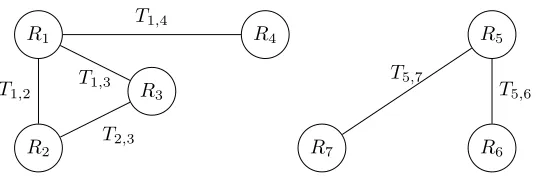
Figure 1: How we should visualize the re-encryption keysTi,j. Given a secret
key for any node and a set of reencryption keys, we get all of the secret keys in that connected component, but we should get no more information about the other keys. For example, if an adversary has the secret key toR2 and all of the
shown Ti,j, the adversary can also get secret keys to R1, R3, and R4, but not
the secret keys forR5,R6, orR7.
2. Commit. Acommits to an identity id∗ that it will attack.
3. Query. Allow Ato make polynomially many secret-key, public key, and re-encryption key queries. All of these queries must be made at once.1
(a) For a re-encryption key query fromAof the formid1, id2, we return
rk1,2 = RKGen(sk1, sk2) with the exception that A is not allowed
to query for a re-encryption key that allows A to trivially decrypt messages underid∗using re-encryption keys.
(b) For id query from A, we return skid = Keygen(mpk, msk, id) with
the exception that A is not allowed to query for secret keys in a connected component withid∗.
4. Challenge. Aoutputs (m0, m1). We choose a randomb
$
← {0,1}and give
Athe ciphertextc=Enc(mpk, id, mb).
5. Guess. Aoutputs a bitb0∈ {0,1}. Ifb=b0, then Awins.
The scheme is secure under this model if the advantage the adversaryAhas is negligible. That is,
Pr
A(1k) = 1 :b= 1
−Pr
A(1k) = 1 :b= 0
<negl(k).
5.1.2 Playing the Security Game
Here we will show that if there is an adversary who can break our security game, then this adversary can break the Quadratic Residuosity assumption3.
1The Cocks’ IBE can get away with having some of these queries be adaptive. As long as
Definition 3. The Quadratic Residuosity Assumptionstates that for all PPT adversaries A, if A is given a composite RSA modulus N = pq, and an elementa∈Z×N such that
a N
= 1, then
|Pr [A(N, a) = 1 :a∈QRN]−Pr [A(N, a) = 1 :a6∈QRN]|<negl(|N|).
So, assumeAcan break the security game. We will construct an adversary
Bto complete the reduction.
1. BgetsN and an elementR∗ with Jacobi symbol 1.
2. Setup forA. B inputs public parameterN to A.
3. Commit forA. Acommits to a public identityid∗ that it will attack.
4. Query for A. A outputs a polynomially-sized set of re-encryption key, public key, and secret key queries.
• Bseparates re-encryption key queries into those in a connected com-ponent withid∗ and those in other components.
• For each edge in re-encryption key queries in the connected com-ponent with id∗, B simulates the hashes of the public keys in the
following manner. Bbuilds each re-encryption key as an edge in the component and defines the public keys based off of them.
– LetH(id∗) =R∗
– If the edge is not completing a cycle, then we are connecting a node id to a new node id0. Denote H(id) = R, we choose
T ←$ Z×N and letH(id0) = R T2.
– If the edge is completing a cycle, then we consider the nodes, in the cycle labeled in order 1,2,· · ·, kwith public keysR1,· · · , Rk.
We haveTi translates between Ri andRi+1, and given the
pre-vious construction,Ri+1=TR2i
i
.
We defineTk = T 1
1T2···Tk−1.
• For each id not in a connected component, we just generate secret key-public key pairs, r ←$ Z×N and R = r
2 and we let H(id) = R.
We answer secret key queries onidwithr, public key query withR, and for a re-encryption key query betweenidandid0, we return r
r0,
a correct translate key.
5. Challenge forA. Since we can only encrypt a single bit,Aoutputs (0,1).
Bchooses a randomb← {$ 0,1}. Bthen chooses a randomt←$ Z×N so that t
N
= (−1)b and produces the ciphertextc=t+Rt∗. BgivesctoA.
6. Guess forA. Aoutputs a bitb0.
In order for this to work, we need to make the case that we are correctly sim-ulating responses to the public key, private key, and re-encryption key queries. For each re-encryption key query,T between public keysR andR0, T must be the ratio of the (arbitrary) square roots ofR andR0. That is, T2= RR0.
• If R and R0 are not part of the connected component with T, then we have direct access to the roots,randr0, and correctly outputT =rr0.
• IfRandR0are part of the connected component withT, then we have two cases. IfT was adding a new node, thenR0 was chosen so thatR0 = TR2, and henceT2= RR0.
If T was connecting a cycle, then we label T as Tk, the translate key
between R1 and Rk, and look at the entire cycle used to define Tk ,
R1,· · ·, Rk. Expanding Tk2, we get, as desired,
Tk2= 1
T2
1T22· · ·Tk2−1
= 1
T2 1
· · · 1
T2
k−1
= R2
R1 ·R3
R2
· · · Rk
Rk−1
= Rk
R1
.
Since we will never answer secret key queries about the connected component withid∗, we can simulate answers to all of A’s queries.
5.2
Re-encryption of Full Cocks Ciphertexts
Throughout this section, we have shown how to re-encrypt a simplified Cocks ciphertext2.3. Re-encrypting a full Cocks ciphertext,c= (c1, c2), requires more
subtlety than just applyingReEncryptto each component. In particular, given two public keysR=h(id) and R0 =h(id0) and the re-encryption key between them T = r/r0, we do not know if R or uR is a square or if R0 or uR0 is a square. So, we must include an extra bit inT: if RandR0 are both squares or non-squares, the bit is 0, and the bit is 1 otherwise. The algorithm is detailed inRKGen, below.
Algorithm 5:RKGen(N, u, R, r, R0, r0)
Input: Public parametersN andu, public keyRand corresponding secret keyr, public keyR0 and corresponding secret keyr0
Output: Re-encryption key from public keyRto R0, (T, b)
1 Letb= 0;
2 if r2r02=uRR0 then 3 Letb= 1;
4 end
5 LetT ← rr0;
6 return(T, b)
Algorithm 6:ReEncrypt Full(N, u, R, R0,(T, b),c= (c1, c2))
Input: Public parametersN andu, public keysRandR0, the
re-encryption key fromRto R0 and bit (T, b), and the full Cocks ciphertextcencrypted underR.
Output: Full Cocks ciphertextc0 encrypted underR0.
1 if b= 0then
2 Letc0 = (ReEncrypt(N, R, R0, c1, T),ReEncrypt(N, uR, uR0, c2, T));
3 end
4 if b= 1then
5 Letc0 = (ReEncrypt(N, uR, R0, c2, T),ReEncrypt(N, R, uR0, c1, T)); 6 end
7 return c0
ReEncrypt Fullis correct.
There are four cases to consider depending which of R, uR, R0, and uR0 are squares.
• RandR0are both squares. RKGenwill output (T =r/r0,0). ReEncrypt Full
assigns c0 = (c0
1, c02). We will decrypt with r0 using c01. Since R and R0
are both squares andReEncryptis correct, we correctly decrypt c01 as we decryptc1.
• R and R0 are both non-squares. RKGen will output (T =r/r0,0), as in the first case. However, when we decrypt with r0, we will decrypt the second component, c02. Since uR and uR0 are both squares in this case andReEncryptis correct, we correctly decryptc02 withr0 as we decryptc2
withr.
• R is a non-square andR0 is a square. This means uR and R0 are both squares and we want to decrypt using the first component, c01. RKGen outputs (T =r/r0,1). BecauseReEncrypt is correct, when we decryptc01
withr0 as though we were decryptingc2withr.
• R is a square andR0 is a non-square. This means R and uR0 are both
squares and we will want to decrypt using the second component of c0,
c02. RKGenoutputs (T,1). Because ReEncryptis correct, when we try to decrypt the output of ReEncrypt Full, we correctly decrypt c02 with r0 as though we were decryptingc1 withr.
6
Conclusion
proxy re-encryption. We showed how to statistically re-randomize a ciphertext. The structure revealed in the proof of re-randomizing, we believe, is powerful. It shows that the multiplicative group of ciphertexts behaves well with respect to Jacobi symbols and squares. Perhaps these concepts can lead to other applica-tions, like functional encryption, or be applied to other QR schemes, like BGH [BGH07]. In particular, maybe BGH has homomorphic properties as well.
Acknowledgments
I would like to thank Vinod Vaikuntanathan and Shafi Goldwasser for bringing this quesiton to my attention, and Vinod for working with me and for his advice on putting this project together. I would also like to thank Aloni Cohen for his invaluable assistance on the last details of these proofs.
References
[ABB10] Shweta Agrawal, Dan Boneh, and Xavier Boyen. Efficient Lattice (H)IBE in the Standard Model, pages 553–572. Springer Berlin Hei-delberg, Berlin, HeiHei-delberg, 2010.
[AFGH06] Giuseppe Ateniese, Kevin Fu, Matthew Green, and Susan Hohen-berger. Improved proxy re-encryption schemes with applications to secure distributed storage.ACM Trans. Inf. Syst. Secur., 9(1):1–30, February 2006.
[AFV11] Shweta Agrawal, David Mandell Freeman, and Vinod Vaikun-tanathan. Functional encryption for inner product predicates from learning with errors. InInternational Conference on the Theory and Application of Cryptology and Information Security, pages 21–40. Springer, 2011.
[BBG05] Dan Boneh, Xavier Boyen, and Eu-Jin Goh. Hierarchical Identity Based Encryption with Constant Size Ciphertext, pages 440–456. Springer Berlin Heidelberg, Berlin, Heidelberg, 2005.
[BBS98] Matt Blaze, Gerrit Bleumer, and Martin Strauss. Divertible proto-cols and atomic proxy cryptography, pages 127–144. Springer Berlin Heidelberg, Berlin, Heidelberg, 1998.
[BF01] Dan Boneh and Matthew K. Franklin. Identity-based encryption from the weil pairing. In Proceedings of the 21st Annual Interna-tional Cryptology Conference on Advances in Cryptology, CRYPTO ’01, pages 213–229, London, UK, UK, 2001. Springer-Verlag.
[BLS13] Dan Boneh, Rio LaVigne, and Manuel Sabin. Identity-based encryp-tion withethresiduosity and its incompressibility. TRUST Confer-ence, poster presentation, 2013.
[Boy13] Xavier Boyen. Attribute-based functional encryption on lattices. In
Theory of Cryptography, pages 122–142. Springer, 2013.
[BSW11] Dan Boneh, Amit Sahai, and Brent Waters. Functional Encryp-tion: Definitions and Challenges, pages 253–273. Springer Berlin Heidelberg, Berlin, Heidelberg, 2011.
[CH07] Ran Canetti and Susan Hohenberger. Chosen-ciphertext secure proxy re-encryption. In Proceedings of the 14th ACM Conference on Computer and Communications Security, CCS ’07, pages 185– 194, New York, NY, USA, 2007. ACM.
[CHT13] Michael Clear, Arthur Hughes, and Hitesh Tewari. Homomorphic Encryption with Access Policies: Characterization and New Con-structions, pages 61–87. Springer Berlin Heidelberg, Berlin, Heidel-berg, 2013.
[Coc01] Clifford Cocks. An identity based encryption scheme based on quadratic residues. In Proceedings of the 8th IMA International Conference on Cryptography and Coding, pages 360–363, London, UK, UK, 2001. Springer-Verlag.
[GA06] Matthew Green and Giuseppe Ateniese. Identity-based proxy re-encryption. Cryptology ePrint Archive, Report 2006/473, 2006.
http://eprint.iacr.org/.
[GM84] Shafi Goldwasser and Silvio Micali. Probabilistic encryption. Jour-nal of Computer and System Sciences, 28(2):270 – 299, 1984.
[GPSW06] Vipul Goyal, Omkant Pandey, Amit Sahai, and Brent Waters. Attribute-based encryption for fine-grained access control of en-crypted data. InProceedings of the 13th ACM conference on Com-puter and communications security, pages 89–98. Acm, 2006.
[GPV08] Craig Gentry, Chris Peikert, and Vinod Vaikuntanathan. Trapdoors for hard lattices and new cryptographic constructions. In Proceed-ings of the Fortieth Annual ACM Symposium on Theory of Comput-ing, STOC ’08, pages 197–206, New York, NY, USA, 2008. ACM.
[GVW15] Sergey Gorbunov, Vinod Vaikuntanathan, and Hoeteck Wee. Pred-icate encryption for circuits from lwe. In Annual Cryptology Con-ference, pages 503–523. Springer, 2015.
[RS03] Karl Rubin and Alice Silverberg. Advances in Cryptology -CRYPTO 2003: 23rd Annual International Cryptology Conference, Santa Barbara, California, USA, August 17-21, 2003. Proceedings, chapter Torus-Based Cryptography, pages 349–365. Springer Berlin Heidelberg, Berlin, Heidelberg, 2003.
[SC09] Jun Shao and Zhenfu Cao. CCA-Secure Proxy Re-encryption with-out Pairings, pages 357–376. Springer Berlin Heidelberg, Berlin, Heidelberg, 2009.
[SW04] Amit Sahai and Brent Waters. Fuzzy identity based encryp-tion. Cryptology ePrint Archive, Report 2004/086, 2004. http: //eprint.iacr.org/2004/086.
A
Technical details of
Convert
and
Rerand
.
Here we go through some technical lemmas for why algorithms Convert and Rerandwork. In particular, our goal is to show first thatRerandrandomizes the Jacobi symbol of the linear term of a CHT ciphertext, and then that Rerand actually statistically re-randomizes a linear ciphertext. We will need a few lemmas along the way.
Notation and the ring of ciphertexts.
WithinZN, we letJ1denote elements with Jacobi symbol 1 andJ−1denote the
elements with Jacobi symbol−1. Squares modN areQRN and squares modp
areQRp.
All of our operations done in this linear-function model will be in the ring
ZN[x]/(x2−R). Let RN = ZN[x]/(x2−R), and Rp = Zp[x]/(x2−R). To
denote the multiplicative groups of these rings, we writeR∗
N andR∗p. Note that
|R∗
N|=|R∗p| · |R∗q|= (p2−2p+ 1)(q2−2q+ 1). SoR∗N is the overwhelmingly
large fraction or RN, which has order p2q2; almost all elements in RN have
multiplicative inverses.
A ciphertextax+b decrypts to 1 if arN+b= 1 and to −1 if arN+b=−1. We denote the set of ciphertexts inR∗
N that decrypt to 1 asC1 and those that
decrypt to−1 to beC−1. Note that when usingC1andC−1, we are only referring to ciphertexts in the multiplicative groupR∗
N.
Working Modulo a Prime p
Lemma 4. If ar+b is a square mod a prime p, then we can write ax+b as
(cx+d)2 inR∗
p. Ifar+bis a non-square mod a primep, then we can take any
u6∈QRp and writeax+b asu(cx+d)2 (modx2−R). Proof. Letu∈Z∗p, butu6∈QRp.
All squares inR∗
pcan be written as (cx+d)2. Notice thatu(cx+d)2cannot
be a square inR∗
all non-squares asu(cx+d)2 – uas a member of the group is a bijection as a multiplicative map from Rp to itself, and thus u(cx+d)2 maps to a different
non-square for each square (cx+d)2.
For a contradiction, assumear+b∈QRp, butax+b is not a square. This
meansax+b=u(cx+d)2 (modx2−R) for somecx+d. But, when we evaluate atr, (ar+b) =u(cr+b)2,
u(cr+b)2
p
=
u
p
·
cr+b
p
2
=−16=
ar+b
p
.
This is a contradiction, and soar+b being a quadratic residue mod pimplies
ax+b is a sqaure inR∗
p.
If we letar+b6∈QRp. We get thatax+b=u(cx+d)2for the same reason:
ifax+b= (cx+d)2, then evaluation atrresults in a contradiction.
Working InRN
Lemma 5. Allax+b∈ C1 are of the form (a0x+tb0)2 where t N
= 1. Similarly,
all linear function encryptions ax+b ∈ C−1 are of the form (a0x+tb0)2 where
t N
=−1.
Proof. First, assumeax+b∈ C1. We have two cases of decryption to deal with: one where ar+b is a square in both Zp and Zq and the other where it is a
square in neither.
• ar+b∈QRpandQRq. From lemma4, we know thatax+bis a square in bothR∗
pandR∗q. This means that modp, we can writeax+b= (cpx+dp)2
and mod q, ax+b = (cqx+dq)2. By the Chinese Remainder Theorem
(CRT) , we can thus writeax+b= (cx+d)2. Now letγ∈
Z∗N,
ax+b= (γcx+γd)
2
γ2 =
(a0x+b0)2
γ2 ,
andγ2is guaranteed to have Jacobi symbol 1 because it is a square.
• ar+b 6∈QRp or QRq. Again from lemma 4, ax+b is neither a square inR∗
p orR∗q. Again by CRT and lemma4,ax+b=u(cx+d)2. Now, we
can do the same trick as before, to get
ax+b= (γcx+γd)
2
γ2/u =
(a0x+b0)2
γ2/u .
Notice thatγ2/uis neither a square modpor modqand thus has Jacobi
symbol 1 modN.
The case whereax+b∈ C−1 is similar. Now, without loss of generality, we
can assumear+b ∈ QRp and ar+b 6∈QRq. Lemma 3 tells us that mod p,
Chinese Remainder Theorem, we can find at∈ ZN so that t≡1 modpand
t≡1/uq modq, as well as a0 ≡cp modpand cq modq andb0 ≡dp modp
anddq modq. We can rewrite
ax+b≡N
(a0x+b0)2
t (modx
2−R).
Now we have Nt=1p·uq
q
=−1 as desired.
A.1
Proving lemma
1
Now we can prove lemma1, which shows that algorithmConvertterminates in polynomial time.
Proof of Lemma 1
This proof will be re-writingax+bin terms of being a square inRpandRq
or not.
First, we know that we can rewriteax+b=(a0x+t0b0)2 where
t0 N
= ar+b N
by lemma 5. Now, the term in our probability (ax+b)(cx+td)2 becomes
((a0x+b0)(cx+d))2
tt0 . Since a0x+b0 will also have an inverse in RN, and we are
choosing cx+d at random, we are just as likely to choose c, d as we are to choosec0, d0 where (c0x+d0) = (a0x+b0)(cx+d) (modx2−R). The term we
are trying to bound the probability on is (cxt+d) whereNt0= arN+b. Let m = arN+b
, the decryption of our ciphertext. We now have that the probability we are looking at is
Pr
c,d←$Z∗N,t
$
←J1
e
N
= 1 whereex+f = (ax+b)(cx+d)
2
t
= Pr
c,d←$Z∗N,t
$
←Jm
e
N
= 1 whereex+f =(cx+d)
2
t
.
Now, we expand 1
t·(cx+d)
2 (mod x2−R), our linear term is just 2
tcd. We
can analyze
Pr
c,d←$Z∗N,t
$
←Jm
2cd/t N = 1 = X
γ∈J1
Pr
c,d←$Z∗N,t
$
←Jm
2cd
t =γ
= X
γ∈J1 X
T∈Jm
Pr
t∈Jm
[t=T] X
C∈Z∗N
Pr
c∈Z∗N
[c=C]· Pr
d∈Z∗N
d=T γ 2C
= X
γ∈J1 X
T∈Jm
2
φ(N) X
A∈Z∗N
1
φ(N)· 1
φ(N)
= φ(N) 2 ·
φ(N) 2
2
φ(N) φ(N)· 1
φ(N)
· 1
Lemma1 means that any linear ciphertextax+bdecrypted by arN+bcan be converted into a Cocks ciphertext by algorithm1Convert, which employs a re-randomizing algorithm2Rerand.
A.2
Proof of lemma
2
We now have enough machinery to prove lemma 2: Rerand statistically re-randomizes ciphertexts.
First, recall the distributionDax+b, defined on an element inRN.
Dax+b:=
(ax+b)(cx+d)
2
t :cx+d
$
← R∗N, t←$ J1
,
which is statistically close to the output of Rerand. We say statistically close becauasecanddare chosen randomly fromZN. With overwhelming probability,
cx+d will have a multiplicative inverse in R∗
N. So, we will prove that D
randomizes ciphertexts that have inverses, and because the distribution fromD
is statistically close to the actual output ofRerandand the set of ciphertexts that have inverses is statistically close to the set of all ciphertexts,Rerandstatistically re-randomizes a ciphertext.
Proof of Lemma2 Recall that our goal is to show that ifax+b∈ C1, then
D ≡nex+f whereex+f ← C1$ o,
and ifax+b∈ C−1, then
D ≡nex+f where ex+f ← C−1$ o.
We will define an alternative distribution. Letm= arN+b
, and letD0 be
D0:=
(cx+d)2
t :cx+d
$
← C1, t←$ Jm
.
We will first show thatD ≡ D0. As in the proof of theorem1, we can rewrite
ax+b= (a0xt+0b0)2 for sometwith Jacobi symbol 1 using lemma5. So, expanding
our output fromD, (ax+b) =((a0x+b0tt)(0cx+d))2. Since we are choosing (cx+d)
from the multiplicative group R∗
N at random and a0x+b0 is also in R∗N, the
probability ofD chooses (cx+d) for its output is the same as the probability
Dchooses (a0x+b0)(cx+d) (modx2−R). Sincett0 N
= t
N
, the probability
Doutputs a specific (cx+td)2 with Nt
=m is equivalent to the probabilityD0
outputs that element inR∗
N.
Our goal now is to show thatD0 outputs, uniformly, a ciphertext that
de-crypts to arN+b
. Note that, by counting, |C1|=|R∗
the elements inR∗
N are squares divided by elements of Jacobi symbol 1 and the
other half are squares divided by elements of Jacobi symbol −1. This means the probability that a uniform distribution onC1 outputsex+f is |R2∗
N|
. Let ex+f ∈ C1. We will analyze the probability D0 outputs ex+f. By
lemma5,ex+f = (e0x+γf0)2 whereγ ∈J1. We have two cases,γ ∈QRN and
γ6∈QRN:
• γ∈QRN. The probability thatD0 outputsex+f is the probability that (cx+d)2
t =
(e0x+f0)2
γ when we randomly choosecx+d∈ R
∗
N andt∈J1:
Pr
cx+d←R$ ∗
N,t
$
←J1
(cx+d)2
t =
(e0x+f0)2
γ
= X
T∈J1 Pr
t←$J1
[t=T]· Pr
cx+d←R$ ∗
N
(cx+d)2= T
γ(e
0x+f0)2
.
Notice that this equation only has a solution in cx+d if t ∈ QRN. Otherwise, we are trying to solve (cx+d)2= γt(e0x+f0)2 (modx2−R) when (cx+d)2is a square, but γt(e0x+f0)2is not.
Now, assuming that T
γ ∈QRN, we can letk2 = Tγ and rewrite k
2(e0x+
f02) = (ke0x+kf0)2= (ˆex+ ˆf)2. We are looking for the probability that
a randomcx+dis a solution to (cx+d)2= (ˆex+ ˆf)2 (modx2−R). We
need to know how many solutions there are to this. We will use CRT.
Modp, there are exactly two solutions cx+d∈ R∗
p to (ˆex+ ˆf)2: at least
two because±(ˆex+ ˆf) are both solutions, and no more than two because the size of squares is exactly half ofR∗
p. Modqthere are also exactly two
solutions. This means, modN there are 4 total solutions. Now, when we continue to analyze this probability, we have
X
T∈J1 Pr
t←$J1
[t=T]· Pr
cx+d←R$ ∗
N
(cx+d)2=T
γ(e
0x+f0)2
= X
T∈QRN
2
φ(N)· 4
|R∗
N|
=
φ(N) 4 ·
2
φ(N) · 4 |R∗ N| = 2 |R∗ N| .
So, in this case, the distributionD0 is the same as uniform.
be inQRN, but still must have Jacobi symbol 1. So,
Pr
cx+d←R$ ∗
N,t
$
←J−1
(cx+d)2
t =
(e0x+f0)2
γ
= X
T6∈QRN
2
φ(N)· 4
|R∗
N|
=
φ(N)
4 · 2
φ(N)
· 4 |R∗
N|
= 2
|R∗
N|
.