Effect of Addition And Partial Replacement Of Cement By Wood
Waste Ash On Strength Properties Of Structural Grade Concrete
P
1
P
G.Subbaramaiah, P
2
P
Prof.H.Sudarsana Rao, P
3
P
Dr.Vaishali G. Ghorpade,
P
1
P
Research Scholar, J.N.T.U.A College of Engineering, Anantapur, AP,
P
2
P
Vice- Chancellor (I/C) Civil Engineering Department, J.N.T.U.A College of Engineering, Anantapur, AP,
P
3
P
Professor, Civil Engineering Department J.N.T.U.A College of Engineering, Anantapur, AP,
Abstract: Due to current boom in
construction industry, cement demand has escalated which is the main constituent in concrete. The production of cement involves an intensive use of raw material and energy, while at the same time, releases high quantities of carbon dioxide into the atmosphere. Utilization of waste materials and by-products is a partial solution to environmental and ecological problems. Wood waste ash is generated as a by-product of combustion in wood-fired power plants, paper mills, and other wood
burning industries. The present
investigation is mainly aimed to use wood waste ash (WA) in structural grade concrete as partial replacement and addition to cement at various levels of 0%, 10%, 20%, 30% and 40%. The mechanical properties of concrete viz. compressive strength, splitting tensile strength and flexural strength were determined at different curing periods. The mechanical properties of wood waste ash concrete have improved at 10% of replacement of cement. Further increase in WA replacement level decreased the mechanical properties significantly.
Keywords: Wood waste ash, compressive
strength, splitting tensile strength, flexural strength.
1. Introduction
The rapid development of construction industry increased the demand of consumption cement. But the production of cement involves the depletion of natural resources and greenhouse gas emissions. Thus, there is need to search for alternative materials to cement in the construction. Continuous generation of wastes arising from industrial by-products and agricultural residue, create acute environmental problems both in terms of their treatment and disposal. The construction industry has been identified as the one that absorbs the majority of such materials as filler in concrete [1]. Some industrial wastes have been studied for use as supplementary ce-menting materials such as Fly ash [2-4], Silica fume [5 & 6], Pulverized fuel ash [7], volcanic ash [8], Rice husk ash [9] and Corn cob ash (CCA) [10]. Wood waste ash is generated as a by-product of combustion in wood-fired power plants, paper mills, and other wood burning facilities. Abdullahi (2006) [11] determined the properties of wood ash to be used as partial replacement of cement. Naik et al. (2002) [12] investigated the compressive strength, splitting tensile strength and flexural strength of concrete mixtures made with wood ash up to the age of 365 days. Wood ash content was 5, 8, and 12% of the total cementitious materials. Ramos
et al. (2013) [13] revealed that strength activity indexes obtained were higher than 100% at 90 days of curing for 10% and 20% WA replacement level and higher than 98% at 28 days. Siddique (2014) [14] concluded that strength properties of WA blended concrete decreases marginally with the increased percentage of WA content, whereas these properties increased with age due to pozzolanic action of WA.
To know the appropriate percentage replacement and addition of wood waste ash (WA) in structural grade concrete, the present investigation is aimed to study the effect of WA on the mechanical properties at different curing periods.
2. Experimental study
This section describes the materials and test methods used in the present investigation. Experimental program has been discussed to carry out the present research.
2.1.Materials
Ordinary Portland cement 53 grade corresponding to IS 12269:1987 [15] was used. The specific gravity of cement was
3.05. Properties of wood waste ash
obtained from the local hotels are tabulated below in Table 1 and chemical composition of wood waste ash in Table 2. Crushed granite stones of maximum size 20 mm and 10 mm (60:40) were used as coarse aggregate. The specific gravity and fineness modulus were found to be 2.622 and 7.08 respectively. Natural river sand was used as fine aggregate. The specific gravity and fineness modulus of fine aggregate were found to be 2.75 and 2.80 respectively. Wood waste ash (WA) was obtained from local hotels where the saw dust is used as fuel for cooking.
Table 1. Properties of Wood Waste Ash
Specific gravity 2.56
Fineness 6.0 %
Table 2. Chemical Composition of Wood Waste Ash
Silicon dioxide (SiOR2R) % 31.00
Aluminum oxide (AlR2ROR3R)% 14.40
Iron oxide (FeR2ROR3R) % 6.90
Calcium oxide (CaO) % 12.60
Magnesium oxide (MgO) % 0.69
Potassium Oxide (KR2RO) % 1.57
Loss of Ignition (1000P
0
P
c) 34.30
Moisture content % 1.60
Alkalis % 0.89
2.2.Test methods
Compressive strength tests were carried out on wood waste ash concrete as per IS 516 [17]. Three cubes of size 150 mm x 150 mm x 150 mm were cast for all the mixes and curing periods. Splitting tensile strength tests were carried out on concrete as per IS 5816 [18]. Three cylinders of size 150 mm diameter and 300 mm height were cast for all the mixes and curing periods. Flexural strength tests were carried out on concrete mixes as per IS 516 [17]. Three prisms of size 50 mm x 50 mm x 100 mm were cast for all the mixes and curing periods.
2.3. Experimental program
In this study, the mechanical properties of wood waste ash concrete were studied at different WA addition and replacement levels (0%, 10%, 20%, 30%
and 40%). These properties were
compared to M 20 grade of conventional
concrete (CC) [19 & 20] whose mix proportions are presented in Table 3.
Table 3. M 20 grade of concrete mix proportions
3. Results and discussions
This section discusses the effect of wood ash addition and replacement on the mechanical properties of concrete.
3.1. Compressive strength
3.1.1. Effect of wood ash addition
Compressive strength results are presented in Table 4 and Figure 1. From the compressive strength results, it is observed that there was a decrease in the compressive strength with the addition level of WA content.
Table 4. Compressive strength (addition
of wood ash)
The decrease in compressive
strength is due to increase of wood ash, as
it requires more water. But it is also
observed that the compressive strength of
concrete mixes with 10% WA addition
were comparable to conventional concrete
(CC). It is revealed that, the compressive
strength decreased with addition of wood
ash to the concrete, however the decrease
is marginal up to 10% addition.
Figure 1:Compressive strength
% of addition of wood ash
3.1.2. Effect of replacement of cement by wood waste ash
Compressive strength results are
presented in Table 5 and Figure 2. The
compressive strength of concrete was
increased with 10% of replacement of
cement by wood ash.
Table 5. Compressive strength
(replacement of cement)
S. N o. Mix 3days (N/mmP 2 P ) 7 Days (N/mmP 2 P ) 28 days (N/mmP 2 P ) 90 days (N/mmP 2 P ) 1
WAC-R- 0 20.88 23.00 28.63 33.25
2
WAC-R-10 22.00 26.25 29.74 34.00
3
WAC-R-20 19.55 24.00 28.62 31.11
4
WAC-R-30 16.00 22.25 2121 25.55
5 WAC–
R-40 18 18.95 24.0 224
Mate rial Cem ent (kg/ mP 3 P ) Wat er (kg/ mP 3 P ) 20 mm (kg/ mP 3 P ) 10 mm (kg/ mP 3 P ) San d (kg/ mP 3 P )
384 202 666 444 708
S.N
o. Mix
3days (N/mmP 2 P ) 7 Days (N/mmP 2 P ) 28 days (N/mmP 2 P ) 90 days (N/mmP 2 P )
1 WAC -A 0
20.88 23 28.637 33.259
2 WAC -A 10
20.15 22.65 28.148 30.696
3 WAC -A 20
18.65 20.38 24.622 25.156
4 WAC -A 30
16 17.65 20.726 22.85
5 WAC -A 40
12.35 12.98 13.259 16.77
0 10 20 30 40
10 12 14 16 18 20 22 24 26 28 30 32 34 C om pr es si ve S tr engt h i n N /m m 2
% addition of Wood Ash
3 Days 7 Days 28 Days 90 Days
The further increase in the WA
replacement level decreased the
compressive strength. But it is also
observed that the compressive strength of
concrete mixes with 20% WA replacement
were comparable to conventional concrete
(CC). As the age of concrete increased, the
compressive strength of concrete is also
increased; this may be due to maturity of
concrete, during this period hydration
process is continued.
Figure 2. Compressive strength vs % of
replacement of wood ash
3.2. Splitting tensile strength 3.2.1.Effect of wood ash addition
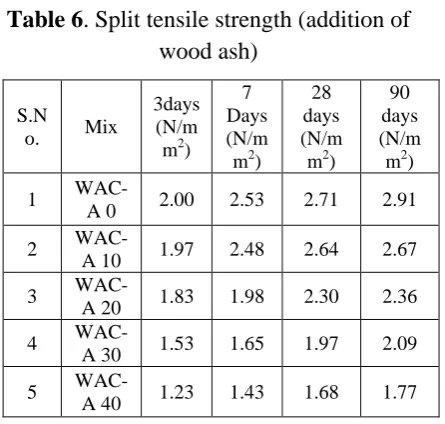
Splitting tensile strength results are presented in Table 6 and Figure 3. From the results, it is observed that there was a decrease in the splitting tensile strength of concrete with increased quantity of addition of wood ash for all mixes.
Table 6. Split tensile strength (addition of
wood ash)
The decrease in splitting tensile strength is due to decrease in compressive strength of WA concrete mixes, as it requires more water which affects the strength. But it is also observed that the splitting tensile strength of concrete mixes with 10% WA addition were comparable to conventional concrete (CC). It is revealed that, the splitting tensile strength decreased with addition of wood ash to the concrete.
Figure 3. Split tensile strength
vs %of addition of wood ash
0 10 20 30 40
14 16 18 20 22 24 26 28 30 32
34 3 Days 7 Days
28 Days 90 Days
C
om
pr
es
si
ve S
tr
engt
h i
n N
/m
m
2
% replacement of Wood Ash
0 10 20 30 40
1.0 1.2 1.4 1.6 1.8 2.0 2.2 2.4 2.6 2.8 3.0
% Addition of Wood Ash
S
pl
it T
ens
ile S
tr
engt
h i
n N
/m
m
2 3 Days
7 Days 28 Days 90 Days
S.N
o. Mix
3days (N/m
mP
2
P
) 7 Days (N/m
mP
2
P
)
28 days (N/m
mP
2
P
)
90 days (N/m
mP
2
P
) 1
WAC-A 0 2.00 2.53 2.71 2.91 2
WAC-A 10 1.97 2.48 2.64 2.67 3
WAC-A 20 1.83 1.98 2.30 2.36 4
WAC-A 30 1.53 1.65 1.97 2.09 5
WAC-A 40 1.23 1.43 1.68 1.77
3.2.2. Effect of replacement of cement by wood waste ash
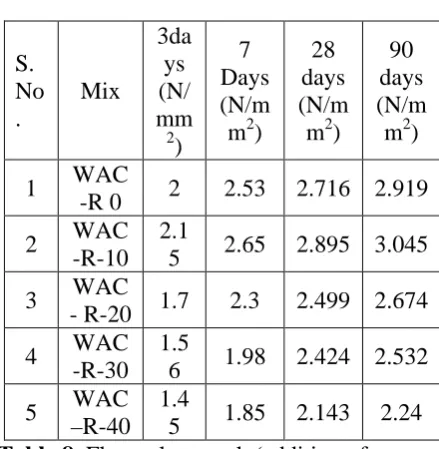
Splitting tensile strength
results are presented in Table 7 and Figure 4. The splitting tensile strength of concrete was increased with 10% of replacement of cement by wood ash.
Table 7. Split tensile strength
(replacement of wood ash)
The further increase in the WA
replacement level decreased the
splitting tensile strength. But it is also observed that the splitting tensile strength of concrete mixes with 20% WA replacement were comparable to conventional concrete (CC). As the age of concrete increased, the splitting tensile strength of concrete is also increased; this may be due to maturity of concrete, during this period hydration process is continued.
Figure 4. Split tensile strength
vs % of replacement of wood ash
Table 8. Flexural strength (addition of
wood ash)
3.3. Flexural strength
3.3.1. Effect of wood ash addition
Flexural strength results are presented in Table 8 and Figure 5. From the results, it is observed that there was a decrease in the flexural strength of concrete with increased quantity of addition of wood ash for all mixes.
0 10 20 30 40
1.0 1.2 1.4 1.6 1.8 2.0 2.2 2.4 2.6 2.8 3.0
S
pl
it T
ens
ile S
tr
engt
h i
n N
/m
m
2
% replacement of Wood Ash
3 Days 7 Days 28 Days 90 Days
S . N
o .
Mix
3days (N/m
mP
2
P
)
7 Days (N/m
mP
2
P
)
28 days (N/m
mP
2
P
)
90 days (N/m
mP
2
P
)
1 WAC
-A 0 3.0 3.53 3.75 3.90
2 WAC
-A 10 2.85 3.35 3.59 3.75
3 WAC
-A 20 2.50 3.0 3.3 3.55
4 WAC
-A 30 2.30 2.63 2.8 3.0
5 WAC
-A 40 1.89 2.0 2.50 2.85
S. No .
Mix 3da
ys (N/
mmP
2
P
)
7 Days (N/m
mP
2
P
)
28 days (N/m
mP
2
P
)
90 days (N/m
mP
2
P
)
1 WAC
-R 0 2 2.53 2.716 2.919
2 WAC
-R-10 2.1
5 2.65 2.895 3.045
3 WAC
- R-20 1.7 2.3 2.499 2.674
4 WAC
-R-30 1.5
6 1.98 2.424 2.532
5 WAC
–R-40 1.4
5 1.85 2.143 2.24
The decrease in flexural strength is due to decrease in compressive strength of WA concrete mixes, as it requires more water which affects the strength. But it is also observed that the flexural strength of concrete mixes with 10% WA addition were comparable to conventional concrete (CC). It is revealed that, the flexural strength decreased with addition of wood ash to the concrete.
Figure 5. Flexuralstrength vs
%of addition of wood ash
Table 9. Flexural strength (replacement of
wood ash)
3.3.2.Effect of replacement of cement by wood waste ash
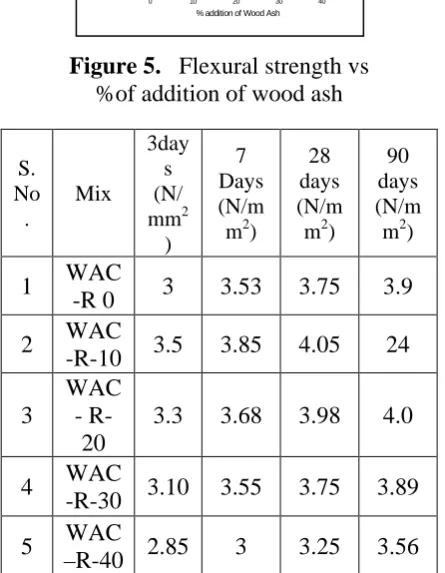
Flexural strength results are presented in Table 9 and Figure 6. The flexural strength of concrete was increased with 10% of replacement of cement by wood ash.
The further increase in the WA replacement level decreased the flexural strength. But it is also observed that the flexural strength of concrete mixes with 20% WA replacement were comparable to conventional concrete (CC). As the age of concrete increased, the flexural strength of concrete is also increased.
Figure 6. Flexural strength f replacement of cement
4. Conclusions
This section describes the conclusion drawn from the research.
1. It is possible to produce structural
grade concrete (M20) with both addition an also replacement of cement by WA
2. The increase in the addition of WA
decreased the mechanical properties viz. compressive strength, splitting tensile strength and flexural strength at all ages. This is mainly attributed to the water demand required by WA.
3. The decrease in compressive strength
for 10% addition to the reference
0 10 20 30 40
1.8 2.0 2.2 2.4 2.6 2.8 3.0 3.2 3.4 3.6 3.8 4.0
F
lex
ur
al
S
tr
engt
h i
n N
/m
m
2
3 Days 7 Days 28 Days 90 Days
% addition of Wood Ash
0 10 20 30 40
2.8 2.9 3.0 3.1 3.2 3.3 3.4 3.5 3.6 3.7 3.8 3.9 4.0 4.1 4.2 4.3
% replacement of Wood Ash
F
lex
ur
al
S
tr
engt
h i
n N
/m
m
2
3 Days 7 Days 28 Days 90 Days
S. No
.
Mix
3day s (N/ mmP
2
P
)
7 Days (N/m
mP
2
P
)
28 days (N/m
mP
2
P
)
90 days (N/m
mP
2
P
)
1 WAC
-R 0 3 3.53 3.75 3.9
2 WAC
-R-10 3.5 3.85 4.05 24
3
WAC -
R-20
3.3 3.68 3.98 4.0
4 WAC
-R-30 3.10 3.55 3.75 3.89
5 WAC
–R-40 2.85 3 3.25 3.56
concrete is very marginal but for other mixes the strength variation is very significant.
4. The mechanical properties of wood
waste ash concrete were increased with 10% of replacement of cement by wood ash. Further increase in WA replacement level decreased the mechanical properties significantly.
References
1. Antiohos S, Papageorgiou A,
Tsimas S. Activation of fly ash cementitious systems in the presence of quicklime. Part II: nature of hydration products, porosity and microstructure development. Cem Concr Res 2006;36(12):2123–31.
2. Siddique, R. (2004), “Performance
characteristics of high-volume Class F fly ash concrete”, Cement and Concrete Research, Vol. 34 No.3, pp. 487-493.
3. Wang, S. and Baxter, L. (2007),
”Comprehensive study of biomass fly ash in concrete: Strength, microscopy, kinetics and durability”, Fuel Processing Technology, Vol. 88, pp. 1165-1170.
4. Wang, S.; Miller, A.; Llamazos, E.;
Fonseca, F. and Baxter, L. (2008), “Biomass fly ash in concrete: Mixture proportioning and mechanical properties”, Fuel, Vol. 87, pp. 365-371.
5. Lee, S.; Moon, H. Y. and Swamy
R. N. (2005), “Sulfate attack and role of silica fume in resisting strength loss”, Cement & Concrete Composites, Vol. 27, pp. 65-76.
6. Turker, F.; Akoz, F.; Koral, S. and
Yuzer, N. (1997), “Effects of
Magnesium sulfate concentration on the sulfate resistance of mortars with and without silica fume”, Cement and Concrete Research, Vol. 27, pp. 205-214.
7. Balendran, R. V. and
Martin-Buades, W. H. (2000), “The influence of high temperature curing on the compressive, tensile and flexural strength of pulverized fuel ash concrete”, Building and Environment, Vol. 35 No.5, pp.415-423.
8. Hossain, K. M. A. (2005),
“Chloride induced corrosion of reinforcement in volcanic ash and pumice based blended concrete”, Cement & Concrete Composites, Vol. 27, pp. 381-390.
9. Waswa-Sabuni, B.; Syagga, P. M.;
Dulo, S. O. and Kamau, G, N. (2002), “Rice Husk Ash Cement – An Alternative Pozzolana Cement for Kenyan Building Industry”, Journal of Civil Engineering, JKUAT, Vol. 8, pp. 13-26.
10.Adesanya, D. A. and Raheem, A.
A. (2009a), “A study of the workability and compressive strength characteristics of corn cob ash blended cement concrete”, Construction and Building Materials, Vol. 23, pp. 311–317.
11.Abdullahi, M. (2006)
Characteristics of Wood Ash/OPC Concrete” Leonardo Electronic
Journal of Practices and
Technologies, 8: 9-16.
12.Naik TR, Kraus RN, Siddique
R, Demonstration of manufacturing technology for concrete and CLSM utilizing wood ash from Wisconsin,
Report No. CBU-2002-30, Report for Year 1 activities submitted to the Wisconsin Department of Natural Resources, Madison, WI, for Project # 01-06 UWM Center for By-Products Utilization, Department of Civil Engineering and Mechanics, University of Wisconsin-Milwaukee, Milwaukee, pp. 124, 2002.
13.Ramos T, Matos AM,
Sousa-Coutinho J. Mortar with wood waste ash: Mechanical strength carbonation resistance and ASR expansion. Construction and Building Materials. 2013; 49; pp 343-351.
14.Siddique R. Utilization of
industrial by-products in concrete. Procedia Engineering. 2014; 95; pp 335-347.
15.IS 12269 (1987). Specification for
53 grade ordinary Portland cement. Bureau of Indian Standards, New Delhi.
16.ASTM C 618. 2003. Standard
specification for coal fly ash and raw or calcined natural pozzolan for use in concrete.
17.IS 516 (1991). Methods of tests for
strength of concrete. Bureau of Indian Standards, New Delhi.
18.IS 5816 (1999). Splitting tensile
strength of concrete method of test. Bureau of Indian Standards, New Delhi.
19.IS 10262 (2009). Concrete Mix
Proportioning-Guidelines. Bureau of Indian Standards, New Delhi, New Delhi.
20.IS 456 (2000). Plain and reinforced
concrete code for practice. Bureau of Indian Standards, New Delhi.