Optimisation of Construction Resource
Allocation and Levelling Using Genetic
Algorithm
Wajid Hussain
1, Dr.M.K.Trivedi
2, Dr. R. Kansal
3P.G. Student, Department of Civil Engineering, Madhav Institute of Technology and Science, Gwalior, M.P., India1
Professor, Department of Civil Engineering, Madhav Institute of Technology and Science, Gwalior, M.P., India2,
Professor and Head of Department, Department of Civil Engineering, Madhav Institute of Technology and Science,
Gwalior, M.P., India3
ABSTRACT: Resource allocation and levelling is one of the top challenges in construction project management, due
to complex nature of the construction projects.CPM and PERT is most commonly used methods for scheduling of construction projects. However it is not capable of minimising undesirable fluctuations in resource utilisation profile. This research describes a Genetic algorithm approach to resource levelling and allocation in construction industry. The procedure which is used in this paper finds an optimum set of tasks and priorities that generate better-levelled resources
profiles using Genetic Algorithm in MATLAB software
.
KEYWORDS:Resource allocation, Resource levelling, Genetic algorithm, MATLAB
I. INTRODUCTION
Critical path method and program evaluation and review technique have been used for planning and scheduling large scale construction projects. In every construction project each activity is processed after all the predecessors activities are finished. The main purpose of scheduling is to minimize the total duration of the project. In last several years costs of construction resources have progressively rises. Today resource management is one of the most important parts of the construction project management. Several resource levelling models are designed to minimize resource fluctuations by using the floats available to keep duration of the project unchanged. This paper brings out a model of optimisation using Genetic Algorithm (GA) for resource allocation and levelling. In this model, objective function optimizes both resource allocation and levelling simultaneously using Genetic algorithm in MATLAB software. Genetic Algorithm has several advantages as it consider the objectives of resource allocation and levelling all together. Genetic algorithm
has more suppleness to solve scheduling problems because of no fixed heuristic rule
.
II. RELATED WORK
Tarek (1999) presented a GA based algorithm which considered resource leveling and allocation and minimized the moment of the resource histogram around the horizontal axis (time). GAs employs a random yet directed search for locating the globally optimal solution (Goldberq 1989). Genetic Algorithms (GAs) are search procedures that combine an artificial survival of the fittest strategy with genetic operators abstracted from nature [Michell 1998]. In this paper
model is presented double moment concept which originally was proposed by Tarek (1999). In this process, My takes
into consideration the resource utilization period in addition to Mx that considers the resource fluctuation
.
III. RESOURCE ALLOCATION AND LEVELLING
Copyright to IJIRSET DOI:10.15680/IJIRSET.2015.0406073 4574
utilization of available resources. The main objective of any organization is not to waste the resources. There are some optimization methods and heuristics methods for solving the resource allocation and levelling problems.
Resource allocation is related with conveying the required number of those resources acknowledged in the previous step to each activity acknowledged in the plan. It does not follow any stable blueprint, sometimes activity which requires fewer resources initially may require more or same resources in next stages of the activities. A resource levelling is the process that ensures resource demand will not exceed resource availability.
IV. GENETIC ALGORITHM
Genetic algorithms (GAs) were invented by John Holland in the 1960s and were developed by Holland and his students and colleagues at the University of Michigan. In contrast with evolution strategies and evolutionary programming, a genetic algorithm (GA) is a search technique used in computing to find true or approximate solutions to optimization problems. It is a global search heuristics. It is a evolutionary algorithms that use techniques inspired from evolutionary biology such as mutation, selection and crossover. Genetic algorithm uses genetics as its model of problem solving. It handles the population of possible solutions; each solution is represented by chromosome which is just a theoretical representation. GAs work with a family of solutions, known as the "current population" from which the "next generation" of solutions is obtained, better solutions from one generation to the next are progressively obtained [Harmanani 2001]. GAs procedure begins by generating an initial collection (referred to as population) of random solutions that are programmed in the form of strings called Chromosomes. Each individual Chromosome represents one solution that is better or worse than others in the population. The fitness of each solution is determined by evaluating its performance with respect to an objective function. To stimulate the natural survival of the fittest process, best Chromosomes exchange information to produce offspring that are evaluated and can replace fewer members in the population.
Application of GA to resource allocation and levelling
The minimum resource moment algorithm was improved using both Mx and My resource moments. Resource
fluctuations is represented by Mx and the resource utilisation is represented by My. When the combined value of these
moments is minimum that means resources are efficiently utilised. The random activity priorities and the combined moments approach from the basis of the optimisation process.
V. MATLAB IMPLEMENTATION
GAs procedure is implemented on MATLAB software. A model is programmed in MATLAB using genetic algorithm for optimisation of resource allocation and levelling. Problem solving model in MATLAB requires the relevant data that is activity, predecessors, resource availability and resources requirements per day.
Performing Optimisation Process
This application is perform to optimize the process of the resource allocation and levelling on the construction project having 20 activities and for ease we took only one type resource for allocation and levelling. Optimization options are set as follows-
Options of GA
Population Size: number of the population.
Crossover Fraction: Fraction of the population that is not mutated.
Stopping conditions: as GA gives results that shows no further improvements.
1 2 3 4 5
6
YES
14
YES 11
NO NO
7
8
13 12
9
10
NO YES
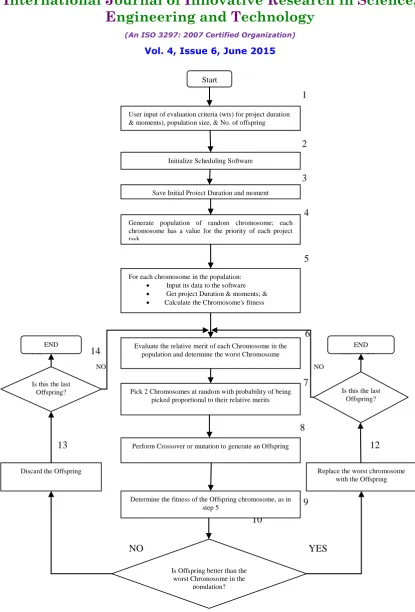
Figure 1 Genetic Algorithm Procedure
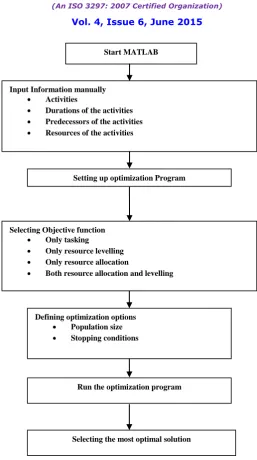
The proposed model in this paper comprises processing project data in MATLAB software and optimizing resource allocation and leveling using genetic algorithms program. The detailed procedure of optimizing process of resource
Evaluate the relative merit of each Chromosome in the population and determine the worst Chromosome
Pick 2 Chromosomes at random with probability of being picked proportional to their relative merits
Perform Crossover or mutation to generate an Offspring
Determine the fitness of the Offspring chromosome, as in step 5
Generate population of random chromosome; each chromosome has a value for the priority of each project task
For each chromosome in the population:
Input its data to the software
Get project Duration & moments; &
Calculate the Chromosome's fitness
Start
User input of evaluation criteria (wts) for project duration & moments), population size, & No. of offspring
Initialize Scheduling Software
Save Initial Project Duration and moment
Is Offspring better than the worst Chromosome in the
population?
Replace the worst chromosome with the Offspring
Is this the last Offspring?
END
Discard the Offspring Is this the last
Copyright to IJIRSET DOI:10.15680/IJIRSET.2015.0406073 4576
.
FIGURE 2 Optimization processes of the resource levelling and allocation
VI. RESULTS
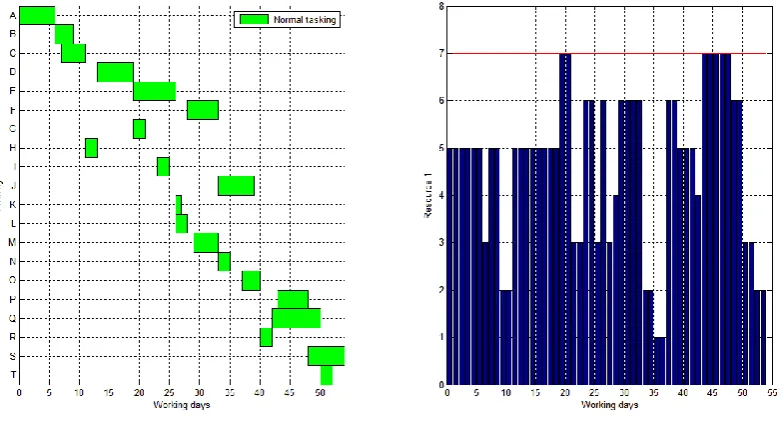
Problem is executed by using many generations. The total project duration before resource allocation and levelling is 32 days as shown in figure.3.
Start MATLAB
Input Information manually
Activities
Durations of the activities
Predecessors of the activities
Resources of the activities
Setting up optimization Program
Selecting Objective function
Only tasking
Only resource levelling
Only resource allocation
Both resource allocation and levelling
Defining optimization options
Population size
Stopping conditions
Run the optimization program
Figure 3 before resource allocation and levelling
In order to satisfy resource limitation constraints, the duration of the project after the resource allocation and levelling is 54 days. as shown in figure 4 After the optimisation of the resource allocation and levelling the model has been considered for the well levelled resource utilisation. Best fitness is obtained in 100 generations.
Figure 4 after resource allocation and levelling
VII. CONCLUSION
Copyright to IJIRSET DOI:10.15680/IJIRSET.2015.0406073 4578 REFERENCES
1. Goldberg, David E. (1989). Genetic Algorithms in Search Optimization and Machine Learning. Addison Wesley. p. 41.ISBN 0-201-15767-5.
2. Hegazy.T, Optimization of resource allocation and leveling using genetic algorithms, Journal of Construction Engineering and Management
125 (3) (1999) 167–175
3. Michell,M.,1998,"An Introduction to Genetic Algorithms", MIT press, London, England
4. Senupta, B. and Guha, H.,1995, "Construction Management and Planning",Tata Mc Gra-Hill
5. NEURAL NETWORKS, FUZZY LOGIC AND GENETIC ALGORITHM: SYNTHESIS AND APPLICATIONS BY S. RAJASEKARAN, G.
A. VIJAYALAKSHMI PAI
6. Hiyassat, A. M., 2001, "Applying Modified Minimum Moment Method to Multiple Resource Leveling", ASCE, Journal of Construction