ABSTRACT
DROSOS, IAN ZACHARIAH. HappyFace: Identifying and Predicting Frustrating Learning Obstacles at Scale. (Under the direction of Christopher Parnin.)
Unnecessary obstacles limit learning in cognitive-complex domains such as computer program-ming. When accompanied by a lack of appropriate feedback mechanisms, novice programmers
can experience frustration and disengage from the learning experience. In large-scale educational
settings, the struggles of learners are often invisible to the learning infrastructure and learners have limited ability to seek help. In this paper, we perform a large-scale collection of code snippets from
a learning platform, Python Tutor, and collect a frustration rating through a light-weight feedback
mechanism. We then devise a technique that is able to automatically identify sources of frustration based on participants labeling their frustration levels. We found 3 factors that best predicted novice
programmers’ frustration state: syntax errors, using niche language features, and understanding
code with high-complexity. Additionally, we found evidence that we could predict sources of frus-tration. Based on these results, we believe an embedded feedback mechanism can lead to future
© Copyright 2017 by Ian Zachariah Drosos
HappyFace: Identifying and Predicting Frustrating Learning Obstacles at Scale
by
Ian Zachariah Drosos
A thesis submitted to the Graduate Faculty of North Carolina State University
in partial fulfillment of the requirements for the Degree of
Master of Science
Computer Science
Raleigh, North Carolina
2017
APPROVED BY:
Tiffany Barnes Kathryn Stolee
DEDICATION
BIOGRAPHY
The author is a Masters of Science student in Computer Science at North Carolina State University. He will be continuing on as a PhD student in Cognitive Science at the University of California, San
ACKNOWLEDGEMENTS
TABLE OF CONTENTS
LIST OF TABLES . . . vii
LIST OF FIGURES. . . .viii
Chapter 1 Introduction. . . 1
1.1 Motivating Example . . . 3
Chapter 2 The HappyFace System . . . 5
2.1 Design Goals . . . 6
2.1.1 Brief and Minimalist: . . . 6
2.1.2 Problem and Language Agnostic: . . . 7
2.2 Implementation . . . 9
2.2.1 Affect Survey . . . 9
2.2.2 Data Collection . . . 9
2.2.3 Data-set Extraction . . . 9
2.2.4 Code Analysis . . . 9
2.2.5 Extended Feedback . . . 10
Chapter 3 Online Deployment Studies . . . 11
3.1 Research Questions . . . 11
3.2 Surveys . . . 12
3.3 Participants . . . 12
3.4 Analysis . . . 13
3.4.1 Data Cleaning . . . 13
3.4.2 System Refinement . . . 13
Chapter 4 Results . . . 14
4.1 Research Question 1 . . . 14
4.2 Research Question 2 . . . 15
4.3 Research Question 3 . . . 17
Chapter 5 Discussion . . . 19
5.1 Implications . . . 19
5.1.1 Interventions . . . 19
5.1.2 Language Design . . . 20
5.1.3 Feedback Mechanisms . . . 20
5.1.4 Prediction of Categories . . . 21
5.2 Challenges . . . 22
5.2.1 Integrations . . . 22
5.2.2 Extraction of Informative Features . . . 22
5.2.3 Participation . . . 23
5.3 Limitations . . . 23
5.4.1 Lightweight and Static Analysis of Code at Scale . . . 24
5.4.2 Using the Crowd . . . 25
Chapter 6 Conclusion. . . 26
LIST OF TABLES
Table 2.1 Extracted Features . . . 8 Table 2.2 Selection Categories . . . 8
LIST OF FIGURES
Figure 1.1 Code example on Python Tutor with HappyFace affect survey . . . 3
Figure 2.1 HappyFace Affect Survey . . . 5
Figure 4.1 HappyFace vote distribution . . . 15
CHAPTER
1
INTRODUCTION
Frustrating obstacles during programming[FOR15]can cause a learner to disconnect from the learning process and can even lower their self efficacy. In massive open online courses (MOOCs)
and large-scale learning environments, such as Python Tutor, frustration can come from course
difficulty, lack of support, lack of digital or learning skills, and failed expectations[OB14]. When students cannot overcome these obstacles, they often dropout as a result[Con13], with only 15% of
learners completing the course[Jor]. There is a need to discover these frustrations felt by learners so
that tools that provide interventions to assist learners in their studies can be effective.
In large-scale learning systems, traditional mechanisms for overcoming learning difficulties, such
as peer feedback and tutor instruction, do not scale well. This results in having limited context about
the problems being solved, limited knowledge about the level of learner, and a lack of insight into a learner’s potential misconceptions. Learners from all around the world are editing, running, and
visualizing code from introductory courses or may be trying to debug a more advanced programming
assignment. While coding, learners inevitably run into frustrating events ranging from syntax errors to misunderstanding features of the code language. These frustrations can limit the effectiveness of
the platforms the learners are using.
Several platforms have tried to help novice programmers at scale. For example, HelpMeOut
order to help inexperienced programmers understand and correct errors[BH10]. While crowd-based strategies can be effective for resolving certain types of obstacles, maintaining incentives
and quality of a crowd-based systems can be difficult, especially for rapidly evolving technologies
and for obstacles beyond interpretating an error message. Intelligent tutoring systems (ITS) have been used to automatically assist learners by providing adaptive and individualized feedback about
a learner’s work. In particular, JavaTutor has been used to predict how a learner’s affect changes
in response to questions from the automated tutor[Vai16]. Unfortunately, obtaining affect data required for prediction requires several physical sensors. For MOOCs, the population of learners is
numerous so that it would be beneficial to not rely on each student having a webcam, Kinect, or
any other sensor. Further, intelligent tutors rely on pre-written assignments, requiring structure that usually only exists in courses.
In this paper we describe HappyFace, a system that allows a novice programmer to annotate their
learning experience and then automatically infer what type of learning obstacle they are encounter-ing. Even with low participation rates, HappyFace can discover types of frustrating experiences and
predict categories of learner frustration. Our system is not restricted by pre-written assignments
and relies on simple input from the learner. HappyFace is composed of four components:
• Affect Survey. Embedded in a host system, HappyFace collects the current affect of a learner when the learner selects the face that most represents their current state.
• Feature Extraction. HappyFace automatically analyzes the code the learner was working on when they reported their current affect. This analysis is done via static program analysis
through the parsing of abstract syntax trees to extract features, and stylometric analysis through the extraction of features relating to the style of the code.
• Correlation. HappyFace correlates the extracted features with the affect vote to discover frustrating features.
• Prediction. HappyFace predicts the type of learning obstacle a learner is facing when they report their affect.
In a 2.5-month online study, we found that learners were willing to provide feedback about their
current emotional state during a learning experience. We implemented HappyFace into an existing Web-based program visualization tool called Python Tutor[Guo13]. Python Tutor lets users to write
code inside their browser and then visualize each execution step of their code, allowing the user to
From learner annotations we found that syntax errors, features that increase code complexity, and niche language features, such as the Python Slice Operator and Globals, correlated with frustration
in learners. After an odds ratio analysis we found that syntax and indentation errors doubled the
odds that a learner is frustrated. We also found that each occurrence of boolean comparators, library imports, and use of Globals increased the odds of frustration by 1.5 to 1.7 times. In a follow-up study,
we found that annotations could be used to help identify and predict frustrating experiences. Using
Logistic Regression, we predicted when learners did not understand their code with 80% precision. Despite HappyFaces affect survey being a simple 5-choice survey, the data we collected yielded
an abundance of useful data without using more complex methods of data collection such as
physical sensors. Further we were able to use this data to discover features causing frustration with only lightweight static program analysis. Based on these results, we believe the approaches used in
HappyFace can be used to support future learning interventions.
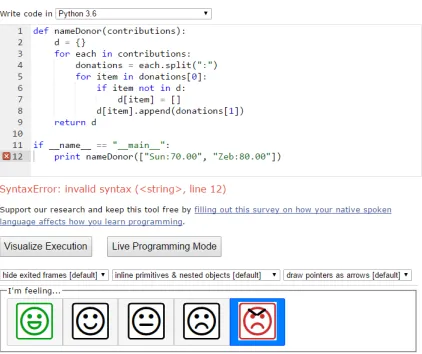
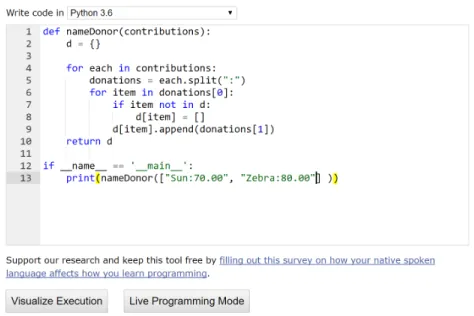
Figure 1.1 Code example on Python Tutor with HappyFace affect survey
1.1
Motivating Example
For example, take a professor who is teaching an introductory programming MOOC and has just
given the 1000+students in the course a new programming assignment involving splitting strings and printing results. Since this is an introductory course, many of these students are new to
the professor had to ask the TAs to obtain sources of frustration felt by the students and causes of errors in student code. The TAs attempted to obtain this information through interviews of the
students via forum threads, but this requires a lot of manual effort. Also, while the TAs are able to find
some categories of frustration, most of the students do not yet have the knowledge or experience to accurately convey the issues they faced in the assignment.
Instead, the professor has implemented HappyFace this semester so students can report when
they are frustrated during an assignment. One student, Ada, is using Python Tutor for the assignment but when she executes her program she receives a SyntaxError (Fig 1.1). Ada becomes frustrated as
she does not understand why she is getting this error as she is not aware of certain syntactic rules in
Python 3.
Ada clicks a face that represents frustration on the HappyFace survey, located under the code
editor, when she receives her error. HappyFace can then analyze her code and report valuable
information to the professor that show some of the students are frustrated when dealing with SyntaxErrors. The professor can now adjust the lecture to include strategies to solving this error,
alleviating any unnecessary frustration that may be felt by students like Ada attempting similar
CHAPTER
2
THE HAPPYFACE SYSTEM
HappyFace allows a learner to annotate their learning experience. We embed a survey to analyze these annotations by creating an abstract syntax tree (AST) from code snippets and process the
code for language features and other stylometric features, such as types of whitespace, code
com-plexity, and the standard deviation of line length. These scores are run through randomized logistic regression for feature selection to identify potentially frustrating learning experiences. HappyFace
is then extended to allow for participants to select additional reasons for frustration. Using our code
metrics, we then predict the problem categories a code snippet will fall into.
2.1
Design Goals
To define HappyFace’s design goals, we examined multiple feedback surveys in use today. Further,
we tested a few prototype designs to assess which style of survey implementation would elicit the most responses from learners on Python Tutor. Lastly, in order to gather and analyze data provided
by learners, HappyFace must be adopted by learning frameworks. Based on these observations, we
adhered to these design goals:
2.1.1 Brief and Minimalist:
To enable participation, the design must be brief and minimalist. If the survey component of
HappyFace clashes with the learning platform it is embedded, it will serve as an unwanted distraction to the learning process. Thus, HappyFace is designed to be as brief as possible so a learner can
use the platform as intended. HappyFace is also designed to be minimal. It is an in-line survey
that takes only the amount of visual space it requires. When a learner decides to cast a frustration vote, any further parts of the survey expand to allow the learner to provide more information and
then collapse once a learner has finished answering the survey. This allows HappyFace to provide a
feedback tool that minimally disrupts the appearance of the learning platform it is embedded and allows learners to quickly return to their learning workflow.
The first prototype of HappyFace included a slider that manipulated the color and smile of a
smiley face above the slider. When the user neared the maximum frustration rating the face became red and had a frown, when the user neared the minimum frustration rating the face became green
and had a smile. This first prototype also had a free-form text area to allow the learner to explain why
they were or were not frustrated in their own words. Once the frustration score was selected, the user could then press a button to submit their frustration score, frustration reason, and code snippet.
This prototype survey was hosted on Python Tutor for a week but did not receive a satisfiable amount
of votes. We attribute this to the fact that it took multiple steps to answer the survey, potentially adding frustration to an already frustrated learner. Thus, we sought to redesign the interface.
To implement this design goal, we drew inspiration from Bieri et al. work on the self-assessment of pain severity[DBZ90]. The authors asked children to look at a set of faces depicting different levels
of pain and order them from no pain to the most pain. The aim of the authors was to create a scale
with “minimal cognitive demands”. The authors found that their face-based pain scale required little direction of the child as they are simply told to point to the face that matches the amount of
pain they feel. The quick and simple face-based pain scale showed that it could be used reliably and
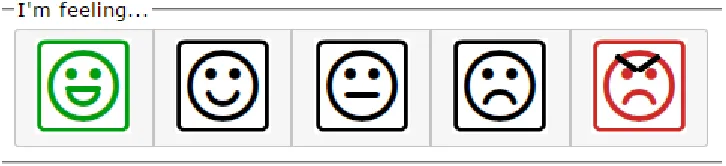
Thus, the HappyFace survey became a simple five button design that took inspiration from the pain scales used by medical professionals (Fig??). The five buttons had faces with a range of emotions, from happy to angry. The only instruction provided to the learner is text saying “I’m
feeling...”, implying to the learner they should select the face that best represents their current feeling. Self-reporting of frustration on HappyFace is also very quick, one button click on the face
that most represents the learner’s frustration is all that is needed from the learner. Once a learner
clicks a face, HappyFace collects the rest of the relevant data automatically.
2.1.2 Problem and Language Agnostic:
To ease adoption, the design of the system must be able to accommodate the many different
programming problems as well as programming languages that a learning platform may support. For example, several approaches for automated feedback of student assignments require that the
problem be known ahead of time[Vai16]and that it is accompanied by set of test cases[DKRR16].
Further, these techniques require heavier analysis, such as symbolic execution, which can work appropriately on few student assignments, but may not scale well when needing to do an analysis
of millions of code snippets.
To implement this design goal, we drew inspiration from Caliskan-Islam et al. work on code stylometry[ACIG15]. Caliskan-Islam used submissions to a Google Code Jam as a dataset and
extracted stylometric features from the code and attempted to de-anonymize programmers based
on these features. Machine learning methods were run against the extracted feature sets and the paper’s authors found that they could correctly attribute the author of a piece of source code at high
accuracy (>90%). This result gave us confidence that properties extracted from the AST of the code
could provide sufficient features without a more complex representation of problem state.
Thus, the analysis component of HappyFace was based on light-weight static analysis of the AST,
using the same features as Caliskan-Islam et al.[ACIG15]. For example, some styles of programming,
such as very long and complex lines of code, could frustrate a learner who is having difficulty understanding the meaning of a line of code. While the current analysis by HappyFace parses ASTs
from Python code, the structure of most languages contain similar features like if statements, loops,
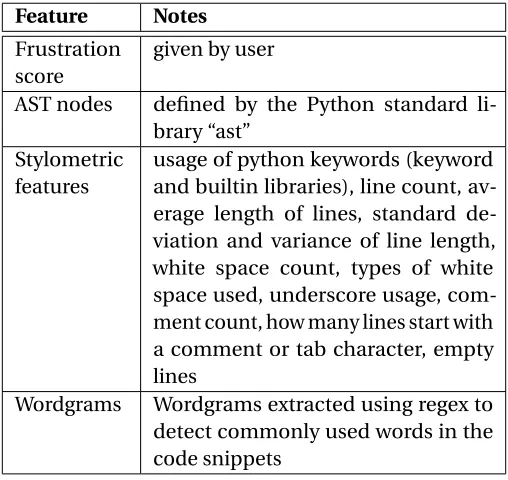
Table 2.1 Extracted Features
Feature Notes Frustration
score
given by user
AST nodes defined by the Python standard li-brary “ast”
Stylometric features
usage of python keywords (keyword and builtin libraries), line count, av-erage length of lines, standard de-viation and variance of line length, white space count, types of white space used, underscore usage, com-ment count, how many lines start with a comment or tab character, empty lines
Wordgrams Wordgrams extracted using regex to detect commonly used words in the code snippets
Table 2.2 Selection Categories
Category Description Happy
cate-gories
“I fixed an error”, “My output is right”, “My code works”, “I understand this code”, “Other (user input required)” Frustrated
categories
2.2
Implementation
2.2.1 Affect Survey
HappyFace has an inline survey that can be embedded into a system to collect frustration data from its users. The current version of HappyFace was implemented on PythonTutor.com[Guo], a
website that visualizes code execution. A user can use the HappyFace survey during their workflow
on the website. When a user selects a face that best represents their current feeling, a vote is sent to checkbox.io[Par], a research survey site. This vote is comprised of data that includes their frustration
score (1-5, happy to frustrated) and the code snippet they are programming on Python Tutor. In
an extension of the affect survey, the user is also presented with a choice of tags they can select to better describe their vote in the form of a frustration class. This data is compiled in a database and
extracted to a json file for analysis.
2.2.2 Data Collection
HappyFace was embedded on Python Tutor’s visualize page under the code editor and “Visualize
Execution” button (Fig 1.1). While users of the site were programming on this page they could select
a face that most represents their current affect. Once a face was selected, HappyFace collects the code the user has written along with the affect rating and stores the vote in a database for analysis.
The survey is constantly available and allows for multiple votes over the user’s entire coding process.
For the extended survey, after a user selects an affect they are presented with several categories to optionally annotate their affect with.
2.2.3 Data-set Extraction
The compiled data is then processed in Python for analysis. Each vote is run through a filter that removes invalid votes. Votes that are missing data (frustration score), votes that were cast missing
code snippets, and spam votes (a multitude of votes cast by the same person in a short period of
time) are removed.
2.2.4 Code Analysis
From the resulting data-set we process the feedback by creating an abstract syntax tree (AST) from
code snippets attached to a frustration score. If an AST cannot be parsed from a snippet, the error produced by the compilation of code is caught and added as a feature. The frequencies of features,
This AST is traversed and, as each node name is visited, the node is counted as a feature. After AST features are extracted, the code snippet is parsed for stylometric and word frequency features. These
extracted features are listed in Table 2.1 and include feature name, such as AST nodes, along with a
description of the feature. The majority of stylometric features we chose to extract are derived from Caliskan-Islam’s code stylometry feature set[ACIG15].
2.2.5 Extended Feedback
For a follow-up study, we extended HappyFace to allow for the annotation of the frustration felt by the learner. We presented the learner with several categories of frustration that the learner may
feel their frustration can be placed. These categories were created after manually inspecting code
reported by frustrated users and hypothesizing the issue faced. Also included is an Other category that elicits a free-form response from the user. These free-form responses can be used to tune
categories presented to the learners once common categories become apparent. A list of these
CHAPTER
3
ONLINE DEPLOYMENT STUDIES
We developed a lightweight feedback mechanism called HappyFace that allows for the collection of learning experiences from programming learners. We then run two studies to gather learner
feedback and use this feedback to discover frustrating factors in programming.
3.1
Research Questions
We ran a study with HappyFace, collecting frustration and code data from learners using
Python-Tutor.com, a web-based automated program visualization tool. With the data collected we then conduct an empirical evaluation to answer the following research questions.
• RQ1:Are learners willing to provide feedback about their current emotional state during a learning experience?
• RQ2:Can we identify features of code that are related to frustration?
3.2
Surveys
For this paper we ran two implementations of HappyFace to gather frustration data from learners in
two studies. The survey used in our first study included the face vote (Happy to Frustrated faces) and the extraction of the code the participant is working on. After finding several features that correlated
with frustration we decided to run a follow-up study to see if these code features can predict the
categories of the problems learners were facing. So, for the follow-up study we extended HappyFace to included a second section that allowed the participant to optionally select a problem category
for the purpose of predicting user chosen categories using the extracted features present in learner
code. For our two implementations of HappyFace we integrated our survey with Python Tutor for 2.5 months for the first study and 2 months for our follow-up study. Each survey collected thousands of
votes from learners using Python Tutor which were then filtered down to extract usable data.
3.3
Participants
Any user of Python Tutor could then self-report their frustration level and, for the extended survey,
annotate their frustration. Users of Python Tutor was a compelling population for discovering frustrating features of code since the user base is likely to be: (1) learners who are new to a language
attempting to code small samples and (2) learners using the visualization features of Python Tutor
to better understand the code snippets they are working on as one major source of users on Python Tutor are hundreds of thousands of learners taking introductory programming courses on MOOCs
like Coursera, edX, and Udacity[Guo13]. Since it is unlikely experts with full featured IDEs and
experience dealing with common frustrations of code are using Python Tutor, we can attribute frustrations reported through HappyFace to frustrations felt by learners due to features of the code
they are working with. Frustrations differ between the coding frameworks being used as a fully
featured IDE may have features that eliminate common frustrations of developers, as well as differing between the experience levels of the users being frustrated. A less experienced programmer will find
certain features more frustrating than an experienced developer who has discovered solutions to common frustrating problems. Participants voluntarily responded to the HappyFace survey without
3.4
Analysis
3.4.1 Data Cleaning
An initial 7,450 valid votes were received for our first study. We then filtered out any reporting of frustration that was done before the user had started writing code, as we cannot extract code
features without this data. After this pruning, we had 1,013 votes with code in Python 2 and 797
votes with code in Python 3. The resultant data contained 83 and 82 different AST node types, 1,025 and 805 word grams, and stylometric features as defined in Table I for Python 2 and 3 respectively.
Despite the syntactic rules of both versions of Python being mostly similar, the changes done in
Python 3 changed some features already existing in Python 2 as well as added new features, creating incompatibilities between the two versions. Because of these differences, we needed to separate the
analysis of Python 2 and 3 code.
3.4.2 System Refinement
After we ran our first study we extend HappyFace’s affect survey to take in an annotation by the learner
on why they are frustrated. Common reasons for frustration. or non-frustration, are presented to the
learner after a face vote. These categories range from the (mis)understanding of code to receiving or fixing of errors. Rather than correlate frustrating features of code, the frustration annotations the
learner provides through the extended survey allows us to predict the categories of frustration a
learner will feel given a particular set of code features. An initial 909 Python 2 and 1,304 Python 3 votes with code snippets were left after filtering thousands of votes cast by learners for the second
CHAPTER
4
RESULTS
4.1
Research Question 1
Are learners willing to provide feedback about their current emotional state during a learning experience?
Our first research question is to investigate the learners’ willingness to inform a system on their current level of frustration while they are in the process of coding. Our goal was to make a survey that
could quickly be taken without much interruption to the learner’s work flow. If we failed learners
would be unlikely to give us feedback on their frustration level, so a usable and streamlined survey was presented to learners for their feedback. Further, creating a survey that elicits feedback from
the learner removes and necessity for more complex ways to gather frustration (physical reactions,
typing characteristics, etc).
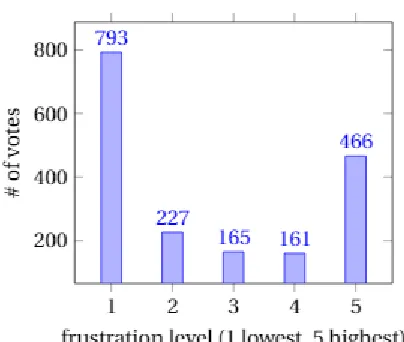
During the time period we ran our first study (April 2nd - June 14th), Python Tutor received
101,044 unique visitors who executed Python 2 or 3 code. Of these visitors, 2,385 voted on the
HappyFace affect survey and gave us frustration values and code snippets. This represents a 2.36% participation rate for Python learners on Python Tutor. Our affect survey is meant to be unobtrusive
below the coding interface and was completely optional for Python Tutor users to participate,
Figure 4.1 HappyFace vote distribution
frustration, we received enough data from participants for our analysis of frustrating code features.
This showed that learners were willing to give us feedback on their current emotional state despite
being deep into the coding process and potentially being frustrated.
4.2
Research Question 2
Can we identify features of code that are related to frustration?
One of our interests is in the correlation between features of programming languages, in this
case Python, with frustration felt by learners. With learner frustration feedback along with features
of the code snippets provided through our feedback mechanism we searched for supported features through randomized logistic regression feature selection.
Features were run through Randomized Logistic Regression for discovery of supported features.
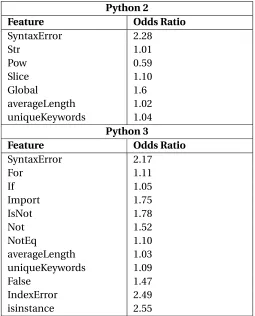
For Python 2 we found that use of Sets, Globals, Strs, Pow, Slices, and occurrences of SyntaxErrors were selected from the 83 extracted AST features. For Python 3 we found that use of Boolean
com-parators (is not, !, and !=), import statements, with statements, If statements, Load expressions,
and occurrences of SyntaxErrors were selected from the 82 extracted AST features. The strongest correlating feature with frustration was SyntaxErrors. For stylometric features, the average length of
the lines of code as well as the usage of python keywords were found to be supported, with average
Table 4.1 Odds Ratio
Python 2
Feature Odds Ratio
SyntaxError 2.28
Str 1.01
Pow 0.59
Slice 1.10
Global 1.6
averageLength 1.02
uniqueKeywords 1.04 Python 3
Feature Odds Ratio
SyntaxError 2.17
For 1.11
If 1.05
Import 1.75
IsNot 1.78
Not 1.52
NotEq 1.10
averageLength 1.03
uniqueKeywords 1.09
False 1.47
IndexError 2.49
and other python keywords correlated stronger than any other selected wordgram.
One example of a frustrating feature is the use of global variables. Python has unique rules for
global variables[Fou]: If a variable is assigned a value inside of a function, it is considered a local
variable unless the variable is declared as global. If the global variable is only referenced inside a function, this declaration is not needed. Not knowing that globals need to be explicitly declared
in Python can cause frustration in learners when it violates their expectation. While the goal of
this rule may have been to remove clutter caused by multiple global declarations, it also inserted a frustrating obstacle for learners.
As part of our analysis we extracted the odds ratios of our selected features. The odds ratio “is a
measure of association between an exposure and an outcome”[Szu10]. That is, the occurrence of a specific feature will affect the odds of a certain outcome. In the case of HappyFace, the existence
of certain AST and stylometric features will increase, decrease, or have no effect on the odds that
the learner will be frustrated. If the odds ratio of an independent variable is greater than 1.00, an increase of a unit of the variable will increase the odds that the learner is frustrated. Inversely, when
the odds ratio of an independent variable is less than 1.00, an increase in that variable decreases the
odds of frustration. The larger the distance from 1.00, or neutral with no effect on odds, the larger effect on the odds of frustration. For example, if the odds ratio of SyntaxError is 2.00, the odds that a
learner will be frustrated when a SyntaxError exists in their code is doubled (2.00/1.00). Table 4.1 lists the intercept and odds ratio of each selected feature for Python 2 and 3 we extracted for the
first study. For Python 2, the feature that increased the odds of frustration was SyntaxErrors with an
odds ratio of 2.28 For Python 3, SyntaxErrors also had a comparatively high odds ratio of 2.17. The highest odds ratio for Python 3 was the use of the isinstance function at 2.56.
4.3
Research Question 3
Can these features predict categories of problems faced when programming?
After extending our survey component to include annotations for the learner to select as a reason
for their current emotional state, we ran a second experimental survey. The annotations presented
to learners were categories we hypothesised as potential causes of frustration and happiness during the coding process. We also included another field so learners could write their own annotations
to help us find frustrating experiences we might have missed. The extension only added a second, but optional, button click to select an annotation which did not disrupt the learners’ willingness to
provide feedback.
could provide after casting a face vote. For votes with Python 2 code we received 215 reason votes, 23.65% of total votes. For votes with Python 3 code we received 303 reason votes, 23.24% of total
votes. The most common reason for being frustrated was“I get an error”with 32 occurrences for Python 2 votes and 47 for Python 3 votes. Other commonly chosen reasons were“My output is wrong”and“I don’t understand this code”, both showing that misunderstanding code is a cause for frustration in learners. The most common reason for being happy was“I understand this code” with 38 occurrences for Python 2 and 64 for Python 3. Other commonly chosen reasons for not being frustrated are“My code works”and“I fixed an error”. This was an expected result as the reasons that learners are not frustrated are antithetical to the reasons that learners are frustrated. We also
allowed the learner to input their own reason in a free-form text box by selecting the “Other” reason. Using Logistic Regression to predict the learner-selected category based on features extracted
from the user’s code snippets, we were able to obtain a precision, recall, and f1-scores for predicting
categories of frustration selected by learners. For Python 2 we were able to predict the choice of “I don’t understand this code” with a precision of 0.80, recall of 0.33, and f1-score of 0.47 with a support
of 12 out of 41 annotations. “I get an error” was predicted with precision of 0.39, recall of 0.85, and
f1-score of 0.54 with support of 13 of 41. For Python 3 we were able to predict the choice of “I don’t understand this code” with a precision, recall, and f1-score of 0.30 with a support of 10 out of 46
annotations. Selection of “I get an error” was predicted with precision of 0.52, recall of 0.76, and f1-score of 0.62 with support of 17 of 46. The other frustration categories could not be predicted as
CHAPTER
5
DISCUSSION
We discuss several implications and challenges for future research on learner frustration.
5.1
Implications
5.1.1 Interventions
We believe HappyFace can be used to inform intervention systems, both automatic and manual.
In a large-scale learning framework like a MOOC, a frustrated student can report their frustration. HappyFace then can predict the category of frustration felt by a learner working on the particular
code snippet. Interventions to this category of frustration can then be automatically presented to
the learner.
For example, when HappyFace predicts that the frustration of the learner is from improper
indentation, HappyFace can offer to perform “automatic repair” on the learner’s code in order to
fix the frustrating code. In the case of our learner Ada from the motivational example, HappyFace can inform intervention systems on when she is facing a frustrating SyntaxError. The intervention
system can then highlight a suggested fix, for Ada’s SyntaxError the system can highlight missing
HappyFace can inform them when a learner is facing frustrations along with the likely features causing frustration. Assistants more suited to helping learners understand code may prioritize
helping frustrated learners whose code is difficult to understand.
Figure 5.1 Highlighted feedback to learner
5.1.2 Language Design
Our findings support the need for better feature design in programming languages. Our analysis
reinforced the common knowledge that SyntaxErrors are a frustrating obstacle that learners face, and potentially unnecessary in languages targeting novice programmers. Further, code complexity
can be monitored and even prevented by the language when a learner’s code starts to get too
complex, frustrating learners when they do not understand their code. Lastly, certain features and the rules to use them may cause frustration in their implementation, such as global variable usage in
Python mentioned in RQ2. HappyFace can discover these frustrating experiences in a programming
language so that better designs can be created to remove barriers to programming education and aid learners in their understanding.
5.1.3 Feedback Mechanisms
With HappyFace we created a light-weight feedback mechanism that collects the affect of the voter and data describing the current actions of the learner. The design of HappyFace is purposefully
simple, a single button click is all that is required of the voter. We believe this increases participation
also lowers the impact on the voter by minimizing the interruption caused by the act of provid-ing feedback. HappyFace shows you can gather meanprovid-ingful data for discoverprovid-ing results, such as
what features in Python cause learner frustration, by leveraging the actions of the voter while only
requiring the voter to self-report their affect.
Carter et al. has investigated the automated detection of when a programmer is having difficulty
or is “stuck”[JC10]. Researchers found that it was not efficient to allow programmers to manually
change their status to stuck, as developers delay asking for help when they need it. Instead detecting difficulty by monitoring developers can inform helpful interventions earlier. While predicting affect
is an important aspect in getting learners help, we are also interested in detecting why learners need
help.
HappyFace allows for the discovery of issue-categories so that interventions can be done to
alleviate the frustration of learners at both the education level and the learning platform level.
While learning platforms do usually take in feedback and suggestions for improvement, most users may not know what their actual issue is and what improvements need to be made to deal with it.
HappyFace uses the self-reported level of frustration and correlates this score with the learners’
code to predict the category of the issue that is causing frustration. This reveals issue categories from code complexity and errors to missing features and bugs of the learning framework which
teachers and platform developers can use to provide interventions that ease learner frustrations. For example, during our second study a few learners stated that they were receiving an indentation
error as the reason for their frustration. This could inform the learning platform that it need to
extend its capabilities and add auto-indentation or PEP-8 warnings to assist a learner in properly indenting their Python code.
5.1.4 Prediction of Categories
We were able to predict when a learner did not understand the code because AST feature extraction
give us metrics on how complex the code is, which can create a difficulty in understanding the code for learners. However, while ASTs can be useful for some categories, some AST features cannot give
us insight on expected behaviors or values and require more analysis.
Another accuracy-disruptive attribute of the categories is that they can overlap in meaning. Code with an error might also be confusing to the learner, meaning both annotations could possibly
be chosen. Once HappyFace discovers these frustration categories caused by confusing code and errors, intervention systems can be informed by HappyFace to produce and present interventions.
One potential system for HappyFace integration is the Apex system, which automatically provides
an explanation for why the cause produces an error[DKRR16]. Similarly, Singh et al. presented a method for providing feedback automatically for learner errors by using an error model to present
corrections to a learner’s code[RSSL13]. Both of these methods can be helpful interventions to aid
learner understanding of the errors encountered in the execution of code.
Finally, our current extracted features may not be good predictors for the categories, so we must
further investigate features that can be extracted from learners’ code that could be used to improve
category prediction. Despite these current weaknesses, the ability to predict that a learner does not understand the code relates to our finding that complex features cause frustration in learners.
5.1.4.1 Programmer Frustration
Ford et al. investigated causes of frustration for software developers via a survey[FOR15]. The
reported causes of frustration were then grouped into several categories ranging from frustrations caused by the skill of the developer, the complexity of the code, and the features of the programming
tools in use. Rather than manual surveys to elicit frustrating features in programming, HappyFace
analyzes code with reported frustration to discover frustrating features automatically. Further, HappyFace can predict the problem categories a user is facing based on the feature of the code,
removing the necessity of manual categorization of user frustrations previously done and lessening
the effort required to discover frustrations felt by programmers.
5.2
Challenges
5.2.1 Integrations
While Python Tutor is an excellent platform to integrate HappyFace into, we would like to expand
HappyFace’s reach into stand-alone IDEs. The survey component of HappyFace’s current
imple-mentation allows it to be integrated into any web-based IDE as it is written in HTML, but many IDEs like Eclipse or Visual Studio cannot implement the survey. In order to increase the breadth of
HappyFace’s ability to report learner frustrations, it must have the ability to be implemented into
the tools that learners use. For this a plug-in must be developed that replicates the HTML survey component implementation of HappyFace.
5.2.2 Extraction of Informative Features
correlated with frustration. Further investigation into what frustrates a learner can help discover new features that would be beneficial to extract. One method, implemented in our extended survey,
is to elicit causes of frustration from the learner through free-form text fields. After learners report
other causes of frustration, we can extract features we believe correlate with that cause to analyze the strength of correlation the new features have with frustration.
5.2.3 Participation
Increasing learner participation will give our analysis more data on features that correlate with frustration. We can increase participation rate by better survey design, prompts to the learner,
or even automated detection of frustration. Our implementation of HappyFace in Python Tutor
was a passive survey that did not prompt the learner to provide a vote. It is possible that knowing automated help could be given by the system could increase participation by learners. We did not
want to prompt the learner through a pop-up notification as to limit the interruption the survey
would cause the learner, potentially becoming a frustrating feature itself. In a classroom and MOOC setting, learners can be prompted by the course instructor to take the HappyFace survey, increasing
participation to provide more data for analysis. Despite challenges to participation, the scale of the
environments HappyFace can be implemented, such as millions of learners taking a MOOC course, means that even low percentages of participation can mean thousands of participants providing
valuable data to analyze.
5.3
Limitations
HappyFace and our studies have the following limitations:
While HappyFace can collect any code language, the capability of our analysis is limited to Python 2 and 3 code. In order to increase the breadth of our analysis we would need to parse each
language’s code into ASTs through libraries like Esprima for JavaScript code. This will give us insight
on the differences in frustrating features in code languages. For example, the metric of semicolons per line may affect Java learners much more than Python learners as semicolons are required in
Java to terminate lines. Another example is indentation in Python which affects functionality and
execution paths, so it may correlate with frustration in Python but not in Java. In order to investigate these differences HappyFace must be extended.
HappyFace only receives data on a vote by a learner, but frustration is a continuous experience.
but the frustration felt by receiving the error may increase exponentially the longer the learner has been coding. Since HappyFace only collects the feedback at the discrete time of the vote, we cannot
analyze the entire learning experience. In order to handle this limitation, it may be beneficial to
conduct a controlled experiment where the learner is told to report their current emotion periodically so we can analyze changes over time. Further, rather than self-reported feedback we could detect
frustration through bodily reactions similarly to JavaTutor[Vai16]over an entire programming
session. Thus, we see the need to integrate HappyFace with existing continuous affect systems or future studies to more finely understand the time course of frustration.
Another issue is that different learners experience frustration differently. An impatient learner
may find certain obstacles much more frustrating than most. It is also possible that some votes by learners represented frustration with external factors and may already be frustrated before coding.
These external factors can play a role in learner frustration that we cannot detect. Perhaps a learner
was having a bad day and receiving a (usually) non-frustrating obstacle affected them greatly, causing them to report they were frustrated. For example, during the follow-up study one learner selected
the “Other” annotation and wrote “I have a midterm today” as the reason they were frustrated. This
may falsely affect the correlation between certain features and frustration.
5.4
Related Work
5.4.1 Lightweight and Static Analysis of Code at Scale
OverCode is a system that uses static analysis of code to cluster solutions written by learners[Gla15].
Glassman et al. found that OverCode gave teachers a high-level overview that allowed them to
discern students’ understanding and misconceptions about the code they are working on. OverCode accomplished this by reformatting and “cleaning” (standardizing) raw code, then creating stacks of
resulting code that became identical. Teachers or teaching assistants can then observe these stacks
for misconceptions and holes in learners’ knowledge. HappyFace is also a system that uses static analysis of code, but instead of presenting an expert with stacks of solutions it extracts code features
and correlates them with user-reported frustration levels. Further, HappyFace performs its analysis on raw code rather than cleaned code to keep stylometric features and word-unigrams intact. There
can be valuable information in these features that standardizing the code can miss. For example, the
occurrence of the word “Fibonacci” in the frustrating code could show that learners have frustration with implementing that algorithm. While OverCode offers analysis at scale by clustering solutions,
these are solutions to the same problems faced by some group of learners as part of a course.
features in programming. These discovered features, possibly the result of learner misconceptions or complexities beyond the learner’s current understanding, can be obtained from code at a scale
beyond a single problem space.
5.4.2 Using the Crowd
Codepourri uses a volunteer crowd of learners to create code tutorials and annotate each step of the tutorials[GG15]. The best annotations for use in a tutorial were chosen through a vote by the learners.
These tutorials were judged by experts to be near the quality of their own expert-created tutorials. The importance of this finding to HappyFace is that a crowd of learners can provide a similar quality
of observation that experts can and can even provide insights that experts missed. HappyFace
uses a crowd of learners to discover and predict causes of frustration in programming. Rather than expert analysis of features that may cause frustration, learners report when they are frustrated
and the code causing frustration. We can then correlate the features of the code with frustration
scores to identify frustrating experiences in programming. In the extended survey, HappyFace allows learners to annotate their frustration and code to experiment with HappyFace’s ability to predict
CHAPTER
6
CONCLUSION
Frustrating obstacles during programming caused by lack of support, course difficulty, and even lack of skills can cause learners to drop out of large-scale MOOCs. In this paper we present
Happy-Face, a light-weight feedback mechanism and automated analysis and prediction engine that can
discover these frustrations felt by learners. HappyFace can gather and discover frustrating features at scale. This allows an efficient method of data collection from thousands of students quickly and
painlessly by collecting learner affect and code in one button click. We believe that HappyFace’s
automated analysis and prediction can be used to inform intervention systems built into learning frameworks in order to provide learners with solutions to frustrations. When these systems lack a
specific intervention for a frustration, HappyFace can discover common frustrating features that
BIBLIOGRAPHY
[ACIG15] Aylin Caliskan-Islam Richard Harang, A. L.A.N.C.V.F. Y. & Greenstadt, R. “De-anonymizing programmers via code stylometry”.SEC’15 Proceedings of the 24th USENIX Conference on Security Symposium(2015).
[BH10] BjÃ˝urn Hartmann Daniel MacDougall, J. B.S.R. K. “What Would Other Programmers Do? Suggesting Solutions to Error Messages”.CHI 2010(2010).
[Con13] Conole, G.MOOCs as Disruptive Technologies: Strategies For Enhancing The Learner Experience and Quality of MOOCs, http://www.um.es/ead/red/39/conole.pdf. 2013.
[DBZ90] Daiva Bieri Robert Reeve, G. C. & Ziegler, J. B. “The Faces Pain Scale for the self-assessment of the severity of pain experienced by children: Development, initial validation, and preliminary investigation for ratio scale properties”.Pain(1990), pp. 139–150.
[DKRR16] Dohyeong Kim Yonghwi Kwon, P. L.I.L.K.D.M.P.X. Z. & Rodriguez-Rivera, G. “Apex: au-tomatic programming assignment error explanation”.Proceedings of the 2016 ACM SIGPLAN International Conference on Object-Oriented Programming, Systems, Lan-guages, and Applications (OOPSLA 2016)(2016).
[FOR15] FORD D., P. C. “Exploring the Causes of Frustration for Software Developers”.IEEE ICSE 8th International Workshop on Cooperative and Human Aspects of Software Engineering (CHASE)(2015).
[Fou] Foundation, P. S.Programming FAQ, https://docs.python.org/3/faq/ programming.htmlwhat-are-the-rules-for-local-and-global-variables-in-python.
[Gla15] Glassman, E. L. et al. “OverCode: Visualizing Variation in Student Solutions to Pro-gramming Problems at Scale”.ACM Trans. Comput.-Hum. Interact.22.2 (2015), 7:1– 7:35.
[GG15] Gordon, M. & Guo, P. J. “Codepourri: Creating visual coding tutorials using a volunteer crowd of learners”.Proceedings of the IEEE Symposium on Visual Languages and Human-Centric Computing (VL/HCC). VL/HCC ’15. 2015, pp. 13–21.
[Guo] Guo, P.Python Tutor, http://pythontutor.com/.
[Guo13] Guo, P. J. “Online Python Tutor: Embeddable Web-based Program Visualization for CS Education”.SIGCSE ACM, 579-584(2013).
[JC10] Jason Carter, P. D. “Design, implementation, and evaluation of an approach for deter-mining when programmers are having difficulty”.GROUP ’10 Proceedings of the 16th ACM international conference on Supporting group work(2010).
[OB14] Onah Daniel F. O., S. J. & Boyatt, R. “Dropout rates of massive open online courses : behavioural patterns”.EDULEARN14 Proceedings pp. 5825-5834(2014).
[Par] Parnin, C.checkbox.io, http://checkbox.io/.
[RSSL13] Rishabh Singh, S. G. & Solar-Lezama, A. “Automated feedback generation for introduc-tory programming assignments”.Proceedings of the 34th ACM SIGPLAN Conference on Programming Language Design and Implementation (PLDI 2013)(2013).
[Szu10] Szumilas, M. “Explaining Odds Ratios”.J Can Acad Child Adolesc Psychiatry(2010), pp. 227–229.