Sewage Treatment Technique
Maaz Allah Khan Mohd. Salman
Maharishi University of Information Technology Azad Institute of Engineering &Technology
Abstract
Sewage / waste water treatment consist of different processes which protect the environment & human through cleansing the water pollutant. In history people used difference method of treatment for purification of water which get advance by advancement in technological world. India faces a number of waste water issue & water related health hazard. Sewage treatment plant (STP) has constructed in most places in India to maintain the sustained balance between the ecosystem (land ecosystem & water ecosystem)
Keywords: Sewage Treatment Technique, Waste Water Treatment Procedure
________________________________________________________________________________________________________
I. INTRODUCTION
Sewage Treatment Plant is a vital process in the modern industrial world, alongside this, more than 97% of water is stored in saline (Oceans) and only 3% in fresh water, however only less than 1% is available for consumption. As time goes by, there will be population growth for which the government would have to provide more useable water for society. Sewage treatment plant uses chemical, physical, and biological processes to cleanse sewage in order to protect the environment and public health. Sewage treatment is a modern practice, while ancient Romans used to create sewers for removing the foul-smell of the used water now days, the main reason for constructed sewage is to remove or decrease the dangerous pollutants such as nutrients, carbon inorganic and organic elements.
II. OBJECTIVES
There are three main objectives in sewage treatment: Removal of floatable and postponed particles Removal of BOD ( Biochemical oxygen demand)
Removal of micro-organic which may be the cause of dangerous diseases
III. DOMESTIC WASTE WATER CHARACTERISTIC
The man reason for designing of sewage treatment plant or building sewer in the cities is domestic waste water. The waste water characteristic is divided into two parts;
Physical characteristic
Chemical or industrial characteristic
Physical Characteristic
Physically waste water can be judge in these three distinct standards (color, temperature and weight)
The color waste water which has been produced early is grey, however as time goes by it changes to black the reason why is suspended solid which cannot dissolve or settled in the waste water. In addition, the solids increase the weight of the wastewater which has been measured 1,000,000 grams in one cubic meter in the waste.
Chemical or Industrial Characteristic
During the chemical waste water characteristic is more complicated than explaining the attributes of the physical. There are a lot of different chemical element in waste water which makes the exact chemical measurement impossible. however the experts in the field divided the wastewater chemicals into generals groups of compound for making the measurements easier; for example polyphosphates, orthophosphates and organicphosphate are all being considered under a major group called “Total Phosphorus (as P). Mono-hydrogen phosphate (HPO42-)is usually determined to be phosphorus in waste water. Its existence in order to prevent the reduction of eutrophication and this process put to use through chemical precipitation, using the three compound methods given below:
Using ferric chloride
Fecl3 + HPO4-2 = FePO4 + H+ + 3CL- Using Alum
Using Lime
5Ca(OH)2 + 3HPO42- =Ca5(PO4)3OH + 3H2O +6(0H)- The ph value of domestic waste water is estimated between 6.5 to 8.5.
Further In above mentioned precipitation reaction alum & ferric chloride reduces the ph while lime increases the ph to maintained balance between equation.
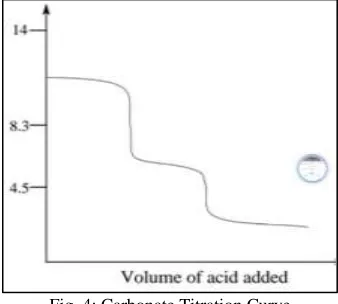
Fig. 4: Carbonate Titration Curve
IV. SEWAGE TREATMENT PROCEDURE
Unit Process of Treatment
AS we known there are lot of pollutant and waste in the waste water such as pathogens, coarse solids, salts and inorganic particles etc. these pollutants are harmful for both ecosystem (land & water)
For removing this pollutant we use different method. The one which we are using is unit operation in sewage treatment. The primary objective of this treatment is reduction in water pollution. Form starting till end of the treatment process which can be disposed or reused as product of reduction process (chemical, physical or biological).
Chemical Unit Processes
IT IS playing a vital role in advanced cleansing reaction in waste water components such processes are used while. The physical & biological process acting simultaneously. There different chemical process acting such as precipitation, coagulation, neutralization, oxidation, reduction and ion-exchange that may be added during the procedure of purification.
Physical Unit Processes
There are some treatment method which cleanses the waste water by using the physical forces such as flocculation, floatation, mixing, filtration, screening, and gas transfer.
Biological Unit Processes
In These process the beak down of grease/oil, suspended solid, organic matter, nitrogen and phosphorus by bacteria which grow naturally in the biological reactor. The bacteria consumes the carbon based material in the sewers, also the primary goal of this treatment is to reduce biological element in wastewater.
V. STAGES OF TREATMENT
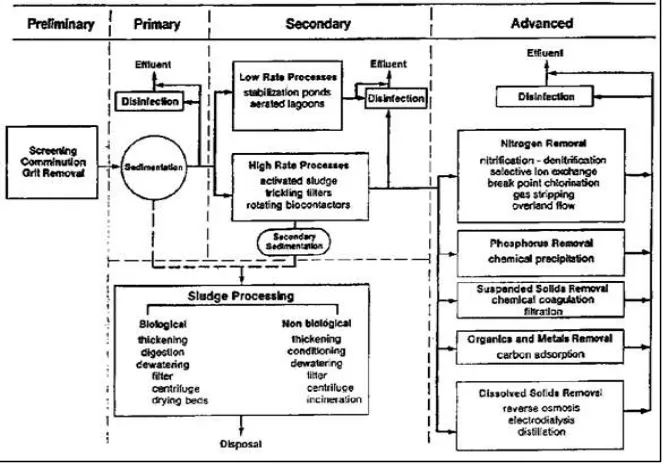
The different stages used in the process of treatment are: Preliminary
Primary Secondary
Advanced wastewater (tertiary)
Preliminary Wastewater Treatment
The objective is to remove the large materials like coarse solids which are being frequently seen in wastewater preliminary treatment procedure usually contain grit removal, coarse screening and communication of large objects. This process decrease the wastewater BOD, by approximately 15 to 30% and the devices which are being used during this treatment are grit chamber and communicator.
Primary Wastewater Treatment
In this treatment the main objective is to remove the solid particle by sedimentation. In solids component such as phosphorous. These waste which are collected form sedimentation process known as Primary effluent.
Secondary Wastewater Treatment
This treatment used after the primary treatment which completes the cleansing process. In this treatment removal biodegradable, colloidal or organic matter and aerobic biological
Secondary treatment process will decompose organic matter by bacteria. In some time bacteria act as a treatment reactor and may consist of oxidation ponds, aerated tanks, rotating biological contactors and trickling filters.
Tertiary Treatment or Advanced Wastewater Treatment
In this treatment the main objective is to remove constitutes particle which cannot remove by secondary treatment. Tertiary treatment removes such as Toxic substance, Organic substance and solid particles.
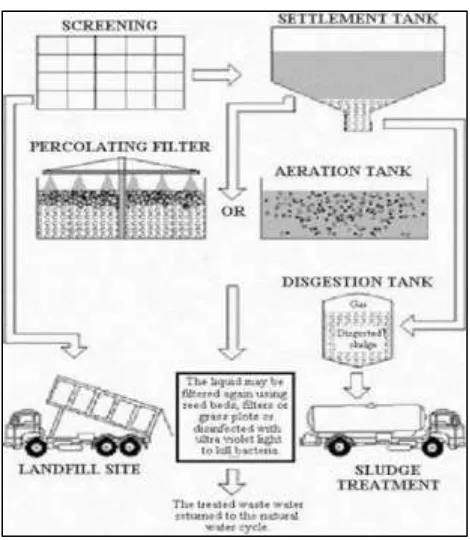
In this tertiary process, procedure wastewater treatment stages schematically. By chemical, biological or both combination treatment which remove nitrogen and phosphorus. Also done other treatment like as sedimentation, chemical coagulation, filtration and flocculation decreases the water toxicity.
Fig. 5: Tertiary Treatment or Advanced Wastewater Treatment
VI. DESIGN OF SEWAGE TREATMENT PLANT
In the order to ascertain the effluent quality requirement, a designer is encouraged to liaise with EPD by submitting the following information, prior to design of STP;
Block and location plans of site
Maximum number of persons(resident and non-resident) to served Presence of shops, restaurants or other service trades
Possibility of the need for future extensions to the plant Proposed location of discharge
All the element of STP should be open to views as far as possible for easy operation and maintenance.
Mechanical equipment which is critical to the functioning of the STP should be provided with on line standby units.
Entrance to the STP should be by a proper door without the use of steps or ladders and accessible by a vehicle. A exit should be provided as far as possible for emergency purpose at the opposite end of the plant room.
Due consideration should be given to the possible initial low flow condition before full population is achieved.
Excessive quantities of grease and oil may cause malfunction of an STP. In such cases, arrangement should be made where practicable for grease and oil to be removed at source. A properly design a grease trap should be provided where restaurants or garages are to be served by the STP.
Swimming pool filter backwash, if any should be discharge to the STP for treatment. Design of STP should take into account in the flow and loadings of such wastewater. Pool water itself should however be drained to the storm water system.
Under special circumstances an auto start standby power generator may be required if it is considered that discharge of untreated wastewater to a specific water course is unacceptable even for a brief period during power failure.
Design Parameter
The design peak flow arriving at the STP as a proportion of dry weather flow (DWF) shall be taken as: 6 DWF for population equal to or under 1000
4 DWF for population over population over 1000 but not less than that based on 1000 population
Either the STP can be designed for the above peak flow rate or it can be to cater for a peak flow of 3DWF, excess flow over 3DWF being equalized in an equalization tank. In the latter case the feed pumps must be sized accurately to avoid excessive peak flow rate production.
Equalized tanks should be designed to hold the excess flow for a period of two hrs. Only the tank volume above the duty pump cut-in level should be considered as effective equalization volume. Air ejectors should be provided to prevent septicity of sewage.
Primary sedimentation tanks shall be design for: Maximum surface loading of 40m3/m2/d at peak flow Maximum retention time of 2 hours at peak flow Maximum weir loading of 250m3/m/d at peak flow
Fig. 6: Primary Sedimentation
Practical Design and Installation
A portable submersible pump should be provided in order to allow flexibility in operation. This pump can be to recycle the plant effluent to maintain the STP in a working condition when incoming flow is low.
General headroom of 3m should be maintained for enclosed or underground STP with artificial ventilation. This may be reduced to 2.5 m at localized points e.g., under beams.
For enclosed STP a minimum air volume of 14 m3 should be provided. Artificial ventilation should be provided with not less than 10 air changes per hour. Ventilation exhaust pipes should be carried up to a height not less than 1 m above the roof of the building at which the STP is located.
Access walkways of minimum 0.75 m clear width should be maintained within the STP for access to all areas requiring maintenance and operation. Walkways should have safety rails (preferably stainless steel) and toe boards. Walksways should be laid to a 1:25 cross fall to prevent ponding if of solid construction and they should not be obstructed by crossing pipework.
Where levels, vary, staircases should be provided and not catladders or step irons.
All tanks should be provided with stainless steel ladders or step irons for access. Mild steel should not be used. Step irons should be spaced at 300 mm/cc horizontally and 250 mm/cc vertically.
If a tank has to be covered stainless steel or aluminium alloy open mesh flooring should be used (aluminium should however not be used in chlorination facilities located in confined space). Open mesh flooring should be designed for 5kPA uniformly distributed load.
Provision of an emergency by pass to the STP is not allowed under normal circumstances. Fresh water taps for hoses and hand washing should be provided in the STP. Electrical distributer boards and controls panels should be installd in location not liable to flooding. Panels should have a dehumidifying heater.
Mechanical screens should be the ststictyoe or the type having the rakes moving in the bar opening and not on the bar. Either manual or channel should have high level over flow into the stand by screen channel so that the flow diverts automatically through the stand by screen in case duty the one is blocked.
Pump should be designed to limit the pump start to not more than 10 times per hours.
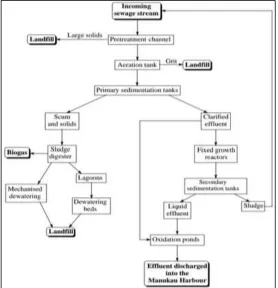
Fig. 8: Treatment of STP through Flow station Tank
VII. SEWERAGE SYSTEM
A sewerage system is used to receives the wastages which have been released from the domestic and industrial sources and after collection of these sources then treatment procedure is applied and finally releases the left pollutant into the environment. Some factors are used before designing a sewerage system.
Environmental Factors
These factors consider to the environmental conditions like- Surface water, Ground water and other disturbance factors like- insects affects the land values and public health.
Engineering Factors
Cost Consideration
These factors related to the cost of treatment of sewage system. The financial analyzer should be appoint for the cost consideration.
The work of the analyzer including the project which consists of the maintenance, fuel, repair, staff, cost for equipment, land cost and construction cost.
Process Consideration
In the process consideration need of those thing or people which related to the process operation like – skilled staff, requirement of equipment, land availability. These process operation also used in design of sewerage system
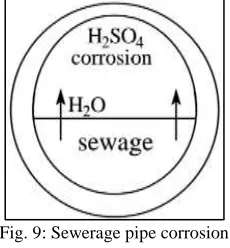
Fig. 9: Sewerage pipe corrosion
VIII. DISPOSAL AND RE-USED
It is the final procedure of sewage treatment plant, which pleases the economic and scientific goals and procedures.
Two main group are considered in disposal system, the first where they are situated and second one is this how they are function: Onsite and Off side (Public used) re-used system.
Onsite these disposal used a land filling where excavated land is filled with the disposal and covered it with the soil. Where the minimum pollutant is present like- only couple of house in a wide geometric range the disposal also dispose.
Offsite or public system all the sewage is collected in an area here the residential building was not build or people was not living in the wide range area. Then the sewage is collected and dispose through it.
IX. SUMMARY
The main objective of sewage treatment is to protect the environment; social economic and public health form the pollutants. This treatment based or depends on the (Primary, Preliminary, Secondary or Tertiary treatment). The nature of defined as the is essential for designing a suitable process and operation. The treatment process should be designed and constructed under scientific circumstances and factors. In summary, treatment of wastewater as that result patient which suffering of infection diseases.
In india the amount of waste which being produced increased increase too, and the government of india should provide the most beneficial environment for engineers to design a proper sewage treatment as take places in various field.
The imperative factors of wastewater treatment is its capability to create a system proficient in making vast changes and this can be observed through assessing the fact being that every 30 seconds a child dies child from the usage of polluted water.
X. CONCLUSION
For the primary treatment of domestic and municipal sewage an-aerobic ponds are suitable. In a low energy requirement they are easily maintain. For secondary & tertiary municipal sewage treatment constructed wet land because wet lands are eco-friendly.
When the same bio-chemical & physical process occur in a more natural environment instead of reactor tanks & basins, the result system often consumes less energy is more reliable require less operation & maintenance & as a result costs less.
The constructed wetlands, incorporator natural biochemical process which are time & temperature depended both system followed anaerobic ponds such as “Jamaica”is suitable subtropical region.
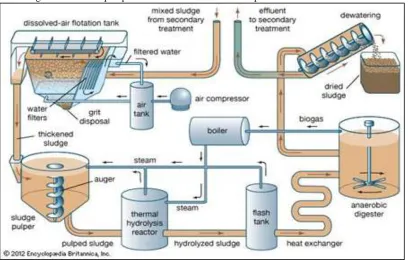
Fig. 10: Sewage Treatment Plant
REFERENCES
[1] Holden, J. (2013). Water resources: an integrated approach. Routledge
[2] VassoOreopoulou, W. R. (2006). Utilization of By Products and Treatment of Waste in the Food Industry. Springer Science and Business Media.