University of Windsor University of Windsor
Scholarship at UWindsor
Scholarship at UWindsor
Electronic Theses and Dissertations Theses, Dissertations, and Major Papers
1-1-2007
A web service based architecture for authorization of unknown
A web service based architecture for authorization of unknown
entities in a Grid environment.
entities in a Grid environment.
Jordan Rivington
University of Windsor
Follow this and additional works at: https://scholar.uwindsor.ca/etd
Recommended Citation Recommended Citation
Rivington, Jordan, "A web service based architecture for authorization of unknown entities in a Grid environment." (2007). Electronic Theses and Dissertations. 6996.
https://scholar.uwindsor.ca/etd/6996
A Web Service Based Architecture for Authorization of
Unknown Entities in a Grid Environment
by
Jordan Rivington
A Thesis
Submitted to the Faculty of Graduate Studies through Computer Science
in Partial Fulfillment of the Requirements for the Degree of Master of Science at the
University of Windsor
Windsor, Ontario, Canada 2007
Library and Archives Canada
Bibliotheque et Archives Canada
Published Heritage Branch
395 W ellington Street Ottawa ON K1A 0N4 Canada
Your file Votre reference ISBN: 978-0-494-35021-8 Our file Notre reference ISBN: 978-0-494-35021-8
Direction du
Patrimoine de I'edition
395, rue W ellington Ottawa ON K1A 0N4 Canada
NOTICE:
The author has granted a non exclusive license allowing Library and Archives Canada to reproduce, publish, archive, preserve, conserve, communicate to the public by
telecommunication or on the Internet, loan, distribute and sell theses
worldwide, for commercial or non commercial purposes, in microform, paper, electronic and/or any other formats.
AVIS:
L'auteur a accorde une licence non exclusive permettant a la Bibliotheque et Archives Canada de reproduire, publier, archiver,
sauvegarder, conserver, transmettre au public par telecommunication ou par I'lnternet, preter, distribuer et vendre des theses partout dans le monde, a des fins commerciales ou autres, sur support microforme, papier, electronique et/ou autres formats.
The author retains copyright ownership and moral rights in this thesis. Neither the thesis nor substantial extracts from it may be printed or otherwise reproduced without the author's permission.
L'auteur conserve la propriete du droit d'auteur et des droits moraux qui protege cette these. Ni la these ni des extraits substantiels de celle-ci ne doivent etre imprimes ou autrement reproduits sans son autorisation.
In compliance with the Canadian Privacy Act some supporting forms may have been removed from this thesis.
While these forms may be included in the document page count,
their removal does not represent
Conformement a la loi canadienne sur la protection de la vie privee, quelques formulaires secondaires ont ete enleves de cette these.
Abstract
As the “Grid” becomes closer and closer to fruition, not as a static entity, but as a
dynamic global solution, certain issues must be addressed. These issues include, but are
not limited to, virtualization, discovery, accounting and fault tolerance [Kesselman2002].
Many of such issues are being addressed with the advent of OGSA/OGSI and related
service-based changes, which are being applied to grid-based computing
[Kesselman2002]. Of course, these changes also include security, but not from the point
o f view of unknown entities. Before we can successfully achieve pervasive computing,
we must leave behind, or at least augment, the current notion of pre-established trust
[Rivington2004]. This requires too much administrative overhead, and is not realistic in a
distributed environment where processing may occur across thousands to millions of
independently administered nodes [Kirschner2004]. Therefore, the purpose of this paper
is to present a new architecture for distributed authorization which will surpass current
schemes in scalability, due to a lower administrative overhead, while also supporting the
Dedication
I dedicate this work to my parents. Without their support, mentally, emotionally, and
financially, as well as their influence in general, I would not have become the person I
am today. It took a little while fo r me to realize that I d o n ’t know everything and I have
them to thank fo r it. It also took some time fo r them to convince me that education was in
Acknowledgements
Throughout the lifetime of this project, many major events have occurred in my life. I
met my fiance, we have planned a wedding, we have purchased a house, and we now
have three pets chewing everything in sight. I am very happy with how my life is
progressing. The completion o f this project will be the proverbial icing on the cake. That
being said, the first person I would like to acknowledge is my fiance Kristin. She has
supported me throughout this long process, and I could not have done this without her.
Soon we shall be able to spend more time together without the laptop.
From a technical and mentoring point of view, I could not have asked for a better person.
Dr. Robert Kent has played many roles in this project including technical consultant,
devil’s advocate, motivator, and friend. I still remember the day I went into his office to
ask him if I could work with him for my Master’s. He abruptly said “you have thirty
seconds to tell me why I shouldn’t kick you out of my office right now”. I guess I said
what I needed to say, because I have been working with him ever since. Although at
times I became quite frustrated with his suggested changes of topic, I have since realized
that it was all part of the learning process, and I cannot thank him enough for the
guidance. In the end, I don’t consider anything I have done a waste of time.
Most people are lucky if they can find one person to provide them with the necessary
help and guidance required to complete this type o f project. I was fortunate to have not
only one supporter. Dr. Akshai Aggarwal was also always available to help me with the
Table of Contents
Preface...1
1 Introduction...2
2 Background Terminology and Technologies... 5
2.1 Authorization... 5
2.2 Web Services... 6
2.3 XML...6
2.4 W SDL...7
2.5 UDDI...7
2.6 SO A P... 8
2.7 OGSA... 8
2.8 Globus (GT4)... 9
3 Literature Review and Related W ork ...11
3.1 Authorization Systems...11
3.1.1 A kenti(1999)... 11
3.1.2 Certificate Based Authorization Simulation System (2001)... 12
3.1.3 MAFTIA1 (2001)...13
3.1.4 CAS (GT4) (2002)... 13
3.1.5 KEYNOTE (1999)... 14
3.1.6 PERMIS (2002)... 14
3.1.7 CARDEA (2003)... 15
3.1.8 FIDELIS (2003)... 16
3.1.9 HP HSA (2003)... 16
3.1.10 CONTEXT SENSITIVE (2003)... 17
3.1.11 TERA (2004)... 17
3.1.12 IBM TE (2004)... 18
3.1.13 Shibboleth (2004)... 18
3.1.14 VOMS (2004)... 19
3.1.15 PRIMA (2004)... 19
3.1.16 WS AA Authorization Framework (GT4) (2006)... 19
3.1.17 General System Comparison...20
3.2 Methods o f Authorization... 21
3.3 Comparison 1: Authorization... 21
3.4 Comparison 2: Features... 22
3.5 Comparison 3: Implementation...24
3.6 Comparison 4: Arbitrary Entities...24
3.7 Authorization System Comparison Summary... 25
4 Augmented Authorization System Using Reputation... 27
4.1 Justification... 27
4.2 Overall Architectural Comparison with A A SU R... 28
4.3 Problem Statement...28
5 AASUR... 31
5.1 Design Context... 31
5.4 Reputation and Evidence... 38
5.5 Architectural Assumptions... 41
5.6 Maj or Components and Packages... 42
5.6.1 org.aasur.ejbca.ca.AassurCaService (ACS)...42
5.6.2 org.aasur.resource.ResourceSiteServiceListener (RSSL)...44
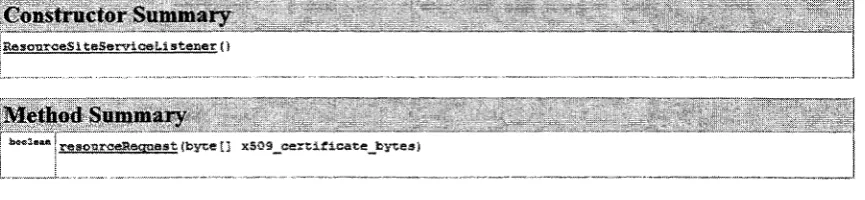
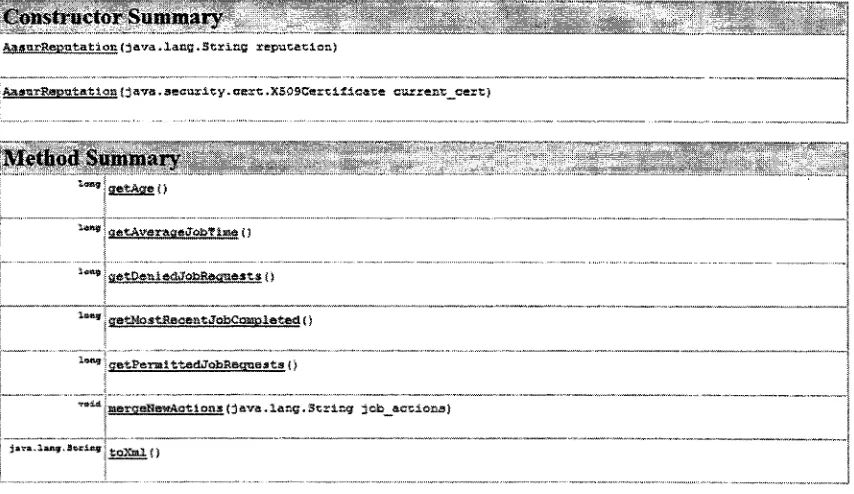
5.6.3 org.aasur.reputation.AASURReputation (A R )...46
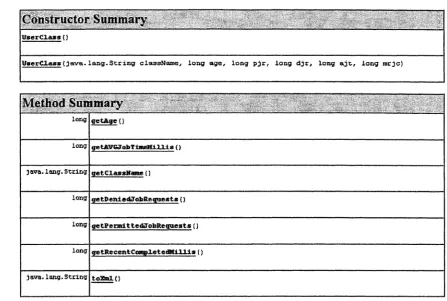
5.6.4 org.aasur.policy.UserClass (U C )...48
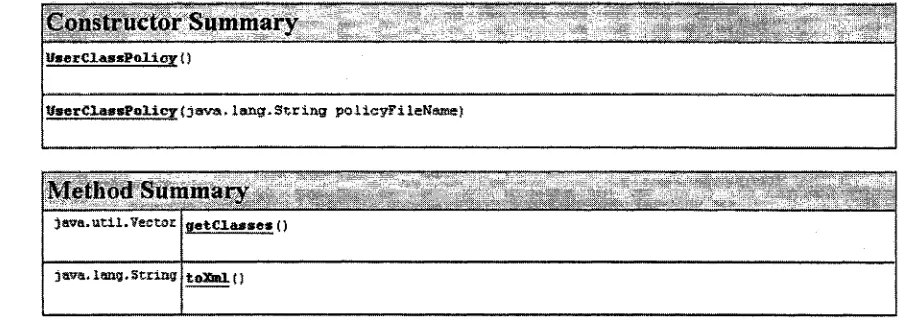
5.6.5 org.aasur.policy.UserClassPolicy (UCP)... 49
5.6.6 org.aasur.policy.UserClassEngine (UCE)... 50
5.6.7 org.aasur.policy.RiskFactorPolicyEntry (RFPE)...52
5.6.8 org.aasur.policy.RiskFactorPolicy (R FP)... 53
5.6.9 org.aasur.policy.RiskFactorEngine (RFE)... 54
5.6.10 org.aasur.policy.AccessDecisionPolicyEntry... 55
5.6.11 org.aasur.policy.AccessDecisionPolicy... 56
5.6.12 org.aasur.policy.AccessDecisionEngine... 58
5.7 Supporting Components...59
5.7.1 org.aasur.user.UserSiteSimulator... 59
5.7.2 org.aasur.common.Serializer... 59
5.7.3 org.aasur.common.TextCompressor...61
5.7.4 org.aasur.common.FileContentExtractor... 62
5.7.5 org.aasur.common.RandomNumberGenerator...63
5.7.6 org.aasur.common.ReputationExtractor... 64
5.7.7 org.aasur.common.XMLDomParser...64
5.7.8 org.aasur.simulation.RandomJobGenerator... 65
5.7.9 org.aasur.simulation.JobAction... 66
5.8 Policy Formats... 67
5.8.1 Risk Factor Determination Policy... 68
5.8.2 Access Decision Policy... 69
5.8.3 User Class Definition Policy...70
5.8.4 Local Blacklisting Actions Definition Policy... 71
5.9 Message Form ats... 72
5.9.1 Resource Access R equest...72
5.9.2 Point Action Notification... 72
5.9.3 Resource Access Ticket... 73
5.10 OTHER FORMATS... 74
5.10.1 Certificate Point Format (Reputation)...74
5.10.2 Local Blacklist Format... 75
5.11 Extensibility...76
5.12 Sample Walkthrough (SYSTEM FLOW)... 77
5.13 Sample Walkthrough (AUTHORIZATION DECISION)... 80
5.14 Current State...87
5.15 Limitations... 87
5.16 Implementation...88
6 Development/Deployment Infrastructure...90
6.1 Required Components... 90
6.3 Installation and configuration... 92
6.3.1 JB oss... 92
6.3.2 Ja v a ...93
6.3.3 Linux... 94
6.3.4 EJBC A ... 94
6.3.5 M ySQ L... 97
7 Testing and Verification... 99
7.1 Code Correctness Verification... 99
7.2 M etrics...99
7.3 Procedures and Results...100
7.3.1 Test A: Certificate Retrieval Time (NO REPUTATION)... 100
7.3.2 Test B : Certificate Retrieval Time (EMPTY REPUTATION)...102
7.3.3 Test C: Certificate Retrieval Time (0-100,000 ACTIONS)... 104
7.3.4 Test D: Certificate Size Vs. Actions in Reputation... 106
7.3.5 Test E: Access Decision Time (0-100,000 ACTIONS)...108
7.4 Performance Comparisons...110
7.4.1 Akenti...110
7.4.2 Perm is...I l l 7.4.3 AASUR / Permis / Akenti Comparison Summary... I l l 8 Conclusion... 113
8.1 Future W ork... 114
References... 116
Appendix A: Environment Configuration Instructions... 121
A. 1 LINUX INSTALLATION...121
A.2 JBOSS INSTALLATION...122
A.3 MYSQL CONFIGURATION... 123
A.4 EJBCA INSTALLATION...124
A. 5 PREPARATION AND DEPLOYMENT... 125
Table of Tables
1. Table 1: Legal/Illegal Point Actions...39
2. Table 2: Other Point Actions... 39
Table of Figures
1. Graphical Representation of the Grid Security Infrastructure (GSI)...10
2. Figure 2: System Comparisons 1: Authorization Methods... 22
3. Figure 3: System Comparisons 2: Features... 23
4. Figure 4: System Comparisons 3: Implementation...24
5. Figure 5: System Comparisons 4: Arbitrary Entity Support... 26
6. Figure 6: System Comparisons 5: Overall Architectural Comparison... 28
7. Figure 7: AASUR Reputation Object... 41
8. Figure 8: AasurCaService Object...44
9. Figure 9: ResourceSiteServiceListener Object...45
10. Figure 10: AasurReputation Object... 47
11. Figure 11: UserClass Object... 49
12. Figure 12: UserClassPolicy Obj ect... 50
13. Figure 13: UserClassEngine Object... 52
14. Figure 14: RiskFactorPolicyEntry Obj ect...53
15. Figure 15: RiskFactorPolicy Obj ect... 54
16. Figure 16: RiskFactorEngine Obj ect...55
17. Figure 17: AccessDecisionPolicyEntry Obj ect... 56
18. Figure 18: AccessDecisionPolicy Object...57
19. Figure 19: AccessDecisionEngine Object...58
20. Figure 20: Serializer Object... 61
21. Figure 21: TextCompressor Object... 62
23. Figure 23: RandomNumberGenerator Object... 64
24. Figure 24: ReputationExtractor Object...64
25. Figure 25: ReputationExtractor Object...65
26. Figure 26: RandomJobGenerator Object... 66
27. Figure 27: JobAction Object... 67
28. Figure 28: Sample Transaction Walkthrough... 77
29. Figure 29: TEST A: 1000 Certificate Retrievals. No reputation...101
30. Figure 30: TEST B: 1000 Certificate Retrievals. Empty reputation... 103
31. Figure 31: TEST C. 1000 certificate retrievals. 100,000 action reputation...105
32. Figure 32: Test D. Certificate size increase with 100,000 actions in reputation.... 107
Preface
This thesis is the direct result of my own work and includes nothing which is the outcome
of work done with others, except where specifically indicated in the text. O f course,
direction and suggestions have been given to me by my supervisor and other faculty. This
thesis is not the same as any that I have submitted for another degree or any other
qualification at any other educational institution. No part of this work has already been,
1 Introduction
Grid computing encompasses the sharing of computational, storage, and networked
resources that are controlled by different resource owners, typically independent
institutions, and where the users of grid resources may be members of some, but not all,
institutions [Foster2001]. Before such foreign users may be permitted to access remote
grid resources it is necessary that their identities be authenticated and their requests for
access to resources be authorized. The Open Grid Services Architecture (OGSA)
provides a universally applicable and adopted framework for grid system integration,
virtualization, and management [Kesselman2002]. It also provides several mechanisms
with respect to security.
The various OGSA mechanisms which address security do so within a scope defined by a
specified and limited lifetime of application. At the present time OGSA is still in a
relatively infant stage of development with primary attention paid to issues of
authentication which have been treated effectively, for the most part. Authorization
mechanisms, however, are generally considered as underdeveloped and many problems
still remain to be treated. New techniques must be integrated into OGSA to provide both
new authentication as well as authorization mechanisms to address evolving security
problems and schemas in modem distributed systems. [Rivington2004]
Though the security of web services has been addressed in the OGSA specifications,
authorization is, at best, rudimentary. Currently, OGSA authorization relies on a static
obtained using a public key certificate (PKC) to a local account [Keahey2002]. Local
account rights are then used as the basis for granting access to resources. While this
approach certainly has a place in the general authorization scheme of OGSA, especially
in the case of pre-established collaborations and federations, it is not sufficient for an
evolving distributed computing environment, where resources may be shared with
individuals who may be unknown to the resource provider [Kirschner2004]. Moreover, if
each new entity must be manually added to the local grid-map file the scalability of the
system becomes limited [Kirschner2004].
Similar types o f authorization manifest themselves in several other architectures and
systems, through various novel approaches. Within all of these approaches there exist
potential issues that affect the overall scalability, performance, administrative overhead
requirements, and other characteristics which would limit the overall scale of use of these
approaches.
In this thesis we propose an architecture which collects and records actions performed by
an entity throughout its lifetime in a grid. These actions are tracked through a subsystem,
and are recorded as points which are then used as evidence. When combined with site
specific policies, this evidence is used to determine an entity’s reputation and to augment
other local policies to obtain an authorization decision. This architecture, called
Augmented Authorization System Using Reputation (AASUR) [Rivington2004], has
been implemented and tested and various performance results are presented and
The remainder o f the thesis is organized as follows. Chapter 2 introduces terminology
and discusses a number of relevant existing software tools, components, and systems. In
Chapter 3 we review several authorization approaches and systems presented in the
literature. This discussion includes a critical review of the problems and limitations of
those approaches. Chapter 4 is dedicated to developing the precise context of our
AASUR approach to authorization and how it intends to address and overcome the
limitations of other systems. In this context we state the thesis problem and provide a set
of specific objectives, justifications and intended contributions relating to authorization
for grid computing. Chapter 5 outlines in complete detail the Augmented Authorization
System Using Reputation, including design context, assumptions, discussion dealing with
reputation, components, policies/messages and associated formats, discussion regarding
extensibility, and sample transactions to illustrate functionality. We also discuss the
current state of AASUR, inherent limitations, and various implementation details.
Chapter 6 provides details regarding the development and deployment infrastructure used
for AASUR. Chapter 7 discusses the verification and testing o f our approach, including
procedures, correctness, performance, and associated metrics leading to a comparison
with several other existing systems. Chapter 8 contains our conclusions, including what is
new and novel with respect to this system, and a discussion of possible future research
work. There is one Appendix wherein we present a detailed procedure for installing and
2 Background Terminology and Technologies
In order to provide a foundation and consequently an appreciation of the nature of the
authorization problem in grid computing, we begin by defining conventional terminology
used in discussions of security and describing the various software tools and technologies
pertinent to web services, distributed systems, and authorization.
2.1 Authorization
In the context of grid and distributed computing, authorization is the act of determining
what a user may be permitted to do within a computing system, including the set of
resources for which access may be granted and also the actions that may be performed on
those resources [0pplinger2000].
Typically, in the context of existing approaches, authorization is derived from
authentication. This means that once a user’s identity has been determined the actions
that may be performed are derived from that identity [Lampson2000]. This has worked
very well in the context of operating systems and other systems where control is
generally centralized. This paradigm does not necessarily shift well into the realm of
globally distributed processing where it is very likely that a resource will have no prior
knowledge of a user. Creating a mapping between an unknown user and a set of
associated rights becomes very difficult. Inevitably, centralized schemes will suffer from
a lack of scalability since the central services must handle ever larger amounts of traffic
2.2 Web Services
Current trends, including grid computing, are increasing the degree of reliance on
networks; in short networked elements must communicate with each other necessitating
the use of software modules to achieve this intent. Hence, web services are web based,
compositions of small, well defined modules [Curbera2001]. The evolution of distributed
computing, like networks, is very dynamic and web services reflect this dynamism.
Modularity affords easier maintenance, code reuse, abstraction from unnecessary
implementation details, and domain-wide access [Fiadeirol995]. Once properly described
(using descriptive languages described below) and maintained in a repository for
discovery purposes (also described below), these publicly exposed modules can be
accessed as Web Services using well known scripting languages, such as Hypertext
Markup Language (HTML) and the extensible Markup Language (XML), and protocols,
such as the Simple Object Access Protocol (SOAP) [Curbera2001]. All services are
offered individually and completely abstracted from their underlying complexity and
implementation details. These services can be used independently or composed to create
more complex services [Koehler2003].
2.3 XML
The extensible Markup Language, or xml, is an Open Source standard proposed by the
World Wide Web Consortium (W3C). It is a self-describing data format intended to
enable data interchange among various applications and hosts across the Internet
[W3C1]. Due to the simple tagged structure o f XML, parsing is very straightforward, and
many programming languages have built-in support for xml parsing. All xml documents
empty [W3C1]. This ensures that parsing of the xml is unambiguous. We note that all of
the policies, formats, and reputation in our system, defined later in this thesis, are defined
in xml based formats because of the many benefits inherited through its use.
2.4 WSDL
The Web Services Description Language, or WSDL, is an XML based language whose
function is to support the definition of web services. In other words, WSDL defines a
web service in terms o f its publicly accessible interface, including method names, input
parameters, and return types [Orth2002]. This definition specifies web services as a set of
network endpoints (that is, ports) operating on a message payload [W3C2]. The services
are abstractly defined in terms of messages and available operations, and consequently
bound to underlying protocols in a concrete instance [W3C2]. This ensures that the
individual definitions can be reused. Although WSDL is extensible, it is typically bound
to SOAP, the Hypertext Transfer Protocol (HTTP), and multipurpose internet mail
extensions (MIME) [W3C2].
2.5 UDDI
UDDI stands for Universal Description Discovery and Integration [ShaikhAli2003].
UDDI is a platform-independent, xml based registry which is available to store
information about various businesses that have an internet presence. More specifically,
UDDI registers web services that may be discovered and utilized. An entry in UDDI is
composed of three parts [ShaikhAli2003]:
1. White pages - address/contact information
Essentially, UDDI exists to allow SOAP based web service queries to obtain WSDL
documents that will enable other businesses or users to make use of the offered services.
2.6 SOAP
SOAP is an acronym which stands for the Simple Object Access Protocol. It is an XML
based method of exchanging information between hosts [W3C3]. The SOAP messaging
protocol is stateless, and operates within the context of simplex communication but can
be extended using underlying protocols [W3C3]. SOAP can accommodate various
messaging paradigms, but the most commonly used is the RPC style. From a web
services point o f view, SOAP is transferred over a common protocol, typically HTTP
[W3C3]. In other words, SOAP has HTTP bindings. This allows the transfer of SOAP
messages to be accomplished by any single machine on the Internet.
2.7 OGSA
The Open Grid Services Architecture, or OGSA, is the current core architecture that
describes and specifies the alignment and augmentation of Grid and Web services
technologies [Kesselman2002]. OGSA is a continuing development project coordinated
through the auspices of the Open Grid Forum (formerly, the Global Grid Forum)
[Foster2005]. The intent underlying OGSA is that it will contain a well defined set of
basic interfaces that may be used to build more complex useful systems from a
distributed computing viewpoint. This is analogous to the main paradigm of Web
Services.
In the spirit of interoperability, OGSA also specifies open, extensible, and vendor-neutral
WSDL and application development frameworks such as the Globus Toolkit, itself
constructed, in part as a service oriented architecture [Foster2005].
2.8 Globus (GT4)
The Globus Toolkit is an application development framework for grid computing
[Globus2005]. This middleware layer is intended to support all necessary mechanisms to
achieve grid computing including job distribution, accounting, resource discovery,
security, etc. For security, the GT4 supplies a component known as the Grid Security
Infrastructure (GSI) [Butler2000, Fosterl998j. As mentioned above, OGSA recommends
employing web services to expose the Globus Toolkit as a Web Service entity which
forms a fairly complete distributed processing system [Globus2005].
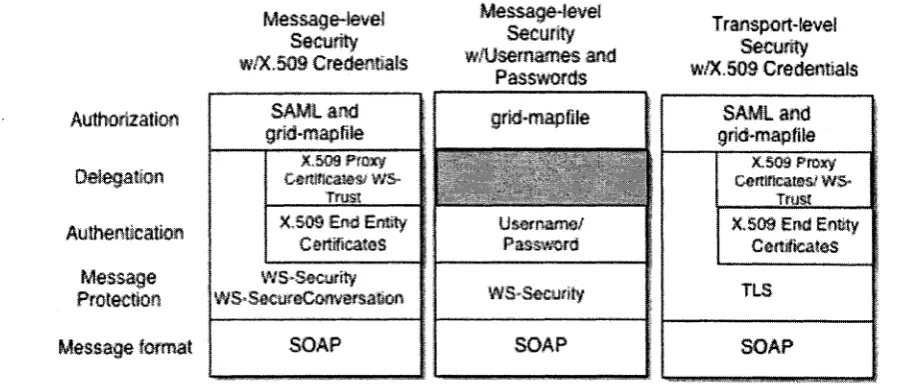
The GSI provides four distinct functions. All of which deal explicitly with the security
aspect of grid systems. These include [Globus2005]:
1. TLS (transport-level) or WS-Security and WS-SecureConversation (message
level) are used as message protection mechanisms in combination with SOAP.
2. X.509 End Entity Certificates or Username and Password are used as
authentication credentials
3. X.509 Proxy Certificates and WS-Trust are used for delegation
4. SAML assertions are used for authorization
All of these functions are absolutely essential to the proper security of any grid system.
grid-map file as well as SAML for the authorization aspect of the GSI. Both of these will
be discussed in more detail later in this thesis.
Authorization Delegation Authentication Message Protection Message format
Figure 1: Security layout of the Grid Security Infrastructure (GSI)
Message-level Security w/X.509 Credentials MtessagaHevei Security w/Usernames and Passwords SAML and grid-map file x.509 Proxy ws-Trusi X.509 End Entity
Csrticatas WS-Security WS-SecunsConversation SOAP grid-roapfite . W Sm M m M M
Username/ Password WS-Security SOAP Transport-level Security w/X.SOi Credential SMIL and grid-mapflle
X.509 Proxy
Cenmcawsrws- TrusJ X.509 End Entity
Certificates
TLS
3 Literature Review and Related Work
In this chapter we review the relevant research literature. Our focus is on complete
authorization systems and approaches that serve as a foundation and comparative basis
for developing an augmented system as described later in this thesis. We conclude the
chapter with a critique of current problems and limitations of existing authorization
systems and approaches and, thereby, provide a foundation for the approach described
later in the thesis.
3.1 Authorization Systems
Several systems have been proposed to accomplish authorization in distributed
environments. Though all of these systems share at least something in common to our
system, they were designed with different goals in mind. Thus, our system is intended to
augment other existing systems, not replace them entirely.
3.1.1
Akenti (1999)
The Akenti system was developed under a grant from the Department of Defense (DOE)
at Lawrence Berkeley National Laboratories by Mary Thompson, William Johnston,
Srilekha Mudumbai, Gary Hoo, Keith Jackson, and Abdelilah Essiari. Akenti is an
authorization system which supports “multiple, independent and geographically dispersed
stakeholders” [Thompsonl999]. These stakeholders state their access requirements in
certificates known as use-condition certificates and define those trusted to confirm the
satisfies all the requirements. Once Akenti has all the necessary certificates, it returns
control of the access decision to the server (resource) [Thompson1999]. The resource
server then acts on that decision to allow/deny access to the resource on behalf of the
client. Akenti is a PKI based system, and thus to operate within Akenti, a user must have
an X.509 public key certificate (PKC) at authentication time. Further, “Akenti policies
are hierarchical and distributed between proprietary Policy Certificates and Use-
Condition Certificates” [Thompsonl999]. The main focus of Akenti is classical
discretionary access control lists. Akenti always replies with a Capability Certificate, that
states what a user is authorized to do [Thompson1999].
3.1.2 Certificate Based Authorization Simulation System (2001)
CBASS is a system which was developed by Jie Dai and Jim Alves-Foss from the Center
for Secure and Dependable Software at the University o f Idaho. Within CBASS, an AC is
used for both authentication and authorization. A user’s certificate is the vehicle chosen
to carry policies and capabilities, specified via java/prolog [Dai2001]. Note that there are
two types of certificates (policy and credential). CBASS also supports anonymity and
Discretionary Access Control lists (DAC) [Dai2001].
The client, better known as the requester initiates a resource access request by asking the
server (responder) for a credential template which indicates the necessary credential
certificates to authorize the request [Dai2001]. After the template has been received, the
client performs certificate discovery, including a local search of its own certificate
database [Dai2001]. This is followed by credential retrieval from other external objects
request [Dai2001]. The server verifies the credentials against its policies and decides
whether to acknowledge permission or to deny the request.
3.1.3 MAFTIA1 (2001)
MAFTIA was developed in France at LAAS-CNRS by Noreddine Abghour, Yves
Deswarte, Vincent Nicomette, and David Powell. It supports an authorization scheme that
can grant each user the appropriate access rights, while only distributing the credentials
and information needed to execute its own task [Abghour2001]. MAFTIA employs an
authorization server for the granting or denying rights. If a complex operation is
authorized, the server distributes the necessary credentials/capabilities for all the
individual basic operations that are needed to carry it out [Abghour2001]. On each host, a
security kernel performs the necessary tasks for fine-grain authorization. To ensure that
the security kernels on off-the-shelf computers connected to the Internet are adequately
protected, critical parts of the security kernel will be implemented on a Java Smart Card
[Abghour2001].
3.1.4 CAS (GT4) (2002)
The Community Authorization Service (CAS) is a trusted third party server that is
responsible for managing the various necessary policies which govern access to a
community’s (Virtual Organization, VO) set of shared resources [Welch2002]. It was
developed in collaboration between various institutions. The principal participants
include Laura Pearlman, Von Welch, Ian Foster, Carl Kesselman, and Steven Tuecke.
The CAS server contains individual entries for Certificate Authorities, users, servers and
resource or resource group that specific permission is granted on, and what rights that
permission entitles the user or group to [Pearlman2003]. CAS employs the notion of
restricted proxies, which are built from a credential format that is designed to be neutral
to the actual policy language employed [Pearlman2003]. An access request is made to the
CAS server and if granted, a proxy is returned which contains the appropriate
permissions to access the resource in question. Note that CAS can support various
arbitrary policy languages such as Controlled English [Bacon2001], ASL [Jajodial997],
or Ponder [Damianou2001].
3.1.5 KEYNOTE (1999)
Keynote was developed by Matt Blaze, Joan Feigenbaum, and Angelos D. Keromytis at
AT&T Labs in 1999. Keynote in three words is a Trust Management System. It uses
credential assertions to denote what actions can be done and who may perform them
[Blaze 1999]. Signature verification is build into the system. The assertions are based on
human readable syntax [Blaze 1999]. Keynote uses a very simple notation for specifying
policy and credentials. Each trusted action is described by a simple attribute/value pair
[Blaze1999]. Each application can define its own set of attributes which require
application specific credentials to operate on them [Blaze1999].
3.1.6 PERMIS (2002)
Permis is a Java based authorization system developed by David Chadwick and Sassa
Otenko at the University of Kent in the UK. It consists of a custom language to define
actions, users, policies, and credentials as well as a compliance checker which is invoked
built in accordance to the latest X.509 standard [Otenko2003]. Permis leaves the
mechanisms for authentication up to the application. The Permis policies are written in
XML and are contained within one X.509 Attribute Certificate (AC) [Otenko2003]. The
system also has implemented role based access controls which recognize separate
hierarchies for authentication (CAs) and authorization (stakeholders) [Otenko2003].
Once the appropriate credentials and policies are retrieved, the compliance checker
makes an access decision which is a simple yes or no. Unfortunately, Permis has no
ability to return Capability Certificates [Otenko2003].
3.1.7 CARDEA (2003)
CARDEA is a product of Rebekah Lepro at NASA’s Advances Supercomputing
Division. It is a system which dynamically evaluates relevant characteristics of the
resource and requester when processing all requests for access instead of considering
specific local identities (not unlike grid-map) [Lepro2003]. Shared resources within an
administrative domain are protected by local resource access control policies. All users
are identified by X.509 proxy certificates and are then modeled according to individual
characteristics [Lepro2003]. The necessary information needed to complete a decision is
determined and collected during the decision process [Lepro2003]. Once all necessary
information has been collected, it is presented to the policy decision point (PDP) for an
access decision [Lepro2003]. From a conceptual point of view, Cardea “contains a
SAML Policy Decision Point (SAML PDP), one or more Attribute Authorities (AA), one
or more Policy Enforcement Points (PEP), one or more references to an Information
3.1.8 FIDELIS (2003)
Fidelis was developed by Walt Teh-Ming Yao for a PhD. at the University of Cambridge
in 2003. It is a decentralized framework for trust management [Yao2003]. It specifies the
necessary mechanisms for defining and managing trust information. It defines principals
and policies which define the “who” and the “what” o f a particular access decision
[Yao2003]. Trust conveyance is the major concept within Fidelis, and is used to specify
what a specific principal (subject) is trusted to do and who trusts the principal to do the
specified actions [Yaoo2003]. This trust is specified using custom policy language
statements. Fidelis also makes use of modified x.509 certificates which contain the
required attributes. Fidelis is a web service platform which enables communication
between complete strangers via third-party assertions and Role Based Access Control
(RBAC) [Yao2003].
3.1.9 HP HSA (2003)
This paper presents a distributed authorization model which is appropriate in a web
service scenario where multiple stakeholders are involved in performing a particular
action [Mont2003]. This model uses a third party authorization service to compare
specific credentials with a set of authorization policies [Mont2003]. The authorization
model is built in such a way to enable authorization policies to be checked and built as a
component of the web service composition process [Mont2003]. The major factor which
makes this architecture different from others is its reliance on a hardware security
3.1.10 CONTEXT SENSITIVE (2003)
Context Sensitive authorization is a Role-Based Access Control (RBAC) form of
authorization. In this system, authorization is derived dynamically within specific
contexts [Mostefaoui2003]. More specifically, context-based security tries to adapt the
security policy according to relevant information which has been collected from the
dynamic runtime environment [Mostefaoui2003]. As the context of a particular action
changes, so may the authorization decision. Users which operate under this type of
authorization are consequently mapped to roles based on their credentials and associated
competencies [Mostefaoui2003].
3.1.11 TERA (2004)
Trust Enhanced Role Assignment (TERA) is an authorization system developed by
several individuals at Purdue University in 2004. The main principals include Bharat
Bhargava and Leszek Lilien. TERA is a Java framework which is based on uncertain
evidence and trust which is determined dynamically [Bhargava20004]. TERA evaluates
the trust of a user directly based on their behaviors. The system will then decide “whether
a user should be authorized for an operation based on the policies, the evidence, and the
degree o f trust” [Bhargava2004]. The reliability of the evidence is derived from the trust
of the evidence provider [Bhargava2004]. A third party service, known as a reputation
server, is responsible for managing the trust information. TERA makes use of two
algorithms, which have been developed to determine a user's trust value based on a
3.1.12 IBM TE (2004)
IBM Trust Establishment (TE) is a Java based, trust management tool which can be used
to create trust relationships between strangers using their PKC [Ibm2004]. Rather than
local account mapping based on a unique id, TE can determine a user’s role(s) by their
X.509 certificate [Ibm2004]. Though X.509 certificates are the most commonly used
certificates, other certificate types are also supported. Note that this system is not
responsible for making any access decisions, instead it provides user to group/role
mappings, based on PK [Ibm2004].
3.1.13 Shibboleth (2004)
Shibboleth is a system which is intended to properly secure access to web-based
resources under the Single Sign On (SSO) paradigm of access control [Morgan2004]. It
has been designed in such a way to allow various federations and collaborations to extend
their identity management systems (and PKI) to work together in partnerships, while
always protecting the privacy of user’s at individual sites [Morgan2004]. This scalable
architecture predominantly performs attribute based authorization using the Security
Associations Markup Language (SAML). To accomplish these tasks, Shibboleth employs
both a Shibboleth Identity Provider (IdP) and a Shibboleth Service Provider (SP)
[Morgan2004]. Typically a user will sign on to their local IdP which authenticates the
user and returns a SAML assertions stating that the user has logged in. This assertion can
then be sent to other sites within the collaboration to enable access without repeating the
3.1.14 VOMS (2004)
VOMS is an authorization system which is similar in nature to CAS. It provides an
authorization capability in the context of Virtual Organizations. It is composed of several
parts which include a user server (manages and returns information about users, including
their certificates), the user client which accepts a user’s certificate and returns a list of
groups, roles, and capabilities, the administration client which enables management of the
overall system, and the administration server which handles the requests from the
administration client [Alfieri2003]. Authorization requests are accompanied by the
appropriate capabilities which will enable access to a specific resource.
3.1.15 PRIMA (2004)
The Privilege Management (PRIMA) system was developed as a PhD. thesis by Markus
Lorch from Virginia Polytechnic Institute and State University in 2004. The Prima model
consists of the necessary components to define a fine-grained authorization framework
for distributed systems [Lorch2004]. These components include “a high-level privilege
management model, an incremental user-centric trust model, and a dynamic model for
authorization and enforcement” [Lorch2004]. Within Prima, all access rights are granted
in the form of a privilege, which are secured using the proper mechanisms to prevent
theft/tampering. These privileges are specified in a platform-independent policy
language, with a limited lifetime, and can be delegated to other users [Lorch2004].
3.1.16 WS AA Authorization Framework (GT4) (2006)
The Authorization framework in Version 4 of the Globus Toolkit (GT4) provides many
accomplished by several different mechanisms [Globus2005]. These authorization
methods include a module which supports the typical gridmap based authorization, access
control lists, SAML assertions, and others [Globus2005]. The AA framework also
supports delegation.
3.1.17 General System Comparison
There are other systems which also address some aspects of authorization in distributed
environments. Any system which makes use of the Globus Toolkit (GTK) makes use of a
grid-map file and Security Associations Markup Language (SAML) assertions in varying
degrees, for authorization [Globus2005]. Such systems require accounts to be created
prior to job execution. Though the possibility o f a set of local generic accounts for
unknown entities would solve this problem, it is undesirable from several viewpoints,
including accounting. The Akenti Authorization System provides a mechanism for a finer
degree of specification of authorization rights from multiple owners [Thompson2003].
Shibboleth, a SAML-based authorization framework, provides a mechanism for
combining attribute information of known entities from multiple resource sites for the
purpose of an access decision [Morgan2004]. VOMS and CAS have been developed to
provide authorization on the basis of Virtual Organization (VO) membership, which
enhances scalability, but still requires the manual configuration of trust relationships and
VO memberships [Welch2002, Pearlman2003, and Cecchini2004] respectively. IBM
Trust Establishment (TE) uses Role Based Access Control (RBAC) to provide
authorization on roles rather than individual users [Ibm2004]. This is more scalable, but
arguably, still not scalable enough. Several other systems were also researched and
3.2 Methods of Authorization
All architectures considered in this thesis research make a significant contribution to the
problem at hand. Further, the culmination of these other systems could achieve the end
goal of functional authorization with little to no administrative overhead in a scalable
manner. It is the goal of the AASUR architecture not to combine all features o f these
other systems; rather, to combine the necessary aspects to achieve the desired end. All
systems that were compared were considered from several points of view. These include:
1. Authorization Type (Cl)
2. Architectural Features (C2)
3. Implementation Details (C3)
4. Arbitrary Entity Support (C4)
3.3 Comparison 1: Authorization
From Figure 2 we see that the majority o f the systems tested involved some type of third
party assertions. This means that some type of pre-established trust relationships must
exist. Also, we can see that Attribute Certificates (AC) and/or capabilities are commonly
used to specify what rights a particular user has [0pplinger2000]. The problem with the
AC/Capability is that the access specifiers must exist within the AC or capability, prior to
a job request. These specifiers may also take the form of access tickets which have been
granted to a user or have been delegated to another user. These specifiers must be
associated with sites that we have already established trust with. The access level is not
determined dynamically. Within many o f these systems, RBAC is employed as it is
The most important aspect of this table is the reputation column. Notice that only one
other system makes use of some type of reputation to perform the access decision. Please
note that although several of thee system may operate within the context of Globus and
the notion of map files, the do not rely on map files natively, unless specified in the
Figure 2.
Figure 2: Authorization Comparison
3.4 Comparison 2: Features
Figure 3 illustrates various features including what type of policy languages the system
supports to define access rights to its resources, whether or not the system operates in the
context of a public key infrastructure (PKI), and whether the system supports multiple
stakeholders, anonymity, and delegation. Several of these features are considered
essential in this type of environment, while others are simply features albeit very useful
ones.
From Figure 3 we see that almost every system is PKI based, and that most also support
delegation. Delegation is useful for sharing access rights to trusted users, but it is not
REPUTATION ASSERTIONS MAP FILE ATTRIBUTE CERTIFICATES CAPABILITIES RBAC
AKENT1 -2000 X X X
CBASS - 2001 j ... X ... X
A F n A i - M o t L I * ' ' X
CAS (GT4}-2002 X x
KEYNOTE-2002 X : x
PER M IS-2002 i T x X
CARDEA-2003 . X ... ! x x
FIDELIS - 2003 i X ...[... ...X L . HP HSA - 2003 ...x '
'
... r ... . x ... ...
CONTEXT SENSITIVE- 2003 X
TERA-2004 X X X
IBM TE - 2004 ! X
SHIBBOLETH - 2004 X ■ x
VOMS - 2004 X X
PRIMA -2004 ! .. x
included within AASUR at this stage of design/development. Note, however, that it could
be included in the future. We note that there is a wide range of policy languages which
are supported by the various systems. More than half of the systems make use of a
custom policy language which is a detriment to interoperability. This means that every
site must now use the specific custom policy language in order to interact. A couple of
systems, including AASUR, are completely policy language independent, meaning access
policy specifications can be presented in different languages at each site. This is due to
the fact that only the site which makes the access decision and generates the access ticket
will have to understand it. Finally, anonymity is the least important attribute in this table.
Though it has a place in some use cases, typically we want each user to be held
accountable for their actions; knowing who they are helps to ensure that no malicious
actions take place. It also provides a way of enforcing certain actions if any rules are
broken. Most systems do not support anonymity. Note that both FPL and TPL are custom
policy specification language developed specifically for Fidelis and IBM TE respectively.
ACCESS POL. LANG i PKI MULTIPLE STAKEHOLDERS ANONYMITY (DELEGATION
AKENTI-2000 ! CUSTOM YES X509 1 X
CBASS - 2001 (PROLOG YES CUSTOM ! ( ' X X
MAFTIA1 - 2001 : CUSTOM YES CUSTOM ( ( ' " ! X ! X CAS fST4j - 2002 (in d e p e n d e n t •YES. X509 X
KEYNOTE -2002 (c u s t o m YES X509 I X
PERMIS-2002 (c u s t o m YES INDEPENDENT !... ( X / X CARDEA-2003 XACML YES XS09
FIDELIS-2003 (FPL (YES, CUSTOM ( X (((" ' X... H PH SA -2M 3 (CUSTOM (Y£S( X509... j ...X
CONTEXT SENSITIVE- 2003 (CUSTOM (NO im pl
TERA -2004 (CUSTOM (YES.X509 X
IBM T E - 2004 (TPL (YES. X509
SHIBBOLETH-2004 (in d e p e n d e n t (YESC XS09 X, limitwi VOMS - 2004 (in d e p e n d e n t lYES, XS09. via GT4 I 1 X. via globus PRIMA-2004 (c u st o m (YES( X509 i ...x r ! X... IWS AA AL1THZ (GT4) - 2006 i CUSTOM (YES. X509 ! x " _'
3.5 Comparison 3: Implementation
\
The implementation comparison involved which language was used (if implemented at
all), whether or not the system was web service based, and whether or not it relied on any
type of external servers other than Certificate Authorities (CA) (as nearly almost every
system needs at least one CA). Figure 4 illustrates this comparison appropriately. Most
systems are implemented in Java, due to its security model and web capabilities. The
performance of Java has been under attack by many, but it is in fact very close to C++ in
many ways. Note that nearly all systems need some type of external server which will
increase the overall message transfer time requirements, thus hindering performance.
Finally, due to the shift in design paradigms towards web services, most of these systems
have been implemented in such a way which exploits web services.
.JAVA" OTHER LANGUAGE THEORY / NGTIfsIPl. SERVICE BASED" EXTERNAL SERVERS
iAKENTl-2000 ! X x :
jCBASS - 2001 X
IMAFTIA1 -2001 X ... x'... ..
;CAS (GT4| - 2002
iKEYNOtE-2002 i x ! X I X
" X ' x ... J
PERMIS-2002 : X ... X ... :
CARDEA - 2003 ; X ... X " X ;
iFIDEUS - 2003 X X X I
lH PH SA -2003 : X ■ ... X x :
ICONTBCT SENSITIVE- 2003 X X
ITERA - 2004 : X x T
jIBMTE -2004 ■ X
! SHIBBOLETH - 2004 X A : X
VOMS - 2004 " x :' X . ’A . A A x A . . . . ; PRO lA - 2004 X
v S AA AUTHZ (GT4) - 2006 1 * A I T . A
Figure 4: Implementation Comparison
3.6 Comparison 4: Arbitrary Entities
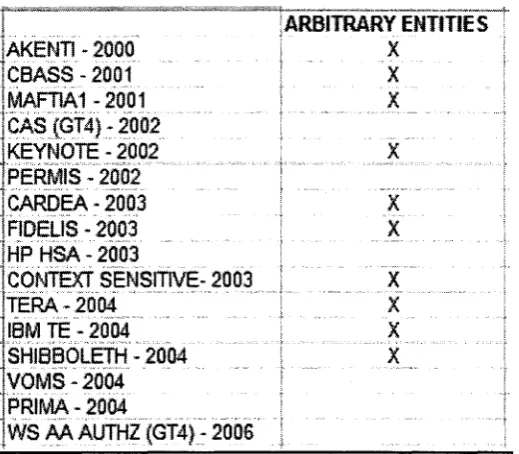
The meaning of arbitrary entity support is straightforward. Supporting arbitrary users
means that the system has the capability to allow an unknown user (that is, with no prior
however, a caveat (in general and specifically directed to Figure 5). Technically, this
includes knowledge of a user both directly and indirectly. If a user is trusted (but not
known) through another site, there is still a requirement for pre-established trust. The best
way to ultimately make a system scalable from an administrative overhead point of view
is to ensure that a site does NOT require ANY direct or indirect knowledge of a user. In
that scenario, the reputation is the only contributing factor to the access decision.
'AKENTl 2000 CBASS 2001 MAFTIA1 -2001 CAS (GT4) - 2002 KEYNOTE - 2002 PERMIS - 2002 CARDEA-2003 FIDELIS-2003 HP HSA-2003
CONTEXT SENSITIVE-2003 TERA -.2004
IBM TE - 2004 ... SHIBBOLETH-2004 VOMS-2004 PRIMA-2004
WSAAAUTHZ{GW)-2Q06
[ARBITRARY ENTITIES
1 X
I X
I X
X A
x'
x
x XFigure 5: Arbitrary Entity Support
3.7 Authorization System Comparison Summary
As with any new development many issues have come to light. Most have been very
minor, but one major issue came up. The solution to the main issue involved striking a
balance between the amount of information kept which will severely affect the certificate
resource sites to determine who may have access to their resources based on their past
actions. In the end, we have gone with a minimalist approach to ensure unlimited scale.
The closest match to AASUR is the TERA (Trust-Enhanced Role Assignment) system
[Bhargava2002]. Though TERA encapsulates ideas, similar to AASUR, it has several key
differences. First, the reliability of the evidence is based on the trust of an evidence
provider [Bhargava2002]. This implies that evidence may come from a third-party source
and be potentially less reliable. Our system maintains a globally consistent representation
of an entity’s past, which allows a resource site to make an access decision based on a
local interpretation. Secondly, TERA relies on a separate reputation server to manage
user reputation [Bhargava2002], whereas we store the actions an entity has performed in
its PKC, managed by a Certificate Authority (CA). In AASUR, the reputation is
calculated using local processing power to maintain scalability. Finally, whereas our
architecture has been developed as a web service, TERA is an application based system.
In this chapter we have critiqued several approaches and systems for authorization
presented in the literature. In the next chapter we introduce a system that augments the
4 Augmented Authorization System Using Reputation
In this section will give a detailed description about our system, the Augmented
Authorization System Using Reputation (AASUR). At the most general level, the main
contribution of this architecture is the notion of providing authorization on the basis of
points which are collected in a standardized way, and which in turn may be used by
individual resources to determine reputation. The only guarantee that this architecture
makes is that points will be collected consistently for accepted actions. Any decision that
results in a breach at a resource site is completely the responsibility o f the resource site
that misinterpreted the points presented at the time of resource request. There is no
requirement to obtain or analyze any assertions from any third party though, in the future,
this capability could be exploited to enhance this system further. From an administrative
point of view, there is no need to establish anything prior to a job request/allowance.
Though these features may exist in other systems individually, this combination, and
consequently the overall ability of the system, does not exist anywhere else to the best of
our knowledge.
4.1 Justification
The reason for this architecture is simple. If the current notion of the “grid” is to reach a
level where the masses are able to use/sell spare cycles on a global scale (not unlike
selling power back to the grid) then minimally, from an administrative point of view,
changes needed to occur. Scalability in current systems is, without a doubt, a hindrance to
this goal. O f course, this architecture (AASUR) is not the end solution, but it is a step in
4.2 Overall Architectural Comparison with AASUR
Although all of these previous comparisons are valuable in and of themselves, an active
comparison of the most important characteristics which AASUR possesses is also
needed. This can be found in Figure 6. This table takes the most important aspects of the
AASUR system, and shows how the other systems compare to it. Although many systems
show some similarities in various categories, none provide the complete set which
AASUR does, including support for reputation. The details regarding the inner workings
of AASUR will be dealt with next in Chapter 5.
RepBAC RBAC FLEX POLICY PKI JAVA SERVICE B A SH ) EXTERNAL SERVERS i
AASUR - 2006 X x ! INDEPENDENT 1X509 X ... X
CAS (GT4J - 2002 X 'i n d e p e n d e n t X509 X ... X ' x ...!
PERMIS - 2002 X i CUSTOM Y E S IND. X X
CARDEA-2003 1XACML X509 "X ...X X
FIDELIS - 2003 X 'FPL ;YES. CUSTOM X X
TERA - 2004 * X CUSTOM X503 r x X
SHIBBOLETH-2 0 0 4 X INDEPENDENT ■X509 X
V O M S -2004 X INDEPENDENT X509. via GT4 f 7 x ... “ ’ “ j r . X ...
Figure 6: Overall Architectural Comparison
4.3 Problem Statement
We have introduced existing tools, components, and systems which are used as parts of
complete authorization systems. We have also discussed the various systems which have
been created to solve problems with the current state of authorization. Further, we have
defined the major characteristics of our system, AASUR, and provided a comparison of it
alongside the other existing systems. We will now define clearly what the current
problem is and how we intend to overcome it.
1. The requirement for pre-established trust among user-to-resource and resource-
to-resource (in the case of delegation of credentials), is not feasible due to the
administration overhead.
2. Further, scalability in general due to the pre-established trust, is significantly
hindered, which results in limited scale for any architecture which mandates
pre-established trust.
3. Many existing systems require the use o f a particular policy language which
creates the need for every site to use a specific policy language.
4. Though many systems are Web Services based, some are not. Evolution in
current distributed computing certainly requires an architecture which is based
on Web Services.
With this background information, and the comparison o f exiting systems, we state the
following:
The current requirement fo r pre-established trust, the lack o f consensus fo r the
use o f web services, and the specific requirements f o r policy languages are a
detriment to the overall adoption o f the various authorization schemas in
existence. This is not only due to the significant overhead, but also due to the lack
o f flexibility inherent in existing systems. We present a solution to this problem
using the AASUR architecture, which w ill achieve what other systems have not.
We accomplish this through the use o f reputation metrics which allow individual
resource sites to make authorization decisions without having any prior
resource access policy language thereby providing much flexibility to individual
resource sites.
Through various simulations and consequent numerical results we show that AASUR
contends well in distributed authorization from a performance point of view and also
from an administrative overhead point of view. We show also that AASUR does in fact
5 AASUR
AASUR was developed to solve the problem discussed throughout Chapters 3 and 4. It is
written in Java and its functionality is exposed as web services described by WSDL
documents. All messages and formats are XML based. It can be deployed to any
application hosting environment, but must be used alongside EJBCA, an Enterprise Java
Bean Certificate Authority. They (AASUR + EJBCA) have all of the necessary
components to retrieve certificates, request resource access, perform authorization
decisions, collect job actions, and update a user’s certificate to reflect newly performed
actions. Of course, there are several components which are needed to support these
critical tasks as well. All of this will be discussed in detail further on in this paper.
5.1 Design Context
The context which this architecture was developed within is very straightforward. The
major goal was to develop a system in which automated discovery and authorization
could occur. Existing systems provide other aspects of automated discovery. In fact other
systems provide automated authorization, but in the context of pre-established trust and
local accounts with rights setup prior to authorization/execution. The AASUR system has
been developed within the context of automated authorization without any pre-
established trust, and very minimal administrative overhead at any participating site. The
goal of AASUR was to provide not only automated authorization, but also automated
collection of a user’s history, which would allow for this authorization to take place with
5.2 Design Methodology
The methodology that was followed was simple. It started with isolation of specific
characteristics within current systems which would prevent the goals of this architecture
from being realized. Several issues were very quick to surface, and are as follows. First,
the requirement for existing accounts to exist which provide a mapping to locally defined
rights, although functional, were not conducive o f an architecture which could scale
easily. Second, although a possible solution to the previously mentioned issue, the notion
o f shared accounts at resource sites does increase scalability, but eliminates any
possibility of maintaining an individuals actions or providing any kind of accounting or
non-repudiation. Third, though receiving assertions from other trusted sources enables a
site to use some combinational logic to determine a best action, it is still subjective to
some to degree. This may require some clarification, as this (AASUR) approach also is
subjective in some ways. The major difference is that this architecture is subjective with
respect to the resource sites decision for access, not the collection or portrayal of a user’s
reputation. Finally, many systems lack flexibility when it comes to the decision of
whether or not access will be granted. This should always be left completely up to the
resource owner.
The goals then of AASUR are the converse of these issues found within distributed
authorization systems. Once these initial goals had been established it was time to begin
designing the system. From the outset we wanted to develop a set of metrics that would
allow the storage of a fairly detailed history which could be used to derive a user’s
what a user could potentially do (both good and bad) during the execution of a job. The
specific details regarding these categories will be discussed in the Section 5.4.
Once the point categories were determined, we began designing how and what else would
be stored. Always, the maintenance of the highest degree of resource site flexibility was
constant. For example, we wanted an individual resource site to be able to deny a user
because that user had performed a Buffer Overflow (BOF) at Site X on May 3, 2007 at
6:03 pm.
Our initial format to represent a user’s reputation is as follows:
<? xml v ersio n -1.0' encoding-ISO-8859-11 ?> <reputation>
<collection type-LFC'>
<site shal-A123A3E4B32CD3E2145CC32DDEF4A123A3E4B32C'> <date>
1158654532123 </date>
<date>
1156785432345 </date>
</site>
<site shal-45CC32DDEF4A123A3E4B32CD3E21F678A3B5C332'> <date>
1165434567897 </date>
<date>
1124567543567 </date>
</site> </collection>
<collection type='LMO'>
<site shal-D3E21F678A3B5C33245CC32DDEF4A123A3E4B32C'> <date>
2232357889764 </date>
</site> </collection> </reputation>
This format allows for several things. First, everything is broken down into point
categories, so that the act of summing them to make the necessary calculations is more
efficient. Second, within each category the occurrences are divided up by location so that
if a user has ever been involved with a specific resource site, the points earned from those
interactions can be quickly ignored. Third, the absolute date/time in milliseconds has
been recorded to allow for maximum flexibility with respect to filtering of actions based
on date and time. There was one caveat however, to this design. Due to the detail which
was kept in this format, the overall scalability could be an issue. This was not only
because an X.509 certificate was not meant to store a lot of extra information, but simply
because o f the scale of information that would be involved.
The initial testing was strictly intended to determine how scalable this particular setup
would be. This involved creating one certificate (to represent an individual user) and
begin running some simulated jobs to see how a certificate would handle the reputation.
The job simulator, which is discussed in detail later (5.7.9), has the ability to configure
the percentage of good actions which are generated as well as the percentage of bad
actions generated. Initial testing involved a 90/10 split (good/bad). I generated 100
actions (corresponding to random point categories) for each job. I decided to make the
first run consist o f 1000 jobs, for a total of 100,000 actions, including a date for each one