IOT Based Smart Garden
Dr.R.M.S.Parvathi[1], K. Bala Bharathi[2], D. Devimala[3]
[1]
Professor & Head/CSE, Department of Computer Science and Engineering, Sri Ramakrishna Institute of Technology,
Coimbatore, TamilNadu, India
[2]
Final Year CSE, Department of Computer Science and Engineering, Sri Ramakrishna Institute of Technology,
Coimbatore, TamilNadu, India
[3]
Final Year CSE, Department of Computer Science and Engineering, Sri Ramakrishna Institute of Technology,
Coimbatore, TamilNadu, India
ABSTRACT: The eternal need of every human being in this world is oxygen. Plants play a vital role in maintaining the carbon dioxide and oxygen content in the air. Number of plants are being destroyed each and every day for urbanization process. The number of plantings made is also reduced. Apart from these things more plants die due to lack of maintenance. IoT allows objects to be sensed and controlled remotely across existing network infrastructure, creating opportunities for more direct integration between the physical world and computer – based systems , and resulting in improved efficiency , accuracy and economic benefit. As water supplies become scarce and polluted, there is an urgent need to irrigate more efficiently in order to optimize water use to support green environment. The sensors gather and analyse data about changing weather, soil moisture, humidity conditions.
The main aim of this project is to maintain the nature of the plants by continuously monitoring the parameters leading to the increased life of both plants and human beings. The automatic systems are preferred to a manual system.
KEYWORDS: IoT; smart ; garden;
I.INTRODUCTION
Automation rules the world nowadays. It is a technique of using computers or mobile phones in monitoring and controlling the simple parameters of day to day life. The standard of our life will be nourished by the practice of using automation for simple things. Using the concept of IOT we make sensors to communicate with each other which are powerful in automation. The important aspect of this prototype is that it saves cost and ensures safety. When people try to make plantings and set up their own garden, they were cautious in maintenance at only in their beginning stages. As days go on due to lack of maintenance the plants get destroyed. The Internet of Things can offer a feasible solution to this. The garden can be modernized with electronic technology that continuously monitors the conditions of plants and soil, so the plants could be provided watering and shade as required. All of this can be controlled and monitored online with the application of IoT.
1.1 INTERNET OF THINGS (IoT)
Internet of Things (IoT) is an ecosystem of connected physical objects that are accessible through the internet. It is a system of interrelated computing devices, mechanical and digital machines, objects or people that are provided with unique identifiers and the ability to transfer data over a network without requiring human or human-to-computer interaction. It includes traditional computing devices such as laptops, tablets and smartphones, but also includes a growing list of other devices that have recently become internet enabled. Examples include home appliances, automobiles, wearable electronics, security cameras and many other things. In order for a device to be part of the Internet of Things, it must be able to communicate with other devices. Therefore, it requires some type of built-in wired or wireless communication. Most IoT devices are Wi-Fi enabled, but Bluetooth can also be used to transfer data to nearby devices. IoT devices are commonly called “smart devices”, since they are able to communicate with other things. Along with the capacity to communicate, many IoT devices also include an array of sensors that provide useful information. While the Internet of Things is still in its infancy, it provides promising opportunities for the future. In time, the Internet of Things will become less of an abstract idea and more of a way of life.
1.2 IMPORTANCE OF IoT 1.2.1 Communication:
IoT system increases and encourages machine to machine communication (also known as M2M). Because of this ingenious innovation, physical devices stay in touch with one another leading to greater efficiency and higher quality. It also allows full transparency.
1.2.2 Automated:
Due to the overall wireless infrastructure of these smart devices, it requires little to no human intervention, being able to pretty much operate on their own. This allows for greater control and automation leading to more operating efficiency.
1.2.3 Information:
IoT systems have allowed a greater flow of information which in turn allows people to make better decisions. It can be as simple as informing you that you are out of groceries to more complicated decisions at work. As people say knowledge is power! The systematic use of information also allows you to save time and work in an effective manner.
1.2.4 Money:
1.2.5 Use of IoT in different systems:
Using IoT in systems such as healthcare or security can generate excellent results. For instance, by implementing chips in patients, doctors can monitor their patient’s vital signs and respond immediately in case of an emergency. Moreover, it can increase monitoring patients at homes, allowing for more free space in hospitals for serious cases. In case of security, police can use the IoT system to monitor the street cameras and improve the law and order.
1.2.6 IoT systems in businesses:
IoT systems would prove to be extremely advantageous for businesses; it would allow them to monitor consumer trends and respond to the demand changes in a timely manner. This could lead to greater sales which lead to greater profits and revenues.
1.3 Applications: 1.3.1 Wearables:
Wearable technology is a hallmark of IoT applications and probably is one of the earliest industries to have deployed the IoT at its service. Fit Bits, heart rate monitors and smart watches are the most commonly used wearable these days. Wearables includes the Guardian glucose monitoring device. The device is developed to aid people suffering from diabetes. It detects glucose levels in the body, using a tiny electrode called glucose sensor placed under the skin and relays the information via Radio Frequency to a monitoring device.
1.3.2 Smart City:
Most cars on the streets go around and round the same block, in search of parking spots. That’s the main reason for traffic congestion in the city. Thus, sensors are installed at all the parking spots around the city. These sensors pass the occupancy status of each spot to the cloud. Any number of applications can consume that data. It can guide the drivers through the shortest route to an open spot.
1.3.3 Industrial Automation:
Industrial automation is one of the most profound applications of IoT. With help of internet of things infrastructure backed with advanced sensor networks, wireless connectivity, innovative hardware and machine-to-machine communication, conventional automation process of industries will transform completely. Automation completely reduces the need for manual checking of various process parameters.
1.3.4 Smart Home:
II. THE PROPOSED SYSTEM REQUIREMENTS
This project has been implemented with the motive of to maintain the nature of the plants by continuously monitoring the parameters leading to increased life of plants. The project deals with the automated temperature and humidity control and all the sensors used are available in the market. The different sensors are being used to maintain the nature of the plants. The system will continuously monitor the temperature condition of the room and the data can be monitored at anytime and anywhere from the Internet. A Mobile Application is developed and the data are stored in the database. An alert or notification is send to the user if the water level in the tank is low.
III. PROPOSED SYSTEM HARDWAE ARCHITECTURE
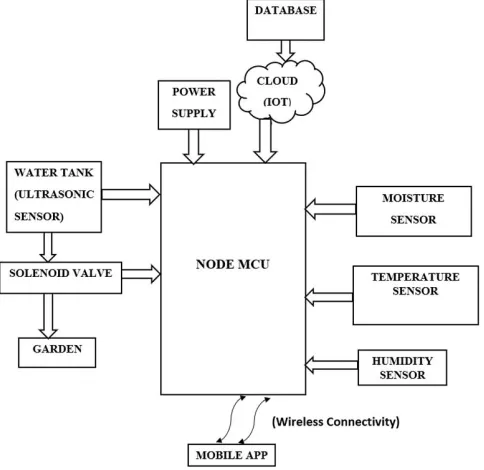
It usually consists of a central microcontroller to which other objects are connected. The smart garden consists of NodeMCU as a hub to which different types of sensors such as moisture sensor, humidity sensor, temperature sensor and ultrasonic sensor are connected. The ultrasonic sensor is connected to a water tank which indicated the level of water in the tank. Other sensors are connected to their respective positions and these sensors send the data to NodeMCU which consists of an inbuilt Wi-Fi technology.
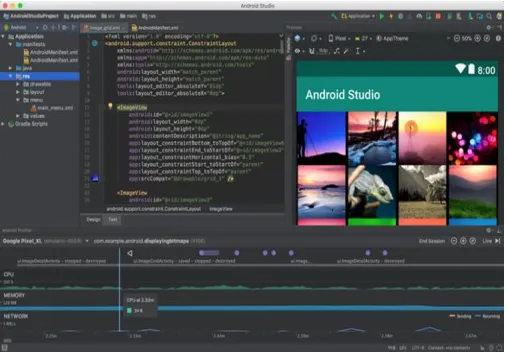
Android application is developed using android studio software. Within the software, the connectivity between the application and firebase will be made. So, the user can monitor the parameters from anywhere.
Watering of garden varies with the type of soil. Hence the values of the sensors are predetermined for automation purposes inside the software. Whenever the user finds need of watering the garden, a switch in the application will automate the process. This helps in complete maintenance of the garden.
Fig 3.2 Flowchart of the proposed System 3.3 Advantages of the proposed System:
• The system will continuously monitor the temperature condition of the room and the data can be monitored at anytime and anywhere from the Internet.
• The System monitors the water level in the tank. If the water level is low it sends an alert notification to the user.
• If the water level in tank is reduced to a minimum value then the motor switch is turned on automatically to the water level of the tank reaches the maximum value.
• The results show that the proposed system has good feasibility. It reduces the cost of monitoring system at the same time
• Its continuously monitor the moisture content in the soil.
• Its continuously checks the water level in the soil.
IV. SYSTEM SOFTWARE ARCHITECTURE 4.2.1 Ubidots
Ubidots time-series backend services are performance optimized for IoT data storage, computation and retrieval. Its application enablement platform supports interactive, real-time data visualization(widgets) and an IoT App Builder that allows developers to extend the platform with their own HTML/JS code for private customization when desired.
Figure 4.8 Ubidots platform 4.2.2. Android Studio:
Android Studio is the official Integrated Development Environment (IDE) for Android app development, based on
IntelliJ IDEA . On top of IntelliJ's powerful code editor and developer tools, Android Studio offers even more features that enhance your productivity when building Android apps, such as:
• A flexible Gradle-based build system
• A fast and feature-rich emulator
• Instant Run to push changes to your running app without building a new APK
• Code templates and GitHub integration to help you build common app features and import sample code
• Extensive testing tools and frameworks
• Lint tools to catch performance, usability, version compatibility, and other problems
• C++ and NDK support
Fig 4.9 Android Studio IDE
V. SIMULATION, IMPLEMENTATION AND TESTING 5.1 Overview:
The proposed system incorporates both hardware and software implementation. The Hardware implementation consists of the Arduino Atmega328, DHT11 Humidity and Temperature Sensor, Rain Sensor, Ultrasonic Sensor, Soil moisture Sensor, WI-FI module ESP8266.
The Software implementation consists of both the android app and web page. Javascript is used as a scripting language to display the output in a webpage.
5.2 Hardware implementation:
The hardware implementation requires an Arduino Mega. The humidity and temperature sensor, rain sensor, soil moisture sensor, ultrasonic sensor is connected with the arduino mega. The soil sensor used to measure the water content in the soil. The humidity and the temperature sensor continuously monitor the temperature. The ultrasonic sensor monitor the water level in the tank.
Programming the Arduino Uno:
STEP 1: Install Arduino IDE software in windows operatingsystem.
1. Figure 5.1 Creating a new Arduino Sketch
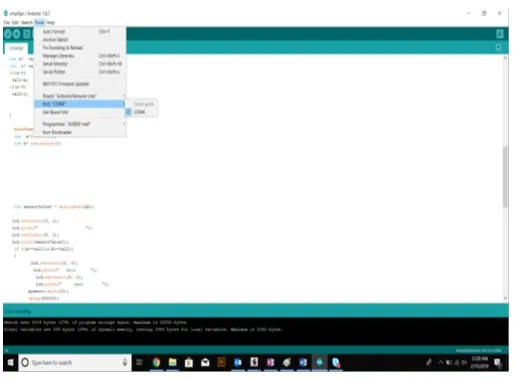
STEP 3: Select Arduino board type which is Arduino mega.Tools -> Board -> Arduino/Genuino mega
STEP 4: Select the Port to which the Arduino is connected which is COM4.
Tools -> Port -> COM4.
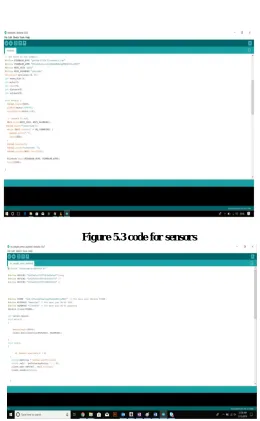
STEP 5: Insert the code.
Figure 5.3 code for sensors
Figure 5.4: Code for WiFi Module STEP 6: Use Upload option to upload the code to Arduino
Board.
Figure 5.5: Uploading the code to Arduino 5.3 Software Implementation:
The software implementation provides the creation of API.
Figure 5.6 first page
Figure 5.9 ubidots demopage
Figure 5.7 login page
Figure 5.10 Ubidots event page
VI. CONCLUSION
The implementation of IoT based smart garden has been verified to satisfactorily work by connecting different parameters of the soil to the cloud and was successfully controlled remotely through a mobile application and web page. The system designed not only monitors the sensor data, like moisture, humidity, temperature and ultrasonic but also actuates other parameters according to the requirement, for example, if the water level in tank is reduced to a minimum value then the motor switch is turned on automatically to the water level of the tank reaches the maximum value.
The initial cost and the installation of this system are cheap and hence it can be implemented anywhere. With the development of sensor technology, the system can be elevated to the next level which helps the users to utilize their investment in an economic manner. If soil nutrient sensors can be installed, then the system can be modified to supply fertilizers to the garden precisely. This system saves manpower and efficiently utilizes the water resources available ultimately leading to more profit. The feedback provided by the system will improve the implementation of the gardening process.
ACKNOWLEDGMENT
The authors would like to thank the Computer Science and Engineering Department, Sri Ramakrishna Institute of Technology, CBE, for providing the resources. Special thanks go to Ms. R.M.S.Parvathi for her contribution in smart garden monitoring and testing.
REFERENCES
1. Base paper: T.Thamaraimanalan , S.P.Vivekk, G.Satheeshkumar and P.Saravanan, “Smart Garden Monitoring System Using IOT”,
Asian Journal of Applied Science and Technology, 2018
2. S.Abirami,M.Hemalatha, “IOT Based Indoor Garden
3. Monitoring System”, International Journal of Contemporary Research in Computer Science and Technology , 2017
4. M.Lavanya*, P. Muthukannan, Y.S.S. Bhargav, V.
5. Suresh, “Iot Based Automated Temperature and Humidity Monitoring and Control”, Journal of Chemical and Pharmaceutical Sciences , 2016
6. Yen-Lin Liu, Chun-Lin Chao , “Smart Garden Monitoring System”, International Conference on Recent Trends in Information
Technology, 2016
7. A.R.Al-Ali , Murad Qasaimeh , Mamoun Al-Mardini , Suresh Radder , I.A.Zualkernan , IEEE , “ZigBee-based irrigation system for home
gardens” , 2015