ISSN (e): 2250-3021, ISSN (p): 2278-8719
Vol. 09, Issue 5 (May. 2019), ||S (VIII) || PP 04-09
IoT Based Smart Agriculture System
Kajal N. Dhawale, Dr. Narendra Bawane
M.Tech VLSI, Jhulelal Institute of Technology, Nagpur Nagpur, India Professor, Principal, Jhulelal Institute of Technology, Nagpur Nagpur, India_______________________________________________________________________________________
Abstract: Huge amount of data is collected by the sensors from the end Subsequently, this considerably big amount of data must be processed, analyzed and stored in a cost effective ways. In this manner, an enormous pool of computing resources and storage must be provided to compute this vast amount of data. We focused on introducing the latest technologies such as sensors, IOT to radically revise approaches to agriculture by collecting the data about the various parameters of soil, analyze the data and performed the computations, giving the best optimal solutions for the farming. The application of computing in agricultural economy will open up a vast range of prospects, such as the vast storage of agriculture information, the cloud management of agricultural production process, the storage of agricultural economy information, early-warning and policy-making based on the agricultural products market, the tracing management of agricultural products quality. Keywords: sensors; computing resources; IOT; ubidots.
I.
Introduction
The main contextual data elements of Aurdnio sensor based feedback advisory system include many different types of sensors, such as temperature, humidity, soil moisture, canopy temperature, canopy humidity and wind velocity, placed on the field with data loggers to communicate the observations to the server. Apart from sensor information the farmer uploads information about climatic conditions, soil conditions, rain, etc. By presenting all this information in the context of the farmer query, the expert can diagnose the problem and promptly provide advice to the farmer in his native language and maybe even using feedback suggestions.
The classification and modeling of agricultural events, modeling of the agricultural experiences, and a method to browse through the history of agriculture experiences soil type, crop, crop variety, season, target, and if available fertility status. In the challenges involved in the Developments of decision support system to be used by farmers as end user are presented, however aims to bridge the gap between farmers, agricultural experts, financial institutions, soil testing labs, agriculture market and other agriculture related institutions. We propose a novel experiential computing approach which aims to provide more insights to an expert by capturing, detecting, storing and analyzing the history of various events in agriculture. Each weather station possesses atmospheric, soil and plant parameters monitoring sensors; data logger and modem for data storage and transmission; battery to energize all blocks of the weather station and a solar panel based battery charging unit. The sensors that are available with weather station includes temperature, relative humidity, soil moisture, soil temperature, grass temperature, wind direction, wind speed, solar radiation, rain gauge, leaf temperature and leaf wetness, and virtual dew point sensor. The data logger on weather station collects the data from sensors and transmits. Each farmer, seeking the service, is initially required to perform registration by providing the details of the field location, crop, crop type, soil type, petiole analysis reports, and history of irrigation, fertilizer and pesticide application on the field.
II.
Research Anaylsis
A. In the current scenario, farmers have very less knowledge about the soil and its parameters level, percentage of carbon, nitrogen, water absorbing capacity etc. which plays a very big role in the crop production. B. Farmers are doing the farming based on traditional knowledge so it is difficult for them to predict that
which type of soil is suitable for which type of crop and because of insufficient knowledge farmers are facing loss in the crop production degrading the economical structure of the farmers.
C. As the scientific consensus grows that significant climate change, in particular increased temperatures and precipitation, is very likely to occur over the 21st century economic research has attempted to quantify the possible impacts of climate change on soil.
I. INTERNET OF THINKS
The Internet of Thinks (IoT) is interconnection everything being equal, living things and non-living things that are implanted with sensors, actuators, electronics, software and network availability and the capacity to exchange human-to-human or human-to-PC association. The IoT enables articles to be detected or controlled remotely crosswise over existing system framework, making open doors for more straightforward, and bringing about improved productivity, exactness and monetary advantage notwithstanding diminished human mediation. At the poi when IoT is expanded with sensors and actuators, the innovation turns into an occasion of more board class of digital physical frameworks, which additionally incorporates advances.
How IoT works
An IoT ecosystem consists of web-enabled smart devices that use embedded processors, sensors and communication hardware to collect, send and act on data they acquire from their environments. IoT devices share the sensors data they collect by connecting to an IoT gateway or other edge device where data is either sent to analyzed or analyzed locally. Sometimes, these devices communicate with other related devices. The devices do most of the work without human intervention, although people can interact with the devices for instance, to set them up, give them instruction or access the data. The connectivity, networking and communication protocols used with web-enabled devices largely depend on the specific IoT applications deployed.
I. UBIDOTS
It is a platform used by Internet of Thinks for collecting data from different nodes and store for future use. This is basically used for monitoring and controlling purpose with operating features of devices.
Ubidots is a stage giving different administrations solely focused to building IoT applications. It offers the capacities of constant information gathering, picturing the gathered information as graphs, capacity to make modules and applications for teaming up with web administrations, informal organization and different APIs. We will think about every one of these highlights in detail underneath. Ubidots is an application stage for the Internet of Things. Ubidots enables you to construct an application around information gathered by sensors. Highlights of Ubidots include: continuous information gathering, information preparing, representations, applications, and modules. At the core of Ubidots a channel is the place you send your information to be put away. When you have a Ubidots Channel you can distribute information to the channel or E-mail, have Ubidots process the information, and after that have your application recover the information. Another observing is through LCD display .LCD (Liquid Crystal Display) screen is an electronic presentation module and locate a wide scope of uses.
II. PROPOSED METHODOLOGY
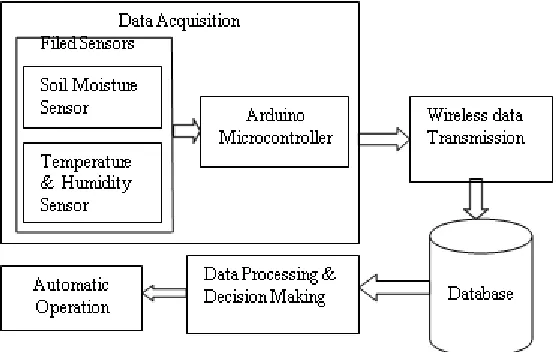
The proposed system as shown in figure 1 will be too developed for centralize monitoring and control for the agriculture land. This can be managed and functioned from any location wirelessly using a mobile device. The application user can control basic operations of collection of environmental, soil, fertilization, and irrigation data automatically and action taken by the system automatically. The perspective of assessing crop performance, compute crop forecasts and personalize crop recommendations for any particular farm using the application.
The main block of the proposed system shown in fig. 1 is microcontroller. It is portable, low power for battery- operated, secure and fast connection. Environmental conditions variations will affect the overall yield of the crop. Plants require proper very specific conditions for optimal growth and health. Monitoring the condition of crop field is very much necessary so sensors are used. Temperature infrared thermopile sensor is used; it has built in digital control and math engine. It senses the temperature values in real time and humidity sensor track the relative moisture of air within the farming field.
Firstly, the microcontroller will check for three conditions: Availability of adequate water level in the water source. Availability of continuous power supply.
Fig. 1 Block Diagram of Proposed System
If the moisture level in the soil falls to the lowest level then the microcontroller will check the above mentioned 1st two conditions& will turn ON the motor for irrigation of the farm. The motor will be turned OFF by the microcontroller as soon as the soil moisture sensor indicates adequate availability of moisture in the soil. Turning OFF the motor will stop the irrigation of the farm.
The farmer will be informed via an SMS if the following conditions occur: When the moisture level of the soil is the least.
The water level in the water source has reached the minimum level. When there is no power supply available at the farm.
If there is need of fertilizer, pesticide, etc.
Data from all these nodes is collected and transferred to a cloud. Here, we are using the cloud service as a storage database. The Data sent to the cloud is stored in the cloud database.
The data from the cloud is given to the mobile application. With the help of the mobile application the farmers get ease to control various devices and record the readings from the sensors. The system also focuses on reducing the cost and energy consumption during the process. The entire field is embedded with sensor nodes including soil moisture sensors, humidity sensors, soil Ph sensor, controller node, solar panels, irrigation sprinkler and control valves.
If the moisture value and the humidity value is less than the prescribed value then the system will decide to open the valves. The valves in the pipe will open and then automatically operate and closed. As the entire system will be triggered for every 1 hour, it is more sufficient for a plant to maintain the moisture required for it.
Also, the water level sensor in the tank will monitor the water level inside the tank and if it is lower than the necessary parameter, the system will start the motor to pump the water from the well. For all the events, the information about the status of the water level, motor on/off, moisture and temperature level will be notified to the user via SMS.
A. Components Required
1. Temperature Sensor
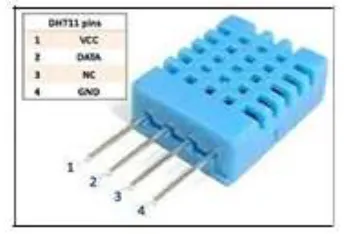
Fig. 2 DT11 Temperature and Humidity Sensor
Figure 1 Shows DHT11 Temperature and Humidity Sensor. The change of soil temperature directly impact on soil nutrient absorption and soil moisture keep and sport. The soil temperature plays a certain role on many of the physical processes of soil.
2. Moisture Sensor
Fig. 3 Soil Moisture Sensor
Figure 2 sensors are used to sense the moisture content in the soil. It works on the principal of electrical conductivity. Resistance of the sensor is inversely proportional to moisture content in the soil. Moisture content of the soil is a major factor determining plant growth. The present work Comprises of development of a soil moisture sensor. Figure 2 shows the Soil Moisture Sensor. Moisture sensor used as soil sensor.
3. Microcontroller
Fig. 4 Ardunio Mini Pro Board
level.
B. PC SERIAL PORT
The output of voltage converter MAX232 is given to PC through connector RS232. It is a 9 PIN input female connector .The connector on PC has male pins .The mating cable therefore terminates in a DB9/F. Thus only 3pins RD, TD and Gnd (2,3,5 respectively) of connector are used.
Fig. 5 Interface with server
III.
Implentation
Node McU.↓
Interface temperature sensor DT11, humidity sensor and soil moisture sensor. ↓
Store data from sensors in a server. ↓
Ubidots IOT service to send notification from sensor when situation arises and to display stored data. ↓
The communication between sensor nodes and sink nodes, and exchange between sink nodes Networks coordination is similar.
↓
Software design mainly programmed combining for the collected data display, analysis and storage etc. ↓
When the server receives weather data from sensor nodes, the server will check the weather data with notification value by using decision making techniques.
↓
If it matches with the pre-conditions, it will notify the stem administrator and record of the notification and automatically store weather data to the database.
IV.
System Testing
We had performed system testing, which is design to uncover weakness that was not found in entire test. Hence include forced system failure and validation of total system as is tested.
V.
Output
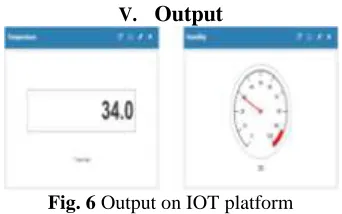
Fig. 6 Output on IOT platform
VI.
Conclusion
Channels store all the data that a Ubidots application collects. Each channel includes eight fields that can hold any type of data, plus three fields for location data and one for status data. Once you collect data in a channel, you can use Ubidots apps to analyze and visualize it.
References
[1]. Bhushan G. Jagyasi, Arun K. Pande, Ramesh Jain Event based Experiential Computing in “Agro-Advisory System for Rural
Farmers”, Wireless Communication©2017 IEEE.
[2]. Prathibha S R I, Anupama Hongal 2, Jyothi M P3 “IoT Based Monitoring System in Smart Agriculture”, International Conference
on Recent Advances in Electronics and Communication Technology, 2017.
[3]. Gokul L. Patil, Prasand S. Gawande and R. V. Bag “Smart Agriculture System based on IoT and its Social Impact”, International
Journal of Computer Applications (0975-8887), Vol. 176- No. 1, October 2017.
[4]. Tanmay Baranwal, Nitika , Pushpendra Kumar Pateriya “Development of IoT based Smart Security and Monitoring Devices for
Agriculture”, 6th International Conference - Cloud System and Big Data Engineering, 978-1-4673-8203-8/16, 2016 IEEE.
[5]. Narayut Putjaika, Sasimanee Phusae, Anupong Chen-Im, Dr. Phond Phunchongharn and Dr. Khajonpong Akkarajisakul “A Control
System in an Intelligent Farming by using Arduino Technology”, 5th ICT- ISPC, 2016.
[6]. Angel C and Asha S “A Study on Development a Smart Environment in Agricultural Irrigation Technique”, IJASA Vol.3, No.2/3,
September 2015.
[7]. Bhagat Singh., “Intelligent Monitoring & Controlling Of Agricultural Field Parameters Using Zigbee”, IJITE Vol.03 Issue-01,
January 2015.
[8]. Prachi Patil, Akshay Narkhede, Ajita Chalke, Harshali Kalaskar and Manita Rajput “Real Time Automation of Agricultural
Environment”, International Conference for Convergence of Technology-2014.
[9]. Meonghun Lee, Jeonghwan Hwang, and Hyun Yoe “Agricultural Production System based on IoT”, IEEE 16th International
Conference, 2013.
[10]. A. Pande, B. G. Jagyasi, S. Kimbahune, P. Doke, A. Mittal, D. Singh, and R. Jain, “Mobile phone based agro-advisory system for