ISSN(Online) : 2320-9801
ISSN (Print) : 2320-9798
I
nternational
J
ournal of
I
nnovative
R
esearch in
C
omputer
and
C
ommunication
E
ngineering
(An ISO 3297: 2007 Certified Organization)
Vol. 3, Issue 7, July 2015
Balanced Agility in Manufacturing Method a
Practical Solution to Achieve Agility
Regarding to Limited Resource
Farhang H F1, Navabakhsh M2
Department of Industrial Engineering, Shahriar Branch, Islamic Azad University, Tehran, Iran
Department of Industrial Engineering, South Tehran Branch, Islamic Azad University, Tehran, Iran
ABSTRACT:After more than a decade of the 21st century and development of all fields of technology and communications, the competition environment become more turbulence and more pressure than before and this fact is sensed by manufacturing companies that for survival and success in new competitive situation has no choice except agility [1].
The agility concept had enter to manufacturing literature in word class during recent 20 years and developed by lots of scientists and researchers. Good conceptual models have had offer and developed by these scientist, and very manufacturing companies had tried to become agile with use of them while looks that they have many diverse trouble to achieve agility. These problems on take scope wide of economic, cultural and social factors and Etc.one of important factors is allocation of limited resources of organization to achieve agility capabilities and turret … them. According to this fact that resources are limited, this paper tries to offer a useful method to prioritization agility capabilities with attention to strategic goals of organization and balancing their progress.
KEY WORDS:Balancing, Agility Capabilities Development, Agile Manufacturing, Limited
Resources, Resources Allocation, Balancing levels
I. INTRODUCTION
In the beginning of the 21century, the pressure of competition environment and increasing changes in the business market and lack of ability to manufacturing conventional systems like lean manufacturing persuaded institutions and researchers to try to find an effective method in order to respond to changes. Studies have led to advent of manufacturing new methodology called "agile manufacturing". This methodology has based on the facts of business environment such as customers new requirements, fragmented market, information systems, and so on…. The pivotal original of offered method in this field is " response to unexpected changes (In some cases, it is predictable)".
Gunasekarn introduced capability in four field included strategy, technology, system and peoples with an efficient information system as agility achieving principles [2]. According to Gunasekaran: agile manufacturing focus on speed and flexibility [3].
Sharifi and Zhang have discussed about agility drivers and organization capabilities include responsiveness, flexibility, competencies, and speed. They have also talked about gap analyses and have tried to answer these questions:
1. What agility level does the company need?
2. What kind of emergency does it need? They have explained that the agility levels are measurable but for each company are unique and they should not be used by other similar companies. [4].
ISSN(Online) : 2320-9801
ISSN (Print) : 2320-9798
I
nternational
J
ournal of
I
nnovative
R
esearch in
C
omputer
and
C
ommunication
E
ngineering
(An ISO 3297: 2007 Certified Organization)
Vol. 3, Issue 7, July 2015
about environment and control and He believes, that the surveillance has a key role in achieving agility.
Each researcher has discussed the agility concept from different perspective. In modern business environment, the companies will be successful having all capabilities of agile manufacturing. Organizations face many problems in this field. For example, limited resources, very competitive business environment, social pressures, cultural factors and etc.
It seems important to manage the limited resources to have maximum benefits for organization. It is necessary to paying attention to this fact that if the resources have not allocation in correct and targeted way; it causes to stagnant of other organization capacities, decreases efficiency of capitals, increases tension in the organization and else. These tensions are first sensed as a stress over agile teams. For this reason, Yauch' belief is that these teams must have necessary abilities to overcome the stress. In this paper author tries to suggest a way to prioritization of agility fields to access resources and development regarding to maximum output of investment. This method is called" balancing" in this paper.
"Balancing", it means in conception, strategic usage from resources of organization to simultaneous development of agility capabilities and on strategic views of organization. In organization resources allocations despite to this fact that efficiency is one of the most vital influential factors on competitiveness in manufacturing companies, many researchers believe that efficiency is not first priority and those who have an effect on it [7-8].
To successfully access by agile manufacturing method, it is necessary to be presented one dynamic and strategic plan so that bring the manufacturing companies goals along. This strategic plan must be developed in such a way that increases the organization elements efficiency on strategic goals and on mission accomplishment of organization.
This point should not be missed that weakness in one or more agility capabilities causes reduction of efficiency of other capabilities for company. To make clear this idea, it needs for you to pay attention to this example if the organization technology level increases a lot but the human resources don't have the knowledge to deal with it, then the organization can't get a profit out of technology and the investment which was considered for it will damage the system. In such an organization, to avoid being empty of technologic capacities, it is necessary to focus on empowering people. This example can be generalized to other aspects of agility. In order to show the strategic plan of becoming agile, it is necessary to be answered to these main questions: 1- What shall be the benefits of the capitals used for agility?
To increase the capitals, this investment has to be used in which factors of agility and how much for each?
Since balanced agility is a strategic solution in order to achieve agile, it needs to have a strategic controller tool to move along with goals of the organization. This tool has to be able to measure the agility capabilities and control them to grow and develop BSC (Balanced Score Card) is a strategic control tool which can be very useful [9]. This tool is used for evaluating the activities in different parts of the organization in accordance with organization missions and determining the productivity and efficiency of the finished activities. This tool will also remove the obstacles facing the organization by making strategic decisions based on present conditions and major and minor goals of the organization. Getting to know suggested deep concepts in field of BSC is necessary for understanding of the concept of balancing agility.
According to the content expressed the purpose of balancing is creating a method to appropriate development of agility capabilities in order to increase efficiency and use maximum organization capacities to achieve goals. In other words the continuous growth of agility capabilities is a dynamic, progressive and continuous method in order to become agile.
II.RESEARCH METHODOLOGY
ISSN(Online) : 2320-9801
ISSN (Print) : 2320-9798
I
nternational
J
ournal of
I
nnovative
R
esearch in
C
omputer
and
C
ommunication
E
ngineering
(An ISO 3297: 2007 Certified Organization)
Vol. 3, Issue 7, July 2015
III.BALANCING AGILITY ASPECTS
In order to balance the agility capabilities, it needs to take a look at the following stages: Definition of agility aspects
Balancing in defined aspects
Stage1:Definitionof agility aspects
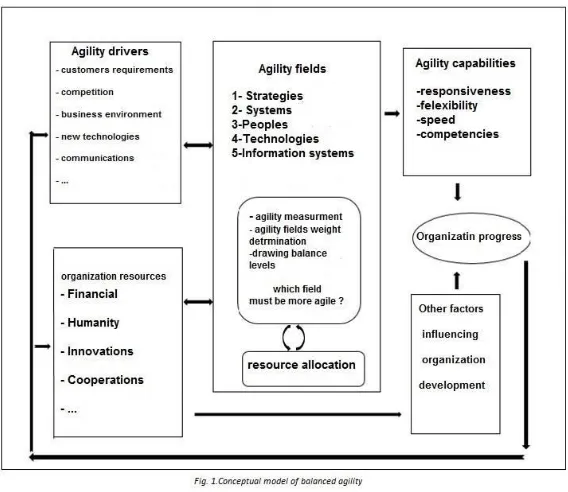
First of all, it is necessary to define essential factors for achieve agility. These factors include the fields which by enhancing them, the organization will be agile, and to strengthen them must benefit from organization resources. These factors have been classified in five categories:
A. Strategies
1. Virtualization: An agile organization will be formed by the merger of key competencies among people selected carefully, but usual organizations have been formed from similar supply chain that focus on rapid sale, price decreasing and increasing the quality [10]. Gunasekaran introduces the virtual organizations as temporary organizations. He believes that a common organization usually can't respond appropriately to the requirements of the competitive environment. [2] A virtual organization doesn't exist materially and is establishing for a project in no time and is dissolving after the project is over. The most important factor in virtual organizations success is reformation of them in the best possible way and in the minimum time.
2. Agile supply chain: An original network related to manufacturing and services and commodities, is called "supply chain", that it is composed of physical factors and informational data. The range of this chain is composed of materials and initial information to end of services to customers. Gunasekaran for agilization of supply chain suggests its integration. [2]
3. Concurrent engineering: It means that all the designing steps, production, marketing, sales, after sales services and etc. are done simultaneously An integrated R&D groups when can be come true that the human resources, multifunctional be flexible and trainable.
B.Manufacturing Systems
By increasing pressure in business competition, manufacturers have adopt lean practices to reduce costs and improve quality.[11] and this idea has recognized that he lean production is the foundation and basis of agile manufacturing so the methods used in lean production in the world class are being used with agile manufacturing methods in agile manufacturing.[5] These methods are such as ERP, ERP II, JIT, TOCH, CONBAN, ABC/ABM and etc In other words the lean production and agile manufacturing tools are being combined and mixed in order to respond to the changes in business environment more properly. This fact is undeniable that for achieving agility must traverse across that rout that is passing through the lean manufacturing.
1.Peoples: Peoples how work in agile manufacturing system should have abilities needed for this method. These abilities are being multi skill, flexible and teachable [2], and "Plonka" emphasizes that teach ability and increasing skills must be continues and dynamic. These peoples have high ability for team working and quickly adapting to new working situations in new projects. They should solve problems when face with, of course it is necessary to provide suitable work situation [12] and activities mange by top management to achieve expected results. In addition to competencies listed they also should have high rate of innovation, because of innovation in an organization can lead to the development of innovative solutions and meta-heuristic to solve problems and bring abrupt progress in organization goal(s). Effective use of these empowered people is requires to have ability to attraction, employment and training them that will not available without top management.
ISSN(Online) : 2320-9801
ISSN (Print) : 2320-9798
I
nternational
J
ournal of
I
nnovative
R
esearch in
C
omputer
and
C
ommunication
E
ngineering
(An ISO 3297: 2007 Certified Organization)
Vol. 3, Issue 7, July 2015
response to special costumer requirements in lowest possible time. This is not being available without use of new technologies. Another challenge manufacturing companies faced with is increasing customize orders via customers. To pass this challenge a manufacturing company needs to modular production facilities to able to produce diverse products. These facilities must be flexible in hardware and software works under NC and CNC. Use of tools such as Robotics, AGVSs, CAD/CAM, is necessary to becoming agile manufacturer [2]. In addition to have new technologies, a manufacturing company should be able to run a maintenance program to save facilities and assurance that they work properly. So the company needs to peoples who can run EM and PM programs and has access to support services for facilities. Since technologies development is usually expensive should be consider That the technologies must develop at the right time and in organization goals following way with views to R&D strategic plans.
3. Information systems: Nowadays changes occurring more unexpected and suddenly so companies need to immediate
and true information for on time reaction to survive, this purpose can be accessible by use from up to date information system. An information system is a system aims at processing, storage, analyzing and on time distribution information. Sarlak also emphasis that IT is one of integral components of information management in today world [13]. Communications Technology is a combination of software, remote communication hardware, internet and other communication technologies [14]. The other vital area for organization is knowledge management. In today complex situation of competition Dracker consider the knowledge as new competition benchmark and also the most important source of 21centery [15]. In knowledge management can said that the knowledge management includes creating, organize, and publish process in complex organizations such as grate companies, universities and governmental organizations. Hence all field of information systems should be consider in agility measurement.
Stage 2: Measurement and Balancing defined indexes
Figure 1: Conceptual model of balanced agility
ISSN(Online) : 2320-9801
ISSN (Print) : 2320-9798
I
nternational
J
ournal of
I
nnovative
R
esearch in
C
omputer
and
C
ommunication
E
ngineering
(An ISO 3297: 2007 Certified Organization)
Vol. 3, Issue 7, July 2015
Step I: Measurement of agility in each fields
To compare intended fields to each other, they need to be converted to numerical digits but these areoften qualitative. To converse qualitative data to numerical one, we can use accessible methods which are developed for this purpose. So the factors which are effective in agility of manufacturing like technology have to be listed first. Then determine importance rate of them - calls as factor weight in paper -. This information collected in the table as Table.1 shown below.
Table 1: Sample of agility questionnaire in technologies
Sl no Question Score levels
Low level=1 High level=10
1 Are people multi skills? Single skill Multi skills
2 How is the diversity of specialty in organization?
Diversity is low Varies completely
3 How is the distribution of human resources?
Stable people in each department
Variable people in different department 4 How is an employment contract in
organizations?
Life time Temporary completely and based on project 5 What is the level of innovation rate for
organization?
Very low Very high
6 How are the education programs in organizations?
Very low In regular period with short internal
7 What is the level of job satisfaction in organization?
Not at all Entirely
Table 2: Sample of agility questionnaire in peoples
Sl no Question Score levels
Low level=1 High level=10 1 How is the level of company technology? entirely traditional entirely automatic 2 How is the maintenance program? without any program entirely programmed
and computerized 3 How is the access to facilities after sale
support?
without any support full support in every time
4 How is the facilities design? for unique production entirely flexible and customize production based
5 How is the software of facilities design? for unique production entirely flexible and customize production based
6 How is the need of training to use facilities?
without any need to education
need to special educations
7 Can the company cooperate with other companies to use of their production technologies?
no , in no way yes ,without limitation
8 How is the technology change rate in the company business field?
very high very low
9 How is the company ability to create new required technologies?
has no ability self-sufficient
10 How is the ability to production if facilities damage is?
ISSN(Online) : 2320-9801
ISSN (Print) : 2320-9798
I
nternational
J
ournal of
I
nnovative
R
esearch in
C
omputer
and
C
ommunication
E
ngineering
(An ISO 3297: 2007 Certified Organization)
Vol. 3, Issue 7, July 2015
Table 3: Sample of agility questionnaire in strategies
Table 4: Sample of agility questionnaire in information systems
" ", in the table, is the score of company ability in question field and give a score between 1to10. " ", is the weight of influence of the question field on company business process, in fact it is shows the company how much be affected when the activity that question talk about run completely and get the highest possible score that is 10. In otherwise " explain. It gives a value between 1to10. Agility value in each field – for example technology field – being calculated by the following formula:
=(Σ ∗ ) / (10Σ )
"AVi", is Agility value in field " " in equation. Sl no
Question
Scorelevels
Lowlevel=1 Highlevel=10
1
How is the process of Production, manufacturing, marketing and so on for a
product? Step by step Simultaneously
2
How is the process of Production, manufacturing, marketing and so on for a product?
In separated
department In a cohesive team
3
Are processes operated be
for simulation? No, not at all Yes, in all cases
4
Are shared information related to material with
suppliers and partner? Notoften
Yes, in details for all products
5 Is it virtual organization? Not, physically Yes,completely
6
Is organizational chart
capable of changing? No, stable
Yes, it changes completely
Sl no Question Score levels
Low level=1 High level=10
1 Is there any MIS in organization? no Yes, top MIS
2 Is there any office automation in organization?
no Yes, completely
3 Is there any sale and marketing in web and/or social networks?
No, not at all Yes ,very widely
4 How is the information processing? Completely by man Completely by computer 5 Is there any possibility to employee for
work distance?
Not, at all Yes, for every one
6 Is there any knowledge management in organization?
No Yes, in top level
ISSN(Online) : 2320-9801
ISSN (Print) : 2320-9798
I
nternational
J
ournal of
I
nnovative
R
esearch in
C
omputer
and
C
ommunication
E
ngineering
(An ISO 3297: 2007 Certified Organization)
Vol. 3, Issue 7, July 2015
It is very important that questionnaires have answered carefully by certified people whose know agility concept. It is necessary to paying attention when questionnaires have designed, environmental factors have been considered to each field agility has compared with rate of change in business environment, organization perspectives and missions should be considered too.
Step II: Weighting agility fields
Weight of each field shows the importance and influence value of that in strategic plan of organization and the variation is from 1(With low influence) to 10(vital and with high influence).By increasing importance score value increase too .these weights have to be determined carefully to reflex correct results at end. Attention must be paid that these weights are unique for each company and refers to business environment, competitive situation and the company properties. So these should not be used for another company even by similar business or production domain. Agility weight shows by " " in equation follows.
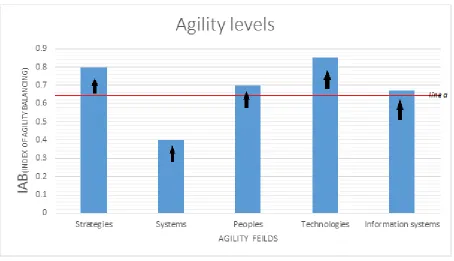
Step III: Drawing agility level charts
Agility levels chart use to proper agility value between its own fields. A sample of chart has shown in Figure 2.
Figure 2: Agility Balancing Chart
Horizontal line in the chart show fields of agility and vertical line is the value of "Index of Agility Balancing". This shows the present agility value of each field according to the perspectives of organization and calculated from the following equation: = ∗1/
Step IV: Balancing agility values
After drawing agility balancing charts, we have Tow way to balancing agility values that explain follows.
Way 1: Use from mean line (mean value).
For calculating mean value of agility we can use from following equations:
ISSN(Online) : 2320-9801
ISSN (Print) : 2320-9798
I
nternational
J
ournal of
I
nnovative
R
esearch in
C
omputer
and
C
ommunication
E
ngineering
(An ISO 3297: 2007 Certified Organization)
Vol. 3, Issue 7, July 2015
=Σ /5, =1 5
After calculating mean value we should drawing mean line (line ‘a’ in Figure. 2.), then those fields that their IABs are under mean line must be growing to mean value. The next step is calculating mean value again and this cycle is repeats until levels be balancing perfectly.
Way 2: Use from ranking of fields
Fore use from method select minimum IAB and upgrade it to its upper level and repeat this method to perfect balance.
In use from balanced method should paying attention to some point that’s:
In equal IBAs if we have not enough resource to develop all fields, which is has more weight is priority to resource allocation.
After achieving a perfect balance, to continue the company development IBAs must be imbalanced. To this purpose one (or more) field must be develop according to company situation and business environment.
The speed of becoming agile refers to company resources and management ability in organization. So it can be a rapid method to achieve agility or slow one, however it is a continuous way.
IV.CONCLUSION
Considering the issues which were discussed, achieving agility is an inevitable fact for organizations. All the capabilities and the factors had been discussed in time and the tools had been presented. It seems that the organizations have to follow these rules in order to survive and grow. Developing the agility factors depends on the organization resources. On the other hand the development has to be considered in all the fields. Due to the fact that resources are limited and the organizations can't reach their goals considering only a field, there sources have to be allocated wisely in order to get the most out of them. It is suggested that the trained and experienced teams have to be considered to prioritize the organization requirements and budgeting the limited resources. The members have to be experts and have to understand the organization's goal and missions clearly. After a while of performing the above process, balancing levels are equalized so in order to keep the organization agile we have to disorder this balance. Disordering the balance has to be according to competitive environment conditions and organization's trait. If there were enough resources then the agility has to be done in the field of highest weight(efficiency).Otherwise we have to consider the lower weighting fields. In the future articles we willd is cussthe relation between fields and how to affect the mand also how to disorder the balance.
REFERENCES
1. Yusuf YY, Sarhadi M, Gunasekaran A, “Agile Manufacturing: The Drivers, Concepts and Attributes”, Int. J. of Production Economics, 1999.
2. Gunasekaran A, “Responsive supply chain: A Competitive Strategy in Network Economy”, 1999.
3. Gunasekaran, “Agile Manufacturing: A Framework for Research and Development”, Int. J. Production Economics, 2008.
4. Sharifi H, Zhang Z, “A Methodology for Achieving Agility in Manufacturing Organizations: AnIntroduction”, Int. J. Production Economics, 1999.
5. Sharp JM, Irani Z, Desai S, “Working towards Agile Manufacturing in the UK Industry”, Int. J.Production Economics, 1999.
6. Hormozi AM, “Agile manufacturing: The Next Logical Step”, Int. J. Benchmarking Vol8, pp. 32- 143, 2001.
7. Sink DS, Tuttle TC, “Planning and Measurement in your Organization of the Future”, Ch. 5, Industrial Engineering and Management Press, 1989.
8. Broman M, “Assessing productivity in assembly systems”, Licentiate thesis, Department of Production Engineering, The Royal Institute of
Technology, Stockholm, 2004.
9. Kaplan SR, Norton PD, “The Balanced Scorecard Measures that Drive Performance”, Harvard Business Review, 1992.
10. Abair RA, “Agile Manufacturing: This is not just Repackaging of Material Requirements Planning and just-in-time”, Annual International
Conference Proceedings American Production and Inventory Control Society, pp. 196-198, 1995.
11. Inman AR, Samuel Sale R, Kenneth W, Green JR, Whitten D, “Agile Manufacturing: Relation to JIT”, Operational performance and firm
performance, J. of operation Mgmt, 2011.
12. Plonka FE, “Developing a Lean and Agile Work Force”, Int. J. of Human Factors in Manufacturing, 1997.
13. Sarlak MA, Forati H, “Management of Information Systems”, University of Payamenoor, 2008.
14. Mercarder J, Cedan R, Sanchez ALRS, “Information Technology and Learning”, 1997.