https://doi.org/10.5194/nhess-18-2801-2018 © Author(s) 2018. This work is distributed under the Creative Commons Attribution 4.0 License.
Data assimilation with an improved particle filter and
its application in the TRIGRS landslide model
Changhu Xue1, Guigen Nie1,2, Haiyang Li1, and Jing Wang1
1GNSS Research Center, Wuhan University, Wuhan, 430079, China
2Collaborative Innovation Center for Geospatial Information Technology, Wuhan, 430206, China
Correspondence:Guigen Nie ([email protected])
Received: 12 December 2017 – Discussion started: 2 January 2018
Revised: 18 August 2018 – Accepted: 14 October 2018 – Published: 26 October 2018
Abstract. Particle filters have become a popular algorithm in data assimilation for their ability to handle nonlinear or non-Gaussian state-space models, but they have significant disadvantages. In this work, an improved particle filter al-gorithm is proposed. To overcome the particle degeneration and improve particles’ efficiency, the processes of particle re-sampling and particle transfer are updated. In this improved algorithm, particle propagation and the resampling method are ameliorated. The new particle filter is applied to the Lorenz-63 model, and its feasibility and effectiveness are verified using only 20 particles. The root-mean-square differ-ence (RMSD) of estimations converges to stable when there are more than 20 particles. Finally, we choose a peristaltic landslide model and carry out an assimilation experiment of 20 days. Results show that the estimations of states can effec-tively correct the running offset of the model and the RMSD is convergent after 3 days of assimilation.
1 Introduction
Mountainous areas all over the world suffer frequent land-slide disasters. Works of landland-slide monitoring, analysis and forecasting are crucial. Many numerical modeling methods of slope evolution, such as discontinuous deformation anal-ysis (DDA) (Shi, 1992; Jing et al., 2001; Ma et al., 2011) and the distinct element methods (DEMs) (Lorig and Hobbs, 1990; Marcato et al., 2007; Li et al., 2012), have been pro-posed and developed recently. Iverson propro-posed a mathemat-ical model that uses Richards’ equation to evaluate effects of landslides in response to rainfall infiltration (Iverson, 2000). The Transient Rainfall Infiltration and Grid-Based Regional
Slope-Stability (TRIGRS) model is a raster-based model and depends on time of transient rainfall infiltration (Baum et al., 2008). Jiang adopted the ensemble Kalman filter land-slide movement model in relation to hydrological factors, which introduced data assimilation (DA) to landslide eval-uation (Jiang et al., 2016).
DA is a common approach to estimating optimal states in dynamic systems. With DA algorithms and operators, DA merges different scales of observations into dynamic mod-els to take advantage of all the information. Many DA algo-rithms have been developed and improved in recent years, and particle filters (PFs) are a popular algorithm for their ability to handle nonlinear and non-Gaussian distributed models (Arulampalam et al., 2002; Moradkhani et al., 2005). The application and improvement of PFs has been researched recently in DA and other fields.
Salamon and Feyen (2009) applied the residual resampling particle filter (RRPF) to assess parameter, precipitation and predictive uncertainty in a rainfall–runoff model. Thirel et al. (2013) assimilated snow-covered areas in physical dis-tributed hydrological models and MODIS satellite data to improve pan-European flood forecasts. Mattern et al. (2013) carried out assimilation experiments for a three-dimensional biological ocean model and satellite observations and veri-fied the feasibility of biological state estimation with sequen-tial importance resampling (SIR) for realistic models.
the range of observation error (van Leeuwen, 2010). This method can achieve good results using only 10–20 particles in high-dimensional assimilation experiments. But the num-ber of key particles is reduced when the system variance is larger than the observed variance, and the values of added items are uncertain. Another improvement is to replace the duplicating process by generating a Halton sequence in resid-ual resampling (Zhang et al., 2013). The disordered parti-cle sets are turned into ordered sets and too few partiparti-cles can hardly describe the posterior probability density function (PDF) better.
In Sect. 2, a new resampling approach is proposed to im-prove the above method, maintaining both particle diversity and efficiency. The new algorithm formula and implementa-tion process are listed in the text. To predict the safety fac-tor of peristaltic landslide, a simulation experiment, applied to the Lorenz-63 model using different numbers of particles, ranging between 10 and 200, is explained in Sect. 3, which demonstrates that the new method shows efficiency and sen-sitivity to the number of particles. Finally, a rainfall infiltra-tion landslide model case is analyzed. We choose an experi-mental landslide model with a 10×10 size grid, of which the side length of each grid cell is 10 m. The improved assimila-tion algorithm is applied to the TRIGRS program to evaluate the change of factor of safety (FS) in the experimental model.
2 Improvements to residual resampling particle filtering
In sequential importance sampling, the state vector is repre-sented by a set of particles:
xk=f (xk−1)+Gk(xk−1)εk−1, (1)
wherex is the state vector with initial PDFp(x0),k is the
subscript of time steps,εk−1is system noise with zero mean
at stepk−1 andf (·)is the model operator. InitialNparticles are sampled fromp(x0). The observation equation is
zk=h(xk)+ηk, (2)
wherezk is the observation vector at stepk, andh(·)is the observation operator. Weights of particles are calculated by Eq. (3) and normalized to obtainwki by Eq. (4)
e
wki =wk−i 1·p(zk |xi
k)p(xik|xik−1)
q(xi
k|xik−1,zk)
, (3)
wki = ew i k N P
j=1e
wkj
, (4)
whereiis the index of particle number,p(zk|xik)is the likeli-hood of observation andq(xik|xik−1,zk)is the proposal func-tion.
Residual resampling is a way to solve particle degeneracy, which is an unavoidable problem in PFs. To keep most par-ticles effective, low-weight parpar-ticles are removed and high-weight particles are duplicated. But with recursive progress the particle sets can hardly represent the prior PDF due to declining particle diversity.
Some improvements to the residual resampling algorithm are proposed in this paper. Firstly, in the process of particle transferring, we choose
xik=f (xik−1)+ ˆεk−1+Jk[zk−h(xˆk−1)], (5)
where Jk is a coefficient like the “gain” in an extended Kalman filter:
Jk=Dk/ k−1BTkBkDk/ k−1BTk +Rk −1
Dk/ k−1=Ak−1Dk−1/ k−1ATk−1+Gk−1(xˆk−1)
Qk−1GTk−1(xˆk−1)
, (6)
in whichAk,Bkare the linearization parameters off (·)and
h(·), respectively: Ak=
∂fk
∂xk
(xˆk), Bk=
∂fk
∂xk
(xˆk/ k−1). (7)
Dk/ kis the estimation variance of statexkat stepk. This pro-cess is equal to translating particles close to observations. But the value ofJk is difficult to determine because the variance of state estimationDk−1/ k−1in PFs is difficult to compute.
To simplify the calculation, suppose that the translated parti-cles are a series of virtual observations about the state at step
k. Write the particle set as
XNk/ k= n
xik/ ko
i=1,2,...,N (8) and replaceDk−1/ k−1with the variance of particles. To keep
the value ofDk−1/ k−1 unchanged before and after
transla-tion, we choose the posterior particles at stepk−1:
Dk−1/ k−1=var(Xk−1/ k−1). (9)
Secondly, using the method of Zhang et al. (2013) to com-pute accumulative copy times (ACTs), each parent particle with high weight regenerates a set of new particles. Differ-ently, instead of duplicating or generating a Halton sequence, it generates a series of normally distributed particles: n
x1k,x2k, . . .,xACTi
k o
∼Nxik,Gk
xik,
where ACTi is the ACT of theith particle, and the mean and variance are related to the value of the parent. Accordingly, the resampled particle set is composed of some different par-ticle sets that obey normal distribution. Assuming that thejth particle ofxikis written asxijk, the formula (3) can be written as
e
wijk =wk−i 1·p(zk
|xkij)p(xkij|xk−i 1) q(xkij|xk−i 1, zk)
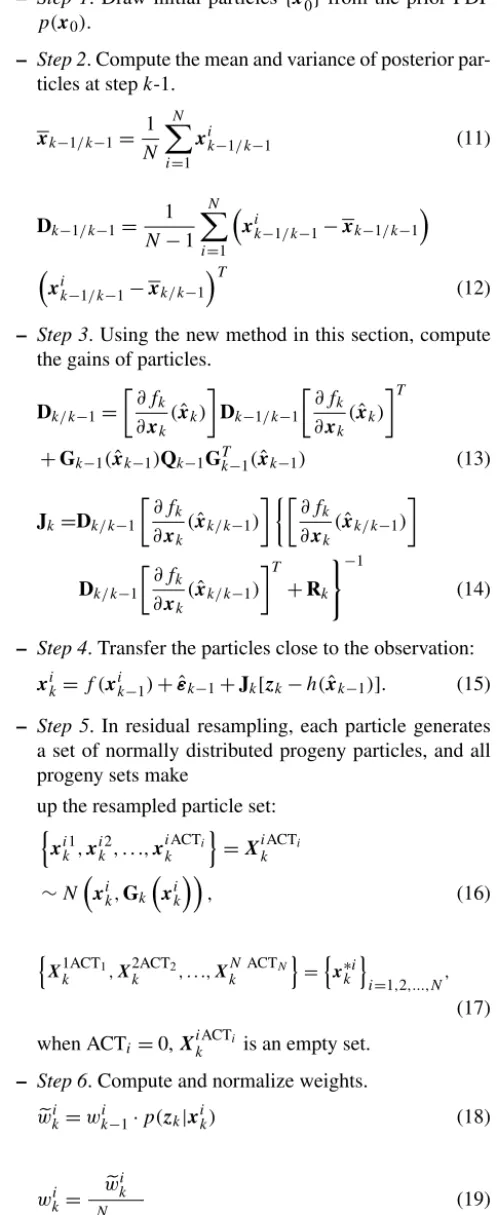
Briefly, the improved RRPF in this section can be imple-mented by the following steps:
– Step 1. Draw initial particles{xi0}from the prior PDF
p(x0).
– Step 2. Compute the mean and variance of posterior par-ticles at stepk-1.
xk−1/ k−1=
1
N
N X
i=1
xik−1/ k−1 (11)
Dk−1/ k−1=
1
N−1 N X
i=1
xik−1/ k−1−xk−1/ k−1
xik−1/ k−1−xk/ k−1 T
(12) – Step 3. Using the new method in this section, compute
the gains of particles. Dk/ k−1=
∂f k
∂xk
(xˆk)
Dk−1/ k−1 ∂f
k
∂xk
(xˆk) T
+Gk−1(xˆk−1)Qk−1GTk−1(xˆk−1) (13)
Jk=Dk/ k−1 ∂f
k
∂xk
(xˆk/ k−1)
∂fk
∂xk
(xˆk/ k−1)
Dk/ k−1
∂fk
∂xk
(xˆk/ k−1) T
+Rk )−1
(14)
– Step 4. Transfer the particles close to the observation:
xik=f (xik−1)+ ˆεk−1+Jk[zk−h(xˆk−1)]. (15)
– Step 5. In residual resampling, each particle generates a set of normally distributed progeny particles, and all progeny sets make
up the resampled particle set: n
xik1,xik2, . . .,xiACTi
k o
=XiACTi
k
∼Nxik,Gk
xik, (16)
n X1ACT1
k ,X
2ACT2 k , . . .,X
NACTN
k o
= n
x∗ik o
i=1,2,...,N, (17) when ACTi=0,XikACTiis an empty set.
– Step 6. Compute and normalize weights. e
wki =wk−i 1·p(zk|xik) (18)
wki = ew i k N P
j=1e
wkj
(19)
– Step 7. Compute the state estimation.
ˆ
xk/ k= N X
i=1
x∗ik ·wki, (20)
a measure to assess the accuracy of calculation is the root mean square difference (RMSD), which is defined as RMSD= v u u t 1 T T X
t=1
(Xˆt−Xobst )
2, (21)
whereT is the period of assimilation, andXˆt andXobst are the assimilated value and the observation of state at timet, respectively.
3 Application to the Lorenz-63 model
We choose the Lorenz-63 model as an example to test the improved algorithm (Baines, 2008).
dx
dt =σ (y−x)
dy
dt =x(ρ−z)−y
dz
dt =xy−βz
, (22)
where the constants σ, ρ and β are system parameters proportional to the Prandtl number, Rayleigh number and certain physical dimensions of the layer itself. Parameters are given by dt=0.01, σ=10, ρ=28, β=8/3, the ob-servation error σobs=
√
2 and the model transmission er-ror based on time interval σmod=2
√
1t. Initialize the fil-ter with the starting point, which is set to (x0, y0, z0)=
(1.50887,−1.531271,25.46091). The truth is obtained by the formula of the model recursively. Observations are gen-erated from the truth by adding a disturbance every 40 steps, with 1000 recurring steps, and assimilating the observation with the model when observation exists at the current step and moving to the next step when there is no observation.
Figure 1.Results of the new PF for the Lorenz-63 model of the xcomponent. The red crosses are observations, the black line is the true state and the blue line represents the new PF results.
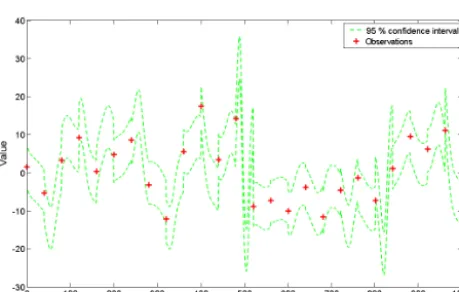
Figure 2.The 95 % confidence interval computed by posterior par-ticles. The green dashed lines denote the upper and lower limits of the interval and the red crosses are observations.
4 Application to landslide simulation based on the TRIGRS model
TRIGRS is a program modeling rainfall infiltration, using an-alytical solutions for partial differential equations that rep-resent one-dimensional vertical flow in isotropic, homoge-neous materials for simply saturated or unsaturated condi-tions. It computes changes of rainfall pore pressure and FS with rainfall infiltration. The FS is computed using a simple infinite-slope model, cell by cell.
In this experiment, the FS is applied to assimilation. It is calculated as follows:
Fs=tanφ tanα+
c−ϕ(Z, t )γWtanφ
γSZsinαcosα
, (23)
in which cis soil cohesion, αis slope angle,φ is soil fric-tion angle,ϕis the groundwater pressure head depending on depthZand timet,γWis groundwater unit weight, andγSis
soil unit weight at saturation.
An example of the 10×10 grid TRIGRS model is set to be the background, and each grid is a square with a length
Figure 3.The evolution of posterior particles in time. The green dashed lines show the traces of all particles; the red crosses denote the observations.
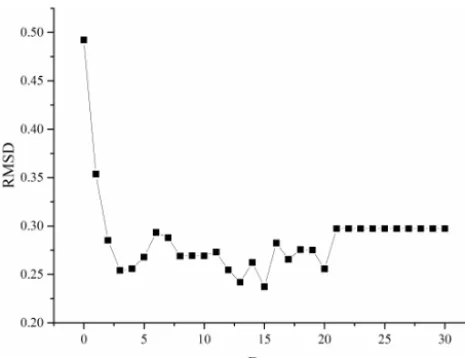
Figure 4.RMSD of the estimation with respect to particle numbers. The value is relatively high when the particle number is fewer than 20 and tends to be stable when higher than 20.
of 10 m. The simulated observations are generated from the FS by adding a disturbance with normal distributionN(0.2, 0.3). Due to the difficulties of determining the parameterϕ, the soil friction angle and its high sensitivity to results, we now generate a set of particlesϕki to formϕ, in which k
Figure 5.Model results and assimilation results of FS. The maps in the first row are the model running for 5, 10, 15 and 20 days, and those in the second row are the assimilation results. The horizontal and vertical coordinates in each graph are the grid numbers of each cell.
Figure 6.The distribution variation in groundwater pressure head (ϕ)with assimilated time. The horizontal and vertical coordinates in each graph are the grid numbers of each cell.
To evaluate the distribution variation inϕ, we propose that the estimation ofϕis calculated as formula
ˆ
ϕk/ k= N X
i=1
ϕki·wik, (24)
in which wik is calculated using Eqs. (18) and (19). Fig-ure 6 shows the distribution variation inϕrunning for 5 days, 10 days, 15 days and 20 days. Actually, the estimation ofϕ
uses the same method and particles of the estimation of FS. Figure 6 shows the distribution variation in ϕrunning for 5 days, 10 days, 15 days and 20 days. The change of ϕ esti-mation in a single cell is illustrated in Fig. 7, considering the middle unit, grid cell (5, 5).
Figure 7.The changing line of the groundwater pressure head (ϕ) estimation of grid cell (5, 5) with assimilation time. The value grows with the evolution of the landslide.
To assess estimations of all grid cells, the RMSD of the whole grid of points to measure the estimated error is modi-fied to
RMSDgrid= s
1
Np X
i,j
(Xˆij−Xobsij )
2, (25)
whereNp is the total number of grid points, and i and j
Figure 8.RMSD line of all grids depending on assimilation time. The TRIGRS model is assimilated with observations in the first 20 days, and results of days 21–30 are model running results with-out observations assimilated.
5 Conclusion and discussion
The problems of particle degeneration and efficient expres-sion of posterior PDF are long-term difficulties that affect the performance of particle filters. Many resampling methods can improve effectiveness of particles, but they still need a large number of samples resulting in a large amount of com-putation.
In this study, we propose two approaches to improve the particle filter process. Firstly, for the problem of particle de-generation, new Gaussian-distributed offspring particles are generated for each mother particle. This avoids particle du-plication and maintains particle diversity. Secondly, in order to improve the propagating efficiency of a priori particles into a posteriori particles, an additional item is added that is sim-ilar to the Kalman gain at the step of particle propagation, which greatly reduces the number of particles required. It uses only dozens of particles to achieve good results. A sim-ulation experiment of the Lorenz-63 model is carried out to validate the feasibility of these methods. The TRIGRS land-slide model is first proposed for application to the assimila-tion system. Results show that the assimilaassimila-tion process can make the estimation close to observations, which proves the feasibility of applying the improved particle filter to the land-slide model.
However, some disadvantages are still present. Grid cells are independent of each other in TRIGRS, and this leads to the FS estimations possibly being greater than the actual val-ues. Therefore, the FS estimations only provide a reference for the actual values. The experiment needs improvement.
Data availability. The data in this experiment are mainly collected by observation or generated by simulation. Data sets and figures have been uploaded to the Supplement. The model information and program of TRGIRS are obtained from https://pubs.usgs.gov/of/ 2008/1159/ (US Geological Survey, 2017).
Supplement. The supplement related to this article is available online at: https://doi.org/10.5194/nhess-18-2801-2018-supplement.
Author contributions. CX conceived the idea of this article and completed the paper. GN proposed some important suggestions of algorithm applications in the TRIGRS assimilation. Validation of the algorithm, chart sorting and editing were completed by HL and JW.
Competing interests. The authors declare that they have no conflict of interest.
Acknowledgements. This work is financially supported by the National Key Basic Research Program of China (grant no. 2013CB733205).
Edited by: Thomas Glade
Reviewed by: two anonymous referees
References
Arulampalam, M. S., Maskell, S., Gordon, N., and Clapp, T.: A tutorial on particle filters for online nonlinear/non-Gaussian Bayesian tracking, IEEE Trans. Signal Process., 50, 174–188, https://doi.org/10.1109/78.978374, 2002.
Baines, P. G.: Lorenz, EN 1963: Deterministic nonperiodic flow. Journal of the Atmospheric Sciences 20, 130–41, Prog. Phys. Ge-ogr., 32, 475–480, https://doi.org/10.1177/0309133308091948, 2008.
Baum, R. L., Savage, W. Z., and Godt, J. W.: TRIGRS – A For-tran Program for Transient Rainfall Infiltration and Grid-Based Regional Slope-Stability Analysis, version 2.0, U.S. Geological Survey Open-File Report, 2008–1159, 75, 2008.
Iverson, R. M.: Landslide triggering by rain
in-filtration, Water Resour. Res., 36, 1897–1910,
https://doi.org/10.1029/2000wr900090, 2000.
Jiang, Y. A., Liao, M. S., Zhou, Z. W., Shi, X. G., Zhang, L., and Balz, T.: Landslide Deformation Analysis by Cou-pling Deformation Time Series from SAR Data with Hydrolog-ical Factors through Data Assimilation, Remote Sens., 8, 179, https://doi.org/10.3390/rs8030179, 2016.
Jing, L. R., Ma, Y., and Fang, Z. L.: Modeling of fluid flow and solid deformation for fractured rocks with discontinuous deformation analysis (DDA) method, Int. J. Rock Mech. Min. Sci., 38, 343– 355, https://doi.org/10.1016/S1365-1609(01)00005-3, 2001. Li, X. P., He, S. M., Luo, Y., and Wu, Y.: Simulation of the
earthquake using a distinct element method, Environ. Earth Sci., 65, 1049–1054, https://doi.org/10.1007/s12665-011-0953-8, 2012.
Lorig, L. J. and Hobbs, B. E.: Numerical Modeling of Slip Instabil-ity Using the Distinct Element Method with State Variable Fric-tion Laws, Int. J. Rock Mech. Min. Sci. Geomech. Abstr., 27, 525–534, https://doi.org/10.1016/0148-9062(90)91003-P, 1990. Ma, G. C., Kaneko, F., Hori, S., and Nemoto, M.: Use of Discontinuous Deformation Analysis to Evaluate the Dy-namic Behavior of Submarine Tsunami-Generating Landslides in the Marmara Sea, Int. J. Comput. Methods, 8, 151–170, https://doi.org/10.1142/S0219876211002526, 2011.
Marcato, G., Fujisawa, K., Mantovani, M., Pasuto, A., Silvano, S., Tagliavini, F., and Zabuski, L.: Evaluation of seismic effects on the landslide deposits of Monte Salta (Eastern Italian Alps) using distinct element method, Nat. Hazards Earth Syst. Sci., 7, 695– 701, https://doi.org/10.5194/nhess-7-695-2007, 2007.
Mattern, J. P., Dowd, M., and Fennel, K.: Particle filter-based data assimilation for a three-dimensional biological ocean model and satellite observations, J. Geophys. Res.-Oceans, 118, 2746–2760, https://doi.org/10.1002/jgrc.20213, 2013.
Moradkhani, H., Hsu, K. L., Gupt, H. A., and Sorooshian, S.: Un-certainty assessment of hydrologic model states and parameters: Sequential data assimilation using the particle filter, Water Re-sour. Res., 41, 17, https://doi.org/10.1029/2004wr003604, 2005.
Salamon, P. and Feyen, L.: Assessing parameter, precipitation, and predictive uncertainty in a distributed hydrological model using sequential data assimilation with the particle filter, J. Hydrol., 376, 428–442, https://doi.org/10.1016/j.jhydrol.2009.07.051, 2009.
Shi, G. H.: Discontinuous Deformation Analysis: A New Numerical Model for the Statics and Dynamics of
De-formable Block Structures, Eng. Comput., 9, 157–168,
https://doi.org/10.1108/eb023855, 1992.
Thirel, G., Salamon, P., Burek, P., and Kalas, M.: Assimilation of MODIS Snow Cover Area Data in a Distributed Hydrological Model Using the Particle Filter, Remote Sens., 5, 5825–5850, https://doi.org/10.3390/rs5115825, 2013.
US Geological Survey: TRIGRS – A Fortran Program for Transient Rainfall Infiltration and Grid-Based Regional Slope-Stability Analysis, Version 2.0, available at: https://pubs.usgs.gov/of/ 2008/1159/, last access: 6 December 2017.
van Leeuwen, P. J.: Nonlinear data assimilation in geosciences: an extremely efficient particle filter, Q. J. Roy. Meteorol. Soc., 136, 1991–1999, https://doi.org/10.1002/qj.699, 2010.