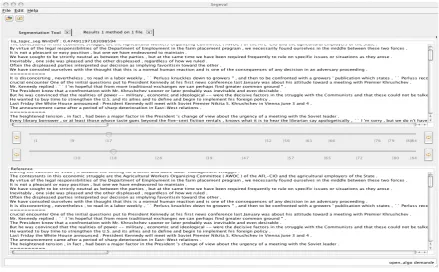
Figure 1: Segeval : graphical comparison between referenced and hypothesised boundaries computed with varying parameters of LIA_topic_seg on one text. One may select two segmentations for a text comparison as shown on figure 2
Figure 2: Segeval : comparison between an automatic segmentation with LIA_topic_seg and the reference. The small vertical lines on the central sliders give an overview of the boundaries in the text and offer a quick navigation system from one boundary to another.
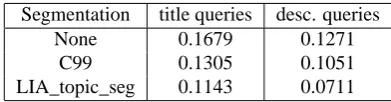
a linear representation as shown in figure 1 is available. Then a comparison can be made between two segmenta-tions and an in depth analysis can be made as in figure 2. It allows a qualitative evaluation of the differences. Also, Segeval allows a comparison (based on the average
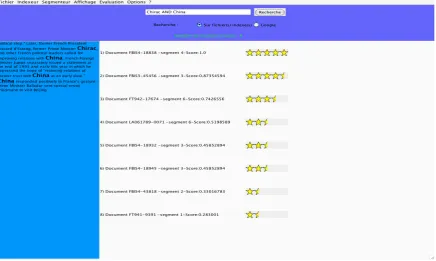
Figure 3: Human Interface of our Lucene based search engine that uses segments instead of whole documents for the indexation as long as for results printing. The results are ordered by relevance in the middle of the window, and by one click on a title the corresponding segment appear on the left, with words from the query highlighted.
important information and gives the user the possibility to not read the whole document.
The main graphical interface is presented in figure 3. The answer is focused on the target segment (the most similar according to the query) and there is an access to the original document wih the page-setting using the segmentation of the whole document.
In this context, additional boundaries do not decrease read-ability even if both created segments deal with the same topic. On the contrary, if two segments with totally differ-ent topics are merged, it is confusing for the reader.
4.
Conclusion
The currently used framework of evaluation of the segmen-tation tools is reliable but not adapted to many uses of topic segmentation. We proposed new ways of evaluating tasks like clustering, improving readability, and retrieving infor-mation. We have developped two graphical interfaces for two contexts of segmentation tools evaluation. One was for an intrinsec comparison, the other one was dedicated to an evaluation in an information retrieval context. These tools will be very soon distributed under GPL licences on the Technolangue project web page.
5.
References
Ricardo Baeza-Yates and Berthier Ribeiro-Neto. 1999.
Modern Information Retrieval. Addison-Wesley.
Douglas Beeferman, Adam Berger, and John Lafferty. 1997. Text segmentation using exponential models. In
Proceedings of the 2nd conf. on Empirical Methods in Natural Language Processing, USA.
Freddy Y. Y. Choi. 2000. Advances in domain independent linear text segmentation. In Proceedings of the 1st
Meet-ing of the North American Chapter of the Association for Computational Linguistics, USA.
Gael Dias and Elsa Alves. 2005. Unsupervised topic seg-mentation based on word co-occurrence and multi-word units for text summarization. In In association with ACM editions, editor, Proceedings of the ELECTRA
Workshop associated to 28th Annual International ACM SIGIR Conference, pages 41–48, Salvador, Brazil,
Au-gust 19.
Marti A. Hearst. 1997. Text-tiling : segmenting text into multi-paragraph subtopic passages. Computational
Lin-guistics, pages 59–66.
J.Callan. 1994. Passage-level evidence in document re-trieval. In Proccedings of the ACM/SIGIR Conference
of Research and Development in Information Retrieval,
pages 302–310.
X. Ji and H. Zha. 2003. Domain-independent text seg-mentation using anisotropic diffusion and dynamic pro-gramming. In in Proceedings of the 26 Annual
Inter-national ACM SIGIR Conference on Research and De-velopment in Information Retrieval, pages pp.322–329,
Toronto, Canada.
W. M. Shaw Jr., R. Burgin, and P. Howell. 1997. Per-formance standards and evaluations in ir collections: Cluster-based retrieval models. Information Processing
and management, pages 1–14.
Confer-ence on Digital Libraries, pages 25–38.
Gabriele Nordbrock, Henrike Gappa, Yehya Mohamad, and Carlos A. Velsaco. 2004. Automatic modification of text for people with learning disabilities using internet ser-vices. In Proceedings of ICCHP, pages 995–998, July. Lev Pevzner and Marti A. Hearst. 2002. A critique and
im-provement of an evaluation metric for text segmentation.
Computational Linguistics, pages 19–36.
L. Sitbon and P. Bellot. 2004. Adapting and comparing linear segmentation methods for french. In Proceedings
RIAO’04, Avignon, France.
Ellen M. Voorhees and Dona Harman. 1999. Overview of the eighth text retrieval conference (trec-8). In
proceed-ings of the eighth Text REtrieval Conference, pages 1–24,