International Journal of Scientific Research in Computer Science, Engineering and Information Technology © 2018 IJSRCSEIT | Volume 3 | Issue 1 | ISSN : 2456-3307
The Comparative Analysis of BABEL, DSDV and AODV Routing
Protocols for Loop Avoidance Mechanism
Dr. J Rajeshwar
Professor & HOD, Department of CSE Guru Nanak Institutions Technical Campus (Autonomous), Ibrahimpatnam, Hyderabad, India
ABSTRACT
With rapid growing technology latest electronic gadgets coming in the field of computer networks thereby technology used in the networks are dynamically changing day to day, to adopt this latest modifications required to networks. Routing in this dynamic wireless environment is very challenging job, many routing protocols evolved for to perform routing mechanism in wireless networks each of with merits and demerits. Route discovery is the fundamental mechanism which faces many challenges, out of which looping is the major concern during routing mechanism. This paper focuses on loop avoidance mechanisms, specially the routing protocols which are addressing the looping problem. The routing protocols like Babel, Destination sequenced distance vector routing (DSDV), and Ad-hoc on-demand distance vector (AODV) are discussed with mechanism employed for loop avoidance. Finally comparative analysis is made to find out the best mechanism of loop avoidance and proposing a better routing protocol.
Keywords: Babel, DSDV, AODV, Loop mechanism, Loop avoidance
I.
INTRODUCTION
Babel is a routing protocol originally developed for mesh networks and to be robust and efficient on both wireless mesh networks and wired networks. Based on the quality of link it initiates routing. it is robust in case of desynchronization, once mobility in the network takes place it reconvergence quickly. The basic idea is derive from DSDV, AODV and Enhanced Interior Gateway Routing Protocol to design this routing protocol.
This paper is organized in the following way, chapter 1 describes about Babel routing protocol and briefs about the routing mechanisms of DSDV and AODV, chapter 2 describes looping problem, chapter 3 describes the mechanism used by Babel, DSDV and AODV for loop avoidance, chapter 4 with conclusion and chapter 5 with references.
A. Babel Routing Protocol
Babel routing in dynamic topology [2]:
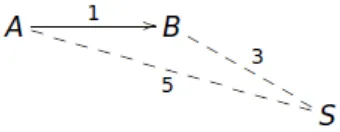
The normal routing of data for table driven routing protocols is as follows. Consider the following network with three nodes A, B and S. When any data packet needs to be exchanged among them Figure-1, node A can send data directly to node S, and B reaches through A to S.
Figure 1. Node movements in network
Figure 2. Node movements in network
After the node movement refer Figure 2, Node A reaches to S using B, before B has shifted to the direct route, this situation will present till the topology change is successfully broadcasted to B. Using Babel routing protocol, A will wait for switching routes until it can be definite that B has shifted to the direct route.
B. Destination Sequenced Distance Vector Routing Protocol.
DSDV [7] is class of Distance vector routing protocol, it is proactive routing protocol. The major drawback of Distance vector routing protocol is that it can’t prevent looping, thereby majority of the packets drop in the middle of the network resulting poor performance. The route looping problem is addressed in the DSDV. In this routing protocol each node contains routing table. This routing table is required to be updated in timely manner regularly. It floods the dynamic changes in the network to each, when two nearby nodes enter in the communication range
of each other it results in a network wide broadcast Similarly when two nodes moving apart from each other’s range there is a link breakage, Also results in a network wide broadcast. The Local movements of the nodes have global effects.
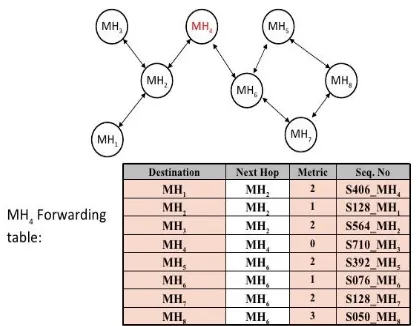
The routing table accompanies the fields: destination, next, metric, sequence number, installs time, stable data etc. Sequence numbers are normally generated from destination itself which are used for preventing loops in the network. Install time are used to delete wrong entries from table. Stable data is a pointer to a table having information on how stable a route is and also used to damp fluctuations in network. The figure-3 depicts the routing operation of packets using DSDV.
Advantages of DSDV:
1. It ensures loop free routes.
2. It solves count to infinity problem in routing which was the major drawback of distance vector routing.
3. With help of additional traffic can be avoided along the paths.
4. It maintains only best available path in routing table there by reducing space consumption.
Limitations of DSDV:
1. It takes more band width for frequent updating of routing information.
2. It do not incorporate Multi path Routing. 3. Time delay cannot be predicted for route
updating.
Figure 3. routing operation using DSDV.
C. Adhoc On-Demand Distance Vector Routing Protocol.
Ad hoc On-Demand Distance Vector Routing Protocol (AODV) [5] is a reactive routing protocol, which adopts the best features Dynamic Source Routing (DSR) and DSDV protocol. It accomplishes the message transport using the following routing mechanism which comprises of Route Discovery and Route Maintenance.
(1) Route discovery: In order to send a packet from one node to another node it initiates route discovery mechanism which finds the path from source to destination. If the route is not found in the routing table to reach the destination then RREQ (Route Request) information is flooded in to the network. Upon receiving the RREQ, the node creates a reverse routing entry towards the originator of RREQ, which is used to forward replies later. The destination or the intermediate node, which has a valid route towards the destination, replies with a RREP (Route Reply) information. On receipt of RREP, the reverse routing entry towards the originator of RREP is also created, similar to the processing of RREQ. Associated with each routing entry is a so-called precursor list, which is created at the same time. The precursor list contains the upstream nodes which use the node itself towards the same destinations.
(2) Route maintenance: To show the presence a node always sends information periodically to neighboring nodes in the form of HELLO messages. If a node does
not listen to HELLO message from the neighboring node then it updates the routing table by deleting the routing information corresponding to that node. If the destination with this neighbor as the next hop is believed not to be far away), local repair mechanism may be launched to rebuild the route towards the destination; otherwise, a REER (Route Error) packet is sent to the neighbors in the precursor list associated with the routing entry to inform them of the link failure. The following figure-4 depicts the routing operation using AODV.
Figure 4. Routing operation using AODV.
II.
ROUTE LOOPING PROBLEM
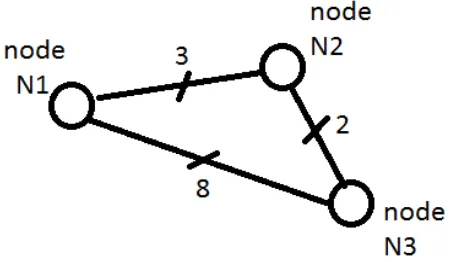
that it originated back from node N2 and consults its routing table. Node N1's routing table will say that it can reach node N3 via node N2 as still N1 is not updated with the latest routing information that is the route breakage thus sending its data back to node N2 creating an infinite loop
Figure 5. Node displacement
There may be another scenario in which if node N3 crashes if this information is not updated then node N1 and N2 will be in notion that still the route exist to N3, thus looping still persist in the network.
This route looping can cause severe problem and data packet rate come down drastically, lowering the performance of the routing protocol. So loops in the routing must be avoided there are different methods used in the different routing protocols to mitigate have in built mechanism of loop avoidance such link-state routing protocol example OSPF or IS-IS, a routing loop can be avoided by resetting the new topology for the network and this information must be updated to the neighboring nodes. Few of older routing protocols like RIP do not implement the newest forms of loop prevention and only implement mitigations such as split horizon, route poisoning,
hold down timer, trigger update and define maximum hops.
It is found that it is very essential to have built in route prevention mechanisms in routing protocol some of routing protocols like BGP, EIGRP, DSDV and Babel [3] are having built-in loop prevention scheme, they use algorithms to assure that routing loops can never happen, not even transiently.
A. Loop Avoidance Mechanism In Babel
Condition [8] just as EIGRP: The best known metric mA together with a sequence number sA (number reflecting age of metric, higher means younger and more current) to a destination network N from a router A denotes its feasible distance (FD), FDA(N) = (sA , mA). Routing information received by router A
Applying FC, count-to-infinity problem can be avoided known from original RIP implementation. However, the FC might cause starvation, when the only one route exists, and it cannot be used because it does not satisfy FC. Therefore, Babel is checking sequence numbers which is same as in DSDV to recognize outdated FD. Moreover, Babel equips routing updates also with advertising router identification to distinct between different routes to the same network prefix.
B. Loop Avoidance Mechanism In Dsdv [7]
It is proactive routing protocol which is mainly originated from the idea of Bellman-Ford routing algorithm and Routing Information Protocol (RIP). In this routing a node contains a routing table with advertising incremental routing packets. The routing information sent in regular intervals of time by a node comprises a new sequence number, the destination address, the number of hops to the
destination node, and the sequence number of the destination.
Loop Avoidance can be done in the following way: 1. If the new address has a higher sequence number, the node chooses the route with the higher sequence number and discards the old sequence number. 2. If the incoming sequence number is similar to the one belonging to the present route, a route with the minimum cost is chosen. number (incremented) is assigned to it to assure that the sequence number of that metric is always greater than or equal to the sequence number of that node.
C. Loop Avoidance Mechanism In Aodv
each hop). The RREP travels back to the originator of the RREQ (this time as a unicast). At each intermediate node, a route to the destination is set (again, unless the node has a ‘fresher’ route than the one specified in the RREP). In the case that the RREQ is replied to by an intermediate node (and if the RREQ had set this option), the intermediate node also sends a RREP to the destination. In this way, it can be granted that the route path is being set up bidirectionally. In the case that a node receives a new route (by a RREQ or by a RREP) and the node already has a route ‘as fresh’ as the received one, the shortest one will be updated. If there is a subnet (a collection of nodes that are identified by a common network prefix) that does not use AODV as its routing protocol and wants to be able to exchange information with an AODV network, one of the nodes of the subnet can be selected as their ‘network leader’. The network leader is the only node of the subnet that sends forwards and processes AODV routing messages. In every RREP that the leader issues, it sets the prefix size of the subnet. Optionally, a Route Reply Acknowledgment (RREP-ACK) message may be sent by the originator of the RREQ to acknowledge the receipt of the RREP. RREP-ACK message has no mutable information. In addition to these routing messages, Route Error (RERR) message are used to notify the other nodes that certain nodes are not anymore reachable due to a link breakage. When a node rebroadcasts a RERR, it only adds the unreachable destinations to which the node might forward messages. Therefore, the mutable information in a RERR are the list of unreachable destinations and the counter of unreachable destinations included in the message. Anyway, it is predictable that, at each hop, the unreachable destination list may not change or become a subset of the original one. technologies. The mechanism used in Babel routing protocol for loop avoidance is clearly explained. And the mechanism of loop avoidance in some other routing protocols DSDV and AODV are described. These routing protocols prove to be better in some or other situations depending upon the implementations. Finally Babel is considered a better routing protocol for mobile networks comparing to Destination-Sequenced Distance-Vector (DSDV) or Ad hoc On-Demand Distance-Vector (AODV) routing protocols. Babel is a hybrid distance vector routing protocol. Still more work need to be done in finding the newer techniques of loop avoidance considering power consumption, load balancing.
V.
REFERENCES
[1].The Babel routing protocol: RFC 6126
[2].M. Boutier and J Chroboczek. Source-Specific routing. To appear in IFIP Networking 2015. [3].Maria E. Villapol et al. Performance comparison
of mesh routing protocols in an experimental network with bandwidth restrictions in the border router. Revista de la Facultad de Ingenieria U.C.V., 28:1. 2012.
[4].Jesús Friginal, Juan-Carlos Ruiz, David de Andrés and Antonio Bustos. Mitigating the Impact of Ambient Noise on Wireless Mesh Networks Using Adaptive Link-Quality-based Packet Replication. DSN'2012:1-8. 2013.
<http://www.cise.ufl.edu/~helal/6930F01/papers/ DSDV.pdf>
[8].J. J. Garcia-Lunes-Aceves, "Loop-Free Routing Using Diffusing Computations," IEEE/ACM Transactions on Networking, vol. 1, no. 1, pp. 130-141, February 1993.
[9]. "Babel Routing Protocol for OMNeT++ More