CSEIT1831119 | Received : 12 Jan 2018 | Accepted : 29 Jan 2018 | January-February-2018 [(3) 1 : 577-584 ]
International Journal of Scientific Research in Computer Science, Engineering and Information Technology © 2018 IJSRCSEIT | Volume 3 | Issue 1 | ISSN : 2456-3307
577
Comparative Study of AODV and DSR Protocols in Wireless
Sensor Network
Kaushal Bahuguna
Department of Computer Science, Faculty of Technology, Uttarakhand Technical University, Dehradun Uttarakhand, India
ABSTRACT
Wireless Sensor Network has provided the availability of small, tiny and low cost sensor nodes which are capable to sense various kinds of physical and environmental conditions, data gathering, data processing and wireless communication. The sensing capability of these sensors results sufficiency in applications areas. However Wireless sensor network requires effective routing protocols for data transmission and process. The major challenges of Wireless sensor network are the design of robust routing protocol. The basic purpose of designing the routing protocol is to established correct and effective paths between source and destination in a secure manner. In this paper protocols AODV and DSR are compared to evaluate the performance of protocols which are network throughput, total length of trusted path, total number of hopes and total energy consumption with varying data traffic CBR (constant bit ratio) using MATLAB R2015a.
Keywords: Wireless Sensor Network (WSN), Base Station (BS), Ad-Hoc on demand distance vector (AODV), Dynamic Source Routing (DSR)
I.
INTRODUCTION
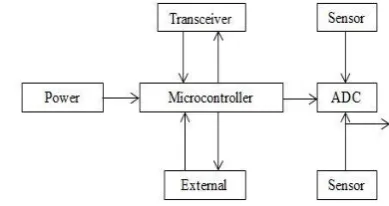
A Wireless Sensor Network (WSN) consists of [1] independent sensor which is spatially distributed to monitor physical or environmental conditions. The development of WSNs is one of the most important technologies of the 21st century [2]. In the past decade it has gained tremendous attention from researchers in all over the word. A sensor node consists of battery to the severe energy constraint, analog to digital converter, sensing device. All the components have their own functions. Due to all these components there are some factors that affect the design of sensor networks, these factors include fault tolerant, availability and production cost. However, WSNs are used in civil applications, including traffic and habitat monitoring, healthcare and home. It also used environment monitoring, military surveillance, and industrial process control [3].
Wireless sensor nodes can be used in both [4] terrestrial/earthly and underwater environment. Terrestrial wireless sensor nodes (TWSN) are used to monitor, detect and track various environmental phenomenon and events.
Figure 1. Architecture of Wireless Sensor node
There is an ecological difference between TWSN and UWSN. TWSN uses radio signals or can say radio frequency (RF) communication and it is operated at the transmission rate of Gigabits/sec. We cannot be used RF communication in underwater environment due to heavy noise. Hence we need an audio communication in underwater environment. Transmission rate of sound in water is 1481 m/s while in air is 343.2 m/s. Therefore acoustic wave provides a complete solution for underwater applications.
A. Routing Protocols of WSN
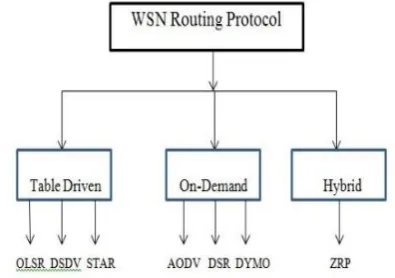
Due to the constraint resources of WSN devices, routing protocols in WSN environments [5] make the choice from existing pool of routing schemes very limited. DSR and AODV have been considered as a strong candidate for WSN due to its simplicity in finding route. However, some modification must be done in AODV in order to suit it into WSN environments. In this Section, two WSN routing protocols, LOAD and DYMO-low which based on AODV routing scheme are discussed [6]. Besides that, routing protocols such as Hi-Low also is used to provide scalability.
Figure 2. Existing routing protocols for WSN
1. Dynamic Source Routing (DSR)
DSR, as illustrated in, uses routing tables differently to AODV. If a node needs to send information, it first verifies, in its memory, the existence of a route leading to the requested destination. If not true, it sends RREQ (Route Request) in order to figure out a new route. The destination will find the number of
all the crossed stations included in the RREQ. The sequence will be transferred to the source using RREP (Route reply) as the sender will need it to send the message. In fact, DSR does not hold any routing tables except for the sender. Thus, this strategy helps reducing the energy consumed by each node.
But, updates are slower comparing to AODV. This causes important packet loss leading to a slow communication and a low network throughput. In DSR, whenever a node finds out a route to the destination, the path will be included itself. The data packet carries an entire route. So if network is not so large path will be small.
Figure 3. Network having small path
But if network will grow, in this case the byte request to stores path and data packets will also increase. So most of the time, network bandwidth will not be used.
Figure 4. Network having large path
This protocol has two basic operations
between the originating node and the target node are established in both directions. The information about the originator found in the RREQ is processed first, but subsequent entries are processed the same way:
If the routing table does not contain an entry for the originator, one is created. The next hop entry is the address of the node from which the RREQ was received. Likewise, the next hop interface is the interface on which the RREQ was received.
If an entry exists, the sequence number and hop count found in the RREQ is compared to the sequence number route and hop count in the table entry to check if the information in the RREQ is stale or should be disregarded. If an entry exists and is not stale or
disregarded, the entry is updated with the information found in the RREQ.
Figure 5 shows how RREQ and RREP messages are propagated in the network to establish a route between source node and destination.
Figure 5. DSR Route Discovery
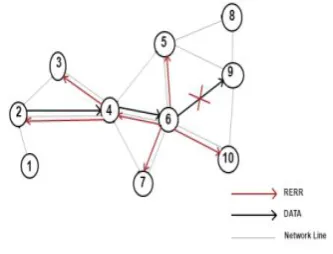
Route Management: When the route monitoring process detects a broken route, a broken flag is set for the corresponding route entry. If a node tries to use this route, a route error (RERR) message is flooded. The RERR contains information about the unreachable node, and may also contain information about nodes previously reachable through this node. A RERR warns other nodes that some nodes are no longer available through the sender of the RERR. Fig. 9 shows how RERR message is propagated in the network to indicate a broken link.
Figure 6. Dissemination of RERR Messages
2. Ad-hoc On-Demand Distance (AODV)
AODV has been considered [7] as a strong candidate for WSN due to its simplicity in finding route. It is an extension of DSR (dynamic source routing). AODV removes the drawback encountered by DSR.
AODV is a reacting routing protocol. It uses a broadcast route discovery mechanism. RREQ (route request packet) broadcast is used to find a route. RREP (route reply packet) is used to set up forward path.
In AODV node maintains its route table, which holds the information of nodes and routes. Any entry added in the routing table timer will also associate to it. It specifies at what time that the entry should be entered.
Destination sequence number is used in AODV. It is like a time stamp. At what time we have received the path information from the destination. So in case the information is old or not fresh the destination sequence number can be used to check whether the coming information is fresh or not, the conclusion is that the destination sequence number is also avoiding routing loop.
Route Request Message (RREQ): A route request packet is broadcasted through the network when a route is not available for the destination from source.
Table 1. Route Request Message
The new RREQ is discarded if there is already RREQ packet with same pair of parameters. A node that has no route entry for the destination, it rebroadcasts the RRER with incremented hop count parameter. A route reply (RREP) message is generated and sent back to source if a node has route with sequence number greater than or equal to that of RREQ.
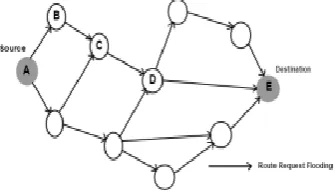
Figure 7. Route Request (RREQ) Flooding
Table 1 shows the fields of a RREQ message and Fig. Shows how RREQ message is flooded in the network in route discovery phase.
Route Reply Message (RREP): On having a valid route to the destination or if the node is destination, a RREP message is unicasted back to the source by the node. Table VI shows the fields of a RREP message and Fig shows how RREP message is propagated back to the source node from destination in the network in route discovery phase.
Table 2. Route Reply Message
The reason one can unicast RREP back is that every node forwarding a RREQ message caches a route back to the source node.
Figure 8. Route Reply (RREP) Flooding
Route Error Message (RERR): When a route that is active is lost, the neighborhood nodes are notified by route error message (RERR) on both sides of link.
Hello Messages: Hello messages are periodically broadcasted by active nodes and use to detect and monitor links to neighbors. If a node fails to receive several Hello messages from a neighbor, a link break is detected.
B. Related Work
Many researchers proposed the comparison between different routing protocols to increase the throughput, decrease the length of trusted path, number of Hops, energy consumption, jitter, End to End delay, Packet Delivery Ratio Normalized Routing Load and Data Packet Loss etc.
In [8] the authors have simulated different types of wireless sensor network with DSDV, AODV, DYMO, DSR, and OLSR routing protocols. In all these scenarios, we have used Packet Delivery Ratio, Throughput, End-to-End delay, Normalized Routing Load and Data Packet Loss as metric to analyze the performance of each considered routing techniques. Simulation results suggest that selection of routing protocol for a particular wireless sensor network has great significance on the overall performance of the network and for selecting a routing protocol, it would be better to consider the nature of the network first to achieve higher performance.
Vector routing (AODV), Fisheye, Dynamic MANET On-demand (DYMO), Source Tree Adaptive Routing (STAR) protocol, Routing Information Protocol (RIP), Bellman Ford, LANd Mark Ad hoc Routing protocol (LANMAR) and Location Aided Routing protocol (LAR). The comparison results were graphically depicted and explained.
In [10] the authors attempt have been made to compare four well known routing protocols (AODV, DSR, OLSR and DYMO) by using performance metrics like throughput, packet delivery ratio (PDR), average end to end delay ,mean jitter and packet loss ratio considering mobility factor . A comparative analysis of how mobility of nodes affects the performance of protocols is given in this paper. From the analysis we have drawn a conclusion, which protocol works well in stable condition and which protocol works well when the nodes are highly mobile.
In [11] ZRP component protocols IARP and IERP and three on demand routing protocols AODV, DSR and DYMO based on IEEE 802.11 have been analyzed and compared in this paper. Comparative performance evaluation has been done based on performance measuring metrics jitter, end-to-end delay and throughput with MAC and physical layer model. The data is collected for four metrics; Jitter, End to end delay and Throughput.
In this paper protocols AODV and DSR are compared to evaluate the performance of protocols which are network throughput, total length of trusted path, total number of hopes and total energy consumption.
II.
METHODS AND MATERIAL
We have used MATLAB (version- R2016a) as a simulator to model and simulate our scenario architecture. We have designed various scenarios with different number of nodes, pause time ranging 0s to 195s deployed in field configuration of 100x100
m2.
We can manually set the field area by requirement. In the scenario TCP (Transmission Protocol) connection was used and data traffic of File Transfer Protocol (FTP) was applied between source and destination. Each simulation was carried out for 200 seconds.
Table 3. Simulation Parameter Table Parameters Value Packet Size 512 bytes Number of packet
sent in a unit time
4000
Traffic type FTP
III.
PERFORMANCE METRICS & RESULTS
1) Total Energy Consumption: The total energy consumed by the network over a period of time depends upon the following:
Energy spent for sensing the channel Energy spent during the transmission stage Energy spent during the receptions stage Total Distance covered
Total number of Hops included
Figure 9. Total energy consumed by AODV and DSR protocols
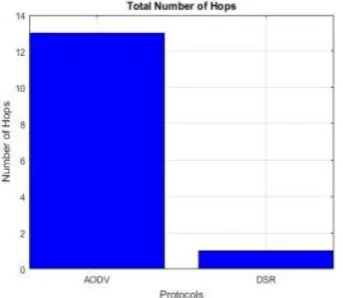
Figure 10. Total number of Hops used by AODV and DSR protocols
Hops are basically sensor nodes, during the transmission of data from Source node to destination, first source node discover the route by route discovery process or by RREQ (route request process). After route discovery process, a packet can be send from source to destination by using various nodes, such communicative nodes are known as Hops.
3) Total Length of trusted path: Total Length of trusted path depend upon the total number of Hops covered during transmission of packet.
Figure 11. Total length of trusted path used by AODV and DSR protocols
And length of each node is calculated by
√
4) Network throughput: A benchmark can be used
to measure throughput. In data
transmission, network throughput is the amount of data moved successfully from one place to
another in a given time period, and typically measured in bits per second (bps), as in megabits per second (Mbps) or gigabits per second (Gbps). Throughput of a network can be measured using various tools available on different platforms. People are often concerned about measuring the maximum data throughput in bits per second of a communications link or network access. A typical method of performing a measurement is to transfer a 'large' file from one system to another system and measure the time required to complete the transfer or copy of the file. The throughput is then calculated by dividing the file size by the time to get the throughput in megabits, kilobits, or bits per second.
Figure 12. Network Throughput of AODV and DSR protocols
The Maximum bandwidth can be calculated as follows:
Where RWIN is the TCP Receive Window and RTT is the round-trip time for the path.
Table 4. Theoretical Analysis Of Aodv And Dsr Protocols
Status AOD
V
DSR
Energy uses High Low
The following Figures 9, 10, 11 and 12 shows that the Total Energy Consumption, Total number of Hops, Total Length of trusted path and Network throughput respectively for AODV and DSR routing protocols.
IV.
CONCLUSION
In this paper, we made a comparison for AODV protocol and DSR protocol, Table 4 explains which one is energy efficient and utilize the network in the best way with minimum energy consumption so that network may remain alive for long time. Also we have used the Location Parameter for betterment of the proposed approach. The implementation of this algorithm is carried out in the MATLAB version named as R2016a.
We have first identified the distance of each nodes from the source node and the subsequent neighbor nodes. The proposed approach is totally reactive i.e., the whole processing is done on demand.
So after implementation and analysis of the proposed approach, we came to the conclusion that:
1) AODV routing protocol is more energy consumed then DSR protocol.
2) For high number of nodes DSR followed less number of Hops as compare to AODV.
3) DSR followed minimum length of trusted path. 4) Network throughput of AODV is greater if
number of nodes is greater.
Therefore we can conclude that each routing protocol has its own advantage depending upon the application it involves. There are some tradeoffs in the respective routing protocols. The comparison gives a basic idea for highly stable and utilizes
maximum of the network which is essential for a WSN life.
V.
REFERENCES
[1]. Carlo Fischione, An Introduction to Wireless Sensor Networks Draft, version 1.8 September 2014
[2]. SILICON LABs , The Evolution of Wireless Sensor Networks proposed
[3]. Delphine Christin, Andreas Reinhardt, Parag S. Mogre, Ralf Steinmetz Multimedia Communications Lab,Wireless Sensor Networks and the Internet of Things: Selected Challenges Technische Universit¨at Darmstadt Merckstr. 25, 64283 Darmstadt, Germany [4]. Sahana Salagare, P.N.Sudha, Karthik P, A
Survey on Applications and Challenges of Underwater Wireless Sensor Node International Journal of Engineering Trends and Technology (IJETT) – Volume-41 Number-4 - November 2016
[5]. Shio Kumar Singh, M P Singh, and D K Singh, Routing Protocols in Wireless Sensor Networks – A Survey proposed International Journal of Computer Science & Engineering Survey (IJCSES) Vol.1, No.2, November 2010
[6]. M.Rehenasulthana, P.T.V Bhuvaneswari, N.Rama, Enhanced location based Routing Protocol for 6lowpan, International Journal of Computer Networks & Communications (IJCNC) Vol.4, No.3, May 2012
[7]. V. D. Park and M. S. Corson, "Ad hoc On demand Distance Vector (AODV) version 4: Func- tional specification," IETF Internet Draft, July 2001.
[8]. Md. Khaled Ben Islam, Md. Al Mehedi Hasan, Julia Rahman, Md. Moyen Uddin, Impact of Routing Protocol on the Performance of Wireless Sensor Network proposed
[10]. Md. Niaz Imtiaz , Md. Mohidul Hasan , Md. Imran Ali , Md. Mostak Shaikh, Performance Evaluation of Routing Protocols (AODV, DSR, OLSR and DYMO) in MANET Considering Mobility Factor