Development of Text And Speech Database For Hindi And Indian English
Specific To Mobile Communication Environment
1
Shyam Agrawal,
2Shweta Sinha,
3Pooja Singh,
4Jesper Olsen
1,2,3
KIIT College of Engineering, Gurgaon, 4Nokia Research Center, China
[email protected], [email protected], [email protected], [email protected]
Abstract
This paper describes the method and experiences of text and speech data collection in mobile communication in Indian English Hindi. The primary data collection is done in the form of large number of messages as part of Personal communication among natives of Hindi language and Indian speakers of English.
To gather the versatility of mobile communication database among Hindi and English, 12 domains were identified for collection of text corpus from speaking population belonging to deferent age groups, sex and dialects. The text obtained in raw form based on slangs and unconventional grammar were cleaned using on language grammar rules and then tagged and expanded to explain context specific meaning of the words. Texts of 1163 participants from Hindi speaking regions and 1405 English users were taken for creating 13 prompt sheets; containing 630 phonetically rich sentences created using a special software. Each prompt sheet was recorded by at least 7 users simultaneously in three channels and recorded by a total of 100 speakers and annotated. The work is a step forward in the direction of development of standards for mobile text and speech data collection for Indian languages.
Keywords - Speech data base, Text analysis, mobile communication, Hindi and Indian English Speech, multi-lingual speech processing.
1.
Introduction
Mobile communication has significantly increased the pace of communication leading to faster message transmission in lesser time. The Multilingual and Multimodal communication with user friendly devices are in increasing demand. Communication in ones own language is becoming the necessity which should take place in the form of speech as well as in the form of written text particularly short messages. These applications help in breaking language barriers among the people of different parts of world. For all these applications it is essential to develop speech corpora to enable the researchers to study the acoustic and linguistic properties of speech and to develop models for speech recognition and synthesis. The situation in mobile communication is not same as in normal communication. With this objective in mind we have worked on speech and text collection for Hindi and Indian English for mobile communication applications. So far, very little or no effort has been made for development of corpora in these languages related to the short messages used by people for personal communication. These messages possess very different characteristics and uses slang based grammar. The understanding and recognition of these words would certainly enhance the usage of mobile phones by providing quality information at reduced cost. The language used for communication is often a cluster of many languages. Indian communication text is very often a mixture of the main language with other languages. For Example in Hindi, words from English, Urdu and Arabic are often used and vice versa for example. These
databases will help in developing new language models for speech recognition, synthesis, translation ,language Identification purpose in mobile communication environment and hence a step towards breaking the language barrier using mobile phones, Tablets & PDAs through speech.
standards for mobile text and speech data collection for Indian languages. This text and speech database is available for further development of Hindi and Indian English speech recognition, speech synthesis and speaker recognition in the mobile domain. The problem executed and the experiments gained during this work have been described.
2.
Text data collection and corpus design
2.1
Phonetic Lexicon of Hindi and English
The text database of Hindi and English is collection of words taken from messages used in mobile communication. The speech database is the collection of utterances, recorded from the above collected text. To read the written text and understand the spoken utterances knowledge of phonemes and their sounds are very important. Table 1 gives a brief outline of phonetic lexicon of Hindi and Indian English consonants similarly the phonetic lexicon of Hindi and Indian English vowels is shown in figure 2.
Table 1: Phonetic Lexicon of Hindi and Indian English
Table 2: Phonetic Lexicon of Hindi and Indian English
The text database for Hindi and Indian English was designed keeping in mind the communication among people of different age groups. For this few domains of
communication were identified which were observed to be most frequent in mobile communication. These domains helped to capture the versatility of communication. The 12 communication domains namely ‘Vacation report’, ‘Change of Plans’, ‘Family Communication’, ‘Invitation’, ‘Congratulation’, ‘Travel Plans’, ‘Business’, ‘Feedback’, ‘Teenagers’, ‘School’ and‘Open Domain’ were identified for creation of text corpus. The participants were explained about each category with the help of an example [1].
The domain ‘School’ was meant for the age group between 15-21 years , Domain , ‘Business’ was meant for persons in the age group of 22years and above. The other domains were open for persons of all age groups. The participants were briefed about the contents of the messages by giving examples.
The participants selected for this work belong to different age group, different professions and academic qualifications. The age criterion was categorized into 3 groups and based on percentage the participants were registered into the system. Table 3 shows the grouping of age and percentage of participants.
0 20 40 60 80
15-21 Year
22-50 Year
50 + Year
% Participants
% Participants
Figure 1: Percentage of participants based on age
All the participants registered in the system were necessarily having Hindi as their first language. As Hindi itself has many dialectal variations the Hindi speaking region of India was grouped into 5 groups [1]. This grouping helped us to capture the dialectal variation of different regions. By capturing these variations we look forward to develop more robust speech recognition system. For Indian English, participants all across India were selected for text and speech collection. These participants did not have English as their mother tongue. During selection process for speech collection efforts have been made so that dialectal variability of different parts of India could be captured.
provide 10sms for each of the 11 domain based on their eligibility. In total, every participant had to give at least 110 messages.
2.2
Message collection, expansion and tagging
The short messages were collected from the mobile sets of the participants with their permission, some messages were received through email and some other messages were received through an online system developed and implemented in a local area network. Since the QWERTY keyboard available with the computer does not provide friendly interface for Hindi language, a transliteration tool KTRANS based on the specifications of Itrans-3 was developed [3]. This tool receives input from the QWERTY keyboard in roman and converts the text into Hindi using Devnagri script. For Indian English text collection the conventional keyboard available with the computer was used for text collection. All these short messages were encoded in UTF-8 form. Initially these messages were in their raw form, using conventional grammar and slangs used in messaging through mobile.
There are a large number of words which are used as slang words in the actual messages. Some Examples of these words in Indian English are you = u, your = ur, please = plz, have = hv, and = n, are = r etc. In Hindi, however there are very few words which can be used as slang words. Moreover the Hindi messages are sent using roman script.
Once these raw messages were received they were next cleaned to check their correctness for grammar with reference to corresponding language grammar. Sentences which were meaningless/not clear were discarded during the process of cleaning. Sentences were manually corrected based on specifications/guidelines given by Nokia Research Center [4]. For example , it was instructed that a series of messages consisting of same or similar phrases while making the text message unique have to be altered a bit to create a more diverse database. Also it was instructed that if a message as a whole is good but it also contains a profanity, the message should be appropriately cleaned up rather than discarded as a whole. In case of Indian English initial word of sentences were capitalized and proper nouns used in the message text were also capitalized.
Once the messages had been checked for their correctness the next step was the expansion and tagging of messages. These expansions and tagging were done based on the specifications given by Nokia Research Center (NRC). The tagging is context specific and intent to simplify the meaning of the text. Table 4 shows the list of tags used to specify their meaning which varies depending upon context.
Table 3: Tags used for specifying the context specific meaning
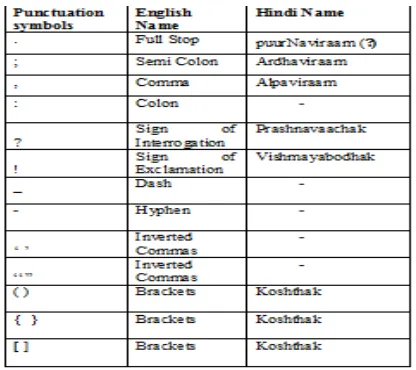
The punctuation marks and special symbols were expanded. Expansion of days, months, numbers and punctuation marks were done as their name in each language. For eg. In Indian English the weekdays Sun, Mon are expanded as Sunday, Monday etc whereas in Hindi , are expanded as ,
correspondingly. Similarly numerals zero to nine in Indian English is expanded as for (one) and for (two) and so on. Month name in Hindi and Indian English also differs. In Hindi name of month are as ऽ, etc. which corresponds to April and May months of English. During expansion all these issues were taken care of. Similar was the case with punctuation marks. Their expansion in both the databases has been done accordingly. Table 5 represents the expansion of punctuation symbols in both the languages.
Table 4: Expansions of Punctuations in English and Hindi
Words such as ‘Hi’, ‘Great’, ‘good’, ‘train’ etc are the most commonly used words of English during communication in Hindi. The analysis of collected data shows that out of all collected unique words 15% are foreign words belonging to above mentioned languages.
Hindi
Mode Message
Raw 1000 1012
3:30 PM ! Hospital "#$
Clean
1000 " 10 2012 3:30 PM " ! Hospital "#$%
Expend
FN//FN LN/ /LN C/1000/C "
D/10/D MN//MN Y/2012/Y O/ /O <H/3/H HM/30/HM P_M> " TN/ !/TN &Hospital "#$
<"&_' >
English
Mode Message
Raw
hi D have a trip with 5000 discount from 3rd may12 to goa in summer ram’s family plz buy ticket 12:30 pm.
Clean
Hi Dear, Have a trip with discount ` 5000 from 3rd may 2012 to Goa in summer with Ram’s family, Please buy ticket by 12:30 PM.
Expend
&Hi Dear <COMMA> Have a trip with discount C/ `/C CN/5000/CN from D/3rd/D MN/ may/MN to TN/Goa/TN in summer with FN/Ram’s/FN family<COMMA> Please buy ticket by <H/12/H HM/30/HM P_M> <PERIOD>
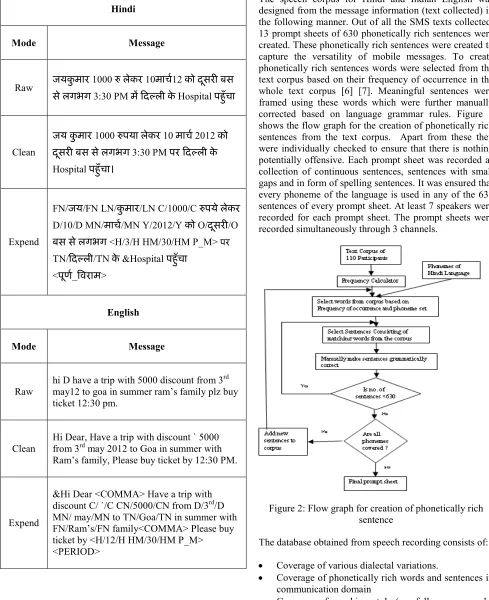
Table 5: Modes of Hindi & Indian English Sentences
Table 5 shows an example of the manner in which the raw message of Hindi and Indian English have been cleaned, tagged and Expanded using the procedures explain above.
3.
Speech data recording and annotation
The speech corpus for Hindi and Indian English was designed from the message information (text collected) in the following manner. Out of all the SMS texts collected, 13 prompt sheets of 630 phonetically rich sentences were created. These phonetically rich sentences were created to capture the versatility of mobile messages. To create phonetically rich sentences words were selected from the text corpus based on their frequency of occurrence in the whole text corpus [6] [7]. Meaningful sentences were framed using these words which were further manually corrected based on language grammar rules. Figure 1 shows the flow graph for the creation of phonetically rich sentences from the text corpus. Apart from these they were individually checked to ensure that there is nothing potentially offensive. Each prompt sheet was recorded as collection of continuous sentences, sentences with small gaps and in form of spelling sentences. It was ensured that every phoneme of the language is used in any of the 630 sentences of every prompt sheet. At least 7 speakers were recorded for each prompt sheet. The prompt sheets were recorded simultaneously through 3 channels.
Figure 2: Flow graph for creation of phonetically rich sentence
The database obtained from speech recording consists of:
• Coverage of various dialectal variations.
• Coverage of phonetically rich words and sentences in communication domain
• Coverage of environmental influence on recording through 3 channels.
The recorded speech was annotated based on the specifications of Nokia Research Center and unwanted sounds in the recording were marked. It was taken care that whenever the noise level or the quantity of unwanted sound in the recording exceeds the permissible percentage
then that sentence has to be re-recorded.
3.1
Recording Environment
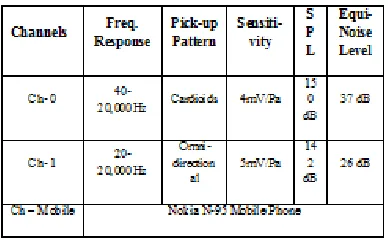
The speech signals were recorded through 3 channels simultaneously. The specification of each channel is given in table 6. The third channel used was the Nokia N-95 mobile phone.
Table 6: Specifications of recording channels used for speech recording
The signals were recorded directly in the digital format. They were recorded with a sampling rate of 16 KHz, 16 bit quantization. In case of mistake or error in recording the same text was re-recorded. All the recordings were done in office environment at an SNR 40 db. The mobile phone was kept at a distance of approximately 15 inches apart from the speaker’s mouth (see figure 2). Recording through mobile was done in speaker on mode. Auditech Audio recorder software was used for recording purpose. After the session was complete the data was transferred to the system through a Bluetooth data connection.
Figure 2: Recording through 3 channels simultaneously
3.2 Speaker Specifications
For the purpose of Hindi database speakers having their first language as Hindi were only registered for recording.100 speakers from Hindi speaking regions representing different dialects were divided into different demographic criterion (age, gender and dialect) as set out in specifications. Also a minimum was imposed on different age group given in table 3. For Indian English 100 speakers from different part of India were selected for recording. During selection of speakers, issues like their acquaintance with English language and representation of different dialects and pronunciation variations were taken into consideration. The database comprised of 40% male data and 60% female recordings. After the recording of one speaker was over the recorded speech was annotated. This annotation was done to mark the unwanted sound, some particular noise and unvoiced portion of the speech.
4.
Statistical analysis and observation
The database of Hindi and English included all the commonly used vowels and consonants, special letters, punctuation marks and symbols, numerals, name of months and currency etc. In Hindi Data Base foreign language words of English, Punjabi and Urdu were obtained. In Indian English very few foreign words were used but their occurrence was very frequent in the collected messages. The analysis shows that 15% of the unique words of Hindi and 8% of the unique words in Indian English are taken from foreign language during mobile communication in Hindi.
The comparative analysis has been outlined in table 7
Table 7 : Comparative analysis of Hindi and Indian English Database in mobile communication.
with their loved ones. The text database of 42801 unique words of Hindi and 33963 words of English would be used for developing language models, language features, language translation etc. This effort on message collection and analysis in mobile communication has been done for the first time. Thereby a new model for language and speech is being developed for a real life practical application.
8.
Acknowledgement
We would like to thank Mr. A.K. Dhamija, for help in Recording PCOM Text and Speech Data and regularly maintaining it. Thanks are extended to our supporting staff Mr. Gautam Kumar, Mr. Yogesh chand, Mr. Heera Prasad and Mr. Jagmahinder for their continuous assistance in development of text and speech corpora from various sources. Our special thanks are due to KIIT management particulars Dr. Harsh Vardhan & Ms Neelima Kamrah for their constant support and providing conducive environment for this work.
9.
References
[1] Shweta Sinha, S.S. Agrawal, Jesper Olsen (2011) Development of Hindi mobile communication text and speech corpus, Proceedings of O-COCODSA- 2011
[2] Gibbon, D., Moore, R. & Winski, R. (1997), Handbook of Standards and Resources for Spoken Language Systems. Mouton de Gruyter. Berlin, New York. 1997
[3] ITRANS- Technology Development for printing in Indian Languages using English encoded input http://www.aczoom.com/itrans
[4] Project specification for “Personal Communication (PCOM) Text and Speech Data Collection For Hindi /
Indan Englssh“ prepared by Nokia Research Centre , China 2008-10.
[5] Karunesh Arora, Sunita Arora, S S Agrawal, Niklas Paulsson, Khalid Choukri, “Experiences in Development of Hindi Speech Corpora based on ELDA standards” Proceedings of O-COCOSDA 2006
[6] Sunita Arora, Karunesh Kr Arora, S.S.Agrawal “Vishleshika: Statistical Text Analyzer for Hindi and other Indian Languages” Proceedings of International Workshop on Spoken Language Processing, TIFR, Jan 9-11, 2003 pp 191-198
[7] Karunesh Arora, Sunita Arora, Kapil Verma, S S Agrawal, “ Automatic Extraction of Phonetically Rich Sentences from Large Text Corpus of Indian Languages” INTERSPEECH2004 -ICSLP Jeju,Korea
[8] Jesper Olsen, Yang Cao, Guohong Ding, Xinxing Yang. “ A decoder for large vocabulary continuous short message dictation on embedded devices”. In Proceedings of ICASSP'2008. pp.4337-4340
[9] Zheng-Hua Tan (etac) “Speech Recognition on Mobile Devices: Distributed and Embedded Solutions” Inter Speech 2008, Brisbane, Australia -22-26 Sept.2008
[10] Z.H.Tan and B. Lindberg (Eds.) “Automatic Speech Recognition on Mobile Devices and over Communication Networks. Springer-Verlag, London-2008.