Question Answering on web data: the QA evaluation in Quæro
Ludovic Quintard
1, Olivier Galibert
1, Gilles Adda
3Brigitte Grau
3,5, Dominique Laurent
2,
Véronique Moriceau
3,4, Sophie Rosset
3,
Xavier Tannier
3,4, Anne Vilnat
3,41LNE, Trappes, France 2Synapse Développement, Toulouse, France 3LIMSI-CNRS, Orsay, France 4Université Paris-Sud 11, Orsay, France
5ENSIIE, Evry, France
Abstract
In the QA and information retrieval domains progress has been assessedviaevaluation campaigns(Clef, Ntcir, Equer, Trec).In these evaluations, the systems handle independent questions and should provide one answer to each question, extracted from textual data, for both open domain and restricted domain. Quærois a program promoting research and industrial innovation on technologies for automatic analysis and classification of multimedia and multilingual documents. Among the many research areas concerned byQuæro. The Quaero project organized a series of evaluations of Question Answering on Web Data systems in 2008 and 2009. For each language, English and French the full corpus has a size of around 20Gb for 2.5M documents. We describe the task and corpora, and especially the methodologies used in 2008 to construct the test of question and a new one in the 2009 campaign. Six types of questions were addressed, factual, Non-factual(How, Why, What), List, Boolean. A description of the participating systems and the obtained results is provided. We show the difficulty for a question-answering system to work with complex data and questions.
1.
Introduction
There are multiple paradigms used to search for informa-tion. A very popular one, embodied in search engines such as Google, is named information retrieval. In that approach, documents matching a user query are returned. The matching is often based on some keywords extracted from the query, and the underlying assumption is that the documents best matching the query provide a data pool in which the users might find information that suits their needs. The queries can be very specific (e.g. Who is pre-siding the French Senate?), or can be topic-oriented (e.g. I’d like information about the French Senate). An evolu-tion of that approach is embodied by so-calledquestion an-swering(QA) systems, which return the most probable an-swers given a specific question. For instance, to the ques-tionIn what year was the American Constitution drafted?, such a system would try to answer1787. In the QA and information retrieval domains progress has been assessed
via evaluation campaigns (Voorhees and Harman, 2005; Forner et al., 2008; Ayache et al., 2006; Mitamura et al., 2008). In these evaluations, the systems handle indepen-dent questions and should provide one answer to each ques-tion, extracted from textual data, for both open domain and restricted domain.
Quæro1is a program promoting research and industrial
in-novation on technologies for automatic analysis and classi-fication of multimedia and multilingual documents. Among the many research areas concerned byQuæro, a yearly eval-uation campaign on question-answering on web data is or-ganised. The corpus is composed of documents selected from the web from a log of real user requests. The ques-tions are also created by using the same requests. Han-dling web data is complex due to its varied nature: forum, blog, Wikipedia, journal, spam, etc. This evaluation was
1http://www.quaero.org
performed in 2008 and in 2009, showing a nice improve-ment in the systems’ performance.
2.
The Tasks
The purpose of the Quæro QA task is to answer questions on a Webdata corpus. The fundamental idea is to try to provide more precise answers while staying with an inter-face reminiscent of a public search-engine. This requires working from web data, which is what users expect to have access to. In addition to precise answers, supporting pas-sages must also be provided to convince the user of the validity of the answers. The reproducibility requirements preclude from working with live web data; a fixed but large collection was constituted instead.
Two languages were addressed: French and English. For each question participants may return up to three answers. Each answer is a combination of a short string and the pas-sage which supports it. Six types of questions were cov-ered: factual, how, why, definition, list and boolean. The answer evaluation can take 6 statuses described in section 5.:Full,Right,Unsupported,Supported,InexactandFalse. Three metrics were chosen for the primary evaluation: the Mean Reciprocal Rank (MRR), the First Hit Success (HS) or top-1, and the Hit Success (HS) or top-3. An answer is considered as correct according to these metrics if it is evaluatedFullorRight.
3.
The Data
3.1. The corpusThe document corpus for the QA evaluation has been cre-ated by taking the first 100 pages returned for the requests present in a set of web search logs. Exalead provided logs from their search-engine2. These extracted logs were in
English and in French. A filtering was made to remove
the non-pertinent (for the evaluation) requests such as sex or YellowPages. At the beginning 739,000 requests were available and after filtering 39,262 requests were kept for French, 9,820 for UK English and 29,442 requests for US English. Finally for each language the full corpus has a size of around 20Gb for 2.5M documents, from which a subset of around 500K documents was selected for the 2008 and 2009 evaluations. The table 1 gives the precise size for the French and English corpus actually used in the evaluations.
Table 1: corpus specifications French English Nb of documents 500 k 499 k Nb of sentences 82 M 92 M Nb of words 840 M 921 M Nb of characters 4.2 G 4.9 G
3.2. Questions
Different types of questions were created for the evalua-tions. Factual, Non-factual, List, Boolean and Nil ques-tions. The set of questions was created for each language by a native speaker. Table 2 shows the number of questions by type.
Table 2: Number of questions by type
2008 2009
French English French English Nb questions 250 250 507 518
Factual 167 167 295 137
Non-factual 49 49 68 44
List 20 20 21 6
Boolean 6 6 28 14
nil 8 8 95 317
Nb of words 9.15 8.26 6.21 7.07
3.2.1. Questions for the 2008 evaluation
For the 2008 evaluation the question creation process was to first select a document by using a user request and af-terwards to write a question by using the data in the doc-ument. For example for the request wood manufacturing
the search-engine proposes a lot of links. By visiting the different pages a passage was found : "Drew Graham, a wood manufacturing technician from Nova Scotia required a website to showcase his work for potential employers". The questionWho is Drew Graham ?was built from it. The associated answer waswood manufacturing technician. This methodology guarantees an answer for each question. Nevertheless, the questions are close to the text and are not necessary close to a real application. The mean number of words per question was 9.15 for French and 8.26 for En-glish. A set of 250 questions was created for this baseline evaluation, including 167 factual questions, 49 non factual questions, 20 list questions, 6 boolean questions and 8nil
questions. For each language a native speaker created the set of questions.
3.2.2. Questions for the 2009 evaluation
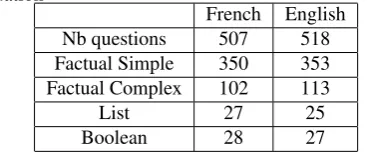
For the 2009 evaluation the questions were created with-out referring to the documents. A request was taken and a number of questions were generated from it when appropri-ate. Once again six types of questions were created for the evaluation. The simple factual, the complex factual (how, why, definition), the list and the boolean questions. Table 3 shows the number of created questions by type.
Table 3: Number of created questions by type for 2009 evaluation
French English Nb questions 507 518 Factual Simple 350 353 Factual Complex 102 113
List 27 25
Boolean 28 27
In practice 800 requests were used from the logs to create those 1,025 questions.
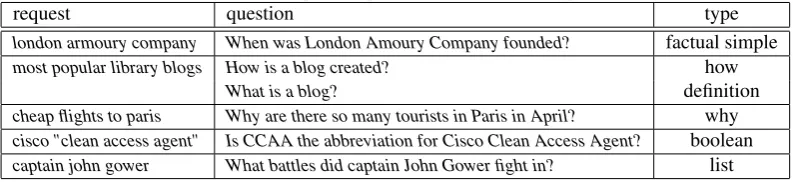
Examples of question creation from requests are presented in table 4.
When creating the questions no information was available about whether an answer is present in the corpus. In fact, a large number of questions are left for which no correct an-swer has been found. The evaluator then checks the corpus by hand for answers using a simple search engine and his knowledge. Questions for which no answer is found (nil
questions) are subsequently eliminated from the test. They comprised around 20% of the initial questions for French and 60% for English. Table 2 shows the final number of questions used in the 2009 evaluation. This large number ofnilquestion is balanced with the fact that the questions seem to be closer to a real application. As mentioned in the table 2 the mean number of words used per question is less important than for 2008: that probably means that the questions are simpler and more general, perhaps more representative of what a human would ask a system.
4.
Participants and systems
Four systems have participated to the evaluation. A descrip-tion of each system follows.
4.1. The Ritel-QA system
The LIMSI Ritel-QA system has been built on the frame-work of the RITELsystem (Schooten van et al., 2007). The RITELproject aims to integrate a spoken language dialogue system and an open-domain information retrieval system in order to enable human users to ask a general question and to refine interactively their search for information.
Table 4: Examples of question creation from request
request question type
london armoury company When was London Amoury Company founded? factual simple
most popular library blogs How is a blog created? how
What is a blog? definition
cheap flights to paris Why are there so many tourists in Paris in April? why
cisco "clean access agent" Is CCAA the abbreviation for Cisco Clean Access Agent? boolean
captain john gower What battles did captain John Gower fight in? list
100 steps and takes roughly 4 ms on a typical user or doc-ument sentence. The analysis identifies about 300 different types of entities. The analysis is hierarchical, resulting in a set of trees. Both answers and important elements of the questions are supposed to be annotated as one of these en-tities (Rosset et al., 2008).
The results of the document analysis is stored in a spe-cialized index. This index contains all pairs (type,value) produced by the analysis and provides the raw occurrence counts for each of the elements.
The first step of QA system itself is to build a search de-scriptor (SD) that contains the important elements of the question, and the possible answer types with associated weights. Some elements are marked as critical, which makes them mandatory in future steps, while others are
secondary. The element extraction and weighting is based on an empirical classification of the element types in im-portance levels. Answer types are predicted through rules based on combinations of elements of the question. Documents are selected using this SD. Each element of the document is scored with the geometric mean of the number of occurrences of all the SD elements that appear in it, and sorted by score, keeping then-best. Snippets are extracted from the document using fixed-size windows and scored using the geometrical mean of the number of occurrences of all the SD elements that appear in the snippet, smoothed by the document score.
In each snippet, all the elements whose type is one of the predicted possible answer types are candidate answers. A scoreS(r)is associated to each candidate answerr. This score is the sum of the the distances between the candidate answer and the elements of the SD, each elevated to the power−α, ponderated by the element weights. That score is smoothed with the snippet score through aδ-ponderated geometric mean. All the scores for the different instances of the same element are added together, and in order to com-pensate for the differencing natural frequencies of the en-tities in the documents the final score is divided by the oc-curence count in all the documents and in all the examined snippets, each elevated to the powerβ andγrespectively. The entities with the best scores then win.
Moreover, for thedefinitionquestions we decided to use the analyzer in order to collect all possible definitions in the data collection and to store them in a table containing the definition itself, word entry and an identifier for the docu-ment in which the definition appears. For thehowandwhy
questions, we added two markers (causeandmanner) in or-der to indicate when a procedure or an explanation is given in a document. For example,
le bleu du ciel <cause> est le
résultat </cause> de la diffusion de la lumière solaire par les composants de l’ atmosphère. (the blue of the sky is the result of the diffusion of the light by the components of the atmosphere)
peler les tomates <manner> en les plongeant </manner> quelques secondes dans une casserole d’ eau bouillante.
(peel the tomatoes by dunking them for a handful of seconds in boiling water)
These tags are useful only to extract a sentence in which the answer can be found.
For the 2009 QUAERO evaluation, we used the same sys-tem as for the 2008 evaluation but we added a new step for document selection. This new step works as a filter func-tion which is based on language models. Roughly 30% of the previously selected documents are discarded. The other difference between the 2008 and 2009 systems concerns the analyser which has been improved.
4.2. The FIDJI system
FIDJI (Finding In Documents Justifications and Infer-ences), an open-domain QA system for French (Moriceau et al., 2009), combines syntactic information with tradi-tional QA techniques such as named entity recognition and term weighting in order to validate answers. The main dif-ficulty is that an answer (or some pieces of information composing an answer) may be validated by several docu-ments. Our answer validation approach assumes that the different entities of the question can be retrieved, properly connected, either in a sentence, in a passage or in multiple documents.
In this context, FIDJI’s approach consists in checking if all the characteristics of a question (namely the dependency relations) may be retrieved in one or several documents. The system relies on syntactic analysis provided by XIP (Aït-Mokhtar et al., 2002), which is used to parse both the questions and the documents from which answers are extracted.
Figure 1 presents the architecture of FIDJI. The document collection is indexed by the search engine Lucene3. Only a
traditional bag-of-word indexing is necessary, and all fine linguistic analysis is performed online on a small subset of documents. First, the system submits the keywords of the question to Lucene: the top 100 documents are then processed (syntactic analysis and named entity tagging).
Candidate terms
Retrieved documents Search engine
Type & category Focus
Tagged sentences: named entity tags and term indexation
Vocabulary & frequencies Re-indexing and selection of
documents (FASTR)
Named entity recognition
Questions Corpus
- question analysis - term extractor
Document module
Subset of ranked documents
Answer module:
- focus recognition - answer extraction - sentence selection
Ordered sequences of answers Question module:
Figure 2: Architecture of QALC
Among these documents, FIDJI looks for all sentences containing the highest number of syntactic relations of the question. Finally, answers are extracted from these sentences and the answer type, when specified in the question, is validated.
FIDJI was originally designed to process "clean" document collections (such as well-formed and syntactically correct news articles) and obtains good results (66% of correct an-swers on CLEF 2005) (Moriceau et al., 2009). For the Quaero evaluation, FIDJI has been adapted to process new question types.
4.3. The QALC system
The basic architecture of QALC (Ferret et al., 2002) is com-posed of different modules, one dedicated to the questions, one to the corpora, and a last module in charge of produc-ing the answer. Each of these main modules is decomposed in several processes.
• Question module : the analysis of the questions allows to extract several pieces of information from the ques-tions, among them:
– an answer type that corresponds to the types of entities which are likely to constitute the answer to this question (a Named Entity type otherwise a concept type).
– a question focus: a noun phrase that is the entity about which an answer is required and thus that is likely to be present in the answer
– a question category that gives syntactic clues to locate the answer.
• Document module : the collection is indexed and searched by Lucene after a decomposition in overlap-ping units equivalent to a paragraph.
• Answer module : this module relies on two main oper-ations: the sentence scoring and the answer extraction. All the data extracted from the questions and the docu-ments by the preceding modules are used by a pairing module to evaluate the degree of similarity between a document sentence and a question. The answers are then extracted from the sentences according to several criteria:
1. the presence of the expected answer type or not. In that experiment, this part was not used for con-stituting the final result with RITEL.
2. the recognition of several question charasteristics in the sentence: focus, main verb, expected type when it is a concept type
3. the category of the question and its associated patterns.
When the expected answer type is not a named entity, the QALC system locates the very answer within the candidate sentence through syntactic patterns. Syntactic patterns of answer include the focus noun phrase and the answer noun phrase, which can be connected by other elements such as comma, quotation marks, a preposition or even a verb. Thus, a syntactic pattern of an answer always includes the focus of the question. As a result, the focus has to be determined by the question analysis module in order to enable the QALC system to find a common noun or verb phrase as answer. If we consider the following question: " What do Knight Ridder publish? "
The focus of the question, determined by the rules of the question analysis module, isKnight Ridder. This question pertains to the question typeWhat-do-NP-VB, withKnight Ridder as NP and the verb publish as VB. One answer pattern applying to this category is called FocusBeforeAn-swerVBand consists of the following syntactic sequence: NPfocus Connecting-elements NPanswer
The NPfocus is the noun phrase corresponding to the question focus within the sentence-answer. It is followed by the connecting elements, then by a noun phrase that is supposed to contain the very answer. The connecting elements mainly consist of the question verb (VB in the question type). The following answer fits with the
FocusBeforeAnswerVBpattern:
" Knight Ridder publishes 30 daily newspapers ... ", This answer was extracted from the following sentence: " Knight Ridder publishes 30 daily newspapers, including the Miami Herald and the Philadelphia Inquirer, owns and operates eight television stations and is a join venture partner in cable television and newsprint manufacturing operations. ".
Figure 1: Architecture of FIDJI
questions that the QALC analysis has typed as expecting a named entity, we applied RITEL on the passages selected by QALC for these questions. Thus, the final run mixed the answers extracted by the two systems. The performance we obtained by this collaborative strategy is better than the current results of RITEL and the results
4.4. Synapse system
The systems from Synapse Développement are archety-pal of the resource-heavy approach. Initially working in the grammatical correction field and since then diversify-ing into other fields such as question-answerdiversify-ing, they de-veloped a huge amount of resources describing the French and now the English language, including such things as a WordNet-equivalent, morphosyntaxic derivation tables, syntactic and semantic compatibility information, tables of expressions, etc. Using undisclosed algorithms leveraging these resources they can produce a complete, in-depth syn-tactic and semantic analysis of the text. Considering results of this analysis, 8 different indexes are built:
• heads of derivation. A head of derivation can be a sense for a word. In French, the verb voler has 2 differ-ent meanings (to steal or to fly). The meaningdérober
(to steal) will lead tovol(robbery), voleur (thief) or
voleuse(female thief). The second meaning,se mou-voir dans l’air(to fly), will lead tovol(flight),volant
(flying as an adjective), voleter ( to flutter) orenvol
(taking flight) and all its forms.
• proper names. If they appear in our dictionaries.
• idioms. Those idioms are listed in our idioms dic-tionaries. They encompass approximately 50,000
en-tries, like word processing, fly blind or as good as your word.
• named entities. Named entities are extracted from texts.George W. Bushor Defense Advanced Research Project Agencyare named entities.
• concepts. Concepts are nodes of our general taxon-omy. 2 levels of concepts are indexed. The first level lists 256 categories, like "visibility". The second level, actually the leaves of our taxonomy, lists 3387 subcat-egories, like "lighting" or "transparency",
• fields. 186 fields, like "aeronautics", "agriculture", etc.,
• question and answer types for categories like "dis-tance", "speed", "definition", "causality", etc.,
• keywords of the text.
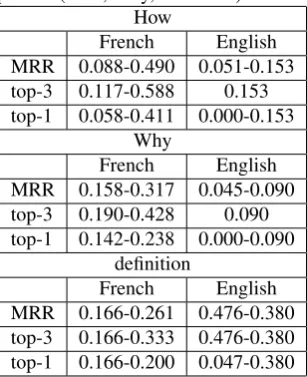
Table 7: Results for the 2009 evaluation campaign for the complex question(How, Why, definition)
How
French English MRR 0.088-0.490 0.051-0.153 top-3 0.117-0.588 0.153 top-1 0.058-0.411 0.000-0.153
Why
French English MRR 0.158-0.317 0.045-0.090 top-3 0.190-0.428 0.090 top-1 0.142-0.238 0.000-0.090
definition
French English MRR 0.166-0.261 0.476-0.380 top-3 0.166-0.333 0.476-0.380 top-1 0.166-0.200 0.047-0.380
Table 8: Results for the 2008 and 2009 evaluation campaign for the boolean question
French
2008 2009
MRR 0.0-0.333 0.208-0.827 English
MRR 0.0-0.333 0.500-0.857
6.
Conclusions & Future Work
The results of the Quæro 2009 evaluation are very encour-aging, showing that QA technology is starting to be able to deal with complex and noisy corpus. All systems increased their results between 2008 and 2009 by about 40% relative. The task definition should be kept stable to be able to as-sess progress. Still, we will try to switch to the larger (20G) original corpus in order to, hopefully, benefit from a higher redundancy in the documents. Another way is to estimate the difference between the two corpora of questions. To do so, we will study the work done in (Bernard et al., 2010). The corpus of questions with the answers and the snippets will be available in 2010. For any question about the cor-pus and how you can obtain it you may send an email at
[email protected] and [email protected]. The document corpus itself, being Web data, is not redis-tributable.
Acknowledgement
This work has been partially financed by OSEO under the Quæro program.
7.
References
Christelle Ayache, Brigitte Grau, and Anne Vilnat. 2006. EQueR: the French Evaluation campaign of Question-Answering Systems. InLREC 2006, Genoa, Italy, May. Salah Aït-Mokhtar, Jean Pierre Chanod, and Claude Roux.
2002. Robustness beyond shallowness: Incremental deep parsing. Natural Language Engineering, 8:121– 144.
Guillaume Bernard, Sophie Rosset, Martine Adda-Decker, and Olivier Galibert. 2010. A question–answer dis-tance measure to investigate QA system progress. In
LREC’10.
Olivier Ferret, Brigitte Grau, Martine Hurault-Plantet, Gabriel Illouz, Christian Jacquemin, Laura Monceaux, Isabelle Robba, and Anne Vilnat. 2002. How nlp can improve question answering. Knowledge Organization, 29(3-4).
Pamela Forner, Anselmo Peñas, Iñaki Alegria, Corina Forascu, Nicolas Moreau, Petya Osenova, Prokopis Prokopidis, Paulo Rocha, Bogdan Sacaleanu, Richard Sutcliffe, and Erik Tjong Kim Sang. 2008. Overview of the CLEF 2008 Multilingual Question Answering Track. InWorking Notes for the CLEF 2008 Workshop, Aarhus, Denmark, September.
Teruko Mitamura, Eric Nyberg, Hideki Shima, Tsuneaki Kato, Tatsunori Mori, Chin-Yew Lin, Ruihua Song, Chuan-Jie Lin, Tetsuya Sakai, Donghong Ji, and Noriko Kando. 2008. Overview of the NTCIR-7 ACLIA Tasks: Advanced Cross-Lingual Information Access. In Pro-ceedings of the Seventh NTCIR Workshop Meeting on Evaluation of Information Access Technologies: In-formation Retrieval, Question Answering, and Cross-Lingual Information Access, Tokyo, Japan.
Véronique Moriceau, Xavier Tannier, and Brigitte Grau. 2009. Utilisation de la syntaxe pour valider les réponses à des questions par plusieurs documents. InProceedings of COnférence en Recherche d’Information et Applica-tions, CORIA, Presqu’île de Giens, France.
Sophie Rosset, Olivier Galibert, Guillaume Bernard, Eric Bilinski, and Gilles Adda. 2008. The limsi participation to the qast track. InWorking Notes of CLEF 2008 Work-shop, Aarhus, Denmark, September.
Boris Schooten van, Sophie Rosset, Olivier Galibert, Aure-lien Max, Rieks Akker op den, and Illouz. 2007. Han-dling speech input in the ritel qa dialogue system. Inin InterSpeech’07, Anvers, Belgique.