Towards a
R
evised
M
otor
T
heory of L2
S
peech
P
erception
Abstract
This study aims to review, through experiment proof of a salient effect of articulatory gestures on L2 perception, the time-honored but still put-to-sideways motor theory of speech perception. On one hand, previous studies in support to motor theory were largely done by tests of mismatch in duplex perception of acoustic/speech data; or by L1 development observations. On the other hand, L2 learning studies had seldom followed the motor theory framework. The current study employed two experiments on experienced L2 English speakers from a Cantonese L1 background to finish discrimination tasks on both 1) same allophone [tr] and [tʃ] but with different gestural overlapping in real words 2) the crucial acoustic cue of distinguishing the gestural differences of the same contrast by native speakers in isolation -- namely, the CV transitions. Results showed that non-native speakers could perform native-like in experiment 2 but not in experiment 1. Though both experiments contain the same acoustic information, only experiment 1 contains the entire gestural information. It is concluded that, at least, errors in second language acquisition has a gestural basis, which might partly support the motor theory from a new perspective.
1
Introducing the theoretic dispute
Acoustic-based perception mechanisms claim that human speech is perceived by a psycho-acoustic device which is capable of normalizing incoming sound tokens and extracting acoustic cues from acoustic sounds to form phonological categories (Pisoni, 1985; Kuhl, 2000). But the myth these theories failed to give explicit clarification to lies
in the multiplicity and high variability of acoustic signal in one same percept of speech sound. Upon this possible discrepancy, it is suggested by motor theorists that the human percept for speech sounds lies in the articulatory gestures and production is based on that accordingly (Liberman and Mattingly, 1985).
Inconsistencies between the two theories of speech perception lie in what the primitive percept of speech is and the nature of processes of perception are. Acoustic perception theorists insist that human beings actively detect the acoustic information in the flow of speech, which is recognized as speech sounds. In motor theory, however, sound waves are but the product of intended articulatory gestures, which constitute an independent “language module”. In terms of process, the acoustic perception of speech inevitably introduces two systems consisting of phones, the physical property of acoustic signals; and phonemes, the mental representation or classification of meaningful sound units (Ladefoged, 1993). However, the motor theory believes that we only perceive speech sounds (not other acoustic signal) through gestures because only linguistic sounds own gestural properties.
Despite the difference, an important common ground shared by both models is that both models separate phonetics (physical stimuli) and phonology (mental representation) with different instruments. For acoustic models, the two systems are separated by two levels of processing; for motor theory, a completely torn-apart module was introduced by claiming that the ability to detect gestures is “purely linguistic” and differs from acoustic perception fundamentally (ibid.).
Previous studies supporting the motor theory of speech perception had largely adopted the methodology of duplex perception (Rand, 1974; Whalen & Liberman, 1987) to show that segmentation of speech sounds by using acoustic detail is not plausible for human language perception because experiments has shown that humans perceive CV transitions (primarily stops
Yizhou Lan
Department of Chinese, Translation and Linguistics
City University of Hong Kong
Tat Chee Avenue, Kowloon, Hong Kong
[email protected]
and fricatives) in speech sounds (part of a word) more accurately and context-dependent than non-speech acoustic sounds, like bird chirps.
More recent studies on animal perception of language (Kuhl, 2000) provided arguments against the motor theory because the ability to perceive gestures, as it was put, can also be captured by other mammals. On its basis, Best (1995) brought forward another gesture-based theory of speech perception entitled the direct-realist view. Its basic viewpoint, different from the motor theory, is that language perception is not innate, because although without intended gestures, other animals can still distinguish human vowels. Rather, human beings perceive speech by generalizing others’ gestures, no matter he or she have such knowledge of gesture.
Even so, the direct realist theory faces two challenges. Firstly, it did not specify what are the gestures being utilized as categories, not like motor theory’s predecessors’ work with articulatory gestures (Browman and Goldstein, 1987, 1992), and is inherently phonemic. The other limitation is that it did not fully explain how sounds are learned, although there are hints that it was through frequency-based statistical learning. Maybe the cause was the fear to be labeled another auditory-based theory, because statistical learning of speech sounds is inherently normalization of psycho-acoustic data. Both challenges cannot be resolved by only using L1 data. The reason is shown in the section below.
2
Employing L2 as a condition to unveil
the
motoric
nature
of
speech
perception
Second language acquisition of speech is believed to be influenced by the native language of the learners. Especially, experienced learners who are considered near-native in proficiency will often establish stable intermediate categories in an audio-based learning model, the most widely renowned being the Speech Learning Model (SLM, Flege, 1987; Flege et al., 2003). In essence, L2 provides another dimension to testify language perception models by providing an intermediate, if not impoverished, level between L1 and L2 in the speaker’s ontogeny (Major, 2002), and thus may depict different perceptual accuracy in acoustical or phonological tasks.
The motor theory is not exactly what others (Massaro and Chen, 2008) has criticized that perception comes through multiple sources. According to Liberman and Mattingly (1985)
“...the string of phonetic segments is overlapped in the sound ... [with] no acoustic boundaries. Until and unless the child (tacitly) appreciates the gestural source of the sounds, he can hardly be expected to perceive, or ever learn to perceive, a phonetic structure.” Under an experiment design of L2 perception, it will be even more demanding for L2 speakers to tactically retrieve intended gestures which are different from that in L1.
The basic rationale of motor theory is that gestures are invariant (and that acoustics are too variable), and thus more prone to be regarded as the percept under the ecological mechanism of human perception (Galantucci et al., 2006). This claim has been more amplifiably proven by this experiment because variations in gestures have caused serious perceptual problems, but not the ‘crucial’ acoustic cue of formant transition in L2 perceivers.
3
Gestural difference in Cantonese L2
speech of English
tr-
cluster
Cantonese speakers were reported by previous literature to have an inclination to mispronounce English C-r clusters. They either deleted the [r] or substituted it to [w] (Hung, 2002; Chan, 2006). However, for alveolar clusters (tr- and dr-), previous studies showed that considerable affrication was a feature of their production (Lan and Oh, 2012). According to SLM, Cantonese speakers should be able to perceive them in a
tr-/ch- contrast in the initial position, given that they had ample experience in using English.
Even for native speakers, the acoustic signals of [r] in C-r production with the two vowel contexts are very similar. However, the
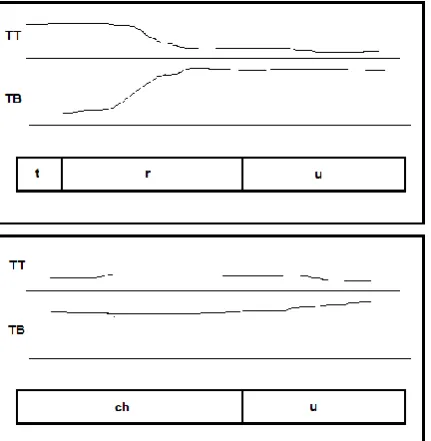
tr-clusters in two vowel conditions, /i/ and /u/, were observed to have different gestures. The gestural difference can be shown in the following four schematic scores (following Browman and Goldstein, 1987) of gestures of CV syllables in
true, chew, tree and Chee, respectively (See Figure 1). TT stands for Tongue Tip constriction degree. If the tongue tip moves forward or frontward, the magnitude would be high; TB stands for Tongue Body constriction degree. If the tongue body moves backward, the magnitude would be high.
Figure 1: Schematic gestural scores for true, chew,
tree and Chee, from top to bottom.
Note that the contrast of gestural scores for the [r] part in tr-i and ch-i is clear, because the [r] in /i/ environment shows both TT backward and TB retraction; whereas in ch-i, TT was always in forward position and TB always in rest position. However, the contrast of in tr-u and ch-u is more opaque because the TT and TB for both tr- and
ch- words are eventually attaining the same position. Temporal overlap has made the sound contrast even more indiscernible to L2 learners.
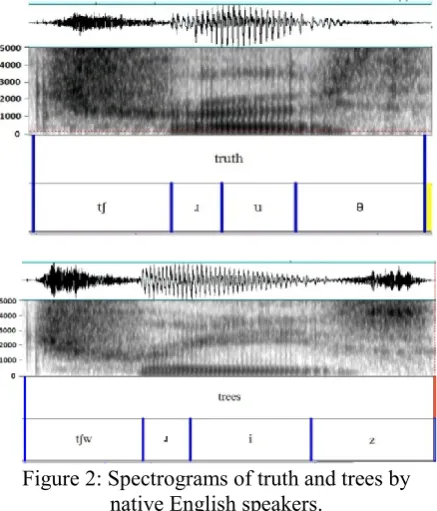
Figure 2: Spectrograms of truth and trees by native English speakers.
Apart from the impressionistic data, 92 of these tokens (46 trees and 46 truth productions) by native English speakers were analyzed for F3 in the [r] part and the results were sent to an independent variable t-test. Result showed that the difference of F3 in two vowel context was insignificant [t=-2.09, df=90, p=.305].
4
Experiment protocols for current
study
The two experiments employed a contrast of word perception and non-speech acoustic detection respectively. In experiment 1, speakers were presented tr-i and tr-u sounds with ch-i and ch-u
sounds as contrasts for discrimination perception. And in experiment 2, the CV formant transition parts are elicited from the speech and participants were asked to distinguish the acoustic segments from tr-i and ch-i, as well as tr-u and ch-u.
If the results are in support to auditory perception, as suggested by SLM, then the perceptual accuracy, no matter high or low, should be the same for L2 speakers because in both vowel contests, [r] sounds fully represents the acoustic data which is needed for L2 speakers to successfully/unable to distinguish the target sound contrast. The accuracy rate depends on the degree to which Cantonese speakers categorize the /r/ sound into phonemes correctly.
If the results support the classic motor theory, provided the difficulty in gestural contrast of tr- in the /u/ context by the learners, then the perceptual accuracy for full words should be better than the
acoustic differences because of prior duplex experiments on native speakers has shown that acoustic perception of elicited “perceptual cues” should be poorer if not supported by the information of intended gestures by complete words. Also, the higher predicted accuracy may be attributed to the motor theorists’ belief that human perception of speech sounds is modular and universal, which enables the universal grammar to help L2 learners perceive the intended gestures. A further prediction is that the accuracy for vowel contrasts of /i/ and /u/ should be different because of the different gestural difficulty demonstrated by the previous section.
4.1
ParticipantsParticipants were three adults (2 females and 1 male, mean age=27.5) working as administrative staff at City University of Hong Kong. They all spoke English fluently as their working language. None of them had exposure to other foreign languages except English. All participants were right-handed with no reported hearing or motor-control defects. They did not have prior exposure to musical training. For controlling, three native monolingual English speakers (2 females and 1 male, mean age=26.5) from California, U.S. also participated in the study and went through the same procedure.
4.2
StimuliThe perception tests were carried out in the Phonetics Lab, City University of Hong Kong. The listening perception materials used in two experiments are elicited from the same set of language productions by a native speaker. Stimuli words were produced by another Native American English speaker in a carrier sentence of “Now I say_____”.
participants × 2 experiments × 5 vowels × 10 repetitions).
4.3
ProcedureBoth experiments utilize the discrimination paradigm of the sounds in the minimal pairs. In this paradigm, three consecutive words (e.g.,
treek/tweek/tweek) were played, where the third word was identical to either the first or the second one. The participants were asked to circle the correct word on the answer sheet. The inter-stimulus intervals (ISI) were set at 250 milliseconds for both tasks.
To resolve a possible problem that might hinder reliability of stimuli induced by acoustic differences other than from the critical consonant part, the original vowel parts of the stimuli were replaced with the identical vowel which was sectioned from one token so that vowel quality remained consistent for the tasks. For instance, the [i] in one clear production of “treek” was used for all tokens with /i/ vowels in both experiments.
5
Results
5.1
Results by participant groupsFor the sake of contrasting the two experiments and highlighting the difference, the results were first presented with Cantonese and native English contrast and then by experiments.
Native English speakers showed an average accuracy rate of 98.8% in discerning the tr-/
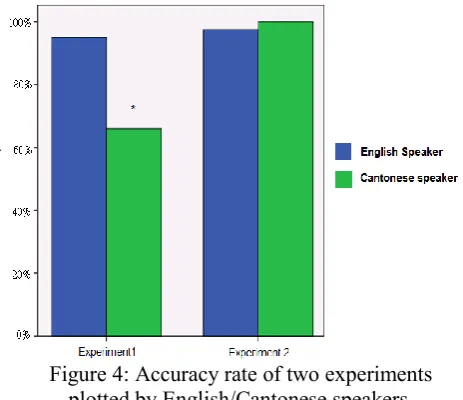
ch-contrast in words (N=300, std=.111). The difference between experiment 1 and 2 was 100% and 97.5%, which was statistically significant [t=-2.259, df=298, p<.05]. The difference between subjects was not significant [F(2, 297)=.302, p=.740]. The effect of vowel was not significant in experiment 2 [F(4, 145)=1.021, p=.398]. It was not significant in experiment 1 either.
For native Cantonese speakers, the overall accuracy rate was 81% (N=300, std=.397). The difference between experiment 1 and 2 was 66% and 95% [t=5.534, df=298, p<.0001]. The difference between subjects was insignificant [F(2, 297)=1.557, p=.214]. The effect of vowel was not significant in experiment 2 [F(4, 145)=.511, p=.728]. However, it was significant in experiment 1. [F(4, 145)=3.031, p<.05]. Among the vowel members, Tukey’s post-hoc tests showed that the difference of vowel /i/ and /u/ were significant [/i/: md=.45, std.E=.145, p=.02; /u/: md=.45, std.E=.145, p=.02] (See Figure 3).
Figure 3: Accuracy rates of English and Cantonese speakers plotted by vowel types.
5.2
Results by experimentsThe comparison of Cantonese and native English speakers’ accuracy rate in each experiment was done, too. For experiment 1, the difference was significant [t=10.116, df=298, p<.0001]. However, for experiment 2, the difference was insignificant [t=1.136, df=258, p=.257] (See Figure 4).
Figure 4: Accuracy rate of two experiments plotted by English/Cantonese speakers.
6
Discussions
of tr- cluster in two vowel contexts. The result shows that Cantonese speakers perform poorly in real-word perception tests but near-ceiling in acoustic sound perception. This shows that acoustic sound is not a basis for L2 speech perception and the results supports the motor theory that speech is not perceived through sounds exclusively. However, the result that L2 speakers having an intermediate rate of successfully perceiving the L2 sounds raises questions towards motor theory’s claim that the language modular is innate and cannot be shaped by experience.
Through these results, a new model of gestural learning was proposed through the discussions above. This model would bring fine-grained gestural percepts and frequency-based normalizing process of category formation together. Further investigations, such as more sound contrasts from more L1 and L2 linguistic backgrounds, as well as real-time EMA or fMRI imaging of L2 speakers’ articulations may be done to testify it in detail.
Acknowledgments
The author is grateful to Dr. Dong Yanping for her advice, which gave birth to an initial idea of this study.
References
A. M. Liberman and I. G. Mattingly. 1985. The motor theory of speech perception revised. Cognition 21 (1), 1–36.
B. Galantucci, C. A. Fowler, and M. T. Turvey. 2006. The motor theory of speech perception reviewed. Psychonomic bulletin & review, 13(3), 361-377. C. P. Browman and L. Goldstein. 1987. Tiers in
articulatory phonology, with some implications for casual speech. Haskins Laboratories Status report on speech research, 1-30.
C. P. Browman and L. Goldstein. 1992. Articulatory phonology: an overview. Phonetica, 49, 155-180. C. T. Best. 1995. A Direct Realist View of
Cross-Language Speech Perception. In Strange, W. (ed.). Speech perception and linguistic experience: Issues in cross-language research, 171-204.
C. T. Best, G. W. McRoberts, and E. Goodall. 2001. Discrimination of non-native consonant contrasts varying in perceptual assimilation to the listener’s native phonological system. Journal of Acoustics Society of America, 109(2), 775–94.
D. B. Pisoni. 1985. Speech perception: Some new directions in research and theory. Journal of the Acoustical Society of America, 78, 381-388.
D. H. Whalen. 1981. Effects of vocalic formant transition and vowel quality on the English [s]-[S] boundary. Journal of the Acoustical Society of America, 69, 275-282.
D. W. Massaro and T. H. Chen. 2008. The motor theory of speech perception revisited. Psychonomic bulletin & review, 15 (2), 453-457.
J. E. Flege. 1987. The production of "new" and "similar" phones in a foreign language: evidence for the effect of equivalence classification, Journal of Phonetics, 15, 47-65.
J. E. Flege, C., Schirru., and I. R. A. MacKay. 2003. Interaction between the native and second language phonetic subsystems, Speech Communication, 40, 467-491.
P. K. Kuhl. 2000. A new view of language acquisition. Proceedings of the National Academy of Sciences, 97(22), 11850-11857.
P. Ladefoged. 1993. A course in Phonetics. Harcourt Brace Jovanovich College Publishers.
R. C. Major. 2001. Foreign Accent: The Ontogeny and Phylogeny of Second Language Phonology. Mahwah, NJ: Lawrence Erlbaum Associates. T. C. Rand. 1974. "Letter: Dichotic release from
masking for speech". The Journal of the Acoustical Society of America, 55 (3), 678–680.
T. N. Hung. 2002. Language in contact: Hong Kong English phonology and the influence of Cantonese. In Kirkpatrick, A. (ed.). Englishes in Asia: Communication, Identity, Power and Education. Melbourne: Language Australia,191-200.
V. A. Mann and A. M. Liberman. 1983. Some differences between phonetic and auditory modes of perception. Cognition, 14, 211-235.