Article
1
A Function-as-a-Service Based Fog Robotic System
2
for Cognitive Robots
3
Hyunsik Ahn 1*
4
1 Department of Robot System Engineering, Tongmyong University; [email protected]
5
* Correspondence: [email protected]; Tel.: +82-10-2518-4777
6
Received: date; Accepted: date; Published: date
7
Featured Application: Robot Cloud and Cognitive Robots.
8
Abstract: Cloud robotics is becoming an alternative to support advanced services of robots with low
9
computing power as network technology advances. Recently, fog robotics has gained attention since
10
the approach has merit relieving latency and security issues over the conventional cloud robotics.
11
In this paper, a Function-as-a-Service based Fog Robotic (FaaS-FR) for cognitive robots is proposed.
12
The model distributes the cognitive functions according to the computational power, latency and
13
security with a public robot cloud and fog robot server. During the experiment with a Raspberry Pi
14
as an edge, the proposed FaaS-FR model shows efficient and practical performance in the proper
15
distribution of the computational work of the cognitive system.
16
Keywords: Robot Cloud; Cognition as a Service; cognitive robots; sentential cognitive system; cloud
17
service; human–robot interaction
18
19
1. Introduction
20
Cloud computing is a widely advancing information and communications technology service
21
and is a key technology of the advanced industry. Robot clouds applying cloud computing to robots
22
allows robots to connect to a cloud environment, uses a huge computational infrastructure, and
23
obtains results of high level programs from the cloud [3]. The cloud robots share information
24
including environments, actions, and objects and offload heavy computation to a cloud server.
25
However, such cloud robot services could give rise to security issues of privacy breaches and
26
latency issues of control signals delays for robot motions. Recently, to solve these issues, fog robotics,
27
distributing computing work properly with fog servers and edges, is getting attention as it has the
28
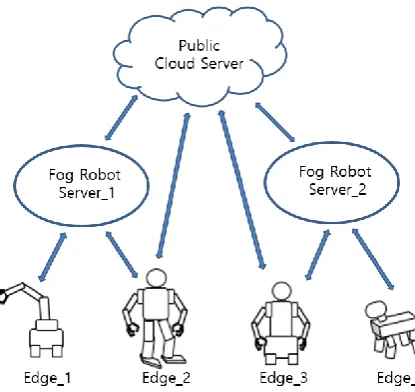
advantages of reducing latency and security matters (Figure 1) [18,19,25].
29
These merits of fog robotics can accord with cognitive robots to reduce the cost of the robot and
30
its Human-Robot Interaction (HRI) services. If the cognitive robot adopts fog robotics model
31
offloading burdened computing tasks to clouds or fog servers, it also needs to consider privacy,
32
security and latency as well as abundant computing power for advanced intelligent functions.
33
Especially, the cognitive robots can represent experienced cognitive information, store it in a proper
34
form, and retrieve it using a reasoning procedure. It means that the fog robotics model of cognitive
35
robots need to consider the characteristics of the cognitive structure.
36
In this paper, a Function-as-a-Service based Fog Robotics (FaaS-FR) for the Sentential Cognitive
37
System (SCS) of cognitive robots is proposed. FaaS-FR model includes the edge as the local robot
38
system, the fog robot servers for the private, security and computing power, and the robot clouds for
39
the high performance computation. The previous SCS consists of multiple modules to recognize new
40
events that the robot has experienced and describes them in a sentential form to be stored in a
41
sentential memory and retrieved with a reasoning process in the future [24]. In this approach, the
42
SCS adopts FaaS-FR, and each module of the SCS is classified with the functionality of privacy,
43
security, and latency as well as required computing power. According to the functionality, the
44
computation of modules is executed on the edge or offloaded to fog robot servers or robot clouds [7].
45
The merit of FaaS-FR is that advanced services utilizing high performance computation is
46
possible even in the edge system of low cost and low computing capability. A module in the SCS
47
acquires and transfers raw data to the fog sever or a cloud. Then, the server processes the data and
48
sends back the results to the SCS. In the implementation and test, we can observe that the FaaS-FR
49
can make cognitive robots more efficient via proper distribution of the computing power and
50
information sharing.
51
The contributions of this study are as follows: (1) a fog robotics model, FaaS-FR model, is
52
suggested to be applied to a cognitive robot for efficient and advance services at a low cost. (2) with
53
this model, a functionality based modular networking in SCS of a robot is proposed and tested.
54
This paper is organized as follows. In section 2, related work on robot cloud and fog robotics are
55
described. Section 3 details the theoretical background of the proposed FaaS-FR model. Section 4
56
describes an application of the model to a SCS for a cognitive robot platform. Section 5 provides the
57
implementation of the proposed approach to a service robot through experimental results. Finally
58
conclusions and future work are presented in section 6.
59
60
61
62
63
Figure 1. Fog robotics schematic [27]
64
2. Related Work
65
Cloud robot services applying the technology of cloud computing to robots utilize computation,
66
storage, and communication in internet infrastructure. For instance, RoboEarth, a pioneering robot
67
cloud service, supports the service of storing software components, mapping information, behavior
68
information, and object information in a database (DB) and utilizing a cloud engine for services;
69
robots can use it by virtualizing the information [9].
70
However, there have been different opinions regarding the usefulness of robot clouds. An
71
advocative side, on one hand, agrees that a robot can enhance its capability by combining it with
72
robot cloud services. Kuffner insists that the robot cloud, for a robot system having limited computing
73
power, can carry over burdened tasks to cloud servers [10]. On the other hand, Laumond noted that
74
the approach of robot clouds could result in harmful effects to the performance of robots [11]. He
75
insisted that the rapid advancement of real-time capability of on-board processing could make the
76
concept of cloud robotics meaningless, and the cloud robot depending on the network could weaken
77
the autonomy and reliability of robots.
78
Nevertheless, a robot cloud has characteristics of cloud computing and robot technology and the
79
unique characteristics of the robot cloud itself. Particularly at the robotics level, robots in the robot
80
cloud can communicate with each other to share the burden of tasks rather than serve as isolated
devices that allow only data exchange with remote servers. As a result, the robot cloud will optimize
82
the outstanding achievements that exist in robotics.
83
There are different levels of service in the field of cloud computing comprising
Infrastructure-84
as-a-Service (IaaS), Platform-as-a-Service (PaaS), and Software-as-a-Service (SaaS) [12]. These models
85
can be applied to robot clouds and multiple studies regarding them have been introduced.
86
Mourandian et al. [13] highlighted aspects of IaaS in robotic applications. They proposed an
87
architecture that enables cost-effectiveness by delegating virtualization and dynamic tasks to robots,
88
including robots that could belong to other clouds. Gerardi et al. [14] proposed a PaaS approach to a
89
configurable suite of products based on cloud robotics applications. It allowed end users to be free
90
from the low-level decisions needed to construct architectures of complex systems distributed among
91
robots and clouds. For example, if the REALabs platform was built using a PaaS model, it was
92
predicted that many robot applications could be developed in this area [15]. In the framework of
93
SaaS, a robot used a remote server for the training of locations with a neural network [16]. This case
94
was used to establish communication between the cloud and the robot through a wide environment
95
and to identify its location in images transmitted by the robot at the SaaS level. Chen and Hu [17]
96
described Robot-as-a-Service (RaaS) with the Internet of Things. The RaaS was able to create a local
97
pool of intelligent devices using autonomous and intelligent robots and make local decisions without
98
communicating with the cloud.
99
However, networking robots has given rise to security and latency issues. DeMarinis et. al [26]
100
checked a number of robots can be accessible and controllable from the Internet and dangerous to
101
both the robot and the human, and the robot’s sensors can be viewed to be a threat to privacy.
102
Chinchali et. al [19] issued that cloud robotics comes with a key communicating with the cloud over
103
congested wireless networks may result in latency or loss of data, and formulated offloading as a
104
sequential decision making problem, and proposed a solution using deep reinforcement learning.
105
To overcome security and latency matters of cloud robotics, fog robotics, a new network model,
106
was introduced [27]. The model, as shown in Figure 1, distributes storage, computer and networking
107
resources between the cloud and the edge in a federate manner. Gudi et. al [25] first suggested fog
108
robotics that fog robot servers gather the cloud information and server it to the private robots.
109
Tanwani et. al [18] introduced a fog robotics approach for secure and distributed deep robot learning.
110
It provides that deep learning models are trained on public synthetic images in the cloud, the private
111
real images are adapted at the edge within a trusted network.
112
In summary, the robot cloud systems aim to improve robot performance with the aid of clouds
113
enhancing computing power and data management capability. However, the robot cloud structure
114
is challenged by the issues of real-time control, synchronizations, and stability risks. Alternatively,
115
the fog robotics aims to improve the performance of robots by distributing computation burden with
116
cloud, fog, and edge computing works, and at same time enhancing security and latency. In the next
117
section, an advanced fog robotics model, the FaaS-FR model, distributing computing tasks according
118
to the cognitive functions based on SCS is detailed.
121
Figure 2. The schematic of FaaS-FR
122
3. FaaS -FR model for cognitive robots
123
In the cloud robot paradigm, there are various deployment models, including private,
124
community, public, and hybrid clouds. Wang et al. introduced these models into the robot clouds [6].
125
This study proposes and evaluates various connection methods that occur in the implementation of
126
cloud robots. Public cloud models exchange large amounts of data and information across networks
127
and clouds. The cloud can be used to share data in a computing environment that everyone can share.
128
However, the exclusive materials of an individual should be served in a proper separate manner. In
129
a personal robot cloud, a server or cloud is privately connected to a home or company. Personal robot
130
clouds can form an external and independent cloud and distribute the robot's computing power
131
through the servers.
132
In the view of fog robotics, the function of personal cloud servers can be matched with fog robot
133
servers which personally support edges (local robot system) [25]. Therefore, we adopt the term of
134
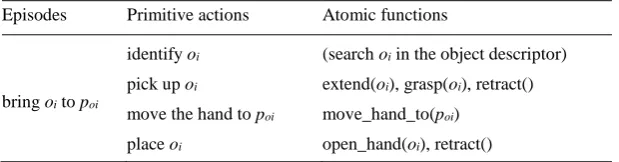
“fog robotic server” than “cloud robotic server” because the server works not for other’s robots but
135
for specific robots privately.
136
However, the fog robotics models generally have a hierarchical model consisting of clouds, fog
137
servers, and edges. With these models, it is difficult for edges directly to access to a cloud and get the
138
result of services which have specific functionality with enough computing power.
139
In this paper, to overcome these matters, an advanced model, FaaS-FR model, is proposed as
140
shown in Figure 2. In the model, all the functional modules of cognitive robot are classified according
141
to privacy, security and computing power, and have their own networking with concept of fog
142
robotics. The functions of the robot are suitably divided for being worked on edges, fog robot servers,
143
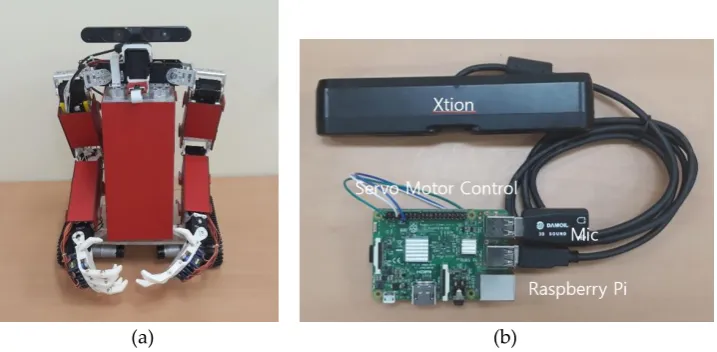
and public robot clouds respectively. In the case of information possibly being a violation of privacy,
144
it is computed and stored in an edge or a fog robot server. If the edge need to uses the public robot
145
cloud to utilize an advanced computing service, it can access the cloud directly to reduce latency or
146
go through a fog robot server to the cloud. The reason that a new term is coined, FaaS, is that the
147
classified functions of robot can be offloaded on the cloud or fog servers according to the security,
148
latency, privacy, as well as computing power
151
Figure 3. A schema of cognitive robot functionality
152
153
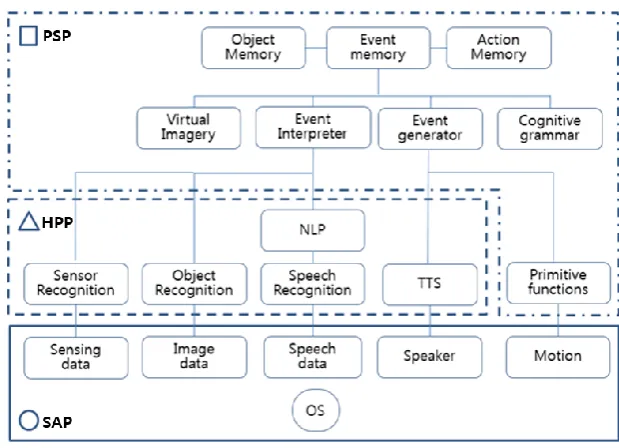
Figure 3 shows a schema of modular cognitive functions of a general structure of cognitive
154
robots. It has perception modules comprising sensing, object recognition, and speech recognition.
155
Therefore, the robot can talk with humans regarding the visual situation that the robot recognizes.
156
The robot also has behavior modules such as utterance and motion. In the higher part, there are
157
interpretation and generation modules which can produce descriptive cognitive information from
158
the perceptional. Memory modules are used to store the descripted cognitive information, and can
159
be retrieved for the future by a reasoning procedure with virtual imager and cognitive grammar. In
160
the view of functionality including privacy, security, safety, latency, and computing power, the
161
functions can be divided with 3 parts; Sensing and Actuation Part (SAP), Privacy and Security Part
162
(PSP), and High Performance Part (HPP).
163
The SAP which covered by solid line and marked with a circle, is the essential part including
164
OS, sensing and actuation which are indispensable for the robot. This part should have OS,
165
perception functions including sensors, cameras and microphones, and behavior functions including
166
speakers and actuators. These functions are dependent on the hardware of the robot and cannot be
167
taken over by others.
168
The PSP covered with dashed single-dotted line and marked with a rectangle should be installed
169
on edges or fog servers. For low cost robot services with minimum computing power and network
170
infrastructure, this part needs to be offloaded to clouds; however, these functions can be related to
171
private and security information. Therefore, it is reasonable that this part is working on the edges or
172
a fog servers. In the case that the private information is not serious and well secured, it could be
173
offloaded to a public cloud.
174
The HPP which has dashed line with a triangle marked is dependent on public robot cloud tools
175
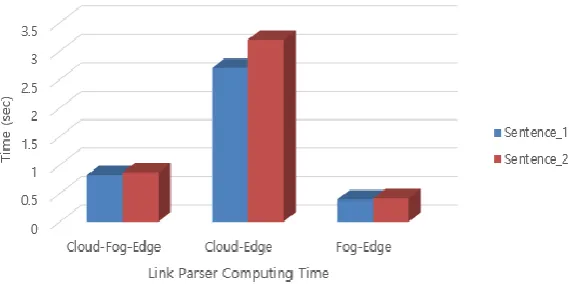
that can supply high-quality performance such as speech recognition, Natural Language Processing
176
(NLP), 2D and 3D object recognition, and Text-To-Speech (TTS). The Google Cloud Application
177
Programming Interface (API) supports multiple modules of deep learning in its public cloud [8].
180
(a) (b) (c) (d) (e) (f)
181
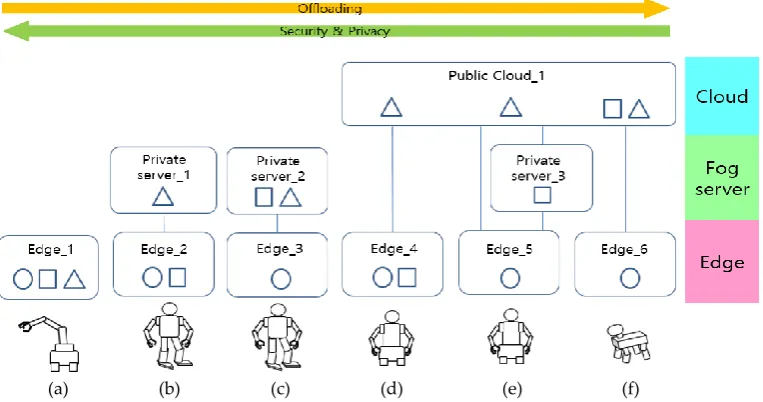
Figure 4. Various distribution of robot functions and offloading levels
182
(a) Stand-alone type, (b) and (c) are using private servers for offloading computation burden, (d),
183
(e) and (f) adopt clouds. The proposed FaaS-FR adopts model (e).
184
185
Figure 4 shows various distribution of functions and offloading levels. As shown in the top,
186
according from the left to right side, the functions of the robot is dependent of the servers and clouds.
187
On the contrary, the security and privacy could be weaken with the direction.
188
The stand-alone type (a) is a conventional type of robot computing in which the edge covers all
189
parts (SAP, PSP and HPP). (b) and (c) both use private servers for the functional parts. Edge_3 of (c)
190
offloads the PSP to the private server, then the edge can work with lower computing power. In these
191
cases, the HPP and PSP should be developed and installed on the server by developers for the
192
functions of the robots.
193
In the case of (d) and (f), the conventional robot cloud models, all the high performance
194
computations is offloaded on the cloud. In the case of (d), the edge has computing power to cover
195
PSP. However, the model of (f) even transfers the PSP to the cloud to reduce the computational load
196
of the edge. We will be able to see this case for mass robot service providers. The public cloud should
197
safely manage private information for the robot
198
The model of (e) shows the typical characteristics of fog robotics. It provides flexibility in
199
adopting applications among the edge, the server, and the cloud. Specifically, Private Server_3 can
200
be a fog robot server to do the job of PSP. This is applicable to achieve high quality functions with
201
low computing power by offloading them to clouds. In this case, there are two kinds of services: The
202
first method is that the edge directly access the cloud for the HPP service. The other method is that
203
the fog robot server mediates for receiving the service from the cloud and additive processing, and
204
then transfer it to the edge. In this paper, the model (e) is adopted as FaaS-FR.
205
206
Table 1. The characteristics computing of FaaS-FR
207
Computing type Functional parts Service levels
Public robot cloud HPP PaaS, SaaS
Fog robot server PSP PaaS, SaaS
Edge OS, SAP -
208
The FaaS-FR model can be applied according to the specified functionality and the service level.
209
Table 1 shows the level of FaaS in the fog robotics model. In the cloud, the function is offloading high
210
performance computation. In the case of fog robot server, it is used to privacy and security as well
211
computing power distribution. Edges, shallow computing systems, covers OS and elementary data
212
acquisition and actuation. For the clouds and fog servers, both PaaS and SaaS can be adopted
according to the functionality and the computing power of the edge. In the PaaS case, the user should
214
develop an application using APIs supported by the PaaS [22]. On the contrary, SaaS supports
215
applications without any application development.
216
217
218
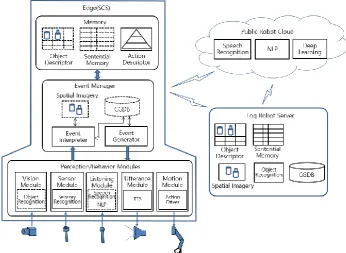
Figure 5. The block diagram of the SCS based on FaaS-FR that offloads the computation of modules.
219
220
Table 2. Examples of sentences stored in sentential memory
221
# Time Module
Sentence
VERB AUX ARG1 ARG2 SPACE TIME
1 t1 VM appeared - (NP A cup) - (PP at (NP x, y, z))
2 t2 LM move - - (NP the cup) (PP to (NP the front) (PP of (NP the bottle))) -
3 t3 MM picked up - (NP I) (NP the cup) - -
VM: Vision module, LM: Listening module, MM: Motion module
222
4. A SCS model based on FaaS-FR
223
Figure 5 shows that the proposed FaaS-FR model which is applied to the SCS of a service robot.
224
The functions are categorized according to cognitive functions for allocation according to
225
functionality. The modular functions with dotted line are offloaded to a public robot cloud or a fog
226
robot server. The applications for the functions use APIs of PaaS or SaaS of the cloud and the fog
227
server.
228
In the memory of the SCS, the sentential memory stores a series of sentences describing cognitive
229
information of events as shown in Table 2 [24]. When an event occurs in a module, the system
230
converts the cognitive information of the event to a sentential form and stores it in a sentential
231
memory. Each sentence has a modular and time tags for being used to query the memory for
232
reasoning. SCS uses an object descriptor to store the features of objects, such as labels, shapes, and
233
current poses, for expressing visual events. The motion descriptor stores the information of physical
234
actions of the robot hierarchically [7]. Each module of the memory is related to the privacy and
235
security and indispensable for the essential functions of robots. In the view of FaaS-FR, the memory
236
modules can be worked on the edge when the computing power is enough. If the computing power
237
of the edge is limited, the task of the module can be moved to the fog robot server
The event manager controls the interpretation and reasoning of events. The event interpreter
239
interprets the cognitive information obtained from the modules and creates sentences. The event
240
manager stores the sentences in the sentential memory. Schematic imagery is an imitation of a human
241
mental model for spatial reasoning. If the SCS needs a reasoning of the visual situation at a certain
242
time, it produces a virtual scene by placing the models of the objects and derives sentences that
243
express the spatial context of the scene. The cognitive grammar DB (CGDB) has grammar rules to
244
generate sentences from the cognitive information of the events. For the purpose of FaaS-FR, the
245
function of the event manager is essential for the robots to work properly. Therefore, the modules
246
can be work on the edge or in the robot fog servers.
247
There are perception and behavior modules linked to and from the external world in the lower
248
part of the Figure 5. The vision module is used to recognize visual events by capturing scenes by a
249
camera and recognizing objects. The sensor module includes all sensing functions of the robot
250
acquired by data acquisitions that include physical contacts, sound, and temperature. The listening
251
module captures human speeches and transfers it to the cloud to use a speech recognition application
252
to get sentences. Then, it analyzes the acquired sentences via an NLP including syntactic and semantic
253
parsing. The utterance module generates sentences using a sentence generator and utters them with
254
TTS application.
255
The action module controls the motion of the robot. A physical emergency situation could be
256
happened and therefore the motion must be managed and controlled in the edge to keep security and
257
privacy. This approach adopts a hierarchical motion model to provide effective handling of objects
258
by using predefined primitive actions (Table 3). It comprises three levels: episodes, primitive actions,
259
and atomic functions [4]. Episodes could be human commands asking the robot to perform a task via
260
a series of primitive actions. The primitive action calls the predefined atomic functions with the
261
atomic functions in the motion descriptor of an SCS, and physically performs them in the motion
262
module. For example, as shown in Table 3, if a user orders “bring oi to poi,” it can consist of a series of
263
primitive actions: “identify oi,” “pick up oi,” “move the hand to poi,” and “place oi.” A primitive action,
264
such as “pick up oi,” calls the atomic functions: extend (oi), grasp (oi), and retract (). The motion
265
descriptor of the SCS stores the elements of each level of the hierarchical model, sustains their linkage,
266
and physically responds to the human speech commands.
267
Table 3. An example of action events with the action descriptor.
268
Episodes Primitive actions Atomic functions
bring oi to poi
identify oi
pick up oi
move the hand to poi
place oi
(search oi in the object descriptor)
extend(oi), grasp(oi), retract()
move_hand_to(poi)
open_hand(oi), retract()
270
271
Figure 6. The schematic of the FaaS-FR service implementation with an edge of low computing power.
272
5. Implementation and experimental results
273
In this paper, the proposed FaaS-FR model was implemented in a mobile robot and tested object
274
recognition, speech recognition, and object handling motion. Figure 6 shows the schematic of
275
implemented FaaS-FR. The functions of the robot service were distributed with SAP, PSP, and HPP
276
which worked for their own tasks. Figure 7 shows a two handed mobile robot as a testbed of the edge.
277
The system of the edge was Raspberry Pi 3 using Linux OS (Ubuntu) that has low computing power,
278
and a desktop computer with Windows 10 was used as the fog robot server. Table 4 shows the system
279
specifications of the edge and the fog robot server. In the vision module, there is an Xtion sensor
280
made by ASUS for acquiring color and depth (RGB-D) image. For the listening model, it had a
281
microphone on the edge system and captured the human speech, and transferred it to Google Cloud
282
to get the recognized text data. The acquired text data was transferred to a parsing cloud, Link parser
283
server, and got the parsed results.
284
The test scenario of the FaaS-FR was that a user asks a speech order to the robot to move an
285
object and place it a specific position. For the execution of the order, the robot used the listening
286
module for understanding the human speech, the vision module for 3D object recognition, and the
287
motion module to bring the object. The FaaS-FR based SCS distributed tasks on the edge, a robot fog
288
server, and Clouds. Table 5 shows the functions and fog computing types.
289
For the listening module, the speech recognition was executed with the cloud (Google Cloud),
290
but the NLP was done on the fog server (Link parser server). For the speech recognition, the edge
291
first acquired a human speech and transfer it to the Google Cloud to get the text of the speech. The
292
speech recognition application utilized Google Cloud speech API as a PaaS. And the result of speech
293
recognition was transferred to the fog robot server to recognize the meaning of the sentence with
294
syntactic and semantic parsing. The event interpreter requested a motion to execute the order of the
295
human.
296
In the case of vision module, if the scene is changed, the module transfers the capture RGB-D
297
data to the fog server, then the server runs an object recognition application. In this paper, for the
298
object recognition, You Only Look Once (Yolo), a Convolution Neural Network (CNN), was adopted
299
[20]. It produced Bounding Boxes (BBX) and labels of the objects in the RGB image. The trained
300
weight files were brought from a cloud (Yolo server), but the object recognition was done on the fog
301
robot server as a SaaS. The depth data were converted to XYZ coordinates for being used for 3D
302
segmentation and extracting the real coordinates of the objects to be handled by the robot.
305
(a) (b)
306
Figure 7. A test bed of FaaS-FR using Raspberry Pi.
307
(a) The service robot, (b) a Raspberry Pi and perception and behavior modules
308
309
Table 4. The system specification of an edge and a fog robot server.
310
Specification Edge Fog robot server
System
CPU
Clock
RAM
Network
Bandwidth
Raspberry Pi 3 B
Quad Cortex A54
1.2GHz
1GB SDRAM
Wifi
14.4 Mbit/sec
Desktop
Intel® Core™ i7-770
3.6GHz
8GB RAM
LAN
94.5 Mbit/sec
311
Table 5. The functions of the robot and service types.
312
Modules Tasks Servers Fog computation
types Functionality
Listening module Speech recognition Google Cloud Cloud-Fog-Edge
High performance computation Semantic parsing Link parser Fog-Edge Computing power
Vision module Object recognition Yolo Fog-Edge Computing power
Motion module Object handling Motion application Edge Security & privacy
313
Figure 8 shows the results of vision module with a fog server. When the module of SCS of the
314
robot captures the RGB-D data by using an Xtion sensor, the SCS executes the vision processing in
315
the fog cloud by transferring the acquired data. The fog server receives the data and processes an
316
object recognition algorithm that needs a relatively higher computing power and then transfers the
317
results of the processing to the cognitive system. Figure 8 (a) and (b) show the RGB and depth data
318
of the Xtion sensor. Figure 8 (c) shows the result of object recognition using Yolo. The vision module
319
had the result of BBX and label of the object with offloaded on the cloud fog server. Figure 8 (d) shows
320
the 3D view of scene using OpenGL library to get x, y, z coordinates of the cloud points from the
321
acquired RGB-D data, which were processed in the fog robot server. Figure 8 (e) shows the result of
322
3D object recognition obtained by using 3D segmentation on the BBX area of the object. It provided
323
x, y, z coordinates of the object to be used for the handling of the robot hand
324
For the action to handle objects, the action module analyzed the meaning of the ordered sentence.
325
The argument of the sentence was linked with the cup in the object descriptor and search the position
326
and pose of the object. Figure 9 shows the motion executing an episode, “bring the cup to the front
327
of the bottle.” The order was an episode and divided with primitive actions: (a) “identify the cup,”
(b) “pick up the cup,” (c) “move the hand to the front of the bottle,” and (d) “place the cup.” These
329
primitive actions are executed with atomic functions.
330
In this paper, FaaS-FR model was tested by comparing the two fog computing types. Table 6
331
shows two sentences and their speech signals for testing FaaS-FR. Two sentences, “bring the cup”
332
and “bring the cup to the front of the bottle” were tested with the Link parser cloud in textual
333
syntactic parsing and Google Cloud for speech recognition. Figure 10 shows the average computing
334
times with two types of FaaS-FR models to utilize the Google Cloud for speech recognition. The graph
335
shows that the Cloud-Fog-Edge type is better in the response time. Figure 11 shows Link parser
336
response time. We can see Fog-Edge type is best to reduce the computation time.
337
From the results of two cases, the response time of the services are not proportional to the size
338
of the data. The syntactic parsing shows that the response time performance between
Cloud-Fog-339
Edge and Cloud-Edge is largely different, but the speech recognition produces relatively small
340
difference. It could be related to the bandwidth, computing time, and overhead of files. Therefore,
341
when one selects a fog computation type, a previous performance test is needed.
342
343
344
345
(a) (b)
346
347
348
(c) (d)
349
350
351
(e)
Figure 8. The result of object recognition with the fog robot service: (a) an RGB image, (b) a depth image,
353
(c) the result of object recogntin with BBX and label, (d) a 3D view of scene, (e) the result of 3D object recognition
354
after 3D segmenatation on the BBX areas.
355
356
357
(a) (b)
358
359
360
(c) (d)
361
Figure 9. The motion of the service robot excuting “bring the cup to the front of the bottle”: (a) identify
362
the cup, (b) pick up the cup, (c) move the hand to the front of the bottle, (d) place the cup.
363
364
Table 6. The sentences and speech signals for testing FaaS-FR.
365
Sentence_1 Sentence_2
Text
Time (sec)
File size (Kbyte)
“bring the cup”
1.55
135
“bring the cup to the front of the bottle”
2.93
180
366
367
Figure 10. Google speech cloud computing time according to the fog service model
371
Figure 11. Link parser computing time according to the fog service model
372
6. Conclusion
373
In this paper, a FaaS-FR model for cognitive robots is proposed. The functions of cognitive
374
system are categorized as SAP, PSP and HPP according to functionality of security, privacy, high
375
performance computation, and needed computing power. The modular functions of SCS of the robot
376
are divided into classes apt to be proper to edges, fog robot servers, and public robot clouds.
FaaS-377
FR was implemented on Raspberry Pi as an edge, and PCs as a fog robot server, and Google Cloud
378
and Link parser server as robot clouds. From the test of objects handling, the edge system of the robot
379
worked successfully even it had a low cost Raspberry Pi in speech recognition, 3D object recognition,
380
and object handling motion. The test showed that the robot can work more efficiently even in the
381
cases of low specification edges by properly selecting the computation types. The proposed FaaS-FR
382
model can be an alternative selection for low cost but high performance service robots. In the future,
383
the issue of an autonomous selecting of fog computation types needs to be studied to produce the
384
best performance even low cost edges of cognitive robots.
385
386
Funding: This research was funded by Tongmyong University Research Grants 2016.
387
Acknowledgments: This research was supported by Tongmyong University Research Grants 2016 (2016A017).
388
Conflicts of Interest: The author declares no conflict of interest..
389
References
390
1. Roy D., Semiotic Schemas: A Framework for Grounding Language in Action and Perception, Artificial
391
Intelligence 2005, 167, 170–205.
392
2. Coradeschi, S.; Saffiotti, A., An introduction to the anchoring problem, Robotics and Autonomous Systems
393
2003, 43, 85–96.
394
3. RoboEarth. Available online: http://roboearth.ethz.ch/ Accessed: 2019-09-01.
395
4. Ahn, H., A CaaS Model Based on Cloud/IoT Service for Cognitive Robots, ICGHIT 2016. 1, 106–107.
396
5. ROS. Available online: https://www.ros.org/ Accessed: 2019-09-01.
397
6. Wang, X. V.; Wang, L.; Mohammed, A. A.; Givehchi, M., Ubiquitous manufacturing system based on
398
Cloud: A robotics application, Robotics and Computer-Integrated Manufacturing 2017, 45, 116–125.
399
7. Ahn, H.; Ko, H., Natural-Language-Based Robot Action Control Using a Hierarchical Behavior Model, IEIE
400
Transactions on Smart Processing & Computing 2012, 1(3), 192–200.
401
8. Google Cloud. Available online: https://cloud.google.com/ Accessed: 2019-09-01.
402
9. Ansari, F. Q.; Pal, J. K. ; Shukla, J.; Nandi, G. C.; Chakraborty, P. ; A Cloud Based Robot localization
403
technique, Contemporary Computing 2012, 347–357.
404
10. Kuffner, J., Cloud enabled humanoid robots, Humanoids 2010 Workshop Talks,
405
https://www.scribd.com/doc/47486324/Cloud-Enabled-Robots. Accessed: 2019-09-01.
406
11. Guizzo, E., Robots with their heads in the clouds, IEEE Spectrum 2011, 48(3) 16-18.
407
12. Mell, P.; Grance, T., The NIST Definition of Cloud Computing, NIST Special Publication, Vol. 800, 2011, p.
408
7.
13. Mouradian, C.; Errounda, F. Z.; Belqasmi, F.; Glitho, R., An infrastructure for robotic applications as cloud
410
computing services, WF-IoT, IEEE, 2014, pp. 377–382.
411
14. Gherardi, L.; Hunziker, D.; Mohanarajah, G., A software product line approach for configuring cloud
412
robotics applications, Proceedings of the 7th International Conference on Cloud Computing, IEEE, 2014,
413
pp. 745–752.
414
15. Guizzo, E.; Deyle, T., Robotics trends for 2012, IEEE Robotics and Automation Magazine, 2012, Vol. 19, 119–
415
123.
416
16. DeMarinis, N.; Tellex, S.; Kemerlis, V.; Konidaris, G.; Fonseca, R., Scanning the internet for ROS: A view of
417
security in robotics research, CoRR 2018, vol. abs/1808.03322.
418
17. Chen, Y.; Hu, H.; Internet of intelligent things and robot as a service, Simulation and Modelling Practice and
419
Theory 2013, 34, 159–171.
420
18. A. K. Tanwani, N. Mor, J. Kubiatowicz, J. E. Gonzalez, K. Goldberg, A Fog Robotics Approach to Deep
421
Robot Learning: Application to Object Recognition and Grasp Planning in Surface Decluttering 2019
422
19. Chinchali, S.; Sharma, A.; Harrison, J.; Elhafs, A.; Kang, D. ; Pergament, E.; Cidon, E.; Katti, S.; Pavone,
423
M., Network Offloading Policies for Cloud Robotics: a Learning-based Approach, Robotics: Science and
424
Systems 2019, Freiburg im Breisgau, June 22-26, 2019.
425
20. Redmon, J.; Farhadi, A., YOLO9000: Better, Faster, Stronger, CVPR 2017,
426
https://pjreddie.com/publications/. Accessed: 2019-09-01.
427
21. Verma, H., Cloud Computing: Levels (IaaS, PaaS, SaaS) and Deployment models (Public, Private, Hybrid),
428
KnowledgeBlob, http://www.hostingadvice.com/how-to/iaas-vs-paas-vs-saas/. Accessed: 2019-09-01.
429
22. Stamey L., IaaS vs. PaaS vs. SaaS Cloud Models,
http://www.hostingadvice.com/how-to/iaas-vs-paas-vs-430
saas/, 2017. Accessed: 2019-09-01.
431
23. Wang, X. V.; Wang, L.; Mohammed, A.; Givehchi, M., Ubiquitous manufacturing system based on Cloud:
432
A robotics application, Robotics and Computer-Integrated Manufacturing 2017, 45, 116–125.
433
24. Ahn, H., A sentential cognitive system of robots for conversational human–robot interaction, Journal of
434
Intelligent & Fuzzy Systems 2018. 35, 6047–6059
435
25. Gudi, S. Ojha, B. Johnston, J. Clark, and M.-A. Williams, Fog robotics: An introduction, in IEEE/RSJ
436
International Conference on Intelligent Robots and Systems, 2017.
437
26. N. DeMarinis, S. Tellex, V. Kemerlis, G. Konidaris, and R. Fonseca, Scanning the internet for ROS: A view
438
of security in robotics research, CoRR, vol. abs/1808.03322, 2018.
439
27. Fog Robotics, https://sites.google.com/view/fogrobotics. Accessed: 2019-09-01.
![Figure 1. Fog robotics schematic [27]](https://thumb-us.123doks.com/thumbv2/123dok_us/7949225.1319254/2.595.172.447.316.489/figure-fog-robotics-schematic.webp)