A Robust Tree Quantization Image Watermarking
Technique Based on Qualified Significant Even
Wavelet Tree (QSEWT)
B.Vijayakumar 1, Dr.V.Vijayakumar2, Dr. Rajya Lakshmi3
1Research Scholar, GITAM University Vizag, Professor&HOD IT, SMEC, Hyderabad, India 2Dean Computer Sciences, Head-Srinivasa Ramanujan Research Forum, GIET Rajahmundry, India
3 Professor & HOD IT, GIT,GITAM University, Vizag., India
Abstract- Recently to improve the compression of significance
maps of wavelet coefficients, a new data structure called Wavelet Tree (WT) is introduced. The present paper extends the study on wavelet trees and developed new concept called Qualified Significant Even Wavelet Tree (QSEWT) to address the problem of 1) obtaining the best image quality for a given bit rate, and 2) to render the watermark more resistant to frequency based attacks, i.e., to achieve high robustness. This problem is important in many applications, particularly for progressive transmission, image browsing, multimedia applications and compatible transcoding in a digital hierarchy of multiple bit rates. It is also applicable to transmit over a noisy channel in the sense that the ordering of the bits in the order of importance leads naturally to prioritization for the purpose of layered protection schemes. Unlike other watermarking techniques which use a single casting energy, the proposed approach adopts adaptive casting energy in different resolutions. The experimental results indicate high robustness and image quality against various attacks when compared to several existing methods.
Keywords— Watermarking, Wavelet Tree, Robustness, Qualified Significant Even Wavelet Tree.
I. INTRODUCTION
In recent years, increase in use of the widespread internet has allowed the authors to distribute their content in digital form. The content includes audio, video, digital repositories, libraries or web publishing. Particularly, the growth of digital multimedia technology has shown itself on internet and wireless applications. Further now a days, significant part of commercial and governmental organizations like museums, cultural organizations, libraries, commercial enterprises, image archiving and retrieving agencies etc., invest heavily in new technologies for image digitization. The great explosion of this digital technology also has brought some problems beside its advantages. The great facility is found in copying a digital content rapidly, perfectly and without limitations on the number of copies have resulted the problem of copyright protection. Hence image authorization, authentication and security have become prime need. To address the above issues a great deal of research efforts has been focused on digital watermarking in recent years. There are several other areas like broadcast monitoring, fingerprinting, authentication and covert communication, e-commerce, e-governance [2, 4-8] that makes the extensive use of digital watermarking technologies. That's why the research on digital watermarking methods has received considerable attention in recent years. In watermark, a secret imperceptible signal is embedded into the original data in
such a way that it remains present as long as the perceptible quality of the content is at an acceptable level. The owner of the original data proves his/her ownership by extracting the watermark from the watermarked content in case of multiple ownership claims.
A new data structure called Wavelet Tree (WT) is introduced to improve the compression of significance maps of wavelet coefficients. Few researchers used the concept of wavelet tree data structure, and developed efficient compression algorithms. The Wavelet Tree algorithms [3] are simple and remarkably effective image compression algorithms, having the property that the bits in the bit stream are generated in the order of importance, yielding a fully embedded code.
One famous wavelet image/video coding, is Embedded Zero tree Wavelet (EZW) coding [1]. The EZW played an important role in image/video compression standards, such as JPEG2000 and MPEG4 due to its excellent performance in compression. The present paper proposes new concepts of wavelet tree called Qualified Significant Even Wavelet Tree (QSEWT) using Haar wavelets based on EZW to achieve the robustness of watermarking scheme. The proposed approach has the following advantages similar to EZW (a) the extracted watermark is visually recognizable to claim one’s ownership (b) the approach is hierarchical and has multi-resolution characteristics (c) the embedded watermark is hard to detect by human visual perceptivity (d) the approach matches the upcoming image/video compression standards (e) the experimental results show that the proposed watermarking approaches are very robust to image compression and complicated image distortions.
The remaining sections of this paper are organized as follows. Preliminary about DWT and Wavelet tree are described in Section 2. Section 3 describes the proposed method for embedding and extraction of watermark. The section four describes the experimental results. The conclusion is discussed in the final section.
II. PRELIMINARIES A. Wavelet transform of images
critically sub-sampling horizontal and vertical channels using sub band filters. The sub bands labeled HL1, LH1, and HH1 represent the finest scale wavelet coefficients. To obtain the next coarser scaled wavelet coefficients, the sub band LL1 is further decomposed and critically sub-sampled. This process is repeated several times, which is determined by the application at hand. An image being decomposed into 13 sub bands for four levels is shown in Figure 1 Each level has various bands information such as low–low, low–high, high– low, and high–high frequency bands. Furthermore, from these DWT coefficients, the original image can be reconstructed. This reconstruction process is called the inverse DWT (IDWT).
B. Wavelet trees
To improve the compression of significance maps of wavelet coefficients, a new data structures called QSEWT is proposed in the present paper. A parent child relationship can be defined between wavelet coefficients at different scales corresponding to the same location. Except the highest frequency sub bands (i.e., HL1, LH1, and HH1), every coefficient at a given scale can be related to a set of coefficients at the next finer scale of similar orientation. The coefficient at the coarse scale is called the parent, and all coefficients corresponding to the same spatial location at the next finer scale of similar orientation are called children. For a given parent, the set of all coefficients at all finer scales of similar orientation corresponding to the same location are called descendants. Similarly, for a given child, the set of coefficients at all coarser scales of similar orientation corresponding to the same location are called ancestors. A four level wavelet decomposition is shown in Figure 1. The parent child dependencies are shown in Figure 2. Note that in Figure 2 the arrow points from the sub band of the parents to the sub band of the children. The lowest frequency sub band is the top left and the highest frequency sub band is at the bottom right. In this section, coefficients with local information in the sub bands are chosen as the target coefficients to be cast. The coefficients selection approach of the proposed QSEWT are derived from EZW, and the basic definitions are given as follows.
Definition 1: A wavelet coefficient xn(i,j) Є D is a parent of xn-1(p,q), where D is a sub band labeled HLn, LHn, HHn, p=i*2-1|i*2,q=j*2-1|j*2,n>1,i>1, and j>1. [1] represented the EZW algorithm for image compression using the zero-tree of wavelet coefficients. The zero tree is defined as follows. Given an amplitude threshold value T, if a wavelet coefficient |x(i,j)|satisfies |x(i,j)| < T , then the |x(i,j)| is said to be insignificant over a given threshold value T. If a coefficient and all of its descendants are insignificant over T, then the set of these wavelet coefficients are called as zero trees for the threshold value T. An element of a zero tree for threshold value T is a zero tree root if it is not the descendant of a previously found zero tree root for the threshold value T. The zero tree is based on the hypothesis that if a wavelet coefficient at a coarse scale is insignificant with respect to a given threshold value T, then all wavelet coefficients of the same orientation in the same spatial location at finer scales are likely to be insignificant with respect to T [1].
Definition 2: If a wavelet coefficient xn(i,j) at the coarsest scale and its descendents xn-k(p,q) satisfy |xn(i,j)| < T, |xn-k(p,q)| < T for a given threshold T, then they are called wavelet zero trees, where 1<k<n.
Definition 3: If a wavelet coefficient xn(i,j) at the coarsest scale satisfy |xn(i,j)| > T for a given threshold T, then xn(i,j) is called a significant coefficient [1].
Definition 4: If a wavelet coefficient xn(i,j) Є D at the coarsest scale is a parent of xn-1(p,q), where D is a sub band labeled HLn, LHn, HHn satisfy |xn(i,j)| > T1, |xn-1(p,q)| > T2 for a given threshold T1, T2 then xn(i,j) and its children are called qualified significant wavelet tree (QSWT) . The present study based on the above definitions derived new definition on wavelet tree.
III.PROPOSED QSEWT METHOD
Definition for proposed QSEWT: If any wavelet coefficient xn(i,j) Є D where n belongs to even number at the coarsest scale, and the corresponding coefficients at all even- scales till the finest scale of xn(i,j) Є D satisfy |xn(i,j)| > T1, |xn -2(p,q)| > T2, |xn-4(p,q)| > T3 , … , |xn-k(p,q)| > Ti where for a given threshold T1, T2, … ,Ti then xn(i,j) and all its even children are called qualified significant even wavelet tree (QSEWT).
The host image of size n by n is transformed into wavelet coefficients using the L level DWT. With L level decomposition, one can have L×3+1 frequency bands. The proposed methods are experimented with four levels as shown in Figure 1, when L = 4, the lowest frequency sub band is located in the top left (i.e., the LL4 sub band), the highest frequency sub band is at the bottom right (i.e., the HH1 sub band). The relationship between these frequency bands from the blocks of variable size can be seen as a parent child relationship. With the exception of the lowest frequency sub band LL4, the parent child relationship can be connected between these sub nodes to form a wavelet tree. If the root consists of more than one node, then an image will have many wavelet trees as explained below.
A wavelet tree descending from a coefficient in sub band HH4 of QSEWT, with the exception of the lowest frequency sub band, all parents have four children. For the lowest frequency sub band, the parent child relationship is defined such that each parent node has three children in the QSEWT. In the proposed QSEWT approaches the scanning of the coefficients is performed in such a way that no child node is scanned before its parent. For an N scale transform, the scan begins at the lowest frequency sub band, denoted as LLN, and scans sub bands HLN, LHN and HHN, at which point it moves on to the scale N-1, etc. Each coefficient within a given coarser sub band is scanned before any coefficient in the next finer sub band in the proposed QSEWT method.
The coefficients are grouped according to wavelet trees except the coefficients of LL band (A4,4). Therefore the coefficients in sub band A4,1, A4,2, A4,3 forms as roots of wavelet tree. By using a four level wavelet transform image of a 512×512, at the fourth level, the sub bands, A4,1, A4,2, A4,3 have 322 coefficients, and there are total 3×322 = 3072 trees in QSEWT. Each tree consists of 1+4 +16+64 = 85 coefficients as shown in Figure 2. The coefficients are in the order of parent to children.
For an image of size N×N at the level two there are (N/4)2 coefficients and there are a total of 3× (N/4)2 trees in the QSEWT. For an image of size N×N at the level four there will be (N/24)2 coefficients and there are a total of 3× (N/24)2 trees. In the same way for a level L, for an image of size N×N, there are (N/24)2 coefficients and there are a total of 3× (N/24)2 trees in the QSEWT. For coefficients in the sub bands of the same level, a novel raster scanning order is proposed in QSEWT as shown in Figure 3. The jth coefficient of a tree is denoted by x (j), 1≤ j ≤ 85.
Figure1. Wavelet decomposition and its sub bands.
Figure2. Tree structure of wavelet coefficients and parent child relationship of QSEWT
A. Watermark insertion process of QSEWT
The present paper adopted various pre-processing steps for selecting significant sub bands of QSEWT. Pre-processing steps enhances the quality, better illumination, contrast and sharpening of image. By this confidentiality, quality, data integrity and robustness of the image are improved. In the proposed approach, the pre-processing step mean is applied as threshold. The pre-processing equation on mean is given in the Equation 3.1.
z j i P Mean
z
i z
j
1
0 1
0 ) , ( int
(3.1)
where P(i,j) represents the gray level value at the location (i, j) of the window, z is number of pixels in the block.
The watermark bit is embedded according to the ordered coefficients. In this method the watermark bit is inserted in the 6th LSB or 7th LSB if the coefficient of the pixel value is even or odd respectively. After embedding the watermark bits in the 85 coefficients as explained above, the next sub band is chosen and the same process is repeated until the entire watermark bits are embedded.
B. Watermark Extraction process of QSEWT
For extraction of the watermark the proposed method initially transform the watermarked image into four levels of DWT. Then, wavelets trees are created as explained above and rearranged them into 3072 trees. From these trees, based on the pre-processing method significant QSEWT are identified and watermark bits are extracted.
IV.EXPERIMENTAL RESULTS AND DISCUSSION The performance of the proposed algorithm is evaluated with respect to watermark imperceptibility, and robustness. The proposed QSEWT is experimented with 30 standard images and few sample images Lena, Monalisa, House and Cheetah of size 512x512 are shown in Figure 4. The figure shows the original and watermarked images. The Haar wavelet transform is used in the proposed method. The watermark considered for the experiments is a binary logo “SRRF GIET” of size 32×32 is shown in Figure 4. In the proposed method, the pre-processing step mean is applied as threshold. However any pre-processing method can be applied. The watermark is inserted in the selected locations by using the above method.
A. QSEWT with attacks
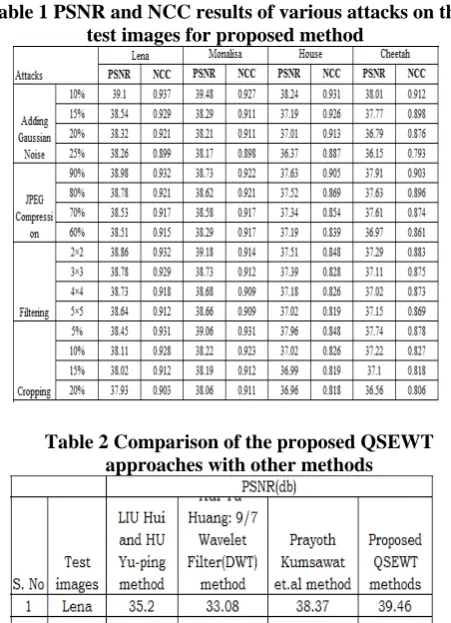
The proposed QSEWT methods on Haar wavelets are also tested with various attacks such as JPEG compression with different ratios (90%, 80% ,70% and 60%), Gaussian noise with different ratios (10%,15%,20% and 25%), cropping with different ratios (5%, 10% ,15% and 20%),and Median filter with different size (2×2, 3×3, 4×4,5×5), to test the robustness. Table 1 shows the PSNR and NCC values with various attacks on the considered images. From the Table 1, it is clearly evident that the proposed method is having a very good PSNR for all the images even after attacks. The experimental results demonstrate that the correlation coefficient‘s value is above 0.7. The NCC values of Table 1 clearly indicates the quality of the watermark image is not degraded for all the attacks. The table also indicates the robustness is not degraded for the proposed methods with attacks.
Figure4. Original and Watermarked Images with PSNR and NCC values
Table 1 PSNR and NCC results of various attacks on the test images for proposed method
Table 2 Comparison of the proposed QSEWT approaches with other methods
V. CONCLUSION
The present paper demonstrated a novel scheme called QSEWT which is an extension of zero wavelet trees. In the proposed scheme each watermark bit is embedded in various frequency bands and the information of the watermark bit is spread throughout large spatial regions. While the proposed watermarking schemes achieve high perceptual quality of the watermarked image for human eyes, it possesses high performance of robustness to various malicious manipulations including median filtering, low pass filtering, image rescaling, image cropping, JPEG, and JPEG2000 compression. Even the proposed scheme is implemented to provide that the value of NCC of the extracted watermark is as high as 0.9 while the watermarked image is attacked by the JPEG compression with a quality factor as low as 40%. In addition to copyright protection, the proposed watermarking schemes can also be applied to data hiding or image authentication. The proposed approach is hierarchical and has multi-resolution characteristics. In the proposed approach, the embedded watermark is hard to detect by human visual perceptivity. The approaches match the upcoming image/video compression standards.
ACKNOWLEDGEMENTS
The authors would like to express their gratitude to Sri K.V.V. Satyanarayana Raju, Chairman, and Sri K. Sasi Kiran Varma, Managing Director, Chaitanya group of Institutions for providing necessary Infrastructure. Authors would like to thank the anonymous reviewers for their valuable comments.
. REFERENCES
[1]. Shapiro.J. M, “Embedded image coding using zero trees of wavelet coefficients,” IEEE Trans. Signal Processing, vol. 41, pp. 3445–3462, (1993) December.
[2]. Voyatzis. G and Pitas.I,“Chaotic watermarks for embedding in the spatial digital image domain , ” in Proc. IEEE Int. Conf. Image Processing (ICIP’98), Chicago, IL, (1998) October. 4–7.
[3]. Wang. S. H and Lin. Y. P, “Wavelet tree quantization for copyright Protection watermarking,” IEEE Trans. on Image Processing, vol. 13, pp. 154-165, (2004) February.
[4]. Cox . I. J,Kilian . J, Leighton .F. T, andShamoon. T, “Secure spread spec- trumwatermarking formultimedia,” IEEE Trans. Image Processing, vol. 6, pp. 1673–1687, (1997) December.
[5]. Chen.L,“VLSI Design of Wavelet Transform: Analysis, Architecture and Design Examples”, Imp. College press (2007).
[6]. Celik M, Sharma GM, Tekalp. A, “Lossless watermarking for image authentication: a new framework and an implementation”, IEEE Trans Image Proc;15(4):1042–9 (2006).
[7]. Carlson, A.B., Crilly, P.B., and Rutledge, J.C., “Communication Systems”.
[8]. Bas P, J. M. Chassery. P, and Macq. B, “Geometrically invariant watermarking using feature points,” IEEE Trans. Image Processing, Vol. 11, No. 9, pp. 1014-1028, (2002) September.
[9]. LIU Hui and HU Yu-ping, “Wavelet Tree Quantization-based Biometric Watermarking for Offline Handwritten Signature,” IEEE Proceeding, International Asia Symposium on Intelligent Interaction and Affective Computing, (2009) 978-0-7695-3910.
[10]. Hui-Yu Huang and Shih-Hsu Chang, “A 9/7 Wavelet-based lossless data hiding”, 2011 IEEE, 978-1-4244-9915-1/11.
[11]. Prayoth Kumsawat, Kitti Attakitmongcol and Arthit Srikaew,“A Robust Image Watermarking Scheme Using Multiwavelet Tree,” Proceedings of the World Congress on Engineering , Vol I, (2007) July .
AUTHORS PROFILE
Vijayakumar.B. Completed his M S in CSE from
DPI, Donetsk, USSR in 1993. He worked as Software Engineer in Serveen Software Systems pvt. Ltd. Secunderabad, India for four years (1993-1998). After that he worked as Associate Professor in JBIET and RITS and then as Professor in JBIET, Hyderabad for six years. Also worked in Jyothishmathi College of Engineering & Technology, Hyderabad as Professor & HOD of CSE&IT for three years. Later he has joined as Professor & Head of the Department of IT & MCA in Saint Martin's Engineering College, Hyderabad, India. He is pursuing Ph.D. in Computer Science & Engineering under the guidance of Dr. Vakulabharanam Vijayakumar. He is a life member of CSI, ISTE, NESA and ISCA. He has published more than 10 research publications in various National, International Journals, Conferences and Proceedings.
Dr.Vakulabharanam Vijayakumar received integrated M.S. Engg, degree from Tashkent Polytechnic Institute (USSR) in 1989. He received his Ph.D. degree in Computer Science from Jawaharlal Nehru Technological University (JNTU) in 1998.He has served the JNT University for 13 years as Assistant Professor and Associate Professor and taught courses for M. Tech students. He has been Dean for Dept of CSE and IT at Godavari Institute of Engineering and Technology since April, 2007.His research interests includes Image Processing, Pattern Recognition, Digital Water Marking and Image Retrieval Systems. He is a life member for CSI, ISTE, IE, IRS, ACS and CS. He has published more than 120 research publications in various National, International conferences, proceedings and Journals. He has established Srinivasa Ramanujan Research Forum (SRRF) at GIET,Rajahmundry,India for promoting research activities.
Dr. D. Rajya Lakshmi Completed her Ph.D in CSE
at JNTU, Hyderabad in "Computer Vision and Image Processing". She has worked as Asst. Prof. at GITAM College of Engineering in the Dept. of CSE, August 1995 – July 2000 (5 years). Worked as Associate Professor at RVR & JC College of Engineering from July, 2000 – October,2005 in the Dept. of IT (5 years 3 months). Worked as HOD, IT (2 years at RVR & JC).Worked as Professor & HOD IT at Vignan’s Engineering College, Vadlamudi from 28-10-2005 to 31-05-2007.Worked as Professor & HOD at ANITS Engineering College, Visakhapatnam. Presently she is working as Professor & Head of IT Department in GITAM University, Visakhapatnam from 16-11-2007 to till date. She has published 15 technical papers in International Journals.