Article
Multi-Objective Optimization of a Spring Diaphragm
Clutch on an Automobile Based on the
Non-Dominated Sorting Genetic
Algorithm (NSGA-II)
Junchao Zhou 1,2,*, Chun Wang 1,2 and Junjun Zhu 3
1 School of Mechanical Engineering, Sichuan University of Science and Engineering, Zigong 643000, China; [email protected]
2 Sichuan Provincial Key Lab of Process Equipment and Control, Zigong 643000, China
3 School of Mechanical and Vehicular Engineering, Beijing Institute of Technology, Beijing 100081, China; [email protected]
* Correspondence: [email protected]
Abstract: The weight coefficients of the diaphragm spring depend on experiences in the traditional optimization. However, this method not only cannot guarantee the optimal solution but it is also not universal. Therefore, a new optimization target function is proposed. The new function takes the minimum of average compress force changing of the spring and the minimum force of the separation as total objectives. Based on the optimization function, the result of the clutch diaphragm spring in a car is analyzed by the non-dominated sorting genetic algorithm (NSGA-II) and the solution set of Pareto is obtained. The results show that the pressing force of the diaphragm spring is improved by 4.09%by the new algorithmand the steering separation force is improved by 6.55%, which has better stability and steering portability. The problem of the weight coefficient in the traditional empirical design is solved. The pressing force of the optimized diaphragm spring varied slightly during the abrasion range of the friction film, and the manipulation became remarkably light.
Keywords: clutch; diaphragm spring; multi-objective; optimization; NSGA-II
1. Introduction
optimization and its application model is also proposed.The authors of [9] set up a new multi-objective optimization design, taking the minimum of average compressing force of spring within the scope of the friction slice wear and the driver’s minimum manipulating force on separating bearings as optimization objectives. They also make some analysis using algorithms combined with the genetic algorithm. The optimum mathematical model of a light carrying truck’s diaphragm spring clutch is established in Ref.[10].The optimal solution set of a multi-objective optimization model of a diaphragm spring was gained using the multidisciplinary optimization software ISIGHT [11,12]. According to the above, it can be seen that many scholars havebegun to study the theory of optimization design and its applications. In respect of multi-objective optimization design, multi-objective optimization is usually transformed into single optimization by each optimal target’s weight coefficient. However, there is no exact method to obtain the true optimal value of each optimal target’s weight coefficient and it usually depends on the scholar’s experience and should be adjusted many times. This method not only cannot guarantee the optimal solution but also is not universal.
1A F
1B F
1
F
1N
λ
1H
λ
λ11F
λ
λ
1B
λ
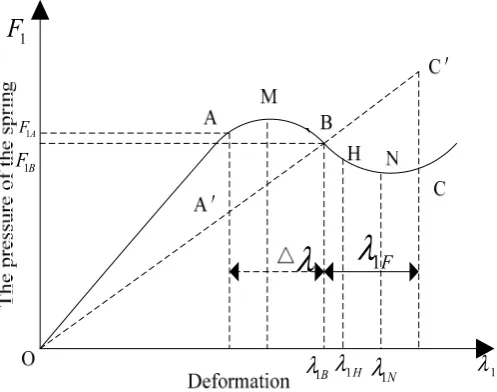
Figure 1. Characteristics of loading-deflection diaphragm spring.
In this paper, we are concerned with the automobile clutch diaphragm spring and current related research. We aim to study the separation stroke average of the minimum separation of control force and the pressing force change minimum as two multi-objective optimization models. At the same time, the Pareto solution set of the multi-objectives is obtained under the NSGA-II.The problem of the weight coefficient in the traditional empirical design is solved.The pressing force of the optimized diaphragm spring varied slightly during the abrasion range of the friction film, and the manipulation became remarkably light. This method is verified to be correct and effective by simulations.
This paper is organized as follows: in Section2, we provide theoretical analysis. Section 3 presents the NSGA and multi-objective solution. The comparison of the NSGA-II simulations are shown in Section 4.Section 5 concludes the paper with possible extensions in the future.
2. Diaphragm Spring Multi-Objective Mathematical Model
2.1. Multiple Objective Functions
absolute value of the pressing force changes separating the spring is selected as the first optimization target F1(X)to transfer torque reliably. The driven disc spring-loaded force difference between the
minimum most is chosen as the second optimization target F2(X). Therefore, the objective function
can be expressed as [8]:
( )
( )
(
)
1
2 1
1 min
b a
n
bi b
i
F X F F
F
F X F F
N =
= −
=
= −
(1)where Fb is diaphragm spring’s working pressure of working point; Fa is working pressure of diaphragm spring when the wear reaches the limit point; Fbi is the pressing force corresponding to point N.
Figure2. Main structural parameters of diaphragm spring. H—cone height of the disc spring,
h—spring diaphragm thickness,R1—the radius of the pressure plate’sloading point,r1—he radius of loading point of the support ring,r0—diameter of spring diaphragm’s small end,rf—action radius of
the separating bearing force,δ1—width of the small end,δ2—window width,re—the radius of the
small end,R—the big end radius of the disc spring, r—the small end radius of the disc spring.
2.2. Design Variables
Diaphragm spring design is complex. For the formula of theloading-deflection diaphragm spring, six variables are needed[9]. The lateral position of the new point B and corresponding amount of deformation λ1Bhas a greater impact on the entire characteristic curve. So the main design parameters are seven parameters according to the objective function [8], namely, h, R, r, R1, r1andλ1B. The diaphragm spring design variables matrix X is determined as:
[
]
1, 2
, , , , ,
3 4 5 6 7, , , , , ,
1 1 1T T
B
X
=
x x x x x x x
=
H h R r R r
λ
(2)2.3. Constraints
(1) The new pressing force of the spring Fashould be equal to the required clamping forceFY [3]:
a Y
(2) To ensure the stable operation after the friction plate, the pressing force of the spring work after the damaged F1Ashould not be less than the new corresponding parameters F1B[3]:
1A 1B
F
≥
F
(4)(3) Considering the depth-thickness ratio H/h has impactions on the load-deformation curve of the diaphragm, it should be met within a certain range. At the same time, the diaphragm spring initial cone angle α0 should be controlled within a certain range [8]. That is:
0
1.7
2.2
9
15
H h
α
≤
≤
≤
≤
。 。 (5)(4) For the friction plate on the pressing force distribution, the radius of the big end of the friction plate R1 should be taken between the mean radius and the outside diameter of the friction plate,
according to engineering experience [9]:
(
)
(
)
1
1
:
4
2 3
:
4
2 3
pull
pus
D d
r
D
D d
R
D
h
+
≤ ≤
−
+
≤
≤
−
(6)(5) In order to meet the structural arrangement of the diaphragm spring actual situation, the big end of the radius R, the support ring radius R1, load radius r1 and inner diameterr should be in a
certain range [9]:
1 1 1 0
1
7
0
6
0
6
R R
r r
r r
≤
≤
≤
≤
≤
≤
-
-
-
(7)(6) To ensure the working point, the wear point and separation point should be distributed relatively reasonabley the new location λ1Bshould meet the following conditions[8]:
1
1 1
0.8
BR r
1.0
H
R
r
λ
−
≤
−
≤
(8)(7) The work pressing force of the new designed diaphragm FB should be not less than the force FC in the Separation process [9]:
C
B
F
F
≥
(9)(8) In order to make diaphragm spring satisfy a certain leverage ratio during the separation, the ratio of the outer diameter to inner diameter should be met [3]:
(
1)
(
1 1)
1.2
1.3
3.0
f4.0
R r
r r
R
r
≤
≤
≤
−
−
≤
(10)(9) To take advantage of spring material, part size should meet certain requirements, according to engineering experience [8]:
0
1.2
/
1.35
70 2 /
100
3.5
/
5.0
R r
R h
R r
≤
≤
≤
≤
≤
≤
(11)(10) The highest point of the tensile stress σAmax (σCmax) in the bottom of the A (or C) dangerous parts
[ ]
[ ]
max
max
A A
C C
σ
σ
σ
σ
≤
≤
(12)(11) During the diaphragm spring manufacturing process, there are some major dimensions machining errors, the error during assembly process should meet certain requirements [9]:
(
Δ + Δ + Δ + Δ
F
hF
tF
RF
r)
F
b≤
0.05
(13)3. NSGA-II Algorithm and Multi-Objective Solution
In 2002, Deb et al. proposed theNSGA-II, and introduced elite strategies to improve the efficiency of the algorithm searches and robustness[13,14].
Figure3.Non-dominated sorting genetic algorithm(NSGA)-II algorithm optimization process.
4. Results and Discussion
The design of certain new type of pull diaphragm spring clutch ooptimization is taken as anexample. The parameters are as follows: Maximum engine torque is 1150N·m, reserve coefficient β
is 1.8, the friction factor is 0.3, and the diaphragm spring material is 60si2MnA.Allowable stress is1500–1700MPa; Poisson’s ratio is 0.3, the wear limit is 3.2mm and separation stroke is 3.5mm. The specific target variables of the experiment are shown in Table 1.The NSGA-II algorithm parameter setting is shown Table 2.
Table1.Experimental parameters design of optimization variables .
Plan Objective Function Algorithm
A + Penalty function method
B + genetic algorithm
C , NSGA-II
Note: , -weighted coefficient; + = 1
Table2. NSGA-II algorithm parameter setting.
Population Size
Stop Algebra
Fitness Function Value Deviation
Optimal Front End Individual Coefficient
Maximum Iterative Algebra
100 200 1 × 10−100 0.3 200
0 20 40 60 80 100 120 3.8
4 4.2 4.4 4.6 4.8 5
Spring pressing force difference /N
Pr
es
sin
g
forc
e c
ha
ng
e v
alue
/N
A
D C
B
105
103 A,B—Forward Pareto solutions of the target 1 C,D—Forward Pareto solutions of the target 2
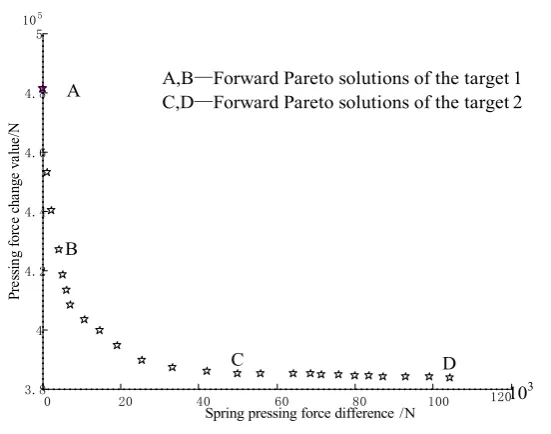
Figure4. Multi-objective optimization Pareto optimal solution set.
From Figure 4, it is found that the Pareto frontier A and D stand for the absolute value of the difference between the minimum point and the spring pressing force changes before and after the spring-loaded force of the diaphragm spring break disc wear. During AB there are great changes in discs wear spring-loaded forces due to small changes of the spring pressing force. During CD there are great changes of the spring pressing force since small changes by disc wear loaded forces. Therefore, the midpoint near the BC is chosen as a result of multi-objective optimization. The optimal results of the diaphragm spring are shown in Tables 3 and 4.
Table 3. Comparison of optimized structural parameters with original ones.
Plan H/mm h/mm R/mm r/mm R1/mm r1/mm
Original 5.8 2.93 145.7 116.8 143.66 116.1 4.80
A 5.24 2.80 140.00 115.00 138.68 115.00 4.21
B 5.20 2.80 140.04 115.18 138.80 114.00 4.02
C 5.21 2.81 140.35 115.48 140.66 114.50 4.01
Table 4. Comparison of optimized performance parameters with original ones.
Plan /N /N /N | — |/N | — |/| |/%
Original 5226 5925 3817 699 13.37
A 4834 5185 3709 351 7.23
B 4757 5016 3715 259 5.44
C 4422 4603 3567 181 4.09
The optimal results of diaphragm spring are illustrated in Tables 3 and 4.FromTables 3 and 4it is found that the smaller the deformation of the big-deformation λ1,the longer the lifespan of the
clutch. So the lifespan of the diaphragm spring by the NSGA-II is better than the penalty function method and the genetic algorithm. The wear range |Fb−Fa|=181N and relative rate of change |Fb−
Fa|/|Fb|=4.09%, which is far less than the 10% [9], improving the compaction force stability. In addition, the steering separation force of the clutch after optimization is the smallest. There rate of change of the steering separation force|3817 − 3567|/3817=6.55%, so the operating flexibility is improved.
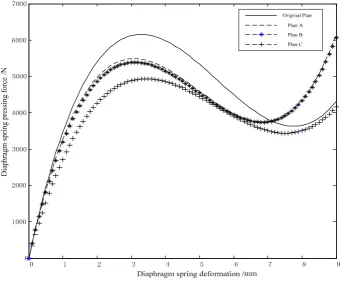
driver control force average change is increased slightly. So the optimization of the scheme A is not ideal. Compared with the original scheme, the friction plate abrasion clamping force of the diaphragm spring within the limit range in scheme B is greatly reduced too. In addition, separation of the driver control force average also decreased, so the effect is good. Compared to the scheme C with the original scheme, the friction plate abrasion clamping force of the diaphragm spring within the limit range is drastically show, and separation of the driver control force is greatly reduced. The separation performance improved significantly compared withthe first two schemes. Comparing A, B and C, the three schemes improve a little, but clamping force in scheme C is more gentle. At the same time, the pedal force that needs to be overcome to separated the drives control force is smaller, so separation is more portable and the comprehensive performance of the last program is the most comprehensive andcomparative one of three integrated programs.
It can be seen from Tables 3 and 4, and Figure 5, in can be seen that the pressing force of the optimized diaphragm spring varied slightly during the abrasion range of the friction film, and the manipulation became remarkably light. The problem of the weight coefficient in the traditional empirical design is solved. The new optimization model is proved correct and effective, and the purpose of optimization is achieved.
Figure 5. Characteristic curve of the diaphragm spring.
5. Conclusions
Acknowledgments: This research is supported by the research project of the Sichuan Provincial Key Lab of Process Equipment and Control (GK201508) (GK201603) and Sichuan University of Science and Engineering (2014PY04).
Author Contributions: Chun Wang analyzed the data;Junjun Zhu contributed analysis tools;Junchao Zhou wrote the paper.
Conflicts of Interest: The authors declare no conflict of interest.
Reference
1. Xia, C.; Zhu, P.; Zhang, M.; Gao, X.; Lu, L. Dispersion of the mechanical parts performance indicators based on the conceptof random vector. Chin. J. Mech. Eng.2012, 25,153–159.
2. Haugen,E.B.Probabilistic Mechanical Design; John Wiley & Sons: New York, NY, USA, 1980.
3. Wu, Y.-H. Multi-objective optimization design of vehicle clutch diaphragm spring. In Proceedings of the International Conference on Intelligent Computation Technology and Automation, Changsha, China, 10–11 October 2009; pp. 193–197.
4. Tripathi, K.Some Design-Objectives and Design-Guidelines for Automotive Friction Clutch Based on Clutch Engagement Dynamics. J. Inst. Eng.2014, 95, 51–61.
5. Amisano, F.; Ercole, G.; Mattiazzo, G.; Mauro, S.; Serra, G.; Velardocchia, M. The influence of the push plate mechanical characteristic on torque transmissibility in diaphragm spring.In Proceedings of the 3rd International AIMETA Tribology Conference, Vietri sul Mar, Italy, 18–20 September 2002; Volume24, pp. 98–108.
6. Xi, J.-Q.; Lu, J.; Pan, C.Modeling and simulation of the static characteristics ofdiaphragm spring clutches.J. Beijing Inst. Technol.2015, 24,188–193.
7. Kaya, N. Optimal design of an automotive diaphragm spring with high fatigue resistance. Int. J. Veh. Des.2006, 40,126–143.
8. Zhao, L.-J.; Liu, T.; Song, B.-Y. Optimumdesign of automobile diaphragm spring clutch. In Proceedings of theIEEE Vehicle Power and Propulsion Conference, Harbin,China, 3–5 September 2008; pp. 1421–1427. 9. Ran, Z.Y.; Zhao, S.E.; Yu,L.I. Optimum Design for the Diaphragm Spring Clutch on Automobile with
Genetic Algorithms. J. Chongqing Univ.2003, 26,77–81.
10. Mohamad, N.; Iovenitti, P.; Vinay, T. Modelling and Optimisation of a Spring-Supported Diaphragm Capacitive MEMS Microphone. Engineering2010, 2,762–770.
11. Ye, Z.; Kaiyuan, Y. A Study of Belleville Spring and Diaphragm Spring in Engineering. J. Appl. Mech.1990,
57,1026–1031.
12. Chan, C.-K.; Lai, W.-C.; Wu, M.; Wang, M.-Y.; Fang, W. Design and Implementation of a Capacitive-Type Microphone with Rigid Diaphragm and Flexible Spring Using the Two Poly Silicon Micromachining Processes. IEEE Sens. J.2011, 11, 2365–2371.
13. Pasandideh, S.H.R.; Niaki, S.T.A.; Asadi, K. Bi-objective optimization of a multiproduct multi-periodthree-echelon supply chain problem under uncertainenvironmentsNSGA-II and NRGA. Inf. Sci.2015, 292,57–74.
14. Brownlee, A.E.I.; Wright, J.A. Constrained, mixed-integer and multi-objective optimization ofbuilding designsby NSGA-II with fitnessapproximation.Appl. Soft Comput.2015, 35, 114–126.
15. Li, Y.; Liao, S.;Liu, G. Thermo-economic muti-objective optimization for a solar-dishbrayton system using NSGA-II and decision making.Electr. Power Energy Syst.2015, 64,167–175.
16. Bandyopadhyay, S.; Bhattacharya, R. Solving multi-objective parallel machine scheduling problem by modified NSGA-II. Appl. Math. Model.2013, 37,6718–6729.
17. Nourbakhsh, A.; Safikhaniand, H.; Derakhshan, S. The comparison of multi-objective particle swarmoptimization and NSGA II algorithm: Applicationsin centrifugal pumps.Eng. Optim.2011,
43,1096–1113.
18. Murugan, P.; Kannan, S.; Baskar, S. Application of NSGA-II Algorithm toSingle-Objective Transmission ConstrainedGeneration Expansion Planning. IEEE Trans.Power Syst.2009, 24,1790–1797.