Performance Study of Noise Removal
Techniques for Recognition of Modi Consonants
Deepti Dubey
Bhumika Solanki
Maya Ingle
SCS &IT SCS & IT SCS & IT D.A.V.V., Indore D.A.V.V., Indore D.A.V.V., IndoreAbstract— In digital image processing, scanned images are degraded by various kinds of noise. When an image is transformed from one form to another during scanning, transmitting, digitizing, storing etc., degradation occurs in the output image. Hence, the output image needs to be enhanced in order to be better analyzed. Denoising is considered to be one of the effective pre-processing techniques in digital image processing. This paper investigates the performance of linear as well as non linear filters namely; Gaussian filter, Mean filter, Median filter, Sobel filter and Canny filter for removing several noises such as Gaussian noise, Salt & Pepper noise, Speckle noise and Poisson noise. The performance of the above five linear and non linear filters is compared by using two performance parameters namely; Mean Square Error (MSE) and Peak to Signal Noise Ratio (PSNR). The experimental result shows that median filter performs best than other five filters for both performance parameters.
Keywords— Gaussian noise, salt & pepper noise, speckle noise, poisson noise, linear and non linear filters, MSE and PSNR
I. INTRODUCTION
Noise exists as a sharp transition in gray level of an image which is visible as grains. It is produced due to random variations in intensity values, variations in illumination, poor contrast etc. It has been introduced in an image during image acquisition or transmission phase. Thus, the pixel values in the noisy image show various intensity values instead of true value. There subsist several factors which can cause noise in an image mainly; environmental condition during image acquisition, distortion of image during transmission, type of sensing device, insufficient light levels etc. In general, noise may be classified broadly into several types namely; additive noise, multiplicative noise, impulse noise etc. There exist several noise removal algorithms which eliminate and compress the noise from an image by smoothening, sharpening and blurring [1]. At the same time, literature reveals that there exist several noise removal and filtering techniques for recognition of a variety of Indian language scripts such as Kannada, Bengali and Oriya etc [11]. Also, it is evident that very few efforts have been put over the recognition of Modi script which is an ancient script as compared to other Indian ancient languages. Modi handwritten characters are normally both cursive as well as
unconstrained [2][3]. When the images are transmitted over channels, these may get corrupted with several kinds of noise due to sudden disturbances caused by an image signal such as bars over an image, constant noise level at dark areas of an image etc. However, there is a scope to recognize Modi consonants using various types of filters in presence of different types of noises before processing.
Noise creates distortion in the scanned image of various scripts that affects the intensity values of an image. In this paper, we are intended to analyze the effect of various existing filtering techniques in presence of different types of noises for recognition of Modi consonants. Section 2 deals with description of existing Modi consonants in brief. In Section 3, we present the overview of several types of noise that subsist in an image. Section 4 illustrates various existing noise removal techniques on scanned images of Modi consonants which in turn may enhance the structural characteristics of respective images effectively. In Section 5, we compare the performance of several kinds of filters using performance parameters as Mean Square Error (MSE) and Peak to Signal Noise Ratio (PSNR). Finally, we conclude with the conclusion and future scope in Section 6.
II. MODI SCRIPT-AN INTRODUCTION
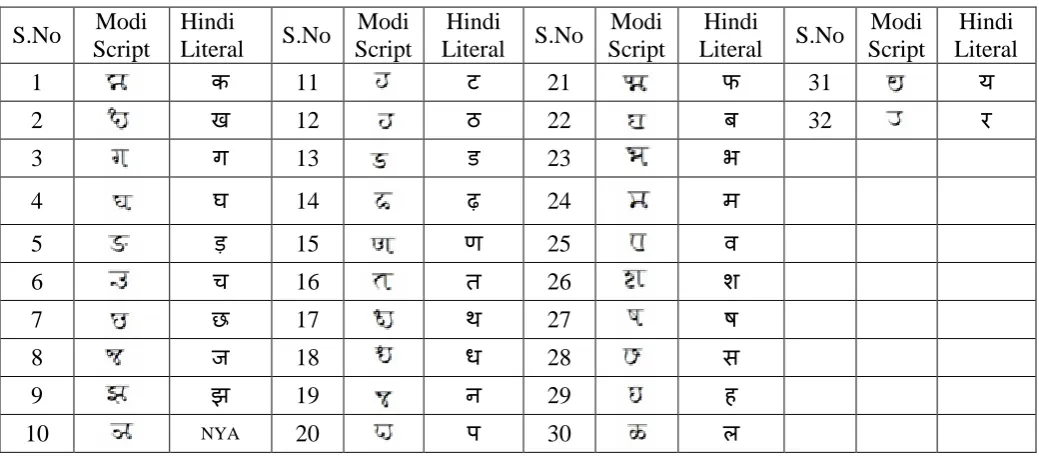
TABLE I: CONSONANTS OF MODI SCRIPT
[Resource: Proposal to Encode the Modi Script in ISO/IEC 10646]
III. EFFECT OF VARIOUS NOISES ON MODI CONSONANTS
Noise is the result of undesirable effects which hampers the quality of an image. During image acquisition and transmission phase, noise is usually caused due to several factors such as environmental condition, distortion of an image etc. Variation in corrupted pixels values determines the quantification of noise [3]. The original noise free scanned image of Modi consonants is shown in Fig. 1. Noise creates disturbance in an image and affects quality of an image to various extent. There exist varied kinds of noise that produce distortion, change in contrast values, poor illuminations etc. in scanned image. Thus, several types of noise have been identified that affect entire quality of an image as follows:
A. Gaussian Noise
Gaussian noise is additive in nature and follows Gaussian distribution with Probability Density Function (PDF) expressed as in Eq. (1). Further, each pixel in the noisy image is the sum of the true pixel value and a random Gaussian distributed noise value and is independent of intensity of pixel value at each point [4][5]. It is a major part of the read noise of an image sensor that is of the constant level of noise in the dark areas of the image [8]. Effect of Gaussian noise on the scanned image of Modi consonants is shown in Fig.2 (i).
; -∞ < x < ∞ (1) where x represents the gray level of an image, μ and σ is the mean and standard deviation respectively.
B. Poisson Noise
Poisson noise is also known as shot photon noise. It is produced when the number of photons sensed by sensor is not sufficient to provide detectable statistical information. Hence, various types of electronic noise may be created when the finite number of particles that carry energy such
as electrons in electronic circuit and photon in optical device. This type of noise creates detectable statistical fluctuations during measurement [5]. The detection of individual photon can be treated as independent event which follows random temporal distribution. As a result, photon counting is described by the discrete probability distribution, which is termed as standard poisson distribution is shown in Eq. (2) as:
(2) where N is the number of photons measured by a given sensor element over a time interval t and λ is the expected number of photons per unit time interval. The uncertainty described by this distribution is called as photon noise. Further, Fig. 2(ii) shows the effect of Poisson noise on scanned image of Modi consonants.
C. Salt & Pepper Noise
It is also termed as Impulse valued noise/ spike noise. It is usually caused by failure of memory cells,
malfunctioning of camera's cells as well as during image digitization/ transmission. The pixel values of an image are
randomly replaced by corrupted pixel values as maximum/ minimum pixel value. Thus, maximum value
achieved in an image by salt & pepper noise is 255 which represent salt noise and minimum value gathered is 0 that represents pepper noise [10]. The PDF of impulse noise is specified in Eq. (3) as:
(3) if a>b, gray-level a appears as light dot in the image otherwise appears as dark dot. In case of impulse noise f(x) is 0 which is called as unipolar. Fig. 2(iii) shows an image with 25% of Salt & Pepper noise.
S.No
Modi
Script
Hindi
Literal
S.No
Modi
Script
Hindi
Literal
S.No
Modi
Script
Hindi
Literal
S.No
Modi
Script
Hindi
Literal
1
क
11
ट
21
फ
31
य
2
ख
12
ठ
22
ब
32
र
3
ग
13
ड
23
भ
4
घ
14
ढ़
24
म
5
ड़
15
ण
25
व
6
च
16
त
26
श
7
छ
17
थ
27
ष
8
ज
18
ध
28
स
9
झ
19
न
29
ह
D. Speckle Noise
It is multiplicative in nature, which may be seen in coherent imaging system such as laser, radar, acoustics etc. It is alike Gaussian noise but PDF follows gamma distribution which is expressed in Eq. (4) as follows:
(4) where aα is variance and g is the gray-level of an image. Speckle noise is applied on scanned image of Modi consonants as shown in Fig. 2(iv).
(a)ब (b)क
(c) ढ़ (d)ग (e) ज
Fig. 1: Noise Free Images of Modi Consonants
(a)ब (b)क
(c) ढ़ (d)ग (e) ज
(i): Gaussian Noise
(a)ब (b)क
(c) ढ़ (d)ग (e) ज
(ii): Poisson Noise
(a)ब (b)क
(c) ढ़ (d)ग (e) ज
(iii): Salt & Pepper Noise
(a)ब (b)क
(c) ढ़ (d)ग (e) ज
(iv): Speckle Noise
IV. NOISE REMOVAL TECHNIQUES AND PERFORMANCE STUDY ON MODI CONSONANTS
As our main aim lies at the comparative study of filtering techniques, various types of filters applied on Modi consonants have been discussed. The selection of filtering technique is determined by two factors namely; the nature of task performed by filter as well as the behavior and type of data. Noise removal technique is broadly classified into two types mainly: linear and non linear. Now, we discuss these two types of filter applied as follows:
A. Linear Filter
Linear filter is a technique in which the value of an output pixel is a linear combination of the values of the pixels in the input pixel's neighborhood. It is spatially invariant, which is implemented using convolution mask. In general, convolution determines the values of a central pixel by adding the weighted values of its entire neighboring pixel. It creates blurs on the sharp edges as well as keeps smooth areas of an image intact. Further, smoothening of an image destroy the fine details and performs worst in the presence of signal dependent noise [7]. Linear operations calculate the resulting value in the output image pixel f(i, j) as a linear combination of brightness ina local neighborhood of the pixel h(i, j) in the input image. Eq. (5) depicts discrete convolution performed on an image as follows:
f (i, j) = w*k =
) (5)
where function w is called a convolution kernel or a filter mask. Linear filters are further divided into several types described as follows:
Gaussian Filter
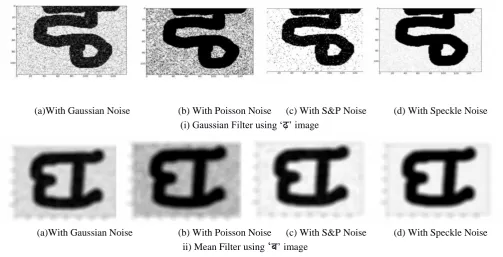
Gaussian filter commonly used in image processing for smoothing, reducing noise and computing derivative of an image. It is non- uniform low pass filter based on convolution which uses a Gaussian matrix as its underlying kernel [8]. The Gaussian function is used in various fields thereby it defines the PDF for noise or act as a smoothing operator. When working with images it is defined as two dimensional function expressed as in Eq. (6). The Gaussian filters works by using the 2D distribution as a point-spread function, which is achieved by convolving the 2D Gaussian distribution function with the image. Gaussian filter is applied on ‘ढ़’ image with mean (0, 0) and σ = 1on different noises as shown in Fig. 3(i).
(6)
where, μ and σ is the mean and standard deviation respectively. Mean Filter
It is a simple sliding window spatial filter of linear class. It replaces the center value in the window of an image
with average of all the pixel values in the window. There exist several types of mean filter such as arithmetic mean filter, geometric mean filter, harmonic mean filter etc. These filters respond differently in presence of different noises [10]. The simplest form of mean filter is arithmetic mean which is expressed in Eq. (7). It computes the average value of corrupted image g(x, y) in the area defined by ,
where represents the set of coordinates in a rectangular
sub image window of size . Effects of mean filter
applied on various noises of ‘ब’ image as shown in Fig. 3(ii). The f(x, y) is the restored image at point (x, y) which is simply computed using the pixels defined by
region.
(7)
B. Non- Linear Filter
Non-Linear filters are considered as order-statistics filters. Basically, these filters are based on ordering (termed as ranking) the pixels. Further the value of the center pixel contains the value determined by ranking result. Median filters are measured effectively and provide excellent noise reduction capabilities. In order to overcome the shortcomings of linear filter, variety of non-linear median filter such as rank conditioned, weighted median, relaxed median, rank selection have been developed for further processing [7][10]. Non linear filters whose performance study has been carried out are described below.
Median Filter
It is based on order statistics and chiefly measured as order filter. Median filters are primarily effective in presence of impulse noise mainly; salt & pepper noise. It changes the image intensity mean value, if the spatial noise distribution in the image is not symmetrical within the window. In order to provide a symmetrical window shape, the median filter preserves the location and the shape information of edges [9][10]. It replaces the center value of the pixel by median of the pixel values under filter region which is expressed in Eq. (8) as:
(8)
Eq. (9) represents an NxN image and window W(x, y) along with pixels (x, y) being the midpoint of W. The pixel intensity values of pixels in W are ordered from smallest to the largest as follows:
W(x, y) = Median (W (x, y)) = 104
(a)With Gaussian Noise (b) With Poisson Noise (c) With S&P Noise (d) With Speckle Noise (i) Gaussian Filter using ‘ढ़’ image
(a)With Gaussian Noise (b) With Poisson Noise (c) With S&P Noise (d) With Speckle Noise ii) Mean Filter using ‘ब’ image
Fig. 3: Performance of Linear Filters on Modi Consonants
(a)With Gaussian Noise (b) With Poisson Noise (c) With S&P Noise (d) With Speckle Noise
(i) Median Filter using ‘ढ़’ Image
(a)With Gaussian Noise (b) With Poisson Noise (c) With S&P Noise (d) With Speckle Noise (ii) Sobel Filter using ‘ग’ Image
(a)With Gaussian Noise (b) With Poisson Noise (c) With S&P Noise (d) With Speckle Noise (iii) Canny Filter using ‘ब
’ image
Sobel Filter
Sobel filtering technique is particularly used in edge detection algorithm in order to create an image emphasizing edges. An edge in image occurs when gradient is greatest, and Sobel operator produces better approximations of the gradients exist in an image. It is a discrete differential operator and performs a 2-D spatial gradient measurement on an image to emphasize regions of high spatial frequency that corresponds to the edges [10]. The operator utilizes two 3x3 kernels: one estimates the gradient in the x-direction, while the other one estimates the gradient in the y-direction [11]. It is based on convolving the image with both kernels to approximate the derivatives in horizontal and vertical change. At each point of an image, the gradient magnitude can be approximated
using Eq. (10). It highlights the small specs such as foreign matter/ miniscule imperfections as well as enhances small
discontinuities. Edge detection of
‘
ग’ image of Modi
consonants on various noises is shown in Fig. 4(ii).(10)
Canny Filter
Canny filter is also considered as an edge detection technique and widely known as optimal detector. Canny operator uses a multi-stage algorithm to detect a wide range of edges in an image. It significantly reduces the amount of data in an image while preserving the structural properties which are used for further image processing. The adjustable parameters improve the effectiveness of canny method. Small filters are preferable for detection of small, sharp lines; since it causes fewer instances of blurring where as large filters are desirable for detecting larger, smoother edges. However, it causes higher instances of blurring. It also enhances the signal to noise ratio and immune to noisy environment. Effects of Canny filter applied on ‘ब’ image of Modi consonants along with several noises is shown in Fig. 4(iii).
V. COMPARATIVE STUDY OF FILTERS ON MODI CONSONANTS
It is worth to state that the performance parameters such as Mean Square Error and Peak to Signal Noise Ratio are highly useful for further analysis. Thus, we discuss these two performance parameters in brief first. Subsequently, case study is prepared to compare performance of various filters along with existing noises on Modi consonants.
A. Performance Parameters:
It is recognized as a measure of image quality. In order to quantify the clarity of an image as well as achieve good discrimination, an effective measure of image clarity is used. Two commonly used measures are mainly; Mean Square Error and Peak to Signal Noise Ratio which is described as follows:
Mean Square Error (MSE):
MSE is usually applied when the distortion is caused by degradation of additive noise. The MSE is the cumulative square error between the encoded and the original image defined in Eq. (11):
MSE = 2 (11)
Where f is the original image and g is the noisy image. The dimension of the images is m x n. Thus, MSE should be as low as possible for effective noise removal.
Peak to Signal Noise Ratio (PSNR):
It is usually expressed in terms of the logarithmic decibel scale and measured as peak error. PSNR is the ratio between maximum possible power of a signal and the power of distorting noise which affects the quality of its representation. It is defined in Eq. (12) as:
PSNR = 20 * (12)
Where, MAXf is the maximum signal value that exists in
our original noise free image. The signal value for MAXf is
considered as 255 when pixels are represented using 8 bits per sample.
B. A Comparative Study FTs and NSs
In the absence of noise, the two images f and g are identical thereby value of MSE is represented as zero whereas the value of PSNR is measured as infinite. The minimum value for MSE shows slighter amount of noise in an image. On the other hand, maximum value for PSNR indicates ratio of noise in minute quantity on an image. Thus, it is obvious that the noise removal scheme having a lower MSE and higher PSNR can recognize an image in an efficient way. We represent this scheme as {min( MSE), max(PSNR)}.
We have studied the performance of various noise removal techniques by introducing different types of noises on Modi consonants and shown it in Table II. It is evident that there exist a variety of results in Table II and hence, we discuss the observations in terms of cases as follows:
Case I: Comparative Performance of Filters
This case pertains to the scheme possessing minimum value for MSE and maximum value for PSNR in favor of each filter. As depicted in Table II, the scheme for median filter on Salt & Pepper Noise is {0.002, 22.28}. Thus, it is evident that the performance of median filter for Salt & Pepper Noise shows effective results for recognition of Modi Consonants. Moreover, the performances of Gaussian filter and Mean filter show effective results in presence of speckle noise i.e. with {0071, 21.38} and {.0088, 20.55) respectively as highlighted in Table II. On the other hand, Sobel and Canny filters with poisson noise show the better performance as highlighted.
Case II: Performance Study of FTs and NSs on Modi Consonants
Using aforesaid scheme, we analyze the results of various filtering techniques corresponding to different Modi consonants as described in Table II. It is observed that the usage of Median filter in presence of S&P noise
effectively in case of recognition of the consonants ‘ढ़’ and ‘ज’ as the corresponding schematic values are {.0089,
20.42} and {.0072, 21.38} respectively.
VI. CONCLUSION
In general, noise is generated due to random variations of intensity values in an image during image acquisition. We have studied different types of noises that affect the quality of images of Modi consonants particularly. Also, several filtering techniques have been explored on the consonants along with aforesaid noises. Using the scheme i.e. {min(MSE), max(PSNR)}, we have presented a comparative study of filtering techniques using several noises on Modi consonants. On the basis of this study, it is advisable to use median filters in presence of S&P noise as it works significantly on scanned image of Modi consonants. This study will be highly useful to enhance as well as to restore the structural properties of scanned images.
R
EFERENCES[1] Rohit Verma, “A Comparative Study of Various Types of Image Noise and Efficient Noise Removal Techniques”, International Journal of Advanced Research in Computer Science andSoftware Engineering, Vol. 3, Issue 10, 2013.
[2] D. N. Besekar “Special Approach for Recognition of Handwritten MODI Script’s Vowels”, International Journal of Computer Applications (IJCA) Medha, 2012.
[3] D. N. Besekar and R. J. Ramteke, “Study for Theoretical Analysis of Handwritten Modi Script: A Recognition Perspective”,
[4] International Journal of Computer Applications, Vol. 64, No. 3, pp. 0975-8887, February 2013.
[5] Ajay Kumar Boyat, “A Review Paper: Noise Models in Digital Image Processing”, Signal & Image Processing: An International Journal (SIPIJ), Vol. 6, No 2, April 2015.
[6] Pawan Patidar, “Image De-noising by Various Filters for Different Noise” International Journal of Computer Applications,Vol. 9, No.4, pp. 0975 – 8887, November 2010.
[7] http://www.Intelligence.Tuc.r/~Petrakis/Courses/.../Filtering. Pdf, E.G.M. Petrakis, Filtering.
[8] Priyanka Kamboj and Versha Rani, “A Brief Study Of Various Noise Model And Filtering Techniques” Journal of Global Research in Computer Science, Vol. 4, No. 4, April 2013.
[9] D. Maheswari, “Noise Removal In Compound Image Using Median Filter”, International Journal on Computer Science and Engineering, Vol. 02, No. 04, pp. 1359-1362, 2010.