
Comparative Study On Solubility Enhancement
Methods For Mefenamic Acid And Its Formulation And
Evaluation
Ayyaj A. Badgire
1, Syed Abdul Azeem A.
2, Shoeb Qazi
3, Ansari Yaasir Ahmed
4,Rahil Meman
5 1Ali Allana college of Pharmacy, Akkalkuwa, Dist- Nandurbar-425415. 2,3,4,5Lecturer at Jamia College of Pharmacy, Akkalkuwa, dist Nandurbar-425415.
Email: 1) [email protected] 2)[email protected]
Abstract-Solubility is the phenomenon of dissolution of solid in liquid phase to give a homogenous system. Solubility is an important parameter to attain desired concentration of drug in systemic circulation for the required pharmacological. Poorly water soluble drugs frequently require high doses in order to reach therapeutic plasma concentrations after oral administration. Poor aqueous solubility is the major problem encountered with formulation development of new chemical entities. For the absorption of drug at the site it must be present in the form of an aqueous solution. Most of drugs weakly acidic and weakly basic with poor aqueous solubility. Hence various techniques are used for the improvement of the solubility of poorly water-soluble drugs. The purpose of this research is to carry out comparative study of solubility enhancement methods for the attainment of improved solubility of Mefenamic acid a non-steroidal anti-inflammatory drug further study is elongate to compare the formulation of enhanced method with respect to the marketed preparation. Methods selected for comparative solubility study are cosolvency, complexation and solid dispersion. In this drug and polymers are used in various ratios and percentages. In case of formulation equivalence study dispersible tablet with reduced dose is prepared and compare with marketed dispersible tablet. In this study, beta cyclodextrine complexation shows higher solubility at 1:3 ratio. Formulated Mefenamic acid dispersible tablet with 75mg dose shows approximately same drug release as that of marketed 100mg dispersible tablet of Mefenamic acid. Other parameters are also shows results within the limits as per the standard references.
Index Terms- Solubility enhancement, complexation, cosolvency, solid dispersion, dispersible Tablet,
Mefenamic acid.
1. INTRODUCTION
Mefenamic acid, an anthranilic acid derivative, is a non‐steroidal anti‐inflammatory drug (NSAID). It is used in mild to moderate pain including headache, dental pain, postoperative and postpartum pain, dysmenorrhea, osteoarthritis. The usual dose by mouth is 500 mg three times daily. Mefenamic acid is absorbed from the gastro intestinal tract. Peak plasma concentrations occur about 2 to 4 hours after ingestion. Most of the NSAIDs belong to class II category under Biopharmaceutical classification system (BCS) i.e., they are inherently highly permeable through biological membranes, but exhibit low aqueous solubility. Low aqueous solubility is the major problem encountered with formulation development of new chemical entities as well as for the generic development. Any drug to be absorbed must be present in the form of solution at the site of absorption. Various techniques are used for the enhancement of the solubility of poorly soluble drugs which include physical and chemical modifications of drug and other methods like particle size reduction, crystal engineering, salt formation, solid dispersion, use of surfactant, complexation, and so forth. Selection of solubility improving method depends on drug property, site of absorption, and required dosage
of absorption. Solubilisation of poorly aqueous soluble drugs is a frequently encountered challenge in screening studies of new chemical entities as well as in formulation design and development. Cosolvency, pH adjustment, surfactant addition, solid dispersion and complexation are the most commonly encountered pharmaceutical approaches for solubilizing drug candidates with low aqueous solubility. Among them, use of cosolvent (i.e., cosolvency) is one of the most popular approaches for improving the solubility of poorly aqueous soluble drugs in pharmaceutical liquid formulations. Cosolvents are the mixtures of miscible solvents often used to water which can dramatically change the solubility of poorly aqueous soluble drugs. Weakly electrolytes and nonpolar molecules frequently have poor water solubility. Their solubility usually can be increased by the addition of water miscible solvent in which the drug has good solubility. This process is known as cosolvency, and the solvents used to increase solubility are known as cosolvent. Cosolvent system works by reducing the interfacial tension between the aqueous solution and hydrophobic solute. It is also commonly referred to as solvent blending.In recent years in industry for enhancing the solubility and dissolution rate of poorly soluble drugs complexation with cyclodextrins has gained good acceptance. Cyclodextrins (CDs) are cyclic torus-shaped molecules with a hydrophilic outer surface and a lipophilic central cavity which can accommodate a variety of lipophilic drugs. As a consequence of inclusion process many physico-chemical properties such as solubility, dissolution rate, and bioavailability can be favorably affected. Cyclodextrins have been receiving increasing application in pharmaceutical formulation in recent years due to their approval by various regulatory agencies.
Solid dispersion (SD) technique has been widely used to improve the dissolution rate, solubility and oral absorption of poorly water-soluble drugs. Solid dispersion is defined as the dispersion of one or more active ingredients in an inert excipient or matrix (carrier), where the active ingredients could exist in finely crystalline, solubilized or amorphous state. Once the solid dispersion is exposed to aqueous media and the carrier dissolve, the drug is released as very fine to colloidal particles. Because of greatly enhanced surface area obtained in this way, the dissolution rate and the bioavailability of poorly water-soluble drugs are expected to be high. The enhanced solubility and dissolution rate of drugs from solid dispersions is based on following mechanisms:
a) Reduction in particle size provides large surface area.
b) Particles with improved wettability and dispersibility of drug.
c) Particles with higher porosity. d) Drugs in amorphous state.
e) Solubilizing effect on the drug by water soluble carrier.
f) Formation of metastable dispersion.
Various pharmaceutical approaches for the preparation of SDs, include co-precipitation, lyophilization, spray drying, melting solvent method, melt extrusion method, solvent evaporation, fusion and powder mixing methods.
2. MATERIALS AND METHODS
Mefenamic acid was a gift sample from Sehat Pharma Pvt.Ltd. At. Savgadh, Himatnagar(GJ). Beta cyclodextrin, crospovidon, polyethylene glycol 400, propylene glycol, ethanol, Ac Di Sol and other excipient were procured from S.D. Fine Chem. Ltd. Mumbai. All other materials used were of laboratory grade and were procured from commercial sources.
Preparation Of Standard Calibration Curve Of API In Phosphate Buffer Ph 7.4
Accurately weighed sample of 100 mg of API was dissolved in 100 ml of phosphate buffer pH 7.4. 1 ml of this solution was diluted to 10 ml with phosphate buffer pH 7.4. The resulting stock solution was 100µg/ml. From this stock solution, serial dilutions 5, 10, 15 and 20 µg/ml of concentration was made using phosphate buffer pH 7.4. The prepared solution of API was analyzed by UV Spectrophotometer by measuring the absorbance at 284 nm. The method obeyed Beer’s law in the concentration of 0-20μg/ml.
Determination Of Solubility Of Pure Drug.
The solubility of Mefenamic acid was determined by preparing saturated solutions. An excess of Mefenamic acid was added to a 25 ml volumetric flask containing 10 ml of phosphate buffer pH 7.4. Stirring was carried out for 12 hr. by using magnetic stirrer. The equilibrated solutions were then removed, filtered using Whatman filters to separate from the saturated solutions excess undissolved drug. Concentration of Mefenamic acid was determined spectrophotometrically at 284 nm. Solubility experiment was conducted in triplicate.
3. COSOLVENCY
Solubility Of Mefenamic Acid In Pure Solvents.
The solubility of Mefenamic acid in water, PEG 400, PG, and ethanol at room temperature was determined. Saturation solubility was carried out to determine the solubility of Mefenamic acid in the individual solvents. The solubility of Mefenamic acid was found higher in ethanol than other solvents investigated in the study.
Solubility Studies In Various Solvents
in order to obtain equilibrium. After 12 hrs. of equilibrium, aliquots will be withdrawn, filtered through Whatman filter paper, and diluted suitably. These samples were analyzed using UV-VIS spectrophotometer at 284 nm wavelength. From the absorbance-concentration data, saturation solubility (mg/ml) values were calculated. Solubility experiments were conducted in triplicate for each sample.
4. COMPLEXATION
Preparation Of Mefenamic Acid Inclusion Complex With Β-Cyclodextrin
Mefenamic acid and β-cyclodextrin were taken in the ratio of 1:1(Blend-A), 1:2(Blend-B), 1:3(Blend-C) respectively. Triturate this mixture in mortar pestle to mix drug properly with polymer. Then dispense these mixtures in the porcelain dish respectively. Water was used as a solvent to prepare the complexation. Keep these mixtures for 24 hour. These complexes were used for the solubility measurement. Kneading method used to prepare the complex of drug and polymer.
Determination Of Solubility
The solubility of cyclodextrine inclusion complex was determined by preparing saturated solutions. An excess of Blend A, B, C was added to a 25 ml volumetric flask containing 10 ml of phosphate buffer pH 7.4. Stirring was carried out for 12 hr. by using magnetic stirrer. The equilibrated solutions were then removed, filtered using Whatman filters to separate from the saturated solutions excess undissolved drug. The saturated solutions were suitably diluted with phosphate buffer pH 7.4 solution. These blends were analyzed using UV-VIS spectrophotometer at 284 nm wavelength. From the absorbance-concentration data, saturation solubility (mg/ml) values were calculated. Solubility experiments were conducted in triplicate for each blend.
5. SOLID DISPERSION (BY SOLVANT
EVAPORATION)
Preparation Of Solid Dispersions Using
Superdisintegrant Crospovidon
Solid dispersions of MA in superdisintegrant crospovidon were prepared by solvent evaporation method. The required quantity of MA was dissolved in methanol to get a clear
solution in a dry mortar. The superdisintegrant crospovidone (passed through #120) was then added to clear drug solution and dispersed. The solvent was removed by continuous trituration. Trituration was continued until a dry mass was obtained. The mass obtained was further dried at 50 0 C for 4 hours in an oven. The product was crushed, pulverized and shifted through #100. Solid dispersions in the superdisintegrant crospovidone were prepared at a
ratio of MA:CP as 1:1(Blend-A), 1:2(Blend-B), 1:3(Blend-C) respectively.
Saturation Solubility Study
Saturation solubility of solid dispersions of Mefenamic acid was estimated in phosphate buffer pH 7.4 contained in 25 ml volumetric flask. For this, 10 ml phosphate buffer pH 7.4 was added into each of 25 ml volumetric flask and to it excess amounts of solid dispersions blend A, B, C was added respectively. Stirring was carried out continuously for 12 hr. on a magnetic stirrer. The resulting solutions were filtered through Whatman filter paper. Appropriate dilutions of filtrates were made. These samples were analyzed using UV-VIS spectrophotometer at 284 nm wavelength. From the absorbance-concentration data, saturation solubility (mg/ml) values were calculated. Solubility experiments were conducted in triplicate for each of the SD Blend.
From the above solubility enhancement study it was concluded that Mefenamic acid shows higher solubility by β-cyclodextrine complexation. After that Mefenamic acid dispersible tablet was formulated to compare the solubility enhancement with respect to the marketed formulation. Dispersible tablets containing Mefenamic acid were prepared by direct compression method. Powdered lubricated blend was compressed into tablet by Rimek, minipress-2nd DL 09 station BB Tooling machine using 12 mm round concave punches. Tablets were prepared by using the selected formulation i.e. Mefenamic acid:β-cyclodextrine (1:3) which showed higher solubility profile at comparative study among three methods. The formulation of various tablets tried to select the best tablet with enhanced solubility with lower dose as compared to marketed preparation.
Composition of Dispersible tablets of Mefenamic acid
Ingredient
BCD-100
BCD-65
BCD-75
Complex 400 260 300
Ac-Di-Sol 20 20 20
Magnesium stearate 5 5 5
Talc 5 5 5
Microcrystalline
cellulose 50 190 150
Manitol 20 20 20
Total 500 500 500
All quantities are in mg.
6. EVALUATION PARAMETERS
the need for molecular modification or merely confirm that there are no significant barriers to the compound development.
Tablets from the formulation (BCD-75) were subjected to following quality control test.
Tablet hardness
Hardness of tablet is defined as the force applied across the diameter of the tablet in the order to break the tablet. The resistance of the tablet to chipping, abrasion or breakage under condition of storage transformation and handling before usage depends on its hardness.
Hardness of the tablet of each formulation was determined using Pfizer hardness tester.
Friability
It is measure of mechanical strength of tablets. Friabilator was used to determine the friability by following procedure. A pre weighed tablet was placed in the Friabilator. It consists of a plastic-chamber that revolves at 25 rpm, dropping those tablets at a distance of 6 inches with each revolution. The tablets were rotated in the Friabilator for at least 4 minutes. At the end of test tablets were dusted and reweighed, the loss in the weight of tablet is the measure of friability and is expressed in percentage as
%Friability = loss in weight / Initial weight x 100
Drug Content
Taken five tablets were powered and the blend equivalent to 20 mg of Mefenamic acid was weight and dissolved in 100 ml of phosphate buffer (pH 7.4). Stock solution was sonicated for 15 minute. Filter the sample and withdraw 1ml filtrate was taken in 100 ml phosphate buffer (pH 7.4) and analysed spectrophotometrically at 284 nm. The amount of Mefenamic acid was estimated by using standard calibration curve of drug.
Drug content studies were carried out in triplicate.
Tablet thickness
Tablet thickness is an important characteristic in reproducing appearance and also in counting by using filling equipment. Some filling equipment utilizes the uniform thickness of the tablets as counting mechanism.
Ten tablets were taken and their thickness was recorded using Vernier calliper.
Uniformity of weight
I.P. procedure for uniformity of weight was followed, twenty tablets were taken and their weight was determined individually and collectively on an electronic weighing balance. The average weight of one tablet was determined from the collective weight. The weight variation test would be a satisfactory method of determining the drug content uniformity.
In-vitro dispersion time
Tablet was added to 10 ml of phosphate buffer solution (pH 1.2) at 37±0.5°C. Time required for complete dispersion of a tablet was measured.
Test for Uniformity of dispersion
In this method, two tablets were placed in 100 ml of water and stirred gently until completely dispersed. A smooth dispersion must be obtained which passes through a sieve screen with a nominal mesh aperture of 710μm (sieve no. 22).
In-vitro Disintegration study
The disintegration test was carried out in an apparatus containing a basket rack assembly with six glass tubes of 7.75 cm length and 2.15 mm in diameter the bottom of which consists of a 10 mesh sieve. The basket is raised and lowered 28-32 times per minute in the medium of 900 mL which is maintained at 37 ± 2 °C. Six tablets were placed in each of the tubes and the time required for complete passage of tablet fragments through the sieve (# 10) was considered as the disintegration time of the tablet.
In Vitro Dissolution study
The release rate of Mefenamic acid from rapid dispersible tablet was determined by using USP dissolution testing apparatus II (paddle type). The dissolution test was performed using 900 mlof phosphate buffer pH 1.2, at 37±0.50C and 50 rpm. A sample (1 ml) of the solution was withdrawn from the dissolution apparatus every 5 min for 30 min and the samples were replaced with fresh dissolution medium. Absorbance of these solutions was measured at 284 nm using UV spectrophotometer. Cumulative percent drug release was calculated by using an equation obtained from a standard curve.
Stability study
Stability of a pharmaceutical preparation can be defined as “the capability of a particular formulation in a specific container/closure system to remain within its physical, chemical, microbiological, therapeutic and toxicological specifications throughout its shelf life.”
In the present study, stability studies were carried out at room temperature 25-30 0C for a specific time period up to 30 days for selected formulations. For stability study, the tablets were sealed in aluminum packaging coated inside with polyethylene. The tablets were analyzed for drug content uniformity, in vitro dispersion time, in vitro disintegration time and in vitro dissolution study for up to 30 days.
7. RESULTS AND DISCUSSION
region in the cosolvent can reduce the ability of the aqueous system to squeeze out nonpolar solutes.
Three commonly used pharmaceutical cosolvents; PEG 400, PG, and ethanol were investigated in the present study as cosolvents for the aqueous solubility of Mefenamic acid. Solvent with higher drug solubility (cosolvent) in the pure state is referred to as the stronger solvent and the other as the weaker solvent (here water). All these cosolvents formed a homogeneous mixture with water.
Table No 1
Solubility enhancement by cosolvency technique using PEG 400
Sr. No Water:PEG 400 Avg. solubility mg/ml
1 00:10 11.73
2 1:9 11.60
3 2:8 11.51
4 3:7 11.46
5 4:6 11.36
6 5:5 11.31
Table No 2
Solubility enhancement by cosolvency technique using Propylene glycol
Sr. No Water:PG Avg. solubility mg/ml
1 00:10 1.43
2 1:9 1.38
3 2:8 1.26
4 3:7 1.17
5 4:6 1.14
6 5:5 1.06
Table No 3
Solubility enhancement by cosolvency technique using Ethanol
Sr. No Water:Ethanol Avg. solubility mg/ml
1 00:10 13.35
2 1:9 13.21
3 2:8 13.15
4 3:7 13.08
5 4:6 13.01
6 5:5 12.91
In case of cyclodextrin complexation solubility enhancement study was carried out at various ratios i.e. 1:1, 1:2 and 1:3. In this study it was observed that as the concentration of BCD increases solubility of Mefenamic acid also increases because Cyclodextrins (CDs) are cyclic oligosaccharides with a hydrophilic outer surface and a hydrophobic central cavity. Cyclodextrins are able to form inclusion complexes with many compounds by taking up the drug molecule in whole or part into the cavity.
Complex formation is influenced by both the chemical structure and the physicochemical properties of the compound. Complexation can also be used to protect a drug against both chemical and enzymatic degradation.
Table No 4
Solubility enhancement by β-Cyclodextrine
complexation
Sr. No MA:BCD Avg. solubility mg/ml
1 1:3 8.63
2 1:2 19.36
3 1:3 22.32
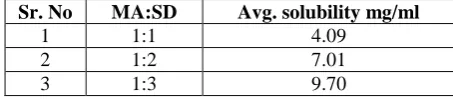
For solid dispersion by solvent evaporation method crospovidon was used in 1:1, 1:2 and 1:3 ratios. The carrier used for the preparation of solid dispersion showed significant increase in the solubility of Mefenamic acid. The results of solubility studies of Mefenamic acid and its solid dispersions were studied. It was observed that the solubility of drug increased with increase in the amount of carrier and it also observed that 1:3 (drug: polymer) ratio showed highest solubility. The solubility of Mefenamic acid solid dispersions will be increased with the optimized ratio of drug and polymer. Thus the Solid dispersion technique is one of the reliable methods of solubility enhancement of poorly water soluble drug.
Table No 5
Solubility enhancement by solid dispersion with Crospovidon
Sr. No MA:SD Avg. solubility mg/ml
1 1:1 4.09
2 1:2 7.01
3 1:3 9.70
Post formulation study was carried out on the tablets with reduced dose (75mg) which shows drug release equivalent to the marketed tablet (100mg)
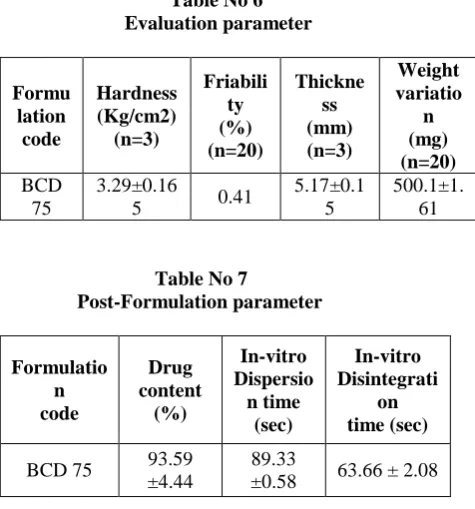
Hardness i.e. tablet crushing load, which is the force required to break a tablet by compression in radial direction was performed by Pfizer hardness tester. It was found to be 3.29 ± 0.165 kg/cm2, as these tablets are rapidly disintegrating.
Friability was found well within the approved range (<1%) in the formulation i.e. 0.41%.
The thickness of the tablets was measured by using Vernier calliper by picking the tablets randomly. The values are almost uniform in the formulation. Thickness was found in the range of 5.17 ± 0.15 mm.
[image:5.595.309.534.184.237.2] [image:5.595.304.531.466.516.2]The drug content uniformity was examined as per I.P specification. The tablets of batch were found to comply with uniformity of content test. The content uniformity for formulation was analyzed spectrophotometrically. The mean value and standard deviation of the formulation was calculated. The results indicated that in all the formulation the drug content was uniform.
The drug content of the tablets was found 93.59 ± 4.44 % of Mefenamic acid.
In vitro dispersion time is measured by the time taken to form uniform dispersion. From the batch randomly three tablets were used for the study. In vitro dispersion time is measured by the time taken to form uniform dispersion. It is an unofficial parameter applicable only to dispersible tablets. Time required for complete dispersion of a tablet was measured which shows 34.45 ± 2.05 seconds.
In vitro Disintegration test was performed to ensure disintegration of tablets in water, if it is to be used as a dispersible tablet. Disintegration time of dispersible tablets was found to be 63.66 ± 2.08 sec. Disintegration time is the time required for a tablet to break into granules of specified size (or smaller), under carefully specified test conditions. Formulation shows disintegration time less than 180 seconds. Results for drug content uniformity, in vitro dispersion time, in vitro Disintegration time tabulated in table #7
Uniformity of dispersion was checked which is applicable only to dispersible tablet. The dispersed mixture passed freely from the sieve without leaving any residue indicating that the batch passed the test for uniformity of dispersion.
In Vitro Dissolution study
Drug release study were carried out on marketed formulation and prepared BCD formulations. Marketed formulation containing 100mg Mefenamic acid gives 19.26 % (19.26mg/ml) drug release at the end of 30 min. Prepared formulation of BCD complex containing 100mg, 65mg and 75mg Mefenamic acid gives 30.04% (30.04mg/ml), 24.32% (15.80mg/ml) and 28.77% (21.58) drug release respectively.
All the three formulations were subjected for the in vitro dissolution studies using tablet dissolution tester USP XXIII. The sample were withdrawn at different time intervals and analyzed at 284 nm. Cumulative drug release was calculated on the basis of mean amount of Mefenamic acid present in respective tablet.
The results obtained in the in vitro drug release for the formulations are given in the table. In this study first of all drug release by the marketed tablet was studied in triplicate for this study the marketed tablet which was used having dose of 100mg. This marketed tablet shows 19.26% drug release i.e. 19.26mg/ml drug release was obtained. After that formulation of tablet was carried out which contain 100mg drug (100mg MA+ 300mg BCD) this
batch gives 30.04% (30.04mg/ml) drug release, but drug release was required equivalent to marketed tablet so the dose was reduced to 65mg on the basis of calculation by cross multiplication.
Tablets were formulated by taking 260mg complex (65mg MA + 195mg BCD) it gives 24.32% (15.80mg/ml) drug release which was less than the required so dose was increase by 10mg i.e. 75mg improvement in the dose. Tablet formulated contain 300mg complex (75mg MA + 225mg BCD) shows 28.77% (21.58mg/ml) drug release which was slightly more than the required. Comparative drug release profile was mentioned in table #8 and its graph in figure #1.
Stability study
Stability study was carried on the BCD complex formulation containing 75mg Mefenamic acid. Formulation showed negligible change over time for parameters like in vitro dispersion time, drug content, dissolution, etc. No significant difference in the drug content between initial and formulations kept for stability. In any rational design and evaluation of dosages forms for drugs, the stability of the active component must be major criteria in determining their acceptance or rejection. During the stability studies the product is exposed to normal condition of temperature and humidity. Formulation showed negligible change over time for parameters and the drug content was found to be 96.15 % for Mefenamic acid at the end of 1 month on accelerated stability condition. (Table #9)
Table No 6 Evaluation parameter
Formu lation code
Hardness (Kg/cm2)
(n=3)
Friabili ty (%) (n=20)
Thickne ss (mm) (n=3)
Weight variatio
n (mg) (n=20)
BCD 75
3.29±0.16
5 0.41
5.17±0.1 5
500.1±1. 61
Table No 7
Post-Formulation parameter
Formulatio n code
Drug content
(%)
In-vitro Dispersio n time
(sec)
In-vitro Disintegrati
on time (sec)
BCD 75 93.59 ±4.44
89.33
[image:6.595.301.539.446.701.2]Table No 8
Comparative In-Vitro Dissolution study
Time (min)
Marketed 100 (%)
BCD 100 (%)
BCD 65 (%)
BCD 75 (%)
5 9.57 12.81 9.76 13.08 10 13.03 17.65 13.31 17.38 15 14.42 19.04 16.86 20.15 20 16.26 26.19 19.70 22.08 25 17.42 29.19 21.48 25.92 30 19.26 31.04 24.32 28.77
Table No 9
Evaluation of formulation after stability study
Tim e
Formulati on code
Drug conte
nt (%)
In-vitro Dispersi
on time (sec)
In-vitro Disintegrat
ion time (sec)
0 mont
h
BCD 75 93.59 ±4.44 63.66 ± 2.08
1 mont
h
BCD 75 96.15 90 66
Figure No 1
Comparative drug release profile
8. CONCLUSION
From the comparative solubility study it was concluded that complexation of Mefenamic acid with β Cyclodextrine at 1:3 ratio shows higher solubility. The tablet was prepared by taking BCD in 1:3 concentration and it was evaluated. Drug release study was carried out and comparison was done with marketed preparation. From the drug release profile of marketed tablet and prepared tablet it was concluded that the drug release shown by prepared tablet containing 75mg dose shows the approximately equal drug release as that of the marketed 100mg tablet. Hence BCD complexation is the best method for solubility enhancement of poorly water soluble drugs. Mefenamic acid tablet was prepared by direct compression and it was found to be good without
sticking, chipping, and capping. IR study reveals that there was no any drug-excipient interaction or compatibility.
Other evaluation parameters were found to be within the limit.
During stability study formulation showed negligible change over time.
REFERENCES
[1] Indian Pharmacopoeia 2007, Government of India Ministry of Health & Family Welfare, Published By the Indian Pharmacopoeia Commission, Ghaziabad. Volume 1st, 477, 478, 177-183. [2] Ansari Yaasir Ahmed*, Dr. Gulam Javed khan,
Ansari Abdul Aleem, Ansari Abubakar (2016): Comparative Assessment of Analytical Methods of orally Disintegrated Tablet of Ondansetron. Asian Journal of Pharmaceutical Technology & Innovation, 04 (21), pp. 01 – 09.
[3] Ansari Yaasir Ahmed*, Dr. Sumer Singh, Dr. Majaz Quazi, Jameel Ahemad, Ansari Mohd. Razi (2019): Stability Indicating HPLC Method Development and Validation for Simultaneous Estimations of Atenolol and Nifedipine in Bulk and Tablet Dosage Form. Journal of Emerging Technologies and Innovative Research, 6(2), pp. 29-36.
[4] British Pharmacopoeia Published by The stationery office on behalf of the Medicines and Healthcare products Regulatory Agency(MHRA), 2005. Volume 1st, 11.
[5] Sharma Chandrakant, Bhardwaj Sudhir, Khan Imran et. al, “A Novel Concept On: Solubility Enhancement Technique.” Indo American Journal of Pharmaceutical Research. 2013, 3(5).
[6] Amit Chaudhary, Upendra Nagaich, Neha Gulati et. al, “Enhancement of solubilization and bioavailability of poorly soluble drugs by physical and chemical modifications: A recent review.” Journal of Advanced Pharmacy Education & Research. 2012, 2 (1), 32-67.
[7] Varshney H. M., Chatterjee A., “Solubility Enhancement Of Poorly Hydrophilic Drugs By Using Different Newer Techniques: A Review.” International Journal of Therapeutic Applications. 2012, 6. 8 – 13.
[8] Md. Ali Sajid and Vicky Choudhary. “Solubility Enhancement Methods with Importance of Hydrotrope”. Journal of Drug Delivery & Therapeutics. 2012, 2 (6), 96-101.
[9] Vipul P. Patel, Rajesh K. Parikh, Mukesh C. Gohel et. al, “In Vitro Dissolution Enhancement of Albendazole by Preparation of Inclusion Complexs with HP- ß Cyclodextrin”. Pharma Science Monitor An International Journal Of Pharmaceutical Sciences. 2011, 2 (1).
[11] Yogesh S. Thorat, Indrajeet D. Gonjari, Avinash H. Hosmani. “Solubility Enhancement Techniques: A Review on Conventional and Novel
Approaches”.International Journal of
Pharmaceutical Science and Research. 2011, 2 (10).
[12] K.Hemanth Pavan Kumar, Yerram Chandramouli, C.Surya Prakash Reddy et. al, “Enhancement of Solubility and Dissolution Rate of Diclofenac Sodium by Solid Dispersion
Method”. International Journal of Advanced
Pharmaceutics. 2012, 2 (2), 110-118.
[13]Abhishek. Y. Kanugo, Pratibha Chavhan, V.V. Potnis, “Melt Evaporation Method: A Solid Dispersion Strategy to Enhance Solubility and Dissolution of Lafutidine”. World Journal of Pharmaceutical Research. 2013, 2 (6), 2283-2300. [14] Tejaswi Annapureddy, J. Padma preetha1, Dr. N. Arun Kumar et. al, “Enhancement of Solubility of Nifedipine by Liquisolid Compacts Technique”.
Indo American Journal of Pharmaceutical Research. 2013, 3(4).
[15] Panna Thapa, Prakash Thapa, Ritu Thapa et. al,
“Solubility Enhancement of Domperidone Fast
Disintegrating Tablet Using
Hydroxypropyl-β-Cyclodextrin by Inclusion Complexation
Technique”. Scientific Research Pharmacology & Pharmacy. 2014, 5, 238-249.
[16] Seeprarani Rath, Panchaxari Mallappa Dandagi, Suryasri Lavanya Adavi et. al, “Preparation and In Vivo Evaluation of Poorly Soluble Deferasirox Dispersible Tablets by Hydroxy Propyl Beta
Cyclodextrin Complexation”. International
![Crystal structure of 2,3,5,6 tetrakis[(methylsulfanyl)methyl]pyrazine†](data:image/gif;base64,R0lGODlhAQABAIAAAP///wAAACH5BAEAAAAALAAAAAABAAEAAAICRAEAOw==)