Question Classification using HDAG Kernel
Jun Suzuki, Hirotoshi Taira, Yutaka Sasaki, and Eisaku Maeda
NTT Communication Science Laboratories, NTT Corp. 2-4 Hikaridai, Seika-cho, Soraku-gun, Kyoto, 619-0237 Japan
jun, taira, sasaki, maeda @cslab.kecl.ntt.co.jp
Abstract
This paper proposes a machine learning based question classification method us-ing a kernel function, Hierarchical Di-rected Acyclic Graph (HDAG) Kernel. The HDAG Kernel directly accepts struc-tured natural language data, such as sev-eral levels of chunks and their relations, and computes the value of the kernel func-tion at a practical cost and time while re-flecting all of these structures. We ex-amine the proposed method in a ques-tion classificaques-tion experiment using 5011 Japanese questions that are labeled by 150 question types. The results demon-strate that our proposed method improves the performance of question classification over that by conventional methods such as bag-of-words and their combinations.
1 Introduction
Open-domain Question Answering (ODQA) in-volves the extraction of correct answer(s) to a given free-form factual question from a large collection of texts. ODQA has been actively studied all over the world since the start of the Question Answering Track at TREC-8 in 1999.
The definition of ODQA tasks at the TREC QA-Track has been revised and extended year after year. At first, ODQA followed the Passage Retrieval method as used at TREC-8. That is, the ODQA task was to answer a question in the form of strings of
50 bytes or 250 bytes excerpted from a large set of news wires. Recently, however, the ODQA task is considered to be a task of extracting exact answers to a question. For instance, if a QA system is given the question “When was Queen Victoria born?”, it should answer “1832”.
Typically, QA systems have the following compo-nents for achieving ODQA:
Question analysis analyzes a given question and
determines the question type and keywords.
Text retrieval finds the top paragraphs or
docu-ments that match the result of the question anal-ysis component.
Answer candidate extraction extracts answer
can-didates of the given question from the docu-ments retrieved by the text retrieval component, based on the results of the question types.
Answer selection selects the most plausible
an-swer(s) to the given question from among the answer candidates extracted by the answer can-didate extraction component.
phrases or named entities in the texts. Question clas-sification provides the benefit of a powerful restric-tion that reduces to a practical number of the answer candidates that should be evaluated in the answer se-lection process.
This work develops a machine learning approach to question classification (Harabagiu et al., 2000; Hermjakob, 2001; Li and Roth, 2002). We use the Hierarchical Directed Acyclic Graph (HDAG) Ker-nel (Suzuki et al., 2003), which is suited to handle structured natural language data. It can handle struc-tures within texts as the feastruc-tures of texts without converting the structures to the explicit representa-tion of numerical feature vectors. This framework is useful for question classification because the works of (Li and Roth, 2002; Suzuki et al., 2002a) showed that richer information, such as structural and se-mantical information inside a given question, im-proves the question classification performance over using the information of just simple key terms.
In Section 2, we present the question classifica-tion problem. In Secclassifica-tion 3, we explain our proposed method for question classification. Finally, in Sec-tion 4, we describe our experiment and results.
2 Question Classification
Question classification is defined as a task that maps a given question to more than one of question
types (classes).
In the general concept of QA systems, the result of question classification is used in a downstream process, answer selection, to select a correct answer from among the large number of answer candidates that are extracted from the source documents. The result of the question classification, that is, the la-bels of the question types, can reduce the number of answer candidates. Therefore, we no longer have to evaluate every noun phrase in the source docu-ments to see whether it provides a correct answer to a given question. Evaluating only answer candidates that match the results of question classification is an efficient method of obtaining correct answers. Thus, question classification is an important process of a QA system. Better performance in question classi-fication will lead to better total performance of the QA system.
2.1 Question Types: Classes of Questions
Numerous question taxonomies have been defined, but unfortunately, no standard exists.
In the case of the TREC QA-Track, most systems have their own question taxonomy, and these are re-constructed year by year. For example, (Ittycheriah et al., 2001) defined 31 original question types in two levels of hierarchical structure. (Harabagiu et al., 2000) also defined a large hierarchical question taxonomy, and (Hovy et al., 2001) defined 141 ques-tion types of a hierarchical quesques-tion taxonomy.
Within all of these taxonomies, question types are defined from the viewpoint of the target intention of the given questions, and they have hierarchical struc-tures, even though these question taxonomies are de-fined by different researchers. This because the pur-pose of question classification is to reduce the large number of answer candidates by restricting the tar-get intention via question types. Moreover, it is very useful to handle question taxonomy constructed in a hierarchical structure in the downstream processes. Thus, question types should be the target intention and constructed in a hierarchical structure.
2.2 Properties
Question classification is quite similar to Text Cate-gorization, which is one of the major tasks in Nat-ural Language Processing (NLP). These tasks re-quire classification of the given text to certain de-fined classes. In general, in the case of text catego-rization, the given text is one document, such as a newspaper article, and the classes are the topics of the articles. In the case of question classification, a given text is one short question sentence, and the classes are the target answers corresponding to the intention of the given question.
ex-periments in these previous works indicated that the structural and semantical features inside ques-tions have the potential to improve the performance of question classification. In other words, high-performance question classification requires us to extract the structural and semantical features from the given question.
2.3 Learning and Classification Task
This paper focuses on the machine learning ap-proach to question classification. The machine learning approach has several advantages over man-ual methods.
First, the construction of a manual classifier for questions is a tedious task that requires the analy-sis of a large number of questions. Moreover, map-ping questions into question types requires the use of lexical items and, therefore, an explicit represen-tation of the mapping may be very large. On the other hand, machine learning approaches only need to define features. Finally, the classifier can be more flexibly reconstructed than a manual one because it can be trained on a new taxonomy in a very short time.
As the machine learning algorithm, we chose the Support Vector Machines (SVMs) (Cortes and Vap-nik, 1995) because the work of (Joachims, 1998; Taira and Haruno, 1999) reported state-of-the-art performance in text categorization as long as ques-tion classificaques-tion is a similar process to text catego-rization.
3 HDAG Kernel
Recently, the design of kernel functions has become a hot topic in the research field of machine learning. A specific kernel can drastically increase the perfor-mance of specific tasks. Moreover, a specific kernel can handle new feature spaces that are difficult to manage directly with conventional methods.
The HDAG Kernel is a new kernel function that is designed to easily handle structured natural lan-guage data. According to the discussion in the pre-vious section, richer information such as structural and semantical information is required for high-performance question classification.
We think that the HDAG Kernel is suitable for improving the performance of question
classifica-tion: The HDAG Kernel can handle various linguis-tic structures within texts, such as chunks and their relations, as the features of the text without convert-ing such structures to numerical feature vectors ex-plicitly.
3.1 Feature Space
Figure 1 shows examples of the structures within questions that are handled by the HDAG kernel.
As shown in Figure 1, the HDAG kernel accepts several levels of chunks and their relations inside the text. The nodes represent several levels of chunks in-cluding words, and directed links represent their
re-lations. Suppose and
rep-resent each node. Some nodes have a graph inside themselves, which are called “non-terminal nodes”. Each node can have more than one attribute, such as words, part-of-speech tags, semantic information like WordNet (Fellbaum, 1998), and class names of the named entity. Moreover, nodes are allowed to not have any attribute, in other words, we do not have to assign attributes to all nodes.
The “attribute sequence” is a sequence of at-tributes extracted from the node in sub-paths of HDAGs. One type of attribute sequence becomes one element in the feature vector. The framework of the HDAG Kernel allows node skips during the ex-traction of attribute sequences, and its cost is based the decay factor !" , since HDAG Kernel
deals with not only the exact matching of the sub-structures between HDAGs but also the approximate structure matching of them.
Explicit representation of feature vectors in the HDAG kernel can be written as #$%"'& #)(*%"+-,.,-,/+.#102%"" , where # represents the
ex-plicit feature mapping from the HDAG to the feature vector and represents the number of all possible
types of attribute sequences extracted to the HDAGs. The value of# %2" is the number of occurrences of
the3 ’th attribute sequence in the HDAG% , weighted
according to the node skip.
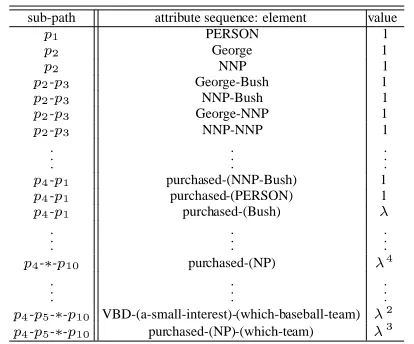
Table 1 shows a example of attribute sequences that are extracted from the example question in Fig-ure 1. The symbol4 in the sub-path column shows
ex-q1 q4 q6
q3
q8
q2
q5 q7
Question: George Bush purchased a small interest in which baseball team ?
How far is it from Denver to Aspen
WRB RB VBZ PRP IN NNP TO NNP
LOCATION LOCATION
ADVP
Question: How far is it from Denver to Aspen ?
? .
WHADVP
q9 q10
p1
p2
p5
p4
p3 p6 p7
George Bush purchased a small interest in which baseball team ?
NNP NNP VBD DT JJ NN IN WDT NN NN .
PERSON NP
NP PP NP
p8
p9
p11
p10
[image:4.612.139.476.76.222.2]p12 p13 p14
Figure 1: Example of text structure handled by HDAG (From the questions in TREC-10)
Table 1: Examples of attribute sequences, elements of feature vectors, extracted from the example ques-tion in Figure 1
sub-path attribute sequence: element value
56
PERSON 1
5/7
George 1
5
7
NNP 1
5 7
-598
George-Bush 1
5/7
-5 8
NNP-Bush 1
5/7
-5 8
George-NNP 1
5 7
-598
NNP-NNP 1
. . .
. . .
. . .
5/:
-5 6
purchased-(NNP-Bush) 1
5 :
-5.6
purchased-(PERSON) 1
5
:
-5.6
purchased-(Bush) ;
. . .
. . .
. . .
5 :
-< -5.6>=
purchased-(NP) ;
:
. . .
. . .
. . .
5?:
-59@
-< -5 6>=
VBD-(a-small-interest)-(which-baseball-team) ;
7
5
:
-5
@
-< -5.6>=
purchased-(NP)-(which-team) ;
8
tracted from sub-path “BA -( ”, and “NNP-Bush” is
in the nodeC( .
The return value of the HDAG Kernel can be de-fined as:
D EGFIHKJMLNPORQSEGFILUTVQMEGJLXWBNZY []\^
Q
[
EGFBLBT*Q
[
EGJMLXH
(1)
where input objects _ and ` are the objects
rep-resented in HDAG %
( and
%ba , respectively.
Ac-cording to this formula, the HDAG Kernel calculates the inner product of the common attribute sequences weighted according to their node skips and the oc-currence between the two HDAGs,% ( and% a .
3.2 Efficient Calculation Method
In general, the dimension of the feature space in
equation (1) becomes very high or even infinity. It might thus be computationally infeasible to generate feature vector#$%2" explicitly.
To solve this problem, we focus on the framework of the kernel functions defined for a discrete struc-ture, Convolution Kernels (Haussler, 1999). One of the most remarkable properties of this kernel methodology is that it can calculate kernel functions by the “inner products between pairs of objects” while it retains the original representation of objects. This means that we do not have to map input objects to the numerical feature vectors by explicitly repre-senting them, as long as an efficient calculation for the inner products between a pair of texts is defined.
However, Convolution Kernels are abstract con-cepts. The Tree Kernel (Collins and Duffy, 2001) and String Subsequence Kernel (SSK) (Lodhi et al., 2002) are examples of instances in the Convolution Kernels developed in the NLP field.
[image:4.612.82.289.327.499.2]Table 2: Distribution of 5011 questions over question type hierarchy
g
question type #
0 !TOP 4963
1 NAME 3190
2 PERSON 824
3 *LASTNAME 0
3 *MALE FIRSTNAME 1 3 *FEMALE FIRSTNAME 2
2 ORGANIZATION 733
3 COMPANY 119
3 *COMPANY GROUP 0
3 *MILITARY 4
3 INSTITUTE 26
3 *MARKET 0
3 POLITICAL ORGANIZATION 103
4 GOVERNMENT 38
4 POLITICAL PARTY 43 4 PUBLIC INSTITUTION 19
3 GROUP 96
4 !SPORTS TEAM 20
3 *ETHNIC GROUP 4
3 *NATIONALITY 4
2 LOCATION 752
3 GPE 265
4 CITY 77
4 *COUNTY 1
4 PROVINCE 47
4 COUNTRY 116
3 REGION 23
3 GEOLOGICAL REGION 22
4 *LANDFORM 9
4 *WATER FORM 7
4 *SEA 3
3 *ASTRAL BODY 5
4 *STAR 2
4 *PLANET 2
3 ADDRESS 59
4 POSTAL ADDRESS 24
4 PHONE NUMBER 22
4 *EMAIL 4
4 *URL 8
2 FACILITY 147
3 GOE 99
4 SCHOOL 27
4 *MUSEUM 3
4 *AMUSEMENT PARK 4
4 WORSHIP PLACE 10
4 STATION TOP 12
5 *AIRPORT 6
5 *STATION 3
5 *PORT 3
5 *CAR STOP 0
g
question type #
3 LINE 24
4 *RAILROAD 3
4 !ROAD 11
4 *WATERWAY 0
4 *TUNNEL 1
4 *BRIDGE 1
3 *PARK 2
3 *MONUMENT 3
2 PRODUCT 468
3 VEHICLE 37
4 *CAR 8
4 *TRAIN 2
4 *AIRCRAFT 5
4 *SPACESHIP 8
4 !SHIP 12
3 DRUG 15
3 *WEAPON 4
3 *STOCK 0
3 *CURRENCY 8
3 AWARD 11
3 *THEORY 1
3 RULE 66
3 *SERVICE 2
3 *CHARCTER 4
3 METHOD SYSTEM 33
3 ACTION MOVEMENT 21
3 *PLAN 1
3 *ACADEMIC 5
3 *CATEGORY 0
3 SPORTS 11
3 OFFENCE 10
3 ART 78
4 *PICTURE 2
4 *BROADCAST PROGRAM 6
4 MOVIE 15
4 *SHOW 4
4 MUSIC 13
3 PRINTING 31
4 !BOOK 10
4 *NEWSPAPER 7
4 *MAGAZINE 4
2 DISEASE 44
2 EVENT 99
3 *GAMES 8
3 !CONFERENCE 17
3 *PHENOMENA 6
3 *WAR 3
3 *NATURAL DISASTER 5
3 *CRIME 6
2 TITLE 97
g
question type # 3 !POSITION TITLE 97
2 *LANGUAGE 8
2 *RELIGION 6
1 NATURAL OBJECT 96
2 ANIMAL 18
2 VEGETABLE 15
2 MINERAL 54
1 COLOR 10
1 TIME TOP 779
2 TIMEX 652
3 TIME 50
3 DATE 594
3 *ERA 5
2 PERIODX 125
3 *TIME PERIOD 9 3 *DATE PERIOD 9 3 *WEEK PERIOD 4 3 *MONTH PERIOD 6 3 !YEAR PERIOD 41
1 NUMEX 882
2 MONEY 187
2 *STOCK INDEX 0
2 *POINT 9
2 PERCENT 94
2 MULTIPLICATION 10
2 FREQUENCY 27
2 *RANK 8
2 AGE 58
2 MEASUREMENT 133 3 PHYSICAL EXTENT 53
3 SPACE 18
3 VOLUME 14
3 WEIGHT 22
3 *SPEED 9
3 *INTENSITY 0
3 *TEMPERATURE 7
3 *CALORIE 1
3 *SEISMIC INTENSITY 2
2 COUNTX 326
3 N PERSON 162
3 N ORGANIZATION 49
3 N LOCATION 27
4 *N COUNTRY 9
3 *N FACILITY 6
3 N PRODUCT 47
3 *N EVENT 8
3 *N ANIMAL 7
3 *N VEGETABLE 0
3 *N MINERAL 0
0 *OTHER 48
4 Experiment
4.1 Data Set
We used three different QA data sets together to evaluate the performance of our proposed method. One is the 1011 questions of NTCIR-QAC11, which were gathered from ’dry-run’, ’formal-run’ and ’additional-run.’ The second is the 2000 questions described in (Suzuki et al., 2002b). The last one is the 2000 questions of CRL-QA data2. These three QA data sets are written in Japanese.
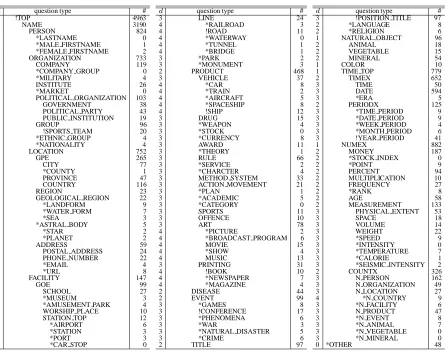
These data were labeled with the 150 question types that are defined in the CRL-QA data, along with one additional question type, “OTHER”. Ta-ble 2 shows all of the question types we used in this experiment, where h represents the depth of the
hi-1
http://www.nlp.cs.ritsumei.ac.jp/qac/
2
http://www.cs.nyu.edu/˜sekine/PROJECT/CRLQA/
erarchy and # represents the number of questions of each question type, including the number of ques-tions in “child question types”.
While considering question classification as a learning and classification problem, we decided not to use question types that do not have enough ques-tions (more than ten quesques-tions), indicated by an as-terisk (*) in front of the name of the question type, because classifier learning is very difficult with very few data. In addition, after the above operations, if only one question type belongs to one parent ques-tion type, we also deleted it, which is indicated by an exclamation mark (!). Ultimately, we evaluated 68 question types.
4.2 Comparison Methods
bag-of-words kernel, a bag-bag-of-words (BOW) with a poly-nomial kernel (d1: first degree polypoly-nomial kernel, d2: second degree polynomial kernel).
HDAG and BOW differ in how they consider the structures of a given question. BOW only con-siders attributes independently (d1) or combinato-rially (d2) in a given question. On the other hand, HDAG can consider the structures (relations) of the attributes in a given question.
We selected SVM for the learning and classifica-tion algorithm. Addiclassifica-tionally, we evaluated the per-formance using SNoW3 to compare our method to indirectly the SNoW-based question classifier (Li and Roth, 2002). Note that BOW was used as fea-tures for SNoW.
Finally, we compared the performances of HDAG-SVM, BOW(d2)-SVM, BOW(d1)-SVM, and BOW-SNoW. The parameters of each com-parison method were set as follows: The decay factor was 0.5 for HDAG, and the soft-margin
i
of all SVM was set to 1. For SNoW, we used
j
&k!M,elMm+9n&o,Kp , andqr&ol . These parameters
were selected based on preliminary experiments.
4.3 Decision Model
Since the SVM is a two-class classification method, we have to make a decision model to determine the question type of a given question that is adapted for question classification, which is a multi-class hierar-chical classification problem.
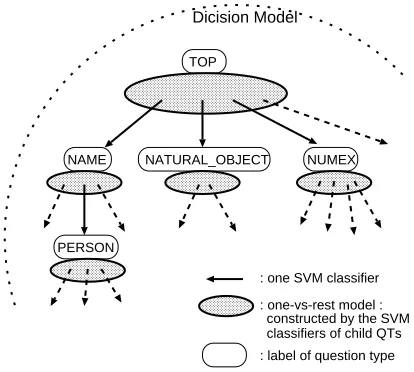
Figure 2 shows how we constructed the final de-cision model for question classification.
First, we made 68 SVM classifiers for each ques-tion type, and then we constructed “one-vs-rest models” for each node in the hierarchical question taxonomy. One of the one-vs-rest models was con-structed by some of the SVM classifiers, which were the child question types of the focused node. For example, the one-vs-rest model at the node “TOP” was constructed by five SVM classifiers: “NAME”, “NATURAL OBJECT”, “COLOR”, “TIME TOP” and “NUMEX”. The total number of one-vs-rest models was 17.
Finally, the decision model was constructed by setting one-vs-rest models in the hierarchical tion taxonomy to determine the most plausible
ques-3
http://l2r.cs.uiuc.edu/˜cogcomp/cc-software.html
Dicision Model
NAME
TOP
NATURAL_OBJECT NUMEX
: one SVM classifier : one-vs-rest model :
constructed by the SVM classifiers of child QTs PERSON
[image:6.612.324.531.70.256.2]: label of question type
Figure 2: Hierarchical classifier constructed by SVM classifiers
tion type of a given question.
4.4 Features
We set four feature sets for each comparison method.
1. words only (W)
2. words and named entities (W+N)
3. words and semantic information (W+S)
4. words, named entities and semantic informa-tion (W+N+S)
The words were analyzed in basic form, and the semantic information was obtained from the “Goi-taikei” (Ikehara et al., 1997), which is similar to WordNet in English. Words, chunks and their rela-tions in the texts were analyzed by CaboCha (Kudo and Matsumoto, 2002), and named entities were an-alyzed by the SVM-based NE tagger (Isozaki and Kazawa, 2002).
Note that even when using the same feature sets, method of how to construct feature spaces are en-tirely different between HDAG and BOW.
4.5 Evaluation Method
Table 3: Results of question classification experi-ment by five-fold cross-validation
Macc
W W+N W+S W+N+S
HDAG-SVM 0.862 0.871 0.877 0.882
BOW(d2)-SVM 0.841 0.847 0.847 0.856 BOW(d1)-SVM 0.839 0.843 0.837 0.851 BOW-SNoW 0.760 0.774 0.800 0.808
Qacc
W W+N W+S W+N+S
HDAG-SVM 0.730 0.736 0.742 0.749
BOW(d2)-SVM 0.678 0.691 0.686 0.704 BOW(d1)-SVM 0.679 0.686 0.671 0.694 BOW-SNoW 0.562 0.573 0.614 0.626
1. Average accuracy of each one-vs-rest model (Macc)
This measure evaluates the performance of each vs-rest model independently. If a one-vs-rest model classifies a given question cor-rectly, it scores a 1, otherwise, it scores a 0.
2. Average accuracy of each given question (Qacc)
This measure evaluates the total performance of the decision model, the question classifier. If each given question is classified in a correct question type, it scores a 1, otherwise, it scores a 0.
In Qacc, classifying with a correct question type im-plies that all of the one-vs-rest models from the top of the hierarchy of the question taxonomy to the given question type must classify correctly.
[image:7.612.323.529.124.349.2]4.6 Results
Table 3 shows the results of our question classifi-cation experiment, which is evaluated by five-fold cross-validation.
5 Discussion
First, we could increase the performance by using the information on named entities and semantic in-formation compared to only using the words, which is the same result given in (Li and Roth, 2002). This result proved that high-performance question clas-sification requires not only word features but also many more types of information in the question.
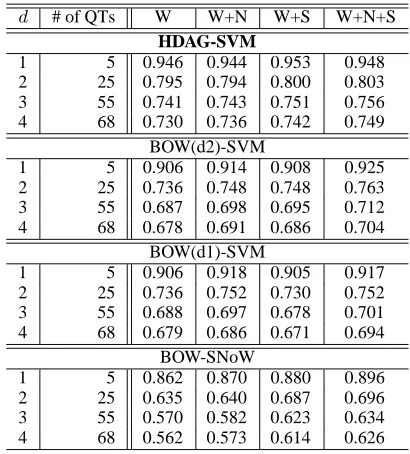
Table 4: Accuracy of each question (Qacc) evalu-ated at different depths of hierarchy in question tax-onomys
# of QTs W W+N W+S W+N+S
HDAG-SVM
1 5 0.946 0.944 0.953 0.948 2 25 0.795 0.794 0.800 0.803 3 55 0.741 0.743 0.751 0.756 4 68 0.730 0.736 0.742 0.749
BOW(d2)-SVM
1 5 0.906 0.914 0.908 0.925 2 25 0.736 0.748 0.748 0.763 3 55 0.687 0.698 0.695 0.712 4 68 0.678 0.691 0.686 0.704
BOW(d1)-SVM
1 5 0.906 0.918 0.905 0.917 2 25 0.736 0.752 0.730 0.752 3 55 0.688 0.697 0.678 0.701 4 68 0.679 0.686 0.671 0.694
BOW-SNoW
1 5 0.862 0.870 0.880 0.896 2 25 0.635 0.640 0.687 0.696 3 55 0.570 0.582 0.623 0.634 4 68 0.562 0.573 0.614 0.626
Second, our proposed method showed higher per-formance than any method using BOW. This re-sult indicates that the structural information in the question, which includes several levels of chunks and their relations, must provide powerful features to classify the target intention of a given question. We assume that such structural information must provide shallow semantic information of the text. Therefore, it is natural to improve the performance to identify the intention of the question in order to use the structural information in the manner of our proposed method.
Table 4 shows the results of Qacc at each depth of the question taxonomy. The results of depth h
represent the total performance measured by Qacc, considering only the upperh levels of question types
an-swer, even though a lower-level classifier has the ability to classify correctly. Thus, using a machine learning approach (not only SVM) is not suitable for deep hierarchically structured class labels. We should arrange a question taxonomy that is suit-able for machine learning to achieve the total per-formance of question classification.
The performance by using SVM is better than that by SNoW, even in handling the same feature of BOW. One advantage of using SNoW is its much faster learning and classifying speed than those of SVM. We should thus select the best approach for the purpose, depending on whether speed or accu-racy is needed.
6 Conclusions
This paper presents a machine learning approach to question classification. We proposed the HDAG ker-nel, a new kernel function, that can easily handle structured natural language data.
Our experimental results proved that features of the structure in a given question, which can be com-puted by the HDAG kernel, are useful for improving the performance of question classification. This is because structures inside a text provide the seman-tic features of question that are required for high-performance question classification.
References
M. Collins and N. Duffy. 2001. Convolution Kernels for Natural Language. In Proc. of Neural Information
Processing Systems (NIPS’2001).
C. Cortes and V. N. Vapnik. 1995. Support Vector Net-works. Machine Learning, 20:273–297.
C. Fellbaum. 1998. WordNet: An Electronic Lexical
Database. MIT Press.
S. Harabagiu, M. Pasca, and S. Maiorano. 2000. FAL-CON: Boosting Knowledge for Answer Engines. In
Proc. of the 9th Text Retrieval Conference (TREC-9).
NIST.
D. Haussler. 1999. Convolution Kernels on Discrete Structures. In Technical Report UCS-CRL-99-10. UC Santa Cruz.
U. Hermjakob. 2001. Parsing and Question Classifica-tions for Question Answering. In Proc. of the
Work-shop on Open-Domain Question Answering at ACL-2001. ACL.
E. H. Hovy, L. Gerber, U. Hermjakob, C.-Y. Lin, and D. Ravichandran. 2001. Toward Semantics-Based Answer Pinpointing. In Proc. of the Human Language
Technology Conference (HLT2001).
S. Ikehara, M. Miyazaki, S. Shirai, A. Yokoo, H. Nakaiwa, K. Ogura, Y. Oyama, and Y. Hayashi, editors. 1997. The Semantic Attribute System, Goi-Taikei — A Japanese Lexicon, volume 1. Iwanami Publishing. (in Japanese).
H. Isozaki and H. Kazawa. 2002. Efficient Support Vector Classifiers for Named Entity Recognition. In
Proc. of the 19th International Conference on Compu-tational Linguistics (COLING 2002), pages 390–396.
A. Ittycheriah, M. Franz, and S. Roukos. 2001. IBM’s Statistical Question Answering System – TREC-10. In Proc. of TREC 2001. NIST.
T. Joachims. 1998. Text Categorization with Support Vector Machines: Learning with Many Relevant Fea-tures. In Proc. of European Conference on Machine
Learning(ECML ’98), pages 137–142.
T. Kudo and Y. Matsumoto. 2002. Japanese Depen-dency Analysis using Cascaded Chunking. In Proc.
of the 6th Conference on Natural Language Learning (CoNLL 2002), pages 63–69.
X. Li and D. Roth. 2002. Learning Question Classi-fiers. In Proc. of the 19th International Conference
on Computational Linguistics (COLING 2002), pages
556–562.
H. Lodhi, C. Saunders, J. Shawe-Taylor, N. Cristianini, and C. Watkins. 2002. Text Classification Using String Kernel. Journal of Machine Learning Research, 2:419–444.
J. Suzuki, Y. Sasaki, and E. Maeda. 2002a. Question type classification using statistical machine learning. In Forum on Information Technology (FIT2002),
Infor-mation Technology Letters (in Japanese), pages 89–90.
J. Suzuki, Y. Sasaki, and E. Maeda. 2002b. SVM Answer Selection for Open-Domain Question Answering. In
Proc. of the 19th International Conference on Compu-tational Linguistics (COLING 2002), pages 974–980.
J. Suzuki, T. Hirao, Y. Sasaki, and E. Maeda. 2003. Hi-erarchical directed acyclic graph kernel: Methods for natural language data. In Proc. of the 41st Annual
Meeting of the Association for Computational Linguis-tics (ACL-2003), page to appear.
H. Taira and M. Haruno. 1999. Feature Selection in SVM Text Categorization. In Proc. of the 16th