1722
Comparative Analysis of HVAC using PID, Fuzzy and
ANFIS Technique
Anil Yadav*, Ajay Goel
Department of Chemical Engineering
Deenbandhu Chhotu Ram University of Science and Technology ,Murthal, Sonipat, Haryana, INDIA
*
Email: - [email protected]
Abstract- Many industrial processes in different industries requires precise control of temperature and humidity guarantee constant product quality. Industrial heating, ventilation and air conditioning (HVAC) control schemes are used to retain the requisite operating conditions for the industrial process even if changes of the ambient atmospheric conditions are prevalent. This paper presents the improvement of temperature and humidity control strategy for HVAC based on INFIS control. The goal of the INFIS based temperature control is to fulfil the control strategy. The simulation test results are satisfactory in control strategy better than FLS (Fuzzy Based System) or conventional PID controller. The main objective of the study is to shed light on new but highly promising approach of adaptive neuro fuzzy interface system in control system. The system provides variation of energy consumption by changing input parameter. The stability of system is defined by settling time, rise time etc.
Keywords: HVAC, ANFIS, PID, Fuggy Logic
1. INTRODUCTION
To ensure the comfortable air quality for humans, using the HVAC (heating, Ventilation, air conditioning) system in big residential and commercial center buildings is extremely important. The two main parameters related to the design of the controllers for two channels of the HVAC are temperature & humidity of the indoor air. Their control is paramount for human comfort as well as industrial automation. In view of the above, In this study we considered three intelligent controllers for controlling the temperature and humidity environment of buildings using MATLAB platform.
A Control scheme for Indoor Room temperature and humidity is proposed based on the continuous monitoring of the thermal and climatic variables. The dynamic behavior of the relevant variables is determined and expressed in terms of a system transfer function. In this study, the indoor temperature control loop has been implemented using a fuzzy logic, ANFIS & then compare it with conventional PID controller.
The HVAC system is designed so that a favorable atmosphere for human as well as industrial systems is achieved. HVAC system controls air
purity Temperature, humidity and air motion. It has been identified that factors leading to the comfort are temperature, relative humidity, air ventilation. Out of which temperature and relative humidity are factors to be controlled.
AC systems are so aimed that they provide perfect temperature control with the suitable humidity in some suitable domain, some industrial and scientific systems need accurate control of temperature and humidity. Energy consumption has increased with demand of air conditioning systems. The energy consumption pattern constitutes nearly half of the world energy consumption by (HVAC) equipment in industrial and other buildings
Buildings other than industrial one’s account for nearly 1/3rd of the total electrical energy spent in India. More than half is consumed by (HVAC) systems.
It is therefore necessary to find means to impROVE SYSTEMS EFFICIENCY.
2. PROBLEM STATEMENT
1723 air is cooled to intended definite humidity. Then
temperature is increased to the desired value. But by this way consumption of energy is enhanced. As per theories of transfer of heat, flow rate of chilled water and the airflow rate supplied choose the system cooling capability together. The controller has direct effect on the air-conditioning system. The objective is to tune the cooling ability of plant as per the fluctuating heat load. PID controllers have been the widely used and have been found valuable and reliable in HVAC applications .AI like fuzzy logic and Artificial Neural Network (ANNs) has been used to get better results. These techniques are better than PID controllers. In this Paper implemented controllers like fuzzy logic and ANFIS are examined for their utility in the control of temperature and humidity in air-conditioning systems.
3. MODELING OF HVAC SYSTEM
[image:2.612.357.516.252.465.2]A commercial chilled-water all-air system has been planned. Experiments were piloted on the system (simulated on MATLAB) to investigate the control method. The control strategy has to be examined theoretically before final application.
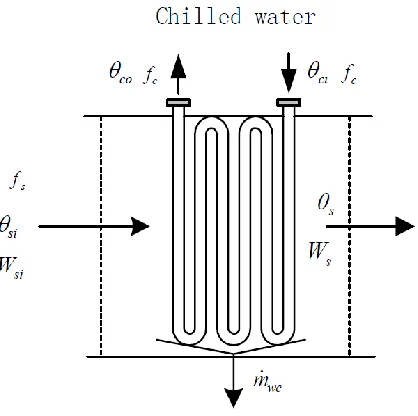
Figure 1 Chilled water AC system
The chiller, which yields the ice-cold water, is the scheme’s cooling resource. The cooled water is provided to the chilling coils in the (AHU) where the water removes hotness from air. This cool managed air is then delivered to the conditioned controlled
space. Thus, the controlled area is maintained at the required state.
4. MODELING OF THE AIR-HANDLING
UNIT
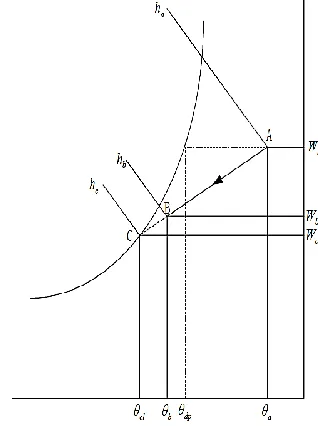
The ice-cold water is made to flow in the cooling coils and the air passes over. Some of the water vapor will condense as they are getting temp below due point. So, cooling and dehumidification take place simultaneously. The process is plotted on the psychometric chart [1].
Figure 2 Cooling and dehumidification
Above figure shows Cooling and dehumidification where the humid air is cooled and dehumidified. The air is in the cooling coils at state a, and dry bulb temp. θa and humidity ratio W. The device dew point
θac, is below the humid air dew point θp. The water
vapor gets condensed and the air leaves with lesser moisture at state B, corresponding to a dry-bulb temperature θb and humidity ratio W. The air velocity
gets lowered, the curve drawn on the psychometric chart showing coil situation becomes steeper, showing more dehumidification per unit of cooling [2].
[image:2.612.75.306.398.617.2]1724
Figure 3 Cooling coil
5. ADAPTIVE NEURO-FUZZY
INTERFACE SYSTEM
It was revealed that fuzzy logic could be effectively applied to room temperature and humidity control. However, the FLC is constructed on linguistic rules based on human experience. If there is not enough initial data available than this system is not applicable. Also, initial fuzzy rules may be incorrect. The fuzzy rules assumed for one system may not be pertinent to other system. Under these circumstances, tuning of fuzzy controller is needed [3]. However, tuning of fuzzy systems is not a direct task. We can’t ascertain how to attain the optimum membership functions and the fuzzy rules. These shortcomings are covered by Neural networks which have the ability of self-learning. This presents a self-tuning fuzzy controller incorporating fuzzy logic with neural networks. The fuzzy controller and neural network structure go hand in hand. The parameters of the fuzzy controller were taken as the connecting weights in the neural network. Thus, tuning of the fuzzy system was done through self-training of the neural network.
The fuzzy logic system has been built with a multi-layer feed-forward neural network [4]. Figure 2 shows fuzzy neural network (FNN) architecture. Here we have two input variables and one output variable. In all there are 49 layers in the network. X1 and X2,
are two input variables to the neural network. X2
Nodes in the1st layer transfer input variables to the next layer with unity connecting weights. Nodes in
Layer 2 are membership nodes or membership functions. Each membership node maps an input linguistic variable into a probable distribution for that variable. Each node in the 3rd layer matches a fuzzy logic rule. All nodes taken together in this layer form the rule base of fuzzy. The last layer node gives the final output.
Figure 2 MATLAB Simulink flow diagram of neural network
For achieving differentiability, the Sum-Product inference method is implemented in place of Max-Min method and for defuzzification weighted sum is implemented. With the firing strength of a rule defined and as the consequent of the rule, the output of the output node is then found from the weighted sum of its all inputs [5].
6. SIMULATION & RESULT ANALYSIS
In this part of the paper, we implemented a fuzzy-logic controller for the air conditioning system in commercial buildings to control both the room temperature and humidity ratio.
Figure 3 MATLAB Simulink Block diagram of Office room temperature with fuzzy controller
[image:3.612.324.556.192.315.2] [image:3.612.334.539.531.658.2]1725 For understanding this HVAC block Diagram
Set point: Figure 3 MATLAB Simulink Block diagram of set point to maintain temperature and humidity, set point is used to set temperature of office room and controller maintain its temperature in block diagram we can see set the temperature at 20 ℃ and humidity 9, this set value helps to controller as a reference value.
Figure 4 Controlled Humidity graph by adaptive
neural network fuzzy interface system
[image:4.612.95.303.216.339.2]Controlled Humidity graph by adaptive neural network fuzzy interface system represents vertical axis in humidity and horizontal axis is in time in seconds. Now Humidity is set at 8.85 by adaptive neuro fuzzy interface system. It has very less steady state error. It reaches to set value easily as compare to other control technique [6].
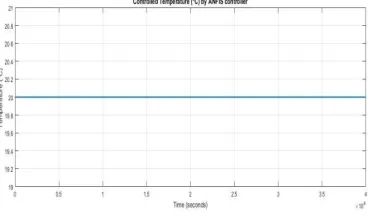
Fig 5 Controlled Temperature graph by adaptive neural network fuzzy interface system
Fig 5 represents Controlled Temperature graph by adaptive neural network fuzzy interface system, represents y- axis in temperature in degree Celsius and x-axis is in time in seconds. Now temperature is set at 20℃ by adaptive neuro fuzzy interface system. It has very less steady state error, it reaches to set
value easily as compare to other control techniques [7-8].
Table 1 and 2 shows the comparative analysis of PID, Fuzzy and ANFIS controller techniques which are used to control Temperature and Humidity control of office buildings.
Table 1 Temperature Control using PID, Fuzzy and ANFIS controller
Sr.No. Parameters PID Controller
Fuzzy Controller
Neuro Fuzzy Controller
1. Overshoot 30% 6% 5%
2. Rise Time 20 Secs 5 Secs 5 Secs
3. Steady State Error
10% 2% 2%
[image:4.612.317.554.254.499.2]4. Peak Time 30 Secs 4 Secs 3 Secs
Table 2 Humidity Control using PID, Fuzzy and ANFIS controller
S.No. Parameters PID Controller
Fuzzy Controller
Neuro Fuzzy Controller
1. Overshoot 40% 10% 4%
2. Rise Time 40 Secs 15 Secs 5 Secs
3. Steady State Error
40% 10% 4%
4. Peak Time 50 Secs 20 Secs 6 Secs
From comparative analysis, in case of temperature control, it was found that ANFIS controller was better than other intelligent control techniques due to improvement in certain parameters like overshoot, it becomes 5% from 6% and peak time is reduced to 3 sec from 4 sec in comparison to Fuzzy controller.
[image:4.612.94.278.487.596.2]1726 comparison to PID and Fuzzy controller for
temperature and humidity control of office buildings.
7. CONCLUSION
In this work, firstly experimental and theoretical analysis of the HVAC system at commercial building was done, and then we implemented the intelligent control techniques for temperature and humidity control of office building. This adaptive scheme was firstly used to build the PID controller for controlling the temperature and humidity control of office building but found some variations in set point. Furtherance improvement was done using artificial intelligent control techniques such as Fuzzy controller and ANFIS controller for controlling the temperature and humidity control of office building. ANFIS controller gave better results in comparison to other intelligent control technique with the improvement in peak overshoot, rise time, steady state error and peak time.
REFERENCES
[1]. Jones, W. P. (1994) Air Conditioning
Engineering (4
th
ed.). London: Edward Arnold. [2]. Chew A. B. (1994.) Performance of Variable Air
Volume Air Conditioning System. Academic Exercise, National University of Singapore. [3]. Huang, S. and R.M. Nelson. (1991) A
PID-Law-Combining Fuzzy Controller for HVAC Applications. ASHRAE Transactions, Vol. 97 (2), pp. 768-774.
[4]. Chen, Y. C. and C. C. Teng. (1995) A Model Reference Control Structure Using a Fuzzy Neural Network. Fuzzy Sets and Systems, Vol. 73, No. 3, pp. 291-312.
[5]. Ahmad Parvaresh, Seyed Mohammad Ali Mohammadi, Ali Parvaresh (July 2012) ”A new mathematical dynamic model for HVAC system components based on MATLAB/Simulink”, International Journal of Innovative Technology and Exploring Engineering (IJITEE) ISSN: 2278-3075, Volume-1, Issue-2.
[6]. Alok Singh, Sandeep Kumar, ( June-July 2012) ”Controlling Thermal Comfort Of Passenger Vehicle Using Fuzzy Controller”, International Journal of Engineering Research and Applications (IJERA) ISSN: 2248-9622 www.ijera.com Vol. 2, Issue 4.
[7]. Henry Nasution, Hishamuddin Jamaluddin, Jamaluddin Mohd. Syeriff ,( April 2011) ” Energy Analysis for Air Conditioning System
Using Fuzzy Logic Controller”,
TELKOMNIKA, Vol.9, No.1, pp. 139~150 ISSN: 1693-6930.
[8]. M. Abbas, M. Saleem Khan, Fareeha Zafar (May-2011) “Autonomous Room Air Cooler Using Fuzzy Logic Control System”, International Journal of Scientific & Engineering Research Volume 2, Issue 5, ,ISSN 2229-5518. [9]. Mohd Fauzi Othman and Siti Marhainis Othman
(2006) Department of Control and
Instrumentations, Faculty of Electrical Engineering, University of Technology Malaysia, “Fuzzy Logic Control for Non Linear Car Air-conditioning” vol 8 no 2.
[10]. W. Leonard, Introduction to control Engineering and Linear Control System (1976) Springer-Verlag Heidelberg, pp. 156-178.
[11]. YAO, Jian and Jin XU. (2010) Indoor Thermal Environment Simulation by using MATLAB and Simulink. Applied Mechanics and Material, vol. 29-32, pp. 2785-2788.
[12]. Norgaard, M., O. Raven, N.K. Poulsen and L.K. Hansen. (2000) Neural Networks for Modeling and Control of Dynamic Systems: a Practitioner’s Handbook. New York: Springer. [13]. Arima, M., E.H. Hara and J.D. Katz erg. (1995)
A Fuzzy Logic and Rough Sets Controller for
HVAC Systems. In Proc. WESCANEX
Communications, Power, and Computing, Vol.1, pp. 133-138.