Backbone Extraction and Pruning for Speeding Up a Deep Parser for
Dialogue Systems
Myroslava O. Dzikovska
Human Communication Research Centre University of Edinburgh
Edinburgh, EH8 9LW, United Kingdom, [email protected]
Carolyn P. Ros´e Carnegie Mellon University Language Technologies Institute,
Pittsburgh, PA 15213, [email protected]
Abstract
In this paper we discuss issues related to speeding up parsing with wide-coverage unification grammars. We demonstrate that state-of-the-art optimisation tech-niques based on backbone parsing before unification do not provide a general so-lution, because they depend on specific properties of the grammar formalism that do not hold for all unification based gram-mars. As an alternative, we describe an optimisation technique that combines am-biguity packing at the constituent structure level with pruning based on local features.
1 Introduction
In this paper we investigate the problem of scaling up a deep unification-based parser developed specif-ically for the purpose of robust interpretation in dia-logue systems by improving its speed and coverage for longer utterances. While typical sentences in di-alogue contexts are shorter than in expository text domains, longer utterances are important in discus-sion oriented domains. For example, in educational applications of dialogue it is important to elicit deep explanation from students and then offer focused feedback based on the details of what students say.
The choice of instructional dialogue as a target ap-plication influenced the choice of parser we needed to use for interpretation in a dialogue system. Sev-eral deep, wide-coverage parsers are currently avail-able (Copestake and Flickinger, 2000; Ros´e, 2000; Baldridge, 2002; Maxwell and Kaplan, 1994), but many of these have not been designed with issues re-lated to interpretation in a dialogue context in mind.
The TRIPS grammar (Dzikovska et al., 2005) is a wide-coverage unification grammar that has been used very successfully in several task-oriented di-alogue systems. It supports interpretation of frag-ments and lexical semantic features (see Section 2 for a more detailed discussion), and provides addi-tional robustness through “robust” rules that cover common grammar mistakes found in dialogue such as missing articles or incorrect agreement. These enhancements help parsing dialogue (both spoken and typed), but they significantly increase grammar ambiguity, a common concern in building grammars for robust parsing (Schneider and McCoy, 1998). It is specifically these robustness-efficiency trade-offs that we address in this paper.
rules and lexical semantics, which may not be im-mediately provided by other available systems.
In the remainder of the paper, we begin with a brief description of the TRIPS parser and grammar, and motivate the choice of LCFLEX parsing algo-rithm to provide a fast parsing foundation. We then discuss the backbone extraction and pruning tech-niques that we used, and evaluate them in compar-ison with the original parsing algorithm. We con-clude with discussion of some implications for im-plementing grammars that build deep syntactic and semantic representations.
2 Motivation
The work reported in this paper was done as part of the process of developing a dialogue system that incorporates deep natural language understanding. We needed a grammar that provides lexical seman-tic interpretation, supports parsing fragmentary ut-terance in dialogue, and could be used to start de-velopment without large quantities of corpus data. TRIPS fulfilled our requirements better than sim-ilar alternatives, such as LINGO ERG (Copestake and Flickinger, 2000) or XLE (Maxwell and Kaplan, 1994).
TRIPS produces logical forms which include se-mantic classes and roles in a domain-independent frame-based formalism derived from FrameNet and VerbNet (Dzikovska et al., 2004; Kipper et al., 2000). Lexical semantic features are known to be helpful in both deep (Tetreault, 2005) and shal-low interpretation tasks (Narayanan and Harabagiu, 2004). Apart from TRIPS, these have not been in-tegrated into existing deep grammars. While both LINGO-ERG and XLE include semantic features related to scoping, in our applications the avail-ability of semantic classes and semantic role as-signments was more important to interpretation, and these features are not currently available from those parsers. Finally, TRIPS provides a domain-independent parse selection model, as well as rules for interpreting discourse fragments (as was also done in HPSG (Schlangen and Lascarides, 2003), a feature actively used in interpretation.
While TRIPS provides the capabilities we need, its parse times for long sentences (above 15 words long) are intolerably long. We considered two
pos-sible techniques for speeding up parsing: speeding up unification using the techniques similar to the LINGO system (Copestake and Flickinger, 2000), or using backbone extraction (Maxwell and Ka-plan, 1994; Ros´e and Lavie, 2001; Briscoe and Car-roll, 1994). TRIPS already uses a fast unification algorithm similar to quasi-destructive unification, avoiding copying during unification.1 However, the TRIPS grammar retains the notion of phrase structure, and thus it was more natural to chose to use backbone extraction with ambiguity packing to speed up the parsing.
As a foundation for our optimisation work, we started with the freely available LCFLEX parser (Ros´e and Lavie, 2001). LCFLEX is an all-paths parser that uses left-corner prediction and ambigu-ity packing to make all-paths parsing tractable, and which was shown to be efficient for long sentences with somewhat less complex unification augmented context-free grammars. We show that all-paths pars-ing with LCFLEXis not tractable for the ambiguity level in the TRIPS grammar, but that by introduc-ing a prunintroduc-ing method that uses ambiguity packintroduc-ing to guide pruning decisions, we can achieve significant improvements in both speed and coverage compared to the original TRIPS parser.
3 The TRIPS and LCFLEX algorithms
3.1 The TRIPS parser
The TRIPS parser we use as a baseline is a bottom-up chart parser with lexical entries and rules repre-sented as attribute-value structures. To achieve pars-ing efficiency, TRIPS uses a best-first beam search algorithm based on the scores from a parse selection model (Dzikovska et al., 2005; Elsner et al., 2005). The constituents on the parser’s agenda are grouped into buckets based on their scores. At each step, the bucket with the highest scoring constituents is se-lected to build/extend chart edges. The parsing stops onceN requested analyses are found. This
guaran-tees that the parser returns theN-best list of analyses
according to the parse selection model used, unless the parser reaches the chart size limit.
In addition to best-first parsing, the TRIPS parser uses a chart size limit, to prevent the parser from running too long on unparseable utterances, similar to (Frank et al., 2003). TRIPS is much slower pro-cessing utterances not covered in the grammar, be-cause it continues its search until it reaches the chart limit. Thus, a lower chart limit improves parsing efficiency. However, we show in our evaluation that the chart limit necessary to obtain good performance in most cases is too low to find parses for utterances with 15 or more words, even if they are covered by the grammar.
The integration of lexical semantics in the TRIPS lexicon has a major impact on parsing in TRIPS. Each word in the TRIPS lexicon is associated with a semantic type from a domain-independent ontology. This enables word sense disambiguation and seman-tic role labelling for the logical form produced by the grammar. Multiple word senses result in addi-tional ambiguity on top of syntactic ambiguity, but it is controlled in part with the use of weak selectional restrictions, similar to the restrictions employed by the VerbNet lexicon (Kipper et al., 2000). Check-ing semantic restrictions is an integral part of TRIPS parsing, and removing them significantly decreases speed and increases ambiguity of the TRIPS parser (Dzikovska, 2004). We show that it also has an im-pact on parsing with a CFG backbone in Section 4.1.
3.2 LCFLEX
The LCFLEX parser (Ros´e and Lavie, 2001) is an all-paths robust left corner chart parser designed to incorporate various robustness techniques such as word skipping, flexible unification, and constituent insertion. Its left corner chart parsing algorithm is similar to that described by Briscoe and Carroll (1994). The system supports grammatical specifi-cation in a unifispecifi-cation framework that consists of context-free grammar rules augmented with feature bundles associated with the non-terminals of the rules. LCFLEX can be used in two parsing modes: either context-free parsing can be done first, fol-lowed by applying the unification rules, or unifica-tion can be done interleaved with context-free pars-ing. The context free backbone allows for efficient left corner predictions using a pre-compiled left cor-ner prediction table, such as that described in (van Noord, 1997). To enhance its efficiency, it
incor-porates a provably optimal ambiguity packing algo-rithm (Lavie and Ros´e, 2004).
These efficiency techniques make feasible all-path parsing with the LCFLEXCARMEL grammar (Ros´e, 2000). However, CARMEL was engineered with fast all-paths parsing in mind, resulting in cer-tain compromises in terms of coverage. For exam-ple, it has only very limited coverage for noun-noun compounding, or headless noun phrases, which are a major source of ambiguity with the TRIPS grammar.
4 CombiningLCFLEXand TRIPS
4.1 Adding CFG Backbone
A simplified TRIPS grammar rule for verb phrases and a sample verb entry are shown in Figure 1. The features for building semantic representations are omitted for brevity. Each constituent has an assigned category that corresponds to its phrasal type, and a set of (complex-valued) features.
The backbone extraction algorithm is reason-ably straightforward, with CFG non-terminals cor-responding directly to TRIPS constituent categories. To each CFG rule we attach a corresponding TRIPS unification rule. After parsing is complete, the parses found are scored and ordered with the parse selection model, and therefore parsing accuracy in all-paths mode is the same or better than TRIPS ac-curacy for the same model.
For constituents with subcategorized arguments (verbs, nouns, adverbial prepositions), our back-bone generation algorithm takes the subcategoriza-tion frame into account. For example, the TRIPS VP rule will split into 27 CFG rules corresponding to different subcategorization frames: VP→V intr,
VP→V NP NP, VP→V NP CP NP CP,etc. For
each lexical entry, its appropriate CFG category is determined based on the subcategorization frame from TRIPS lexical representation. This improves parsing efficiency using the prediction algorithms in TFLEX operating on the CFG backbone. The ver-sion of the TRIPS grammar used in testing con-tained 379 grammar rules with 21 parts of speech (terminal symbols) and 31 constituent types (non-terminal symbols), which were expanded into 1121 CFG rules with 85 terminals and 36 non-terminals during backbone extraction.
tech-(a) ((VP (SUBJ ?!subj) (CLASS ?lf)) -vp1-role .99
(V (LF ?lf) (SUBJ ?!subj) (DOBJ ?dobj) (IOBJ ?iobj) (COMP3 ?comp3)) ?iobj ?dobj ?comp3)
(b) ((V (agr 3s) (LF LF::Filling) (SUBJ (NP (agr 3s)))
(DOBJ (NP (case obj))) (IOBJ -) (COMP3 -)))
Figure 1: (a) A simplified VP rule from the TRIPS grammar; (b) a simplified verb entry for a transitive verb. Question marks denote variables.
nique of context-free parsing first followed by full re-unification was not suitable for parsing with the TRIPS grammar. The CFG structure extracted from the TRIPS grammar contains 43 loops resulting from lexical coercion rules or elliptical construc-tions. A small number of loops from lexical coer-cion were both obvious and easy to avoid, because they are in the form N→ N. However, there were
longer loops, for example, NP → SPEC for sen-tences like “John’s car” andSPEC→NPfor
head-less noun phrases in sentences like “I want three”. LCFLEX uses a re-unification algorithm that asso-ciates a set of unification rules with each CFG pro-duction, which are reapplied at a later stage. To be able to apply a unification rule corresponding to N→Nproduction, it has to be explicitly present in
the chart, leading to an infinite number of N
con-stituents produced. Applying the extra CFG rules expanding the loops during re-unification would complicate the algorithm significantly. Instead, we implemented loop detection during CFG parsing.
The feature structures prevent loops in unifica-tion, and we considered including certain grammat-ical features into backbone extraction as done in (Briscoe and Carroll, 1994). However, in the TRIPS grammar the feature values responsible for break-ing loops belonged to multi-valued features (6 val-ued in the worst case), with values which may de-pend on other multiple-valued features in daughter constituents. Thus adding the extra features resulted in major backbone size increases because of cate-gory splitting. This can be remedied with additional pre-compilation (Kiefer and Krieger, 2004), how-ever, this requires that all lexical entries be known
in advance. One nice feature of the TRIPS lex-icon is that it includes a mechanism for dynami-cally adding lexical entries for unknown words from wide-coverage lexicons such as VerbNet (Kipper et al., 2000), which would be impractical to use in pre-compilation.
Therefore, to use CFG parsing before unification in our system, we implemented a loop detector that checked the CFG structure to disallow loops. How-ever, the next problem that we encountered is mas-sive ambiguity in the CFG structure. Even a very short phrase such as “a train” had over 700 possi-ble CFG analyses, and took 910 msec to parse com-pared to 10 msec with interleaved unification. CFG ambiguity is so high because noun phrase fragments are allowed as top-level categories, and lexical am-biguity is compounded with semantic amam-biguity and robust rules normally disallowed by features during unification. Thus, in our combined algorithm we had to use unification interleaved with parsing to filter out the CFG constituents.
4.2 Ambiguity Packing
For building semantic representations in parallel with parsing, ambiguity packing presents a set of known problems (Oepen and Carroll, 2000). One possible solution is to exclude semantic features dur-ing an initial unification stage, use ambiguity pack-ing, and re-unify with semantic features in a post-processing stage. In our case, we found this strategy difficult to implement, since selectional restrictions are used to limit the ambiguity created by multiple word senses during syntactic parsing. Therefore, we chose to do ambiguity packing on the CFG structure only, keeping the multiple feature structures associ-ated with each packed CFG constituent.
ambi-guity packing improves parsing efficiency, we deter-mined that further enhancements were necessary.
4.3 Pruning
We added a pruning technique based on the scor-ing model discussed above and ambiguity packscor-ing to enhance system performance. As an illustration, consider an example from a corpus used in our eval-uation where the TRIPS grammar generates a large number of analyses, “we have a heart attack vic-tim at marketplace mall”. The phrase “a heart at-tack victim” has at least two interpretations,“a [N1 heart [N1 attack [N1 victim]]]” and “a [N1 [N1 heart [N1 attack]] [N1 victim]]”. The prepositional phrase “at marketplace mall” can attach either to the noun phrase or to the verb. Overall, this results in 4 basic interpretations, with additional ambiguity resulting from different possible senses of “have”.
The best-first parsing algorithm in TRIPS uses parse selection scores to suppress less likely inter-pretations. In our example, the TRIPS parser will chose the higher-scoring one of the two interpreta-tions for “a heart attack victim”, and use it first. For this NP the features associated with both interpreta-tions are identical with respect to further processing, thus TRIPS will never come back to the other in-terpretation, effectively pruning it. “At” also has 2 possible interpretations due to word sense ambigu-ity: LF::TIME-LOC and LF::SPATIAL-LOC. The former has a slightly higher preference, and TRIPS will try it first. But then it will be unable to find an interpretation for “at Marketplace Mall”, and back-track to LF::SPATIAL-LOC to find a correct parse.
Without chart size limits the parser is guaran-teed to find a parse eventually through backtracking. However, this algorithm does not work quite as well with chart size limits. If there are many similarly-scored constituents in the chart for different parts of the utterance, the best-first algorithm expands them first, and the the chart size limit tends to interfere before TRIPS can backtrack to an appropriate lower-scoring analysis.
Ambiguity packing offers an opportunity to make pruning more strategic by focusing specifically on competing interpretations for the same utterance span. The simplest pruning idea would be for ev-ery ambiguity packed constituent to eliminate the in-terpretations with low TRIPS scores. However, we
need to make sure that we don’t prune constituents that are required higher up in the tree to make a parse. Consider our example again.
The constituent for “at” will be ambiguity packed with its two meanings. But if we prune LF::SPATIAL-LOC at that point, the parse for “at Marketplace Mall” will fail later. Formally, the com-peting interpretations for “at” have non-local fea-tures, namely, the subcategorized complement (time versus location) is different for those interpretations, and is checked higher up in the parse. But for “a heart attack victim” the ambiguity-packed interpre-tations differ only in local features. All features as-sociated with this NP checked higher up come from the head noun “victim” and are identical in all inter-pretations. Therefore we can eliminate the low scor-ing interpretations with little risk of discardscor-ing those essential for finding a complete parse. Thus, for any constituent where ambiguity-packed non-head daughters differ only in local features, we prune the interpretations coming from them to a specified prune beam width based on their TRIPS scores.
This pruning heuristic based on local features can be generalised to different unification grammars. For example, in HPSG pruning would be safe at all points where a head is combined with ambiguity-packed non-head constituents, due to the locality principle. In the TRIPS grammar, if a trips rule uses subcategorization features, the same locality principle holds. This heuristic has perfect precision though not complete recall, but, as our evaluation shows, it is sufficient to significantly improve per-formance in comparison with the TRIPS parser.
5 Evaluation
45 words in length (mean 5.38 words/utt, st. dev. 5.7 words/utt). Using our hold-out set, we determined that a beam width of three was an optimal setting. Thus, we compared TFLEXusing a beam width of 3 to three different versions of TRIPS that varied only in terms of the maximum chart size, giving us a ver-sion that is significantly faster than TFLEX overall, one that has parse times that are statistically indis-tinguishable from TFLEX, and one that is signifi-cantly slower. We show that while lower chart sizes in TRIPS yield speed ups in parse time, they come with a cost in terms of coverage.
5.1 Evaluation Methodology
Because our goal is to explore the parse time versus coverage trade-offs of two different parsing architec-tures, the two evaluation measures that we report are average parse time per sentence and probability of finding at least one parse, the latter being a measure estimating the effect of parse algorithm on parsing coverage.
Since the scoring model is the same in TRIPS and TFLEX, then as long as TFLEXcan find at least one parse (which happened in all but 1 instances on our held-out set), the set returned will include the one produced by TRIPS. We spot-checked the TFLEX utterances in the test set for which TRIPS could not find a parse to verify that the parses produced were reasonable. The parses produced by TFLEXon these sentences were typically acceptable, with er-rors mainly stemming from attachment disambigua-tion problems.
5.2 Results
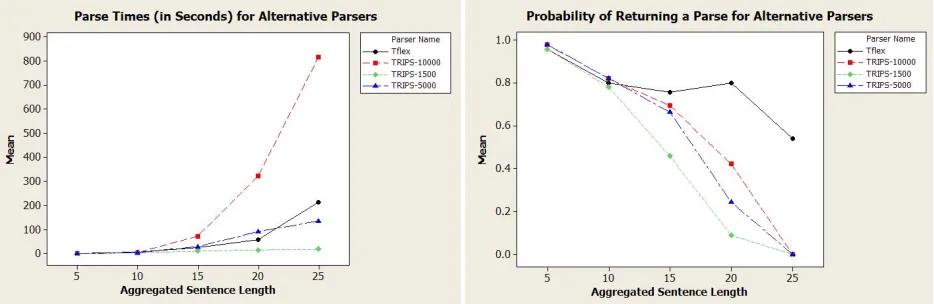
We first compared parsers in terms of probability of producing at least one parse (see Figure 2). Since the distribution of sentence lengths in the test corpus was heavily skewed toward shorter sentences, we grouped sentences into equivalence classes based on a range of sentence lengths with a 5-word increment, with all of the sentences over 20 words aggregated in the same class. Given a large number of short sen-tences, there was no significant difference overall in likelihood to find a parse. However, on sentences greater than 10 words long, TFLEX is significantly more likely to produce a parse than any of the TRIPS parsers (evaluated using a binary logistic regression,
N = 334, G = 16.8, DF = 1, p < .001).
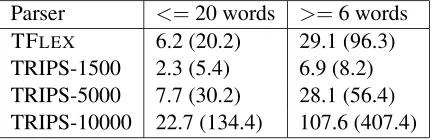
Fur-Parser <=20 words >=6 words
TFLEX 6.2 (20.2) 29.1 (96.3)
TRIPS-1500 2.3 (5.4) 6.9 (8.2)
[image:6.612.328.544.47.117.2]TRIPS-5000 7.7 (30.2) 28.1 (56.4) TRIPS-10000 22.7 (134.4) 107.6 (407.4) Table 1: The average parse times for TRIPS and TFLEXon utterances 6 words or more.
thermore, for sentences greater than 20 words long, no form of TRIPS parser ever returned a complete parse.
Next we compared the parsers in terms of aver-age parse time on the whole data set across equiva-lence classes of sentences, assigned based on Aggre-gated Sentence Length (see Figure 2 and Table 1). An ANOVA with Parser and Aggregated Sentence Length as independent variables and Parse Time as the dependent variable showed a significant effect of Parser on Parse Time (F(3,4164) = 270.03,
p < .001). Using a Bonferroni post-hoc analysis, we
determined that TFLEX is significantly faster than TRIPS-10000 (p < .001), statistically
indistinguish-able in terms of parse time from TRIPS-5000, and significantly slower than TRIPS-1500 (p < .001).
Since none of the TRIPS parsers ever returned a parse for sentences greater than 20 words long, we recomputed this analysis excluding the latter. We still find a significant effect of Parser on Parse Time (F(3,4068) = 18.6, p < .001). However, a
post-hoc analysis reveals that parse times for TFLEX, TRIPS-1500, and TRIPS-5000 are statistically in-distinguishable for this subset, whereas TFLEX is significantly faster than TRIPS-10000 (p < .001).
See Table 1 for for parse times of all four parsers. Since TFLEX and TRIPS both spent 95% of their computational effort on sentences with 6 or more words, we also include results for this subset of the corpus.
Figure 2: Parse times and probability of getting a parse depending on (aggregated) sentence lengths. 5 denotes sentences with 5 or fewer words, 25 sentences with more than 20 words.
words long or less, which is the subset of sentences for which it is able to find a parse.
5.3 Discussion and Future Work
The most obvious lesson learned in this experience is that the speed up techniques developed for specific grammars and unification formalisms do not transfer easily to other unification grammars. The features that make TRIPS interesting – the inclusion of lex-ical semantics, and the rules for parsing fragments – also make it less amenable to using existing effi-ciency techniques.
Grammars with an explicit CFG backbone nor-mally restrict the grammar writer from writing grammar loops, a restriction not imposed by gen-eral unification grammars. As we showed, there can be a substantial number of loops in a CFG due to the need to cover various elliptical constructions, which makes CFG parsing not interleaved with uni-fication less attractive in cases where we want to avoid expensive CFG precompilation. Moreover, as we found with the TRIPS grammar, in the context of robust parsing with lexical semantics the ambigu-ity in a CFG backbone grows large enough to make CFG parsing followed by unification inefficient. We described an alternative technique that uses pruning based on a parse selection model.
Another option for speeding up parsing that we have not discussed in detail is using a typed gram-mar without disjunction and speeding up unification as done in HPSG grammars (Kiefer et al., 1999). In order to do this, we must first address the issue of
integrating the type of lexical semantics that we re-quire with HPSG’s type system. Adding lexical se-mantics while retaining the speed benefits obtained through this type system would require that the se-mantic type ontology be expressed in the same for-malism as the syntactic types. We plan to further explore this option in our future work.
Though longer sentences were relatively rare in our test set, using the system in an educa-tional domain (our ultimate goal) means that the longer sentences are particularly important, because they often correspond to significant instructional events, specifically answers to deep questions such as “why” and “how” questions. Our evaluation has been designed to show system performance with ut-terances of different length, which would roughly correspond to the performance in interpreting short and long student answers. Since delays in respond-ing can de-motivate the student and decrease the quality of the dialogue, improving handling of long utterances can have an important effect on the sys-tem performance. Evaluating this in practice is a possible direction for future work.
6 Conclusions
on ambiguity packing and local features, general-isable to other unification grammars. We demon-strated that our pruning algorithm provides better efficiency-coverage balance than the best-first pars-ing with chart limits utilised by the TRIPS parser, and discussed the design implications for other ro-bust parsing grammars.
Acknowledgements
We thank Mary Swift and James Allen for their help with the TRIPS code and useful comments. This material is based on work supported by grants from the Office of Naval Research under numbers N000140510048 and N000140510043.
References
J. Baldridge. 2002. Lexically Specified Derivational Control in Combinatory Categorial Grammar. Ph.D. thesis, University of Edinburgh.
T. Briscoe and J. Carroll. 1994. Generalized proba-bilistic LR parsing of natural language (corpora) with unification-based grammars. Computational Linguis-tics, 19(1):25–59.
J. Carroll. 1994. Relating complexity to practical per-formance in parsing with wide-coverage unification grammars. InProceedings of ACL-2004.
A. Copestake and D. Flickinger. 2000. An open source grammar development environment and broad-coverage English grammar using HPSG. In Proceed-ings of LREC-2000, Athens, Greece.
M. O. Dzikovska, M. D. Swift, and J. F. Allen. 2004. Building a computational lexicon and ontology with framenet. InLREC workshop on Building Lexical Re-sources from Semantically Annotated Corpora.
M. Dzikovska, M. Swift, J. Allen, and W. de Beaumont. 2005. Generic parsing for multi-domain semantic in-terpretation. In Proceedings of the 9th International Workshop on Parsing Technologies (IWPT-05).
M. O. Dzikovska. 2004.A Practical Semantic Represen-tation For Natural Language Parsing. Ph.D. thesis, University of Rochester.
M. Elsner, M. Swift, J. Allen, and D. Gildea. 2005. On-line statistics for a unification-based dialogue parser. In Proceedings of the 9th International Workshop on Parsing Technologies (IWPT-05).
A. Frank, B. Kiefer, B. Crysmann, M. Becker, and U. Schafer. 2003. Integrated shallow and deep pars-ing: TopP meets HPSG. InProceedings of ACL 2003.
B. Kiefer and H.-U. Krieger. 2004. A context-free ap-proximation of head-driven phrase structure grammar. In H. Bunt, J. Carroll, and G. Satta, editors,New De-velopments in Parsing Technology. Kluwer.
B. Kiefer, H. Krieger, J. Carroll, and R. Malouf. 1999. Bag of useful techniques for efficient and robust pars-ing. InProceedings of ACL 1999.
K. Kipper, H. T. Dang, and M. Palmer. 2000. Class-based construction of a verb lexicon. InProceedings of the 7th Conference on Artificial Intelligence and of the 12th Conference on Innovative Applications of Ar-tificial Intelligence.
A. Lavie and C. P. Ros´e. 2004. Optimal ambiguity pack-ing in context-free parsers with interleaved unification. In H. Bunt, J. Carroll, and G. Satta, editors,Current Is-sues in Parsing Technologies. Kluwer Academic Press.
J. T. Maxwell and R. M. Kaplan. 1994. The interface between phrasal and functional constraints. Computa-tional Linguistics, 19(4):571–590.
S. Narayanan and S. Harabagiu. 2004. Question answer-ing based on semantic structures. InProceedings of International Conference on Computational Linguis-tics (COLING 2004), Geneva, Switzerland.
S. Oepen and J. Carroll. 2000. Ambiguity packing in constraint-based parsing - practical results. In Pro-ceedings of NAACL’00.
C. P. Ros´e and A. Lavie. 2001. Balancing robustness and efficiency in unification-augmented context-free parsers for large practical applications. In J. Junqua and G. Van Noord, editors, Robustness in Language and Speech Technology. Kluwer Academic Press.
C. Ros´e. 2000. A framework for robust semantic in-terpretation. InProceedings 1st Meeting of the North American Chapter of the Association for Computa-tional Linguistics.
D. Schlangen and A. Lascarides. 2003. The interpreta-tion of non-sentential utterances in dialogue. In Pro-ceedings of the 4th SIGdial Workshop on Discourse and Dialogue, Japan, May.
D. Schneider and K. F. McCoy. 1998. Recognizing syn-tactic errors in the writing of second language learners. InProceedings of COLING-ACL’98.
M. Swift, J. Allen, and D. Gildea. 2004. Skeletons in the parser: Using a shallow parser to improve deep parsing. InProceedings of COLING-04.
J. Tetreault. 2005. Empirical Evaluations of Pronoun Resolution. Ph.D. thesis, University of Rochester.