A Naive Theory of Affixation and an Algorithm for Extraction
Harald Hammarstr¨om Dept. of Computing Science Chalmers University of Technology
412 96, Gothenburg Sweden [email protected]
Abstract
We present a novel approach to the unsu-pervised detection of affixes, that is, to ex-tract a set of salient prefixes and suffixes from an unlabeled corpus of a language. The underlying theory makes no assump-tions on whether the language uses a lot of morphology or not, whether it is pre-fixing or sufpre-fixing, or whether affixes are long or short. It does however make the assumption that 1. salient affixes have to be frequent, i.e occur much more often that random segments of the same length, and that 2. words essentially are vari-able length sequences of random charac-ters, e.g a character should not occur in far too many words than random without a reason, such as being part of a very fre-quent affix. The affix extraction algorithm uses only information from fluctation of frequencies, runs in linear time, and is free from thresholds and untransparent itera-tions. We demonstrate the usefulness of the approach with example case studies on typologically distant languages.
1 Introduction
The problem at hand can be described as follows:
Input : An unlabeled corpus of an arbitrary natural
language
Output : A (possibly ranked) set of prefixes and
suffixes corresponding to true prefixes and
suf-fixes in the linguistic sense, i.e well-segmented and with grammatical meaning, for the lan-guage in question.
Restrictions : We consider only concatenative
mor-phology and assume that the corpus comes al-ready segmented on the word level.
The theory and practice of the problem is relevant or even essential in fields such as child language ac-quisition, information retrieval and, of course, the fuller scope of computational morphology and its further layers of application (e.g Machine Transla-tion).
The reasons for attacking this problem in an un-supervised manner include advantages in elegance, economy of time and money (no annotated resources required), and the fact that the same technology may be used on new languages.
An outline of the paper is as follows: we start with some notation and basic definitions, with which we describe the theory that is intended to model the essential behaviour of affixation in natural lan-guages. Then we describe in detail and with ex-amples the thinking behind the affix extraction al-gorithm, which actually requires only a few lines to define mathematically. Next, we present and discuss some experimental results on typologically different languages. The paper then finishes with a brief but comprehensive characterization of related work and its differences to our work. At the very end we state the most important conclusions and ideas on future components of unsupervised morphological analy-sis.
2 A Naive Theory of Affixation
Notation and definitions:
• w, s, b, x, y, . . . ∈ Σ∗: lowercase-letter vari-ables range over strings of some alphabetΣand are variously called words, segments, strings, etc.
• s / w: s is a terminal segment of the wordw i.e there exists a (possibly empty) stringxsuch thatw=xs
• W, S, . . . ⊆ Σ∗: capital-letter variables range over sets of words/strings/segments
• fW(s) = |{w ∈ W|s / w}|: the number of
words inW with terminal segments
• SW = {s|s / w ∈ W}: all terminal segments
of the words inW
• | · |: is overloaded to denote both the length of a string and the cardinality of a set
Assume we have two sets of random strings over some alphabetΣ:
• BasesB ={b1, b2, . . . , bm}
• SuffixesS={s1, s2, . . . , sn}
Such that:
Arbitrary Character Assumption (ACA) Each
characterc∈Σshould be equally likely in any word-position for any member ofBorS. Note that B and S need not be of the same car-dinality and that any string, including the empty string, could end up belonging to both B and S. They need neither to be sampled from the same distribution; pace the requirement, the distributions from which B andS are drawn may differ in how much probability mass is given to strings of different lengths. For instance, it would not be violation ifB were drawn from a a distribution favouring strings of length, say, 42andS from a distribution with a strong bias for short strings.
Next, build a set of affixed wordsW ⊆ {bs|b ∈
B, s ∈ S}, that is, a large set whose members are concatenations of the form bs for b ∈ B, s ∈ S, such that:
Frequent Flyer Assumption (FFA) : The
mem-bers ofS are frequent. Formally: Given any s∈S:fW(s)>> fW(x)for allxsuch that 1.
|x|=|s|; and 2. notx / s0for alls0 ∈S). In other words, if we calls∈Satrue suffixand we callxanarbitrary segmentif it neither a true suffix nor the terminal segment of a true suffix, then any true suffix should have much higher frequency than an arbitrary segment of the same length.
One may legimately ask to what extent words of real natural languages fit the construction model of W, with the strong ACA and FFA assumptions, out-lined above. For instance, even though natural lan-guages often aren’t written phonemically, it is not hard to come up with languages that have phonotac-tic constraints on what may appear at the beginning or end of a word, e.g, Spanish *st- may not begin a word and yields est- instead. Another violation of ACA is that (presumably all (Ladefoged, 2005)) languages disallow or disprefer a consonant vs. a vowel conditioned by the vowel/consonant status of its predecessor. However, if a certain element occurs withlessfrequency than random (the best example would be click consonants which, in some languages e.g Eastern !X˜oo (Traill, 1994), occur only initially), this is not a problem to the theory.
As for FFA, we may have breaches such as Bibli-cal Aramaic (Rosenthal, 1995) where an old -¯a el-ement appears on virtually everywhere on nouns, making it very frequent, but no longer has any syn-chronic meaning. Also, one can doubt the require-ment that an affix should need to be frequent; for instance, the Classical Greek inflectional (lacking synchronic internal segmentation) alternative medial 3p. pl. aorist imperative ending -σθων (Blomqvist and Jastrup, 1998), is not common at all.
Just how realistic the assumptions are is an empir-ical question, whose answer must be judged by ex-periments on the relevant languages. In the absense of fully annotated annotated test sets for diverse lan-guages, and since the author does not have access to the Hutmegs/CELEX gold standard sets for Finnish and English (Creutz and Lind´en, 2004), we can only give some guidelining experimental data.
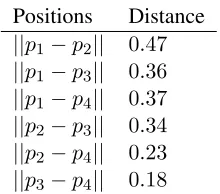
sec-Positions Distance
[image:3.612.131.241.53.150.2]||p1−p2|| 0.47 ||p1−p3|| 0.36 ||p1−p4|| 0.37 ||p2−p3|| 0.34 ||p2−p4|| 0.23 ||p3−p4|| 0.18
Table 1: Difference between character distributions according to word position.
ond, third or fourth position of the word. Since Basque is entirely suffixing, if it complied to ACA, we’d expect the distributions to be simi-lar. However, if we look at the difference of the distributions in terms of variation distance be-tween two probability distributions (||p−q||=
1 2
P
x|p(x) − q(x)|), it shows that they
dif-fer considerably – especially the initial position proves more special (see table 1).
FFA As for the FFA, we checked a corpus of bible portions of Warlpiri (Yal, 1968 2001). This was chosen because it is one of the few languages known to the author where data was available and which has a decent amount of frequent suf-fixes which are also long, e.g case afsuf-fixes are typically bisyllabic phonologically and five-ish characters long orthographically. Since the or-thography used marked segmentation, it was easy to compute FFA statistics on the words as removed from segmentation marking. Com-paring with the lists in (Nash, 1980, Ch. 2) it turns out that FFA is remarkably stable for all grammatical suffixes occuring in the outermost layer. There are however the expected kind of breaches; e.g a tense suffix -ku combined with a last vowel-uwhich is frequent in some frequent preceding affixes making the terminal segment-ukumore frequent than some genuine three-letter suffixes.
The language known to the author which has shown the most systematic disconcord with the FFA is Haitian Creole (also in bible corpus experiments (Hai, 2003 1999)). Haitian cre-ole has very little morphology of its own but owes the lion’s share of it’s words from French. French derivational morphemes abound in
these words, e.g-syon, which have been care-fully shown by (Lefebvre, 2004) not to be pro-ductive in Haitian Creole. Thus, the little mor-phology there is in Haitian creole is very dif-ficult to get at without also getting the French relics.
3 An Algorithm for Affix Extraction
The key question is, if words in natural languages are constructed asW explained above, can we re-cover the segmentation? That is, can we findBand S, given onlyW? The answer is yes, we can par-tially decide this. To be more specific, we can com-pute a scoreZ such thatZ(x) > Z(y) ifx ∈ SW
andy /∈SW. In general, the converse need not hold,
i.e if both x, y ∈ SW, or both x, y /∈ SW, then
it may still be thatZ(x) > Z(y). This is equiva-lent to constructing a ranked list of all possible seg-ments, where the true members ofSW appear at the
top, and somewhere down the list the junk, i.e non-members ofSW, start appearing and fill up the rest
of the list. Thus, it is not saidwhere on the list the true-affixes/junk border begins, just that there is a consistent such border.
Now, how should this list be computed? Given the FFA, it’s tempting to look at frequencies alone, i.e just go through all words and make a list of all seg-ments, ranking them by frequency? This won’t do it because 1. it doesn’t compensate between segments of different length; naturally, short segments will be more frequent than long ones, solely by virtue of their shortness 2. it overcounts ill-segmented true affixes, e.g-ngwill invariably get a higher (or equal) count than-ing. What we will do is a modification of this strategy, because 1. can easily be amended by subtracting estimated prior frequencies (under ACA) and there is a clever way of tackling 2. Note that, to amend 2., when going throughw and each s /w, it would be nice if we could countsonly when it is well-segmented inw. We are given onlyW so this information is not available to us, but, the FFA assumption let’s us make a local guess of it.
0 100 200 300 400 500 600 700 800
laying aying ying ing ng g f e
playing
Figure 1: The observedfW(s)and expectedeW(s)
frequency fors / w=playing.
frequency curve fW(s) and its expected frequency
curveeW(s). The expected frequency of a suffixs
doesn’t depend on the actual characters ofsand is defined as:
eW(s) =|W| ·
1 r|s|
Whereris the size of the alphabet under the assump-tion that its characters are uniformly distributed. We don’t simply use 26 in the case of lowercase English since not all characters are equally frequent. Instead we estimate the size of a would-be uniform distribu-tion from the entropy of the distribudistribu-tion of the char-acters inW. This gives r ≈18.98 for English and other languages with a similar writing practice.
Next, define the adjusted frequency as the differ-ence between the observed frequency and the ex-pected frequency:
fW0 (s) =fW(s)−eW(s)
It is the slope of this curve that predicts the presence of a good split. Figure 2 shows the appearance of this curve again exemplified by “playing”.
After these examples, we are ready to define the segmentation score of a suffix relative to a wordZ : SW ×W →Q:
ZW(s, w) =
(
0 if nots / w
f0(s
i)−f0(si−1) |f0(s
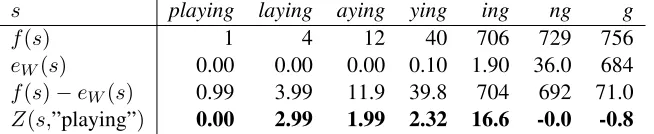
i−1)| ifs=si(w)for somei Table 2 shows the evolution of exact values from the running example.
To move from aZ-score for a segment that is rel-ative to a word we simply sum over all words to get
−2 0 2 4 6 8 10 12 14 16 18
ng g Z
[image:4.612.74.547.53.203.2]playing laying aying ying ing
Figure 2: The slope of thefW0 (s)curve fors / w= playing.
Input: A text corpusC
Step 1. Extract the set of wordsW fromC(thus all
contextual and word-frequency information is discarded)
Step 2. CalculateZW(s, w) for eachw ∈ W and
s / w
Step 3. AccumulateZW(s) =Pw∈WZ(s, w)
Table 3: Summary of affix-extraction algorithm.
the final scoreZ :SW →Q:
ZW(s) =
X
w∈W
Z(s, w) (1)
To be extra clear, the FFA assumption is “ex-ploited” in two ways. On the one hand, frequent affixes get many oppurtunities to get a score (which could, however, be negative) in the final sum over w ∈ W. On the other hand, the frequency is what make up the appearance of the slope that predicts the segmentation point.
The final Z-score in equation 1 is the one that purports to have the property thatZ(x) > Z(y) if x ∈ SW andy /∈ SW – at least if purged (see
be-low). A summary of the algorithm described in this section is displayed in table 3.
The time-complexity bounding factor is the num-ber of suffixes, i.e the cardinality of SW, which is
s playing laying aying ying ing ng g
f(s) 1 4 12 40 706 729 756
eW(s) 0.00 0.00 0.00 0.10 1.90 36.0 684
f(s)−eW(s) 0.99 3.99 11.9 39.8 704 692 71.0
[image:5.612.145.472.56.123.2]Z(s,”playing”) 0.00 2.99 1.99 2.32 16.6 -0.0 -0.8
Table 2: Exact values of frequency curves and scores from the running “playing” example.
1028682.0 ing 111264.0 ling
594208.0 ed 111132.0 ent
371145.0 s 109725.0 ating
337464.0 ’s 109125.0 ate
326250.0 ation 108228.0 an
289536.0 es 97020.0 ies
238853.5 e 94560.0 ts
222256.0 er 81648.0 ically
191889.0 ers 81504.0 ment
172800.0 ting 78669.0 led
168288.0 ly 77900.0 ering
159408.0 ations 74976.0 er’s
143775.0 ted 73988.0 y
130960.0 able . . . . 116352.0 ated -26137.9 l
113364.0 al -38620.6 m
[image:5.612.311.477.161.393.2]113280.0 ness -78757.3 a
Table 4: Top 30 and bottom 3 extracted suffixes for English. 47178 unique words yielded a total of 154407 ranked suffixes.
4 Experimental Results
For a regular English 1 million token newspaper corpus we get the top 30 plus bottom 3 suffixes as shown in table 4.
English has little affixation compared to e.g Turk-ish which is at the opposite end of the typological scale (Dryer, 2005). The corresponding results for Turkish on a bible corpus (Tur, 1988) is shown in table 5.
The results largely speak for themselves but some comments are in order. As is easily seen from the lists, some suffixes are suffixes of each other so one could purge the list in some way to get only the most “competitive” suffixes. One purging strategy would be to remove x from the list if there is a z
1288402.4 i 33756.55 ler
151056.9 er 29816.53 da
142552.6 in 29404.49 di
141603.3 im 28337.89 le
134403.2 en 26580.41 dan
130794.5 e 26373.54 r
127352.0 an 24183.99 ti
113482.6 a 22527.26 un
82581.95 ya 21388.71 iniz
78447.74 ar 20993.87 sin
76353.77 ak 20117.60 ik
68730.00 n 18612.14 li
64761.37 ir 18316.45 ek
53021.67 la . . . . 47218.78 ini -38091.8 t
44858.18 lar -240917.5 l
37229.14 iz -284460.1 s
Table 5: Top 30 and bottom 3 extracted suffixes for Turkish. 56881 unique words yielded a total of 175937 ranked suffixes.
such that x = yx and Z(z) > Z(x) (this would remove e.g -tingif -ing is above it on the list). A more sophisticated purging method is the following, which does slightly more. First, for a wordw∈W define its best segmentation as: Segment(w) = argmaxs/wZ(s). Then purge by keeping only those
suffixes which are the best parse for at least one word:SW0 ={s∈SW|∃wSegment(w) =s}.
[image:5.612.102.276.165.392.2]Language Corpus Tokens |W| |SW| |SW0 |
Maori (Mao, 1996) 1101665 8354 23007 78
English (Eng, 1977) 917634 12999 39845 63
[image:6.612.72.291.53.88.2]Turkish (Tur, 1988) 574592 56881 175937 122
Table 6: Figures for different languages on the ef-fects on the size of the suffix list after purging.
suffixes or at least less than English.
A good sign is that the purged list and its order seems to be largely independent of corpus size (as long as the corpus is not very small) but we do get some significant differences between bible English and newspaper English.
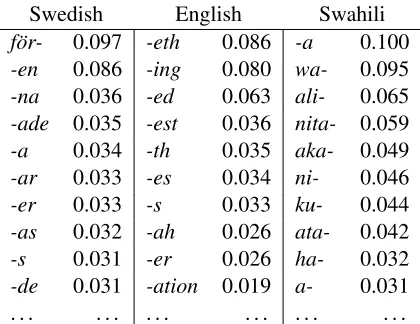
We have chosen to illustrate using affixes but the method readily generalizes to prefixes as well and even prefixes and suffixes at the same time. As an example of this, we show top-10 purged prefix-suffix scores in the same table also for some typo-logically differing languages in table 7. Again, we use bible corpora for cross-language comparability (Swedish (Swe, 1917) and Swahili (Swa, 1953)). The scores have been normalized in each language to allow cross-language comparison – which, judg-ing from the table, seems meanjudg-ingful. Swahili is an exclusively prefixing language but verbs tend to end in-a(whose status as a morpheme is the linguistic sense can be doubted), whereas Swedish is suffix-ing, although some prefixes are or were productive in word-formation.
A full discussion of further aspects such as a more informed segmentation of words, peeling of multi-ple suffix layers and purging of unwanted affixes re-quires, is beyond the scope of this paper.
5 Related Work
For reasons of space we cannot cite and comment every relevant paper even in the narrow view of highly unsupervised extraction of affixes from raw corpus data, but we will cite enough to cover each line of research. The vast fields of word segmenta-tion for speech recognisegmenta-tion or for languages which do not mark word boundaries will not be covered. In our view, segmentation into lexical units is a dif-ferent problem than that of affix extraction since the frequencies of lexical items are different, i.e occur
Swedish English Swahili
f¨or- 0.097 -eth 0.086 -a 0.100
-en 0.086 -ing 0.080 wa- 0.095
-na 0.036 -ed 0.063 ali- 0.065
-ade 0.035 -est 0.036 nita- 0.059
-a 0.034 -th 0.035 aka- 0.049
-ar 0.033 -es 0.034 ni- 0.046
-er 0.033 -s 0.033 ku- 0.044
-as 0.032 -ah 0.026 ata- 0.042
-s 0.031 -er 0.026 ha- 0.032
-de 0.031 -ation 0.019 a- 0.031 . . . .
Table 7: Comparative figures for prefix vs. suffix detection. The high placement of English -ethand
-ahare due to the fact that the bible version used has drinketh, sitteth etc and a lot of personal names in
-ah.
much more sparsely. Results from this area which have been carried over or overlap with affic detec-tion will however be taken into account. A lot of the papers cited have a wider scope and are still use-ful even though they are critisized here for having a non-optimal affix detection component.
Many authors trace their approches back to two early papers by Zellig Harris (Harris, 1955; Har-ris, 1970) which count letter successor varieties. The basic procedure is to ask how many different phonemes occur (in various utterances e.g a corpus) after the firstnphonemes of some test utterance and predict that segmentation(s) occur where the number of succesors reaches a peak. For example, if we have
play, played, playing, player, players, playground
[image:6.612.314.524.54.216.2]The algorithm in this paper is differs significantly from the Harris-inspired varieties. First, we do not record the number of phonemes/character of a given prefix/suffix but the total number of contin-uations. In the example above, that would be the set{ed, ing, er, ers, ground}rather than the three-member set of continuing phonemes/characters. Secondly, segmentation of a given word is not the immediate objective and what amounts to identifi-cation of the end of a lexical (thus generally low-frequency) item is not within the direct reach of the model. Thirdly, and most importantly, the algorithm in this paper looks at the slope of the frequency curve not at peaks in absolute frequency.
A different approach, sometimes used in com-plement of other sources of information, is to se-lect aligned pairs (or sets) of strings that share a long character sequence (work includes (Jacquemin, 1997; Yarowsky and Wicentowski, 2000; Baroni et al., 2002; Clark, 2001)). A notable advantage is that one is not restricted to concatenative morphology.
Many publications ( ´Cavar et al., 2004; Brent et al., 1995; Goldsmith et al., 2001; D´ejean, 1998; Snover et al., 2002; Argamon et al., 2004; Gold-smith, 2001; Creutz and Lagus, 2005; Neuvel and Fulop, 2002; Baroni, 2003; Gaussier, 1999; Sharma et al., 2002; Wicentowski, 2002; Oliver, 2004), and various other works by the same authors, de-scribe strategies that use frequencies, probabilities, and optimization criteria, often Minimum Descrip-tion Length (MDL), in various combinaDescrip-tions. So far, all these are unsatisfactory on two main accounts; on the theretical side, they still owe an explanation of why compression or MDL should give birth to seg-mentations coinciding with morphemes as linguisti-cally defined. On the experimental side, thresholds, supervised/developed parametres and selective input still cloud the success of reported results, which, in any case, aren’t wide enough to sustain some too rash language independence claims.
To be more specific, some MDL approaches aim to minimize the description of the set of words in the input corpus, some to describe all tokens in the corpus, but, none aims to minimize, what one would otherwise expect, the set of possible words in the language. More importantly, none of the re-viewed works allow any variation in the descrip-tion language (“model”) during the minimizadescrip-tion
search. Therefore they should be more properly la-beled “weighting schemes” and it’s an open question whether their yields correspond to linguistic analy-sis. Given an input corpus and a traditional linguis-tic analysis, it is trivial to show that it is possible to decrease description length (according to the given schemes) by stepping away from linguistic analysis. Moreover, various forms of codebook compression, such as Lempel-Ziv compression, yield shorter de-scription but without any known linguistic relevance at all. What is clear, however, apart from whether it is theoretically motivated, is that MDL approaches areuseful.
A systematic test of segmentation algorithms over many different types of languages has yet to be pub-lished. For three reasons, it will not be undertaken here either. First, as e.g already Manning (1998) notes for sandhi phenomena, it is far from clear what the gold standard should be (even though we may agree or agree to disagree on some familiar European languages). Secondly, segmentation al-gorithms may have different purposes and it might not make good sense to study segmentation in isola-tion from inducisola-tion of paradigms. Lastly, and most importantly, all of the reviewed techniques (Wicen-towski, 2004; Wicen(Wicen-towski, 2002; Snover et al., 2002; Baroni et al., 2002; Andreev, 1965; ´Cavar et al., 2004; Snover and Brent, 2003; Snover and Brent, 2001; Snover, 2002; Schone and Jurafsky, 2001; Jacquemin, 1997; Goldsmith and Hu, 2004; Sharma et al., 2002; Clark, 2001; Kazakov and Man-andhar, 1998; D´ejean, 1998; Oliver, 2004; Creutz and Lagus, 2002; Creutz and Lagus, 2003; Creutz and Lagus, 2004; Hirsim¨aki et al., 2003; Creutz and Lagus, 2005; Argamon et al., 2004; Gaussier, 1999; Lehmann, 1973; Langer, 1991; Flenner, 1995; Klenk and Langer, 1989; Goldsmith, 2001; Gold-smith, 2000; Hu et al., 2005b; Hu et al., 2005a; Brent et al., 1995), as they are described, have threshold-parameters of some sort, explicitly claim
not to work well for an open set of languages, or require noise-free all-form input (Albright, 2002; Manning, 1998; Borin, 1991). Therefore it is not possible to even design a fair test.
we may scrutinize the assumptions behind the theory in order to modify or reject it (understanding why we did so). Without a theory there’s no telling what to do or how to interpret intermediate numbers in a long series of calculations.
6 Conclusion
We have presented a new theory of affixation and a parameter-less efficient algorithm for collecting af-fixes from raw corpus data of an arbitrary language. Depending on one’s purposes with it, a cut-off point for the collected list is still missing, or at least, we do not consider that matter here. The results are very promising and competitive but at present we lack formal evaluation in this respect. Future directions also include a more specialized look into the relation between affix-segmentation and paradigmatic varia-tion and further exploits into layered morphology.
7 Acknowledgements
The author has benefited much from discussions with Bengt Nordstr¨om.
References
Adam C. Albright. 2002. The Identification of Bases in
Morphological Paradigms. Ph.D. thesis, University of California at Los Angeles.
Nikolai Dmitrievich Andreev, editor. 1965.
Statistiko-kombinatornoe modelirovanie iazykov. Akademia Nauk SSSR, Moskva.
Shlomo Argamon, Navot Akiva, Amihood Amit, and Oren Kapah. 2004. Efficient unsupervised recursive word segmentation using minimum description length. InCOLING-04, 22-29 August 2004, Geneva, Switzer-land.
Marco Baroni, Johannes Matiasek, and Harald Trost. 2002. Unsupervised discovery of morphologically re-lated words based on orthographic and semantic
simi-larity. InProceedings of the Workshop on
Morpholog-ical and PhonologMorpholog-ical Learning of
ACL/SIGPHON-2002, pages 48–57.
Marco Baroni. 2003. Distribution-driven morpheme
dis-covery: A computational/experimental study.
Year-book of Morphology, pages 213–248.
Winifred Bauer, William Parker, and Te Kareongawai
Evans. 1993. Maori. Descriptive Grammars.
Rout-ledge, London & New York.
Jerker Blomqvist and Poul Ole Jastrup. 1998. Grekisk
Grammatik: Graesk grammatik. Akademisk Forlag, København, 2 edition.
Lars Borin. 1991. The Automatic Induction of
Morpho-logical Regularities. Ph.D. thesis, University of Upp-sala.
Michael R. Brent, S. Murthy, and A. Lundberg. 1995. Discovering morphemic suffixes: A case study in
min-imum description length induction. In Fifth
Interna-tional Workshop on Artificial Intelligence and Statis-tics, Ft. Lauderdale, Florida.
Damir ´Cavar, Joshua Herring, Toshikazu Ikuta, Paul
Ro-drigues, and Giancarlo Schrementi. 2004. On
in-duction of morphology grammars and its role in boot-strapping. In Gerhard J¨ager, Paola Monachesi, Gerald
Penn, and Shuly Wintner, editors,Proceedings of
For-mal Grammar 2004, pages 47–62.
Alexander Clark. 2001. Learning morphology with pair
hidden markov models. InACL (Companion Volume),
pages 55–60.
Mathias Creutz and Krista Lagus. 2002. Unsupervised
discovery of morphemes. In Proceedings of the 6th
Workshop of the ACL Special Interest Group in Com-putational Phonology (SIGPHON), Philadelphia, July
2002, pages 21–30. Association for Computational
Linguistics.
Mathias Creutz and Krista Lagus. 2003. Unsupervised
discovery of morphemes. In Proceedings of the 6th
Workshop of the ACL Special Interest Group in Com-putational Phonology (SIGPHON), Philadelphia, July
2002, pages 21–30. Association for Computational
Linguistics.
Mathias Creutz and Krista Lagus. 2004. Induction of a simple morphology for highly-inflecting languages. In Proceedings of the 7th Meeting of the ACL Spe-cial Interest Group in Computational Phonology (SIG-PHON), pages 43–51. Barcelona.
Mathias Creutz and Krista Lagus. 2005. Unsupervised morpheme segmentation and morphology induction from text corpora using morfessor 1.0. Technical re-port, Publications in Computer and Information Sci-ence, Report A81, Helsinki University of Technology, March.
Herv´e D´ejean. 1998. Concepts et algorithmes pour la d´ecouverte des structures formelles des langues. Ph.D. thesis, Universit´e de Caen Basse Normandie.
Matthew S. Dryer. 2005. Prefixing versus
suffix-ing in inflectional morphology. In Bernard Comrie, Matthew S. Dryer, David Gil, and Martin Haspelmath,
editors, World Atlas of Language Structures, pages
110–113. Oxford University Press.
1977. The holy bible, containing the old and new testa-ments and the apocrypha in the authorized king james version. Thomas Nelson, Nashville, New York.
Gudrun Flenner. 1995. Quantitative
morphseg-mentierung im spanischen auf phonologischer basis.
Sprache und Datenverarbeitung, 19(2):63–78. Also cited as: Computatio Linguae II, 1994, pp. 1994 as well as Sprache und Datenverarbeitung 19(2):31-62, 1994.
´
Eric Gaussier. 1999. Unsupervised learning of
deriva-tional morphology from inflecderiva-tional lexicons. In
Pro-ceedings of the 37th Annual Meeting of the Associa-tion for ComputaAssocia-tional Linguistics (ACL-1999). Asso-ciation for Computational Linguistics, Philadephia.
John Goldsmith and Yu Hu. 2004. From signatures to fi-nite state automata. Technical report TR-2005-05, De-partment of Computer Science, University of Chicago.
John Goldsmith, Derrick Higgins, and Svetlana
Soglas-nova. 2001. Automatic language-specific
stem-ming in information retrieval. In Carol Peters, edi-tor,Cross-Language Information Retrieval and Eval-uation: Proceedings of the CLEF 2000 Workshop, Lecture Notes in Computer Science, pages 273–283. Springer-Verlag, Berlin.
John Goldsmith. 2000. Linguistica: An automatic
morphological analyzer. In A. Okrent and J. Boyle,
editors, Proceedings from the Main Session of the
Chicago Linguistic Society’s thirty-sith Meeting.
John Goldsmith. 2001. Unsupervised learning of the
morphology of natural language. Computational
Lin-guistics, 27(2):153–198.
Margaret A. Hafer and Stephen F. Weiss. 1974. Word
segmentation by letter successor varieties.
Informa-tion and Storge Retrieval, 10:371–385.
2003 [1999]. Bib la. American Bible Society.
Zellig S. Harris. 1955. From phoneme to morpheme.
Language, 31(2):190–222.
Zellig S. Harris. 1970. Morpheme boundaries within words: Report on a computer test. In Zellig S. Harris,
editor,Papers in Structural and Transformational
Lin-guistics, volume 1 ofFormal Linguistics Series, pages 68–77. D. Reidel, Dordrecht.
Teemu Hirsim¨aki, Mathias Creutz, Vesa Siivola, and Mikko Kurimo. 2003. Unlimited vocabulary speech recognition based on morphs discovered in an
unsu-pervised manner. InProceedings of Eurospeech 2003,
Geneva, pages 2293–2996. Geneva, Switzerland.
Yu Hu, Irina Matveeva, John Goldsmith, and Colin
Sprague. 2005a. Refining the SED heuristic for
morpheme discovery: Another look at Swahili. In
Proceedings of the Workshop on Psychocomputational Models of Human Language Acquisition, pages 28–35, Ann Arbor, Michigan, June. Association for Computa-tional Linguistics.
Yu Hu, Irina Matveeva, John Goldsmith, and Colin Sprague. 2005b. Using morphology and syntax
to-gether in unsupervised learning. In Proceedings of
the Workshop on Psychocomputational Models of Hu-man Language Acquisition, pages 20–27, Ann Arbor, Michigan, June. Association for Computational Lin-guistics.
Christian Jacquemin. 1997. Guessing morphology from
terms and corpora. In Proceedings, 20th Annual
In-ternational ACM SIGIR Conference on Research and Development in Information Retrieval (SIGIR ’97), Philadelphia, PA.
Howard Johnson and Joel Martin. 2003.
Unsuper-vised learning of morphology for english and
inukti-tut. InHLT-NAACL 2003, Human Language
Technol-ogy Conference of the North American Chapter of the Association for Computational Linguistics, May 27 -June 1, Edmonton, Canada, volume Companion Vol-ume - Short papers.
Dimitar Kazakov and Suresh Manandhar. 1998. A hy-brid approach to word segmentation. In C. D. Page,
editor,Proceedings of the 8th International Workshop
on Inductive Logic Programming (ILP-98) in Madi-son, Wisconsin, USA, volume 1446 of Lecture Notes in Artificial Intelligence. Springer-Verlag, Berlin.
Dimitar Kazakov and Suresh Manandhar. 2001. Un-supervised learning of word segmentation rules with genetic algorithms and inductive logic programming.
Machine Learning, 43:121–162.
Ursula Klenk and Hagen Langer. 1989. Morphological
segmentation without a lexicon. Literary and
Linguis-tic Computing, 4(4):247–253.
Peter Ladefoged. 2005. Vowels and Consonants.
Black-well, Oxford, 2 edition.
Hagen Langer. 1991. Ein automatisches
Morphseg-mentierungsverfahren f¨ur deutsche Wortformen. Ph.D. thesis, Georg-August-Universit¨at zu G¨ottingen.
Claire Lefebvre. 2004. Issues in the study of Pidgin and
Hubert Lehmann. 1973. Linguistische Modellbildung und Methodologie. Max Niemeyer Verlag, T¨ubingen. Pp. 71-76 and 88-93.
Joanes Leizarraga. 1571. Iesus krist gure iaunaren tes-tamentu berria. Pierre Hautin, Inprimizale, Roxellan. [NT only].
Christopher D. Manning. 1998. The segmentation prob-lem in morphology learning. In Jill Burstein and
Clau-dia Leacock, editors,Proceedings of the Joint
Confer-ence on New Methods in Language Processing and Computational Language Learning, pages 299–305. Association for Computational Linguistics, Somerset, New Jersey.
1996. Maori bible. The British & Foreign Bible Society, London, England.
David G. Nash. 1980. Topics in Warlpiri Grammar.
Ph.D. thesis, Massachusetts Institute of Technology.
Sylvain Neuvel and Sean A. Fulop. 2002.
Unsuper-vised learning of morphology without morphemes. In
Workshop on Morphological and Phonological Learn-ing at Association for Computational LLearn-inguistics 40th Anniversary Meeting (ACL-02), July 6-12, pages 9–15. ACL Publications.
A. Oliver. 2004. Adquisici´o d’informaci´o l`exica i
mor-fosint`actica a partir de corpus sense anotar: apli-caci´o al rus i al croat. Ph.D. thesis, Universitat de Barcelona.
Franz Rosenthal. 1995. A grammar of biblical Aramaic,
volume 5 of Porta linguarum Orientalium.
Harras-sowitz, Wiesbaden, 6 edition.
Patrick Schone and Daniel Jurafsky. 2001.
Knowledge-free induction of inflectional morphologies. In
Pro-ceedings of the North American Chapter of the Asso-ciation for Computational Linguistics, Pittsburgh, PA, 2001.
Utpal Sharma, Jugal Kalita, and Rajib Das. 2002. Unsu-pervised learning of morphology for building lexicon
for a highly inflectional language. In Proceedings of
the 6th Workshop of the ACL Special Interest Group in Computational Phonology (SIGPHON), Philadelphia, July 2002, pages 1–10. Association for Computational Linguistics.
Matthew G. Snover and Michael R. Brent. 2001. A
bayesian model for morpheme and paradigm
identifi-cation. InProceedings of the 39th Annual Meeting of
the Association for Computational Linguistics (ACL-2001), pages 482–490. Morgan Kaufmann Publishers.
Matthew G. Snover and Michael R. Brent. 2003. A prob-abilistic model for learning concatenative morphology.
In S. Becker, S. Thrun, and K. Obermayer, editors,
Ad-vances in Neural Information Processing Systems 15, pages 1513–1520. MIT Press, Cambridge, MA.
Matthew G. Snover, Gaja E. Jarosz, and Michael R.
Brent. 2002. Unsupervised learning of
morphol-ogy using a novel directed search algorithm: Taking
the first step. In Workshop on Morphological and
Phonological Learning at Association for Computa-tional Linguistics 40th Anniversary Meeting (ACL-02), July 6-12. ACL Publications.
Matthew G. Snover. 2002. An unsupervised knowledge free algorithm for the learning of morphology in nat-ural languages. Master’s thesis, Department of Com-puter Science, Washington University.
1953. Maandiko matakatifu ya mungu yaitwaya biblia, yaani agano la kale na agano jipya, katika lugha ya kiswahili. British and Foreign Bible Society, London, England.
1917. Gamla och nya testamentet: de kanoniska
b¨ockerna. Norstedt, Stockgholm.
Anthony Traill. 1994. A !X´o˜o Dictionary, volume 9 of
Quellen zur Khoisan-Forschung/Research in Khoisan Studies. R¨udiger K¨oppe Verlag, K¨oln.
1988. Turkish bible. American Bible Society, Tulsa, Ok-lahoma.
Richard Wicentowski. 2002. Modeling and Learning
Multilingual Inflectional Morphology in a Minimally Supervised Framework. Ph.D. thesis, Johns Hopkins University, Baltimore, MD.
Richard Wicentowski. 2004. Multilingual noise-robust supervised morphological analysis using the
word-frame model. InProceedings of the ACL Special
Inter-est Group on Computational Phonology (SIGPHON), pages 70–77.
1968–2001. Bible: selections in warlpiri. Summer Insti-tute of Linguistics. Document 0650 of the Aboriginal Studies Electronic Data Archive (ASEDA), AIATSIS (Australian Institute of Aboriginal and Torres Strait Is-lander Studies), Canberra.
David Yarowsky and Richard Wicentowski. 2000. Min-imally supervised morphological analysis by
multi-modal alignment. InProceedings of the 38th Annual