Interoperability between Service Composition and Processing Pipeline:
Case Study on the Language Grid and UIMA
Mai Xuan Trang, Yohei Murakami, Donghui Lin, and Toru Ishida
Department of Social Informatics, Kyoto University Yoshida-Honmachi, Sakyo-Ku, Kyoto, 606-8501, Japan [email protected], {yohei,lindh,
ishida}@i.kyoto-u.ac.jp
Abstract
Integrating language resources is a critical part in building natural language process-ing applications. Processprocess-ing pipeline and service composition are two approaches for sharing and combining language re-sources. However, each approach has its drawback. While the former lacks con-sideration about property rights of lan-guage resources, the later is not efficient to process and transfer huge amount of data through web services. In this paper we ad-dress the issue of interoperability between two approaches to mutually complement their disadvantages. We show an integra-tion of service composiintegra-tion and processing pipeline, and how the integration can be used to help developers seamlessly build NLP applications. We then present a case study that adopts the integration to inte-grate two representative frameworks: the Language Grid and UIMA.
1 Introduction
The creation of language resources (LRs) remains a fundamental activity in the field of language technology. The number of language resources has been increasing year by year. Based on these resources, developers build advanced Natural Lan-guage Processing (NLP) applications (hereafter referred to as the applications) such as Watson and Siri by combining some of these resources. However, it is difficult for developers to collect and combine the most suitable set of language re-sources in order to achieve the developers’ goals.
There are two types of language resource coor-dination frameworks supporting developers shar-ing and combinshar-ing language resources and tools: Framework-based processing pipeline such as GATE (Cunningham et al. 2002) and UIMA (Fer-rucci el al., 2004) and framework-based service
composition such as the Language Grid (Ishida,
2006). Interoperability between components in
one framework is dealt by defining Common Data Exchange or standard interface for components. For example, UIMA defines Common Analysis Structure as data exchange between components, the Language Grid defines standard interfaces in a ontology for their language services (Hayashi, 2007). Interoperability among formats of two pro-cessing pipeline frameworks UIMA and GATE is explored in (Ide et al., 2009a). This paper ad-dresses the issue of how to bridge the gap between two data structures of common data exchange for-mat. In this work we focus on interoperability of two different types of frameworks.
Therefore, this paper realizes interoperability between those two types of frameworks to mutu-ally complement their disadvantages. To this end, we address the following issues:
• Integration between two types of
frame-works: Service composition and processing pipeline. The integration provides ability to wrap components of one framework as com-ponents of another. This will lead to more language resources and tools becoming avail-able in both frameworks, facilitating the de-velopment process of NLP applications.
• A case study of integration two representative frameworks: The Language Grid and UIMA is implemented to realize the integration con-cept framework.
The remainder of this paper is organized as fol-lows: in section 2 we will briefly discuss features of the two types of language resource coordination frameworks. The integration of the service com-position and processing pipeline will be presented in section 3. We show a case study on integration between the Language Grid and UIMA in section 4. Finally, section 5 concludes this paper.
Tokenizer
POSTagger
Parser
Assign
Assign
Assign Text
Tokens
Tokens
POSes POSes
ParseTrees
Tokens POSes ParseTrees
Receive
[image:2.595.363.465.59.162.2]Reply
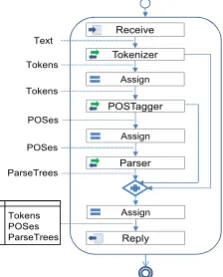
Figure 1: Service composition approach
2 Language Resource Coordination
Frameworks
2.1 Service Composition Approach
In this approach, language resources are wrapped as web services that users can combine to create customized composite language services for their need. Figure 1 shows a composite service compos-ing three language services: Tokenizer, POSTag-ger and Parser. Each service in the workflow is defined by an interface with input and output. In-teroperability between services in a workflow is ensured by conforming interfaces of the services. Output of a previous service and input of the later service in the workflow must be compatible.
Language resources available on these frame-works are provided by variety of providers. For instance, PANACEA currently has more than 160 services provided by 11 service providers. On the Language Grid, over 170 services are provided by 140 groups from 17 countries. Providers need to protect their resources with intellectual rights, so that they can configure permission and monitor us-age statistics of their resources. Service composi-tion approach provides access control funccomposi-tional- functional-ity to deal with this issue. This advantage encour-ages providers to share their language resources, increasing availability of language services.
2.2 Processing Pipeline Approach
This approach focuses on providing a setting for creating analysis pipelines, oriented towards lin-guistic analysis and stand-off annotation model. The purpose of these frameworks is to combine language resources to analyze huge amounts of data at the local environment.
Processing tools are combined into a pipeline
to analyze documents. Each tool is defined as
an annotator to annotate the document with
anno-Tokenizer
POSTagger
Parser Input text
Text Tokens
Text Tokens POSes
[image:2.595.125.237.64.203.2]Text Tokens POSes ParseTrees
Figure 2: Processing pipeline approach
tations represented as stand-off annotation. The document together with annotations is formed in a Common Data Exchange Format (CDEF). The CDEF document is then exchanged between com-ponents in the pipeline. Figure 2 shows a pipeline of three annotators: Tokenizer, POSTagger, and Parser. The pipeline enriches input text with three annotation types: Token, POS, and ParseTree.
A disadvantage of this approach is the lack of access control to share language resources dis-tributedly with intellectual rights. This limits the availability of language resources.
3 Integration of Service Composition
and Processing Pipeline
3.1 Mapping Service Interface Invocation and Stand-off Annotation
The CDEF data structure is defined based on widely used de-facto standards such as TEI
(Van-houtte, 2004), CES (Ide, 2000), andcommon
in-terface format being developed under the con-text of ISO committee TC 37/SC 4 (Ide, 2009b). CDEF basically consists of two parts: one repre-senting document text, and the other reprerepre-senting annotations. Figure 3 shows an example of CDEF in XML-based format:
• <doc>: represents the document, theid at-tribute is used to distinguish documents when a pipeline processing with multiple docu-ments.
• <annotations>: represents all annotations produced by a pipeline. An annotation is de-scribed by<annot>tag, thetypeattribute in-dicates type of the annotation, two attributes
beginandenddefine annotation’s offset and thecomponentIDattribute shows the annota-tor producing this annotation. The structure of the annotation is defined by feature struc-ture (fs) tag and feature (f) tags.
<?xml version="1.0" encoding="UTF-8"?> <annotatedDoc>
<doc id="1" mimeType="text"
docString="Text of the document"/> <annotations>
<annot type="POS" docID="1" begin="1" end="5" componentID="POSTager"> <fs>
<f name="lemma" value="Text"/> <f name="postag" value="noun"/> ...
</fs> </annot> ...
</annotations> </annotatedDoc>
Figure 3: Structure of common data exchange
Annotator CDEF
Maker
CDEF CDEF
Extractor CDEF
Analysis result Service input
(a) Language service wrapper
Language Service CDEF
Extractor
CDEF Maker CDEF
CDEF
Annotation
Service result Annotation’s offset
[image:3.595.312.517.62.163.2](b) Language service wrapper
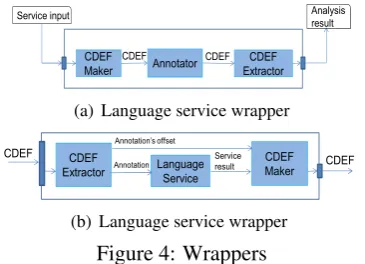
Figure 4: Wrappers
and output are CDEF. The mapping is defined to map input/output of language services with anno-tation types in CDEF. We define CDEF Maker and CDEF Extractor to conduct the mapping and cre-ate two wrappers: Language Service Wrapper and Annotator Wrapper as shown in Figure 4(a) and Figure 4(b) respectively. The former is used to wrap an annotator as a language service, the later is used to wrap a language service as an annotator:
• CDEF Extractor manipulates with CDEF
to extract annotation and maps it with in-put/output of a language service. The Ex-tractor uses XML parsing technique such as DOM and SAX to parse CDEF document and extract annotation. the annotation type and offset are extracted from the element < an-not>. The annotation structure with features and values is extracted from<fs>node and sub-nodes <f>s. The Extractor then maps
the annotation with a corresponding language service type which is served as input or out-put of a language service.
• CDEF Maker maps input/output of language
services to annotation types and creates CDEF document. When wrapping an anno-tator as a language service with defined in-put and outin-put, CDEF Maker first finds the offset of the defined input in the original text and then maps it with an annotation. Finally, it creates CDEF document from the original text and the annotation. In case of the input is
Processing pipeline framework Service composition framework
Composite service container
Composite service
Atomic service container Component repository
Language Service Wrapper Atomic
service
Annotator Wrapper Atomic
service
Annotator Annotator
Flow controller
Pipeline flow engine
Composite service Transformer
Figure 5: Integration Framework
text, the CDEF document is created with only
docpart. When wrapping a language service
as an annotator, CDEF Maker maps structure of the language service output with structure of a corresponding annotation type and use annotation’s offset, extracted by CDEF Ex-tractor, to create an annotation. This annota-tion is then added to the CDEF document.
3.2 Integration Framework
Integration framework enables users easily com-bine both types of components: language service and annotator. Users can use annotators to cre-ate composite services, use language services in a pipeline flow, or use both in composite services or in pipeline flows. It also provides ability to create a pipeline flow from a composite service.
Figure 5 illustrates integration of service com-position and processing pipeline. A wrapper sys-tem consisting of Language Service Wrapper and Annotator Wrapper is used in this integration framework. Annotator providers use the Language Service Wrapper to wrap an annotator as a lan-guage service. This service is then shared with access control in the service composition frame-work. Users who have access rights to the system can invoke this service or can use this service to compose composite services. The language ser-vice providers use the Annotator Wrapper to wrap a language service into an annotator, this annotator can be executed and combined in a pipeline flow.
Language resources are shared as language ser-vices with intellectual rights, it is easy to cre-ate composite services. However, pipeline flow has better performance when processing large amounts of data compared to composite ser-vice. We define Composite Service Transformer to transfer composite services into pipeline flows. A composite service contains information about
binding services. From the binding services,
[image:3.595.90.273.199.331.2]ex-tracted. The transformer uses this information to build an abstract pipeline flow of these language
resources. Later on, developers will negotiate
with the providers to get the concrete language re-sources for the pipeline.
4 Case study: Integration of the
Language Grid and UIMA
Using the integration framework concept, we in-tegrate the Language Grid and UIMA. We imple-ment two wrappers: Language Service Wrapper and Analysis Engine Wrapper. The former is used to wrap an analysis engine as a language service, while the later is used to wrap language service
into an Analysis Engine. A composite service
transformer is also implemented to help develop-ers transfer composite services to UIMA flows.
CAS is common data exchanged between UIMA components. We implement CAS Maker and CAS Extractor to manipulate with CAS docu-ment and create the wrappers:
• CAS Extractor extracts annotation from CAS
document and maps with input/output types of language services.
• CAS Maker maps the input/output types
of language services with UIMA annotation types and creates CAS documents which are served as input/output of an analysis engine. We use some libraries from the Language Grid and
UIMA such as jp.go.nict.langrid.client.ws 1 2.*
and org.apache.uima.* to manipulate with the Language Grid types and UIMA CAS. We also de-fined a new language service interface in the Lan-guage Grid to represent an analysis engine. This
service interface hasanalyzeoperation with input
is a string representing document, and output is a collection of annotations.
A mapping between UIMA annotation types and the Language Grid types is defined. We col-lect popular UIMA types defined for popular NLP functionalities. For each UIMA type we find a cor-responding type in the Language Grid and create a mapping between these two types. For
exam-ple, a uima.annotation.Lemma annotation can be
mapped with langrid.types.Morphem type in the
Language Grid, since these types contain similar morphological information such as partOfSpeech. Composite Service Transformer extracts infor-mation about language resources used in a com-posite service and builds an UIMA flow by cre-ating a descriptor file of the flow from the
infor-mation. This process may be complex, since it is transformation between two different types of flow. To facilitate the transformer, we adapt UIMA Flow Engine into the Language Grid Composite Service Container (Murakami et al. 2011), so that users can use this engine to create composite ser-vices. This kind of composite service is much eas-ier to be transferred into an UIMA flow.
Analysis engines are wrapped as web services
and shared in the Language Grid. Developers
can easily collect and combine services to build a workflow for their application. However, using web services, transformation of huge data is not efficient. After testing the workflow with small amount of data and examine the output, if it sat-isfies the users requirement, then this workflow is transferred to a UIMA flow. Moreover, with the integration we can create hybrid applications com-bining analysis engines and language services.
The integration of UIMA and the Language Grid enhances the number of language resources available in both frameworks. Especially, this in-creases the number of language services related NLP in the Language Grid, and increases the ro-bustness of the Language Grid.
5 Conclusion
In this paper we proposed an integration of two types of language resource coordination frame-works: framework-based service composition and framework-based processing pipeline. The main contributions of this paper are as follows:
• The integration framework increases
avail-ability of language resources. Thus, it facili-tates the process of creating applications.
• Integration of the Language Grid and UIMA
is implemented to realize the framework. In this paper, the type mapping between differ-ent frameworks is manually created. This tech-nique is not very sufficient, due to the significant increase in number of types. Our future work will focus on using ontologies or extendable type sys-tem for a better approach of the type mapping.
Acknowledgments
References
Bel N. 2010. Platform for Automatic, Normalized Annotation and Cos-Effective Acquisition of Lan-guage Resources for Human LanLan-guage Technolo-gies: PANACEA. In Proceedings of the 26th An-nual Congress of the Spanish Society for Natural Language Processing (SEPLN-2010).
Cunningham H., Maynard D., Bontcheva K., and Tablan V. 2002. GATE: A framework and graphical development environment for robust NLP tools and applications. In proceedings of the 40th Anniver-sary Meeting of the Association for Computational Linguistics.
Ferrucci D., and Lally A. 2004. UIMA: an architec-tural approach to unstructured information process-ing in the corporate research environment. Natural Language Egnineering, 10, pp. 327-348.
Hayashi Y. 2007. Conceptual Framework of an Up-per Ontology for Describing Linguistic Services. In: Toru Ishida, Susan R. Fussel, Piek T. J. M. Vossen (Eds.): Intercultural Collaboration, LNCS 4568, Springer-Verlag, pp.31-45.
Ide, N., Bonhomme, P., and Romary, L. 2000. An XML-based Encoding Standard for Linguistic Cor-pora In Proceedings of the Second International Conference on Language Resources and Evaluation, pp. 825-830.
Ide N., and Suderman L. 2009a. Bridging the Gaps: Interoperability for GrAF, GATE and UIMA. In
Proceeding of the Third Linguistic Annotation Work-shop. Singapore, August 2009, pp. 27-34.
Ide, N., and Romary, L. 2009b. Standards for language resources. arXiv preprint arXiv:0909.2719.
Ishida T. 2006. An Infrastructure for intercultural col-laboration. In IEEE/IPSJ Symposium on Applica-tions and the Internet (SAINT-06), pp. 96100.
Kano Y., Miwa M., Chohen K. B., Hunter L. E., Ana-niadou S., and Tshujii J. 2011. U-Compare: A mod-ular NLP workflow construction and evaluation sys-tem. IBM Journal of Research and Development, 55(3).
Murakami Y., Lin D., Tanaka M., Nakaguchi T., and Ishida T. 2011. Service Grid Architecture. In
The Language Grid: Service Oriented Collective In-telligence for Language Resource Interoperability, Ishida T., Ed. Springer 2011, pp. 19-34..
Sch¨afer U. 2006. Middleware for Creating and Combining Multi-dimensional NLP Markup. In
Proceedings of the EACL-2006 Workshop on Mul-ti-Dimensional Markup in Natural Language Pro-cessing. Trento, Italy, April 2006, pp. 8184.