A Second Language Acquisition Model Using
Example Generalization and Concept Categories
Ari Rappoport
Vera Sheinman
Institute of Computer Science Institute of Computer Science The Hebrew University The Hebrew University
Jerusalem, Israel Jerusalem, Israel
[email protected] [email protected]
Abstract
We present a computational model of ac-quiring a second language from example sentences. Our learning algorithms build a construction grammar language model, and generalize using form-based patterns and the learner’s conceptual system. We use a unique professional language learn-ing corpus, and show that substantial reli-able learning can be achieved even though the corpus is very small. The model is ap-plied to assisting the authoring of Japa-nese language learning corpora.
1 Introduction
Second Language Acquisition (SLA) is a central topic in many of the fields of activity related to human languages. SLA is studied in cognitive sci-ence and theoretical linguistics in order to gain a better understanding of our general cognitive abili-ties and of first language acquisition (FLA)1.
Gov-ernments, enterprises and individuals invest heavily in foreign language learning due to busi-ness, cultural, and leisure time considerations. SLA is thus vital for both theory and practice and should be seriously examined in computational linguistics (CL), especially when considering the close rela-tionship to FLA and the growing attention devoted to the latter by the CL community.
In this paper we present a computational model of SLA. As far as we could determine, this is the first model that simulates the learning process
1Note that the F stands here for ‘First’, not ‘Foreign’.
computationally. Learning is done from examples, with no reliance on explicit rules. The model is unique in the usage of a conceptual system by the learning algorithms. We use a unique professional language learning corpus, showing effective learn-ing from a very small number of examples. We evaluate the model by applying it to assisting the authoring of Japanese language learning corpora.
We focus here on basic linguistic aspects of SLA, leaving other aspects to future papers. In par-ticular, we assume that the learner possesses per-fect memory and is capable of invoking the provided learning algorithms without errors.
In sections 2 and 3 we provide relevant back-ground and discuss previous work. Our input, learner and language models are presented in sec-tion 4, and the learning algorithms in secsec-tion 5. Section 6 discusses the authoring application.
2 Background
We use the term ‘second language acquisition’ to refer to any situation in which adults learn a new language2. A major concept in SLA theory
[Gass01, Mitchell03] is that of interlanguage: when learning a new language (L2), at any given point in time the learner has a valid partial L2 guage system that differs from his/her native lan-guage(s) (L1) and from the L2. The SLA process is that of progressive enhancement and refinement of interlanguage. The main trigger for interlanguage modification is when the learner notices a gap be-tween interlanguage and L2 forms. In order for this to happen, the learner must be provided with
com-2Some SLA texts distinguish between ‘second’ and ‘foreign’
prehensible input. Our model directly supports all of these notions.
A central, debated issue in language acquisition is whether FLA mechanisms [Clark03] are avail-able in SLA. What is clear is that SL learners al-ready possess a mature conceptual system and are capable of explicit symbolic reasoning and abstrac-tion. In addition, the amount of input and time available for FLA are usually orders of magnitude larger than those for SLA.
The general linguistic framework that we utilize in this paper is that of Construction Grammar (CG) [Goldberg95, Croft01], in which the building blocks of language are words, phrases and phrase templates that carry meanings. [Tomasello03] pre-sents a CG theory of FLA in which children learn whole constructions as ‘islands’ that are gradually generalized and merged. Our SLA model is quite similar to this process.
In language education, current classroom meth-ods use a combination of formal rules and commu-nicative situations. Radically different is the Pimsleur method [Pimsleur05], an audio-based self-study method in which rules and explanations are kept to a minimum and most learning occurs by letting the learner infer L2 constructs from transla-tions of contextual L1 sentences. Substantial anec-dotal evidence (as manifested by learner comments and our own experience) suggests that the method is highly effective. We have used a Pimsleur cor-pus in our experiments. One of the goals of our model is to assist the authoring of such corpora.
3 Previous Work
There is almost no previous CL work explicitly addressing SLA. The only one of which we are aware is [Maritxalar97], which represents interlan-guage levels using manually defined symbolic rules. No language model (in the CL sense) or automatic learning are provided.
Many aspects of SLA are similar to first lan-guage acquisition. Unsupervised grammar induc-tion from corpora is a growing CL research area ([Clark01, Klein05] and references there), mostly using statistical learning of model parameters or pattern identification by distributional criteria. The resulting models are not easily presentable to hu-mans, and do not utilize semantics.
[Edelman04] presents an elegant FLA system in which constructions and word categories are
iden-tified iteratively using a graph. [Chang04] presents an FLA system that truly supports construction grammar and is unique in its incorporation of gen-eral cognitive concepts and embodied semantics.
SLA is related to machine translation (MT), since learning how to translate is a kind of acquisi-tion of the L2. Most relevant to us here is modern example-based machine translation (EBMT) [So-mers01, Carl03], due to its explicit computation of translation templates and to the naturalness of learning from a small number of examples [Brown00, Cicekli01].
The Computer Assisted Language Learning (CALL) literature [Levy97, Chapelle01] is rich in project descriptions, and there are several commer-cial CALL software applications. In general, CALL applications focus on teacher, environment, memory and automatization aspects, and are thus complementary to the goals that we address here.
4 Input, Learner and Language
Knowl-edge Models
Our ultimate goal is a comprehensive computa-tional model of SLA that covers all aspects of the phenomenon. The present paper is a first step in that direction. Our goals here are to:
• Explore what can be learned from exam-ple-based, small, beginner-level input corpora tailored for SLA;
• Model a learner having a mature concep-tual system;
• Use an L2 language knowledge model that supports sentence enumeration;
• Identify cognitively plausible and effective SL learning algorithms;
• Apply the model in assisting the author-ing of corpora tailored for SLA.
In this section we present the first three compo-nents; the learning algorithms and the application are presented in the next two sections.
4.1
Input Model
One of our major goals is to explore the rela-tionship between first and second language acqui-sition. Methodologically, it therefore makes sense to first study input that is the most similar linguis-tically to that available during FLA, usage exam-ples. As noted in section 2, a fundamental property of SLA is that learners are capable of mature un-derstanding. Input in our model will thus consist of an ordered set of comprehensible usage exam-ples, where an example is a pair of L1, L2 sen-tences such that the former is a translation of the latter in a certain understood context.
We focus here on modeling beginner-level pro-ficiency, which is qualitatively different from na-tive-like fluency [Gass01] and should be studied before the latter.
We are interested in relatively small input cor-pora (thousands of examples at most), because this is an essential part of SLA modeling. In addition, it is of great importance, in both theoretical and computational linguistics, to explore the limits of what can be learned from meager input.
One of the main goals of SLA modeling is to discover which input is most effective for SLA, because a substantial part of learners’ input can be controlled, while their time capacity is small. We thus allow our input to be optimized for SLA, by containing examples that are sub-parts of other examples and whose sole purpose is to facilitate learning those (our corpus is also optimized in the sense of covering simpler constructs and words first, but this issue is orthogonal to our model). We utilize two types of such sub-examples. First, we require that new words are always presented first on their own. This is easy to achieve in controlled teaching, and is actually very frequent in FLA as well [Clark03]. In the present paper we will as-sume that this completely solves the task of seg-menting a sentence into words, which is reasonable for a beginner level corpus where the total number of words is relatively small. Word boundaries are thus explicitly and consistently marked.
Second, the sub-example mechanism is also use-ful when learning a construction. For example, if the L2 sentence is ‘the boy went to school’ (where the L2 here is English), it could help learning algo-rithms if it were preceded by ‘to school’ or ‘the boy’. Hence we do not require examples to be complete sentences.
In this paper we do not deal with phonetics or writing systems, assuming L2 speech has been
consistently transcribed using a quasi-phonetic writing system. Learning L2 phonemes is certainly an important task in SLA, but most linguistic and cognitive theories view it as separable from the rest of language acquisition [Fromkin02, Medin05].
The input corpus we have used is a transcribed Pimsleur Japanese course, which fits the input specification above.
4.2
Learner Model
A major aspect of SLA is that learners already pos-sess a mature conceptual system (CS), influenced by their life experience (including languages they know). Our learning algorithms utilize a CS model. We opted for being conservative: the model is only allowed to contain concepts that are clearly pos-sessed by the learner before learning starts. Con-cepts that are particular to the L2 (e.g., ‘noun gender’ for English speakers learning Spanish) are not allowed. Examples for concept classes include fruits, colors, human-made objects, physical activi-ties and emotions, as well as meta-linguistic con-cepts such as pronouns and prepositions. A single concept is simply represented by a prototypical English word denoting it (e.g., ‘child’, ‘school’). A concept class is represented by the concepts it con-tains and is conveniently named using an English word or phrase (e.g., ‘types of people’, ‘buildings’, ‘language names’).
Our learners can explicitly reason about concept inter-relationships. Is-a relationships between classes are represented when they are beyond any doubt (e.g., ‘buildings’ and ‘people’ are both ‘physical things’).
A basic conceptual system is assumed to exist before the SLA process starts. When the input is controlled and small, as in our case, it is both methodologically valid and practical to prepare the CS manually. CS design is discussed in detail in section 6.
In the model described in the present paper we do not automatically modify the CS during the learning process; CS evolution will be addressed in future models.
4.3
Language Knowledge Model
We require our model to support a basic capability of a grammar: enumeration of language sentences (parsing will be reported in other papers). In addi-tion, we provide a degree of certainty for each. The model’s quality is evaluated by its applicability for learning corpora authoring assistance (section 6).
The representation is based on construction grammar (CG), explicitly storing a set of construc-tions and their inter-relaconstruc-tionships. CG is ideally suited for SLA interlanguage because it enables the representation of partial knowledge: every lan-guage form, from concrete words and sentences to the most abstract constructs, counts as a construc-tion. The generative capacity of language is ob-tained by allowing constructions to replace arguments. For example, (child), (the child goes to school), (<x> goes to school), (<x> <v> to school) and (X goes Z) are all constructions, where <x>, <v> denote word classes and X, Z denote other constructions.
SL learners can make explicit judgments as to their level of confidence in the grammaticality of utterances. To model this, our learning algorithms assign a degree of certainty (DOC) to each con-struction and to the possibility of it being an argu-ment of another construction. The certainty of a sentence is a function (e.g., sum or maximum) of the DOCs present in its derivation path.
Our representation is equivalent to a graph whose nodes are constructions and whose directed, labeled arcs denote the possibility of a node filling a particular argument of another node. When the graph is a-cyclic the resulting language contains a finite number of concrete sentences, easily com-puted by graph traversal. This is similar to [Edel-man04]; we differ in our partial support for semantics through a conceptual system (section 5) and in the notion of a degree of certainty.
5 Learning Algorithms
Our general SLA scheme is that of incremental learning – examples are given one by one, each causing an update to the model. A major goal of our model is to identify effective, cognitively plau-sible learning algorithms. In this section we present a concrete set of such algorithms.
Structured categorization is a major driving force in perception and other cognitive processes
[Medin05]. Our learners are thus driven by the de-sire to form useful generalizations over the input. A generalization of two or more examples is possi-ble when there is sufficient similarity of form and meaning between them. Hence, the basic ingredi-ent of our learning algorithms is idingredi-entifying such similarities.
To identify concrete effective learning algo-rithms, we have followed our own inference proc-esses when learning a foreign language from an example-based corpus (section 6). The set of algo-rithms described below are the result of this study. The basic form similarity algorithm is Single
Word Difference (SWD). When two examples
share all but a single word, a construction is formed in which that word is replaced by an argu-ment class containing those words. For example, given ‘eigo ga wakari mas’ and ‘nihongo ga wakari mas’, the construction (<eigo, nihongo> ga wakari mas) (‘I understand English/Japanese’), containing one argument class, is created. In itself, SWD only compresses the input, so its degree of certainty is maximal. It does not create new sentences, but it organizes knowledge in a form suitable for gener-alization.
The basic meaning-based similarity algorithm is
Extension by Conceptual Categories (ECC). For an argument class W in a construction C, ECC at-tempts to find the smallest concept category U’ that contains W’, the set of concepts corresponding to the words in W. If no such U’ exists, C is moved from the model. If U’ was found, W is re-placed by U, which contains the L2 words corresponding to the concepts in U’. When the re-placement occurs, it is possible that not all such words have already been taught; when a new word is taught, we add it to all such classes U (easily implemented using the new word’s translation, which is given when it is introduced.)
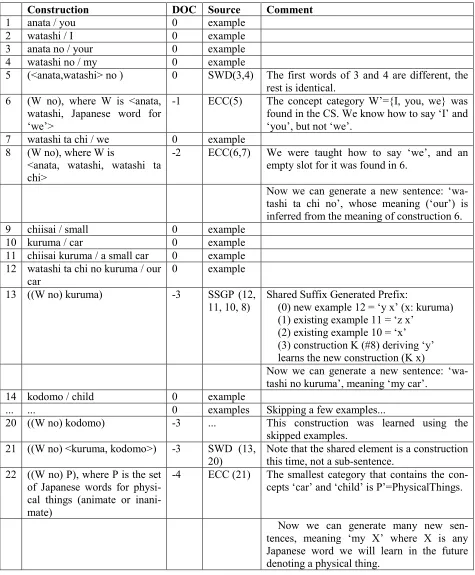
example in which U’ does not equal W’ is given in Table 1 by ‘child’ and ‘car’.
L2 words might be ambiguous – several con-cepts might correspond to a single word. Because example semantics are not explicitly represented, our system has no way of knowing which concept is the correct one for a given construction, so it considers all possibilities. For example, the Japa-nese ‘ni’ means both ‘two’ and ‘at/in’, so when attempting to generalize a construction in which ‘ni’ appears in an argument class, ECC would sider both the ‘numbers’ and ‘prepositions’ con-cepts.
The degree of certainty assigned to the new con-struction by ECC is a function of the quality of the match between W and U’. The more abstract is U, the lower the certainty.
The main form-based induction algorithm is
Shared Prefix, Generated Suffix (SPGS). Given an example ‘x y’ (x, y are word sequences), if there exist (1) an example of the form ‘x z’, (2) an ex-ample ‘x’, and (3) a construction K that derives ‘z’ or ‘y’, we create the construction (x K) having a degree of certainty lower than that of K. A Shared Suffix version can be defined similarly. Require-ment (2) ensures that the cut after the prefix will not be arbitrary, and assumes that the lesson author presents constituents as partial examples before-hand (as indeed is the case in our corpus).
SPGS utilizes the learner’s current generative capacity. Assume input ‘watashi wa biru o nomi mas’ (‘I drink beer’), previous inputs ‘watashi wa america jin des’ (‘I am American’), ‘watashi wa’ (‘as to me...’) and an existing construction K = (<biru, wain> o nomi mas). SPGS would create the construction (watashi wa K), yielding the new sen-tence ‘watashi wa wain o nomi mas’ (‘I drink wine’).
To enable faster learning of more abstract con-structions, we use generalized versions of SWD and SPGS, which allow the differing or shared elements to be a construction rather than a word or a word sequence.
The combined learning algorithm is: given a new example, iteratively invoke each of the above algorithms at the given order until nothing new can be learned. Our system is thus a kind of inductive programming system (see [Thompson99] for a sys-tem using inductive logic programming for seman-tic parsing).
Note that the above algorithms treat words as atomic units, so they can only learn morphological rules if boundaries between morphemes are marked in the corpus. They are thus more useful for languages such as Japanese than, say, for Ro-mance or Semitic languages.
Our algorithms have been motivated by general cognitive considerations. It is possible to refine them even further, e.g. by assigning a higher cer-tainty when the focus element is a prefix or a suf-fix, which are more conspicuous cognitively.
6 Results and Application to Authoring of
Learning Corpora
We have experimented with our model using the Pimsleur Japanese I (for English speakers) course, which comprises 30 half-hour lessons, 1823 differ-ent examples, and about 350 words. We developed a simple set of tools to assist transcription, using an arbitrary, consistent Latin script transliteration based on how the Japanese phonemes are pre-sented in the course, which differs at places from common transliterations (e.g., we use ‘mas’, not ‘masu’). Word boundaries were marked during transliteration, as justified in section 4.
Example sentences from the corpus are ‘nani o shi mas kaa ? / what are you going to do?’, ‘wa-tashi ta chi wa koko ni i mas / we are here’, ‘kyo wa kaeri masen / today I am not going back’, ‘demo hitori de kaeri mas / but I am going to return alone’, etc. Sentences are relatively short and ap-propriate for a beginner level learner.
Evaluating the quality of induced language models is notoriously difficult. Current FLA prac-tice favors comparison of predicted parses with ones in human annotated corpora. We have fo-cused on another basic task of a grammar, sentence enumeration, with the goal of showing that our model is useful for a real application, assistance for authoring of learning corpora.
placeholders for concepts whose words would be taught in the future, which could increase the num-ber exponentially.
In terms of precision, 514 of the 525 sentences were judged (by humans) to be syntactically cor-rect (53 of those were problematic semantically). Regarding recall, it is very difficult to assess for-mally. Our subjective impression is that the learned constructions do cover most of what a reasonable person would learn from the examples, but this is not highly informative – as indicated, the algo-rithms were discovered by following our own in-herence processes. In any case, our algorithms have been deliberately designed to be conservative to ensure precision, which we consider more im-portant than recall for our model and application.
There is no available standard benchmark to serve as a baseline, so we used a simpler version of our own system as a baseline. We modified ECC to not remove C in case of failure of concept match (see ECC’s definition in section 5). The number of constructions generated after seeing 1300 exam-ples is 3,954 (yielding 35,429 sentences), almost all of which are incorrect.
The applicative scenario we have in mind is the following. The corpus author initially specifies the desired target vocabulary and the desired syntacti-cal constructs, by writing examples (the easiest interface for humans). Vocabulary is selected ac-cording to linguistic or subject (e.g., tourism, sports) considerations. The examples are fed one by one into the model (see Table 1). For a single word example, its corresponding concepts are first manually added to the CS.
The system now lists the constructions learned. For a beginner level and the highest degree of cer-tainty, the sentences licensed by the model can be easily grasped just by looking at the constructions. The fact that our model’s representations can be easily communicated to people is also an advan-tage from an SLA theory point of view, where ‘fo-cus on form’ is a major topic [Gass01]. For advanced levels or lower certainties, viewing the sentences themselves (or a sample, when their number gets too large) might be necessary.
The author can now check the learned items for errors. There are two basic error types, errors stemming from model deficiencies and errors that human learners would make too. As an example of the former, wrong generalizations may result from discrepancies between the modeled conceptual
sys-tem and that of a real person. In this case the au-thor fixes the modeled CS. Discovering errors of the second kind is exactly the point where the model is useful. To address those, the author usu-ally introduces new full or partial examples that would enable the learner to induce correct syntax. In extreme cases there is no other practical choice but to provide explicit linguistic explanations in order to clarify examples that are very far from the learner’s current knowledge. For example, English speakers might be confused by the variability of the Japanese counting system, so it might be useful to insert an explanation of the sort ‘X is usually used when counting long and thin objects, but be aware that there are exceptions’. In the scenario of Table 1, the author might eventually notice that the learner is not aware that when speaking of some-body else’s child a more polite reference is in or-der, which can be fixed by giving examples followed by an explanation. The DOC can be used to draw the author’s attention to potential prob-lems.
Preparation of the CS is a sensitive issue in our model, because it is done manually while it is not clear at all what kind of CS people have (WordNet is sometimes criticized for being arbitrary, too fine, and omitting concepts). We were highly conserva-tive in that only concepts that are clearly part of the conceptual system of English speakers before any exposure to Japanese were included. Our task is made easier by the fact that it is guided by words actually appearing in the corpus, whose number is not large, so that it took only about one hour to produce a reasonable CS. Example categories are names (for languages, places and people), places (park, station, toilet, hotel, restaurant, shop, etc), people (person, friend, wife, husband, girl, boy), food, drink, feelings towards something (like, need, want), self motion activities (arrive, come, return), judgments of size, numbers, etc. We also included language-related categories such as pro-nouns and prepositions.
7 Discussion
its generative capacity is unique in its support for degrees of certainty. The model was tested on a unique corpus.
The dominant trend in CL in the last years has been the usage of ever growing corpora. We have shown that meaningful learning can be achieved from a small corpus when the corpus has been pre-pared by a ‘good teacher’. Automatic identification (and ordering) of corpora subsets from which learning is effective should be a fruitful research direction for CL.
We have shown that using a simple conceptual system can greatly assist language learning algo-rithms. Previous FLA algorithms have in effect computed a CS simultaneously with the syntax; decoupling the two stages could be a promising direction for FLA.
The model presented here is the first computa-tional SLA model and obviously needs to be ex-tended to address more SLA phenomena. It is clear that the powerful notion of certainty is only used in a rudimentary manner. Future research should also address constraints (e.g. for morphology and agree-ment), recursion, explicit semantics (e.g. parsing into a semantic representation), word segmenta-tion, statistics (e.g. collocations), and induction of new concept categories that result from the learned language itself (e.g. the Japanese counting system). An especially important SLA issue is L1 trans-fer, which refers to the effect that the L1 has on the learning process. In this paper the only usage of the L1 part of the examples was for accessing a con-ceptual system. Using the L1 sentences (and the existing conceptual system) to address transfer is an interesting direction for research, in addition to using the L1 sentences for modeling sentence se-mantics.
Many additional important SLA issues will be addressed in future research, including memory, errors, attention, noticing, explicit learning, and motivation. We also plan additional applications, such as automatic lesson generation.
Acknowledgement. We would like to thank Dan Melamed for his comments on a related document.
References
Brown Ralf, 2000, Automated Generalization of Trans-lation Examples, COLING ’00.
Carl Michael, Way Andy, (eds), 2003, Recent Advances in Example Based Machine Translation, Kluwer.
Chang Nancy, Gurevich Olya, 2004. Context-Driven Construction Learning. Proceedings, Cognitive Sci-ence ‘04.
Chapelle Carol, 2001. Computer Applications in SLA. Cambridge University Press. .
Cicekli Ilyas, Gu”venir Altay, 2001, Learning Transla-tion Templates from Bilingual TranslaTransla-tional Exam-ples. Applied Intelligence 15:57-76, 2001.
Clark Alexander, 2001. Unsupervised Language Acqui-sition: Theory and Practice. PhD thesis, University of Sussex.
Clark Eve Vivienne, 2003. First Language Acquisition. Cambridge University Press.
Croft, William, 2001. Radical Construction Grammar. Oxford University Press.
Edelman Shimon, Solan Zach, Horn David, Ruppin Eytan, 2004. Bridging Computational, Formal and Psycholinguistic Approaches to Language. Proceed-ings, Cognitive Science ‘04.
Fromkin Victoria, Rodman Robert, Hyams Nina, 2002. An Introduction to Language, 7th ed. Harcourt. Gass Susan M, Selinker Larry, 2001. Second Language
Acquisition: an Introductory Course. 2nd ed. LEA Publishing.
Goldberg Adele, 1995. Constructions: a Construction Grammar Approach to Argument Structure. Chicago University Press.
Klein Dan, 2005. The Unsupervised Learning of Natural Language Structure. PhD Thesis, Stanford.
Levy Michael, 1997. Computer-Assisted Language Learning. Cambridge University Press.
Maritxalar Montse, Diaz de Ilarraza Arantza, Oronoz Maite, 1997. From Psycholinguistic Modelling of In-terlanguage in SLA to a Computational Model. CoNLL ’97.
Medin Douglas, Ross Brian, Markman Arthur, 2005. Cognitive Psychology, 4th ed. John Wiley & Sons.
Mitchell Rosamond, Myles Florence, 2003. Second Language Learning Theories. 2nd ed. Arnold Publica-tion.
Pimsleur 2005. www.simonsays.com, under ‘foreign language instruction’.
Somers Harold, 2001. Example-based Machine Transla-tion. Machine Translation 14:113-158.
Thompson Cynthia, Califf Mary Elaine, Mooney Ray-mond, 1999. Active Learning for Natural Language Parsing and Information Extraction. ICML ’99. Tomasello Michael, 2003. Constructing a Language: a
Construction DOC Source Comment
1 anata / you 0 example 2 watashi / I 0 example 3 anata no / your 0 example 4 watashi no / my 0 example
5 (<anata,watashi> no ) 0 SWD(3,4) The first words of 3 and 4 are different, the rest is identical.
6 (W no), where W is <anata, watashi, Japanese word for ‘we’>
-1 ECC(5) The concept category W’={I, you, we} was found in the CS. We know how to say ‘I’ and ‘you’, but not ‘we’.
7 watashi ta chi / we 0 example 8 (W no), where W is
<anata, watashi, watashi ta chi>
-2 ECC(6,7) We were taught how to say ‘we’, and an empty slot for it was found in 6.
Now we can generate a new sentence: ‘wa-tashi ta chi no’, whose meaning (‘our’) is inferred from the meaning of construction 6. 9 chiisai / small 0 example
10 kuruma / car 0 example 11 chiisai kuruma / a small car 0 example 12 watashi ta chi no kuruma / our
car
0 example
13 ((W no) kuruma) -3 SSGP (12, 11, 10, 8)
Shared Suffix Generated Prefix:
(0) new example 12 = ‘y x’ (x: kuruma) (1) existing example 11 = ‘z x’
(2) existing example 10 = ‘x’ (3) construction K (#8) deriving ‘y’ learns the new construction (K x)
Now we can generate a new sentence: ‘wa-tashi no kuruma’, meaning ‘my car’.
14 kodomo / child 0 example
... ... 0 examples Skipping a few examples...
20 ((W no) kodomo) -3 ... This construction was learned using the skipped examples.
21 ((W no) <kuruma, kodomo>) -3 SWD (13, 20)
Note that the shared element is a construction this time, not a sub-sentence.
22 ((W no) P), where P is the set of Japanese words for physi-cal things (animate or inani-mate)
-4 ECC (21) The smallest category that contains the con-cepts ‘car’ and ‘child’ is P’=PhysicalThings.
[image:8.612.72.547.64.639.2]Now we can generate many new sen-tences, meaning ‘my X’ where X is any Japanese word we will learn in the future denoting a physical thing.