Improving Node Lifetime through Wireless
Transmission of Power in MANET
R.Ambrish1, V.Vijayaganth2
ME Final year, Dept. of CSE, CSICE, Ketti, The Nilgiris, Tamil Nadu, India
Asst. Professor, CSICE, Ketti, The Nilgiris, Tamil Nadu, India
ABSTRACT: Transmitting electric power through wireless medium is made an efficient gateway for many applications. Electricity through wireless can harm human being and other creatures. Mobile ad hoc networks (MANETs) are vulnerable to Power threats due to the open wireless medium and dynamic topology. It is difficult to provide energy for nodes which are location independent. In this paper, we propose a distributed energyresonance -based RMAC protocol for Mobile Ad-hoc Networks (MANETs). The design objective of R-MAC is to transmit power energy to the neighbouring dynamic node of the MANETs using Magnetic induction principle (WIRELESS). Ad hoc On-demand Distance Vector (AODV) protocol is used for frame (ETH, and TRIGGER MESSAGE) exchange between n danger node and the source power. Hence the lifetime of dynamic node (application node, network node and base station node) is increased with high performance.
KEYWORDS: Wireless Power Transmission, R-MAC ,Resonance, Node, Magnetic coil.
I. INTRODUCTION
Mobile Ad-hoc Network (MANET) is a self configured network of mobile terminals connected by wireless links. Mobile terminals such as portable gaming devices, cellular phones, tablets and personal digital assistants (PDAs) [1] all contain wireless networking facilities. By participating in MANETs, these terminals may reach the Internet when they are not in the range of Wi-Fi access points or cellular base stations or communicate with each other when no networking infrastructure is available. MANET can also be utilized in the field of disaster rescue and recovery process. One of the most important issues with continuous participation in MANETs is the network lifetime, because the aforementioned wireless terminals are battery powered, and energy constrained.
Wireless Power Transmission (WPT) is a promising technique for conserving the energy sharing in MANETs. The broadcast nature of the wireless medium is exploited in cooperative fashion. The wireless transmission between a pair of terminals can be received and processed at other terminals for improving network lifetime. WPT can provide gains in terms of the required transmitting and receiving power in every single node.WPT has been researched extensively from the information theoretic perspective on the issues of minimum energy in Ad hoc nodes. Wireless Power transfer is possible based on induction principle and tesla effect proposed by Michael faraday in 18th century. By practical, transmitting electric energy over large distance has made a complex issue [2].
After a research, resonator (resonance principle) is used to increase and boost the transmitting range of electric current [3]. Since electric current has disaster characteristics towards human beings. This can harm mammals and living things. Hence it is clear that transmitting electric energy through wireless is complex. But through induction principle electrical energy can be converted into magnetic energy which doesn’t harm living things.
II. RELATED WORK
A. MODELS
In this section, we present the employed system and energy models, and the background knowledge about Wireless Ad hoc network.
i. SYSTEM AND ENERGY MODELS
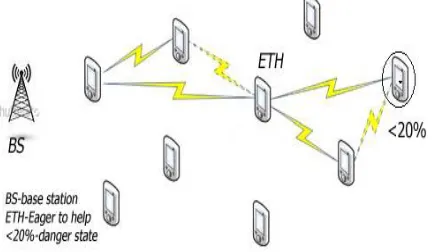
As shown in Fig. 1, a multi-hop MANET with randomly deployed mobile terminals in the network, where all terminals have the capability to relay. To come up with a reasonable system model, we assume that data connections among terminals are randomly generated and the routes are established by running Ad hoc On-demand Distance Vector (AODV) is a widely used conventional routing protocol for MANET. AODV builds the route in a proactive manner by selecting the routing relay terminals initially. When a route is established by the AODV, R-MAC initiates the cooperation in a hop-by-hop manner by selecting the node terminals.
ii. Energy Level in MANET
They are four types of energy consumption by the node in a network as follows:
Energy consumed during sending a packet
Energy consumed during receiving a packet
Energy consumed during idle mode
Energy consumed during sleep mode which occurs when the wireless interface of the Mobile node is turned
off.
Based on the above assumption the status of the node is predicted in the MAC layer and a trigger message is sent to the coordinator requesting for a power resource.
Fig. 1 Node Status in MANETs Scenario
iii. Power Management in Mobile Ad Hoc Network
The proposed scheme, which is concerned with power awareness during route discovery. This scheme deals with mobile ad hoc network having large number of nodes and handles a different data traffic levels. The scheme modified AODV protocol by assuming that battery has three states as shown below:
If (battery status < 20%), then it is in danger state.
If (20% < battery status < 50% ), then it is in critical state and,
If (battery status > 50%) it is in active state. -Where %age is the decay factor of battery.
iv. AODV PROTOCOL
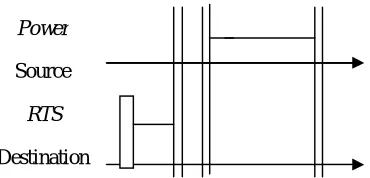
In this section fig. 2, with the objective of prolonging the network lifetime and increasing the energy efficiency, we present a novel RMAC protocol, for multi-hop MANETs. When cooperative relaying is involved, the channel reservation needs to be extended in both space and time in order to coordinate transmissions at the relay. To deal with the relaying and dynamic transmitting power, besides the conventional control frames RTS and ACK, additional control frames are required. When a node is in danger state a trigger message is sent to the neighbouring node giving highest priority to reach the source, then RTS frame is sent to the entire network node and the power is transmitted across the nodes. After the danger node is recharged then ACK will be sent to the coordinator.
Fig. 2 The Frame Exchanging Process
III. PROPOSEDSYSTEM
a. THE PROPOSED R-MAC PROTOCOL
The basic operations of the proposed R-MAC are based on the IEEE 802.11. When the source power is initialize then the R-MAC protocol acts as a energy repeater i.e. carries the magnetic field to a little larger distance to reach the next node.
What is resonance?
A resonance is a hardware coil which is connected with a battery that creates a magnetic field to transfer power from one point to another point.
i. DESIGN APPROACH
Fig.3.Proposed Node Architecture Power
Source
RTS
The component of proposed node consists of Transceiver, Micro-Controller, External Memory, Sensors, Battery and Magnetic coil (wide angle dipole coils). The magnetic coil should be connected to the battery where it produces a magnetic field used for wireless Energy Transfer. Magnetic coil is the new component included in the Manet nodes. This coil is made up of copper coils of size 0.6mm and connected to the battery.
ii. OPERATIONS
Operations includes in DANGER NODE, ETH, POWER TRANSFER, AND POWER ALLOCATION. Danger Node
The Danger node is initiated automatically by giving highest priority when the power goes down below (<20%). So a trigger message is initiated and a flag0 is sent to the neighbouring dynamic node. Every node has a Eager To Help (ETH) Frame Configuration so the trigger message received from the danger node is transmitted across the network to reach the source power.
When the message reaches the source power it initiates with a high voltage power emitting magnetic field. Power allocation
Power is scattered without limits. The entire nodes in the network will be able to recharge their battery but allocating power for each dynamic node is impossible. For the experiment, the source coil and the load coil was constructed using 0.6mm copper tube with radius 13 inches.
We have constructed two receivers one with a single turn and another with double turn. Transmitter circuit is mainly consists of oscillator circuit. A power supply with rectifier circuit is connected to transmitter circuit with a coil to transmit the power. Receiver circuit includes only the load coil with attached capacitor to receive power.
IV. SIMULATIONRESULT
In this section, we evaluate R-MAC via extensive simulations comparing with IEEE 802.11. Since the purpose of our scheme is to transfer power and increasing the node lifetime, the evaluation metrics in this paper are the transmitting power, network lifetime, aggregated. The transmitting power denotes the power consumed at transmit amplifier (without the power consumed at transmit circuitry). The total energy consumption is the summation of the transmitting (including both transmit amplifier and circuitry) and receiving energy cost at the source and destination. To validate the performance
Improvements in R-MAC, we utilize both the single hop scenario and the multi-hop multi-connection scenario. The simulation is carried out in network Simulator2. The initial energy of all the terminals is set to nil (zero). When the proposed R-MAC is initiated, it starts transmitting power in the form of electromagnetic fields.
PERFORMANCE EVOLUTION
The efficiency of the coupled system depends on how much energy is transferred from the transmitted to the receiver circuit.
ηenergy= Ereceiver.max
Etransmitter.max
The maximum energy found on the transmitted Etransmitter.max, is the amount of energy initially put on the input
capacitor Ct by the voltage source V0
Etransmitter.max ≈Einit= CtV2in
The maximum energy transferred to the receiver is only a fraction of input energy. The energy found is receiver circuit is:
At maximum voltage level on receiver circuit, current becomes zero and no current flows the circuit. At this point energy stored in receiver inductor is zero because current is zero. Thus, maximized receiver energy is:
Etransmitter.max= CrV2out,max
The formula for efficiency calculation is,
η = (Pout/Pin) * 100
We used the following formula for power calculation, P = VI
Fig.4. Performance report
From the above fig 4.0, we demonstrated the results of power calculation. The x axis is the distance, which measured by cm and the power voltage is refereed at y axis with the W variable.
V. CONCLUSION
Wireless Electricity technology is a non-radioactive mode of energy transfer, relying instead on the magnetic near field. Magnetic fields interact very weakly with biological organisms such as people and animals, and are scientifically regarded to be safe and secure. The goal of this project was to design and implement a wireless power transfer system via magnetic resonant coupling in MANET. After successful optimization analysis, a system was designed and implemented the proposed framework. Simulation results showed that significant improvements in terms of power-transfer efficiency have been achieved, and this is quite well improvement than the existing one. Measured results are in good agreement with the theoretical models.
VI. FUTUREENHANCEMENT
The next study will focus on the combination of a variety of theoretical, and further explore the energy transfer mechanism based on magnetically coupling resonant wireless power transmission technology. In terms of practical, in order to improve the transmission distance and efficiency of the magnetic coupling resonance wireless energy system, the key lies on designing and producing a coil with a high Q value, and the maximum efficiency of the resonant frequency matching. As the calculation of the existing energy transmission coil rarely involved in antenna theory, fabrication methods is mostly wound coil, the process is difficult to guarantee the production of coils and consistent to the theoretical calculations, thereby affecting the distance and efficiency of wireless energy transmission. Therefore, about how to improve the Q value of the coil above, we need further study, such as on the coil material, production process, calculation methods and antenna theory.
Magnetically coupled resonant wireless power transmission technology is a new energy transmission technology, which can effectively overcome the problem that existed in wired power supply equipment ,such as can’t move flexibility ,unsightly environment ,easy to contact with sparks, supply line exposure ,and especially suitable for mobile devices, inflammable and explosive environment, underwater, safe power supply of oilfield down hole equipment. The technology not only has important applications in the field of electric vehicles, industrial robotics, aerospace, military, oil fields, mines, underwater operations, wireless sensor networks, and also widely used in household appliances, RFID, medical devices and other civilian areas prospects. So it is very important to have a breakthrough on magnetically coupled resonant wireless power transmission technology basic theory and practical aspects.
REFERENCES
1. Nicola Tesla, “The transmission of electrical energy without wires”, Electrical World and Engineer, March 1905. http://www.tfcbooks.com/tesla/1904-03-05.html, (acc. Dec. 08)
2. William C. Brown, “The history of power transmission by radio waves”, Microwave Theory and Techniques, IEEE Transactions, 32(9):1230-1242, September 1984.
3. A.B. Kurs, A. Karalis, R. Moffatt, J.D. Joannopoulos, P.H. Fisher, and M. Soljacic, “Wireless Power Transfer via Strongly Coupled Magnetic Resonances”, Science, 317, pp. 83-86,
(2007).
4. A. Karalis, J.D. Joannopoulos, and M. Soljacic, “Efficient Wireless Non-radiative Midrange Energy Transfer”, Ann. Phys., 323, pp. 34-48, (2008); published online April 2007.
5. J.D. Joannopoulos, A. Karalis, and M. Soljacic, “Wireless Non-Radiative Energy Transfer”,U.S. Patent Numbers 7,741,734; 8,022,576; 8,084,889; and 8,076,800.
6. Wireless Electricity Transmission Based On Electromagnetic and Resonance Magnetic Coupling - Prof. Burali Y. N, Prof. Patil C.B. 7. Design and construction of wireless power transfer system using magnetic resonant coupling- Syed Khalid Rahman1- Apr2014 8. Wireless Power Transmission: An Innovative Idea -Vikash Choudhary, Satendar Pal Singh
9. Wireless Power Transfer-Daniel Deller