Scholarship at UWindsor
Scholarship at UWindsor
Electronic Theses and Dissertations Theses, Dissertations, and Major Papers
1-1-1965
A beta-gamma angular correlation experiment using arsenic-74.
A beta-gamma angular correlation experiment using arsenic-74.
Winston Armstrong University of Windsor
Follow this and additional works at: https://scholar.uwindsor.ca/etd
Recommended Citation Recommended Citation
Armstrong, Winston, "A beta-gamma angular correlation experiment using arsenic-74." (1965). Electronic Theses and Dissertations. 6373.
https://scholar.uwindsor.ca/etd/6373
A
p > - X
ANGULAR CORRELATION EXPERIMENT USING As74BY
WINSTON ARMSTRONG
A Thesis
Submitted to the Faculty of Graduate Studies through the Department of Physics in Partial Fulfillment
of the Requirements for the Degree of Plaster of Science
at The University of Windsor
Windsor, Ontario
INFORMATION TO USERS
The quality of this reproduction is dependent upon the quality of the copy
submitted. Broken or indistinct print, colored or poor quality illustrations and
photographs, print bleed-through, substandard margins, and improper
alignment can adversely affect reproduction.
In the unlikely event that the author did not send a complete manuscript
and there are missing pages, these will be noted. Also, if unauthorized
copyright material had to be removed, a note will indicate the deletion.
®
UMI
UMI Microform EC52554Copyright 2008 by ProQuest LLC.
All rights reserved. This microform edition is protected against
unauthorized copying under Title 17, United States Code.
ProQuest LLC 789 E. Eisenhower Parkway
E. E. Habib
H. Ogata
^
A. van Wijgaarden
In this thesis, the theory of beta-gamma angular cor
relation is discussed briefly. Beta decay is analysed inoluding
allowed and first forbidden beta decay as well as a method of
analysing data from the Ag coefficient to determine whioh nuclear
model is applicable. The corrections applied to the experimental
measurements are introduced. An experiment is performed whioh
measures the beta-gamma angular correlation coefficient, Ag, for
the cascade
2~(
3 + )2+( $ )0+ in the positron deoay of A s ^ to G e ^ 74 and for the cascade2~{ {3~)2+(
)0 in the negatron decay of As to S e ^ , as a function of energy (W).NEGATRONS
w
A2
1 .6 0 .0 1 2
-
0 .0 0 51 .8
-0.045
-
0 .0 0 62 .0
POSITRONS
-0.044
-
0 .0 0 61 .8
0.015 i
0 .0 0 62 .0
0.019 £
0 .0 0 42 .1 0.0 3 0
i
0.0 0 52 .2
0.025 £
0 .0 0 5The positron data is used to examine the structure of the
first excited level in G e ^ . The negatron data was not used due to
insufficient precision or not enough points. Both the shell model
and the collective model can be made to fit the positron data. The
2
satisfactory shell model configurations found are (f^yg) ^
9
/2
^ »(f^/g) (
89
/2
^ ’ and ^f5/2^ ^s9/2^» where TT* andU
are even numbers of protons and neutrons respectively. In order to distinguish between the above configurations and a rotational excit
ation, more data, such as the shape factor and the beta-circularly
polarized-gamma directional correlation coefficient, is required.
I wish to express my sincere thanks to Dr. E.E. Habibj
without whose guidanoe and counsel this experiment could not have
been carried out.
My thanks go to Dr. Ogata who performed the calculations
to determine which nuclear model was applicable. I would like to
express my gratitude to Mrs. Robert Armstrong for typing the
manuscript.
PAGE
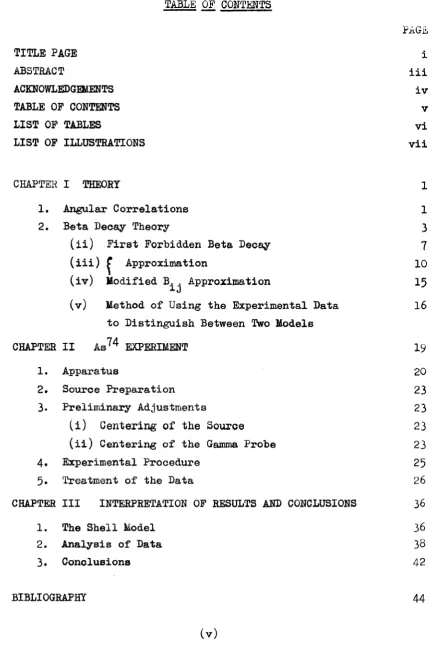
TITLE PAGE i
ABSTRACT iii
ACKNOWLEDGEMENTS iv
TABLE OP CONTENTS V
LIST OP TABLES vi
LIST OP ILLUSTRATIONS vii
CHAPTER I THEORY 1
1. Angular Correlations 1
2. Beta Decay Theory 3
(ii) First Forbidden Beta Decay 7
(iii) ^ Approximation 10
(iv) Modified B . . Approximation
X J 15
(v) Method of Using the Experimental Data
to Distinguish Between Two Models
16
CHAPTER II As74 EXPERIMENT 19
1. Apparatus 20
2. Source Preparation 23
3. Preliminary Adjustments 23
(i) Centering of the Source 23
(ii) Centering of the Gamma Probe 23
4. Experimental Procedure 25
5. Treatment of the Data
26
CHAPTER III INTERPRETATION OP RESULTS AND CONCLUSIONS 36
1. The Shell Model 36
2. Analysis of Data 38
3. Conclusions 42
BIBLIOGRAPHY
(v)
TABLE # NAME OF TABLE PAGE
I Fermi and Gamow-Teller Interactions 5
II Summary of Allowed and First Forbidden Matrix 6
Elements
III Asymmetry, Ag Coefficients and Solid Angle 30
Corrections for Negatrons
IV Asymmetry, Ag Coefficients and Solid Angle 31
Corrections for Positrons
V Corrections for Chance and Scattering Positrons 32
and Negatrons
VI Table of Coincidences to Get a(w) - Positrons 33
VII Table of Coincidences to Get a(w) - Negatrons 35
VIII Table of the Shell Model 37
IX V and Y Corresponding to the Intersects of the 41
Theoretical Circles with the Meniscus
X Calculated Centres of Circles and Radii 41
(Matumoto's Method)
FIGURE # TITLE PAGE
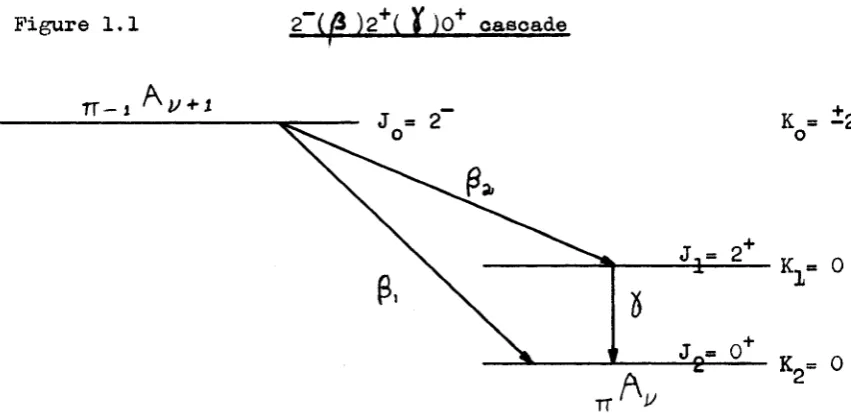
1.1 2 (^3) 2+ ( K ) 0+ Cascade 17
2.1 A s ^ Decay Scheme
19
2.2 A Block Diagram of Circuit Layout 21
2.3 A Two Fold Fast Coincidence Circuit 22
2.4 The Gamma Singles Spectra 24
2.5 The Gamma 1 Spectra in Coincidence with the 27
Betas
2.6 The Gamma 2 Spectra in Coincidence with the 28
Betas
2.7
i>
Change of§
of Peak Counts, N, in Gamma 29 Channel VS. # Change of Lower Discriminator2.8
i
Change in Coincidence Counts in Same Channel 29 as Gammas VS.i
Change of Lower Discriminator3.1 Plot of V vs. Y 40
THEORY
1. Angular Correlations
The probability of emission of a particle or quantum by a
radioactive nucleus depends in general on the angle between the
nuclear spin axis and the direction of emission. Under ordinary
circumstances the total radiation and the radiation for an individual
fi
transition 1^*— ♦Ig from a radioactive sample is isotropic because
the nuclei are randomly oriented in spaoe.
However, in a two step cascade transition, such as
where R denotes the type of radiation,
eg-(^»
$
>e” )> there is often an angular correlation between the directions of emission of two successive radiations,R, and R„, whichare emitted from the same nucleus.
The existence of an angular correlation arises because
the direction of the first radiation is related to the orientation
of the angular momentum, I„ , of the intermediate level. This
orientation can be expressed in terms of the
magnetic-angular-momentum quantum number, mg, with respect to the direction of the
first radiation. If Ig is not zero, and if the lifetime of the
intermediate level is short enough so that the orientation of Ig
persists, then the direction of emission of the second radiation
will be related to the direction of Ig and hence to the first
radiation.
Many of the details of the complicated theory of these
angular correlations have been worked out. Experimental and
theoretical developments have been summarized in a number of
Qlto.s
3excellent review articles. (bLA'i'T.
52
, FRAUN.53
, and LEUTSCH.51
) •For the generalized R,-R„ cascade 1^(1,)lB (l„)lc the
angular-correlation function W(<P) for the angle
<p
between the successive H's can be shown to be, (FALK.50
)i=L
l.a— W ( < ? ) d a = 2- A 9 .P0 .(cos f ) d A i=0
d
where A^^ are coefficients which aepend on l,and 1„, the orbital
angular momentum transferred by R, and R„ respectively.
L is the a M i a a l angular-momentum quantum number.
P g ^ C O S are the even Legendre Polynomials.
There are rigorous restrictions on the number of terms
in eqns. l.a; the highest even power of cos
<Q
is determined by 1,,IB , or 1„ whichever is smallest. Thus 2L is not larger than21, or 2IB , or 21„ and will be one unit less than the smallest if
the smallest is odd. For example, if or ■§■, W(<^)=1, and the
angular correlation distribution will be isotropic.
A convenient experimental quantity is the
Anisotropy=A= -1 .
The conditions of validity of eqn. l.a must include all the
assumptions made in its derivation (for these consult EVANS.55)*
The information that can be obtained from angular
correlation work depends on the type of radiation observed («K,^,'5,e )
and on the properties that are singled out by the experiment
(direction, polarization, energy), and on the extranuolear fields
acting on the nucleus. Here we assume that the decaying nuclei
ntjh We.
are free, ie., that'
5
^' extranuolear fields act on the nucleus and disturb its orientation in the intermediate state,o<~^ and dirccti- nrl correlation information about the
obtained. The relative parities can be determined, however,
if one observes in addition to the direction also the polarization
of the gamma-rays, or if one measures the directional correlation
between conversion electrons^-"). The directional correlation of
a beta-gamma cascade depends not only on the nuclear spins and
parities, but also on the matrix elements involved in the
beta-transition.
In the first transition of a beta-gamma cascade, an
electron and a neutrino are emitted simultaneously. Formally,
this event is described by treating the process as if a neutrino
(antineutrino) enters the nucleus and a negatron (positron) is
emitted. In a beta-gamma correlation experiment one measures the
direction of the electron while the neutrino escapes unobserved.
The theoretical calculation of the angular correlation thus
necessitates an averaging over all neutrino directions and over
the spins of the neutrino and the electron. In our case for a
first forbidden beta-transition the expression for the beta-gamma
directional correlation is (MAT. 63). >*r* : t « 1
l.b— N(W,^) - l+A
2
P2
(cos<f) = 1 + £ ( W ) ( ^ ) ( | cos2
<p- |)2. Beta Decay Theory
In "Beta Decay" three processes can take place,
1
.1
— n— ■>
p + e“ +V
1.2 — p — ^ n + e+ + V1.3
— p + e” — > n +1/
In 1.1, a neutron changes into a proton plus an anti
neutrino and a negatron? in
1
.2
, a proton changes into anegatron to form a neutron and a neutrino. 1.1 is called "Negatron
Emission", 1.2 is called "Positron Einission", and 1.3 is called
"Eleotron Capture".
The leptons (electron and neutrino) may be emitted with
spins parallel or anti-parallel. In the first case, the net spin
$
=1
, (if*s|*let case), and in the seoond case, |> =>0
, (jM^let case). In addition, these particles may possess orbital angular momentumwith respect to the neucleus. The case where the orbital angular
momentum,! , is zero, is called the allowed beta decay, L - 2,***,
1st forbidden,
2
nd forbidden,* The total angular momentum,J, of the leptons must obey the conservation of angular momentum
i.e. J = L + S, { If - 1 ^ < J < | l f + i j — 1.4
where
1
^ and1
^ are the initial and final nuclear spins of thetransition states.
If
S'
=0
")_ q J then J « 0 A I ■ 0 — 1.5
Also if
0
= 1S
I
.- I 0L - 0
j
then J “ 1
A I » 0, i 1
In these cases since L =
0
, the parity of the transforming nucleusis not changed. The condition 1.5 is called the "Fermi Interaction"
and 1.6 the "Gamow-Teller Interaction". Thus we have pure Fermi
radiation ( A l = 0, 0 — > 0 transition) as well as pure Gamow-Teller
radiation (I— > 1 — l). Th© Allowed A l » 0, 1^ = 1^ ^ 0 consists
of both Fermi and Gamow-Teller radiation in proportions depending
on the relative ease with which the requisite final nuclear states
can be formed by the Ferjpi or Gamow-Teller couplings respectively.
TABLE # I
Fermi and Gamow-Teller Interactions
Order Of
Forbiddeness
Fermi
F
Gamow-Teller
G.T.
L *» 0 A I -
0
A i - o, ± i, o V o
L = 1
A t
-o, i 1
A l
-0
,-
1, i 2
o
4
-o
no
0
—?0
no1<~^0
Fermi Theory
The Fermi theory has been very successful in describing
beta decay. Fermi constructed his theory on the model of the theory
of electromagnetic radiation. Fermi assumed that the nucleons
generate beta radiation in proportion to the current associated with
the neutron to proton transformation or its reverse.
Where W » ) describes a proton (neutron) if one agrees
to treat as identical the neutron and proton co-ordinates of the
transforming nucleon, then from the requirements of relativistic
invariance we get the coupling energy density
h ' g(Yp
h
Yn)
(fe X.
W *
c.c. is the complex conjugate.
g is Fermi's fundamental coupling constant and is respon
sible f or the m a g n i t u d e of t he interaction.
Covariant densities other than the four-vector current can be
constructed within the Dirac description of the "internal state" of
tensor (T), an axial vector (A), and a pseudoscalar (P), besides
the four vector (V) used by Fermi. There was not a priori reason
for not expecting beta radiation to be generated by any of these.
However from experimental and theoretioal investigations, the form
of the nuclear beta-decay interaction is well-established. We know
that beta-decay violates parity completely and can be written V-A
(vector-axial vector) for electron (negatron) emission (reference
REV. M. 59)* Parity conservation is equivalent to saying that a
system is invariant under reflections; just as conservation of
total angular momentum, around any axis requires invariance under
rotations. The parity of a state of a nucleus is fixed but the
parity of the leptons during transitions from one state of fixed
parity to another is random.
TABLE II
Summary of Allowed and First Forbidden Matrix Elements
Matrix Element >v A J
£>rr
F orGT
L
Allowed Cv $
1
00
+1 F 00, i 1 1
(no
0
~ ^0
)+1 GT 0
First C. f Y
Forbidden
1 2
CA j ( P r / i ) } •
0
-1 +1° v / rl
°T i 0 1
+
j
—> -1 +1
CA J « * r )
J
(no0
— >0
) CA f iBij}
2 0, ± 1, i 2(no
0
— ^0
. no l«->o)-1
+1
Allowed and first forbidden nuclear elements and their
when regarded as a tensor.)
( A J is the change in angular momentum or nuclear
spin.)
( ATT is the change in parity.)
( L is the orbital angular momentum.)
2.(ii) First Forbidden Beta-Decav (WEID.
6
l)From Konopinski, the interaction density, , for the
beta decay interaction is given by
H/>
' f
mJ [ % *
^ i)(0v " °a V i ) ) T I% ]
dZ
+ herm. conj.where Y i and lj/g are the initial and final wave fens.
Cy and C^ are the vector and axial-vector coupling constants
with values C^. ■ (
1.415
~0
.004
) x10
^
erg cm^°A +
~7T~ m
-1.19 - 0.04 VThe index i refers to the nucleons building up the initial
and final wave fens. 7j>' q and l ^ a r e the wave fans for electron and
neutrino, respectively.
We can compare this interaction for beta decay with the
interaction of an electromagnetic current (r) with the electro
magnetic field given by its vector potential A
^
(r) which is XJ
(r)A>t (r)dZ
The similarity is noted when the beta decay interaction
is put in the form.
X l ffi/t(r)L/a.(r)d'C
which is the "lepton current", a four vector, dependent on a space
co-ordinate r. Iy*(r) also depends on the magnetic quantum numbers
of electron and neutrino. This "lepton current" interacts with the
"baryon current"
B/W.(r) =
^5
(°v “ CA ^ 5 ^ V i .In each case two four-veotors have a point interaction. Consider
ing first the approximations made in the simpler case of ^ radia
tion. Here, the usual procedure consists in a multipole expansion
of the vector potential of the radiation field which is suggested
by the fact that the nuclear levels can be characterized by their
total spin J. This is justified because a multipole of order L has
a factor ( k r i n the expansion, where
k
is the V energy, and r in the interaction integral is limited by the spatial extension of thecurrent, that is, by the nuclear radius E.
Keeping the lowest order terms amounts to keeping two
types of matrix elements, e.g., the Ml- and E2- matrix elements in
the simplest case. Ml- is of order v/o in the nuoleon velocities
compared to the leading electric dipole term, E2- is of order kB
compared to the leading term. In many transitions v/o and kR are
of the same order of magnitude and therefore, in many nuclei
Ml-and E2- transitions have comparable widths.
In nuclear -decay, we have the same situation, except
for two faots,
Lyu
is not divergenceless and we have two types of interaction - vector and axial vector - rather than one, whichincreases the number of pertinent nuclear matrix elements.
is a divergenceless quantity with a gauge-invariant
interaction. This has the consequenoe that there are no electro
transitions corresponding to the electric monopole case are called
allowed transitions in/# -decay.
The first nonvanishing term in the multipole expansion of
■V* is the dipole term. It has a matrix element which we can
hriefly denote by £ r and it is (neglecting retardation) of order
kB and obeys the seleotion rule A j = 0 , - 1 (no 0 — >0), A T T = -1.
The corresponding terms in the expansion of L/x lead to the matrix
elements for first-forbidden
/Q
-decay.The interaction has been found to be one of Vector-Axial
Vector. The vector interaction oonsists of two parts,
oc
and 1. The latter is an allowed term and contributed to the allowed transition. The former is of order v/c in the nuclear co-ordinates, and
has the selection rule A j =
0
, -1
, (no0
'-^0
), A T T = -1
, and is,therefore, a first forbidden term. By keeping terms of order qr
and kr in the lepton currents where k and q are electron and
neutrino momentum respectively, the matrix element with the operator
1
becomesJ
r, which obeys the selection rules for first-forbidden decay. Thus there are two first-forbidden nuclear matrix elementsoriginating from the vector interaction,
Joe
and Jr.Correspondingly, the axial vector interaction consists of
two parts, tf*and The first term gives rise to an allowed matrix
element if one replaces the lepton current by one. If one again
keeps terms of the order qr and kr in the lepton current, this
interaction gives rise to the following three first-forbidden matrix
elements:
j C
r,
J
IjfkrJ . /“ I - J" [ IT,
+ *i (Tj - f
^ ^ € r j j
This is a convenient form because the trace is already contained
in r. The matrix ^ ^ is already of first—forbidden type,
being of order v/o.
The selection rules obeyed by the axial vector
first-forbidden nuclear matrix elements are obvious:
They all have A T T a -l, and
^
^ and have A J «0
, the operators being psudeoscalars, h a s A j a 0, i 1,(no 0 — >0), and Bij has A j »
0
, i1
,-
2, (no 0-»0)(no CX-^l). In an expression involving the matrix elementsj
andj
, whioh are of order v/o, the lepton current may be treated in the "allowed" approximation, i.e., electron and neutrino wave fensmay be replaced by their values for r- > 0 . This does not hold for
expressions involving the other four matrix elements, where the
next term in the expansion of either the electron or the neutrino
wave functions has to be taken.
2.(iii) ^ Approximation
In the
^
-approximation, we assume the following}« Z \ S W
E °
where Wq is the maximum total energy of t h e ^ particles, and has
its name from the fact that,
<*• Z c 2R = ) ’
OC is the fine structure constant,
Z is the nuclear charge,
E is the nuclear radius.
1.7a Coulomb forces in the wave fen. of the electron,"^, are much more
important than the next term in the expansion of the plane wave,
which is of order kr. Therefore, all terms of order ocZ are kept,
whereas, terms of order qR or kR are dropped, (k and q are the
electron and neutrino momenta.) As a result of this,all
first-forbidden quantities in this ^ approximation have the same energy
and angular dependence as the allowed ones.
The spectrum shape factor, -
Y
angular correlation co-efficient, etc. oan be obtained from the allowed case by makingthe following substitutions for the allowed matrix elements (KOT.
59
)- M
1
+ ° A*
f 0A - TCA j T - Cv /«• + f c A
f f x
r ♦ f c T jir . -YJ
The notation used for the nuclear matrix elements is
t^w ■ C^tf-r, ^ ^ v ■ ^
5
* ^°r ^* u - CA J i f x r, ^ y «
-CY j
id
,^x -J
r, f or ^ - 1 11.7b*1 * = for^ “ 2
The nuclear parameters u, v, w, x, y and z, are the ratios
of the various matrix elements compared to a standard matrix element,
, so that
j
can be taken out as a common factor in thetran-2
sition probability. The magnitude o f f i s determined only from
the ft value. (KOT. 59)
2 f t - TT In
W
2
^2
fQ -
fx °
F(Z,W)pWq2
(g 1^- 3- ) dWis called the Corrected Integrated Fermi Function.
/-W
f -
)1
° F(Z,W)pWq2
dWwhere F(Z,W) = Fermi function
W ■ transition end point energy.
The factor
^
^ appearing in the definitions of v and y, is introduced so that y and v are of order unity. One of theinteresting unsolved problems of forbidden -deoay is to determine
the magnitude of the parameter ^ relating the relativistio to the
non-relativistic matrix elements. (Crudely perhaps, ^ a It iS,
however, indicated in reference KOT. POSS. that this relation
probably does not hold for low Z.)
By substituting 1.7b into 1.7a we get
V ■ ^ ^v +
^
w for ^ « 0 - 1.8Y =
^
V -^
(u + x) for A .1
-1.9
Strictly, the parameters in the ^ expansion should be Y and V,instead of
^ .
The ^-approximation corresponds to the assumption that
| Vj — ( Y| ( ~ p ~ 1 0 » | w | ' - / u l ' W x / H * ! - 1 . 1 0
If the
^
approximation holds exactly, then all themeasurable quantities will have the same behavior as in the allowed
case, and will depend only on the ratio of V to Y. Therefore,
transitions which show deviations from the ^ approximation are
examined very thoroughly.
-
1
The cancellation effect means, for example, that * y inY is nearly equal to
^
(u + x). Thus, this effect makes either V or Y (or both) be of the same order as the other nuclear parameters.That is
The Selection Rule Effect
(a) K forbiddenness
K is the projection of the nuclear total angular momentum
(j) on the nuclear axis of symmetry. The K selection rule is, for
the Bohr Mottelson model,
I
Kq - ^ 1 = A K < /\ <|Kq + K^l - 1.12 for a transition from a state with quantum number (Kq , J0
»TT0 )another state (K,, J,, T T f).
TT
stands for the parity.^ designates the rank of the transition operator, when
regarded as a tensor.
The regions established especially well for this nuclear model are
150 < A
<■
190 and A >■ 225- There is no clear experimentalevidence for the applicability of the Bohr-Mottelson model to the
nuolei with A < 150, but some lighter nuolei may deform so that
the K forbiddenness is applicable.
Due to K forbiddenness we have relations like,
I z | > |x| |u{ > | w|
I 1,13
and |y| >-{Vj if there is no cancellation in Y.
J
Since Y includes the large numerical factor
^
, we cannot say v.iiieh of z and Y is larger, unless the reduction factors due tothe K forbiddenness and its perturbation are known. With K
forbiddenness there are large log ft values.
(b) forbiddenness
j is the total angular momentum of a nucleon in a shell.
The J selection rule is, for the shell model with spin-orbit(or jj)
coupling, , .
the beta decay for a transition from ( ^ , Jq , 7 T 0 ) TTj)*
^ is the rank of the nuclear matrix elements, j forbid
denness is applicable to nuolei which are in the region of
50
— Z.N ^ 82. Z and N are the numbers of protons and neutrons respec
tively.
According to j forbiddenness, if ^ 2 , then the
available nuclear matrix element with
?\ •
2
makes the main contri bution. In this j forbiddenness, we have the condition|z| > |x|, (uI, and |w| -
1
.14
bWe cannot say anything about the relative magnitudes of V, Y and z.
In contrast to K forbiddenness whioh suggests an inequality,
|Y| > |V|, j forbiddenness does not.
The opposite extreme to the ^ -approximation is the
"unique forbidden" case, where »
2
, ,ATT*» —1
, so that only thematrix element B. . contributes. The unique oase is the case when
only ONE matrix element B „ contributes. The non-unique case is
the case when MORE than ONE matrix element contributes,’in this case
the may or may not be among those contributing.
The directional correlation ooeffioient (
6
) isf
2
to the first one ( p in
descending ^ expansion. In the nonunique forbidden
ft
-decay£
2
has an energy dependence proportional to (p /l). In the f
approxi-2 — X
mation, the order of magnitude of
£
(p /w)*" is normally expected to be of order ir ( ~ The cancellation effect gives rise to£•
i
1
The cancellation or selection rule effect gives a
relatively large coefficient
(6
) for thej3
- X directional cor relation. When the ^ approximation is applicable then we have*a large Y and V,
a constant shape factor,
2
an angular correlation with a p /W energy dependence, and a
log ft value around
6.0
(a larger value will indicate adeviation).
In the case where the B. . term is predominant we expeot:
a large ft value, with unique
1
st forbidden transitionslog ft *
7 “> 9
with
1
st forbidden parity unfavoured transitionslog ft =
6
— >8
,a large
- %
anisotropya non-statistioal spectrum shape
2.(iv) Modified B ^ Approximation
In this approximation we assume that z ^ 0, Y V 0, V ^ 0
but x = u = w * 0. ie. There are contributions from matrix elements
of rank
0
and1
, which are not negligible in comparison with the B * Jmatrix of rank 2. (MAT. 63) In the
2~—
> 2 + 1st forbiddenJ3
trans. there are six nuclear matrix elements which are applicable. In themodified B ^ approximation we need only two parameters, V and Y
v . (
j i * 5) / ( K j
>2- 1’15
ir - ( J- Cv
j
r - ^ CA ( i & x r + CT j i < * )/CA(( ^ > 2
" i-16
The angular correlation coefficient £ (W) and the shape factor C(W)dependence of C(W) (eqn. 1.18) may become negligible and depending
on the sign of V and Y the energy dependence of
6
: (W) may alsobecome negligible and the deoay will have the characteristic
features of the
£
approximation, namely, a constant shape factor and an angular correlation coefficient with a p / W energy dependence.2.(v) The Method of Using the Experimental Data to Distinguish
Between Two Models.
To see the effects due to both selection rules "j find K"
the Modified B . . Approximation may be used. The nuclear matricies
for the Modifieel B. . Approximation are given by eqns 1.15 and 1.16.
The expression for the
fi - ^
directional correlation isN(W,9) = 1 + A2P2(cos 0) - 1 + £ ( W ) (| cos2
Q
- |) - 1. 19where A^ * C ( W )
The asymmetry, a(W) - ^TVH Tr/2 ). - 1. 20
(~)
is measured and is related to A^ by the eqn. « - -
1
.21
where W(TT) and W(TT/2) are the number of coincidence counts A
at 180° and
90
° respectively.For convenient analysis the eqns 1.15» 1.16, 1.17 and 1.18
can be written in the form (MAT.
63
)(V - V )2 + (Y - Y )2 « R2 -
1
. 22x o o
where V « -(^-)( jr)^(p2/W) 3
+
a(W) - 1. 23Figure
1.1
2
~ ( )2
+ (If
)0
+ cascade7
T-i
K = -2
K.'s (i =
0
,1
,2
) are the projections of the nuclear totalangular momentum («J\ ) on the nuclear axis of symmetry.
T
0
- -(|)(|)*V0
- 1 - 2 4R2 .
Y o2
+ Yo2 + (W/8)(^)* V - ^ (q2 + p2 ) - 1.25 Eqn 1.22 describes a circle in the V - Y plane whoseradius and center depends upon the experimentally observed co
efficient € (W).
Experimentally one determines
6
: (W) at several values ofW, and each determination yields a circle with an uncertainty in
radius and center. Two circles may be drawn corresponding to the
limits of experimental data. The region common to all the experi
mental data will be a meniscus and represents all possible values
of V and Y consistent with the angular correlation experimental
data. Another relationship between V and Y may be obtained from
the daughter nucleus figure 1.1. This relationship depends on the
particular model assumed and is given hy U T . 63 as
V
2
4
. Y2
. S’2
( £ s 2 ) f i 2 - £ s i I (fI 1
J ,,k
) [ 5a, fo2 T T O T T *3 ' 1-26
I ( ) Bi •)
I
The term t)
r
is tJ:le nuclear model dependent term. ) Jij 2 j
al*
a2
“ branching ratios ofjS
^ and^g. fQ = corrected integrated Fermi functionot
fg ■ integrated Fermi function of
^
g •f 0 = corrected integrated Fermi function of
Q n,
I ( Bi •) |
1
The values of —
77
— p 'H1
*'!
have been calculated for different II i j 2(nuclear models by MAT.
63
. If the theoretical circle for a givenmodel intersect with the meniscus of the experimental oircles, then
that model is possible. The values of V and Y at the intersections
may be used to calculate the value of
£7
(W) as a function of W.The extent of agreement with the experimental data may confirm or
reject the model.
The expression used by MAT. 63 is given by
A2
- JT_______
2 7_ ^ v4/v14'
224
-1.27 * v2 ♦ Y2 ♦ | (§) T .I J T
(|) T + i q2 + p2However, this expression assumes x = u = w = 0. A more accurate
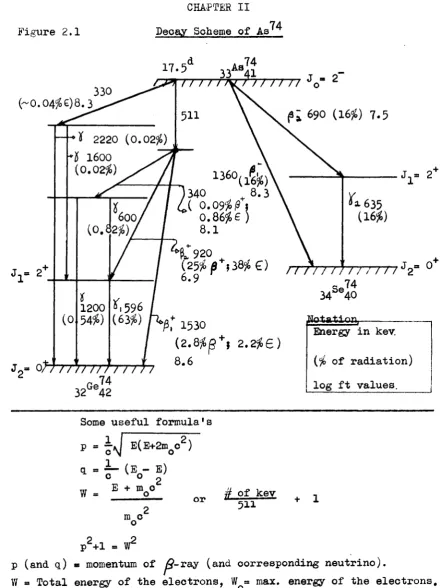
Figure 2.1 Decay Scheme of As74
TTTTT/SU7TT7T7
Jo(~0.043&e)8.3
«
2220
(
0
.
02
$)
5 1600
(0.02J6)
600
(O.8236
)(2.8$£+j 2.2$£)
8.6
7777777
(s;
690
(1636
)7.5
^1635
(1636)
J^- 2
0
Se74 34 40
flotation.
32Ge42
Energy in kev.
($ of radiation)
log ft values.
Some useful formula's
p = E(E+2moc2 )
q » — (E - E)
W = E + m o°
or # of..Jag +
1
511 A
p2+l
m c o
w2
p (and q) ■ momentum of
fZ-vatf
(and corresponding neutrino).W = Total energy of the electrons, Wq= max. energy of the electrons.
As74 E X P E R I M E N T
1. Apparatus
The angular correlation spectrometer used consisted of a
magnetic lens and two gamma spectrometers which could be rotated
with respect to the lens. The two gamma spectrometers were mounted
on the same arm with axis 90° apart. They were moved together using
the automatic scanning device (YOUNG.
64
) one over the range90°
-l
80
°, the other over the range 180° - 270°. Spiral baffles wereused to separate the electrons from the positrons. (GERHOLM.) This
equipment has been described by COLCLOUGH. 63 and also by YOUNG.
64
.In the present version the second gamma speotrometer was added to
the equipment described by YOUNG.
64
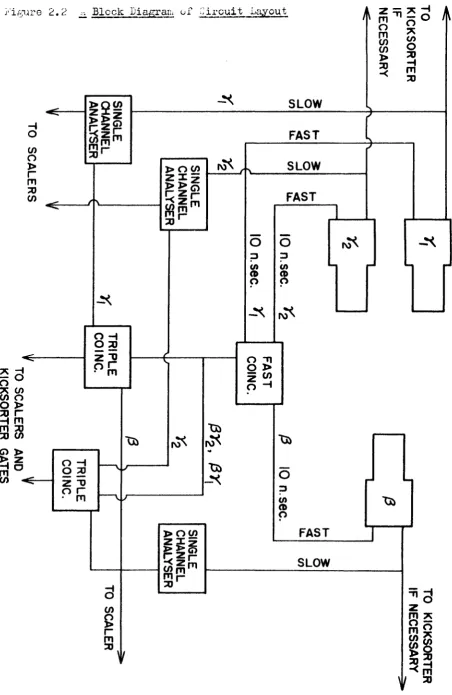
.A block diagram of the electronic counting circuit is
shown in figure 2.2 and differs from the one previously described
in that a "two fold" fast coincidence circuit has been added. This
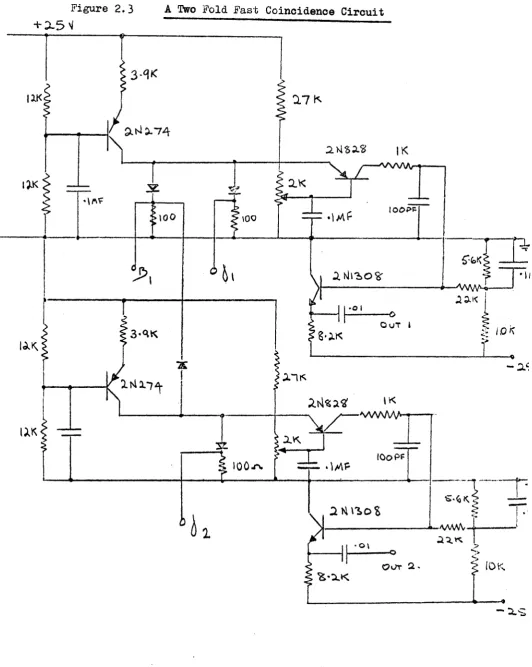
circuit is shown in figure 2.3. Short pulses ^ 1 0 n secs are
produced by the
404
A limiters figure 2.2 and appear at the inputs^ and
^ 2
as labelled in figure 2.3. Coincidences betweeninputs
f3
and ]f^,andj3
and produce output pulses. Coincidences between and ^ produce no output. These output pulses are thenapplied to the slow triple coincidence circuits, the output of which
go to the scalars. The system is essentially the same type as
described by BELL. GRAHAM. PETCH. 52, except, that the short pulses
are produced directly at the anodes of the
404
A limiters and that inthe rest of the circuits transistors are used instead of vacuum tubes.
When the T.M.C. kicksorter was used to observe the gamma
spectrum in coincidence with the betas, the fast coincidence pulses
figure 2 . 2 Block Diagram of Circuit Layout m
o
m
co
co > -<SLOW
FAST
SLOW
FAST
CO
o
> O CO
FAST
Figure 2.3 A Two Fold Fast Coincidence Circuit
+ 2-5
'iI IK
>00
Ou t >
32.
23
circuit, the beta pulses were applied to the third and the output
was used to gate the kicksorter.
To obtain the chance rate, the fast beta pulses were
delayed by ^ l O O n secs and the coincidence rates observed.
2. Source Preparation
A s ^ as sodium arsenate solution was obtained from "The
Radiation Biological Laboratories " Amersham, England. The specific
activity was greater than 120 mc/ml. A few drops of the solution
was evaporated to dryness in a tungsten boat using a heat lamp.
The boat was placed in a Balzer vacuum ooating unit. A substrate
of A1 of about 0.001 inches thickness was used and was placed
directly over the tungsten boat. A mask with a hole of 5®® in
diameter was placed against the substrate. The temperature of the
tungsten boat was raised slowly and the sodium arsenate evaporated
and condensed on the aluminum substrate.
3. Preliminary Adjustments
(i) Centering of the Source
The source was placed on the axis of the spectrometer
using the following method. A cylinder which fits snugly in the
vacuum chamber, and which has a small hole along its axis was placed
in the spectrometer. This hole was then on the axis of the instru
ment. The source was then observed through this hole and adjusted
until it was centrally located.
(ii) Centering of the X Probe
The center of rotation of the gamma spectrometers were
adjusted to obtain equal count rates at the
90
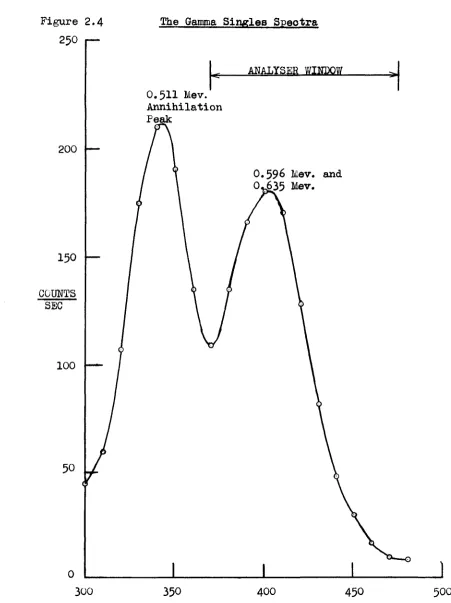
° and 180° positionsFigure 2.4 The Gamma Singles Spectra
250
ANALYSER WITOOW
0.511 Mev. Annihilation Peak
200
0.596 Mev. and OJS35 Mev.
150
COUNTS SEC
100
0
300
350400
450500
probe. The composite peak at 600 kev, see figure 2.4, was used.
The count rates were obtained equal to ~ 1 $ .
4. Experimental Procedures
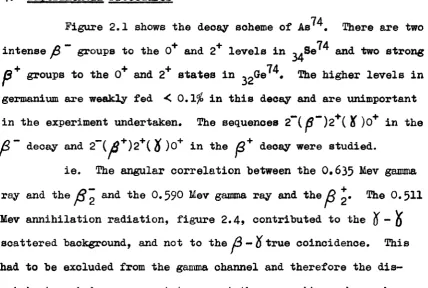
Figure 2.1 shows the decay soheme of A s ^ . There are two
intense
j&~
groups to the 0 and 2 levels in ^ S e and two strongp +
groups to the 0+ and 2+ states in ^ G e ^ . The higher levels ingermanium are weakly fed < 0.1$ in this decay and are unimportant
in the experiment undertaken. The sequences 2~(
f3
”)2+ ( X ) 0 + in the~ decay and 2~(^tf+ )2+ (ft )0+ in the jg+ deoay were studied.
ie. The angular correlation between the 0.635 Mev gamma
ray and the ^ and the 0.590 Mev gamma ray and
the ^
*. The 0.511Mev annihilation radiation, figure 2.4, contributed to the
X ~ %
scattered background, and not to the true coincidence. This
had to be excluded from the gamma channel and therefore the dis
criminator windows were set to accept the composite peak as shown
in figure 2.4*
The equipment was set to record the gamma 1 singles, the
gamma 2 singles, the betas, the doubles, and the triple coincidences
due to ( y # ^ ) and (y£? <*a'fca was printed out and the
positions of the gamma spectrometers changed automatically every
twenty minutes. The equipment was interrupted every 12 hours and
the discriminator reset if necessary.
At the beginning and end of each such sequence, the chanoe
rate and the soattered ( $ ) background rate were recorded. To
obtain the
(X
- X
) background, the baffles in the beta spectrometerwere closed and the coincidence rate recorded. The procedure was
repeated until more than
50
»0°0
coincidences were recorded. Theenergy in the beta channel was then ohanged and the procedure
repeated.
5. Treatment of the Data
Since the anisotropy measured is very small it is impor
tant to eliminate the effect of drifts in the gamma channel. This
is accomplished in two ways.
1/ The position of the counters were changed every twenty
minutes, which is an interval small enough for the drift to be
negligble.
2/ The magnitude of the drifts throughout a sequence was deter
mined and the data rejected when necessay.
The following procedure was followed. The gamma spectrum
in coincidence with the betas was determined^figure 2.5 and figure
2.6. The count rate in the gamma channel as a function of the lower
discriminator setting was determined, using the window used in the
experiment, figure 2.7* From this graph, if the count rate in the
gamma channel is known, the spectrum shift could be read off
directly. The gamma channel rates in the experimental runs were
plotted as a function of time* M 0 H B M H I The straight solid line
passes through the 1st point and has the slope corresponding to the
half-life of A s ^ (l7»5 days). Deviation from this line indicated
drifts in the gamma channel. From the percentage deviation, the
shift of the spectrum was obtained using the graph in figure 2.8.
From the gamma spectra, figure 2.7, the corrections to the data
were obtained.
However, when the data deviated by as much as - 2
%
fromFigure 2,5 The Gamma 1 Spectra in Coinaidence with the Betas
ANALYSER WINDOW
600
COINCIDENCE
r a
PEAKCOUNTS 12 hr
400
SCATTERING PEAK
200
^n-90'
COINCIDENCE ■fa PEAK
600
COUNTS 12 hr
400
200
SCATTERING PEAK
60
Figure 2.6 The Gamma 2 Spectra in coincidence with the Betas
-270° and l8o'
600
ANALYSER WINDOW500
COINCIDENCE PEAK
400
COUNTS 12 hr
300
no scattering peak due to
511
kev anihilation radiation200
100
0
50 55
40 45
Figure 2.7 $ change of # of peak counts,D, in gamma channel
versus change in Lower Discriminator
+15
change of N
+10
+5
+1
+2
%
change inLower Discriminator -1
-10
Figure 2.8 $ change in coincidence count in same channel
versus
$
change of Lower DiscriminatorT +15
+10
change in coincidence counts
^ +1 +2
Jfe change in
Lower Discriminator
- 2
-10
gave the same values. It was therfore deoided to accept data
points which deviated -
1%
and not apply any correction for drifts. If the peak shifts when the gamma probe is changed from90
° position to l80
°, the peak shift must be measured and thecoincidence counts must be corrected for this peak shift. The
percentage difference in position between the two peaks is deter
mined, then the coincidence count for the higher peak must be
reduced by a certain amount determined from figure
2
.8
.TABLE III
Asymmetry, A
2
Coefficient and Solid AngleCorrections for Hegatrons
Energy Asymmetry, a(w) a
2
Correoted CorrectedBaffles Baffles Baffles Baffles for for
Y+fi
W
6
Turns 7 Turns6
Turns 7 Turns Solid SolidOpen Open Open Open Angle Angle
1.6
0.0071 0.0147 0.00470.0098
0.01170.012
-
0.005
1.8
-O.O488
-0.0387 -0.0331 -0.0261
-0.0439 -O.O45
± 0.006
2.0
-0.0477 -0.0323 -0.0433 -0.044i
0.006
p To correct for
j3
spectrometer solid angle divide A^ by_2
Po
P 2
for Baffles 6 turns open » 0.7612 - 0,003 o
P2
for Baffles 7 turns open •p— * 0.7453 - 0.003
To correct for $ spectrometer solid angle divide A
2
by 0.973TABLE IV
Asymmetry, Ag Coefficient and Solid Angle
Corrections for Positrons
Energy Asymmetry
a(w)
A2
Corrected
For
jB
Solid
Angle
Corrected
For
X+P
Solid
Angle
Ag (Corrected)
Average
For Both
Counters
(a)
y
1.8
2.0
2.1
2.2
^ Probe 0.01470.0256
0.0349 0.0243 0.009750.01692
0.022990.01606
0.01322
0.022950.03118
0.02178
0.01360
0.02358 0.032310.02238
(b)
X
1.8
2.0
2.1
2.2
2
Probe0.0181
0.0151
0.0288
0.0306
0.011990.01001
0.01901
0.02019
0.01626
0.01357 0.02578 0.027380.01680
0.01406
0.02671 0.028370.015
“0.006
0.019 - 0.004
0.030
t
0.005
0.025
“0.005
To correct for
f3
spectrometer solid angle divide Ag by pfor baffles 7 turns open * 0.7372 -
0.008
oTo correct for
%
spectrometer solid angle divide Ag by(for 10 cm away and l
^ 11
x 2** Hal crystal)*^ 0.973 — 0.003Corrections for Chance and Scattering
P 0 S I T B 0 N 3
Energy A ? Coinc Counts : Chance Counts< Coinc Counts : Scattering Counts ^
W
*2
^ - 9 0 ° ^ - 1 8 0 ° #2-270° ^ - 1 8 0 ° X ^ O 0 &J-1800X 2-210°
^ - 1 8 0 °1.8 0.0136 0.0168 -.0
80:1
:0 :0 80:1 80:180:1
80:1-
0.004-
0.004
2.0 0.0236 0.0141 160:1 160:1 160:1 160:1 100:1
70:1
90:1
30:1-
0.0028
-
0.00282.1 0.0323 0.0267 :0 :0 :0 :0
70:1
70:1
87:1 77:1i
0.0033
-
0.00332.2 0.0224
0.0284
260:1150:1
580:1170:1
100:1 100:1 100:1 100:1-
0.0031
-
0.0031H e
a
A T B 0 N S1.6 0.0120 6:1 6:1 Corrected for Scattering in Analysis
-
0.005
1.8 -0.0451 3:1 3:1 3:1 3:1
- 0.006
2.0 -0.0445 3:1 3:1 2:1 2:1
-
0.006TABLE VI
P O S I T R O N S
Table of Coinoidenoes to Get a(w)
Energy
(w)
Seq # Probe Coinc 90° Coinc180
° Normalizing Faotor 90°180
° 90°/l80° Normalizing Factor2.0
44 9417 9455 1.0374
1.0232
0.986346
8833 8976 1.0275 0.9951 O.9684
47 4693 4841
1.0100
0.9801
0.9703C
M
12034 12029 1.0227
1.0125
0.9900
45 12845
12872
1.0246
1.0077 0.983646
1143811301
1.0121
0.9975 O.9856
47
6316
6378 1.0133 0.99430,9812
2.1
* 1
49 5984
6074
1.02910.9890
O.96
IO50 5906 5965 1.0207
0.9850
O.965
O52
V
1195
1162
1.0361
1.03641.0002
c>2
48 7492 7650 1.0157 0.9872 0.9719
49
6815
6 8 8 8 I.OI84
0.9934 0.975450 6911 6967
1.0221
0.9919 0.970451
5611
57001.0211
0.9909 0.97042.2
^ 1
53 3871 3817
1.0298
1.0510
1.0205
54
4010
40991.0270
0.9559 0.930655
3060
3227 I.O588
0.9766
0.922356
2753 2752 1.0470 1.06251.0148
57 3173 3129
1.0502
1.0879 1.035858
y
3769 3981 1.0597 0.9894 0.9336
0
2
54 55 56 57 58 4416 3918 2940 3381 4175 4499
4018
2945 3469 4264 1.0173 I.0246
1.0321 I.OO98
0.9944 O.9894
O.9949
0.9993 0.9737 0.9791 0.9725O.
97
IO0.9682
O
.9642
O.9846
1.8
h
59 2429
2460
1.04451.0116
O.9685
60
22542281
1.0334 1.0103 0.977662
1573 1607 1.0542 1.0000 0.948564
Y
1319 1238 1.0717
1.0784
1.0062
6
2
60
2801
2795 1.02351.0071
0.983961
2363 2447 1.0231 0.9736 0.951663 2104
2150
1.0021
0.9688
0.9667
64 1340 1319
0.9900
1.0060
1.0161... .
The ratio ^ — corrected for difference in position of
o l80° o peak between
90
and180
.coinc
90
° and coinc l80
° are corrected for chance andscattering.
However, in TABLE VII, coinc 90° and coinc 180° are corrected for
TABLE VII
N E G A T R O N S
Table of Coincedences to Get a(w)
Energy (w) Seq # Coinc 90° Coino 180° Normalizing Factor 180? "90° .... ~
180° „ Norm.
90
f a c t o r1.6 1 5152 4945 0.9598
3 7588 7492 0.9873
'1
.0147
4 8394 8261 O.
984
I5
6655
6685
1.0045j
6 3813 3685 O
.9664
[
1.00718 3007 2991
1.0288
0.9947 J1.8 12 3630 3376 1.0310 0.9300 O
.9588
13 3656 3347 1.0380 0.9155 0.9503
14 2971 2711 1.0330 0.9125 0.9426
15 5417 4995 1.0320
0.9221
O.9516
16 2254 2172 1.0392 0.9636 1.0014
17 1877 1729 1.0318
0.9212
0.950518 2000 1859 1.0296 0.9295 0.9570
20 723 694 1.0347 0.9599 0.9932
21
828
681 1.03220.8225
0.8490
22 3747 3477 1.0257 0.9279 0.9518
23 1666 1591 1.0309 0.9550 0.9845
2.0 30 2504 2222 1.0353
0.8874
0.9187
31 3892 3608 1.0338
0.9270
0.9583
32
3028
2846
1.0318 0.93990.9697
33 3327 3081 1.0374 0.9261
0.9607
34 2515 2334 1.0360 0.9280
0.9614
35
1142
IO46
1.0323 0.91590.9454
37 2577 2499 1.0445 0.9697
1.0129
38 1753 1661 1.0290 0.9475
0.9750
39 205 181 1.0142 0.8829
0.8954
411, 754
685
1.01430.9085
0.9215
*2 995 994 1.0361 0.9487
0.9829
CHAPTER III
Interpretation of Results and Conclusions
1. The Shell Model
Prom TABLE VIII of the Shell model and from Nuclear data
*7 A
on As (Ref. Fig. 2.1) the reaction that takes place seems to he
of two definite forms.
(i) As*^ A t t =
-1
x>- S e ^ + PUJ
33 41~
^
P
+ 34 4°
*7 A
As has 33 protons and 41 neutrons; the last odd proton
is in the If,- state and the last odd neutron is in the
1st
state.1
1
2 2
An electron (|@ ) is given off by A s ^ to produce Se^^ which has
34 protons and 40 neutrons. When the electron is given off (from
eqn l.l), one neutron disappears and is replaced by a proton. The
extra proton also goes into the If” state and combines with the
1
2other proton already there to form an even-even nucleus or a
STABLE ELEMENT.
i ■
• \ . 74 A T T = -1 + „74
( n ) 33 41 — '> f
3
+ 32 e42a
positron
(j£+)
is given off by A s ^ to produoe G e ^ , which has32
protons and 42 neutrons. In the neucleus one proton disappears andis replaced by a neutron^from the eqn
1
.2
^. The extra neutron goesinto the lg^ state and combines with the neutron that was already
2
there and thus an even-even (STABLE) nucleus is formed. In this
model a nucleon is transformed from a If” to a lg* state when ^
0
Ge|^2
.2
. At 422 2