Scholarship at UWindsor
Scholarship at UWindsor
Electronic Theses and Dissertations Theses, Dissertations, and Major Papers
1-1-1963
A 0-60 ampere current supply and the beta-gamma angular
A 0-60 ampere current supply and the beta-gamma angular
correlation of arsenic-74.
correlation of arsenic-74.
John Delbert ColcloughUniversity of Windsor
Follow this and additional works at: https://scholar.uwindsor.ca/etd
Recommended Citation Recommended Citation
Colclough, John Delbert, "A 0-60 ampere current supply and the beta-gamma angular correlation of arsenic-74." (1963). Electronic Theses and Dissertations. 6327.
https://scholar.uwindsor.ca/etd/6327
This online database contains the full-text of PhD dissertations and Masters’ theses of University of Windsor students from 1954 forward. These documents are made available for personal study and research purposes only, in accordance with the Canadian Copyright Act and the Creative Commons license—CC BY-NC-ND (Attribution, Non-Commercial, No Derivative Works). Under this license, works must always be attributed to the copyright holder (original author), cannot be used for any commercial purposes, and may not be altered. Any other use would require the permission of the copyright holder. Students may inquire about withdrawing their dissertation and/or thesis from this database. For additional inquiries, please contact the repository administrator via email
A 0 - 6 0 AMPERE CURRENT SUPPLY
AND THE p - X ANGULAR CORRELATION
OF As
74
BY
JOHN DELBERT COLCLOUGH
A T h e s i s
S u b m i t t e d t o t h e F a c u l t y o f G r a d u a t e S t u d i e s t h r o u g h t h e D e p a r tm e n t o f P h y s i c s i n P a r t i a l F u l f i l l m e n t
o f t h e R e q u i r e m e n t s f o r t h e D e g re e o f M a s t e r o f S c i e n c e a t
A s s u m p tio n U n i v e r s i t y o f W in d so r
W in d s o r , O n t a r i o
1963
INFORMATION TO USERS
The quality of this reproduction is dependent upon the quality of the copy submitted. Broken or indistinct print, colored or poor quality illustrations and photographs, print bleed-through, substandard margins, and improper alignment can adversely affect reproduction.
In the unlikely event that the author did not send a complete manuscript and there are missing pages, these will be noted. Also, if unauthorized copyright material had to be removed, a note will indicate the deletion.
®
UMI
UMI Microform EC52506 Copyright 2008 by ProQuest LLC.
All rights reserved. This microform edition is protected against unauthorized copying under Title 17, United States Code.
ProQuest LLC 789 E. Eisenhower Parkway
PO Box 1346 Ann Arbor, Ml 48106-1346
APPROVED:
E. E. H a b ib
F . H o l u ju j
K - . £ : x % $ k S ~ .
R. J . T h i b e r t
7 f > '
ABSTRACT
A 0 - 6 0 amp. c u r r e n t s u p p l y i s d e s c r i b e d . The r a t i o o f t h e
o u t p u t r m s . r i p p l e c u r r e n t t o t h e d c . o u t p u t c u r r e n t i s o f t h e o r d e r o f
10" L. The o u t p u t c u r r e n t d o e s n o t d r i f t f o r a l l p r a c t i c a l p u r p o s e s and
c h a n g e s l e s s t h a n
0
.01
% when e i t h e r t h e l i n e v o l t a g e c h a n g e s by1
.0
% o rt h e room t e m p e r a t u r e c h a n g e s by 10 C°. A " f a s t - s l o w " B e l l , Graham and
P e t c h c o i n c i d e n c e c i r c u i t i s d e s c r i b e d and c i r c u i t d i a g r a m s a r e g i v e n
f o r t h e t r a n s i s t o r i z e d " f a s t " u n i t . T h i s e q u ip m e n t was u s e d i n c o n
j u n c t i o n w i t h t h e G erholm c o i n c i d e n c e s p e c t r o m e t e r t o s t u d y t h e
a n g u l a r c o r r e l a t i o n b e tw e e n t h e 0 . 9 3 mev. p o s i t r o n g r o u p and t h e s u b s e q u e n t
600 k e v . gamma r a y o f t h e d e c a y A s ^ ---= t»G e^. The m e a s u r e d ^
c o e f f i c i e n t s a t e n e r g i e s o f W = 1 . 8 , 2 . 0 , 2 . 2 , 2 . 4 and 2 . 6 ( r e l a t i v i s t i c
u n i t s ) a r e :
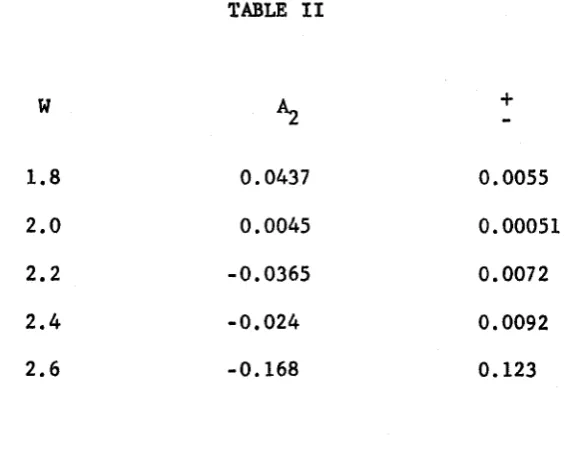
w A
1 . 8 0 . 0 4 3 7 0 . 0 0 5 5
2 . 0 0 . 0 0 4 5 0 . 0 0 0 5 1
2 . 2 - 0 . 0 3 6 5 0 . 0 0 7 2
2 . 4 - 0 . 0 2 4 0 . 0 0 9 2
2 . 6 - 0 . 1 6 8 0 . 1 2 3
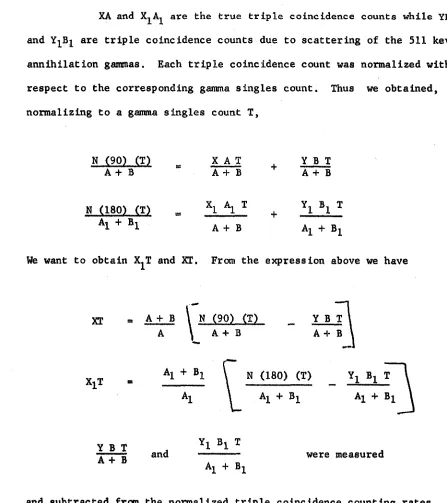
C o r r e c t i o n s w e r e made f o r s c a t t e r i n g o f t h e 511 k e v . a n n i h i l a t i o n gammas
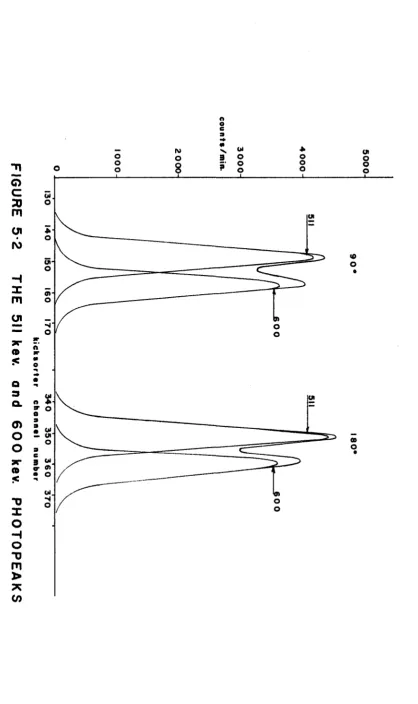
a n d f o r t h e c h a n g e i n t h e 511 p e a k h e i g h t w i t h r e s p e c t t o t h e 600 k e v .
p e a k h e i g h t when t h e s c i n t i l l a t i o n s p e c t r o m e t e r was r o t a t e d . The s m a l l
a n i s o t r o p y i n d i c a t e s t h a t t h e r e i s no s t r o n g K o f j s e l e c t i o n r u l e t o
r e d u c e t h e c o n t r i b u t i o n f o r m a t r i x e l e m e n t s o t h e r t h a n B i j .
l i
ACKNOWLEDGEMENTS
I would lik e to express my appreciation to Dr. E.E. Habib
for h is guidance and in stru ctio n throughout th is work.
My thanks goes to Mr. W. Grewe for the part he played in
the construction of the current supply.
The a ssista n c e o f Mr. R.H. Young
in preparing the source and recording the data is a lso acknowledged.
I
would lik e to thank Miss Lee Latter for typing the manuscript.
1 am
indebted to the National Research Council for fin a n c ia l support in the
form of a bursary.
ABSTRACT
i i
ACKNOWLEDGEMENTS
i i i
CHAPTER I BETA RAY SPECTROMETERS
i)
Introduction
i
i i )
General P roperties of Magnetic Spectrometers
2
i i i )
Ring Focus and B a ffle s
3
iv )
Response of a Spectrometer to a Monoergic Beam
4
v)
Response of a Spectrometer to a Continuous D istrib u tio n
6
v i)
Lens Spectrometers
6
v i i )
The Gerholm Instrument
9
CHAPTER II
^ ANGULAR CORRELATIONS
i )
Introduction
13
i i )
S e le c tio n Rule E ffect
15
i i i )
R elations Between X and Y under the m odified B ij
20
Approximation
\ / / c\
iv )
C alculation of
( ^
)
x23
CHAPTER I I I THE CURRENT SUPPLIES
i)
Introduction
25
i i )
The Reference Supplies
25
i i i )
The Fast Feedback System
30
iv )
The Servo System
30
v)
The Drive Mechanism
32
v i)
The Local Power Supplies
33
v i i )
Construction of the Current Supply
35
v i i i )
T ests on the Current Supply
36
CHAPTER IV THE COINCIDENCE METHOD
i)
Introduction
40
i i )
e-
Coincidences
40
i i i )
e -e Coincidences
42
iv )
Coincidences
46
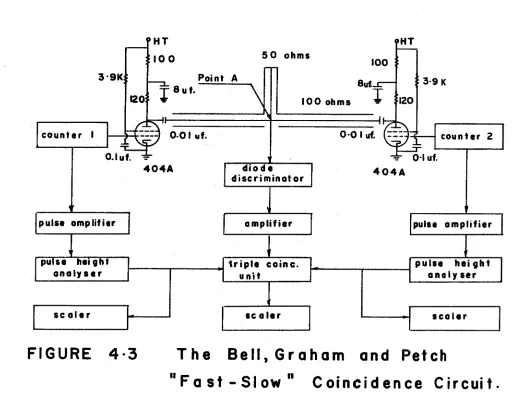
v ) D e s c r i p t i o n o f o u r F a s t C o i n c i d e n c e C i r c u i t
46
v i)
Adjustment of the "Fast-Slow" Coincidence C ircu it
47
CHAPTER V THE As74 EXPERIMENT
i )
Introduction
49
i i )
Procedure
49
iv
I l l )
I n te r p r e t a t i o n o f R e su lts
52
CONCLUSION
55
BIBLIOGRAPHY
57
v
TABLE NO.
PAGE NO.
I
F i r s t Forbidden M atrix Elements
18
I I
The A
2C o e f f ic ie n ts
54
v i
L I S T OF ILLUSTRATIONS
l . l
A Response Curve
3
1.2
Lens Spectrom eter B a ffle s
4
1.3
Short Lens F ie ld Form
9
1.4a
Angular C o rre la tio n Spectrom eter
11
1.4b
E le c tro n -E le c tro n Spectrom eter
11
1.5
F ie ld Form of th e Gerholm Spectrom eter
12
2.1
2 " ( ^ ) 2 + ( ^ ) O f Decay Scheme
21
3.1
Block Diagram of Power Supply
26
3.2
R eference S upplies
27
3.3
Power B ooster
28
3 .4
Servo 8ystam
31
3.5
Schematic of Scanning Mechanism
33
3 .6
Local Power S upplies
34
3.7
n Ganged Zener Diodes
29
3.8
Thorium Lines
37
3.9
Log
v s. D ial
38
4.1
Simple Decay Scheme
40
4 .2
Complex Decay Scheme
41
4.3
B e ll, Graham and P atch "Fast-Slow " Coincidence C ir c u it
43
4 .4
The F a st C irc u it
44
4.5
Prompt Coincidence Curve
45
4.6
Diode Bias Curve
48
5.1
Decay Scheme of A s ^
50
5.2
The 511 kev. and 600 kev, Photopeake
51
v i i
BETA RAY SPECTROMETERS
(1) In tro d u c tio n
Magnetic beta ray spectrometers are used e x te n siv e ly to
analyse complex nuclear sp ectra .
They may be c la s s i f i e d in to two basic
ty p es, the f l a t and the h e lic a l spectrom eter.
In the f l a t type the
magnetic lin e s of force are mainly in the d ir e c tio n perpendicular to
the e lectro n paths whereas in the h e lic a l instrument the lin e s of force
are mainly in the same d ir e c tio n as the e lectro n paths.
t h is type.
One wishes to have a maximum lum inosity (source area x
transm ission) w hile at the same time achieve a maximum energy
r e so lu tio n .
These are, however, m utually c o n flic tin g requirements.
Increasing the lum inosity u su a lly r e s u lts in a decrease of the
r e so lu tio n and v ic e versa.
Problems a lso a r ise regarding d etector
V
d esig n , f ie ld shapes and power requirements.
O rig in a lly the f l a t spectrometers focussed electro n s only
in one plane w hile the len s spectrom eters were space fo cu ssin g .
Today,
however, nearly a l l f l a t types being used are space fo cu ssin g .
This is
^
is the d istan ce to the a x is of symmetry.
This f l a t spectrometer
is easy to construct and to adjust to a high r e so lu tio n .
The
trans-There a re many problems involved w ith sp ectro m eters of
achieved by shaping the transverse f i e l d to vary as
where
m ission can be made high (
) and the source and d etecto r
problems are easy to s o lv e .
1
2
( i i ) G e n e r a l P r o p e r t i e s o f M a g n e t i c S p e c t r o m e t e r s
The e q u a t i o n o f m o t i o n o f an e l e c t r o n m oving i n a p l a n e
p e r p e n d i c u l a r t o a u n i f o r m m a g n e t i c f i e l d i s g i v e n b y :
w h e r e
=r r e s t m ass o f t h e e l e c t r o n
\ / .= v e l o c i t y o f t h e e l e c t r o n
^ 22. r a d i u s o f e l e c t r o n o r b i t
The momentum c a n be e x p r e s s e d , u s i n g ( 1 ) , a s :
I p = j w \ \J “
^
C
^
I t i s t h e r e f o r e c o n v e n i e n t i n e x p e r i m e n t a l w o rk t o e x p r e s s
t h e momentum i n t e r m s o f i t s f t ^ ( g a u s s - c m . ) v a l u e . The
c o r r e s p o n d i n g e n e r g i e s c a n be c a l c u l a t e d d i r e c t l y o r o b t a i n e d fro m
t a b l e s . The r e l a t i o n ( 2 ) i n d i c a t e s t h a t i n t h e f l a t s p e c t r o m e t e r ,
w h e r e ^ i s c o n s t a n t f o r a l l e n e r g i e s a n d t h e f i e l d u n i f o r m ,
t h e r e i s a l i n e a r r e l a t i o n s h i p b e tw e e n t h e momentum f o c u s s e d a n d t h e
a n a l y s i n g f i e l d . A l t h o u g h m o s t o t h e r s p e c t r o m e t e r s do n o t h a v e c o n s t a n t
f i e l d s o v e r t h e e n t i r e t r a j e c t o r y , t h e y d o , h o w e v e r , u n d e r t h e
c o n d i t i o n s o f f i x e d s o u r c e , d e t e c t o r a n d b a f f l e p o s i t i o n s , e x h i b i t a
l i n e a r r e l a t i o n s h i p b e tw e e n t h e f i e l d a t a n y one p o i n t a n d t h e
momentum of the electro n s focussed.
This is a lso co n d itio n a l upon the
shape of the f i e l d remaining the same as the f ie ld B v a r ie s.
The transm ission
i*)
of a spectrometer is defined as the
fr a c tio n of the electro n s of momentum
p
em itted from the source
which arrive at the d etecto r when the instrument is focussed on
.
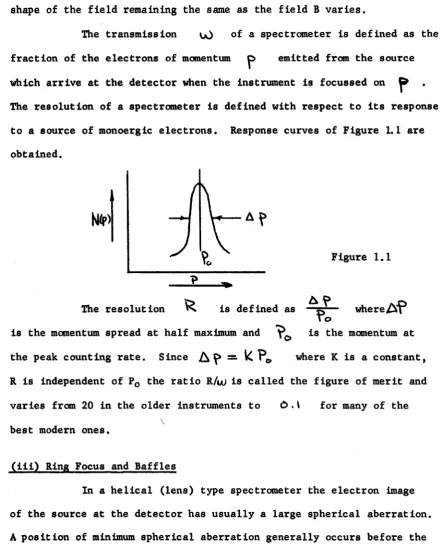
The r e so lu tio n of a spectrometer is defined with resp ect to i t s response
to a source of monoergic e le c tr o n s .
Response curves of Figure 1.1 are
obtained.
Figure 1.1
where A p
The r e so lu tio n
^
is defined as
is the momentum spread at h a lf maximum and
'\>0is the momentum at
the peak counting r a te .
Since A ^
^ P®
where K is a con stan t,
R is independent of PD the r a tio R/u) is c a lle d the figu re of m erit and
va ries from 20 in the older instruments to
O. I
for many of the
v
b est modern ones.
( i i i ) Ring Focus and B a ffle s
In a h e lic a l (le n s ) type spectrometer the e le c tr o n image
o f the source at the d etecto r has u su a lly a large sph erical aberration.
A p o sitio n of minimum sp h erica l aberration g en erally occurs before the
electro n s cross the symmetry a x is .
This is c a lle d the ring focus and
a great improvement in performance is obtained by p lacing d efin in g
b a ffle s at t h is point rather than at the d e te c to r .
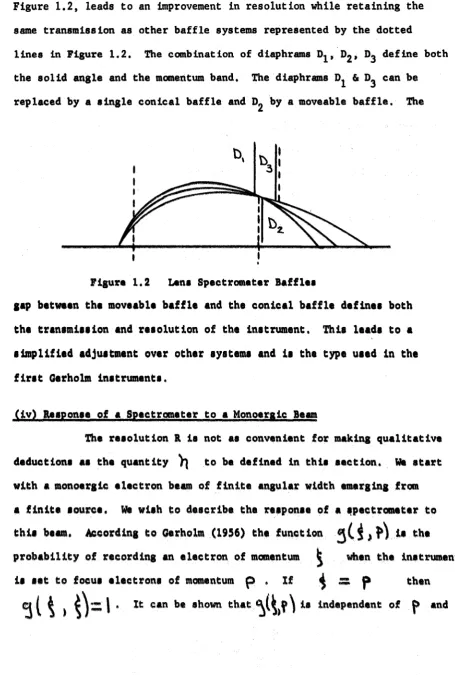
Hubert(1952) has
4
shown the combination of b a f f le s , as shown by the s o lid lin e s of
Figure 1 .2 , leads to an improvement in r e so lu tio n while r eta in in g the
same transm ission as other b a ffle systems represented by the dotted
lin e s in Figure 1 .2 .
The combination of diaphrams
, D
2,
d efin e both
the s o lid angle and the momentum band.
The diaphrams
can be
replaced by a s in g le co n ica l b a ffle and Dg by a moveable b a f f le .
The
gap between th e moveable b a f f le and th e c o n ic a l b a f f le d e fin e s both
th e tra n sm issio n and r e s o lu tio n of th e in stru m en t.
This lead s to a
s im p lifie d adjustm ent over o th e r systems and is th e type used in the
f i r s t Gerholm in stru m e n ts .
(iv ) Response of a Spectrometer to a Monoeraic Beam
d eductions as th e q u a n tity
)r\
to be d e fin e d in t h i s s e c tio n .
We s t a r t
w ith a monoergic e le c tr o n beam of f i n i t e an g u lar w idth emerging from
a f i n i t e s o u rc e .
We wish to d e s c rib e th e response of a sp e c tro m e te r to
F igure 1.2
Lens S pectrom eter B a ffle s
The r e s o lu tio n
R i s not
as convenient fo r making q u a l i t a t i v e
t h i s beam.
According to Gerholm (1956) th e fu n c tio n
^ ( , jji * ^ Y is
p r o b a b ility of rec o rd in g an e le c tr o n of momentum
^
when th e instrum ent
is s e t to focus e le c tr o n s of momentum p .
I f
^
5p
then
It can
be
shown th at
is independent
o f
and
P
W elting
jm
we have:
V = , u .
P
o o
f l C t . r W = =
d - I
This d e fin e s
which Is c o n s ta n t f o r a given sp ectro m eter depending
only on th e so u rc e , d e te c to r and b a f f l e geometry.
I f
is th e i n t e n s i t y o f th e monoergic source o f mean momentum
^ th en th e co u n tin g r a t e
a t a momentum s e t t i n g o f ^
w i l l
• » V I C p ) =
The peak co u n tin g r a t e is
^
‘
I f a p ^o t i s mac*e °*
V)(P) VS.
P
th e a re a under th e peak i s ;
-= w a *
Now
van ish es U nless p ^
and th u s th e e f f e c tiv e
range of in te g r a tio n is sm a ll. T h erefo re
p
remains roughly c o n sta n t
and may be moved o u tsid e th e in te g r a l s ig n .
T h e re fo re
:-oo
W I
Area under
peak
p
Thus:
s
Area under peak
Peak cou n tin g r a t e
In sp e c tro m e ters where th e peak p r o f i l e is sym m etric, Y\ w i l l be very
n e a rly equal to th e r e s o lu tio n ^ .
This c o n d itio n i s s a t i s f i e d fo r
th e Gerholm Instrum ent u sin g th e Hubert b a f f l e system .
( v ) R e s p o n s e o f a S p e c t r o m e t e r t o a C o n t i n u o u s D i s t r i b u t i o n
6
F o r a beam o f e l e c t r o n s o f c o n t i n u o u s d i s t r i b u t i o n we
i n t r o d u c e a s h a p e f a c t o r w h ic h i s t h e p r o b a b i l i t y p e r
e l e c t r o n , t h a t t h e momentum w i l l l i e i n a u n i t i n t e r v a l o f momentum
a b o u t ^
W ith t h e s p e c t r o m e t e r f o c u s s e d a t t h e c o u n t i n g r a t e
60
i s
\
mHi)
M
i>
S i n c e 4 ( ^ v a r i e s s l o w l y w i t h r e s p e c t t o J ^
p u t < H
0
* 4 I p ) = c o n s t a n t o v e r t h e r a n g e o f i n t e g r a t i o n . weThen t h e c o u n t i n g r a t e becomes r. 60
6
P l o t t i n g v s t h e a r e a u n d e r t h e c u r v e i s
T h e s e f o r m u l a s w i l l e n a b l e u s t o make q u a n t i t a t i v e a n a l y s i s on t h e
o b s e r v e d s p e c t r a .
( v i ) Lens S p e c t r o m e t e r s
I t i s e a s i l y s e e n t h a t a n e l e c t r o n m oving i n a u n i f o r m
m a g n e t i c f i e l d p e r p e n d i c u l a r t o i t w i l l d e s c r i b e a c i r c u l a r o r b i t . I f
i t a l s o h a s a v e l o c i t y com p o n e n t i n t h e d i r e c t i o n o f t h e f i e l d , t h e n
i t w i l l d e s c r i b e a h e l i c a l p a t h . Such i s t h e s i t u a t i o n i n a l o n g l e n s
s p e c t r o m e t e r . The e l e c t r o n r o t a t e s t h r o u g h a n a n g l e o f 3 6 0 ° b e f o r e
r e t u r n i n g t o t h e sym m etry a x i s w h e re t h e d e t e c t o r i s p l a c e d . T h i s i s
t h e s i m p l e s t s i t u a t i o n t o v i s u a l i z e a s f a r a s l e n s s p e c t r o m e t e r s a r e
c o n c e r n e d . The e q u a t i o n s o f m o t i o n s f o r a hom ogeneous f i e l d a r e
a c c o r d i n g t o S i e g b a h n ( 1 9 5 5 ) :
z
HUTW
The
s o lu t i o n f o r
r ( z \ is
t " z s |^ ) S U \a- b t *5 U a. §>
where
^
b *
a < A v \ j^
is th e angle of emission of the e l e c t r o n w ith r e s p e c t
t o the
5? a x i s .
When the p aths are drawn in the
t2 plan© i t is
found t h a t
the
paths i n t e r s e c t each o th er r a t h e r c l o s e ly w ith in a
c e r t a i n re g io n ,
The c o n d itio n f o r such a r in g focus is given by
A r
M W
• t i t i # 4 4 f “ 4 r t i - i ^
This leads to th e c o n d itio n
= ***“ ^ o c \
To c a l c u l a t e the r e s o lv in g power the width of th e image a t
the
r in g focus is expressed in terms of i t s
a y
v alu e .
The f i r s t
o rd e r e f f e c t is gsero
we have p laced the rin g focus a t the p o in t where
=
&
The second o rder c o n t r ib u t i o n is
A
o \ r-Z i v
*ss,
■+«
o th er te rm s ,
fcx
o c
h a l f the opening angle a t the source,
S u b s t i t u t i n g
& r s r b { & < ) $ V a a ^ I B 4 c & a V 4 ' Su a o t \
in we get
% W \
The r e s o lv in g power is
8
Since
'
»>.
t
.
A r _ 1 L M b ?
/ B « )
then
V
J
k _ ^
1
? : °S u b stitu tin g in we get
* — & * “
( 3 -4 e.o
S ^
R
The term in brackets has a broad minimum at 45 .
However,
due to p r a c tic a l con siderations such as source dimensions and c o i l s iz e
o
i t is found the optimum o v e r a ll angle of em ission is 30 .
The main
disadvantage with the long lens uniform f ie ld spectrometer is due to the
spreading of the e lectro n beam a fte r passing the b a f f le s .
This requires
a rather large d etecto r thereby introducing a high background count r a te .
An Improved design due to Siegbahn (1946) uses a fieldform which is con
cave upwards.
S la t is and Siegbahn (1949) experimented with d iffe r e n t
f i e l d gradients and found a pronounced increase in transm ission at a
ce r ta in strong f ie ld grad ien t.
In th is type the electro n rays cross
each other at the centre and gather again at the d etecto r.
This allows
a sm aller counter to be used while achieving a 3 per cent transm ission.
The short len s was developed before the long le n s.
Busch
(1927) pointed out the analogy between e le c tr o n op tics of magnetic
len ses and ordinary lig h t o p tic s .
He ca lcu la ted the fo c a l length for
•t <»
^a b o rt lenaes
(
_
*
C
J ,
T “ q I * * ) ' L 2
where
> °) *-s the f i e l d component perpendicular to the len s along
the a x is .
The f ie ld form of the short len s is drawn in Figure 1 .3 .
Typical p h y sica l dimensions would be 15 cm long and 15 cm diameter.
Resolving powers of 2 .5 per cent and transm issions of 0.5% are u su a lly
obtained.
3 o
* \ s * \ o
o
i
F i g u r e 1 . 3 S h o r t Lens F i e l d Form
( v i i ) The G erholm I n s t r u m e n t
I n t h i s i n s t r u m e n t t h e two h a l v e s ( s e e F i g u r e 1 . 4 b ) a r e
m a g n e t i c a l l y i n d e p e n d e n t o f e a c h o t h e r . T h e r e f o r e , m a g n e t i c f i e l d s
o f d i f f e r e n t s t r e n g t h s c a n be u s e d i n e a c h h a l f , t h u s p r o v i d i n g t h e
o p p o r t u n i t y t o f o c u s s i m u l t a n e o u s l y e l e c t r o n s o f two d i f f e r e n t e n e r g i e s .
The f i e l d f o r m , a s shown i n F i g u r e 1 . 5 m e a s u r e d a l o n g t h e a x i s i n c r e a s e s
r o u g h l y l i n e a r l y w i t h i n c r e a s i n g d i s t a n c e . T h e o r e t i c a l ( L i n d g r e n ) a s
w e l l a s e x p e r i m e n t a l s t u d i e s o f t h e t r i a n g u l a r f i e l d s h a p e show t h a t
i t g i v e s a f a v o u r a b l e h i g h l u m i n o s i t y ( s o u r c e a r e a x t r a n s m i s s i o n ) w h ic h
c o m p e n s a t e s f o r t h e s m a l l g e o m e t r i c a l d i m e n s i o n s o f t h e i n s t r u m e n t s . A
h i g h t r a n s m i s s i o n i s v e r y i m p o r t a n t i n c o i n c i d e n c e e x p e r i m e n t s . S o u r c e s
up t o 5 mm i n d i a m e t e r c a n be u s e d w i t h o u t s a c r i f i c e i n r e s o l u t i o n w h ic h
i s 3 p e r c e n t a t a n e f f e c t i v e s o l i d a n g l e o f 3 p e r c e n t . I f i t i s a l s o
p o s s i b l e t o c o n v e r t t h e i n s t r u m e n t i n t o an e l e c t r o n - g a m m a a n g u l a r
c o r r e l a t i o n s p e c t r o m e t e r . I n t h i s s e t ( F i g u r e 1 . 4 a ) up t h e a v e r a g e a n g l e
10
of em ission is reduced to reduce the co rrectio n factor for f i n i t e aperture
angle.
This r e s u lts in a lower transm ission.
Typical fig u res for a 5 mm
source a r e :r e so lu tio n 3 per ce n t, transm ission 1.8 per cen t.
The gamma spectrometer may be rotated between the 90° and the
270° p o s itio n s .
Adjustments are provided so that the axis of ro ta tio n
p asses through the source p o s itio n .
The gain of the p h otom u ltip lier is
a ffe c te d by the extern al magnetic f ie ld of the beta le n s.
The peak
p o sitio n of the 511 kev. a n n ih ila tio n gamma decreases 2 .5 channels (25
k ev .) on the k ick sorter when the spectrometer is rotated from the 180°
to the 90° p o sitio n .
S ‘ SOURCE C -C R Y ST A L L C - U O T C U GHT COLLECTOR P M -F H O T O M U .T n .IE R
B i-C N T « M C £ M F f l t 8 ,'E X IT B A FFLE
F i g u r e l . i i b E l e c t r o n - E l e c t r o n S p e c t r o m e t e r
270*
PH
F i g u r e 1 An g u l a r C o r r e l a t i o n S p e c t r o m e t e r
FIELD STRENGTH
ARBITRARY UNITS
500-1
aooH
300
200
100H
SOURCE
40 cm
■
iooH
F i g u r e 1 . 5 F i e l d Form o f t h e G e rh o lm I n s t r u m e n t
p - )f ANGULAR CORRELATIONS
( i ) I n t r o d u c t i o n
p - ^ a n g u l a r c o r r e l a t i o n s h a v e two m a in a r e a s o f a p p l i c a t i o n .
One i s t o t e s t t h e f u n d a m e n t a l law s o f n a t u r e s u c h a s p a r i t y n o n c o n s e r v a
t i o n and t h e o t h e r i s t o s t u d y n u c l e a r s t r u c t u r e . The f o r m u l a s f o r t h e
p - ^ a n g u l a r c o r r e l a t i o n a r e e x p r e s s e d i n t e r m s o f c e r t a i n n u c l e a r m a t r i x
e l e m e n t s . We g a i n i n s i g h t i n t o t h e n u c l e a r s t r u c t u r e by kno w in g t h e
r e l a t i v e m a g n i t u d e s o f t h e n u c l e a r m a t r i x e l e m e n t s r e s p o n s i b l e f o r t h e
b e t a t r a n s i t i o n .
The f i r s t a r t i c l e on J3- ^ a n g u l a r c o r r e l a t i o n t h e o r y was
p u b l i s h e d by F a l k o f f a n d U h l e n b e c k ( 1 9 5 0 ) . S i n c e t h e n a g r e a t many
e x p e r i m e n t a l a n d t h e o r e t i c a l w orks h a v e b e e n p e r f o r m e d . N o t a b l e
a c c o m p l i s h m e n t s a r e t h e a n a l y s i s o f S b l 2 4 ( H a r t w i g a n d S c h o p p e r ) a n d P r * ^
( S t e f f e n ) . K o n o p i n s k i ( 1 9 5 9 ) h a s w r i t t e n a r e v i e w a r t i c l e on a l l o w e d
t r a n s i t i o n s a n d W e i d e n m u l l e r ( 1 9 6 1 ) h a s p u b l i s h e d an a r t i c l e on f i r s t
f o r b i d d e n t r a n s i t i o n s . An e x c e l l e n t s u r v e y o f t h e l i t e r a t u r e may b e f o u n d
i n h i s p a p e r . K o t a n i ( 1 9 5 9 ) h a s a l s o w r i t t e n a n a r t i c l e on t h e d e v i a t i o n s
fro m t h e ^ a p p r o x i m a t i o n .
When two p a r t i c l e s a r e e m i t t e d s i m u l t a n e o u s l y fro m a n u c l e u s
a n a n g u l a r c o r r e l a t i o n b e tw e e n t h e i r d i r e c t i o n s o f e m i s s i o n c a n i n
p r i n c i p l e be o b t a i n e d . The fo rm o f t h e c o r r e l a t i o n f u n c t i o n W ( © )
d e p e n d s o n l y on t h e a n g u l a r momenta o f t h e n u c l e a r s t a t e s i n v o l v e d and
o f t h e o u t g o i n g p a r t i c l e s . I t i s o f t h e form W ( & ) = l+AgP^COS
13
14
f o r f i r s t fo rb id d en t r a n s i t i o n s .
To determ ine
t h e o r e t i c a l l y
requires
more d e ta ile d in fo rm atio n concerning th e in te r a c tio n s d es
c r ib in g th e decay p ro c e s s .
A ll allow ed t r a n s i t i o n s have is o tr o p ic
B- a n g u la r d i s t r i b u t i o n s and i f th e shape o f an energy spectrum is
s t r i c t l y id e n t i c a l to t h a t f o r an allow ed case then th e d i s t r i b u t i o n w ill
be a ls o i s o t r o p i c .
Many nonunique f i r s t fo rb id d en t r a n s i t i o n s , A3* ^ ®
j
have allow ed shape b e ta ra y energy s p e c tr a . The
^
approxim ation is a p p lic a b le to t h i s c a s e .
In t h i s approxim ation
th e coulomb energy o f th e e le c tr o n a t th e n u c le a r ra d iu s is la r g e r than
th e t o t a l energy o f th e e le c tr o n . M athem atically we have
where
Wft ■ m ax.^ - r a y energy
R a n u c le a r ra d iu s
oL * f in e s tr u c t u r e c o n sta n t
2
* no. o f p ro to n s
The m easurable q u a n titie s in th e
^
approxim ation do n o t
g iv e us enough in fo rm atio n t o determ ine th e n u c le a r m a trix elem ents
u n iq u e ly .
He f in d , however, th a t v a lu a b le r e la tio n s , among th e n u c le a r
m a trix elem ents may be gain ed by c o n sid e rin g nonunique f i r s t fo rb id d en
t r a n s i t i o n s which show d e v ia tio n s from th e ^ approxim ation.
The unique
f i r s t fo rb id d en t r a n s i t i o n s , ^ A T
s .
JL ^ have a unique energy spectrum .
T here i s only one nuclear matrix element contributing to the transition
i . e . th e B*. term .
In t h i s case both th e energy and an g u la r dependence
•*)
<
o f a l l aieasurable q u a n titie s a re determ ined.
In the nonunique t r a n s i
t io n s showing d e v ia tio n s from th e ^ approxim ation th e re is a p o s s i b i l i t y
t h a t th e c o n tr ib u tio n from m a trix elem ents o th e r than th e B ; *
term is
s m a l l . I n t h i s c a s e we e x p e c t t h e n o n u n i q u e t r a n s i t i o n s t o b e h a v e
s i m i l a r l y t o t h e u n i q u e t r a n s i t i o n s . To e x p l a i n t h i s s i t u a t i o n a
s e l e c t i o n r u l e i s i n t r o d u c e d w h ic h i n h i b i t s c o n t r i b u t i o n s fro m m a t r i x
e l e m e n t s o t h e r t h a n \ © » ' .
J
( i i ) S e l e c t i o n R u le E f f e c t
The H a m i l t o n i a n d e s c r i b i n g t h e weak i n t e r a c t i o n i n ^ d e c a y
i s o f t h e fo rm
= ^OOl T+ < +
o ' o t
T . T - l U F - r ^
w h e r e a n d a r e t h e n u c l e o n a n d l e p t o n p o s i t i o n v e c t o r s . i s
t h e o p e r a t o r i n i s p i n s p a c e w h ic h t r a n s f o r m s a n e u t r o n t o a p r o t o n and
„ L.
H r . i s t h e o p e r a t o r , i n i s p i n s p a c e f o r l e p t o n s , w h ic h t r a n s f o r m s
+
a n e u t r i n o i n t o a n e g a t r o n . The H e r m i t i a n c o n j u g a t e s 'X a n d T _
make t h e r e v e r s e t r a n s f o r m a t i o n s . O a n d O . ^ a r e o p e r a t o r s w h ic h
a c t on t h e n u c l e o n and l e p t o n wave f u n c t i o n s r e s p e c t i v e l y . We w o u ld
l i k e t o know t h e fo rm o f O a n d C)^_ .
The H a m i l t o n i a n , , m u s t be i n v a r i a n t u n d e r L o r e n t z
t r a n s f o r m a t i o n s , i n c l u d i n g r o t a t i o n s a n d t r a n s l a t i o n s o f t h e a x e s .
C o n s e r v a t i o n o f a n g u l a r momentum i s a l s o r e q u i r e d . T h e s e r e s t r i c t i o n s
i n d i c a t e t h a t t h e H a m i l t o n i a n m u s t b e a l i n e a r c o m b i n a t i o n o f s c a l a r s
a n d p s e u d o s c a l a r s . The s c a l a r s a n d p s e u d o s c a l a r s c a n be c o n s t r u c t e d
fro m t h e l e p t o n a n d n u c l e o n wave f u n c t i o n s i n f i v e d i f f e r e n t w a y s . The
wave f u n c t i o n s a r e m u l t i p l i e d by 4 4 m a t r i c i e s w h ic h a r e c o n s t r u c t e d
from five independent matricies. There are two sets in common use. One
s e t i s oC cL k ? ^ and t h e o t h e r
c o r r e s p o n d i n g s e t i s An i m p o r t a n t p r o d u c t
m a t r i x i s K ^ Z — X ^ i
*^3
T h e r e a r e a l s o t h r e e p r o d u c t s ~ QC sr . As a n e x a m p le c o n s i d e r
16
t h e v e c t o r i n t e r a c t i o n . The f o u r q u a n t i t i e s ( 4 > ^ h ’Cm H- V . , „
^
1 i ) ^f o rm a f o u r - v e c t o r . The s c a l a r p r o d u c t o f two s u c h v e c t o r s i s i n v a r i a n t
I
^
a n d h e n c e a p o s s i b l e c o m b i n a t i o n o f O s a n d O t S l e a d s t o
( . 3 *
w h ic h i s a s c a l a r m a t r i x e l e m e n t .
4
^ a n d d e n o t e t h e f i n a la n d i n i t i a l n u c l e o n wave f u n c t i o n s r e s p e c t i v e l y w h i l e a n d
d e n o t e t h e i n i t i a l a n d f i n a l l e p t o n wave f u n c t i o n s r e s p e c t i v e l y . A
p s e u d o s c a l a r i s t h e " s c a l a r " p r o d u c t o f a v e c t o r a n d a p s e u d o v e c t o r . A
s u i t a b l e p s e u d o v e c t o r i s ^ if . Hence a
p o s s i b l e i n t e r a c t i o n m a t r i x i s
£ (.a* K*Mi€cK‘h*',
t* < c , I is)
T h i s i s c a l l e d t h e v e c t o r i n t e r a c t i o n . The p s e u d o v e c t o r i n t e r a c t i o n i s
g i v e n by
£ ( i t
Kc ' £ / i )
(
The C a n d C a r e c o u p l i n g c o n s t a n t s .
The f i v e p o s s i b l e f o rm s o f i n t e r a c t i o n s a r e known a s t h e
s c a l a r , t h e p s e u d o s c a l a r , t h e v e c t o r , t h e a x i a l - v e c t o r , a n d t h e t e n s o r
i n t e r a c t i o n . I t h a s b e e n e s t a b l i s h e d ( W e i d e n m u l l e r ) t h a t t h e v e c t o r and
a x i a l - v e c t o r i n t e r a c t i o n s a r e r e s p o n s i b l e f o r t h e b e t a d e c a y .
F o l l o w i n g W e id e n m u l l e r (1 9 6 1 ) t h e H a m i l t o n i a n f o r t h e V-A
( v e c t o r - - a x i a l - v e c t o r ) i n t e r a c t i o n i s
U r “ ?
* 5^
v
^
r
~A
\
* r * t ' y
The v a r i o u s f o r b i d d e n m a t r i x e l e m e n t s a r e f o u n d by e x p a n d i n g t h e s e c o n d
s q u a r e b r a c k e t a n d t a k i n g i n t o a c c o u n t n u c l e a r m a t r i x e l e m e n t s o f t h e
o r d e r v / c .
F o r t h e v e c t o r i n t e r a c t i o n t h e f i r s t s q u a r e b r a c k e t g i v e s
r i s e t o m a t r i x e l e m e n t s ^ I a n d ^ oC . H e re oC i s o f t h e o r d e r
o f v / c a n d h a s t h e s e l e c t i o n r u l e A 3 r o I ( h a o -~t> c> ) ^ / ,
w h i c h i s f o r b i d d e n w h i l e § I i s an a l l o w e d m a t r i x e l e m e n t . I n t h e
e x p a n s i o n o f t h e s e c o n d b r a c k e t we k e e p t e r m s o f t h e o r d e r
gF
a n dkF
w h e re g a n d k a r e t h e n e u t r i n o a n d e l e c t r o n momentum r e s p e c t i v e l y . T h u s ,
t h e m a t r i x e l e m e n t I becom es w h ic h o b e y s t h e s e l e c t i o n r u l e f o r
f i r s t f o r b i d d e n d e c a y . C o r r e s p o n d i n g t e r m s o f o r d e r
F
i n t h e m a t r i xe l e m e n t §o(. w o u ld l e a d t o s e c o n d f o r b i d d e n m a t r i x e l e m e n t s . T h u s ,
t h e two f o r b i d d e n m a t r i x e l e m e n t s o r i g i n a t i n g from t h e v e c t o r i n t e r a c t i o n
a r e a n d § h .
The a x i a l v e c t o r i n t e r a c t i o n c o n s i s t s o f two p a r t s ,
^ 6
andThe <> i s a n a l l o w e d m a t r i x e l e m e n t . K e e p in g t e r m s o f t h e
o r d e r g r a n d k r i n t h e s e c o n d b r a c k e t l e a d s t o t h r e e f i r s t f o r b i d d e n
m a t r i x e l e m e n t s fro m t h e J 6> m a t r i x .
T h e s e a r e :
j
S c * * ? ]
a n d
S
=
S
£ ^
^
"
5" S* i U ' ?^ l
^ i s a l r e a d y f i r s t f o r b i d d e n b e i n g o f o r d e r v / c . T h u s , t h e a x i a l
v e c t o r i n t e r a c t i o n g i v e s r i s e t o f o u r f i r s t f o r b i d d e n m a t r i x e l e m e n t s .
The s i x f i r s t f o r b i d d e n m a t r i x e l e m e n t s , w i t h t h e i r s e l e c t i o n r u l e s and
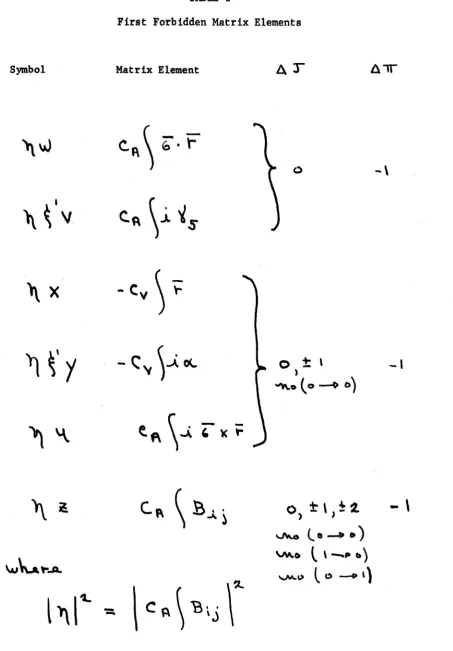
common n o t a t i o n s , a r e g i v e n i n T a b l e 1.
The r a n k
X
o f t h e n u c l e a r m a t r i c e s a p p e a r i n g i nTABLE 1
F i r s t F o r b i d d e n M a t r i x E l e m e n ts
Symbol M a t r i x E le m e n t
A
T
AT T
C * \ f c - l r
- \
\ x
- C v \ \r
M ‘ y
•A
- C v U < x .
a
\ * A 6 X *■
-
I
A a
w
W
ah A .
C - n \ B : :
O , * \
2.
OWo (_ 0 — * • )
V/*.© ^ V —
1
° “ I1 ^ 1 ~
C R U i
e a c h ^ d e c a y h a s t o s a t i s f y
| 3 , , - 3 , |
5 . * 3 ,
- C M
w h e re J
0
a n d J t s t a n d s f o r t h e i n i t i a l a n d f i n a l n u c l e a r s p i n i n ^d e c a y . I t i s c o n v e n i e n t t o i n t r o d u c e two p a r a m e t e r s i a n d ' Y t
T h e s e a r e d e f i n e d a s f o l l o w s :
y 4
v -V ^ VO
\ o r X - *
VJ ^ ' Sj ^ l U 4 > \ r X - V
T h e s e r e p l a c e t h e r e l a t i v i s t i c n u c l e a r m a t r i x e l e m e n t s ^ a n d >j
Xj l
,
v
=%
> ' X ,
y —
v " f ,
I n t h e ^ a p p r o x i m a t i o n t h e f o l l o w i n g r e l a t i o n i s s a t i s i f e d :
| * . | - | V , | t
~ 0> > I w I H
? t ■
U n d e r t h e s e l e c t i o n r u l e e f f e c t we a s k t h a t t h e p a r a m e t e r become o f
t h e same o r d e r a s , o r l a r g e r t h a n , ^ ( a n d ^ . T h i s may b e u n d e r
s t o o d i n tw o p o s s i b l e ways d e p e n d i n g on w h ic h n u c l e a r m o d e l i s a p p l i c a b l e .
One i s known a s t h e "K s e l e c t i o n r u l e " w h i l e t h e o t h e r i s t h e " j
s e l e c t i o n r u l e . "
The K f o r b i d d e n n e s s was i n t r o d u c e d b y A l a g a , A l d e r , B ohr and
M o t t e l s o n ( 1 9 5 5 ) . K i s t h e com p o n e n t o f t h e n u c l e a r t o t a l a n g u l a r
momentum J on t h e n u c l e a r a x i s o f s y m m e tr y . The r a n k X m u s t s a t i s f y
r e l a t i o n ( 2 ) a b o v e a s w e l l a s ( 3 ) b e lo w
|
k o- w , I
fc>\< ^ V i-
K -V v<*
f o r a t r a n s i t i o n
I * . ,
>■"*' ^
20
The r e g i o n s o f a p p l i c a t i o n w h ic h h a v e b e e n e s t a b l i s h e d f o r t h i s m o d el
a r e 150 < A < 1 9 0 a n d A > 2 2 5 .
The j s e l e c t i o n r u l e i s due t o t h e c o n f i g u r a t i o n c h a r a c t e r
o f t h e M a y e r - J e n s e n s h e l l m o d e l . H e re j i s t h e t o t a l a n g u l a r momentum
o f a n u c l e o n i n a s h e l l . F o r j f o r b i d d e n n e s s one c o n s i d e r s n u c l e i i n
t h e r e g i o n 50 - j? ; N ^ 8 2 . I n t h e M a y e r - J e n s e n m o d el n u c l e o n s o u t s i d e
t h e c l o s e d s h e l l ? = N»50 b e l o n g t o t h e h , g , d , d a n d s
s t a t e s . Among t h e s e o n l y t h e h s t a t e h a s odd p a r i t y . S i n c e t h e
f i r s t f o r b i d d e n t r a n s i t i o n s c h a n g e p a r i t y t h e number o f n u c l e o n s w h ic h
o c c u p y t h e h s t a t e h a s t o b e c h a n g e d by one u n i t d u r i n g t h e d e c a y .
T h e r e f o r e , we m u st h a v e a ^ ^ 2 2 . and t h e a v a i l a b l e n u c l e a r m a t r i x
e l e m e n t w i t h N m akes t h e m a j o r c o n t r i b u t i o n . T h u s , i n j
f o r b i d d e n n e s s we h a v e t h e r e l a t i o n s
j f o r b i d d e n n e s s c a n n o t be a p p l i e d w h e re N and Z b e l o n g t o d i f f e r e n t
m a j o r s h e l l s .
M a tu m o to , M o r i t a a n d Yamada ( 1 9 5 5 ; 1958) h a v e s u g g e s t e d
e x a m i n i n g t h e c a s e w h e r e
2
O O , b u t X - - U/ = PT h i s i s c a l l e d t h e m o d i f i e d a p p r o x i m a t i o n .
( i i i ) R e l a t i o n s B e tw e e n X a n d V u n d e r t h e M o d i f i e d A p p r o x i m a t i o n
We w i l l i n t h i s s e c t i o n c o n s i d e r r e s u l t s o n l y f o r a d e c a y
schem e o f t h e t y p e shown i n F i g u r e 2 . 1 .
I n t h e m o d i f i e d B « * a p p r o x i m a t i o n we n e e d o n l y two p a r a -
m e t e r s . T hey a r e a s f o l l o w s :
X
■v
j L L
j
,
%
R
S £ -T - $ C \a n d
^ and a r e s i m i l a r t o a n d '"j d e f i n e d p r e v i o u s l y a n d a r e
t h e r e l a t i v e m a g n i t u d e o f t h e c o n t r i b u t i o n s fro m m a t r i c e s o f r a n k z e r o
a n d one w i t h r e s p e c t t o I n t h e d e c a y schem e o f F i g u r e 2 . 1
o d d - o d d
e v e n - e v e n
F i g u r e 2 . 1 2 " ( ^ ) 2 + ( ^ { ) 0 + D ecay Scheme
t h e b e ta -g a m m a d i r e c t i o n a l c o r r e l a t i o n i s g i v e n a s i n e q u a t i o n (
1
) w i t ha n i s o t r o p y (M atum oto e t a l . 1 9 6 3 ) .
22
_
[-U V t * +
A l ' w [ i f + Y % M i i i f e V
+
* i ^ » ' }
I f we m e a s u r e 14 ^ a t a c e r t a i n e n e r g y a n d i n s e r t t h i s i n t h e a b o v e
e q u a t i o n we w i l l o b t a i n a r e l a t i o n b e t w e e n
X
and^
w h ic h i s ac i r c l e i n t h e Y p l a n e . I t i s
( x - v . V
1+
“ o
.
=
^
Where
v'A,
T
—
_
-^5 ^ 3 -i- ft 4 ^
Y ~ v t /v a . i ; VAJ V_ * _J
\ - - ( r X f . f X
we We w o u ld l i k e t o o b t a i n v a l u e s f o r X an<* ^ • *n p r i n c i p l e
c o u l d o b t a i n X a n d ^ e x p e r i m e n t a l l y fro m two d i f f e r e n t
e x p e r i m e n t s a n d c o m p a re t h e r e s u l t s w i t h t h e o r e t i c a l c a l c u l a t i o n s . The
l a t t e r c a l c u l a t i o n s d o , h o w e v e r , r e q u i r e m ore p r e c i s e k n o w le d g e o f t h e
n u c l e a r r a d i a l wave f u n c t i o n t h a n we h a v e a v a i l a b l e . I n s t e a d we c a n
g e t a s e c o n d r e l a t i o n b e t w e e n X a n d ^ w h ic h i s d e p e n d e n t on t h e
b r a n c h i n g r a t i o (w h ic h c a n b e d e t e r m i n e d e x p e r i m e n t a l l y ) a n d t h e r a t i o
I S
T h i s r a t i o i s d e p e n d e n t on t h e n u c l e a r m o d e l a s su m e d . The s e c o n d r e l a t i o n
i s a g a i n a c i r c l e i n t h e p l a n e a n d i s g i v e n by
R:'
w h e re
<=».
t .
5 a , $c.
( W i ) .
a | a n d a ^ a r e t h e b r a n c h i n g r a t i o s f o r t h e ^ and ^ t r a n s i t i o n s w h i l e
f ^ , ffc , a n d f t ^ a r e t h e i n t e g r a t e d F e rm i f u n c t i o n s f o r ^ d e c a y a n d
t h e c o r r e c t e d i n t e g r a t e d f e r m i f u n c t i o n s f o r ^ a n d ^ d e c a y
r e s p e c t i v e l y . T h e s e a r e g i v e n b y M atum oto e t a l . ( 1 9 6 3 ) . I f X and
h a v e s o l u t i o n s , i . e . i f t h e two c i r c l e s c r o s s e a c h o t h e r , t h e n t h e
a ssu m e d n u c l e a r m o d e l i s r e a l i z e d . I n t h i s w ay, we c a n t e s t e a c h n u c l e a r
s t a t e s , m o d e l t o f i n d t h e c o n f i g u r a t i o n o f t h e ^
c W )
( i v ) C a l c u l a t i o n o f
F o r r o t a t i o n a l e x c i t a t i o n o f t h e c o l l e c t i v e m o d e l ( K s e l e c t i o n
r u l e ) t h e r a t i o i s :
-^ = 1 1 ) 1
T h i s i s c o n s t a n t f o r a l l n u c l e i h a v i n g d e c a y schem es o f F i g u r e 2 . 5
F o r t h e j - j c o u p l i n g s h e l l m o d e l ( j s e l e c t i o n r u l e ) t h e
c a l c u l a t i o n o f M i s m ore d i f f i c u l t . R e s u l t s a r e g i v e n b y M atum oto e t a l .
( 1 9 6 3 ) .
T hey a r e a s f o l l o w s ;
( i ) f o r p r o t o n s e x c i t e d :
(ii) for neutrons excited:
^ V v O ^ 4 - 1 ^ i w , 2 ^ p )
( i ) I n t r o d u c t i o n
Two s o l i d s t a t e 0 - 6 0 amp. c u r r e n t s u p p l i e s h a v e b e e n b u i l t
i n t h i s l a b o r a t o r y t o p r o v i d e c u r r e n t f o r t h e G erholm c o i n c i d e n c e
s p e c t r o m e t e r . The r a t i o o f t h e r m s . r i p p l e c u r r e n t on t h e o u t p u t t o t h e
d c . o u t p u t c u r r e n t i s o f t h e o r d e r o f 10*"*%. The o u t p u t c u r r e n t d o e s n o t
d r i f t f o r a l l p r a c t i c a l p u r p o s e s and c h a n g e s l e s s t h a n
0
.01
% when e i t h e rt h e l i n e v o l t a g e c h a n g e s by 10% o r t h e room t e m p e r a t u r e c h a n g e s by 10
C°
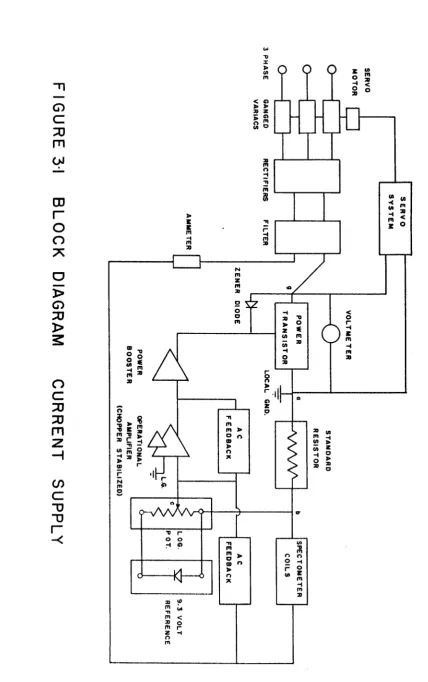
The b l o c k d i a g r a m o f t h e s u p p l y i s shown i n F i g u r e 3 . 1 . T h e r e
a r e two f e e d b a c k s y s t e m s , - t h e f a s t f e e d b a c k s y s t e m , w h ic h c o n t r o l s t h e
c u r r e n t , a n d t h e s e r v o s y s t e m w h ic h c o n t r o l s t h e v a r i a c s s o t h a t t h e r e i s
a lw a y s 3 v o l t s a c r o s s t h e 2N278 s e r i e s r e g u l a t i n g pow er t r a n s i s t o r s .
T h r e e p h a s e 117 v o l t 60 c y c l e p o w e r i s f e d t o t h r e e g a n g e d G e n e r a l R a d io
V a r i a c s . The o u t p u t fro m t h e v a r i a c s g o e s t o a t h r e e p h a s e f u l l wave
r e c t i f i e r . The r e c t i f i e r o u t p u t i s f i l t e r e d by a 1 0 ,0 0 0 u f . c a p a c i t o r .
C u r r e n t p a s s e s fro m t h e p o s i t i v e t o n e g a t i v e t e r m i n a l s o f t h e f i l t e r
t h r o u g h a s e r i e s c o n n e c t e d r e s i s t o r c h a i n c o n s i s t i n g o f t h e s p e c t r o m e t e r
c o i l s , t h e 0 . 1 5 ohm s t a n d a r d r e s i s t o r , a n d t h e 10 2N278 p o w e r t r a n s i s t o r s .
O v e r l o a d p r o t e c t i o n f o r t h e 10 p a r a l l e l c o n n e c t e d 2 N 2 7 8 's i s p r o v i d e d by
a n
8
v o l t z e n e r d i o d e c o n n e c t e d a s shown i n F i g u r e 3 . 3 .( i i ) The R e f e r e n c e S u p p l i e s
The 9 . 3 v o l t o u t p u t fro m t h e r e f e r e n c e s u p p l i e s c h a n g e s l e s s
t h a n 0.01% when t h e i n p u t r m s . v o l t a g e i s c h a n g e d fro m e i t h e r 117 t o 128
25
'
75528
u n i v e r s i t y
m m n m m i m m m
F
IG
U
R
E
3
1
B
L
O
C
K
D
IA
G
R
A
M
C
U
R
R
E
N
T
S
U
P
P
L
Y
G J ■v
R e p r o d u c e d with p erm ission of th e copyright owner. F urther reproduction prohibited without perm ission.
S
E
R
V
II7V:
r m s . :
4 4 V. rms.
t
8 4 V- r
: 9 0 V. r m f t s / i
^ JL
. ■© * 3 0
Ca
r s c t i f i e r s a n d f i l t e r s
Cg f o r l o c a l p o w e r s u p p l i e s .
* + 3 0
o - 9. 3
V-L o g . P o t .
R e f e r e n c e
■»- 9 . 3 V.
Li n. Pot .
Z\
R e f e r e n c e
■o ♦
C, » I 0 0 ut *. 1 5 0 VDC.
C2 - 3 0 0 0 u t . , 5 0 VDC.
C3 * I 5 0 0 u f . , 5 0 VDC.
D| * I 0 J 2 D i o d e
D2 ■ F 2 D i o d e
Z ( * I N 2 6 2 3 9 - 3 V t e m p , c o m p e n s a t e d
z e n e r
d i o d e *
Z 2 - 2XI N262I * 18V
"
"
"
"
Z4 * I N 2 8 3 6
8 2 V, 5 0 WAT T
z e t i e r
d i o d e .
Z3 « I N2 8 3 3 B
6 2 V , "
"
"
"
R, ■ 9 0 0 ohms , R2 - 2 2 K , R3 » 6 8 0 ohms, R4» 3-3 K
R E F E R E N C E
S U P P L I E S
F I G U R E
3 - 2
F
I
G
U
R
E
3 -3<
m
jo
Hm
j o wo
o
0 )
Hm
U * DO
$
m
JO
(ft -* Ocr
N8
.
(»<o
e’ Z V
*
55
\
CM CO (ft ®
2 <
1
(b •>»
o
o . <b (O o 9 (ft <A -*• O ■n M (ft (ft* (ft roz
7 i Oft7 w ° u i 3 <
(ft |A N
£ 5
7. (ft
<
(B a (A -■
O
: °2. M
m -*■
-# o
O 3 -< CL a tCL
Cl
(ft
“» O (ft t * o
-4> OJ
5 ^
5 =
(0 (ft
(ft
o
a.
(ft
o r from 117 t o 106. T h i s i s a c c o m p l i s h e d by u s i n g " g a n g e d " z e n e r d i o d e
c o n s t r u c t i o n a s shown i n F i g u r e 3 . 2 . T e m p e r a t u r e s t a b i l i t y i s o b t a i n e d
by u s i n g t e m p e r a t u r e c o m p e n s a te d z e n e r d i o d e s i n t h e l a s t two s t a g e s .
Z , and Z ^ h a v e t e m p e r a t u r e c o e f f i c i e n t s o f 0.0 0 1 % /C ° a n d 0 .0 0 5 % /C °
r e s p e c t i v e l y .
F i g u r e 3 .7 n Ganged Z e n e r D io d e s
The r e g u l a t i o n f o r n g a n g e d z e n e r d i o d e s ( F i g u r e 3 . 7 ) i s
e a s i l y c a l c u l a t e d fro m t h e e x p r e s s i o n
a r e t h e d r o p p i n g r e s i s t o r s shown i n F i g u r e 3 . 7 .
U s i n g t h i s e x p r e s s i o n two a n d t h r e e s t a g e r e f e r e n c e s u p p l i e s
w e r e c o m p a r e d . I t was f o u n d t h a t s u f f i c i e n t r e g u l a t i o n c o u l d o n l y b e
a c h i e v e d w i t h a t h r e e s t a g e s u p p l y . T e m p e r a t u r e c o m p e n s a t i o n was r e q u i r e d
i n t h e s e c o n d s t a g e s i n c e t h e r e g u l a t i o n f a c t o r ( r ^ / R ^ f o r t h e o u t p u t
s t a g e was n o t s u f f i c i e n t t o c o m p e n s a te f o r t h e t h e r m a l d r i f t s o f an
" u n c o m p e n s a t e d " s e c o n d s t a g e z e n e r d i o d e .
R |
r 2
Rn
w h e r e A V 0 i s t h e o u t p u t v o l t a g e c h a n g e c o r r e s p o n d i n g t o a n i n p p t
v o l t a g e c h a n g e o f 'I*W a r e t h e dynam ic
im p e d e n c e s o f t h e z e n e r d i o d e s Z ^ , Z ^, «. « .
2
^ r e s p e c t i v e l y . T?, ^ ^30
( i i i ) The F a s t F e e d b a c k S y s te m
As shown i n F i g u r e 3 . 1 t h e o u t p u t fro m t h e r e f e r e n c e s u p p l y
i s c o n n e c t e d a c r o s s a 10 t u r n , 1001c l o g a r i t h m i c p o t e n t i o m e t e r . A B u r r -
Brown 1 6 0 2 / 0 4 c h o p p e r s t a b i l i z e d o p e r a t i o n a l a m p l i f i e r c o m p a r e s t h e
v o l t a g e a c r o s s t h e s t a n d a r d r e s i s t o r (Vba) w i t h t h e v o l t a g e p i c k e d o f f
f ro m t h e l o g a r i t h m i c p o t e n t i o m e t e r ( V b c ) . The a m p l i f i e d d i f f e r e n c e
s i g n a l (V ba-V bc) i s i n v e r t e d a n d f e d t o a pow er b o o s t e r s t a g e ( F i g u r e
3 . 3 ) . The o u t p u t o f t h e p o w e r s t a g e i s c o n n e c t e d t o t h e 10 p a r a l l e l
c o n n e c t e d 2N278 s e r i e s r e g u l a t i n g t r a n s i s t o r s ( F i g u r e 3 . 3 ) . The p h a s e
o f t h e f e e d b a c k s i g n a l i s s u c h a s t o r e d u c e t h e d i f f e r e n c e (V ba-V bc) t o
z e r o .
The s y s t e m w i l l e x h i b i t h i g h f r e q u e n c y o s c i l l a t i o n s u n l e s s
a c . f e e d b a c k i s u s e d t o d r o p t h e g a i n o f t h e o p e r a t i o n a l a m p l i f i e r a t
h i g h f r e q u e n c i e s . A N y q u i s t d i a g r a m c o u l d h a v e b e e n p l o t t e d t o d e t e r m i n e
t h e f e e d b a c k e l e m e n t s r e q u i r e d f o r s t a b i l i t y , b u t s i n c e a maximum r i p p l e
r e d u c t i o n a n d a low t i m e c o n s t a n t w e re a l s o r e q u i r e d i t was e a s i e r t o
s e t up t h e c i r c u i t a n d d e t e r m i n e t h e f e e d b a c k e l e m e n t s e x p e r i m e n t a l l y .
The s t a n d a r d r e s i s t o r i s made from c o n s t a n t a n s t r i p , wound
n o n - i n d u c t i v e l y and i s c o o l e d by a 10 i n c h f a n . The f a n a l s o p r o v i d e s
c o o l i n g f o r t h e v a r i a c s , t h e r e c t i f i e r s and t h e v a r i o u s p o w e r t r a n s i s t o r s .
( i v ) The S e r v o S y s te m
The s e r v o f e e d b a c k s y s t e m c o m p a r e s t h e v o l t a g e V ah, w h ic h
i s k e p t a t 3 v o l t s ( F i g u r e 3 . 4 ) and t h e v o l t a g e Vag, a c r o s s t h e p o w e r
t r a n s i s t o r s . The d i f f e r e n c e i s c h o p p e d by t h e 60 c y c l e c h o p p e r and
a m p l i f i e d ( F i g u r e 3 . 4 ) a n d t h e n f e d t o t h e s e r v o m o to r w h ic h c o n t r o l s
t h e a n g u l a r p o s i t i o n o f t h e t h r e e g a n g e d v a r i a c s .
The a m p l i f i e r c o n s i s t s o f a d i f f e r e n c e a m p l i f i e r T ^ , T
2
, and2 N 5 2 7
TO COLLECTO!
OF 2 N 2 7 8 ' S
10 K 5 6 K■
2 N I7 2 8
(c le v ite )
2 N I67
2N5I I
I-5V. rm s - I
6 8 0
|K 60*'v^P
ohm
.. 2 N I6 7
IK
10 ohm s'
10 Out
10 Out
2 2 K ±
2 7 K
TR A N SISTO R
TRANSFORMER
2N 5II
2 N I 7 2 8
(clevite)
12 V O L T S
-ioOO
10 K 5-6K
TO
S E R V O
^ 1-4 u f • M O T O R
— o