Scholarship at UWindsor
Scholarship at UWindsor
Electronic Theses and Dissertations
Theses, Dissertations, and Major Papers
1-1-1968
Beta-gamma angular correlations and shape correction factor
Beta-gamma angular correlations and shape correction factor
determinations in the decays of rhenium-186 and rhenium-188.
determinations in the decays of rhenium-186 and rhenium-188.
Murray L. Trudel
University of Windsor
Follow this and additional works at: https://scholar.uwindsor.ca/etd
Recommended Citation
Recommended Citation
Trudel, Murray L., "Beta-gamma angular correlations and shape correction factor determinations in the
decays of rhenium-186 and rhenium-188." (1968). Electronic Theses and Dissertations. 6062.
https://scholar.uwindsor.ca/etd/6062
6-y ANGULAR CORRELATIONS AND SHAPE CORRECTION FACTOR
DETERMINATIONS IN THE DECAYS OF Re186 AND R e188 .
by
Murray L. Trudel
A Thesis
Submitted to the Faculty of Graduate Studies through the Department of Physics in Partial Fulfillment of the Requirements for
the Degree of Doctor of Philosophy at the University of Windsor
Windsor, Ontario
IN F O R M A T IO N T O U S E R S
T h e q u a lity o f th is re p ro d u ctio n is d e p e n d e n t upon th e q u a lity o f th e copy
su b m itte d . B roken o r in d istin ct print, colored o r p o o r q u a lity illu stra tio n s and
p h otog ra phs, prin t b le e d -th ro u g h , s u b sta n d a rd m argins, and im p ro p e r
a lig n m e n t can a d v e rs e ly a ffe c t re productio n.
In th e u n like ly e v e n t th a t th e a u th o r did not send a co m p le te m a n u scrip t
and th e re are m issing pages, th e s e w ill be noted. A lso, if unau th o rize d
co p yrig h t m a te ria l had to be rem o ve d , a note w ill in d ica te th e deletion.
®
UMI
UMI M icro fo rm D C 52628C o p y rig h t 2 0 0 8 by P ro Q u e st LLC.
A ll rights reserved. T h is m icro fo rm e d itio n is p ro te cte d a g a in s t
u n a u th o rize d copying u n d e r T itle 17, U nited S ta te s C ode.
P ro Q u e st LLC 789 E. E is e n h o w e r P arkw ay
21749
”APPROVED BY:
Dr. E. E. Habib (Supervisor)
Dr. H. Ogata
The directional correlation between the nonunique first for
bidden 935-Kev beta group and the 137-Kev gamma transition in the decay
of Re^-8t>, and the directional correlation between the nonunique first
forbidden 1980-Kev b eta group and the 155-Kev gamma transition in the
decay of Rel8&, have been measured as a function of energy* The
beta-gamma angular correlation coefficient A£ is found to have the following
energy (W) dependence:
w
A2
w
A 2
3.01 0.133 ± 0.005
3.22 0.151 ± 0.004
3.42 0.161 ± 0.006
3.61 0.176 ± 0.004
3.81 0.183 ± 0.006
4.01 0 . 2 0 1 ± 0.004
4.21 0.216 ± 0.006
An investigation of the possible existence of a perturbation
of the angular correlation caused by e x t r a n u d e a r fields has been
carried out. No perturbation effect due to a magnetic hyperfine
structure interaction or to an electric quadrupole interaction has
been detected.
The shapes of the spectra of the 935-Kev and the 1980-Kev
1
86
1 ftft
beta groups in the decays of Re and Re respectively have been
investigated using the beta - gamma coincidence technique. It is
found that these beta groups have the statistical shape: the shape
correction factor C(W) for the 935-Kev beta transition is constant
to within ±1%, and C(W) for the 1980-Kev b eta transition is constant
to within ±1.5%.
The analysis was based upon the theoretical expressions of Kotanl (1).
ACKNOWLEDGMENTS
I should like to thank Dr. E. E, Habib, under whose
supervision this project was carried out, for his guidance and
assistance. 1 should like also to thank Dr. H. Ogata who performed
the calculations to determine the nuclear matrix element parameters.
Acknowledgments are due to Mr. W. Grewe for constructing
the decoupling lens.
Finally, I am indebted to the NRC for its financial
Page
ABSTRACT iii
ACKNOWLEDGMENTS vi
LIST OF TABLES x
LIST OF FIGURES xi
CHAPTER I. INTRODUCTION 1
CHAPTER II. THEORY OF ANGULAR CORRELATIONS OF NUCLEAR
RADIATIONS 4
A. Unperturbed Angular Correlations 4
a. Introduction 4
b. The Importance of Angular Correlations 5
c. The Theoretical Directional Correlation Function
W (6) 7
d. Beta-Gamma Angular Correlation 10
B. Perturbed Angular Correlations 11
a. Introduction 11
b. Static Quadrupole Interaction 13
c. Time-Dependent Magnetic Interaction 14
d. Magnetic Decoupling 15
CHAPTER III. THE THEORY OF NUCLEAR BETA DECAY 17
A. Introduction 17
B. Form of the Beta Interaction lg
C. The Kurie Plot 22
Page
CHAPTER IV. DESCRIPTION OF THE APPARATUS 25
A. The Coincidence Spectrometer 25
B. The Coincidence Circuit 29
C. Geometrical Correction Factors 33
CHAPTER V. BETA-GAMMA DIRECTIONAL CORRELATIONS IN
Rel86 AND Rel88 39
A. Introduction 39
B. Experimental Procedure 39
C. Treatment of Data 46
CHAPTER VI. MAGNETIC AND QUADRUPOLE INTERACTIONS IN
Rel86 A N D Rel88 ANGULAR CORRELATIONS 50
A. Introduction 50
B. Magnetic Decoupling Experiment 51
C. Electric Quadrupole Interaction 59
CHAPTER VII. SHAPE OF BETA SPECTRA IN THE DECAYS OF
Re186
A ND Rel88 68A. Introduction 68
B. Experimental Procedure 53
C. Treatment of Data 71
D. Results
CHAPTER VIII. DETERMINATION OF NUCLEAR MATRIX ELEMENT PARAMETERS IN THE FIRST-FORBIDDEN BETA DECAY
OF Re186 AND Re188 75
A. Introduction 75
B. Theoretical Formulation 75
C. Method of Analysis 77
BIBLIOGRAPHY 83
VITA AUCTORIS 85
LIST OF TABLES
I.
II.
III.
IV.
V.
VI.
VII.
VIII.
IX.
Page
Allowed and First-Forbidden Nuclear Matrix Elements
and Their Selection Rules 23
The Variation in Resolving Time 2t for a B-y Directional
Correlation Run in Rel86 45
The Values of the A2 Coefficients Obtained for the 8-y
Directional Correlation in R e!8 8 48
The Values of the A2 Coefficients Obtained for the B-y
Directional Correlation in Rel86 49
The Values of the A2 Coefficient (W - 2.0) Obtained for
the B-y Directional Correlation in Rel86 Utilizing the
Magnetic Decoupling Lens 58
Summary of Experimental Results Obtained from Time
Spectra Analysis 66
A Tabulation of End Point Energies for Re^-®® and Re^®® 72
Comparison of Theoretical Predictions Based on the Parameter Set Y ■ 4,45; u ■ 0.09; x ■ -0.40 With
Experimental Results for Rel86 79
Comparison of Theoretical Predictions Based on the Parameter Set Y ■ 2.74; u * 0.06; x * 0.085 With
Page
1. Schematic of a Directional Correlation Measurement 9
2. Schematic Diagram of the Electron-Gamma Directional
Correlation Spectrometer 26
3. Triangular Field Distribution for the Gerholm Instrument 27
4. A Block Diagram of the Fast-Slow Coincidence Arrangement 30
5. The Fast Coincidence Circuit 32
6. Discriminator Voltage Curve 34
7. Resolution Curve 34
8. The Pq and P2 Baffles 37
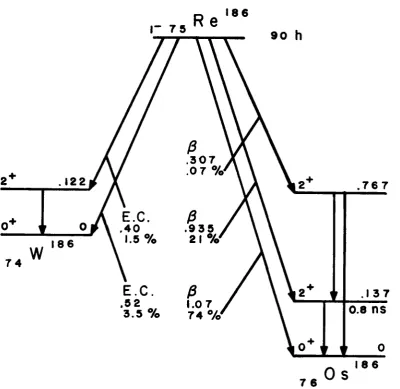
9. Principal Branches of Decay Scheme of Rel®^ 40
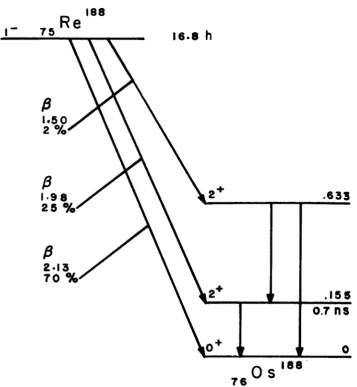
10. Principal Branches of Decay Scheme of R e 188 41
11. Low Energy Gamma Pulse Height Distribution from R e l88 44
12. Low Energy Gamma Pulse Height Distribution from R e l86 44
13. Schematic of the Decoupling Lens and of the Experimental
Arrangement Used in the Magnetic Decoupling Experiment 52
14. Plot of Current vs Magnetic Field for the Decoupling Lens 54
15. Profiles of the 624-Kev Ba-^37 Electron Conversion Line
for 0-KG and 3-KG Fields in the Decoupling Lens 55
16. A Time Spectrum 61
17. Experimental Arrangement for Time Spectra Analysis 62
18. Time Spectrum for the 8-y Cascade in R e l86 Accumulated
19. Pulse Height Distribution for the Beta Particles Focussed on the Plastic Scintillator in the Beta Spectrometer
20. Fermi Plot of the Inner Beta Spectrum of Rel86
INTRODUCTION
The angular correlation between successive nuclear transitions
is frequently used to determine nuclear characteristics, such as the
multipolarities, characters and mixing ratios of the transitions as well
as the spins and parities of the levels involved. Provided the exper
imentally obtained angular correlation represents the true unperturbed
relative directional distribution pattern one can infer the relevant nuclear
parameters in a straightforward w ay from the theory of angular correlations.
It is we l l known that extranuclear fields can cause strong
perturbations of the angular correlation (2). The nuclear magnetic dipole
*
¥
moment couples to external magnetic fields and the nuclear quadrupole
moment will cause a similar coupling to electric field gradients. In
both cases the coupling results in a precession around the external field
(gradient) axis. If the coupling is sufficiently strong the nuclei change
their initial orientation resulting in a smearing out of the angular
correlation. A knowledge of the magnitude of these effects is of
importance for the interpretation of the experimental results.
The beta-gamma directional correlations for the (935-Kev beta)
(137-Kev gamma) cascade in Re^-®®, and the (1980-Kev b e t a ) (155—K ev gamma)
cascade in Re^®® have been previously measured by a number of authors.
2
in R e1 ®6 has been determined with good statistical accuracy by Novey
et al (3), and with poor statistical accuracy by Dulaney et al (4); the
(1980-Kev beta)(155-Kev gamma) directional correlation in Re^®® has been
determined by Wyly et al (5) but wit h extremely poor statistical accuracy.
It was assumed by these authors that their results represented the
unattenuated directional correlation. However, no significant attempt
was made to determine this point experimentally.
The present research concerns itself with the accurate deter
mination of the true unperturbed directional correlations in Re^®® and
Re188.
A serious investigation of the possible existence of perturbationmechanisms was carried out.
In addition to the directional correlation studies that have
been conducted, much research has been done to try to unravel the shapes
of the nonunique first forbidden 935-Kev and 1980-Kev beta transitions
in the decays of Re^®® and Re^®® respectively. Different results have
been obtained by various authors.
Porter et al (6) examined the 935-Kev beta spectrum in
coincidence with the 137-Kev gamma transition and found that the spectrum
exhibits deviations from the allowed shape. The shape correction factor
was found to increase by 18% from 150-Kev to 900-Kev. On the other hand
Koerts (7) and Bashandy et al (8), utilizing the coincidence technique,
have reported an allowed shape for the 935-Kev beta transition. However,
they do not indicate the accuracy with which the shape of the beta
spectrum was determined. Johns et al (9) have also reported an allowed
Involved subtracting out the 935-Kev beta spectrum from a composite beta
spectrum, a method which Is not nearly as sensitive to departures from
the allowed shape as the coincidence technique.
Similar results have been obtained for the 1980-Kev beta
transition in R el8 8. According to Johns et al (9), the spectrum exhibits
deviations from the allowed shape. However, the subtraction procedure
employed in their analysis could seriously affect the shape of the beta
distribution. Bashandy et al (8) have reported an allowed shape for the
1980-Kev beta transition, but they do not give the accuracy w ith which
the shape of the beta spectrum was determined.
In the present investigation the shapes of the spectra of the
935-Kev and the 1980-Kev beta groups have been studied using the 8-y
coincidence technique in order to determine accurately the shape correction
factors C(W) for these beta transitions. The values of C(W) thus obtained
can then be used in the determination of the nuclear matrix elements
involved in the beta transitions.
It is hoped that the research reported in this thesis will
contribute in a positive manner to the body of knowledge already
CHAPTER II
THEORY OF ANGULAR CORRELATIONS OF NUCLEAR RADIATIONS
A. Unperturbed Angular Correlations
a. Introduction. The probability of emission of a particle or
quantum by a radioactive nucleus depends in general on the angle between
the nuclear spin axis and the direction of emission. Under ordinary
circumstances, the radiation R emitted from a radioactive sample for the
O
individual transition Ia ” " 1^, will be isotropic in the laboratory
coordinates because the nuclei are randomly oriented in space. If the
transition I & ^ 1^ is followed by a second transition 1^ - ^ I c ,
the individual radiations from the second transition are likewise isotropic
in the laboratory coordinates.
However, in a two step cascade transition, such as
R l ^ r2v
Ifl ■" s I|j 1 '" / Ic there is often an angular correlation between the
directions of emission of two successive radiations R, and R„ which are
1
2
emitted from the same nucleus.
The existence of an angular correlation arises because the
direction of the first radiation is related to the orientation of the
angular momentum I of the intermediate level. This orientation can be
D
expressed in terms of the magnetic - angular - momentum quantum number m^
with respect to some laboratory direction such as that of the first
radiation. If 1^ is not zero, and if the lifetime of the intermediate level
of emission of the second radiation wi l l be related to the direction I b
and hence to that of the first radiation.
An anisotropic radiation pattern can be observed only from an
ensemble of nuclei that are not randomly oriented. One method of arriving
at such an ensemble consists in picking out only those nuclei whose spins
happen to lie in a preferred direction. This can be realized if the nuclei
decay through successive emission of two radiations and R^. The observa
tion of R^ in a fixed direction selects an ensemble of nuclei that
has a nonisotropic distribution of spin orientations. The succeeding
radiation R£ then shows a definite angular correlation with respect to k^.
In the following we use the term "angular correlation" as
comprising "directional correlation" and "polarization correlation". In
directional correlation only the directions of the two radiations are
observed; in polarization correlation one determines also the linear or
circular polarization of one or both of the radiations.
b. The Importance of Angular Correlations. A study of the
angular correlation of radiations emitted or absorbed in nuclear processes
has been one of the principal methods available for the nuclear spectros
copy of excited states.
The information that can be obtained from angular correlation
wo r k depends on the type of radiation observed (a, y, B, e~ ), on the
properties that are singled out by the experiment (direction, polarization,
energy), and on the extranuclear fields acting on the nucleus.
If we assume that the decaying nuclei are free, i.e., that no
6
in the intermediate state, then, to the extent that this can be realized
in practice, angular correlation measurements provide information about
the properties of the nuclear levels involved and about the angular
momenta carried away by the radiations. To be more precise, the Y - Y
directional correlation yields the spins of the nuclear levels and the
multipole orders of the gamma transitions. The gamma matrix elements
which describe the transitions, and hence the directional correlation,
provide no information on nuclear structure which would check the
validity of nuclear models. The relative parities of the nuclear levels
can be determined if one measures the directional correlation involving
an e“ - y cascade. The e“ - y directional correlation depends in
general on a combination of normal conversion matrix elements and gamma
matrix elements. If in addition to the normal conversion matrix elements
there appear penetration matrix elements then some information on nuclear
structure can be derived (10). The directional correlation of a 3 - y
cascade depends not only on the spins and parities of the nuclear levels
and the multipole orders of the transitions but also depends very
strongly on the matrix elements for the beta transition which in turn
are dependent on the details of nuclear structure. A unique determina
tion of the beta matrix elements could provide a test for a nuclear
model which describes the states involved.
The information that can be obtained from the influence of
extranuclear fields on the nuclear angular correlation is also multifold.
Very often, one can determine the quadrupole coupling Qd^V / Bz^
change of the correlation due to extranuclear fields. In many cases,
one can measure the g - factor of an excited nuclear state by observing
the directional correlation as a function of an external magnetic field.
From the g - factor one gets the magnetic moment if the spin of the
nuclear state is known.
c. The Theoretical Directional Correlation Function W (6) .
The theory of angular correlation is highly developed and general
expressions can be written down for even very complex situations.
However, the general formulation of the theory is very complicated and
is somewhat lengthy. Very good formulations of the theory are present
in the literature (11). We will therefore present in this section a
simple treatment of directional correlation theory that, while restricted
in its usefulness, provides some insight into the correlation mechanism.
The common feature of all correlation problems is to be found
in the fact that they involve an initial nuclear state of sharp angular
momentum 1^ and parity, that undergoes successive transformations,
either emitting or absorbing radiations through intermediate states of
sharp angular momenta Ia , 1^ ... and sharp parity, and terminating
as a nucleus wit h sharp angular momentum l£ and parity. The properties
of the radiations, the observation or lack thereof of their directions
of motion, polarization properties, the presence or absence of any
perturbation of the intermediate nuclear states by external fields
(magnetic (hfs) and possibly quadrupole interactions) condition the
specific correlation discussed.
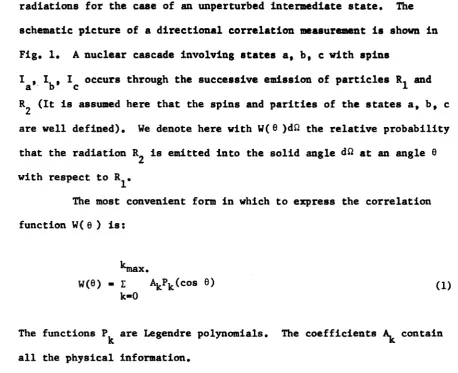
8
radiations for the case of an unperturbed intermediate state. The
schematic picture of a directional correlation measurement is shown in
Fig. 1. A nuclear cascade involving states a, b, c wi t h spins
1 , 1 , 1 occurs through the successive emission of particles R, and
a b c
R^ (It is assumed here that the spins and parities of the states a, b, c
are well defined). We denote here with W( 6 )dft the relative probability
that the radiation is emitted into the solid angle dft at an angle 6
wi t h respect to R^.
The most convenient form in which to express the correlation
function W( 6 ) is:
^max.
W (6) - I Ak Pfc(cos 0) d )
k-0
The functions are Legendre polynomials. The coefficients A k contain
all the physical information.
At this point we introduce the following nomenclature for a
double cascade involving pure multipole radiations, viz, I (L.) I, (L ) I
a 1 b Z c
where 1 , 1 and I denote the angular momenta of the first, intermediate
a b c
and final nuclear levels, and and are the angular momenta of the
two successive radiations.
Three general rules for the coefficients A hold for all types
Iv
du ced w ith pe rm is s io n of th e co py ri gh t o w ne r. Fu rthe r re production p ro h ib ite d wi th ou t p e rm is s io n . Q
b
c
0 0
( b )
Fig. 1. Schematic of a Directional Correlation Measurement
(a) Nuclear cascade
/
s o u r c e
C
n
...
c (e )
e
\
coi nci dences
s
<v
X X c o u n t e r
(O
(b) W (6)dD is the relative probability that the radiation is emitted into the solid
angle dft at an angle 6 wi t h respect to R^.
(c) The two counters 1 and 2 subtend an angle 8 at the source. From the coincidence
count rate as a function of a n g l e , C (6) , one obtains after suitable correction the
k integer, even Q )
0 -
*
W
.
- m i n * (2Ib» 2L1»2V
<2>
\
\ ^a , b ^ \ ^b * ° ^ O )Rule 1 expressing the £act that only even Legendre polynomials
appear, holds as long as one measures only directions and linear polar
izations of the radiations. The observation of the circular polarization,
however, introduces odd integers.
Rule 2 states that the highest term kmgv in the expansion is
smaller than, or equal to, the smallest of the three numbers 21^, 2L^, 2L^
where and are the angular m omenta carried away by and R^. This
rule implies an isotropic correlation if the angular momentum of either
of the radiations or of the intermediate state equals 0 or 1/2. In the
f
event that the cascade involves mixed radiations, i.e.,
and L + l' , rule 2 becomes:
2 2 2
0 < k < min. (2IU , L. + L , , L~ + L 0)
— max. — b* 1 1* 2 2
Rule 3 expresses the fact that the coefficients for a
cascade can be broken up into two factors, each factor depending on only
one transition of the cascade. The second factor A^(b,c), for instance,
is entirely determined by the properties of the levels b and c and of
the radiation R^. Numerical values for the factors A^(a,b) for given
properties of the levels (a) and (b) and of the radiation R have been
calculated for most cases of interest (1 1).
Beta — Gamma Angular Correlation. In the first transition
Formally, this event is described by treating the process as if a
neutrino (antineutrino) enters the nucleus and a negatron (positron) is
emitted. In a 6 “ Y correlation experiment one measures the direction
of the electron while the neutrino escapes unobserved. The theoretical
calculation of the angular correlation thus necessitates an averaging
over all neutrino directions and over the spins of neutrino and electron.
The experimental technique of determining 0 - y directional
correlations is quite straightforward. The fact, however, that the 6 - y
directional correlation is a continuous and smooth function of energy
makes precise measurements difficult. Since the energy dependence of
provides the m ost useful information on the beta transition, the B - Y
directional correlation should be determined within as wide an energy
range as possible.
The 6 - y directional correlation involving a first-forbidden
beta transition is of the form:
W S_ Y (0) - 1 + A2(E)P2 (cos 0) (2)
where E ■ beta energy.
B. Perturbed Angular Correlations.
a. Introduction. The theory of the correlation of the
directions of emission of a sequence of two particles by radioactive
nuclei has been treated extensively in the literature. The conclusions
of these treatments, however, are only applicable if the intermediate
state of the nucleus, between the first and second emissions, is
12
The theory of extranulear perturbations on angular correlations
has been developed during the past 20 years to a high degree of complete
ness. A thorough treatment of the magnetic dipole and the electric
quadrupole interactions, including time-dependent effects has been
presented by Abragam and Pound (12). A comprehensive review of the theory
of perturbed angular correlations has been presented by Karlsson et al (2).
The angular correlation of a cascade I^*>I— ^ 1 ^ will, in general
be altered as soon as the nuclei in their intermediate level I are subject
to torques, due to the interaction of either the magnetic dipole moment p
w i t h an extranuclear magnetic field B, or of the electric quadrupole
moment Q with electric field gradients / 3z^ . In the semiclassical
picture, these interactions produce a precession of the nuclei around the
symmetry axis. The changing nuclear orientation results in an altered
angular correlation. In quantum mechanical language, if the quantization
axis is chosen to coincide with the direction of the first radiation,
the interactions cause transitions amoung the m - substates. The
second radiation is emitted from a level with an altered population
distribution and this change is responsible for the attenuation of the
correlation.
The semiclassical picture of a precessing nucleus adequately
describes the situation if the extranuclear fields are static. However,
there also exist time-dependent fields which produce a change in the
correlation function. In this case, realized for example in certain
viscous fluids, the fluctuating electric field gradients at the site of
A major difference is exhibited between static and
time-dependent interactions in polycrystalline sources. In the case of a
static interaction, the angular correlation in a polycrystalline
source is never wiped out completely because a certain fraction of
nuclei experience the static field in such a direction that their
correlation is unperturbed or only slightly attenuated. Static inter
actions in polycrystalline sources thus never reduce the correlation
below a "hard core" value, the limit of maximum attenuation.
Time-dependent interactions, however, can wipe out the correlation completely.
This is due to the fact that the direction of the field at each nucleus
changes continuously in a random manner. No quantization axis exists
for which the populations of the m - substates remain constant.
Eventually, all m - substates are equally populated for any choice of the
quantization axis and the directional correlation is isotropic.
It is clear that the perturbation depends primarily on the
magnitude and type of the interaction, and on the length of time it can
act, i.e., on the mean life t of the intermediate level. A knowledge of
the magnitude of these effects is of importance for the interpretation
of the experimental results.
b. Static Quadrupole Interaction. In most crystals strongly
inhomogeneous fields are known to be present. Therefore one should quite
generally expect an internal static quadrupole interaction to take place
in solid sources. To what extent this will result in an attenuation of
the angular correlation depends on the lifetime of the intermediate level
14
Abragam and Pound (12) have derived the following expression
for an angular correlation perturbed by a static Interaction:
W(6) - E G ^ P j ^ c o s 8) (3)
k
where the are the coefficients of the expansion In Legendre polynomials
of the unperturbed correlation. The are attenuation coefficients
which contain all the Information on the perturbation of the angular
correlation and depend only on the intermediate nuclear state and not on
the radiative transitions to and from it.
c. Time-Dependent Magnetic Interaction. The escape of a beta
particle from an atom takes place in a time that is short compared to
the orbital period of the shell electrons. The sudden change in nuclear
charge from Z to Z ± 1 introduces a sudden perturbation into the
electrostatic potential in which the shell electrons move. This sudden
perturbation may cause excitations and ionization of the electron shell.
Holes are formed by the "shake-off" of electrons whe n the electron-core
readjusts itself to the new atomic number. Thus there exists a n on
vanishing probability that the daughter atom is in a highly ionized and
excited state following beta emission by the parent atom.
The picture after beta emission and subsequent hole formation
is as follows: A hole is created which moves very rapidly to the
outermost shell. This movement occurs mainly through Auger effects and
hence more holes are created that also move outward. Once these holes
have reached the outermost shell, they can decay only slowly and hence
angular correlation. As a consequence of the after effects of hole
formation in the electron core there might be a magnetic coupling
between the nucleus and the magnetic field produced by the excited
and ionized atomic core.
The final recovery depends on the availability of free electrons
to fill up the holes in the outer shell and neutralize the ion. In a
conducting material such as a metal, free electrons from the conduction
band are readily available. If the radioactive nuclei are embedded in a
metallic environment one should therefore expect the total recovery
time to be too short compared to the precession period to allow for any
attenuation, although such an attenuation cannot be ruled out absolutely.
If the radioactive atoms are placed in an insulator, however, the atom
might remain in its ionized and excited state for a longer period of
time. As a consequence of the presence of incomplete electronic shells,
the nucleus is exposed to a strong magnetic field, which may be of the
order of 10^ - 10^ G. The nuclear spin I will couple to the atomic
spin J. i.e.. a hyperfine structure interaction will occur. Under
normal circumstances J is randomly orientated and will be subject to
rapid fluctuations in time due to the filling up of the electronic
shells. The net result might be an additonal time-dependent attenuation
of the angular correlation pattern, provided the hfs interaction lasts
sufficiently long to cause a deorientation of the nuclear spin system.
d. Magnetic Decoupling. It should be possible to obtain a
decoupling of I and J with the aid of an external m agnetic field
16
decoupling). If the interaction energy between the external magnetic
field B and the magnetic moment ug of the electron core is larger than
the hfs interaction, a decoupling wi l l take place (13), i.e.,
Ue *B > * V BJ
where Un is the nuclear magnetic moment and Bj is the magnetic field at
the nucleus caused by the excited electron core. The required strength
of the external field then becomes B > Un « Bj / ue . a field of a few
thousand G should be quite sufficient to achieve complete decoupling in
most cases of interest. When decoupling has been obtained I and J both
precess around the axis of the external field which is chosen to
coincide w i t h the quantization axis in the angular correlation experiment.
The precession of I around this axis will not give rise to any attenuations
of the angular correlation pattern since the population of the nuclear
m - substates remains unaffected. Transitions between atomic m -substates
and changes in the atomic configuration during the neutralization process
will not change the nuclear spin orientation. The decoupled system
should give only a pure quadrupole interaction in both metallic and
THE THEORY OF NUCLEAR BETA DECAY
A. Introduction.
In the last few years the study of the laws of beta decay
has been the object of many experimental and theoretical investigations.
As a consequence, the form of the nuclear beta decay interaction is now
well established. We know that beta decay violates parity conservation
completely, and can be written as a combination of the vector (V) and
axial-vector (A) interactions.
The fact that parity is not conserved has enlarged the number
of possible experiments on nuclear beta decay. This increase in the
number of experimental possibilities, together w ith our knowledge of the
Interaction law, has given nuclear beta decay a new aspect: in many
cases we can determine the matrix elements involved in the beta transition
£tnd these matrix elements can be applied to the study of nuclear structure.
In general terms the processes of beta decay are to be
described as nuclear transitions between states of equal mass number in
which certain light particles are emitted, absorbed or both. Negatron
and positron beta decay can then be represented as the transformation
of one nucleon in the nucleus, according to:
n ' p + 8” + v (5)
p ■'' ■ n + B+ + v (6)
18
where 3“ is the ordinary negative electron beta ray and B+ is a
positron beta ray. In a similar way, v represents the neutrino and
\5 is the Dirac antineutrino.
In a simple physical description of the beta process, it is
possible to think of the beta process as somewhat analogous to photou
emission and to introduce phenomenologically an interaction which is
responsible for the beta emission. Here the electron-neutrino field
plays a role similar to that of the electromagnetic field in photon
processes. But one striking difference is the strengths of these two
types of coupling. Allowed gamma processes have lifetimes of the order
of less than 10""*® seconds whereas the fastest beta process of comparable
-2
energy has a lifetime of 10 seconds.
B. Form of the Beta Interaction.
The beta decay interaction H can be written as the sum of a
f
scalar term Hg and a pseudoscalar term Hg:
H - Hg + + h.c. (7)
Hg * g(’
J'j0Q+M'i)(>J'*0'Fv)
(8)
% - 8 ( ^ 0 0 + ^ ) (y*oy5 V (9)
where g * coupling constant
■ Dirac matrix
h.c. “ Hermitean conjugate
In equations (8) and (9) 0 is an operator which in the first scalar
product operates on the nuclear variables and in the second scalar
h o w ever, the operator rather than 0 acts on the lepton variables.
?£ and represent the final and initial nuclear states whereas ¥e
and represent the electron and neutrino states. Q* is an operator
which changes a neutron into a proton (3** decay) but leaves its wave
function otherwise unchanged. The operator (contained in the h.c.
term) induces the reverse transition (S+ decay). The lepton scalar
product is to be evaluated at the position of the decaying nucleon and
hence in equations (8) and (9) a sum over nucleons is implied. The 0
operators can be any operators which preserve relativistic invariance.
For the beta decay interaction there are only 5 such operators:
(a) 0 ■ Scalar (S)
(b) 0 « Vector (V)
(c) 0 - Tensor (T)
(d) 0 - Axial-Vector (A)
(e) 0 ■ Fseudoscalar (P) (10)
If there is no way of choosing the appropriate form a priori,
we must admit all five interactions and write:
H - Hg + Hg + h.c.
- g[ Z Cx Hg(X) + I Cx Hg(X) + h.c. ] (11)
X X
where Hg (x) and tip (X) refer to the forms of and Hg [equations (8)
and (9)]obtained by the five choices in (10), and X stands for S, V, T,
A and P. The and are complex coupling constants. There are
therefore 20 coupling parameters to be determined for the beta decay
interaction, viz, the real and imaginary parts of the 10 coupling
constants C and C Unless one measures some pseudoscalar quantity,
20
the use of (Hg + Hg) is an unnecessary complication and the same
results follow from the use of Hg or H g , We consider only Hg in the
following since it suffices for present purposes.
Fortunately, a simplification of the beta decay interaction
Hg is in order. The discovery of parity non-conservation and the
experimental results connected with this discovery have shown that only
the vector (V) and axial-vector (A) interactions are present in the
beta decay interaction. The Hamiltonian density Hg may then be written:
Hg " g[CvH(V) + CAH(A)] (12)
where CA and Cy are the axial-vector and vector coupling constants
respectively.
Given the interaction, the decay probability of an electron
with energy E per unit time is given by the well known quantum mechanical
expression:
N(E)dE - (2TT/*)(Hfi)2(dNF /dE0 ) (13)
where dNp/dEg is the density of final states available to the system per
unit range of total energy, and H ^ is the matrix element of the beta
interaction between the initial (i) and final (f) states.
The matrix element H ^ can be expanded in a rapidly convergent
series of terms characterized by successive integral values for the
angular momentum of the electron-neutrino field with respect to the
emitting nucleus. The largest term represents the allowed transitions;
the successively smaller terms represent the forbidden transitions.
The selection rules follow from inspection of the character of each term.
the transition probability for the so-called ALLOWED beta spectrum.
Physically, this corresponds to the emission of the leptons with zero
orbital angular momentum and no change in parity in the nuclear states.
The selection rules for allowed radiation are divided into two groups:
FERMI selection rules and GAMOW-TELLER (G.T.) selection rules. For
the vector (FERMI) interaction the selection rules are:
A I ■ 1^ - I^ ■ 0 ; “ + 1
where 1^ and ir^, and I £ and refer respectively to the angular
momentum and parity of the initial (i) and final (f) nuclear levels
involved in the transition. For the axial-vector (G.T.) interaction,
the selection rules are:
A I - 0,±1 (0 - h 0) ; TTi TTf - + 1
For the case of allowed transitions, the zero-order term of
yields two "nuclear matrix elements": the Fermi matrix element
/1 and G.T. matrix element /a. In terms of these nuclear matrix
elements, the transition probability becomes:
N(E)dE - 2irg2 [ C2|/l|2 + C2 |/0 |2 ]dN£ (14)
dEO
The second term in the expansion of (first order term) is
much smaller than the first term, and its effects can only be observed
if the allowed transition cannot take place. This term gives the
transition probability for the so-called "FIRST-FORBIDDEN" transitions,
the lowest order nonallowed kind in which the electron-neutrino pair
carries an orbital angular momentum Ml. The selection rules for the
22
AI - 0,±1 (0 — /■ > 0) ; TiiTrf - -1 (FERMI)
AI - 0,±1,±2 (0 /■> 0) ; h .tt - -1 (G.T.)
(0
i)
(i — h * l)
2
2
Whereas allowed transitions are governed by the two nuclear
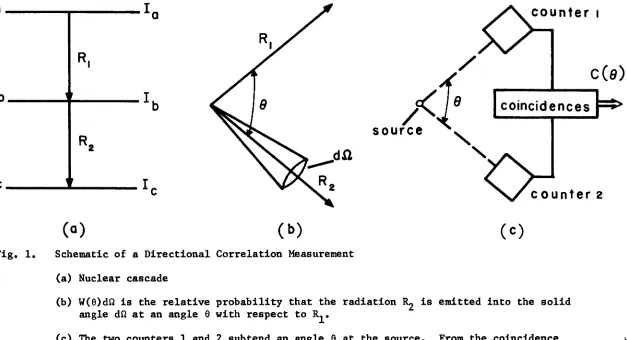
matrix elements I I and /o, first-forbidden decay is governed by six
nuclear matrix elements. They are summarized in Table I together
with their selection rules.
C. The Kurie Plot
In the theory of beta decay the probability N(n)dn that a
beta ray w ith momentum between n and n + dn will be emitted in unit
time can be written as:
N(n)dn " Constant • C(W)n2F(Z,n)(Wq - W)^dn (15)
2
2
where: W ■ m / m • (E + m c )/ m e
o o o
E ■ Kinetic energy of beta particles
W0 * Beta disintegration energy
F(z,n) • Coulomb Correction Factor
C(W) ■ Shape Correction Factor
Equation (15) can be rewritten in the following form:
[ N(n)/n2C(W)F(Z,n) ■ Constant • (WQ - W) (16)
Therefore a straight line results when the quantity [N(n)/n2C(W)F(Z,n)
is plotted against a linear scale of beta ray energy W. Such graphs
are called Kurie plots or Fermi plots. They are especially useful for
revealing deviations from the theory and for obtaining the upper energy
TABLE I
Allowed and First-Forbidden Nuclear Matrix Elements and Their Selection
Rules ( A is the Total Angular Momentum of the Lepton Field:
AI = 11± - If | <_ A <_ I± + I f
Where If and If Stand for the Initial and Final Nuclear Spins in the
Beta D ecay).
Matrix Element A AI TTfTTf
Allowed
V
1
0 0 + 1v ° 1 0,± 1
(0 ' /■>())
+ 1
First Forbidden
v ° - r
0 0 -1
-Cy/ia
- C v /r
C./ioxr A
1 0 , ± 1
(0- f *0)
-1
V Bij
2 0,±1,±2 (0-/-*0)( l - f » l )
2 2
24
energy axis.
The shape correction factor for all allowed transitions is a
constant. Although it is found that many first-forbidden spectra
have the allowed shape (C(W) * constant), it m ay occur that, for certain
first-forbidden transitions. C(W) is an energy dependent quantity. If
1
such is the case, a plot of [N(n)/n^F(Z.n)]2 vs. energy W will not yield
a straight line.
In general, the shape correction factor C(W) and the angular
correlation coefficient A k (W) in the 3 - y angular correlation function:
W 6 - Y ( 0 *W) “ E Ak (W)Pk (cos 9) k
are complicated functions of the individual nuclear m atrix elements (1).
In principle, a comparison of the experimentally determined functions
C(W) and A k (W) wi t h the theoretically predicted functions
c' ( W)
andt
A k (W) for various combinations of the nuclear matrix elements permits a
unique determination of the matrix elements involved in the beta
transition. In practice, however, a unique determination of the matrix
elements is difficult to achieve due to the limitations imposed by
experimental errors. At best, one can hope to estimate the values of
DESCRIPTION OF THE APPARATUS
A. The Coincidence Spectrometer
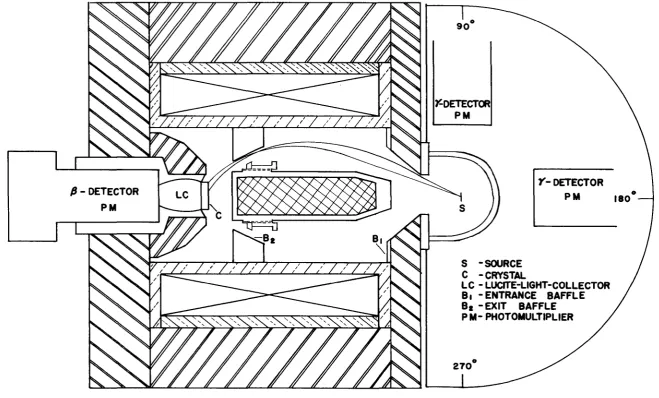
The coincidence spectrometer used for the beta-gamma directional
correlation measurements on Re*®** and Re*-®® is due to T.R. Gerholm (14).
A schematic of the electron-gamma directional correlation spectrometer
is given in Fig. 2.
Magnetic momentum selection is provided in the electron channel
which consists of an iron encapsuled long lens beta ray spectrometer with
"triangular field focussing". The triangular field distribution is
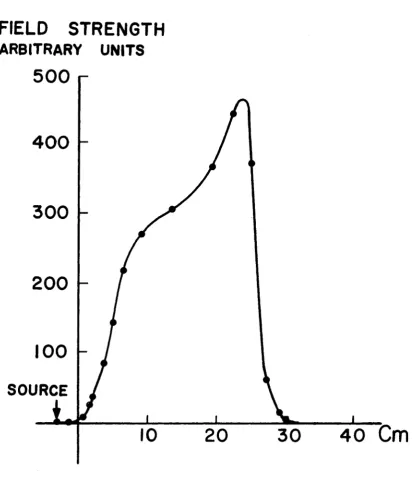
depicted in Fig. 3. Magnetic field measurements show that the source
is in a field free region and that the strength of the magnetic field
increases roughly linearly with increasing distance from the source when
measured along the axis of symmetry. Theoretical as well as experimental
studies of this field distribution show that it gives a favourably high
luminosity (source area x transmission) which compensates for the small
geometrical dimensions of the instrument. Fairly large sources ($ 5mm.)
can be used without sacrifice in resolution (relative width at half
-maximum) the latter being about 3% at a transmission (effective solid
angle in percent of 4ir) of about 1.8% for the arrangement utilized in
our measurements.
For the electron optics a somewhat modified version of the
Hubert ring focus baffle system is used. The envelope baffle consists
Re pro du ced w ith pe rm is s io n of th e co py ri gh t o w ne r. Fu rthe r re production p ro h ib it e d w it ho ut p e rm is s io n .
^DETECTOR
P M
r - DETECTOR
0
- DETECTOR
P M
S -SOURCE
C -CRYSTAL
FIELD
STRENGTH
a r b i t r a r y
u n i t s
500
400
300
200
1 0 0
SOURCE
40
Cm
20
30
Fig. 3. Triangular field distribution for the Gerholm instrument
28
of a cone and the internal baffle of an axially variable disc. As is
shown in Fig. 2 ( this disc baffle defines the extreme rays. It therefore
determines the mean angle of emission as well as the acceptance solid
angle (transmission).
The beta detector consists of a plastic phosphor, in the shape
of a disc, cemented onto a lucite light collector, of ellipsoidal shape,
optically coupled to the central part of the photocathode of a 56-AVP
photomultiplier tube. The scintillator is covered by a thin layer of
M g O serving as a light reflector. The light collector acts as a light
guide and renders it possible to obtain the required magnetic shielding.
The gamma detectors are provided with magnetic shielding
through the use of Netic and Co-Netic wrapping materials. Each gamma
detector consists of a Nal(Tl) scintillation crystal optically coupled
to the photocathode of a 56-AVP photomultiplier tube. A 1 3/A" x 2"
crystal and a 2" x 2" crystal were utilized.
The gamma detectors are mounted at a fixed angle of 90° to one
another on a movable arm which rests on the semicircular angular
correlation table. The arm can be rotated through an angle of 90° about
the source center. The physical arrangement is such that one detector
(denoted the y-1 probe) can be set at either the 270° or the 180°
position, while the other detector (denoted the y - 2 probe) can be set
at either the 180° or the 90° position. Rotation of the movable arm is
accomplished via automatic probe positioning circuitry (15)
on thin aluminum rings. These rings are placed in a pedistal holder
which slides against the source facing surface of the spectrometer
iron flange.
Adjustments are provided for aligning the source with the
symmetry axis of the baffle system and for aligning the center of
rotation of the gamma detectors with the center of the source.
The vacuum system for the spectrometer is a very simple one.
Operating pressures may be reached after five minutes of pumping.
B. The Coincidence Circuit
The coincidence circuit used for the beta-gamma correlation
measurements is a slightly modified version of the "fast-slow" coincidence
circuit due to Bell, Graham and Petch (16). The circuit was set up as
shown in the block diagram of Fig. 4.
The outputs of the detectors are divided into a slow and a
fast channel. The slow channel provides for pulse amplitude selection
for each pulse train while the fast channel provides for time selection
by performing the coincidence function on pulses unselected as to
amplitude.
The detectors utilize high-gain 56-AVP photomultipliers. The
gain of this tube when operated at 200 0 volts is sufficient to ensure
that the limiter (404-A pentode) will be cut off by the very first part
of each pulse from the anode of the photomultiplier. The limited output
pulses from the anode of the 404-A limiter are immediately shaped into
Re pro du ced w ith pe rm is s io n of th e co py ri gh t o w ne r. Fu rthe r re production p ro h ib ite d wi th ou t p e rm is s io n . SLOW FAST PROBE SLOW FAST DETECTOR SLOW FAST PROBE CLIPPING CABLE CLIPPING CABLE CLIPPING CABLE
p r-i
STABILIZER STABILIZER4 0 4 -A LIMITER
of a short-circuited clipping cable with a transit time t
/2.
The widthof these pulses essentially determines the resolving time 2t of the fast
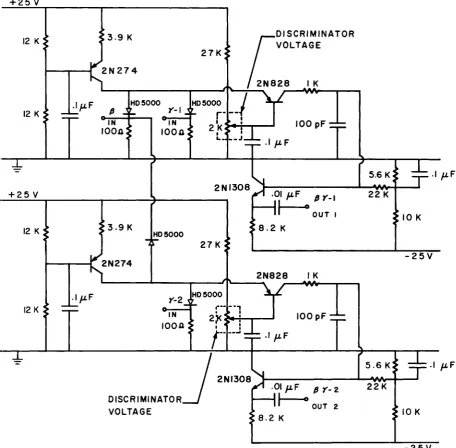
coincidence circuit (Fig. 5). This circuit gives an output pulse for
and Y2” B coincidences only. The output from the fast coincidence
circuit is fed to the slow triple coincidence circuit.
The slow p u l s e s , which contain the pulse height information,
are taken from a dynode near the anode of the photomultiplier. The
gamma pulses are routed through a "spectrum stabilizer" (17) which
"locks-on" the photopeak and thus provides for drift-free measurements.
These pulses are then amplified, passed through a single channel
analyser, and fed to the triple coincidence circuit and to a scaler.
The slow beta pulse train is treated in an identical manner wit h the
exception that it is not routed through the stabilizer.
The output from the triple coincidence circuit is fed to a
scaler. The outputs from all the scalers are fed simultaneously to a
Victor Printer (Model 12-10-321) and to a Tally Tape Perforator (Type 420).
The process of setting up the circuit for an experiment involves
the following steps. First, each spectrometer is set on the position
of the spectrum to be investigated. With the cables in the fast channels
adjusted to approximate values, a discriminator voltage curve Fig. 6,
is taken. This curve consists of a plot of the triples count rate versus
discriminator voltage (Fig. 5). The discriminator voltage operating
point is chosen in the center of the plateau thus assuring that the fast
coincidence circuit produces an output for coincidence pulses only.
32
+ 2 5 V
D I S C R I M I N A T O R V O L T A G E
2 N 2 7 4
2 N 8 2 8
-W\r
HD5000 HD5000
r
- 1 12 Ki o o p F r =
•' H - r
5.6 K
—AAAr
22 K 2 N I3 0 8
.01 f t F
+ 2 5 V T-l
OUT I
3 .9 K
12 K HD 5000
2 7 K
\\
- 2 5 V 2N 274
2N 8 2 8
HD5000
.1 p .F
5 .6 K
—
WNr-22 K 2N I308
D I S C R I M I N A T O R ,
V O L T A G E OUT 2
- 2 5 V
radiations which produce the coincidences and therefore this setting
need not be changed throughout an experiment. With the discriminator
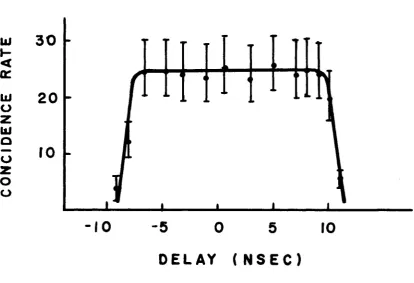
voltage properly set, a resolution curve such as Fig. 7, is obtained by
altering the lengths of the cables between the photomultipliers and the
fast coincidence unit. In order to obtain 100Z coincidence efficiency
it is essential that the resolution curve have a flat top and that the
operating point be chosen near the center of this region. The width
of the resolution curve at half-maximum gives the approximate value of
the resolving time
2t
of the coincidence circuit. An accurate determinationof the resolving time is obtained from the relation:
2
t- N^NgNy
(17)
where Ng - beta singles rate
Ny ■ gamma singles rate
and where N c is the chance coincidence rate, obtained by interposing a
long delay (=100 nsec.) in the beta fast channel and observing the
resulting coincidence rate. As a check on the constancy of
2
t over longperiods of time, the chance rate N c was monitored regularly in the
course of each experiment. In the angular correlation experiments to be
described in Chapter V and Chapter VI resolving times of
15
and20
nsec.were used for the
Y-l
andY~2
probes respectively.C. Geometrical Correction Factors
The finite solid angles subtended by the gamma and electron
detectors result in a smearing out of the angular correlation. Conse
C
O
N
C
ID
E
N
C
E
R
A
T
E
C
O
IN
C
ID
E
N
C
E
R
A
T
E
34
60
40
20
0.7
0.8
0.9
1.0
l.l1.2
DISCRIMINATOR S E T T IN G <VO LTS )
Fig. 6. Discriminator voltage curve.
30
20
1 0
1 0
5
0slightly £rom W(0) as given in equation (2) Chapter II. The experimentally
measured directional correlation becomes:
W e x p . (0) " 1 + f2A 2P 2 (cO80) (18)
The factor f2 is always less than unity and represents the smearing out
of the angular correlation pattern due to the finite apertures in the
two channels. This factor must be applied to the experimental results
and should be known to better than 1%.
The correction factor f2 may be written as a product:
f2 - f2( 0 • f200 < 1
(19)
f2 (Y) is the correction factor for the gamma channel and refers to either
the "photopeak" correction factor or the "whole spectrum" correction
factor, the choice of one or the other depending on the experimental
procedure employed. These correction factors may be easily determined
from published graphs (18) and tables (19). Under normal circumstances
f2 (Y) is fairly close to unity and therefore a minor error in this
correction factor does not seriously affect the experimental results.
For the directional correlation measurements described in this thesis the
"photopeak" correction factor is required. However, at the low gamma
energies of 137-Kev and 155-Kev in Rel®^ and Re^®® respectively, the
"photopeak" and "whole spectrum" correction factors are indistinguishable
and hence, for convenience, the "whole spectrum" correction factors due
to West (18) were utilized. For the directional correlations to be
described in Chapter V, the values of f2( y ) obtained were:
f2 (y) - 0,957 (y-2 Probe : 2" x 2" crystal)