A Novel Watermarking Technique Based on the
Discrete Wavelet Transform and Modified SVD
Rupali Nayyar 1, Randhir Singh 2, Ritika 3
M.Tech Student, Department of ECE, S.S.C.E.T, Badhani, Pathankot, India1
Associate Professor (HOD), Department of ECE, S.S.C.E.T, Badhani, Pathankot, India2
Assistant Professor, Department ofECE, S.S.C.E.T, Badhani, Pathankot, India3
ABSTRACT: Watermarking is the process to cover some information that is called watermark or tag into the first data such that watermark can be extracted or noticed later to produce an assertion concerning the object. The audio watermarking schemes have now been widely used to fix the copyright defence issues of digital audio related to illegal application or distribution. This paper proposes the robustness and imperceptibility characteristics of a good watermarking algorithm by greatly improving the visual quality of the watermarked audio and being robust against common signal processing operations and attacks. Also the watermark scrambling by using the Arnold transform is used to protect watermark further. Arnold transform has changed the watermark in such a way that it becomes meaningless for the hackers or crackers. Various kind of multiple attacks are also considered to evaluate the effectiveness of the proposed technique.
KEYWORDS: Audio Signal, DCT, Arnold Transform, and Digital Audio Watermarking Technique.
I. INTRODUCTION
Audio watermarking involves a process of embedding into host audio signal a perceptually transparent digital signature, carrying a message about the host data in order to mark its ownership. The aim in watermarking systems is to ensure the robustness of the hidden message; the presence of the embedded message itself does not have to be secret [11]. The watermark is always present in the signal, even in illegal copies of it and the protection that is offered by the watermarking system is therefore of a permanent kind. The word steganography was originated from greek which means covered writing. Steganography is the oldest form of covert channel [12] . Depending upon the cover multimedia object for embedding the propriety information, the watermarking schemes are categorized as audio, video, image or text watermarking. Watermarking of audio media is far more challenging as compared to any other type of media (viz. Image, video etc) .the reason is the wide dynamic range of audio signal as compared to the others. In addition, the human auditory system (has) is far more complex. The has perceives sounds over a wide range of frequencies from an order of hertz to kilo hertz. In terms of the power this range is of the order of power of 10. The sensitivity of the has to the additive gaussian noise is high as well which implies that a small disturbance at some frequency will be audible to the ear [13] . So it’s a big challenge to embed information without making any perceptual change in the audio. The typical audio watermarking scheme comprises of two modules: one is the encoding/embedding module which is used to embed watermark without degrading the quality of the resultant audio produced which is called the watermarked audio. The second module is the decoding/extraction/detection module which requires the watermarked audio as an input to extract/detect the watermark.
Watermarking techniques
2. Discrete Wavelet Transform: The DWT is just something of filters. You will get two filters included, one could be the “wavelet filter”, and the other could be the “scaling filter” .The wavelet filtration is just a large go filtration, as the scaling filtration is just a low go filter. After using a 1-level DWT on a picture, we've the approximation sub-band LL, the exterior sub-band LH, the straight sub-band HL, and the diagonal sub-band HH. Moreover, if we wish to use a 2-level DWT on the picture, we just only use still another 1-2-level DWT on the approximation sub-band LL. DWT is preferred, because it provides equally a parallel spatial localization and a volume distribute of the watermark within the host picture.
3. Arnold Transformation: Image scrambling discovers change of the picture, which rearranges the spatial position of the pixels relating to some axioms, and makes picture distortion for the goal of security. Arnold change is applied to battle watermarking image. This is a change proposed by Arnold in his erotic theory named cat-face transformation.
II. RELATED WORK
Wei FOO et al. (2001)[1]offered an flexible algorithm for audio watermarking which uses match hiding method. The algorithm has been split into two parts—encoder style and decoder design. In the encoder section, segmentation is performed on the original audio signal.
Seok et al. (2002)[2]mentioned the basic needs required for sound watermarking algorithm. An algorithm applying Primary Routine Distribute Selection (DSSS) has been discussed. This algorithm requires benefit of the masking convenience of HAS. This removal is blind strategy which employs brightening procedure.
Tsai et al. (2003) [3] planned a smart sound watermarking algorithm that is depends upon the houses of Individual Auditory System(HAS). It uses the techniques contained in Neural communities as properly and works in DCT domain. This is a blind sound watermarking technique.
Cvejic et al. (2003) [4] gave a algorithm in 2003 which will be also on the basis of the wavelet domain. Music indicates is inputted in to the filtration to acquire the wavelet coefficients. Simultaneously, it's passed on for masking examination as well to determine where in actuality the embedding of the watermark can be done.
In- Kwon Yeo et al. (2003) [5] presented the modified patchwork algorithm (MPA), a statistical technique for an audio watermarking algorithm in the transform (not only discrete cosine transform (DCT), but also DFT and DWT) domain. The MPA is an enhanced version of the conventional patchwork algorithms.
Sriyingyong et al. (2006) [6] offered an algorithm which employs DWT alongside Adaptive Tabu Search (ATS). ATS maintains logs of all measures beginning research to solution. It even has capacity of doing backtracking. Binary picture is developed into 1-D matrix and then encrypted. Sound indicates is decomposed.
Shijun Xiang et al. (2007)[7] present a multibit robust audio watermarking solution for such a problem by using the insensitivity of the audio histogram shape and the modified mean to TSM and cropping operations. We address the insensitivity property in both mathematical analysis and experimental testing by representing the histogram shape as the relative relations in the number of samples among groups of three neighboring bins.
Ercelebi et al. (2009) [8] put ahead an algorithm for audio watermarking by which watermark is embedded in the reduced frequency element of the audio signal. In raising centred implementation of DWT has been used. The watermark is embedded in reduced frequency approximation coefficients which match high energy.
Yan yang et al. (2009) [9] offered a story music watermarking algorithm. This Algorithm uses DCT transform. The electronic music indicates after subjection is altered applying DCT transform. Simultaneously, binary image is paid down dimensionally and transferred through pseudo-random compositor. The turned image is stuck into the altered music indicate where Inverse DCT algorithm is applied and watermarked music indicate is obtained.
Vivekananda Bhat k et al. (2010) [10] presents a secure, robust, and blind adaptive audio watermarking algorithm based on singular value decomposition (SVD) in the discrete wavelet transform domain using synchronization code. In our algorithm, a watermark is embedded by applying a quantization-index-modulation process on the singular values in the SVD of the wavelet domain blocks. The watermarked signal is perceptually similar to the original audio signal and gives high quality output
Lalitha et al. (2011) [11] proposed an algorithm which uses DWT-SVD technique of audio-watermarking. The DCT-SVD has been compared with DWT-DCT-SVD as well. The DWT-DCT-SVD algorithm proves to be more robust than DCT-DCT-SVD algorithm.
Bai Ying Lei et al. (2011) [13] propose a new, blind and robust audio watermarking scheme based on SVD–DCT with the synchronization code technique. We embed a binary watermark into the high-frequency band of the SVD–DCT block blindly. Chaotic sequence is adopted as the synchronization code and inserted into the host signal.
Singhal et al. (2011) [14] proposed an algorithm which employs multilevel wavelet decomposition alongside DCT and SVD methodology. Multi-level haar wavelet decomposition is applied following framing the original music signal. After rearranging the approximation coefficient, DCT-SVD is applied and watermark is embedded.
Lalitha et al. (2013) [15] proposed a DWT-Arnold transform centered music watermarking algorithm. Following sampling and dividing the music signal, DWT is applied on the initial music signal to provides facts and approximation sub-bands. Following applying Arnold transform alongside DWT on the picture, it's stuck into the developed music signal.
III.PROPOSEDALGORITHM
RESULTS METHODOLOGY
Watermark Embedding Process:
Step1. Take input cover audio and input watermark image.
Step2. Apply DWT on input cover audio. On other side perform Arnold transform. Step3. Compute the Low layer of the high frequency subband HH of the input cover audio. Step4. Apply SVD to input cover audio for further decompose and extract the singular values.
Step5. Perform Arnold transform on SVD by using input watermark image. This transform gives the Scrambled watermark.
Step6.After Arnold Transform, apply SVD on the scrambled watermark.
Step7. Modify the singular value of decomposed input cover audio with singular value of the scrambled watermark using scaling factor.
Step8. Combine the orthogonal matrix of the input cover image with the modified singular matrix of the scrambled watermark.
Step9. Compute the inverse SVD and apply an inverse DWT to the decomposed audio, using scrambled watermark to get the watermarked audio.
Watermark Extraction Process:
Step1. The Received watermarked audio consider without attack.
Step2. Take DWT of the watermarked audio and calculate the values of bands. Step3. Extract high frequency subband i.e. HH.
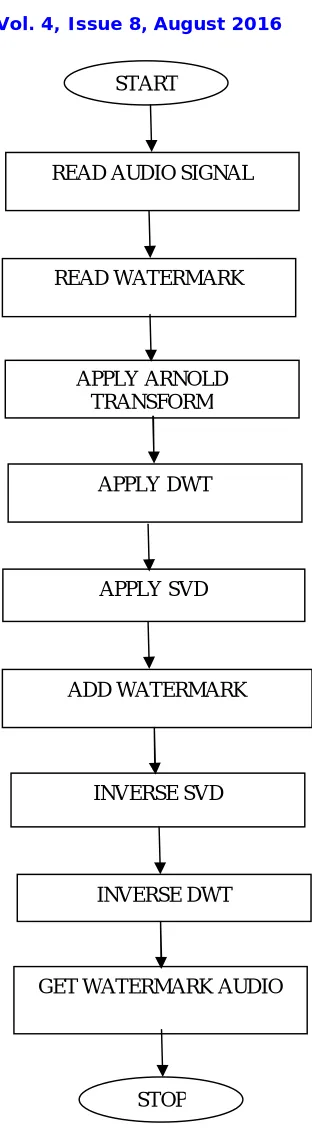
Fig 1: Methodology of the work
START
READ AUDIO SIGNAL
READ WATERMARK
APPLY ARNOLD TRANSFORM
APPLY DWT
APPLY SVD
ADD WATERMARK
INVERSE DWT INVERSE SVD
GET WATERMARK AUDIO
IV.SIMULATIONRESULTS
PERFORMANCE ANALYSIS
This paper has designed and implemented the proposed technique in MATLAB tool u2013a. Some well-known audio performance parameters for digital audios have already been selected to prove that the performance of the proposed algorithm is very much better than the existing methods.
A comparison is drawn between the parameters and a respective tables and figure shows all the results. A. Root Mean Square Error Evaluation
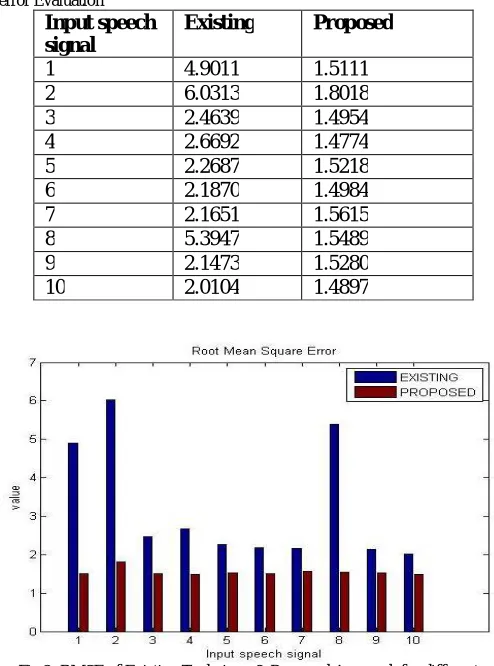
As root mean square error have to be reduced which means proposed algorithm is showing the better results compared to the available methods as root mean square error is less in all cases. Table 1 has clearly shown that the RMSE is minimum in the case of the proposed algorithm therefore proposed algorithm provides better results compared to the available methods.
Table1. Root Mean Square error Evaluation Input speech signal
Existing Proposed
1 4.9011 1.5111
2 6.0313 1.8018
3 2.4639 1.4954
4 2.6692 1.4774
5 2.2687 1.5218
6 2.1870 1.4984
7 2.1651 1.5615
8 5.3947 1.5489
9 2.1473 1.5280
10 2.0104 1.4897
Fig 2: RMSE of Existing Technique & Proposed Approach for different audios
Fig 2 shows the quantized analysis of root mean square error of various audios using watermarking by Existing Technique (Blue color) and watermarking by Proposed Approach (Red Color). It has clearly shown from the table that there's decrease in RMSE values of audios with the usage of proposed method around other methods in all the audios. This decrease represents improvement in the objective quality of the audio.
B. Bit Error Rate Evaluation
Table2: Bit Error Rate Evaluation
Input speech
signal
Existing
Proposed
1 0.0487 0.0244
2 0.0591 0.0264
3 0.0308 0.0243
4 0.0322 0.0242
5 0.0295 0.0245
6 0.0290 0.0243
7 0.0288 0.0248
8 0.0530 0.0247
9 0.0287 0.0245
10 0.0278 0.0243
Fig 3: BER of Existing Technique & Proposed Approach for different audios
Figure 3 shows the quantized evaluation of the bit error rate of various audios using watermarking by Existing Technique (Blue color) and watermarking by Proposed Approach (Red Color). It has clearly shown from the plot that there is decrease in BER value of audios with the usage of proposed technique around other methods in all the audios. This decrease represents improvement in the objective quality of the audio.
C. Structural Similarity Index Metric
As SSIM have to be maximized; so the main aim is to increase the SSIM. Table 3 has clearly shown that the SSIM is maximum in case of the proposed algorithm thus proposed algorithm provides better results compared to the available methods.
Table3: Structural Similarity Index Metric
Input speech
signal
Existing
Proposed
1 0.9513 0.9756
2 0.9409 0.9736
3 0.9692 0.9757
4 0.9678 0.9758
5 0.9705 0.9755
6 0.9710 0.9757
7 0.9712 0.9752
8 0.9470 0.9753
9 0.9713 0.9755
10 0.9722 0.9757
Fig 4: SSIM of Existing Technique & Proposed Approach for different audios
Figure 4 indicates the quantized analysis of the Structural Similarity Index Metric of different audios using watermarking by Existing Technique (Blue Color) and watermarking by Proposed Approach (Red Color). It has clearly shown from the table that there's increase in SSIM values of audios with the usage of proposed method over other methods. This increase represents the improvement in the objective quality of the audio signal.
V. CONCLUSION AND FUTURE WORK
The actual watermarking programmers have already been trusted to fix typically the right of first publication safeguards challenges from electronic persona relating to illegal practice and distribution. A new watermarking technique based on the wavelet domain in combination with the Fast Fourier transform and Arnold transform based SVD has been proposed. This algorithm combines the advantages of these three transforms, therefore have more robust results. The algorithm can help satisfy the robustness and imperceptibility characteristics of a good watermarking algorithm Also the watermark scrambling by using the Arnold transform is used to protect watermark further. Arnold transform has changed the watermark in such a way that it becomes meaningless for the hackers or crackers. Various kind of multiple attacks are also considered to evaluate the effectiveness of the proposed technique. The proposed technique is designed in MATLAB tool with the help of audio processing toolbox. The experiments have clearly shown that the proposed technique outperforms over the available techniques.
REFERENCES
1. X. Yang, J. Liu, F. Zhao, and N. Vaidya, “A vehicle-to-vehicle communication protocol for cooperative collision warning,” in Proc. Int. Conf. MobiQuitous, pp. 114–123,2004.
2. Zhao, J.; Cao, G. (2006), "VADD: Vehicle Assisted Data Delivery in Vehicular Ad Hoc Networks,"INFOCOM 2006. 25th IEEE International Conference on Computer Communications. Proceedings, vol., no., pp.1-12, 2006.
3. Naumov, Valery, Rainer Baumann, and Thomas Gross. "An evaluation of inter-vehicle ad hoc networks based on realistic vehicular traces." InProceedings of the 7th ACM international symposium on Mobile ad hoc networking and computing, pp. 108-119. ACM, 2006.
4. M. Dorigo, M. Birattari and T. Stutzle, "Ant Colony Optimization: Artificial Ants as A Computational Intelligence Technique," IEEE Computational Intelligence Magazine, vol. 1, no. 4, pp. 28-39, 2006.
5. Jerbi, M., Senouci, S.-M., Meraihi, R., and Ghamri-Doudane, Y., “An improved vehicular ad hoc routing protocol for city environments,” Communications, ICC ’07. IEEE InternationalConference, pp. 3972–3979, 2007.
6. Toor Y, Muhlethaler P, Laouiti A. Vehicle ad hoc networks: applications and related technical issues. Communications Surveys & Tutorials, IEEE, pp:74-88, 2008.
7. F. J. Ros, V. Cabrera, J. A. Sanchez, J.A. Martinez and P. M. Ruiz, "Routing in Vehicular Networks," in Vehicular Networks Techniques, Standards, and Applications, eds. H. Moustafa and Y. Zhang, Auerbach Publications, US, pp. 109-14, 2009.
8. Liu Y, Bi J, Yang J. Research on vehicular ad hoc networks. InControl and Decision Conference, 2009. CCDC'09. Chinese 2009 Jun 17 (pp. 4430-4435). IEEE.
9. Härri J, Filali F, Bonnet C. Mobility models for vehicular ad hoc networks: a survey and taxonomy. Communications Surveys & Tutorials, IEEE, pp:19-41, 2009.
10. Moustafa, Hassnaa, Sidi Mohammed Senouci, and Moez Jerbi. "Introduction to vehicular networks." Vehicular Networks, 2009.
11. Shrestha, R.K., Moh, S., Chung, I. and Choi, D” Vertex-based multihop vehicle-to-infrastructure routing for vehicular ad hoc networks. In hicss (pp. 1-7). IEEE. "Vertex-Based Multihop Vehicle-to-Infrastructure Routing for Vehicular Ad Hoc Networks (26458)," 2010.
12. Kohli, Sandhaya, Bandanjot Kaur, and Sabina Bindra. "A comparative study of Routing Protocols in VANET." Proceedings of ISCET , 2010. 13. S. C. Ng, W. Zhang, Y. Zhang, Y. Yang and G. Mao, "Analysis of Access and Connectivity Probabilities in Vehicular Relay Networks," IEEE
Journal on Selected Areas in Communications, vol. 29, no. 1, pp. 140-150, 2011.
14. Kim JH, Lee S. Reliable routing protocol for vehicular ad hoc networks. AEU-International Journal of Electronics and Communications, pp:268-71, 2011.
15. Venkata, M. D., MM Manohara Pai, Radhika M. Pai, and Joseph Mouzna. "Traffic monitoring and routing in VANETs—A cluster based approach." In ITS Telecommunications (ITST), 2011 11th International Conference on, pp. 27-32. IEEE, 2011.
16. Sharma, Yatendra Mohan, and Dr Saurabh Mukherjee."A Contemporary Proportional Exploration of Numerous Routing Protocols in VANET."International Journal of Computer Applications, pp: 0975–8887, 2012.
17. S. Balaji, S. Sureshkumar and G. Saravanan, “Cluster Based Ant Colony Optimization Routing for Vehicular Ad hoc Networks,” International Journal of Scientific & Engineering Research, vol. 4, no. 6, pp. 26-30, 2013.
18. Kabir, Md Humayun. "Research Issues on Vehicular Ad hoc Network."International Journal of Engineering Trends and Technology (IJETT)– Volume 6, 2013.
19. Kazemi, Babak, Masoumeh Ahmadi, and Siamak Talebi. "Optimum and reliable routing in VANETs: An opposition sbased ant colony algorithm scheme." In Connected Vehicles and Expo (ICCVE), 2013 International Conference on, pp. 926-930. IEEE, 2013.
20. Manchanda Puneet and Bangar Parvinder.”Modified AODV-R Routing Protocol.” International Journal of Engineering, Applied and Management Sciences Paradigms, Vol. 16,pp:2320-6608,2014.
21. Y. Xiang, I. Natgunanathan, S. Guo, W. Zhou and S. Nahavandi, "Patchwork-Based Audio Watermarking Method Robust to De-synchronization Attacks," in IEEE/ACM Transactions on Audio, Speech, and Language Processing, vol. 22, no. 9, pp. 1413-1423, 2014. 22. Hu, Hwai-Tsu, and Ling-Yuan Hsu. "Robust, transparent and high-capacity audio watermarking in DCT domain." Signal Processing, pp:
226-235, 2015.
23. S. Roy, N. Sarkar, A. K. Chowdhury and S. M. A. Iqbal, "An efficient and blind audio watermarking technique in DCT domain," 2015 18th International Conference on Computer and Information Technology (ICCIT), Dhaka, pp. 362-367, 2015.
24. Ito, Toshiki, et al. "Audio Watermarking Using Different Wavelet Filters."International Workshop on Digital Watermarking. Springer International Publishing, 2015.
25. Dhar, Pranab Kumar, and Tetsuya Shimamura. "Blind SVD-based audio watermarking using entropy and log-polar transformation." Journal of Information Security and Applications, pp: 74-83,2015.
BIOGRAPHY
Er. Rupali Nayyar received the B.Tech degree from PTU, Punjab in Electronics & communication engineering and pursuing M.Tech in ECE from PTU, Punjab.
Er. Randhir Singh received his B. E. degree in Electronics Engineering from Dr. Babasahib Ambedkar Marathwada University, Aurangabad, India, in 1997 and M. Tech. degree in Electronics and Communication Engineering from Punjab Technical University (PTU), Kapurthala, Punjab, India, in 2009. He is currently a Ph.D. research scholar in PTU, Kapurthala.
He joined the department of Electronics and Communication Engineering, Sri Sai College of Engineering and Technology, Pathankot, in 2004. Presently, he is an Associate Professor and Head of the Department. His research interests include digital signal processing, speech signal processing, image processing, and electronics system designing. He has more than 50 research papers to his credit. He has a wide experience of guiding M.Tech. students.