V
OLUMEN
O.
9
(2019),
I
SSUEN
O.
04
(A
PRIL)
ISSN 2231-5756
A Monthly Double-Blind Peer Reviewed (Refereed/Juried) Open Access International e-Journal - Included in the International Serial Directories
Indexed & Listed at:
V
OLUMEN
O.
9
(2019),
I
SSUEN
O.
04
(A
PRIL)
ISSN 2231-5756
CONTENTS
Sr.
No.
TITLE & NAME OF THE AUTHOR (S)
Page
No.
1
.
AVAILABILITY OF EDUCATION LOAN IN INDIA - A CRITICAL STUDY: WITH
SPECIAL REFERENCE TO STATE BANK OF INDIA
Dr. N. N. PANDEY
1
2
.
WORD OF MOUTH MARKETING AND ITS IMPACT ON ONLINE SHOPPING
Dr. REENA MODI
6
3
.
PROBLEMS AND PROSPECTS OF SMALL AND MEDIUM ENTERPRISES (SMEs)
IN WARANGAL URBAN DISTRICT – A STUDY
K.SIGMATEENA & J. PRANEETHA
12
4
.
ROLE OF ORGANIZED RETAILERS IN DEVELOPING AGRICULTURE PRODUCE
MARKETS - A CRITICAL EVALUATION OF FRUITS AND VEGETABLES MARKET
Dr. SUMATHI.K & SUJATHA.K
15
5
.
A STUDY OF WORK LIFE BALANCE AMONG PROFESSIONAL WOMEN
RENU SINDHU
19
V
OLUMEN
O.
9
(2019),
I
SSUEN
O.
04
(A
PRIL)
ISSN 2231-5756
FOUNDER PATRON
Late Sh. RAM BHAJAN AGGARWAL
Former State Minister for Home & Tourism, Government of Haryana
Former Vice-President, Dadri Education Society, Charkhi Dadri
Former President, Chinar Syntex Ltd. (Textile Mills), Bhiwani
CO-ORDINATOR
Dr. BHAVET
Former Faculty, Shree Ram Institute of Engineering & Technology, Urjani
ADVISOR
Prof. S. L. MAHANDRU
Principal (Retd.), Maharaja Agrasen College, Jagadhri
EDITOR
Dr. PARVEEN KUMAR
Professor, Department of Computer Science, NIMS University, Jaipur
CO-EDITOR
Dr. A. SASI KUMAR
Professor, Vels Institute of Science, Technology & Advanced Studies (Deemed to be University), Pallavaram
EDITORIAL ADVISORY BOARD
Dr. S. P. TIWARI
Head, Department of Economics & Rural Development, Dr. Ram Manohar Lohia Avadh University, Faizabad
Dr. CHRISTIAN EHIOBUCHE
Professor of Global Business/Management, Larry L Luing School of Business, Berkeley College, USA
Dr. SIKANDER KUMAR
Vice Chancellor, Himachal Pradesh University, Shimla, Himachal Pradesh
Dr. JOSÉ G. VARGAS-HERNÁNDEZ
Research Professor, University Center for Economic & Managerial Sciences, University of Guadalajara,
Guadala-jara, Mexico
Dr. TEGUH WIDODO
Dean, Faculty of Applied Science, Telkom University, Bandung Technoplex, Jl. Telekomunikasi, Indonesia
Dr. M. S. SENAM RAJU
Professor, School of Management Studies, I.G.N.O.U., New Delhi
Dr. A SAJEEVAN RAO
Professor & Director, Accurate Institute of Advanced Management, Greater Noida
Dr. D. S. CHAUBEY
Professor & Dean (Research & Studies), Uttaranchal University, Dehradun
Dr. CLIFFORD OBIYO OFURUM
Professor of Accounting & Finance, Faculty of Management Sciences, University of Port Harcourt, Nigeria
Dr. KAUP MOHAMED
Dean & Managing Director, London American City College/ICBEST, United Arab Emirates
Dr. VIRENDRA KUMAR SHRIVASTAVA
Director, Asia Pacific Institute of Information Technology, Panipat
Dr. MIKE AMUHAYA IRAVO
Principal, Jomo Kenyatta University of Agriculture & Tech., Westlands Campus, Nairobi-Kenya
Dr. SYED TABASSUM SULTANA
Principal, Matrusri Institute of Post Graduate Studies, Hyderabad
Dr. BOYINA RUPINI
Director, School of ITS, Indira Gandhi National Open University, New Delhi
Dr. NEPOMUCENO TIU
V
OLUMEN
O.
9
(2019),
I
SSUEN
O.
04
(A
PRIL)
ISSN 2231-5756
Dr. SANJIV MITTAL
Professor & Dean, University School of Management Studies, GGS Indraprastha University, Delhi
Dr. RAJENDER GUPTA
Convener, Board of Studies in Economics, University of Jammu, Jammu
Dr. SHIB SHANKAR ROY
Professor, Department of Marketing, University of Rajshahi, Rajshahi, Bangladesh
Dr. SRINIVAS MADISHETTI
Professor, School of Business, Mzumbe University, Tanzania
Dr. NAWAB ALI KHAN
Professor & Dean, Faculty of Commerce, Aligarh Muslim University, Aligarh, U.P.
MUDENDA COLLINS
Head, Operations & Supply Chain, School of Business, The Copperbelt University, Zambia
Dr. EGWAKHE A. JOHNSON
Professor & Director, Babcock Centre for Executive Development, Babcock University, Nigeria
Dr. A. SURYANARAYANA
Professor, Department of Business Management, Osmania University, Hyderabad
P. SARVAHARANA
Asst. Registrar, Indian Institute of Technology (IIT), Madras
Dr. MURAT DARÇIN
Associate Dean, Gendarmerie and Coast Guard Academy, Ankara, Turkey
Dr. ABHAY BANSAL
Head, Department of Information Technology, Amity School of Engg. & Tech., Amity University, Noida
Dr. YOUNOS VAKIL ALROAIA
Head of International Center, DOS in Management, Semnan Branch, Islamic Azad University, Semnan, Iran
WILLIAM NKOMO
Asst. Head of the Department, Faculty of Computing, Botho University, Francistown, Botswana
Dr. JAYASHREE SHANTARAM PATIL (DAKE)
Faculty in Economics, KPB Hinduja College of Commerce, Mumbai
SHASHI KHURANA
Associate Professor, S. M. S. Khalsa Lubana Girls College, Barara, Ambala
Dr. SEOW TA WEEA
Associate Professor, Universiti Tun Hussein Onn Malaysia, Parit Raja, Malaysia
Dr. OKAN VELI ŞAFAKLI
Professor & Dean, European University of Lefke, Lefke, Cyprus
Dr. MOHENDER KUMAR GUPTA
Associate Professor, Government College, Hodal
Dr. BORIS MILOVIC
Associate Professor, Faculty of Sport, Union Nikola Tesla University, Belgrade, Serbia
Dr. LALIT KUMAR
Course Director, Faculty of Financial Management, Haryana Institute of Public Administration, Gurugram
Dr. MOHAMMAD TALHA
Associate Professor, Department of Accounting & MIS, College of Industrial Management, King Fahd University
of Petroleum & Minerals, Dhahran, Saudi Arabia
Dr. V. SELVAM
Associate Professor, SSL, VIT University, Vellore
Dr. IQBAL THONSE HAWALDAR
Associate Professor, College of Business Administration, Kingdom University, Bahrain
Dr. PARDEEP AHLAWAT
Associate Professor, Institute of Management Studies & Research, Maharshi Dayanand University, Rohtak
V
OLUMEN
O.
9
(2019),
I
SSUEN
O.
04
(A
PRIL)
ISSN 2231-5756
Dr. ASHOK KUMAR CHAUHAN
Reader, Department of Economics, Kurukshetra University, Kurukshetra
Dr. BHAVET
Former Faculty, Shree Ram Institute of Engineering & Technology, Urjani
YU-BING WANG
Faculty, department of Marketing, Feng Chia University, Taichung, Taiwan
SURJEET SINGH
Faculty, Department of Computer Science, G. M. N. (P.G.) College, Ambala Cantt.
Dr. TITUS AMODU UMORU
Professor, Kwara State University, Kwara State, Nigeria
Dr. RAJESH MODI
Faculty, Yanbu Industrial College, Kingdom of Saudi Arabia
Dr. SAMBHAVNA
Faculty, I.I.T.M., Delhi
Dr. THAMPOE MANAGALESWARAN
Faculty, Vavuniya Campus, University of Jaffna, Sri Lanka
Dr. SHIVAKUMAR DEENE
Faculty, Dept. of Commerce, School of Business Studies, Central University of Karnataka, Gulbarga
SURAJ GAUDEL
BBA Program Coordinator, LA GRANDEE International College, Simalchaur - 8, Pokhara, Nepal
FORMER TECHNICAL ADVISOR
AMITA
FINANCIAL ADVISORS
DICKEN GOYAL
Advocate & Tax Adviser, Panchkula
NEENA
Investment Consultant, Chambaghat, Solan, Himachal Pradesh
LEGAL ADVISORS
JITENDER S. CHAHAL
Advocate, Punjab & Haryana High Court, Chandigarh U.T.
CHANDER BHUSHAN SHARMA
Advocate & Consultant, District Courts, Yamunanagar at Jagadhri
SUPERINTENDENT
V
OLUMEN
O.
9
(2019),
I
SSUEN
O.
04
(A
PRIL)
ISSN 2231-5756
CALL FOR MANUSCRIPTS
We invite unpublished novel, original, empirical and high quality research work pertaining to the recent developments & practices in the areas of Com-puter Science & Applications; Commerce; Business; Finance; Marketing; Human Resource Management; General Management; Banking; Economics; Tourism Administration & Management; Education; Law; Library & Information Science; Defence & Strategic Studies; Electronic Science; Corporate Gov-ernance; Industrial Relations; and emerging paradigms in allied subjects like Accounting; Accounting Information Systems; Accounting Theory & Practice; Auditing; Behavioral Accounting; Behavioral Economics; Corporate Finance; Cost Accounting; Econometrics; Economic Development; Economic History; Financial Institutions & Markets; Financial Services; Fiscal Policy; Government & Non Profit Accounting; Industrial Organization; International Economics & Trade; International Finance; Macro Economics; Micro Economics; Rural Economics; Co-operation; Demography: Development Planning; Development Studies; Applied Economics; Development Economics; Business Economics; Monetary Policy; Public Policy Economics; Real Estate; Regional Economics; Political Science; Continuing Education; Labour Welfare; Philosophy; Psychology; Sociology; Tax Accounting; Advertising & Promotion Management; Management Information Systems (MIS); Business Law; Public Responsibility & Ethics; Communication; Direct Marketing; E-Commerce; Global Business; Health Care Administration; Labour Relations & Human Resource Management; Marketing Research; Marketing Theory & Applications; Non-Profit Or-ganizations; Office Administration/Management; Operations Research/Statistics; Organizational Behavior & Theory; Organizational Development; Pro-duction/Operations; International Relations; Human Rights & Duties; Public Administration; Population Studies; Purchasing/Materials Management; Re-tailing; Sales/Selling; Services; Small Business Entrepreneurship; Strategic Management Policy; Technology/Innovation; Tourism & Hospitality; Transpor-tation Distribution; Algorithms; Artificial Intelligence; Compilers & Translation; Computer Aided Design (CAD); Computer Aided Manufacturing; Computer Graphics; Computer Organization & Architecture; Database Structures & Systems; Discrete Structures; Internet; Management Information Systems; Mod-eling & Simulation; Neural Systems/Neural Networks; Numerical Analysis/Scientific Computing; Object Oriented Programming; Operating Systems; Pro-gramming Languages; Robotics; Symbolic & Formal Logic; Web Design and emerging paradigms in allied subjects.
Anybody can submit the soft copy of unpublished novel; original; empirical and high quality research work/manuscriptanytime in M.S. Word format
after preparing the same as per our GUIDELINES FOR SUBMISSION; at our email address i.e. [email protected] or online by clicking the link online submission as given on our website (FOR ONLINE SUBMISSION, CLICK HERE).
GUIDELINES FOR SUBMISSION OF MANUSCRIPT
1. COVERING LETTER FOR SUBMISSION:
DATED: _____________
THE EDITOR
IJRCM
Subject: SUBMISSION OF MANUSCRIPT IN THE AREA OF______________________________________________________________.
(e.g. Finance/Mkt./HRM/General Mgt./Engineering/Economics/Computer/IT/ Education/Psychology/Law/Math/other, please specify)
DEAR SIR/MADAM
Please find my submission of manuscript titled ‘___________________________________________’ for likely publication in one of your journals.
I hereby affirm that the contents of this manuscript are original. Furthermore, it has neither been published anywhere in any language fully or partly, nor it is under review for publication elsewhere.
I affirm that all the co-authors of this manuscript have seen the submitted version of the manuscript and have agreed to inclusion of their names as co-authors.
Also, if my/our manuscript is accepted, I agree to comply with the formalities as given on the website of the journal. The Journal has discretion to publish our contribution in any of its journals.
NAME OF CORRESPONDING AUTHOR :
Designation/Post* :
Institution/College/University with full address & Pin Code :
Residential address with Pin Code :
Mobile Number (s) with country ISD code :
Is WhatsApp or Viber active on your above noted Mobile Number (Yes/No) :
Landline Number (s) with country ISD code :
E-mail Address :
Alternate E-mail Address :
Nationality :
V
OLUMEN
O.
9
(2019),
I
SSUEN
O.
04
(A
PRIL)
ISSN 2231-5756
NOTES:a) The whole manuscript has to be in ONE MS WORD FILE only, which will start from the covering letter, inside the manuscript. pdf.
version is liable to be rejected without any consideration.
b) The sender is required to mention the following in the SUBJECT COLUMNof the mail:
New Manuscript for Review in the area of (e.g. Finance/Marketing/HRM/General Mgt./Engineering/Economics/Computer/IT/
Education/Psychology/Law/Math/other, please specify)
c) There is no need to give any text in the body of the mail, except the cases where the author wishes to give any specific message
w.r.t. to the manuscript.
d) The total size of the file containing the manuscript is expected to be below 1000 KB.
e) Only the Abstract will not be considered for review and the author is required to submit the complete manuscript in the first
instance.
f) The journal gives acknowledgement w.r.t. the receipt of every email within twenty-four hours and in case of non-receipt of acknowledgment from the journal, w.r.t. the submission of the manuscript, within two days of its submission, the corresponding author is required to demand for the same by sending a separate mail to the journal.
g) The author (s) name or details should not appear anywhere on the body of the manuscript, except on the covering letter and the
cover page of the manuscript, in the manner as mentioned in the guidelines.
2. MANUSCRIPT TITLE: The title of the paper should be typed in bold letters, centered and fully capitalised.
3. AUTHOR NAME (S) & AFFILIATIONS: Author (s) name, designation, affiliation (s), address, mobile/landline number (s), and email/al-ternate email address should be given underneath the title.
4. ACKNOWLEDGMENTS: Acknowledgements can be given to reviewers, guides, funding institutions, etc., if any.
5. ABSTRACT: Abstract should be in fully Italic printing, ranging between 150 to 300 words. The abstract must be informative and
eluci-dating the background, aims, methods, results & conclusion in a SINGLE PARA. Abbreviations must be mentioned in full.
6. KEYWORDS: Abstract must be followed by a list of keywords, subject to the maximum of five. These should be arranged in alphabetic order separated by commas and full stop at the end. All words of the keywords, including the first one should be in small letters, except special words e.g. name of the Countries, abbreviations etc.
7. JEL CODE: Provide the appropriate Journal of Economic Literature Classification System code (s). JEL codes are available at www.aea-web.org/econlit/jelCodes.php. However, mentioning of JEL Code is not mandatory.
8. MANUSCRIPT: Manuscript must be in BRITISH ENGLISH prepared on a standard A4 size PORTRAIT SETTING PAPER. It should be free
from any errors i.e. grammatical, spelling or punctuation. It must be thoroughly edited at your end.
9. HEADINGS: All the headings must be bold-faced, aligned left and fully capitalised. Leave a blank line before each heading. 10. SUB-HEADINGS: All the sub-headings must be bold-faced, aligned left and fully capitalised.
11. MAIN TEXT:
THE MAIN TEXT SHOULD FOLLOW THE FOLLOWING SEQUENCE:
INTRODUCTION REVIEW OF LITERATURE
NEED/IMPORTANCE OF THE STUDY STATEMENT OF THE PROBLEM OBJECTIVES
HYPOTHESIS (ES)
RESEARCH METHODOLOGY RESULTS & DISCUSSION FINDINGS
RECOMMENDATIONS/SUGGESTIONS CONCLUSIONS
LIMITATIONS
SCOPE FOR FURTHER RESEARCH REFERENCES
APPENDIX/ANNEXURE
V
OLUMEN
O.
9
(2019),
I
SSUEN
O.
04
(A
PRIL)
ISSN 2231-5756
12. FIGURES & TABLES: These should be simple, crystal CLEAR, centered, separately numbered & self-explained, and the titles must be above the table/figure. Sources of data should be mentioned below the table/figure. It should be ensured that the tables/figures are referred to from the main text.
13. EQUATIONS/FORMULAE: These should be consecutively numbered in parenthesis, left aligned with equation/formulae number placed
at the right. The equation editor provided with standard versions of Microsoft Word may be utilised. If any other equation editor is utilised, author must confirm that these equations may be viewed and edited in versions of Microsoft Office that does not have the editor.
14. ACRONYMS: These should not be used in the abstract. The use of acronyms is elsewhere is acceptable. Acronyms should be defined
on its first use in each section e.g. Reserve Bank of India (RBI). Acronyms should be redefined on first use in subsequent sections.
15. REFERENCES: The list of all references should be alphabetically arranged. The author (s) should mention only the actually utilised references in the preparation of manuscript and they may follow Harvard Style of Referencing. Also check to ensure that everything that you are including in the reference section is duly cited in the paper. The author (s) are supposed to follow the references as per the following:
All works cited in the text (including sources for tables and figures) should be listed alphabetically.
Use (ed.) for one editor, and (ed.s) for multiple editors.
When listing two or more works by one author, use --- (20xx), such as after Kohl (1997), use --- (2001), etc., in chronologically ascending order.
Indicate (opening and closing) page numbers for articles in journals and for chapters in books.
The title of books and journals should be in italic printing. Double quotation marks are used for titles of journal articles, book chapters, dissertations, reports, working papers, unpublished material, etc.
For titles in a language other than English, provide an English translation in parenthesis.
Headers, footers, endnotes and footnotes should not be used in the document. However, you can mention short notes to elucidate some specific point, which may be placed in number orders before the references.
PLEASE USE THE FOLLOWING FOR STYLE AND PUNCTUATION IN REFERENCES:
BOOKS
Bowersox, Donald J., Closs, David J., (1996), "Logistical Management." Tata McGraw, Hill, New Delhi.
Hunker, H.L. and A.J. Wright (1963), "Factors of Industrial Location in Ohio" Ohio State University, Nigeria.
CONTRIBUTIONS TO BOOKS
Sharma T., Kwatra, G. (2008) Effectiveness of Social Advertising: A Study of Selected Campaigns, Corporate Social Responsibility, Edited by David Crowther & Nicholas Capaldi, Ashgate Research Companion to Corporate Social Responsibility, Chapter 15, pp 287-303.
JOURNAL AND OTHER ARTICLES
Schemenner, R.W., Huber, J.C. and Cook, R.L. (1987), "Geographic Differences and the Location of New Manufacturing Facilities," Jour-nal of Urban Economics, Vol. 21, No. 1, pp. 83-104.
CONFERENCE PAPERS
Garg, Sambhav (2011): "Business Ethics" Paper presented at the Annual International Conference for the All India Management Asso-ciation, New Delhi, India, 19–23
UNPUBLISHED DISSERTATIONS
Kumar S. (2011): "Customer Value: A Comparative Study of Rural and Urban Customers," Thesis, Kurukshetra University, Kurukshetra.
ONLINE RESOURCES
Always indicate the date that the source was accessed, as online resources are frequently updated or removed.
WEBSITES
V
OLUMEN
O.
9
(2019),
I
SSUEN
O.
04
(A
PRIL)
ISSN 2231-5756
AVAILABILITY OF EDUCATION LOAN IN INDIA - A CRITICAL STUDY: WITH SPECIAL REFERENCE TO STATE
BANK OF INDIA
Dr. N. N. PANDEY
ASSOCIATE PROFESSOR
INTEGRATED ACADEMY OF MANAGEMENT AND TECHNOLOGY
GHAZIABAD
ABSTRACT
With the gradual reduction of Government subsidies, the financing aspect of higher education in India is slowly moving into private sector domain. As a result, the cost of higher education is going northward day by day which is a matter of great concern for our country. In the absence of any Government sponsored scheme of financing, Banks are only and the last source of the means of finance. This study has made an effort to critically evaluate the opinions of borrowers (students) regarding education loan provided by State Bank of India and critically analyze the policies and practices followed by SBI in this regard. Findings reveal that State Bank of India is providing fairly good services, to the satisfaction of the borrower students, except, the time taken in loan disbursal process which is on higher side. Fast processing of loan application, easy documentation process, simple terms and conditions and low rate of interest are important attractions of SBI education loan.
KEYWORDS
annual report, margin money, collateral securities, third party guarantee, documentation.
JEL CODES
I22, H81.
INTRODUCTION
o subject is of greater importance than that of education. It is the men and women in a country that make and build a nation and it is education that is supposed to build those men and women.”
Pandit Jawaharlal Nehru
The importance of higher education in India cannot be over emphasized. But, it is a matter of serious concern that the cost of higher education is going northward day by day. The most suitable example would be that of the Indian institute of management (IIM), Ahmedabad. The fee of this institute is Rs. 16.15 lacs for the batch of 2018-20. Almost, same is the case with other IIMs. The course fees of ‘A’ category private management institutes are at par, if not more, than IIMs. The situation of engineering colleges and medical institutions are not different. It seems that slowly and steadily higher education is reaching beyond the purview of middle and lower class of society. If corrective actions are not taken immediately, the consequences will impede the socio-economic growth of the country. The negative impacts of increasing cost of higher education are well known. But what is unknown is the solution. Today the most glaring challenge before Government of India is to provide higher education of a reasonable quality at a reasonable cost to the students. The needy parents are worried and are looking towards government with a lot of hope and expectation. India does not have any government funded educational loan programme. Different scholarship schemes and small funding here and there is not going to help. In these circumstances, it is only the Bank loan which remains the prime means of finance for Indian students. Aruna Goel and S.L.Goel have rightly observed in their book “Encyclopedia of higher education in the 21st century-volume.1.p.392” that “The world economy is
experiencing unprecedented change in the new millennium. New developments in science and technology, information technology, competition, media revolution and internationalization are revolutionizing the education sector. We are witnessing several paradigm shifts in higher education, from “national” to “global edu-cation”, from “state controlled” to an “open market economy”, from “General Education” to an “Educational system driven by market forces”, from “One time education for a few” to “Life long education for all”, from “Teachers centered” to “Learner centered” education. These changes make new demands and pose fresh challenges to our established education systems and practices and therefore, a time has come when we have to re-appraise the present administrative structure/finances of higher education management.”
The present study has been conducted under this background. This researcher has selected State Bank of India (SBI) for study because it is the leading education loan provider in the country. At present SBI has around 30% share of this segment. During the Financial Year 2017-18, SBI has given loans to 56042 students amounting to Rs. 4949 crores for pursuing higher studies in India and abroad (Source: The Annual Report of SBI: 2017-18). Most of the time, the policies and practices followed by State Bank of India are being followed by other nationalized and private banks of the country.
In spite of all sincere efforts of regulatory authorities, it is a well known fact that education has been commercialized in India. Banks are also invariably interested in financing those students who have opted for courses having high employment potential. Before sanctioning a loan, banks are guided by plain commercial considerations rather than any holistic national approach. Obviously, financial viability in reference to security and recovery are more important than actual requirement of students. UGC/AICTE, the highest Government bodies concerned with higher education has hardly any say in framing policies of educational loan.
LITERATURE REVIEW
This section examines the research work conducted by different researchers in India on the subject. The studies related to this subject are very few and therefore very little information is available about student’s preferences, perceptions and their requirements of education loan. However, some of the significant studies relevant to our subject are being reviewed in the following paragraph.
Tilak in his study,“funding higher education in India” (2005) analyze the need for continuation of the crucial role of the state in funding higher education. He observed that the costs of higher education have three components viz. academic costs, academic support costs and students welfare costs. He observed that corporate sector was ready to make huge investment in higher education and research development. The state should continue to play the dominant role in financing higher education. There is a need to improve the mechanism of UGC and Government’s grant to Universities and Institutions of higher education. He further suggested that efforts can be made to raise resources from non-government sources.
Dr. A. Vinayagamoorty, Mr. K. Subramaniam and Mr. S. Ayyappan in their study, “A study on educational loan with specific reference to Coimbatore district”(2006) have tried to find out the satisfaction level among students about the education loan scheme and procedures. Their findings were very interesting. Some of them are as follows:
1. The average satisfaction index of 150 respondents is 64%.
2. There exists a significant association between the age and level of satisfaction of respondents. The satisfaction is 66.5% to those who fall in age group of 23 – 24 years.
3. There exists a close association between the sex and level of satisfaction of respondents. The satisfaction is more with male respondents (66%)
4. There exists a close association between the family income and their satisfaction, whose monthly income is above Rs.12000/- is greatest (67%) compare to lower income group.
V
OLUMEN
O.
9
(2019),
I
SSUEN
O.
04
(A
PRIL)
ISSN 2231-5756
5. There exists a significant association between father’s / guardian’s educational qualification and their satisfaction. The satisfaction of the respondents whose father’s / guardians educational qualifications is post graduate level is the greatest (66%) in comparison to other group of respondents.
Prof. Usha Arora and Monica Bansal in their study, “Truth about consumer credit schemes – an analysis of borrowers’ problems” (2007) have concluded that hidden charges are the biggest source of dissatisfaction of the borrowers of State Bank of India (SBI). The Bank should disclose each and every fact to it’s borrowers before signing the loan agreement.
Hua Shen and Adrian Zinderman (2008) reviewed 70 countries across the world for educational loan schemes. The Government sponsored loan schemes in these countries are more or less similar in the matter of various form of subsidies given to the student borrowers.
Allen Nasser and Kelly Norman (2011) examine the pattern of student loan schemes existing in the United States.
OBJECTIVES OF THE STUDY
1. To critically examine the opinions of students i.e. borrowers regarding education loan advanced by State Bank of India. 2. To critically examine the education loan policies and practices of State Bank of India.
RESEARCH METHODOLOGY
This study, primarily a descriptive research, is qualitative in nature. The most distinguished feature of this method is that researcher has no control over the variables. He / she has only to report what is happening or what has happened. The main objective of this study is also to describe the state of affairs as it prevails at the time of study. Utmost care has been taken to furnish the findings in a simple and lucid manner, with all efforts to do away with rigorous statistical analysis as far as possible.
Data is collected from both primary and secondary sources. Data from primary sources has been collected by designing a well-structured questionnaire. An effort was made to see that the questionnaire is brief, precise and framed in such a way that filling it would not take much time. The questions were organized, so as to, extract relevant data that would contribute towards fulfillment of the objectives of the study. The validity of the questionnaire has been ensured, as different dimensions of Education Loanhave been identified after a thorough discussion with professionals and academicians. In order to evaluate the reliabilities of the questionnaire Cronbach’s alpha (α) has been calculated with the help of SPSS which for this scale is 0.846, indicating a good validity.
Information was also collected from secondary sources as and when need arose. For example, literature of Reserve Bank of India, State Bank of India and other commercial Banks have been extensively used. Relevant information from different websites, Journals, magazines and newspapers has been obtained. Due delib-eration has been given regarding suitability, utility and reliability of data collected from secondary sources.
The target respondents of the study were the 174 students, of different Management Institutions situated in Delhi and Near Capital Region (NCR), who have taken education loan from State Bank of India. An attempt was made to select the respondents from various states of India to make the sample as far as possible a true representative of the universe.
SBI – EDUCATION LOAN
A term loan granted to Indian nationals for pursuing higher education in India or abroad where admission has been secured.
ELIGIBLE COURSES
All courses having employment prospects are eligible.
1. Graduation courses / post-graduation courses / professional courses 2. Other courses approved by UGC / Government / AICTE etc.
EXPENSES CONSIDERED FOR LOAN
1. Fees payable to college / school / hostel 2. Examination / library / laboratory fees
3. Purchase of books / equipment / instruments / uniforms
4. Caution deposit / building fund / refundable deposit (maximum 10% of tuition fees for the entire course) 5. Travel expenses / passage money / for studies abroad
6. Purchase of computers considered necessary for completion of course 7. Cost of a two-wheeler up to Rs. 50,000/-
Any other expenses required to complete the course like study tours, project work etc.
AMOUNT OF LOAN
1. For studies in India, maximum Rs. 10 lacs 2. Studies abroad, maximum Rs. 20 lacs
INTEREST RATES
Loan Amount Rate of Interest (per annum)
Loans up to Rs. 7.5 lacs 10.55% Loans above Rs. 7.5 lacs 10.80%
A 0.50% interest rate concession is given to girl students availing education loan.
PROCESSING FEES
1. No processing fee / upfront charges
2. Deposit of Rs. 5,000/- for education loan for studies abroad which will be adjusted in the margin money
REPAYMENT TENURE
Repayment will commence one year after completion of course. Loans are to be repaid in 15 years after the commencement of repayment.
MARGIN
1. For loans up to Rs. 4 lacs: No Margin 2. For loans above Rs. 4 lacs:
o Studies in India: 5%
o Studies abroad: 15%
SECURITY
(i) Up to Rs. 7.5 lacs No Collateral security or third Party guarantee. Only parent / Guardian as co-borrower. (ii) Above Rs. 7.5 lacs to Parent / Guardian as co-borrower and Tangible collateral security.
V
OLUMEN
O.
9
(2019),
I
SSUEN
O.
04
(A
PRIL)
ISSN 2231-5756
RESULTS AND DISCUSSION
i. State wise distribution of Sample: - The distribution pattern of sample (borrower students), state wise, has been given in the following table and figure.
TABLE 1: STATE WISE DISTRIBUTION OF RESPONDENTS
NAME OF STATE RESPONDENTS TOTAL PERCENTAGE West Bengal 57 33
Uttar Pradesh 33 19 Bihar 24 14 Assam 15 9 Jharkhand 12 7
Orissa 12 7 Kerala 9 5 Rajasthan 6 3 Nagaland 6 3 TOTAL 174 100
Table 1 clearly reveals that sample of the study represents various state of India. West Bengal had the highest representation (33%), followed by Uttar Pradesh (19%) and Bihar (14%). Rajasthan and Nagaland had the least representation (3% each).
ii. Personal profile of sample population: Facts leading to personal profile of the borrower students’ viz. Sex, occupation and income of parents etc. has an important effect on the educational loan need of the students. It was therefore felt necessary to analyze the personal profile of the borrower students. (a) SEX
TABLE 2: DISTRIBUTION OF RESPONDENTS ON THE BASIS OF SEX
SEX RESPONDENTS TOTAL PERCENTAGE Male 132 76
Female 42 24
TOTAL 174 100
Out of total respondents (174) more than three fourth (76%) of respondents are male while the remaining (24%) are female. (b) OCCUPATION OF RESPONDENTS’ PARENT/S:
TABLE 3: DISTRIBUTION OF RESPONDENTS’ PARENTS ON THE BASIS OF OCCUPATION
OCCUPATION OF PARENT RESPONDENTS TOTAL PERCENTAGE Business 57 33 Government Employee 51 29 Public Sector Undertakings(PSUs) 30 17 Employee in private Sector 27 16 Retired 09 05
TOTAL 174 100
The Table 3 reflects that the occupations of parent/s were well diversified in our sample of respondents. Out of the total, respondent’s parents of 33% had their own business, 29% were Government employee, 17% were employee in public sector undertakings, 16% were employee of private sector and 5% were retired. C) INCOME OF PARENT/S
TABLE 4: DISTRIBUTION OF RESPONDENTS’ PARENTS ON THE BASIS OF INCOME
INCOME OF PARENT/S (PER ANNUM) RESPONDENTS TOTAL PERCENTAGE Up to Rs. 8,00,000/- 102 58 From Rs. 8,00,001/- to Rs. 10,00,000/- 57 33 Above Rs. 10,00,000/- 15 09
TOTAL 174 100
While classifying our respondents according to the income of their parent/s, we found that (as reflected by above figure) 58% of them belong to the income category of up to Rs. 8, 00,000/-, 33% belong to the income of up to Rs. 10, 00,000/- and the remaining 9% belong to above Rs. 10,00,000/- group.
iii. Findings related to Education Loan
Q.1.Which among the following is the most important reasons for your choosing State Bank of India for Education loan?
TABLE: 5: RESPONDENTS REASONS FOR CHOOSING SBI FOR EDUCATION LOAN
PARAMETERS RESPONDENTS
TOTAL PERCENTAGE Low rate of interest 36 21 Easy processing and documentation 48 28 Easy terms and conditions 42 24 Satisfaction as accountholder- you/your parents 33 19 Others (please specify) 15 08
TOTAL 174 100
V
OLUMEN
O.
9
(2019),
I
SSUEN
O.
04
(A
PRIL)
ISSN 2231-5756
Q.2.Overall, how much satisfied were you with the experience you had while applying for loan?
TABLE 6: SATISFACTION LEVEL OF RESPONDENTS
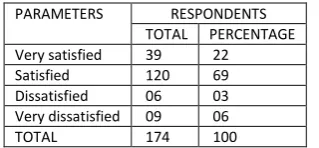
PARAMETERS RESPONDENTS TOTAL PERCENTAGE Very satisfied 39 22 Satisfied 120 69 Dissatisfied 06 03 Very dissatisfied 09 06 TOTAL 174 100
Though majority of the respondents (69%) reported that they were satisfied with the experience they had with SBI, only 22 percent observed that they were very satisfied. Out of the remaining 9 percent, 6 percent were very much dissatisfied and the remaining 3 percent were just ‘dissatisfied’. As always the case, the gap between a satisfied customer and a dissatisfied customer used to very thin, the Bank should consider this result seriously. The main reasons for dissatisfaction of respondents were the long delay in getting loan (Please refer Table 10). As the starting session of any educational course remain predetermine, the timely dis-bursement of loan, become very important.
Q.3. Please gives your opinion regarding the loan documentation and disbursal procedure.
(a)The documents provided by the Bank gave complete information regarding the terms and conditions of loan:
TABLE 7: RESPONDENTS OPINION ON LOAN DOCUMENTS PROVIDED BY BANK
Majority of the Respondents (90%) were of the view that the documents provided by the Bank depicts complete terms and conditions of the education loan. Only few of Respondents (10%) were of opposite view.
(b) The documents provided by the Bank were easy to complete:
TABLE 8: RESPONDENTS OPINION ON EASY COMPLETION OF LOAN DOCUMENTS
PARAMETERS RESPONDENTS TOTAL PERCENTAGE Agree 165 95
Disagree 09 05 TOTAL 174 100
Majority of the respondents (95%) were of the opinion that the documents provided by the Bank were easy to complete and only a few of them (5%), did not find easy to complete the documents.
(c) The documents provided by the Bank, required supporting documents which were easy to provide:
TABLE 9: RESPONDENTS OPINION ON SUPPORTING DOCUMENTS REQUIRED BY THE BANK
PARAMETERS RESPONDENTS TOTAL PERCENTAGE Agree 159 91
Disagree 15 09 TOTAL 174 100
Required supporting documents by Bank were easy to provide said, most of the Respondents (91%). But, only a few of them (9%) found it difficult to provide all the supporting documents required by the Bank.
(d) The loan was disbursed by the Bank in:
TABLE 10: TIME TAKEN BY THE BANKIN LOAN DISBURSAL
PARAMETERS RESPONDENTS TOTAL PERCENTAGE Within 15 DAYS 105 60
16 – 30 DAYS 42 24 31 DAYS & ABOVE 27 16 TOTAL 174 100
A large number of Respondents (60%) had received the loan within 15 days; some of them (24%) had received the loan within 30 days, whereas for few of them (16%) it took more than 31 days to get the loan.
(e) In your opinion, a reasonable time for loan disbursal should be:
TABLE 11: RESPONDENTS OPINION ON REASONABLENESSOF TIME FOR LOAN DISBURSAL
PARAMETERS RESPONDENTS TOTAL PERCENTAGE
UPTO 15 DAYS 174 100
16 – 30 DAYS NIL NIL
31 DAYS & ABOVE NIL NIL
TOTAL 174 100
All the respondents were of the opinion that; the disbursal procedure of loan should not take more than 15 days in any case. (f)The loan amount disbursed by the bank was adequate enough to cover your course fees:
PARAMETERS RESPONDENTS TOTAL PERCENTAGE Agree 156 90
V
OLUMEN
O.
9
(2019),
I
SSUEN
O.
04
(A
PRIL)
ISSN 2231-5756
TABLE 12: RESPONDENTS OPINION ON ADEQUACY OF LOAN AMOUNTPARAMETERS RESPONDENTS TOTAL PERCENTAGE Agree 156 90
Disagree 18 10 TOTAL 174 100
A large majority of respondents (90%) were of the opinion that the loan amount disbursed by the Bank was adequate enough to cover their course fees. Only some of them (10%) thought that the loan amount was not adequate enough to cover their course fees.
Q.4. Are you comfortable with the repayment schedule offered by Bank? (If no, kindly give reason/s)
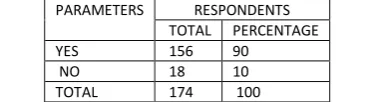
TABLE 13: RESPONDENTS OPINION ABOUT REPAYMENT SCHEDULE
PARAMETERS RESPONDENTS TOTAL PERCENTAGE YES 156 90
NO 18 10 TOTAL 174 100
Most of the respondents (90%) were comfortable with the repayment schedule offered by the Bank. The main reason given by those respondents (10%), who were not comfortable, was short grace period. In their opinion, the commencement of repayment of loan within one year after completion of course was not justified. They wanted at least a moratorium of one year after securing a job or one and half year after completion of course whichever is earlier.
Q.5.Do you think the collateral securities asked by the Bank are justified? If no, kindly give reason/s.
TABLE 14: RESPONDENTS OPINION ON JUSTIFICATION OF COLLATERAL SECURITIES
PARAMETERS RESPONDENTS TOTAL PERCENTAGE YES 174 100 NO 00 00 TOTAL 174 100 All respondents opined that the collateral securities asked by the Bank were justified.
FINDINGS
A deep analysis of our findings, leads us to the following salient features:
1. Fast processing of loan application, easy documentation process, simple terms and conditions and low rate of interest are important attractions of SBI education loan.
2. Majority of the borrower- students were of the view that the documents provided by the Bank gave complete information regarding terms and conditions of loan and all the formalities were easy to complete.
3. Most of the borrower- students were of the view that the supporting documents required by the Bank were easy to provide. 4. All the borrower- students were in agreement that loan disbursal process should not take more than 15 days, in any case.
5. Most of the borrower- students were of the opinion that the loan amount disbursed by the Bank was adequate enough to cover their entire course fees. 6. It was very much appreciated that SBI does not charge any processing fees for education loan.
7. SBI does not ask for margin money up to an educational loan amount of Rs. 4 lacs.
8. Majority of the borrower-students were comfortable with the repayment schedule offered by the Bank. However, some of the respondents were of the view that moratorium period is too short to accept.
9. Majority of the borrower- students were of the opinion that the collateral securities asked by the Bank were justified.
The above mentioned findings may lead us to believe that except some weaknesses here and there, everything is perfectly alright with SBI education loan. But, there is one other aspect. Our sample consisted of those respondents who have already received education loan from SBI. By and large they are more or less satisfied customers. For a better investigation, it would have been a better approach to conduct a survey of those students whose proposal for education loan has been rejected by the Bank. A proper analysis of various reasons given by Bank for turning down the educational loan proposal can throw a new light on the quality of services provided by SBI.
CONCLUSIONS
The financing aspect of education in India is slowly moving into private sector domain. With a gradual reduction of Government subsidies, especially in higher education, study cost is getting costly day by day. Now-a-days it is very difficult to find any Institute of repute which has, on an average a course fee of less than Rs.10 lacs. In this scenario, the role of Banks as a major source of finance cannot be overlooked. SBI, being the largest and leading Bank, obviously, has a very dominant role to play in this regard.
Keeping in view, the findings of our survey it can be concluded that so far as the customers (read borrower students) satisfactions is concerned State Bank of India is providing fairly good services except the time taken in loan disbursal process. Sometimes, it takes more than 30 (thirty) days which is not justified.
However, there are certain lacunae in policies and practices followed by SBI regarding education loan, viz. a) Requirement of tangible collateral security of suitable value for a loan amount above 7.5 lacs. b) Requirement of margin money for a loan amount above 4 lacs.
c) Requirement of statement of assets and liabilities of co-borrower i.e. parent/s in all cases.
d) Restriction on maximum, permissible amount of loan by Bank (Rs. 10 lacs for studies in India and Rs. 20 lacs for studies abroad).
Definitely, these lacunae are more macro than micro in nature. In fact, the onus of rectifying these lacunae lies with the Reserve Bank of India (RBI), which determines and controls the overall banking policies and practices in India.
The above conclusion must be taken keeping in view that the sample of the present study was limited to 174 respondents only, which may not be a true repre-sentative figure to permit generalizations. Moreover, the study would have been more illuminating and interesting had we been able to gather information from the students whose loan applications were rejected by SBI.
REFERENCES
1. Allen Nasser and Kelly Norman (2011), “The Student Loan Debt Bubble Curse of the First Austerity Generation”, Global Research Org. pp.9-18. 2. GOI, MHRD, Education in India: An overview, New Delhi, 2003
3. Goel, Aruna. And Goel S.L. (2006), “Encyclopedia of Higher Education in the 21st Century”– volume 1, pp.392 – published by Deep and Deep publication.
4. Hua Shen and Adrian Zinderman (2008), “Student Loans Repayment and Recovery- International Comparisons”, IJBEMR Vol.1. 5. Patel, Sujata (2004), “Higher Education at the crossroads”, Economic and political weekly, May, 2004, pp-18-21.
V
OLUMEN
O.
9
(2019),
I
SSUEN
O.
04
(A
PRIL)
ISSN 2231-5756
WORD OF MOUTH MARKETING AND ITS IMPACT ON ONLINE SHOPPING
Dr. REENA MODI
ASSOCIATE PROFESSOR
MALLA REDDY COLLEGE OF ENGINEERING & TECHNOLOGY
HYDERABAD
ABSTRACT
As the technology is advancing; there is a drastic change in the customers buying behavior all over the world.With the advent of IT sector and the progress in it,
we see that customers are making more and more use of it in their daily lives. Customers are more aware about the products available in the market. One of the
most important emerging means of promotion of a product is word of mouth marketing (WOM). Thus, in this paper different aims were drawn; the initial aim of
this research is to study the attention of the customers in word of mouth to power their online purchasing activities. The next aim is to analyze the people influenced by interest of word of mouth and other media of promotion.
KEYWORDS
customers buying behavior, word of mouth, online purchasing.
JEL CODE
M31
INTRODUCTION
rom the very beginning, humans have always communicated with each other, sharing and talking about anything and everything anytime. During these kind of conversations, it is quite easy to share point of views, experiences, or give advices and to build up informal communications. Hence, it becomes easy for the people to share their last experience without any difficulty and give their views about the product, the website, ant other aspects related to the purchase. Word of mouth (WOM) is not a new concept, right from the era of barter system, the WOM started as human tends to share their experiences with everyone who is near and dear to them. Thus, word-of-mouth (WOM) marketing is the most old, and still, most effective, forms of marketing. In the last thirty years we have visualized the fast development of the Internet and the different methods to communicate with each other has made the sharing of information much easier and more effective. As we are living in a very fast world and also the customers have evolved highly due to awareness created from different media, where everything is changing rapidly, where products and services are fast becoming obsolete, and where companies promise to the customers an ever more diverse product mix and product line, companies need to face the tough competition that engages companies to attract customers. Consumer buying behavior is becoming more observant what they buy. People gather concerning information and opinions about product from people before purchasing. 75% of people don’t believe in advertisements, but 92% believe brand recommendations from friends. People are four times more likely to buy when referred by friends. WOM generates two times more sales than paid ads.
Word-of-mouth is defined as any positive or negative remark made by customer’s experiences about a product or company, which is made available to a mass of people and any place using the Internet. Word of Mouth (WOM) can also be clear as the method of communication between two non-commercial people and without any profit in the business they are discussing about.
After consuming the product, the feedback of the consumers will increase day by day, creating an exchange of information between consumers and increasing the Word-of-Mouth marketing. There are number of forums, blogs and social networking websites in the World Wide Web that present customers the means of obtaining and sharing this type of information. Thus, the Word-of-Mouth trend began firstly through one to one personal communication and now there are many ways of communicating available by means of all the technologies together with the Internet, most important consumers to the e-Word-of Mouth trend. The Internet enhanced the chances to be in touch with people around you or around the world. Online word-of-mouth became more admired with better use of online social networking sites such as Facebook, twitter, linkedin, and many more.
NEED OF THE STUDY
Marketing is all about connecting to the audience. It only means connecting to people at the right place at the right time. So, today people are spending much time on the internet and the companies are trying to connect with them on the internet where people spend most of the time. This is where digital marketing has taken place of marketing. The need for the present study is to know the prospects response to the various promotional tools with special regards to internet marketing.
SCOPE OF THE STUDY
The scope of the present study is limited to customer’s perceptions about products formed by word of mouth and also their experiences while purchasing online
OBJECTIVES OF THE STUDY
1. To study how the public utilizes and multiplies word of mouth information about online purchasing experience. 2. To understand how communities perceive word of mouth marketing and study their behavior while shopping online.
LITERATURE REVIEW
Studies carried out in the past on WOM have shown that it plays a very vital role in customers buying decision (Allsopet al.2007), and also helps in creating post purchase wakefulness. In today’s competitive world WOM creates Man’s drastic effects on the customers and also the company. Initially it may create a positive or a negative impact in customer’s mind. Secondly, it may create impact on the products or services and also on the employees of the organisation (McGriff, J. A, 2012). A product may be successful due to positive WOM and lack of negative WOM (Mcgriff, J. A, 2012). If a product is new to a market, its success will depend on the WOM created by the people in the market and also the promotional tolls used to get a favourable WOM.
In the olden days online shopping was restricted to only rich and affluent class (Chai, S., & Kim, M, 2010). Now a days it’s easy for the customers to make decisions as the quality and other concerns have been taken care of due to the feedback system on websites (Sharma &Arroyo, 2012). Customers who want to purchase online need positive, dependable and honest feedback from the consumers. e-WOM (electronic word of mouth) has made it easily accessible for the customers. At present we can find technology all around us. These updated technologies have improved our way of interconnecting up to a great extent. Now people use emails, mobile messaging, WhatsApp and other social networking websites (Herr et. al. 1991) which are far faster ways than face-to-face or mails used in the past
V
OLUMEN
O.
9
(2019),
I
SSUEN
O.
04
(A
PRIL)
ISSN 2231-5756
purchasing. This has become a challenge for the companies to retain their customers as with the advent of time the competition in online marketing has become very fierce. So the companies need to maintain quality of the products with competitive pricing.
Word of mouth affects the customer buying behavior. A customer will consult his family members or friends or even relatives before making a purchase. But now due to advancement in technology the websites will have a review and feedback space where experienced consumers can post their reviews and comments. So now there’s no need to depend on face to face communication for online purchasing.
METHODOLOGY
Research designImpact of word of mouth on purchasing behavior of people is seen in this research. And for that descriptive study will be done on consumer attitudes and behaviors in relation to shopping, personal productivity, advertising, and entertainment.
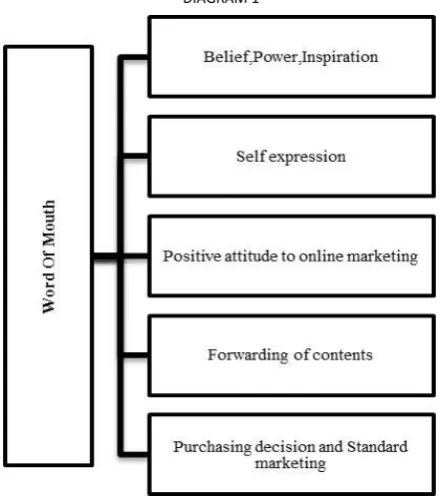
DIAGRAM 1
Population and sampling
To confirm that the sample selected is representative of the population, simple random sampling was used in this research where each individual in the population of interest has an equal likelihood of selection, and a random sample was taken. For this study, a well-designed questionnaire was exercised. The questionnaires were directed to 62 respondents constituting the sample size.
Data collection
Data was collected through the use of primary or secondary sources. Questionnaire was prepared and sent to people, who were selected randomly. The respond-ents were given five options to choose one from. 5 pointer ordinal Likert scale was used. Secondary data was collected from research papers, articles, journals etc related to purchasing behavior of the customers for online purchasing.
DATA ANALYSIS AND INTERPRETATION
1. Do you shop online?TABLE 1 1 NO 3 2 YES 59
CHART 1
V
OLUMEN
O.
9
(2019),
I
SSUEN
O.
04
(A
PRIL)
ISSN 2231-5756
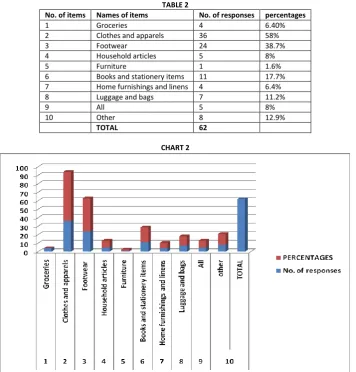
2. What do you shop?TABLE 2
No. of items Names of items No. of responses percentages
1 Groceries 4 6.40%
2 Clothes and apparels 36 58%
3 Footwear 24 38.7%
4 Household articles 5 8%
5 Furniture 1 1.6%
6 Books and stationery items 11 17.7% 7 Home furnishings and linens 4 6.4% 8 Luggage and bags 7 11.2%
9 All 5 8%
10 Other 8 12.9%
TOTAL 62
CHART 2
Interpretation: From the above table it can be interpreted that 6.4 percentage of respondents buy groceries online, 58 percentage of respondents buy clothes and apparels, whereas 38.7 percentage of respondents buy footwear, 1.6 percentage of respondents buy furniture, 17.7 percentage of respondents buy books and stationery,6.4 percentage of respondents buy home furnishings and linens, 11.2 percentage of respondents buy luggage and bags, 8 percentage of respondents buy all the items in the list and 12.9 percentage of respondents buy other items which are not mentioned in the list. Hence, I interpret that most of the respondents buy clothes and apparels online.
3. Do you refer customer reviews for online purchasing?
TABLE 3 Y ES 53 NO 9
CHART 3
Interpretation: From the above analysis it is clear that only 9 respondents do not refer to reviews for online purchasing, whereas 53 respondents refer to reviews for online purchasing. So, I interpret that majority of the respondents refer to reviews for online purchasing
4. How far the reviews influence your online purchasing?
TABLE 4
1 strongly disagree 11
2 disagree 2
V
OLUMEN
O.
9
(2019),
I
SSUEN
O.
04
(A
PRIL)
ISSN 2231-5756
CHART 4Interpretation: From the above analysis it is observed that 11 respondents strongly disagreed that the reviews influence their online purchasing, 2 respondents disagree that the reviews influence their online purchasing, 19 respondents neither agreed nor disagreed, 29 respondents agreed that the reviews influence their online purchasing, 13 respondents strongly agreed that the reviews influence their online purchasing. So, I interpret that majority of respondents agree that the reviews influence their online purchasing.
5. Are you a loyal customer to any website for online purchasing?
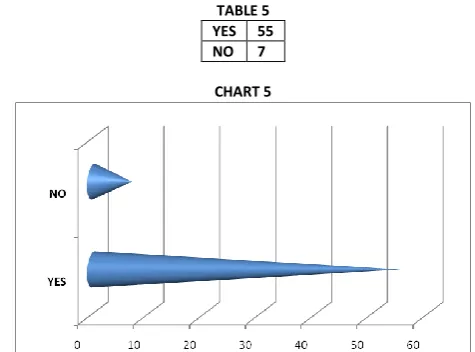
TABLE 5 YES 55 NO 7
CHART 5
6. Do you get information about offers, discounts or sale on your regular shopping site?
TABLE 6 YES 54 NO 8
CHART 6
Interpretation: From the above table it is clear that 54 respondents get information about offers, discounts or sale on your regular shopping site and 8 respondents do not get information about offers, discounts or sale on your regular shopping site. Hence, I interpret that majority of respondents get information about offers, discounts or sale on your regular shopping site.
7. Do you rely on views of your family members/ friends/ relatives for online purchasing?
TABLE 7
never 6
rarely 13
sometimes 38
often 5
V
OLUMEN
O.
9
(2019),
I
SSUEN
O.
04
(A
PRIL)
ISSN 2231-5756
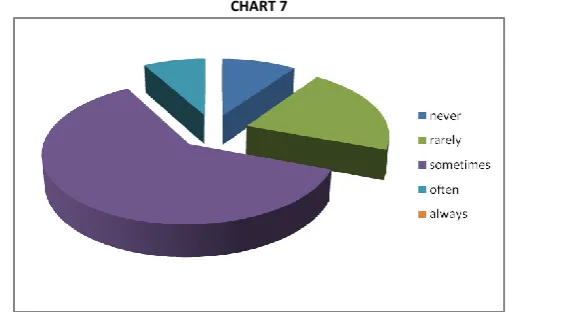
CHART 7Interpretation: From the above analysis it is observed that 6 respondents neverrely on views of your family members/ friends/ relatives for online purchasing, 13 respondents rarely rely on views of your family members/ friends/ relatives for online purchasing, 38 respondents sometimes rely on views rely on views of your family members/ friends/ relatives for online purchasing,5 respondents often rely on views rely on views of your family members/ friends/ relatives for online purchasing, none of the respondents never rely on views of your family members/ friends/ relatives for online purchasing. Hence, I interpret most of the respond-ents rely sometimes on views rely on views of your family members/ friends/ relatives for online purchasing.
8. Do you prefer to shop from advertisements on social media?
TABLE 8
CHART 8
Interpretation: From the above analysis it is observed that 17 respondents neverprefer to shop from advertisements on social media, 16 respondents rarely prefer to shop from advertisements on social media, 22 respondents sometimes prefer to shop from advertisements on social media, 2 respondents often prefer to shop from advertisements on social media,5 respondents always prefer to shop from advertisements on social media. Hence I interpret that majority of respondents sometimes prefer to shop from advertisements on social media.
9. Do you prefer to shop from advertisements on TV/Radio?
TABLE 9
never 22
rarely 18
sometimes 40
often 0
always 1
CHART 9
never 17
rarely 16
sometimes 22
often 2
V
OLUMEN
O.
9
(2019),
I
SSUEN
O.
04
(A
PRIL)
ISSN 2231-5756
Interpretation: From the above analysis it is observed that 22 respondents never prefer to shop from advertisements on TV/Radio, 18 respondents rarely prefer to shop from advertisements on TV/Radio, 21 respondents sometimes prefer to shop from advertisements on TV/Radio, none of the respondents often prefers to shop from advertisements on TV/Radio, only 1 respondent always prefer to shop from advertisements on TV/Radio. Hence, I interpret that most of the respondents never prefer to shop from advertisements on TV/Radio but sometimes some respondents may prefer to shop from advertisements on TV/Radio.10. Do you prefer to shop from advertisements on print media?
TABLE 10
CHART 10
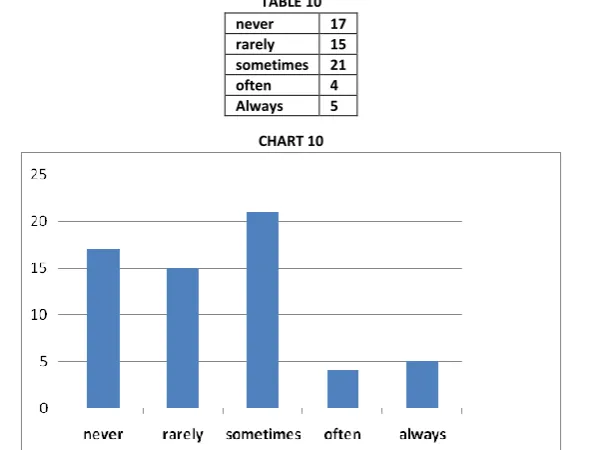
Interpretation: From the above analysis it is observed that 17 respondents never prefer to shop from advertisements on print media, 15 respondents rarely prefer to shop from advertisements on print media, 21 respondents sometimes prefer to shop from advertisements on print media,4 respondents often prefer to shop from advertisements on print media,5 respondents always prefer to shop from advertisements on print media. Hence, I interpret that majority of the respondents sometimes prefer to shop from advertisements on print media.
FINDINGS
1) Most of the respondents go for online shopping, specifically for clothes and apparels.
2) Most of the respondents refer to the reviews online and also get influenced by them up to a certain extent. 3) Majority of the respondents are loyal customers to a website for online purchasing.
4) They also rely on reviews of their family/friends/relatives for online purchasing, up to a certain extent. 5) They do not refer much to other media of advertising like TV, radio, newspapers, journals and magazines.
CONCLUSION
Word of mouth creates an immense impact on the purchasing behavior of the customer’s due comments and reviews on social media. The customers will evaluate the pros and cons of their purchase on the basis of quality and price of the products. Hence, marketers become aware of customer’s preferences and can modify their products to attract new customers and retain the old customers.
REFERENCES
1. Allsop, D. T., Bassett, B. R., & Hoskins, J. A. (2007). Word-of-mouth research: principles and applications. Journal of Advertising Research, 47(4), 398. 2. Chai, S., & Kim, M. (2010). What makes bloggers share knowledge? An investigation on the role of trust. International Journal of Information Management,
30(5), 408-415.
3. Mcgriff, J. A. (2012). A conceptual topic in marketing management: the emerging need for protecting and managing brand equity: the case of online consumer brand boycotts. International Management Review, 8(1), 49-54.
never 17
rarely 15
sometimes 21
often 4