Wayamba Journal of Animal Science – ISSN: 2012-578X; P1793 - P1798, 2019 First Submitted January 28, 2019; Number 1544287238
EFFECTS OF FLOOR AND NEST EGGS ON HATCHABILITY AND CHICK QUALITY PARAMETERS IN BROILER BREEDERS.
Y. I. Ahamed1, A.M.J.B. Adikari1*, G. A. S. N. Gamlath2 and W. A. A. S. K. Somarathna2
1Department of Animal and Food Sciences, Faculty of Agriculture, Rajarata University of Sri Lanka, Anuradhapura (50000), Sri Lanka.
2Bairaha Farms PLC. Pasyala, Sri Lanka.
*Corresponding author: - [email protected]
The quantitative and qualitative parameters of eggs and day old chicks are determined by broiler breeders. Floor and nest eggs are used by commercial hatcheries for incubation. This study was carried out to evaluate the hatchability and chick quality parameters between floor and nest eggs in broiler breeders. The experiment was conducted at the hatchery in a Complete Randomized Design (CRD) with two treatments. Five replicates were maintained for each treatment and each replicate consisted of 90 eggs. Nine hundred eggs from MX male x Cobb 500 female (35-40 weeks of age) were collected from the breeder farm. Eggs were incubated at
Petersime commercial multi-stage (MS)
incubator. Egg quality parameters; initial egg weight and shape index were measured just before the setter period. Egg weight reduction was calculated during incubation period. Live chicks and hatch residues were collected separately at the end of incubation period. Chick quality parameters such as chick weight, chick length and pasgar score were measured. Breakout test was conducted with hatch residues. Data was statistically analyzed using two sample t-test in SAS. Results revealed that there was a significant difference (P<0.05) on hatchability between two types of eggs. Nest eggs reported the highest hatchability (90.0%) compared to floor eggs. Initial egg weight, egg shape index, moisture loss, hatch of fertile, chick weight, chick length, chick yield and pasgar score did not show any significant difference
(P>0.05) between two types of eggs. Breakout analysis showed that higher embryo mortality and contamination occurred in floor eggs compared to nest
eggs. In conclusion, hatchability of nest eggs is better than those of floor eggs. However, floor eggs should be kept separately in the commercial hatcheries to minimize the contamination.
Keywords: Chick yield, Fertility, Hatchability, Hatch of fertile
These criterions can be attained with a good quality egg, meaning that eggs are clean, not broken, and not containing cracks (Van Den Brand et al., 2016).
Normally in breeder farms there are two laying systems such as floor laying and nest laying system. According to that egg quality is also influenced by the laying system under which the hens are kept. The absence of nest sites in conventional cages is considered to be the most serious welfare problem, and several experiments have shown that hens are strongly motivated to use a nest. Nests are important because of both the birds’ preference for them and the birds’ frustration when they are absent. Notwithstanding a nest-box, in free-run systems some hens will still lay their eggs on the floor, and these floor eggs are considered to be one of the major disadvantages of production systems due to bacterial contamination of eggs from floor litter (Singh et al., 2006).
Losses from floor eggs can be a significant problem in the broiler chicken industry due to several types of cracks and bacterial contamination. It has been reported that 6.4% of broiler breeder eggs are not collected due to shell damage and permeability of the eggs due to floor laying. Currently, the commercial hatcheries use two different types of eggs such as floor and nest eggs for incubation to meet the competition and demand of market. Eggs from a flock consist different types of eggs such as nest eggs, floor eggs, double yolk eggs, damaged and tiny eggs. Among those, good and floor eggs have the tendency for incubation. Meanwhile, hatcheries receive considerable amount of floor eggs on peak production period, so that incubation of floor eggs cannot be avoided in hatcheries. Therefore, understanding of incubation characteristics and chick quality parameters of both egg types is a must to produce good quality day old chicks. This study was carried out to compare the hatchability and quality of the day old chicks from floor and nest eggs.
MATERIALS AND METHODS Experimental location and grouping of eggs
The experiment was conducted at the commercial hatchery, Bairaha Farms PLC at Pasyala, Sri Lanka. Two different egg types of commercial Cobb 500 broiler breeder stock (MX male x Cobb 500 Female) were selected (from birds at the age of 34-45 weeks) and eggs were grouped as floor and nest eggs. A total of nine hundreds eggs (900) were obtained from both egg types representing four hundred fifty eggs from each group. The experiment was composed with two egg types each with five replicates and each replicate consisted of 90 eggs. Eggs were incubated at Petersime (Model no: 1152) commercial multi-stage (MS) incubator.
Egg loading process
Eggs were candled using egg grading machine to select the ideal eggs for incubation. One hundred and fifty eggs (150) from single egg type was set in a single setter tray of MS Petersime incubator and numbered from 1 to 150 separately and initial egg weight, length and width were measured using electronic balance and Vernier scale. Eggs from floor and nest were tagged accordingly. These trays were placed middle part of MS setter trolleys and eggs were stored for one day at 19oC. Setter trolleys were taken out from the cool room and eggs were fumigated for 20 minutes with formaldehyde gas before the incubation. Fumigated trolleys were loaded into Petersime MS incubator. Incubation conditions were provided according to the incubator manufacturer’s recommendations. Incubation process of hatchery
Temperature and relative humidity were maintained at 99oF and 86%, respectively. Temperature, relative humidity and egg turning were recorded in the check list once an hour. On the 10th day of incubation, eggs were individually candled in the transfer-room (around 24oC and 60% relative humidity), using a hand held candling lamp. “Clear” eggs were removed and broken out for macroscopic examination to determine early-dead embryos (< 7 day) and fertility. On 18th day of incubation, MS incubated eggs were transferred from setter to hatcher.
After 18th day of incubation, individual eggs were weighed according to their respective numbers and weight losses of eggs were calculated. At the end of 21st day, the hatch was pulled out. Live hatched chicks were counted and recorded separately. Hatch of fertile was estimated.
Egg breakout analysis
Egg breakout analysis was carried out to find out the reasons of failure to hatch. Un-hatched eggs were opened, and examined macroscopically. Dead chicks were recorded separately.
Chick quality analysis
For the purpose of chick quality analysis from each replicate, number of 40% randomly sampled chicks were weighed individually using a sensitive beam balance. Chick length was taken by measuring the length of stretched chick from tip of the beak to the middle toe using a ruler and recorded in centimeters (cm). Pasgar scoring method was followed to analyze the chick quality. Data analysis
Data were statistically analyzed using two sample t-test in SAS (ver. 9.0). Significant level was declared at P=0.05. Following standard formulas were used to estimate the different parameters.
Moisture Loss % =
(Egg setting weight − Egg transfer weight) x 100 Egg setting weight
(Meijerhof, 2009)
Hatchability % = Number of saleable chick x 100
Number of eggs (Petek et al., 2010)
Hatch of fertile % = Number of saleable chick x 100
Number of true fertile eggs (Cobb Ventress Inc, 2008)
Chick yield %
= Average chick weight at hatch x 100 Average egg weight at the point of set
( Djanet & Drüggelte, 2009)
Egg shape index % = Diameter of the egg x 100
Length of the egg (Anderson et al., 2004)
RESULTS AND DISCUSSION Egg quality parameters
Table 1 shows the change of initial egg weight and egg shape index between floor and nest eggs. Initial egg weight and egg
shape index were not significantly different (P<0.05) between two egg types. The highest initial egg weight (55.03g) and egg shape index (78.93%) were observed in nest and floor eggs respectively.
Table 1: The change of initial egg weight and egg shape index between floor and nest eggs
Parameters Floor Eggs Nest Eggs
Initial Egg Weight (g)
54.96 ± 0.17a 55.03 ±
0.14a
Egg Shape Index 78.93 ± 0.47a 78.84 ±
0.30a
Data are presented as mean ± SE. a,bMeans within same row with different superscript are significantly different (P<0.05)
Egg size of the present study was in medium range as mentioned by King’ori (2011). Egg size affects hatchability (Jaya, 2007; Yassin
et al., 2008; King’ori, 2011). Hatchability of
small eggs is lower compared to the medium and large eggs. Eggs within 45-56 g weight hatch better than lighter eggs. Normal hatchability of large (63-70g) and medium eggs (53-63g) were 88.2% and 84.8%, respectively. Those hatchability levels were higher than the hatchability of small eggs (37.5-44 g) (Yassin et al., 2008). Jaya (2007) reported that, egg size has an influence on total incubation time of eggs. Beyond 50 grams, each 2.5 gram range prolongs the incubation time by half an hour. Some studies reported that internal egg composition or ratio, larger egg weight and poor shell quality increased early and late embryo mortality (Tona et al., 2004; King’ori, 2011).
The shape index reported under the study falls within the “round” range. Normal eggs fit well to the trays and make less transit loss. Eggs are characterized using SI as sharp, normal and round if those eggs have an SI value of < 72, between 72 – 76, and > 76 respectively (Anderson et al., 2004). There are limited findings about the relationship between egg shape index and incubation, chick quality parameters.
Incubation parameters
(P<0.05) between two types of eggs. Moisture loss and hatch of fertile were not significantly different (P<0.05) between floor and nest eggs. However, highest egg moisture loss (10.49%), highest hatchability (90%) and highest hatch of fertile (92.65%) were observed in nest eggs.
Table 2: The change of incubation parameters between two types of eggs Parameters Floor Eggs Nest Eggs
Moisture loss % 10.22 ± 0.38a
10.49 ± 0.12a
Hatchability % 83.16 ±
0.69a
90.0 ± 0.71b
Hatch of fertile %
89.01 ± 0.82b
92.65 ± 0.62b
Data are presented as mean ± SE. a,bMeans within same row with different superscript are significantly different (P<0.05).
Egg moisture loss is very important for good quality chicks. For good quality chicks, 12% moisture loss is recommended because less than 6% and more than 14% is difficult for chicks to hatch. Moisture loss also depends upon the humidity levels in the incubators. Adequate water level in the incubators is essential to retain the required water inside eggs necessary to create air cell that helps chicks to come out from eggs in limited time. Air cell allows embryonic lung ventilation after internal piping for a successful hatch (Jabbar, 2018).
Environment temperature is the most important factor in incubation not only for hatchability but also for post hatch growth. Incubator temperature should be maintained between 36oC and 38.9oC. If the temperature inside the incubator drops below 35.6oC, it induces small sized chicks and enhances mortality, because embryo uses their nutrients resources first to survive, instead of growing and developing the embryo. If the temperature rises above 39oC, it induces small sized chicks as well, because of dehydration, and too fast yolk utilization (Lourens, 2008).
Chick quality parameters
The change of chick weight, chick length, chick yield and pasgar score between floor and nest eggs is shown in table 3. The chick quality parameters under study were not significantly different (P<0.05) between
floor and nest eggs. However, highest chick weight (38.67 g), highest chick length (16.95 cm) and highest pasgar score (9.88) were observed in nest eggs, respectively.
Table 3: The change of chick quality parameters between floor and nest eggs Parameters Floor Eggs Nest Eggs
Chick weight
(g)
38.64± 0.06a 38.67 ± 0.04a
Chick length (cm)
16.75± 0.02b 16.95± 0.05b
Chick yield % 70.29 ± 0.17a 70.28 ± 0.17a
Pasgar score 9.71± 0.09b 9.88 ± 0.03b
Data are presented as mean ± SE. a,bMeans within same row with different superscript are significantly different (p<0.05).
Some studies reported that the body weight is the most widely used parameter for assessing day-old-chick quality. But the differences observed in hatch weight may have been mainly influenced by initial egg weight and moisture loss during incubation (Petek et al., 2010). It is agreed that chick weight may be related to slaughter performance of broilers (Tona et al., 2004; Van Den Brand et al., 2016; Jabbar, 2018). Some researchers found a positive correlation between chick length and body weight at 42-day of age. It is also emphasized that chick length is an indicator for chick quality and can be measured quickly (Decuypere et al., 2001; Tona et al., 2004; Pek and Sözcü, 2013). Pek and Sözcü (2013), reported that an increase in chick length in male broilers obtained from same egg size on hatching day resulted in an increasing of body weight. Chick length might be much more important for acquiring the greatest uniformity and predicting growth performance (Djanet & Drüggelte, 2009).
Water loss is very important for good chick yield. The recommended chick yield is 69% for quality chicks. Water loss and chick yield are related to each other. If chick yield excels more than 69%, it becomes a source of dehydration, creates difficulty for chicks to come out from eggs. The chicks yield with more than 69% becomes source of high mortality at farm. Chick yield less than 67%, the water retains in belly of chicks. The
chicks become lethargic and refuse to take feed at farm. The eggs with contamination on egg shell are unable to hold adequate water inside eggs necessary for proper hatching (Tona et al., 2004; Jabbar, 2018). The pasgar score is used to express the chick quality using a number and it has been developed by evaluating five morphological criteria such as reflex, navel, legs, beak and yolk sac volume of the chicks. A sample of at least 30 saleable chicks must be assessed to get a representative score for chick quality of a flock of chicks. Some studies reported that best quality chick have a pasgar score of 10 and one point is subtracted for each abnormality (Tona et al., 2004; Djanet & Drüggelte, 2009).
Followings are the morphological criteria used to evaluate day old chicks. The appearance should be clean, dry, without dirt and contamination with bright and clear eyes. The chick should be alert, active and responding to sounds. The chicks having clear and deep yellow color is better than pale and light yellow. The navel area should be completely sealed. The whole body and legs should have normal confirmation, there should be no swelling or lesions on hock, or skin and the toes should be well formed. The beak should be well formed, firm and straight. The belly area should examine for thickness which is determined by temperature and humidity (Tona et al., 2004; Pek and Sözcü, 2013).
Egg breakout analysis
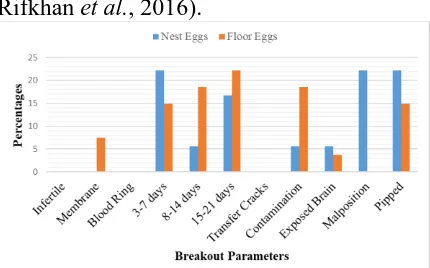
Egg breakout analysis showed that higher rate of embryonic mortality: early (3-7 days) and mid, late (8-14 days, 15-21 days) were observed in nest and floor eggs respectively. Higher rate of contamination also observed in floor eggs. Higher amount of malposition and pipped eggs were observed in nest eggs. The results of egg breakout are beneficial for trouble-shooting problems in production, egg handling and storage. The hatch day breakout analysis involves sampling unhatched eggs from breeder flocks, and classifying them into the various causes of reproductive failure. Those information could help to solve hatchery and breeder flock problems, or improve hatchability and fertility (Mauldin, 2009). Studies reported that high number of early dead of embryo
indicates prolong storage or storage at elevated temperatures, or inadequate egg collection procedures. High temperature of embryo, nutritional deficiencies of breeder flocks and contamination are the reasons for high number of middle dead of embryo at the same time setter/ hatcher temperature and humidity problems, egg transfer damages, egg set upside down, insufficient water loss and nutritional deficiencies of breeder flocks are caused high number of late dead of embryo (Mauldin, 2009; Rifkhan et al., 2016).
Figure 1: Effect of floor and nest egg type on egg breakout analysis
Results from a hatch breakout should be combined with other information to provide a total picture. This information should include hatchability records, breeder performance records, incubation records and hatch timing information. Normal pattern of embryo loss during incubation showing peaks in mortality during early and late incubation. High mortality at other development stages is not normal. A high incidence of mortality at a particular stage of development can indicate an acute problem during incubation caused by a machine failure. Experience of hatch breakouts with good hatching flocks is important for understanding what is normal and abnormal (Anon, 2015).
CONCLUSIONS
Hatchability of nest eggs is better than those of floor eggs. Floor eggs should be kept separately in the commercial hatcheries to minimize the contamination. Floor eggs can be used for incubation during shortage period of eggs.
ACKNOWLEDGMENT
The authors want to thank all the academic and non-academic staff members of the Faculty of Agriculture Rajarata University of Sri Lanka and to Bairaha Farms PLC. Pasyala, Sri Lanka for the valuable coordination and contribution given throughout the study period.
REFERENCES
1. Anon (2015). How to Breakout and Analyse Hatch Debris. Retrieved on August 31, 2018 from:
http://www.aviagenturkeys.com. 2. Van Den Brand, H., Sosef, M. P.,
Lourens, A. & Van Harn, J. (2016). Effects of floor eggs on hatchability and later life performance in broiler chickens. Poult.Sci.; 95(5): 1025– 1032.
3. Cobb Ventress Inc (2008). Hatchery Management Guide. Retrieved on May 03, 2018
from:http://www.cobb-vantress.com.
4. Decuypere, E., Tona, K., Bruggeman, V. & Bamelis, F. (2001). The day-old chick: a crucial hinge between breeders and
broilers. World’s Poult. Sci. J.; 57(02): 127–138.
5. Jabbar, A. & Ditta, Y. A. (2018). Effect of Floor Eggs on
Hatchability, Candling, Water Loss, chick yield, Chick weight and dead in shell. J. of World Poult. Res.; 7(4): 154-158.
6. Jaya, P. (2007). Main Factors Affecting the Hatchability. Avian business unit, Libourne, France; (15): 5–8.
7. King’ori, A. M. (2011). Review of the Factors That Influence Egg Fertility and Hatchabilty in Poultry. Inter. J. of Poult. Sci.; 10(6): 483– 492.
8. Lourens, S. (2008). Embryo Temperature During Incubation: Practice and Theory. PhD thesis, Wageningen University,
Netherlands. 1-139.
9. Mauldin, J. M. (2009). Breakout analyses guide for hatcheries.
Retrieved on August 09, 2018 from:http://ugakr.libs.uga.edu. 10.Meijerhof, R. (2009). Principles of
moisture loss during incubation. Proceedings of the 20th Australian Poultry Science Symposium, Sydney, Australia, 106-110. 11.Poultry Sector Forecast (2016).
Division of Livestock Planning and Economics, Department of Animal Production and Health, Peradeniya, Sri Lanka.
12.Pek, A. İ. and Sözcü, A. (2013). Broiler Chick Quality and Scoring Methods. Journal of Agricultural Faculty of Uludag University, 137: 131–137.
13.Petek, M., Orman, A., Dikmen, S. & Alpay, F. (2010). Physical chick parameters and effects on growth performance in broiler. Archiv Tierzucht, 53(1): 108–115.
14.Rifkhan, M. H. M., Gamlath, G. A. S. N. & Adikari, A. M. J. B. (2016). Effect of Broiler Breeder's Age on Incubation and Chick Quality Parameters. Inter. J. of Livestock Res.; 6(10): 19-26.
15.Singh, R., Cheng, K. M. & Silversides, F. G. (2006).
Production performance and egg quality of four strains of laying hens kept in conventional cages and floor pens. Poult. Sci.;88: 256–264. 16.Djanet, O. A. & Drüggelte, R. S.
(2009). Review of different day-old chick quality parameters in layer type breeds. International Poult. Production; 23(4): 15–19. 17.Tona, K., Onagbesan,O., De
Ketelaere, B., Decuypere, E. & Bruggeman, V. (2004). Effects of age of broiler breeders and egg storage on egg quality, hatchability, chick quality, chick weight, and chick posthatch growth to forty-two days. J. Appl. Poult. Res.; 13(1): 10–18.
18.Yassin, H., Velthuis, A. G. J., Boerjan, M., Van Riel, J. & Huirne, R. B. M. (2008). Field study on broiler eggs hatchability. Poult. Sci.; 87(11): 2408–2417.