Research Article
Combining ability analysis for yield and its components in groundnut
(
Arachis hypogaea
L.)
A.Mothilal and A. Ezhil*
Abstract:
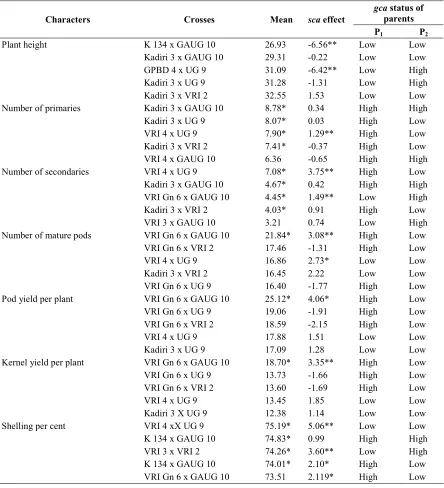
Combining ability was studied among 24 crosses involving eight lines and three testers. The general and specific combining ability variances were highly significant for all the characters studied. The parent VRI Gn 6 proved to be a good general combiner for yield and yield components. Three crosses viz., VRI Gn 6 x GAUG 10, VRI Gn 6 x VRI 2 and VRI 4 x UG 9 exhibited desirable sca effects and also recorded higher per se performance. Most of the crosses involved parents with high x low gca effects which showed the involvement of non-additive gene action in controlling these characters.
Key words:
Groundnut, General combing ability, specific combining ability, yield
Introduction
Combining ability is the relative ability of a genotype to transmit its desirable performance to its crosses. Combining ability analysis is not only the quickest method of understanding the genetic nature of quantitatively inherited traits, but also gives essential information about the selection of parents which in turn throws better segregants. The knowledge of the type of gene action involved in the expression of yield and yield components are essential to choose an appropriate breeding methodology to isolate desirable segregants in the later generations. In the present investigation, line x tester design with geographically diverse parents of groundnut was used to obtain information on combining ability of elite lines for seven yield and yield components in groundnut.
Material and methods
The material for the study consisted of eight diverse lines viz., TMV Gn 13, Kadiri 3, VRI 4, GPBD 4,
Regional Research Station, Tamil Nadu Agricultural University, Vridhachalam 606 001.
Email: [email protected]
K 134, JL 24, VRI 3 and VRI Gn 6 and three testers viz., UG 9, GAUG 10 and VRI 2. The parents were crossed in line x tester mating fashion to synthesize 24 F1 hybrids at the Regional Research Station,
Vridhachalam during Kharif 2007. The experiment was laid out in a Randomized Complete Block Design with two replications. The parents and the crosses were raised in ten rows of 3 m length with a spacing of 30 cm x 15 cm. All the recommended package of practices were followed to raise a healthy crop. Ten plants in parents and hybrids were selected randomly in each replication and observations were recorded for plant height (cm), number of primaries per plant, number of secondaries per plant, number of mature pods per plant, pod yield per plant (g), kernel yield per plant (g) and shelling outturn (per cent). The mean values were subjected to line x tester analysis as suggested by Kempthorne (1957).
Results and discussion
except for number of mature pods per plant, pod yield and kernel yield per plant. Obviously due to the diverse nature of the line and testers the crosses between them were also found to be significant for all the characters. The significant variance of line x tester interaction indicated the importance of specific combining ability. The mean squares due to lines were of a larger magnitude than those of testers and line x tester for all the characters indicating greater diversity among the lines.
The magnitude of specific combining ability variances was much greater than those of general combining ability variances for all the characters, which indicated the preponderance of non-additive gene action for all the characters. The role of non-additive gene action for these traits have been reported by Upadhyaya et al. (1992), Rudraswamy et al. (2001), Jayalakshmi et al. (2002), Dasaradha Rami Reddy et al. (2004), Vasanthi et al. (2004), Yadav et al. (2006) and Rekha et al. (2009).
The per se performance and general combining ability effects are presented in Table 2. The parent VRI Gn 6 recorded significantly higher mean for number of mature pods, pod yield and kernel yield per plant. However, Kadiri 3 registered significantly higher mean for number of secondaries, pod yield and kernel yield per plant. The line parent GPBD 4 recorded significantly high mean for number of secondaries and number of mature pods per plant.
The estimates of gca effect showed that among the lines, VRI Gn 6 was found to be superior as it showed significant and positive gca effect for plant height, number of mature pods, pod yield per plant, kernel yield per plant and shelling outturn. The line parent K 134 was a good general combiner for shelling outturn, while VRI 4 was a good combiner for number of primaries and number of secondaries per plant. The best general combiner for number of primaries per plant was Kadiri 3. Among the tester parents, GAUG 10 recorded significant positive gca effect for number of primaries and number of secondaries per plant while, VRI 2 was a good combiner for shelling outturn. Since, high gca effect is attributed to additive and additive x additive type
number of secondaries per plant, number of mature pods per plant, pod yield per plant, kernel yield per plant and shelling outturn. It is worthwhile to mention that this particular cross also manifested higher per se performance for the above said characters. The cross VRI Gn 6 x VRI 2 also exhibited significant sca effect for number of mature pods per plant, pod yield and kernel yield per plant. Similarly the cross VRI 4 x UG 9 was found to be desirable for number of primaries per plant, number of secondaries per plant, number of mature pods per plant, pod yield per plant, kernel yield per plant and shelling outturn. Biparental mating followed by selection might be worthwhile for fostering greater recombination in these crosses (Francis and Ramalingam, 1999).
References
Dasaradha Rami Reddy, C and Suneetha, K. 2004. Combining ability and heterosis in groundnut (Arachis hypogaea L.). pp. 28-30. Paper presented in the national symposium on Enhancing Productivity of Groundnut for Sustaining Food and Nuritional Security held at NRCG, Junagadh between 11th to 13th October 2004.
Fracies, R.M. and Ramalingam, R.S. 1999. Combining ability in groundnut. Legume Research. 22 (4): 267-269.
Jayalakshmi, V., Raja Reddy, C., Reddy, P.V., and Lakshmikantha Reddy, G. 2002. Combining ability analysis of morphological and physiological attributes in groundnut (Arachis hypogaea L.). Indian J.Agric.Res., 36(3): 177-181.
Kempthorne, O. 1957. An Introduction in Genetic Statistics. John Wiley and Sons, New York. pp 325.
Rekha, D., Savithramma, D.L., Shankar, A.G., Marappa, N. 2009. Combining ability studies for growth and yield traits in groundnut (Arachis hypogaea L.).
Environment and Ecology. 27(1): 117-120.
Rudraswamy, P., Nehru, S.D. and Kulkarni, R.S. 2001. Combining ability studies in groundnut. Mysore J.agric.Sci., 35: 193-202.
Vasanthi, R.P., Babitha, M., Reddy, P.V., Sudhakar, P and Venkateswarulu, O. 2004. Combining ability for water use efficient in groundnut (Arachis hypogaea
Table 1. ANOVA for combining ability for various characters in groundnut
Mean squares
Source of variation df
Plant height Number of primaries
Number of secondaries
Number of
mature pods Pod yield Kernel yield
Shelling outturn
Replications 1 4.78* 0.20 0.68 0.82 5.57* 1.91 7.06*
Treatments 34 97.53** 3.59** 4.78* 23.75** 21.86** 12.45** 13.85**
Parents 10 104.61** 2.80** 3.49* 41.27** 31.41** 16.62** 11.28**
Parents Vs Crosses 1 1039.71** 13.39** 4.06 184.56** 19.44** 10.40** 4.26*
Crosses 23 53.48** 3.49** 5.38** 9.14** 17.81** 10.72** 15.38**
Lines 7 87.33** 8.33** 7.52** 15.63** 42.04** 23.88** 10.07*
Testers 2 37.58** 1.72* 5.16** 1.83 0.42 0.038 15.18**
Line x Tester 14 38.84** 1.33** 4.34** 6.94* 8.18 5.67 18.07**
Error 23 4.318 0.322 0.465 2.346 4.229 2.420 2.032
σ2 gca 0.505 0.074 0.035 0.076 0.332 0.174 -0.092
σ2sca 17.26 0.505 1.939 2.296 1.977 1.626 8.019
σ2gca/ σ2sca 0.029 0.146 0.018 0.033 0.167 0.107 0.011
Table 2. Estimates of gca effect with per se performance of 11 parents for yield and its components in groundnut
Plant height Number of primaries
Number of secondaries
Number of mature
pods Pod yield Kernel yield Shelling outturn
Parents
mean gca
effect mean
gca
effect mean
gca
effect mean gca effect mean
gca
effect mean gca effect mean gca effect
Lines
TMV Gn 13 32.31 1.38 5.80 -0.31 2.17 -1.30** 18.75 -0.51 16.12 -2.34* 11.77 -1.55* 71.92 1.16
Kadiri 3 27.56 -6.79** 6.45 2.39** 3.88* 1.56** 16.41 -0.60 23.31* 0.60 16.59* 0.32 70.95 -0.32
VRI 4 18.40 -0.66 4.00 0.97** 3.30 1.34** 15.50 -0.11 17.30 1.15 12.79 0.68 73.83 -1.10
GPBD 4 27.30 -1.88* 3.50 -0.76** 5.50* 0.31 21.90* -0.97 15.82 -0.96 11.24 -0.89 71.00 -0.74
K 134 28.40 -2.83** 3.70 -0.45 2.20 -1.58** 21.30* -0.88 12.51 -1.35 9.04 -0.78 71.74 1.93**
JL 24 26.80 2.30* 4.45 -0.77** 2.40 -0.38 15.16 -0.23 17.48 -0.42 12.38 -0.40 70.76 -1.12
VRI 3 40.50* 3.62** 4.25 -1.25** 1.38 -0.22 13.50 -0.62 10.14 -2.43** 7.56 -1.85** 74.80* -1.24
VRI Gn 6 35.78 4.85** 6.61 0.17 3.16 0.27 23.89* 3.93** 22.29* 5.75** 16.32* 4.47** 73.54 1.42*
SE gca - 0.848 - 0.231 - 0.278 - 0.625 - 0.839 - 0.635 - 0.582
Testers
UG 9 18.40 1.55** 3.50 -0.05 0.80 -0.10 12.60 -0.39 12.60 0.05 8.43 0.04 65.95 0.19
GAUG 10 30.40 -1.52** 4.10 0.35* 1.40 0.61** 26.10* 0.19 17.17 0.14 12.01 0.01 69.98 -1.06**
VRI 2 39.01 -0.03 5.76 -0.30* 2.38 -0.51** 14.35 0.20 14.70 -0.18 10.67 -0.05 72.78 0.86*
Table 3. Specific combining ability effects of the best five crosses based on per se performance
gca status of parents
Characters Crosses Mean sca effect
P1 P2
Plant height K 134 x GAUG 10 26.93 -6.56** Low Low
Kadiri 3 x GAUG 10 29.31 -0.22 Low Low
GPBD 4 x UG 9 31.09 -6.42** Low High
Kadiri 3 x UG 9 31.28 -1.31 Low High
Kadiri 3 x VRI 2 32.55 1.53 Low Low
Number of primaries Kadiri 3 x GAUG 10 8.78* 0.34 High High
Kadiri 3 x UG 9 8.07* 0.03 High Low
VRI 4 x UG 9 7.90* 1.29** High Low
Kadiri 3 x VRI 2 7.41* -0.37 High Low
VRI 4 x GAUG 10 6.36 -0.65 High High
Number of secondaries VRI 4 x UG 9 7.08* 3.75** High Low
Kadiri 3 x GAUG 10 4.67* 0.42 High High
VRI Gn 6 x GAUG 10 4.45* 1.49** Low High
Kadiri 3 x VRI 2 4.03* 0.91 High Low
VRI 3 x GAUG 10 3.21 0.74 Low High
Number of mature pods VRI Gn 6 x GAUG 10 21.84* 3.08** High Low
VRI Gn 6 x VRI 2 17.46 -1.31 High Low
VRI 4 x UG 9 16.86 2.73* Low Low
Kadiri 3 x VRI 2 16.45 2.22 Low Low
VRI Gn 6 x UG 9 16.40 -1.77 High Low
Pod yield per plant VRI Gn 6 x GAUG 10 25.12* 4.06* High Low
VRI Gn 6 x UG 9 19.06 -1.91 High Low
VRI Gn 6 x VRI 2 18.59 -2.15 High Low
VRI 4 x UG 9 17.88 1.51 Low Low
Kadiri 3 x UG 9 17.09 1.28 Low Low
Kernel yield per plant VRI Gn 6 x GAUG 10 18.70* 3.35** High Low
VRI Gn 6 x UG 9 13.73 -1.66 High Low
VRI Gn 6 x VRI 2 13.60 -1.69 High Low
VRI 4 x UG 9 13.45 1.85 Low Low
Kadiri 3 X UG 9 12.38 1.14 Low Low
Shelling per cent VRI 4 xX UG 9 75.19* 5.06** Low Low
K 134 x GAUG 10 74.83* 0.99 High High
VRI 3 x VRI 2 74.26* 3.60** Low High
K 134 x GAUG 10 74.01* 2.10* High Low
VRI Gn 6 x GAUG 10 73.51 2.119* High Low