DYNAMIC MODELING OF NATURAL CONVECTION SOLAR
ENERGY COLLECTORS FOR AGRICULTURAL DRIERS I: THEORY
AND COMPLETE RUN OF THE SOLUTIONS TO THE DYNAMIC MODEL
EQUATIONS OF SSSCA FLAT PLATE COLLECTOR
D.V.C. ONUOHA *
Department of Mechanical Engineering, University of Nigeria, Nsukka, Enugu State, Nigeria.
*Formerly, Chief Mechanical Engineer, Federal Ministry of Works and Housing, Field Headquaters, Owerri, Imo State, Nigeria.
ABSTRACT
An analysis is made of the dynamic model of a flat plate solar energy collector to be employed in natural convection solar energy driers used for drying agricultural products like meat, fish, grains and vegetables and bring them to acceptable equilibrium moisture content to avoid spoilage when stored. Analytical solutions of the derived model equations enabled expressions for the mean glazing, absorber and outlet fluid temperatures to be obtained. Expressions were also obtained for the collector instantaneous energy delivery rate, efficiency, heat removal factor, and combined plates coefficient of performance (formally called plates efficiency). A plot of the collector output parameters against time from Os (at 6.00a/m.) showed that each possessed a maximum, which occurred between 1800s and 3600s after solar noon where global radiation had its maximum. The shift is attributable to the heat capacities of the materials of the collector Separation of the transient terms from the steady- state terms for the plates' temperatures showed the transient contribution to be very small and practically die out between 14400s and 16200s from start, showing that the transient terms can be neglected. This was confirmed when the transient terms were completely deleted as the maximum values of the output parameters and their times of occurrence remained the same in both cases. The developed output expressions (in closed form) for the dynamic model of flat plate solar energy air heating collectors can easily be used for optimization studies and design of better air heating solar energy collectors.
KEYWORDS AND EXPRESSIONS: Solar collector, Natural Convection, Dynamic and Transient Analyses, Dynamic model closed form output expressions.
1. INTRODUCTION
Without the radiant energy from the Sun in the forms of heat and light (two forms of electromagnetic radiations), life processes on earth will be impossible. However, the efficiency of natural conversion of solar energy is so low (about 1 %) with attendant wastages that the use of man-made equipment for its collection and utilization becomes inevitable. Solar energy collectors in
Though the radiant energy from the sun is constant, the fraction that actually reaches the earth's surface and is available for use is variable in time and space due to the sphericity of the earth's surface (zonal variation), the rotation of the earth about its axis (diurnal variation) and its revolution around the sun (sideral variation). The above effects are taken care of by the latitude L, the hour angle! (=ωt), and the declination, , in the expression for the solar energy falling on it. Hence, a dynamic model incorporating these variations becomes inevitable. The solar energy available for collection and use is also dependent on climatological variables like cloud cover, wind, fog, precipitation, dust and haze. The presence of any of these reduces the amount of collectable solar energy by a solar collector.
Though many papers and books have appeared for the solution of the solar energy heat transfer problem in a forced convection environment (Bhargave et al, 1982; Bala and Woods, 1994, Grainger, et. al.. 1983; Tyer, 1985; Ocsthuizien, 1987; Ready, 1987; Sukhatme, 1984), such solutions under a purely and exclusively natural convection environment remains unresolved as some of the results obtained under the accompanying assumptions are conflicting. Moreover, the transient solutions given so far employ numerical methods and in some cases coupled with analytical methods of which are more cumbersome than a direct analytical solution. The avoidance of direct analytical solution of the derived model equations for a solar collector by past investigators has made it impossible for them to obtain relations for the temperatures of the cover and absorber plates and the outlet fluid stream and this paper is an improvement on the, whether
in a stand- alone configuration (Ghargava, et. al, 1982; Grainger, et. al. 1983), or in conjunction with a crop drier (Bala and Woods, 1994; Iyer, 1985; Oosthuizien, 1987).
2. THE DYNAMIC MODEL OF A FLAT PLATE COLLECTOR 2.1 Dynamic Model Equations
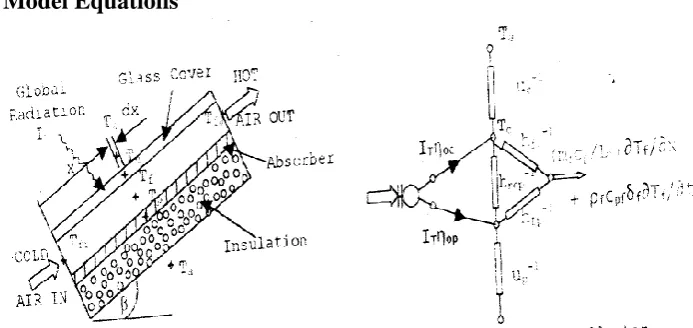
Fig. 1 shows the cross-section of the collector under consideration together with its thermal energy circuit from which can be written the model equations derived from the nodal equations for an element of the collector dx, at position x from the inlet fluid boundary and at time t s from start: COVER: ( ) ( ) ( )- ( ) (1)
FLUID: ( ) ( ) ( ) ( ) (2)
ABSORBER: ( ) ( ) ( ) ( ) (3)
2.2 Initial Condition
(4)
( ) ) ( ) ( ) ( ) (5) Also for operation from cold at t= (6) where Ta0 is the ambient air temperature at time, t = 0s.
2.3 Boundary Conditions
At x = 0, Tf = Tfi = Ta’ t 0 (7)
At x = L2, Tf = Tfo t 0 (8)
2.4 Simplifying Assumptions
(i) The temperatures of the cover and absorber plates are uniform and can be replaced by their mean values necessitating the replacement of their time rates of change by total differentials.
( ) and
( ) . all in JK-1m-2. ( ) ( )
, ( ) ( ) or Hence, the position rate of change of the fluid temperature can be replaced with a total differential. This means that the temperature gradient of the fluid along the plate in the flow direction is the same at all times. Hence, the' position rate of change of the fluid temperature can be replaced with a total differential. This means that the temperature gradient of the fluid along the plate in the flow direction is the same at all times. Similarly, assumption (i) implies that the time rate of change of the plates temperatures is the same at all positions for each plate.
2.5 Solutions of the Dynamic Model Equations With the above simplifications, we can write
( ) ( ) and ( ) (9)
With the initial condition, eqn. (4) replaced by
(10)
3.3 Heat Transfer Coefficients
Cover-to-Ambient Heat Loss Coefficient, uc = hw +hrcs (69)
where hw is the wind speed in ms-1, and hrcs is the cover-to-pay radiation heat loss coefficient, given by McAdams correlations as
hw = 5.7 + 3.8Vw (70)
where Vw is the wind speed in ms-1, and hrcs is the cover-to-pay radiation heat loss coefficient,
Where us and ub are the side-, and bottom-to-ambient heat loss coefficients, L3 is the side heat transfer depth, L1 is the collector width and L2 is its length, k1 is the insulation thermal conductivity, is is the side insulation depth, ib is the bottom insulation depth, and hia is the insulation to ambient heat loss coefficient, taken as infinite.
4. OUTPUT CALCULATIONS, RESULTS AND DISCUSSION 4.1 Input Parameters
= 3.5555E-14T3 - 7.009E-llT2 + 7.9882E-08T - 1.557E-07 Hsm2 (86) Cp = 5.3333E-07T3 - 5.257E-08T2 + 6.3333E-03T + 1003.65714 Jkg-1K-1 (87) k = 1.7777E-11T3 - 5.257E-08T2 + 1.043E-04T - 7.978E-04 Wm-1K-1 (88)
The density of air, ρ = 353.0001988T-1 (89)
is obtained from the perfect gas equation, P/ = RoT/M (90)
with Ro = 8.3143 J mol-1K-1, from Zemansky (1968), P = 101325 Nm-2, and M = 0.0289657kg mol-1, calculated using the table of composition of air by Agrawal and Rao (1974).
The ambient air temperature, Ta is givern by the expression (Onuoha, a)
(91) where are constant
4.2 Other Parameters Used in the Calculations
= 0.95, = 0.174533 rad., Ccp = 840.0 Jkg-lk-1, Cpp = 473.3 Jkg-lk-1, o = 0.004m, f = 0.02m, p = 0.0035m, ib = 0.1925m, is = 0.07m, c = 0.94, p = 0.97,g = 9.81 ms-1 , H = 12.6MJm-2 kec = 30 m-1 , kib = kis = 0.059 Wm-1K-1 , L =
0.0119555 rad (for Nsukka, Nigeria), L1 = 0.94m, L2 = 1.225m, L3 = 0.23m, n = 82, nrc = 1.526, c = 2720.0 kgm-3, p = 7820.0kgm-3, g = 0.2, = 5.6697E-08Wm-2 K- 4,
Wm-2K-4,d = 1.047198 rad., Vw, = 0.74ms-1, (for 23-03-02, Ta0 = 298.83499K, Ta1 = -5.367E-5 Ks-1, Ta2 = 3.1721E-08 Ks-2, Ta3 = -8.571E-13 Ks-3, Ta4 = 5.3463E-18 Ks-4).
4.3 Results and Discussion
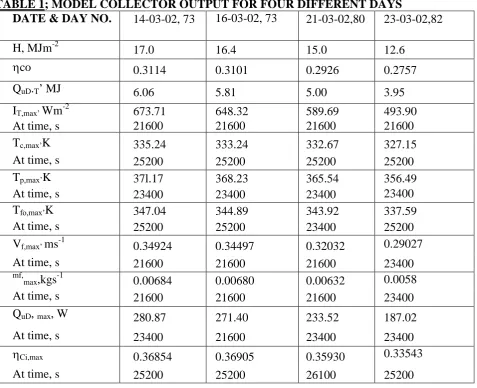
The time lag for the attainment of the maximum temperatures after that of global radiation is attributable to the heat capacity of the materials of the solar collector and the fluid. These, together with the collector total energy delivery and overall efficiency are summarized in table l.
TABLE 1; MODEL COLLECTOR OUTPUT FOR FOUR DIFFERENT DAYS
DATE & DAY NO. 14-03-02, 73 16-03-02, 73 21-03-02,80 23-03-02,82
H, MJm-2 17.0 16.4 15.0 12.6
co 0.3114 0.3101 0.2926 0.2757
QuD.T’ MJ 6.06 5.81 5.00 3.95
IT,max’ Wm-2 673.71 648.32 589.69 493.90
At time, s 21600 21600 21600 21600
Tc,max’K 335.24 333.24 332.67 327.15
At time, s 25200 25200 25200 25200
Tp,max’K 37l.17 368.23 365.54 356.49
At time, s 23400 23400 23400 23400
Tfo,max’K 347.04 344.89 343.92 337.59
At time, s 25200 25200 23400 25200
Vf,max’ ms-1 0.34924 0.34497 0.32032 0.29027
At time, s 21600 21600 21600 23400
mf,
max,kgs-1 0.00684 0.00680 0.00632 0.0058
At time, s 21600 21600 21600 23400
QuD, max, W 280.87 271.40 233.52 187.02
At time, s 23400 21600 23400 23400
Ci,max 0.36854 0.36905 0.35930 0.33543
At time, s 25200 25200 26100 25200
NOTE: H = daily global radiation on a horizontal surface (or its monthly average, H, co = overall collector efficiency, QuDT, = collector total energy delivery ,IT,mass = maximum
instantaneous global radiation on a tilted surface, Tc1max= maximum cover plate temperature,
Tp,mass = maximum absorber plate temperature, Tfo,max = maximum outlet, fluid temperature, Vt,max = maximum fluid velocity, mj,max = maximum fluid mass flow rate, QuD,max = maximum fluid energy
The first two terms of eqns. (33) and (34) are exponential in character and constitute the transient solution to eqns. (16) and (17) and are displayed in figs. (6a, b) for 14-03-02 and 16-03-02 respectively and (7a, b) for 21-03-16-03-02 and 23-03-16-03-02 respectively. The remaining terms constitute the steady state solution. With
( ) ( ) (92) as the damping ratio, ( ) ( ) (93)
as the frequency of natural vibration and
( ) (94)
the solar collector is an overdamped vibrator. Separation of the transient from the steady-state terms showed that the transient terms loose significance after 10800s from start. Entire deletion of the transient terms did not much affect the output and the maxima and minima of the parameters as discussed above were not affected in any way. Hence, the steady-state solutions accurately represent the operation of the solar collector. With the transient terms deleted, we have:
6.1 CONCLUSION
in the volume (Onuoha, A).
NOMENCLATURE (see [1] below)
REFERENCES
1. Onuoha, D. V. C, “Dynamic Modeling of Natural Convection Solar Energy Collector for Agricultural Driers II - Validation of Solutions to the Dynamic Model Equations of SSSCA Flat Plate Collector”. Nigerian Journal of Technology, Vol. 26, No. 2, 2007, pp.99-105.
2. Benedict, R.P. fundamental of Temperature. Pressure. and Flow Measurements. John Wiley & Sons, New York, (1984), pp. 146 – 179
3. Ezekwe, C.I. The Solar Radiation Climate of Nigeria. Solar and Wind Technology (5) 5 (1988), pp. 563-577
4. Ezekwe, C.I., and Ezeilo, C.C.O., “Measured Solar Radiation in a Nigerian Environment Compared with Predicted Data.” Solar Energy (26) (1981), pp 181-6
5. Kent, A. Experimental Low Temperature Physics. The MacMillian Press. London. (1993), p. 157.
6. Michalski, L., Echersdrof. K., and McGhee, J., Temperature Measurment John Wiley & Sons. Chichester, (1991), pp 443, 447, 471, 478, 479.
7. Onuoha. D.V.C. (1997), “Optimization of Natural Convection Solar Energy Crop Driers-Collector and Drier Optimization.” Trans. Int. Conf, on Energy and the Env. Limmaso, Cyprus.
8. Onuoha. D.V.C., Dynamic Modeling of Natural Convection Solar Energy Flat Plate Colector for Agricultural Driers I – Theoretical Derivations and Solutions. Nigerian Journal of Technology, Vol. 23 No. 1, 2004.
9. Onuoha. D.V.C., On the Velocity Variable in Natural Convection Air Heating Solar Energy Collectors and Driers. Nigerian Journal of Technology, Vol. 27, No. 2, 2007, pp. 82-98.
10. Onuoha. D.V.C., Optimal Efficiencies of One-, Two-, and Three-cover Flat plate Solar Energy Thermal Collector, Nigerian Journal Of Technology (in press)
11. Sato, M. Electrochemical Measurements and Control of Oxygen fugacity and other gaseous fugacities with solid dectrolyte sensor, in Ulmer, G.C.(editor) Research Techniques in High Pressure and High Temperature. Springer-Verlag, Berlin, (1971), pp 71, 133,-134.
12. White, G.K. Experimental Techniques in Low Temperature Physics. Clarendon Press. Oxford. (1959), p. 89.