ISSN 2373-7662 (Print) 2373-7670 (Online) Copyright © The Author(s). 2015. All Rights Reserved. Published by American Research Institute for Policy Development DOI: 10.15640/ijn.v3n1a7 URL: https://doi.org/DOI: 10.15640/ijn.v3n1a7
Using a Qualitative Triangulation Method to Explore the Challenge of Myopia Prevention in
School Children for the Role of School Health Nursing
Shu-Ching Chiu
1, Yueh-Chin Chung
2, Lee-Wen, Pai
3& Shu-Fang Chang
4*Abstract
Myopia prevention is difficult, as the number of people with myopia in East Asian countries continues to increase, while the average age of onset decreases. Objectives: to investigate the reasons for the difficulties in the prevention of school children’s myopia, and to analyze the role of school health nurses in the work of myopia prevention. Method: The study is a qualitative research. Data gathering by triangulation was employed to conduct in-depth interviews on planners, executors, and subjects of the myopia-related work. The research site is one of Taiwan’s cities with a high prevalence of myopia; data were gathered during the period of 2012-2013. Results: Analysis revealed that the causes of difficulty in myopia prevention in Taiwan include five aspects: features of the eyes, parents and other caregivers, children, education, and society. The roles of myopia prevention that school health workers play include screening service provider, activity organizer and sponsor, interdisciplinary collaborator, team worker, coordinator, statistician and case manager.
Keywords: children; myopia; nurse; prevention; role; school
Introduction
The prevalence of myopia varies significantly from nation to nation, with high proportions concentrated in East Asian regions, like Singapore, China, Hong Kong, Taiwan, South Korea, and Japan (Beuerman, 2014). According to research, the rate of myopia among Asian children in the UK and US was double that of Caucasian or other children (Logan, Shah, Rudnicka, Gilmartin & Owen, 2011; Ying et al., 2014). In Taiwan, one fourth of first grade students and two thirds of six grade students have a vision problem, primarily ametropia, or more specifically, myopia (Taiwan Ministry of Education, 2016).
Researchers point out the far-reaching influence of myopia, for example, age-related macular degeneration, early cataracts, visual impairment, and blindness (McCarty, Mukesh, Fu & Taylor, 1999; Wong, Loon & Saw, 2006). Moreover, in terms of medical expenses, both the number of clinic visits as well as health insurance and medical expense of Taiwanese people have almost doubled after a decade (Ministry of Health and Welfare of Taiwan, 2014), and these figures do not include the cost of glasses not covered by health insurance. With the incessant escalation of the effects of myopia, vision care members face great challenges in preventing myopia.
1 Ph.D.candidate, School of Nursing, National Taipei University of Nursing & Health Sciences, Taiwan. & RN, Instructor,
Central Taiwan University of Science and Technology, Taiwan.
2Associate Professor, Department of Nursing, Central Taiwan University of Science and Technology, Taiwan.
3RN, Instructor, Central Taiwan University of Science and Technology, Taiwan.
4*Correspondence:Professor, Department of Nursing, College of Nursing, National Taipei University of Nursing and Health
In 1980, Taiwan’s Ministry of Education enforced the “Key measures of improving vision healthcare for school children” and mandated that vision screening be carried out at schools at all levels every semester (Taiwan Ministry of Education, 2011). Eye examinations included vision and eye diseases, sense of stereo, color vision, squint, amblyopia, trichiasis, nystagmus, ptosis and conjunctivitis. School nurses carry out screening with the Snellen E chart; the most frequent task is a vision examination every semester (Ministry of Education School Health Information Network, 2010).
In Beijing, researchers listed the risk factors of myopia: age, female gender, school type, parents’ myopia, high socio-economic background, dim reading surroundings, prolonged hours of learning with short rest periods, time of use of TV or computer, protein intake, feelings about living, fatigue, and dizziness (You et al., 2012). In recent years, researchers have attested to the increased hours of outdoor activities as a protective factor of myopia prevention (French, Ashby, Morgan, & Rose, 2013); however, such an increase is relatively difficult for East Asian countries. Researchers in Singapore state that parents mentioned that the time spent on talent programs would be cut down by increasing outdoor hours (Drury, Saw, Finkelstein, Wong & Tay, 2013).
In spite of a good deal of research being done on myopia each year, vision health care programs and preventive measures being promoted by competent authorities, the population with myopia in Taiwan continues to increase. In this study, the following research questions were investigated:
1. What are the viewpoints of the people in the field of vision healthcare regarding the difficulty in preventing children’s myopia?
2. What are school nurses’ roles in the task of myopia prevention, in order to offer viable directions for future myopia prevention?
Methods
1. Design and Sample
The present research is a qualitative study, with data gathered by interviews. In order to strengthen internal validity, interviews were conducted by data triangulation (Carter, Bryant-Lukosius, DiCenso, Blythe & Neville, 2014) in a face-to-face manner with the participants, who are planners, program executors, and subjects of programs, all in relation to vision. The in-depth interviews were assisted by interview guides. Interview subjects were selected via reference from third persons and interactions; consideration was also given to the past background and experience of the subjects, for understanding and participating in the social context of myopia proliferating in Taiwan. Purposive sampling was employed. We selected those persons who were able to provide rich information as the main interview subjects; their roles included school nurse and chief of health sector, children, main caregivers, ophthalmologist, ophthalmic optician, and teacher, to better understand the reasons affecting Taiwan’s ubiquitous myopia and the difficulty in realizing vision-related prevention.
2. Analytic Strategy
The interview data were examined via conventional content analysis (Smith, 2000), chiefly categorization. To begin with, the recording was converted to verbatim texts. From the texts, core sentences of meaningful statements and related contexts that were relevant to the research object were extracted. The sorted contents then underwent continued comparison and organization, and finally were categorized and named. The analytic results were discussed repeatedly among qualitative experts in respect of the differences in the analysis they made for clarification, prior to reanalysis and verification. Finally, the results were presented in 2 tables.
Results
There were nine participants. The adult subjects are all married and have experience in nurturing 2~3 children, in the age group of 42 to 52 year old (age median: 46), and have related work experiences. The school health nurses have worked for a total of 22 years, the physicians for 24 years, the ophthalmic optician for 19 years, and the teachers for 45 years. Another subject was a parent. The two children subjects are 7 and 11 years old, and one was taking Ortho-K at that time.
1. Causes of the Difficulty in Myopia Prevention
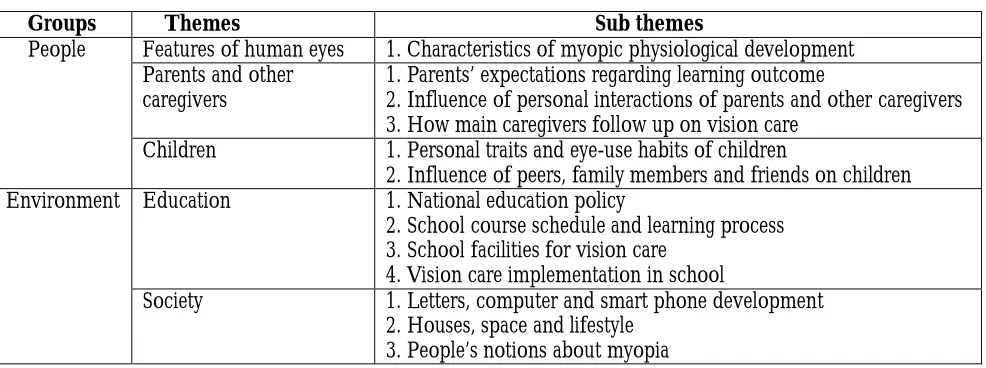
The reasons for the difficulties in myopia prevention, when analyzed with qualitative data, can be discerned according to five aspects: features of the eyes, parents and other caregivers, children, education, and society (see Table 1).
Table 1: Categories of causes of the difficulty in myopia prevention
Groups Themes Sub themes
People Features of human eyes 1. Characteristics of myopic physiological development Parents and other
caregivers
1. Parents’ expectations regarding learning outcome
2. Influence of personal interactions of parents and other caregivers 3. How main caregivers follow up on vision care
Children 1. Personal traits and eye-use habits of children
2. Influence of peers, family members and friends on children Environment Education 1. National education policy
2. School course schedule and learning process 3. School facilities for vision care
4. Vision care implementation in school
Society 1. Letters, computer and smart phone development 2. Houses, space and lifestyle
3. People’s notions about myopia
1.1 Features of the eyes
The participants mentioned that, unlike any other disease, as myopia develops. It does not make one feel unwell during the course of vision becoming blurred; thus, one may not want to deal with it actively, so the task of myopia prevention is more difficult: “The task of vision care is difficult. While a toothache hurts and demands attention, it is relatively more difficult with slowly evolving vision problems” (T.7.28-29).
1.2 Parents and other caregivers
In Taiwan, most families are nuclear, with few children without playmates: “I need to cook at that hour, so I have no time to accompany her. When I finish cooking, I need to pick up her bigger sister. And the situation is that from about five forty to seven, she keeps playing with the computer” (M.16.27-29). Besides, in modern society, many parents are unable to look after their children due to busy work, and have no alternative but to resort to out-of-school clubs or cram schools. These “cram schools… actually handle this problem for many parents. It’s only that it adds to the worsening vision in children” (B.4.8-14). It is the responsibility of a main caregiver: “I suggested that my friend not buy an iPhone or iPad, but he said the daughter’s classmates were all very good, and had bought them; only six months after that, the daughter became myopic” (L.7.11-12). “Parents tell their kids to handle vision care properly, but they never listen. Applying eye drugs (atropine) is uncomfortable, and makes it blurry to look at things nearby, while the vision is not necessarily improved; it only means having one more thing to bother the kids. Also, banning kids from computers and TV leaves them with little to do” (K.5.20-24). “It would also be helpful to ask the teacher of out-of-school clubs to give a hand” (K.5.25). McAnally and Hancox (2014) pointed out that cutting down on TV could lessen the effect of sedentary activities on health.
1.3 Children
Sedentary behaviors like games on hand phone, tablet computers, PCs, watching TV and reading novels are common leisure activities in children’s lives. “I usually read comic books or play games on computers or smartphones” (C.9.14-15); “I do not rest my eyes during TV commercials; I usually switch to another channel and continue watching” (D.22.6-7). In addition, children are liable to influence: “Last semester, her auntie stayed with us and she said that wished to learn about Facebook. She asked if any 5th grade classmate of her niece would teach her. Since then, my whole family is obsessed with Facebook…the little sister was just in the 1st grade, and she began to use Facebook with her classmates” (M.15.10-15).
1.4 Education
The aspect of education is important in the campaign of myopia prevention in Taiwan. Educational reform continues constantly with the fast changing times; yet, a number of diverse concerns arise during the process of reform (Huang, 2000). When the Nine-Year Consecutive Compulsory Education was introduced in 2001, diversified teaching materials led to textbook versions varying from school to school, and problems began to surface. People want their children to be admitted to the best schools; as a result, they resort to private tutoring after school for their kids (Wang, 2004). “They need to go to cram schools after the regular school, which brings them heavy pressure” (K.3.6-7). “The 12-year compulsory education will not alleviate curricular pressures; instead, admission to private schools is a better choice” (T.8.9-10). Taiwan’s 12-year education program keeps kids in school longer, further straining their vision. Myopia is associated with higher levels of education (Williams & Hammond, 2014).
“The kids are allowed to play ball outside if they finish by six… There is Chinese homework, and math homework; if there is also a work sheet, they would be unable to finish” (H.1.3-5). The assistance and cooperation from class advisors greatly affects vision care. “First and second graders obey more. When they are told to go to the corridor to gaze afar, they comply, while fifth and sixth graders are not all willing to comply; they play and fool around... They don’t gaze if you don’t watch them” (H.1.13-14); this affects their eye strain. In addition, “if the teacher says a few more words about the importance of vision and that seeing a physician is a must in case of any problem, or if he or she writes a reminder on the communication log, the kids ask their parents to see a physician. Teachers matter greatly” (T.5.2-4).
1.5 Society
Technological civilization brings conveniences to people, solving some of the problems in living, but it also affects different health issues. “In my experience in ophthalmic diagnosis, for the past 24 years, there would be no more than five persons with myopia if there were no reading, video games or computer use” (K.3.17-18). “Now it seems more students wear eyeglasses; probably because the computer is too popular; it quickly causes deterioration of vision, and the demand for eyeglasses increases. Everything, including laptop, Apple, iPhone, is becoming smaller; focusing on the tiny screen quickly worsens vision” (T.8.16-19).Play is taken for granted for children; however, the process of play is often subject to adults’ sense of values (Glenn, Knight, Holt & Spence, 2013); children began to like playing indoors instead of outdoors. “That kid’s playing video games and with his computer; his vision is decreasing fast. If there is no arrangement of outdoor, activities during this summer vacation… I mean it; his vision would decrease fast, especially at this stage of the fifth grade” (N.22.18-19).
2. The Role of School Nurses
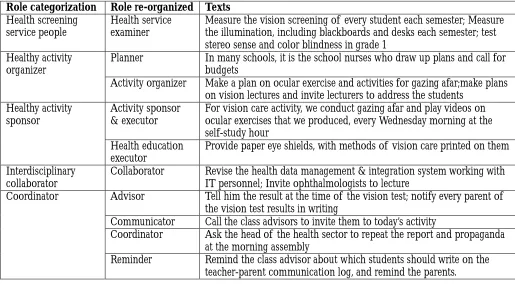
Table 2: Roles that school nurses play in myopia prevention
Role categorization Role re-organized Texts
Health screening service people
Health service examiner
Measure the vision screening of every student each semester; Measure the illumination, including blackboards and desks each semester; test stereo sense and color blindness in grade 1
Healthy activity organizer
Planner In many schools, it is the school nurses who draw up plans and call for budgets
Activity organizer Make a plan on ocular exercise and activities for gazing afar;make plans on vision lectures and invite lecturers to address the students
Healthy activity sponsor
Activity sponsor & executor
For vision care activity, we conduct gazing afar and play videos on ocular exercises that we produced, every Wednesday morning at the self-study hour
Health education executor
Provide paper eye shields, with methods of vision care printed on them Interdisciplinary
collaborator
Collaborator Revise the health data management & integration system working with IT personnel; Invite ophthalmologists to lecture
Coordinator Advisor Tell him the result at the time of the vision test; notify every parent of the vision test results in writing
Communicator Call the class advisors to invite them to today’s activity
Coordinator Ask the head of the health sector to repeat the report and propaganda at the morning assembly
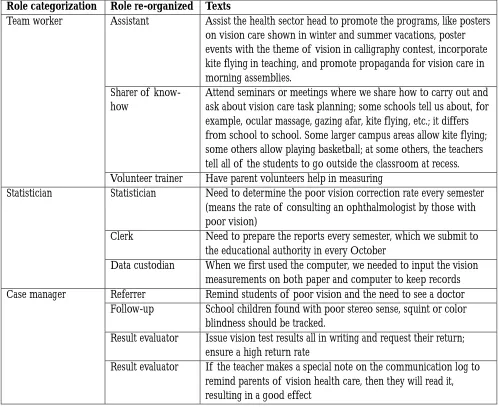
Table 2: Roles that school nurses play in myopia prevention (continued)
Role categorization Role re-organized Texts
Team worker Assistant Assist the health sector head to promote the programs, like posters on vision care shown in winter and summer vacations, poster events with the theme of vision in calligraphy contest, incorporate kite flying in teaching, and promote propaganda for vision care in morning assemblies.
Sharer of know-how
Attend seminars or meetings where we share how to carry out and ask about vision care task planning; some schools tell us about, for example, ocular massage, gazing afar, kite flying, etc.; it differs from school to school. Some larger campus areas allow kite flying; some others allow playing basketball; at some others, the teachers tell all of the students to go outside the classroom at recess. Volunteer trainer Have parent volunteers help in measuring
Statistician Statistician Need to determine the poor vision correction rate every semester (means the rate of consulting an ophthalmologist by those with poor vision)
Clerk Need to prepare the reports every semester, which we submit to the educational authority in every October
Data custodian When we first used the computer, we needed to input the vision measurements on both paper and computer to keep records Case manager Referrer Remind students of poor vision and the need to see a doctor Follow-up School children found with poor stereo sense, squint or color
blindness should be tracked.
Result evaluator Issue vision test results all in writing and request their return; ensure a high return rate
Result evaluator If the teacher makes a special note on the communication log to remind parents of vision health care, then they will read it, resulting in a good effect
Discussion
Myopia prevention, a task of vision healthcare, is a challenging task in the view of ophthalmologists, ophthalmic opticians, and school nurses. In a nutshell, myopia is due to excessive time of activities using the eyes at close distances; however, when consideration is given to major causes, like the social factor, educational factor, the factor of the main caregiver, the children factor or the features of the human eye, the entire environment of Taiwan provides no friendly conditions for vision maintenance. The problem is beyond the perspective of any professional to provide a total solution.
Nevertheless, the main caregivers need cooperation from society as well. For example, in the case of late after school collection by the parents and other caregivers, the children are sent to out-of-school clubs, where the space is narrow and the teachers have even less healthcare resources in relation to vision.
Meanwhile, due to the pressure from their work, parents sometimes cannot be unavailable to help their children do their homework when returning home; the task is transferred to daycare centers. As such, it becomes a vicious cycle where vision care cannot be fully carried out. Furthermore, under the commercial promotion of smart phones and tablet computers, parents, because of their unavailability or to encourage their children’s homework performance often provide these products for their children’s use.
On the whole, everyone has the obligation to maintain children’s vision, as there are no better alternatives than strengthening people’s awareness and reforming the social atmosphere, in which the educational authorities encourage outdoor teaching, and the teachers intend to share more of the responsibility for children’s health. Businesses also need to invest in the tasks of vision care; parents and other caregivers must understand the importance of setting a good example and taking children outdoors more often. Children also need to acknowledge the benefits of outdoor activities and gazing afar for myopia prevention; and the public should remind children to pay attention to vision healthcare.
Presently in Taiwan, with insufficient school nurses, their tasks entail a huge workload. They include the administrative affairs at the health center, assessment of health on campus, physical evaluations, data management at the health center, case management, follow-up and correction, urgent injury/disease treatment, prevention of infectious diseases, counseling on health, environmental assessment, and other affairs that the supervisors assign (School of Nurses Association of Taiwan, n.d.). Despite the nurses’ workload, school children’s health cannot be taken lightly (Maughan & Mangena, 2014).
As for children gazing afar once a week, included in the tasks of school nursing, is certainly not enough; researchers propose the importance of outdoor activity times during class recess (Wu, Tsai, Wu, Yang &Kuo, 2013). Far from an ultimate solution, the aim is to let students, parents and class advisors understand vision healthcare and appreciate the importance of gazing afar to prevent myopia; it will serve as the foundation for future healthy habits. In the future, apart from children in school, the subjects of enforcement of vision care measures should also include parents, teachers, and day care centers/cram schools in the community.
In the future, school nurses should play an active role in spearheading myopia prevention, employing school-based action research to assess, as appropriate, lifestyle in relation to the local children’s vision, as well as to conduct risk assessment to propose preventive measures, and carry out programs of risk mitigation by location, multi-angle and multi-channel approaches. Eventually, as the researchers have noted, school nurses will become the protectors of children's health (Croghan, Johnson & Aveyard, 2004).
Currently, when technology is ubiquitous, myopia prevention is not an easy task. Aside from the responsibility of the state and society, school nurses can combine community resources with the help offered by the professionals of ophthalmology and optometry to muster people or parents in the community who care for children’s vision to create a collaborative working mode with mutual confidence. As such, the tasks of vision healthcare can be known to more people; the proper notions of prevention can be promoted to all corners of the community in saving the vision of our youngsters and preventing myopia.
Implications for Practice
Additionally, school nurses can build interdisciplinary teams and employ community resources as appropriate to increase penetration and enable myopia prevention at multiple levels, as well as broaden the scope of the influence of preventive tasks.
Limitations
Though the sample number was only nine in the present research, the texts of the participants’ abundant experiences provide rich and diverse oral data which show the complete context of real society. Also, as every social culture is unique, researchers are advised to be cautious when applying and generalizing the results in the future.
Conclusion
The present research presented, through data triangulation, the reasons of the difficulty in preventing myopic and the roles of school nurses in the tasks of vision health care in Taiwan. Nowadays when technologies dominate, myopia prevention is not an easy task. Aside from the responsibility of the state and the society, school nurses can combine community resources with the help from the professions of ophthalmology and optometry to muster people or parents in the community who care for children’s vision to create a collaborative working mode with mutual confidence. As such, the tasks of vision health care can be known to more people and go on wider, where proper notion of prevention can be promoted to all corners of the community in saving the vision of our youngsters and preventing myopia.
References
Beuerman, R. W. (2014). Myopia: Animal models to clinical trials. Singapore: World Scientific.
Carter, N., Bryant-Lukosius, D., DiCenso, A., Blythe, J., & Neville, A. J. (2014).The use of triangulation in qualitative research. Oncology Nursing Forum, 41(5), 545-547. doi: 10.1188/14.onf.545-547
Croghan, E., Johnson, C., & Aveyard, P. (2004). School nurses: Policies, working practices, roles and value perceptions. Journal of Advanced Nursing, 47(4), 377-385. doi: 10.1111/j.1365-2648.2004.03115.x
Drury, V. B., Saw, S. M., Finkelstein, E., Wong, T. Y., &Tay, P. K. (2013). A new community-based outdoor intervention to increase physical activity in Singapore children: Findings from focus groups. Annals Academy of
Medicine Singapore, 42(5), 225-231.
French, A. N., Ashby, R. S., Morgan, I. G., & Rose, K. A. (2013).Time outdoors and the prevention of myopia.
Experimental Eye Research, 114, 58-68. doi: 10.1016/j.exer. 2013.04.018
Glenn, N. M., Knight, C. J., Holt, N. L., & Spence, J. C. (2013).Meanings of play among children. Childhood, 20(2), 185-199.
Huang, C. C. (2000). Political directions for Taiwan educational reform. Educational Policy Forum, 3(1), 26-53.
Logan, N. S., Shah, P., Rudnicka, A. R., Gilmartin, B., & Owen, C. G. (2011). Childhood ethnic differences in ametropia and ocular biometry: The Aston Eye Study. Ophthalmic & Physiological Optics, 31(5), 550-558. doi: 10.1111/j.1475-1313.2011.00862.x
Maughan, E., & Mangena, A. S. (2014). The 2013 NASN School Nurse Survey: Advancing school nursing practice.
NASN School Nurse, 29(2), 76-83. doi: 10.1177/1942602x14523135
McAnally, H., & Hancox, R. (2014). The long-term health effects of too much television: Whose responsibility? Journal
of Epidemiology & Community Health. doi:10.1136/jech-2014-204044
McCarty, C. A., Mukesh, B., Fu, C. L., & Taylor, H. R. (1999).The epidemiology of cataract in Australia. American
Journal of Ophthalmology, 128(4), 446-465.
Ministry of Education School Health Information Network.(2010). Manual of student health examination tasks. [Online] Available: http://cpd.moe.gov.tw/health/content.php?cid=21&catalogid=8&subcatalogid=30&page=1 (Accessed in March 25, 2016)
Ministry of Health and Welfare of Taiwan. (2014). over the years the national health insurance health statistics report: Outpatient
treatment of major diseases rate statistics. [Online] Available:
Saunders, K. J. (1995). Early refractive development in humans. Survey of Ophthalmology, 40(3), 207-216. doi: http://dx.doi.org/10.1016/S0039-6257(95)80027-1
School Nurses Association of Taiwan.(n.d.). Practice of school nursing: Duties and status of school nursing tasks. [Online] Available:
http://www.schoolnurses.org.tw/index.php?htm=7&sel=4( Accessed in March 25, 2016)
Seet, B., Wong, T. Y., Tan, D. T., Saw, S. M., Balakrishnan, V., Lee, L. K., & Lim, A. S. (2001). Myopia in Singapore: Taking a public health approach. British Journal of Ophthalmology, 85(5), 521-526.
Smith, C. P. (2000). Content analysis and narrative analysis.Handbook of research methods in social and personality psychology, 313-335.
Taiwan Ministry of Education. (2011). Major policies: Ministry of Education school children three years of vision care plan. 485. [Online] Available: http://epaper.edu.tw/old/topical_past.aspx (Accessed in March 25, 2016)
Taiwan Ministry of Education. (2016). Statistics: Percentage of students with impaired vision in elementary schools (2005-2015). [Online] Available: http://english.moe.gov.tw/ct.asp?xItem=14530&ctNode=11432&mp=1(Accessed in March 25, 2016)
Wang, S. Y. (2004). Discussion of Taiwan educational reform from transition of primary and secondary schools' textbooks publicational screening structures. Journal of the National Institute for Compilation and Translation, 32(2), 4-14.
Warton, P. M. (2001). The forgotten voices in homework: Views of students. Educational Psychologist, 36(3), 155-165. Williams, K. M., & Hammond, C. J. (2014).Prevalence of myopia and association with education in Europe. The
Lancet, 383, S109.
Wong, T., Loon, S., & Saw, S. (2006). The epidemiology of age related eye diseases in Asia. British Journal of
Ophthalmology, 90(4), 506-511.
Wu, P. C., Tsai, C. L., Wu, H. L., Yang, Y. H., & Kuo, H. K. (2013). Outdoor activity during class recess reduces myopia onset and progression in school children. Ophthalmology, 120(5), 1080-1085.
doi: 10.1016/j.ophtha.2012.11.009
Ying, G. S., Maguire, M. G., Cyert, L. A., Ciner, E., Quinn, G. E., Kulp, M. T., . . . Moore, B. (2014). Prevalence of vision disorders by racial and ethnic group among children participating in head start. Ophthalmology, 121(3), 630-636. doi: 10.1016/j.ophtha.2013.09.036
You, Q. S., Wu, L. J., Duan, J. L., Luo, Y. X., Liu, L. J., Li, X., . . . Guo, X. H. (2012). Factors associated with myopia in school children in China: the Beijing childhood eye study. Plos One, 7(12), e52668.